

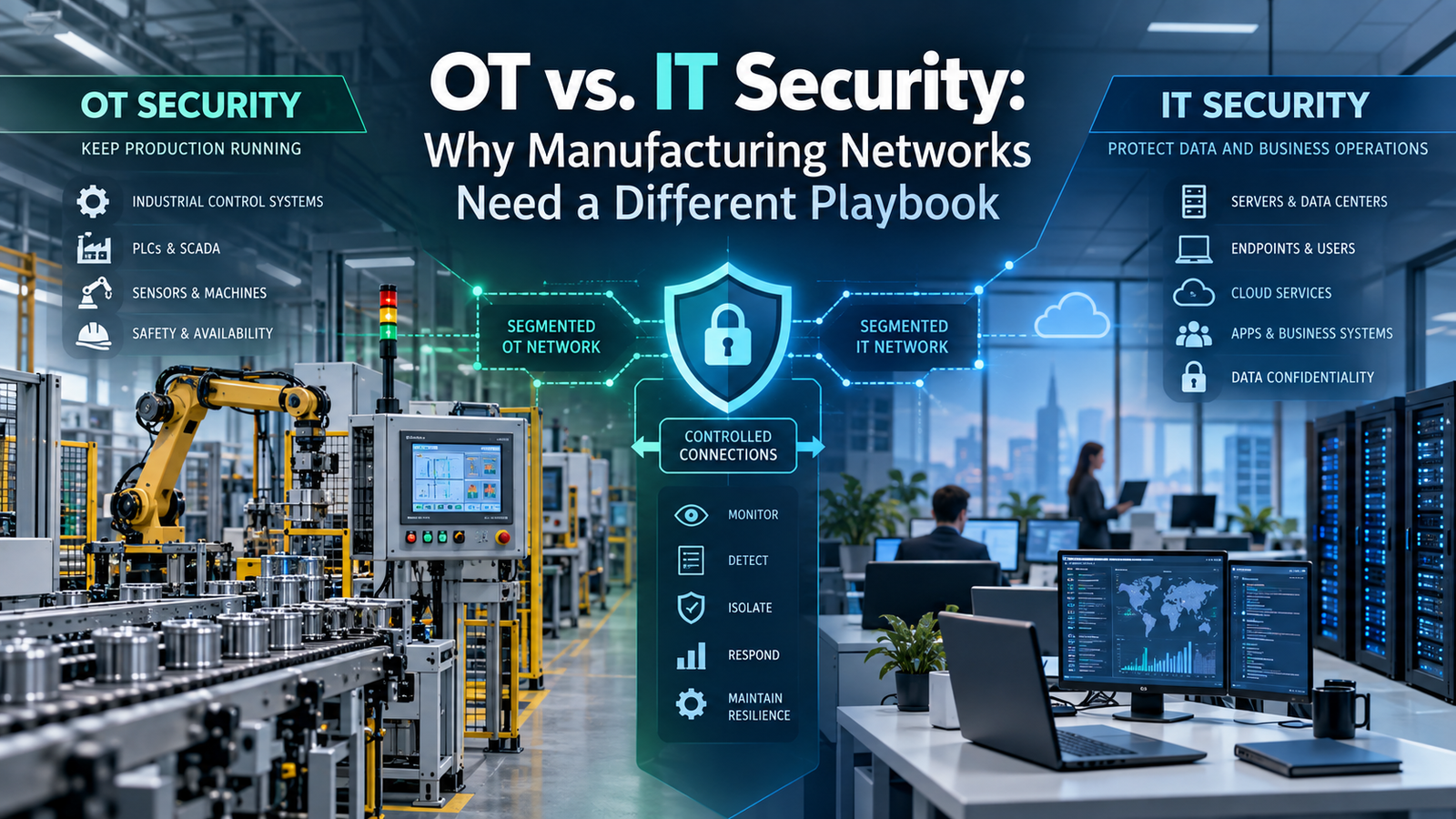
Manufacturing networks now connect business applications, engineering workstations, production systems, vendor tools, and cloud services in ways that older plant designs never expected. That connection supports faster reporting and remote support, but it also means a compromise that begins in ordinary IT can reach systems that control physical processes. The security question is therefore broader than protecting files, endpoints, and user accounts. It includes whether a cyber action can stop production, alter a process, affect product quality, or create an unsafe operating condition.
That is the core issue behind OT vs. IT security. IT and operational technology use some of the same concepts, including access control, network boundaries, monitoring, backups, and incident handling. The way those controls are applied has to change once the protected system can move a robot, change a set point, or interrupt a production line. For manufacturers reviewing their current security model, the gap often appears where corporate controls meet plant constraints. A broader view of cybersecurity services can help frame the enterprise side of that work, while the plant side needs engineering context before the same controls are carried into OT.
The right manufacturing playbook keeps IT and OT under one risk program without pretending they are the same environment. It defines where controls can be shared, where OT needs a different procedure, and who can make decisions when security actions could affect production.
TL;DR
OT vs. IT security comes down to consequence and operating constraint. IT security mainly protects business systems, identities, applications, and information. OT security protects systems that monitor or control physical processes. A routine IT action such as rebooting, scanning, patching, isolating a host, or forcing an authentication change can have a very different effect on a live production line.
A sound manufacturing cybersecurity program therefore starts with asset and dependency visibility, controlled network paths, secure remote access, plant-aware change control, OT-safe monitoring, and recovery procedures that have been tested with operations. IT teams still provide security discipline and shared services. Engineering and plant teams provide the process knowledge needed to apply those controls without creating new operational risk.
What OT and IT Security Actually Protect
IT security usually covers business technology such as user devices, identity platforms, email, ERP systems, databases, servers, SaaS applications, and cloud workloads. The protected outcomes often include confidentiality of business information, integrity of records, reliable access to systems, and resistance to account compromise. Most enterprise security programs are built around systems that can be centrally managed and updated on a regular schedule.
OT covers technology that interacts with the physical environment. In manufacturing, that can include programmable logic controllers, human-machine interfaces, distributed control systems, supervisory control and data acquisition components, industrial switches, engineering workstations, sensors, drives, safety-related systems, and the servers that support production. NIST’s Guide to Operational Technology Security defines OT around programmable systems and devices that interact with the physical environment and stresses their distinct performance, reliability, and safety requirements. That difference should shape every industrial control system security decision.
The phrase OT vs. IT security can sound like a choice between 2 competing teams. It is better understood as a difference in what can go wrong. A compromised email account can expose credentials and business data. A compromised engineering workstation can also become a path to change control logic. The same attacker may cross both environments, yet the operational consequence changes as the attacker moves closer to the physical process.
Common OT assets in a plant
A useful OT inventory goes beyond device names and IP addresses. It should show what each asset controls, what software or firmware it runs, who owns it, which other systems it depends on, whether it supports remote access, and what happens if it becomes unavailable. That context is what makes the inventory useful for OT security in manufacturing rather than a simple network list.
Why Manufacturing Networks Need a Different Playbook
Manufacturing systems are built to keep physical processes within known operating limits. Security controls have to respect that job. If a security change causes a controller to miss required communications, breaks a vendor-supported configuration, or forces an unsafe shutdown sequence, the security team has reduced cyber exposure by creating a production problem. That tradeoff is why OT vs. IT security needs different operating procedures even when both groups use the same policy framework.
NIST’s manufacturing work makes this point in practical terms. Its industrial control system guidance for manufacturers focuses on protecting the integrity of industrial systems while recognizing that manufacturers connect OT and IT to support business processes. The connection creates useful data flows, but it also creates routes that an attacker can abuse if the architecture is flat or loosely controlled.
The plant also has a different change rhythm. Office endpoints may receive security updates through a central tool with a standard restart policy. A production cell may need vendor testing, engineering approval, a maintenance window, a known rollback method, and verification that the process still behaves as expected after the change. Some assets may run unsupported software because the machine vendor has not certified a newer version. Some devices cannot support an endpoint agent at all.
This is where manufacturing cybersecurity becomes an operating discipline rather than a product list. The strongest control is often the one that reduces exposure while respecting production dependencies. That may mean isolating an older asset behind strict network rules, monitoring its communications, limiting who can reach it, and planning its replacement instead of forcing a patch that could stop the line.
OT vs. IT Security: The Operational Differences That Matter
A side-by-side comparison helps explain why the same security policy needs different implementation rules. OT vs. IT security should be compared by system behavior, downtime tolerance, change control, and incident consequence rather than by which team owns the network.
| Area | Typical IT Environment | Typical Manufacturing OT Environment |
| Protected function | Business computing, data, identity, applications | Physical process monitoring and control |
| Change cadence | Frequent and centrally managed in many environments | Often tied to maintenance windows, vendor approval, and production schedules |
| Downtime handling | Planned outages may be acceptable | Unexpected interruption can stop production or affect safety and quality |
| Asset life | Often refreshed on a regular enterprise lifecycle | Equipment can remain in service far longer than standard IT hardware |
| Security tooling | Endpoint agents, active scanning, central identity are common | Tooling may be limited by device capability, protocol behavior, or vendor support |
| Incident containment | Isolating or rebuilding a host is often routine | Isolation may need operations approval because the asset supports a live process |
| Recovery target | Restore business service and data | Restore safe process control, correct configuration, and production sequence |
The table does not mean OT is exempt from basic security controls. It means industrial control system security needs evidence that a control will work safely in that environment. A control that is normal in IT can still be right for OT after testing and plant approval. The mistake is assuming the enterprise implementation can be copied without checking process impact.
Where Standard IT Controls Can Fail on the Plant Floor
The first common failure is aggressive discovery. Active scanning is useful in enterprise networks, but some older controllers and embedded devices may react poorly to unexpected traffic. Discovery in OT often starts with passive methods, switch data, controller inventories, vendor records, and carefully approved scans. The goal is accurate visibility without turning asset discovery into a production test.
Patching is another point of friction in OT vs. IT security. IT teams often measure patch compliance by elapsed time after release. OT teams also have to consider vendor certification, maintenance windows, process criticality, backup state, rollback steps, and whether a compensating control can reduce exposure until a safe change window opens. A vulnerability assessment service can identify exposure across conventional infrastructure, but OT findings still need plant context before they become remediation tickets.
Endpoint controls have similar limits. An engineering workstation may support modern EDR, while a PLC or dedicated HMI may not. Even when an agent can be installed, the vendor may restrict software changes or support only certain versions. Manufacturing cybersecurity therefore needs layered controls around devices that cannot carry the same host protection used on office endpoints.
CISA maintains ICS recommended practices covering topics such as defense in depth, patch management, remote access, and incident response for control systems. The important lesson is procedural: plant security changes need testing, documented ownership, and an implementation path that fits the operational environment.
Map the Manufacturing Attack Surface Before Buying More Tools
Manufacturers often have more pathways into OT than the network diagram suggests. A production system may exchange data with MES, ERP, historian, quality, warehouse, or cloud analytics platforms. Equipment vendors may use remote support tools. Engineers may carry laptops between office and plant networks. USB media may move files to systems that have no direct internet path. Wireless bridges, cellular modems, unmanaged switches, and temporary maintenance connections can create routes that were never entered into the original design.
A useful attack-surface map for OT vs. IT security shows trust boundaries and data flows. It records which systems can initiate connections, which protocols are allowed, where authentication occurs, who owns the connection, and whether the path is monitored. It also identifies dependencies that can cause an indirect outage. For example, an OT application may keep running only while DNS, Active Directory, virtualization, backup storage, or licensing services remain available from IT.
Threat modeling should use behavior seen in real industrial incidents rather than generic malware categories. The MITRE ATT&CK for ICS knowledge base documents adversary behavior observed in industrial control environments and gives defenders a common way to think about tactics and techniques. Pairing that behavior model with penetration testing can help test enterprise paths and exposed infrastructure, but production testing needs strict rules of engagement so the test itself does not create an unsafe condition.
The output should be a prioritized map, not a catalog of every cable and device. Manufacturing cybersecurity teams need to know which paths can move an attacker from a user environment toward critical control assets, which remote connections bypass normal controls, and which dependencies could stop production even if the controllers themselves remain untouched.
IT/OT Network Segmentation: Build Controlled Paths Between Domains
IT/OT network segmentation is one of the clearest ways to limit lateral movement between business systems and production. The aim is controlled communication, not isolation for its own sake. Plants still need approved data flows for production reporting, engineering support, patch staging, historian access, and business integration. Those flows should cross defined boundaries where traffic can be restricted and observed.
A practical architecture often separates enterprise IT, shared or intermediary services, plant operations, control zones, and especially sensitive process areas. The exact design depends on the plant. What matters is that the security team can explain why a connection exists, which side can initiate it, what protocol and destination are allowed, and who approves a change. CISA’s Cross-Sector Cybersecurity Performance Goals include practices for both IT and OT owners and can serve as a baseline when teams are deciding which controls should be prioritized first.
Build the zone model around process function
Start IT/OT network segmentation with process criticality, not VLAN numbering. Systems that perform the same production function may belong together even if they sit in different cabinets. Systems that have different risk or safety roles may need separate zones even if they are physically close. The model should also account for shared services such as historians, jump hosts, patch repositories, and authentication services.
The industrial DMZ is often useful because it gives IT and OT a controlled meeting point. Data that must move between domains can terminate or proxy there rather than allowing direct enterprise-to-controller connections. Remote support can also land in a managed access point before a second, approved step reaches the target asset.
Control traffic between zones
Good IT/OT network segmentation uses allow rules based on required communications. Broad “any to any” access defeats the purpose of the boundary. Firewall policy should be reviewed against actual production flows, with unused routes removed and temporary exceptions given an owner and expiration date. Logging at zone boundaries also gives detection teams a place to see unusual cross-domain behavior.
Segmentation is an architectural control, so it belongs beside routine IT infrastructure and operations work rather than as a one-time firewall project. Network changes, new production equipment, cloud integrations, and acquisitions can all reopen paths that were previously controlled. The segmentation model has to change with the plant.
Secure Remote Access and Privileged Access Without Stalling Support
Remote access is essential in many plants because OEMs and specialist engineers may need to diagnose equipment that local teams cannot repair alone. The risk comes from persistent or weakly governed access. Shared vendor VPN accounts, always-on remote desktop services, unmanaged remote tools, and credentials that remain valid after a maintenance visit can turn support convenience into a standing entry point.
The OT vs. IT security playbook should make every remote path intentional. Access should identify the individual, use strong authentication where the technology supports it, land on a controlled intermediary system, restrict the user to approved assets, record the session where appropriate, and close when the work is finished. CISA’s remote-access material is included in its industrial control system recommended practices, which is useful because remote connectivity needs OT-specific handling rather than a generic VPN policy.
Vendor remote access
Vendor access should have a business owner and a technical owner. The business owner confirms why access is needed. The technical owner defines what the vendor can reach and how long the access remains valid. Emergency access can use an accelerated approval path, but it should still create a record that can be reviewed later.
Privileged access on the plant floor
Shared administrative accounts weaken accountability. Replace them where the platform allows, and control the exceptions where it does not. Engineering tools that require elevated privileges should be limited to approved workstations and users. If modern identity controls cannot be applied directly to an asset, segmentation controls and jump-host restrictions can reduce the exposure around it.
Treat Asset Inventory, Patching, and Change Control as One Discipline
An OT asset inventory becomes valuable when it drives decisions. A list that shows only hostname, IP address, and vendor cannot tell the security team whether an urgent vulnerability affects a safety-related controller, an idle test cell, or a noncritical display. OT security in manufacturing needs process role, criticality, owner, firmware or software version, network zone, dependencies, remote-access method, support status, backup status, and last approved change.
Asset inventory should carry operational context
Ownership is especially important. If nobody can approve a change or explain what the asset does, remediation will stall. The inventory should name the plant or engineering owner who can judge process impact and the security or IT owner who can judge cyber exposure. That pairing keeps industrial control system security from becoming a queue of findings with no decision path.
Patching is a risk decision
A patch policy for OT should answer 4 questions: Is the asset exposed to the vulnerable path? Is exploitation practical in this environment? Can the update be tested and installed safely? What compensating control can reduce risk until the change is made? That approach is slower than enterprise auto-patching, but it produces a defensible decision that accounts for production.
For systems that can support it, endpoint detection and response can add useful host visibility around engineering workstations and servers. The device list should still make clear which assets cannot run an agent. Those assets need network controls, configuration protection, logging where available, and replacement planning if the security gap cannot be reduced enough.
Change control closes the loop. Every security-related modification should record the reason, test result, approved window, rollback plan, and post-change check. In OT vs. IT security, the change record is also evidence that the team considered process behavior before altering a production system.
Monitor OT Without Turning Detection Into a Production Risk
OT monitoring should reveal abnormal behavior without interfering with the process. Passive network monitoring is often a good starting point because it can observe industrial communications without sending probes to every device. The baseline should capture normal peers, protocols, command patterns, remote sessions, configuration changes, and traffic crossing between IT and OT zones.
The detection team also needs process context. A new connection from an engineering workstation to a controller may be normal during a planned maintenance window and suspicious at another time. A change in controller logic may be expected during commissioning and urgent during steady-state production. Industrial control system security improves when alerts carry asset criticality and change-calendar context instead of treating every device as an ordinary IP endpoint.
Enterprise telemetry still matters. Identity logs, firewall events, endpoint alerts, VPN records, and cloud activity may show the attacker before OT-specific sensors do. A managed detection and response service can support continuous enterprise detection, while OT security in manufacturing requires added visibility into industrial protocols and plant changes. The goal is one incident picture with different collection methods, not separate investigations that meet only after production is affected.
A good plant-security detection rule answers a practical question: what behavior would be unusual enough to involve operations? That keeps the alert queue tied to plant risk rather than raw event volume.
Build OT Incident Response Around Safe Containment and Recovery
OT incident response must begin with safety and process state. The fastest cyber containment action is not always the safest production action. Disconnecting a controller, killing power to a cell, or isolating a server may interrupt an automated sequence in a way that damages product or equipment. The response plan should define which actions security can take immediately and which require approval from operations or engineering.
Containment needs production approval paths
The incident plan should name decision owners before an event. Security leads the cyber investigation. Operations decides whether production can continue safely. Engineering explains controller behavior and equipment dependencies. Plant leadership decides when business impact requires a broader shutdown. Those responsibilities need named alternates because incidents do not wait for the primary owner to be available.
OT incident response should also include preapproved containment choices. Examples include blocking a remote-access account, isolating an engineering workstation, restricting an IT-to-OT firewall path, moving a suspicious server to a quarantine zone, or stopping a vendor session. Actions involving live control assets need plant-specific procedures.
Recovery is more than restoring files
OT recovery may require controller logic, HMI projects, switch and firewall configurations, recipes, historian data, licenses, certificates, engineering software, and vendor-specific files. NIST’s 2026 OT Backup Quick Start Guide says OT backups should be integrated into change management, created regularly, tested, and reviewed during recovery exercises. That makes backup work part of production readiness rather than a storage task.
OT incident response exercises should test the order in which services return. A plant may need identity, DNS, virtualization, or network services from IT before an OT application can start. Recovery plans should identify those dependencies and define the minimum trusted state required before production resumes.
Put Governance Across IT, Engineering, and Plant Operations
Security ownership becomes unclear when the corporate team owns the firewall, engineering owns the controller, the plant owns uptime, and a vendor owns key parts of the machine software. Governance should make the shared responsibility explicit. OT vs. IT security works best when one risk process covers both environments while technical procedures remain appropriate to each domain.
NIST CSF 2.0 added stronger emphasis on governance as a core cybersecurity function. The NIST Cybersecurity Framework 2.0 gives organizations a common set of outcomes for managing cyber risk without prescribing one technical implementation. A manufacturing program can use that common structure while writing OT-specific procedures for patching, remote access, recovery, and change control.
A useful governance model assigns ownership for assets, network zones, vendor access, vulnerability decisions, backups, incident actions, and exceptions. It also defines what evidence leaders expect to see. That might include the percentage of critical OT assets with known owners, remote connections reviewed, backups tested, segmentation exceptions still open, and high-risk vulnerabilities that have an approved treatment plan.
For organizations that need security leadership across several technical groups, virtual CISO services can support framework alignment and incident planning. The plant still needs internal decision owners. External guidance cannot replace the engineering knowledge required to judge whether a security action is safe for a production process.
How to Build a Manufacturing Security Playbook
A manufacturing playbook should convert principles into repeatable decisions. The sequence below is designed to improve manufacturing cybersecurity without treating the plant as a large office network.
Establish the plant security baseline
Begin with an asset and dependency map. Identify critical production systems, engineering workstations, shared services, remote-access routes, and data flows between IT and OT. Confirm who owns each critical system and what the plant can do manually if that system becomes unavailable. This baseline supports every later OT vs. IT security decision.
Rank risk by operational consequence
Use cyber severity and process impact together. A vulnerable asset that cannot be reached from an attacker path may be less urgent than a moderately vulnerable remote gateway with direct access to a critical cell. Industrial control system security needs that context because CVSS scores alone do not show production consequence.
Fix trust boundaries and remote paths first
Prioritize IT/OT network segmentation where business systems can directly reach production assets or where plant zones are flat. Remove unused connections. Put remote support behind controlled access. Apply stronger identity controls to jump hosts, engineering workstations, and vendor accounts before trying to modernize every legacy device.
Create OT-specific vulnerability and change procedures
Define how vulnerabilities are triaged, who can approve deferment, what testing is required, and what compensating controls are acceptable. Connect patching to maintenance planning. Review temporary exceptions so they do not become permanent architecture.
Build monitoring around the zone model
Collect visibility at the places where risk crosses boundaries. Monitor remote sessions, changes to key systems, traffic between enterprise and plant zones, and activity from high-privilege engineering assets. Connect OT context to the enterprise incident queue so analysts know which alerts carry production consequence.
Exercise OT incident response and recovery
Run OT incident response tabletops with IT, security, engineering, and plant leaders. Use scenarios that force real decisions: ransomware on an engineering workstation, a compromised vendor account, suspicious controller changes, or loss of a shared IT service required by production. Test backup restoration for selected assets and confirm the recovery order works in practice.
Track progress through evidence
A playbook should produce evidence that risk is changing. Track known critical assets, approved remote paths, tested backups, closed segmentation exceptions, completed recovery exercises, and vulnerability decisions with owners and dates. That evidence makes OT security in manufacturing easier to govern because leaders can see where the program is improving and where production risk remains accepted.
Conclusion
OT vs. IT security matters because manufacturing systems carry physical consequences that enterprise security procedures were not designed to handle by default. The answer is not a separate security universe for the plant. It is one risk program with control procedures that respect how production systems behave.
Manufacturers should know what is connected, where trust boundaries sit, who can reach critical assets, how changes are approved, what behavior is monitored, and how the plant will contain and recover from an incident. Segmentation, plant-aware change control, secure remote access, and tested OT incident response procedures give those decisions structure.
The strongest manufacturing cybersecurity playbook is the one people can use during normal maintenance and during a real incident. It gives security teams enough control to reduce exposure and gives plant teams enough context to protect safe, reliable production.
FAQs
What is the main difference between OT and IT security?
The main difference is what the systems control and what happens when they fail. IT security protects business computing, identities, applications, and information. OT security protects technology that monitors or controls physical processes. OT vs. IT security therefore uses many of the same security principles, but OT procedures have to account for production behavior, equipment safety, maintenance windows, and process recovery.
Why is OT security in manufacturing different from office cybersecurity?
OT security in manufacturing has to protect devices and applications that may run continuously and may be tied directly to machinery. A change that is routine on an office laptop can interrupt a line if it affects a controller, HMI, or engineering workstation. Security changes in the plant usually need more testing, coordination, and rollback planning.
Can manufacturers use the same firewall rules for IT and OT?
They can use the same firewall technology, but the policy should reflect different trust boundaries and traffic needs. IT/OT network segmentation should allow only required communication between enterprise and production zones. OT rules also need process context because some protocols and device relationships are specific to industrial operations.
Should OT networks be air-gapped from IT?
Full isolation can make sense for a small number of highly sensitive systems, but many manufacturers need controlled connectivity for reporting, support, maintenance, and business integration. A better general approach is to document required connections, reduce them to the minimum needed, and monitor the boundaries. IT/OT network segmentation provides that control without assuming every plant can operate as an island.
How should manufacturers handle OT patching?
Patching should be based on exposure, exploitability, production criticality, vendor support, testing, and maintenance availability. OT security in manufacturing often uses compensating controls when a patch cannot be applied safely. Those controls can include tighter network restrictions, reduced remote access, monitoring, and a planned replacement path.
Is active vulnerability scanning safe in OT?
It depends on the device and the scan method. Some modern OT systems tolerate approved scans, while older or fragile devices may not. Industrial control system security teams should start with vendor guidance and passive visibility, then use active techniques only under defined rules and plant approval. A production network should never become an uncontrolled scan target.
What is an industrial DMZ?
An industrial DMZ is an intermediary network between enterprise IT and plant OT. It can host shared services, jump hosts, data transfer points, or security controls so enterprise users do not connect directly to control assets. It is a common part of IT/OT network segmentation because it gives teams a place to restrict and monitor cross-domain traffic.
How should vendor remote access to OT be controlled?
Vendor access should identify the individual, use strong authentication where supported, restrict the session to approved assets, and remain active only for the required period. The access path should be logged and reviewed. Manufacturing cybersecurity teams should also remove old vendor accounts and confirm that temporary remote tools do not remain reachable after maintenance ends.
Do PLCs need endpoint security software?
Many PLCs cannot run conventional endpoint agents, and installing unsupported software can break vendor support. Industrial control system security instead protects such assets with network boundaries, restricted access, configuration management, monitoring, and secure engineering workstations. Devices that cannot support modern controls should also have a documented lifecycle and replacement plan.
What should an OT asset inventory contain?
It should contain enough context to make security decisions. Useful fields include device type, location, process role, owner, network zone, software or firmware version, support status, dependencies, remote-access method, backup status, and criticality. OT security in manufacturing becomes much easier when the inventory explains what the asset does rather than only where it sits on the network.
How is OT monitoring different from IT monitoring?
OT monitoring often relies more heavily on passive network visibility and process context. The team needs to understand industrial protocols, normal controller relationships, engineering activity, and approved maintenance windows. Manufacturing cybersecurity monitoring should also combine OT observations with identity, firewall, endpoint, and remote-access events from IT.
What should an OT incident response plan include?
An OT incident response plan should define decision owners, safe containment options, escalation paths, evidence handling, vendor contacts, communication rules, recovery dependencies, and criteria for returning to production. It should also specify which actions security can take immediately and which require operations or engineering approval.
How often should OT incident response be tested?
The right frequency depends on risk and change rate, but exercises should occur often enough that named decision owners know their roles and major plant changes are reflected in the plan. OT incident response should also be tested after important architecture changes, new remote-access methods, major equipment additions, or lessons from real incidents.
What backups are needed for OT recovery?
Back up the information required to rebuild trusted control and support systems. That can include controller logic, HMI projects, device configurations, firewall and switch settings, recipes, certificates, licenses, historian data, and engineering software. OT recovery improves when backups are tied to change control and restoration is tested rather than assumed.
Who should own manufacturing OT security?
Ownership should be shared through defined decision rights. Security and IT can own common controls and cyber investigation. Engineering should own process and control-system decisions. Plant operations should own production safety and operating state. Industrial control system security works best when those responsibilities are documented before a change or incident forces the teams to decide under pressure.