

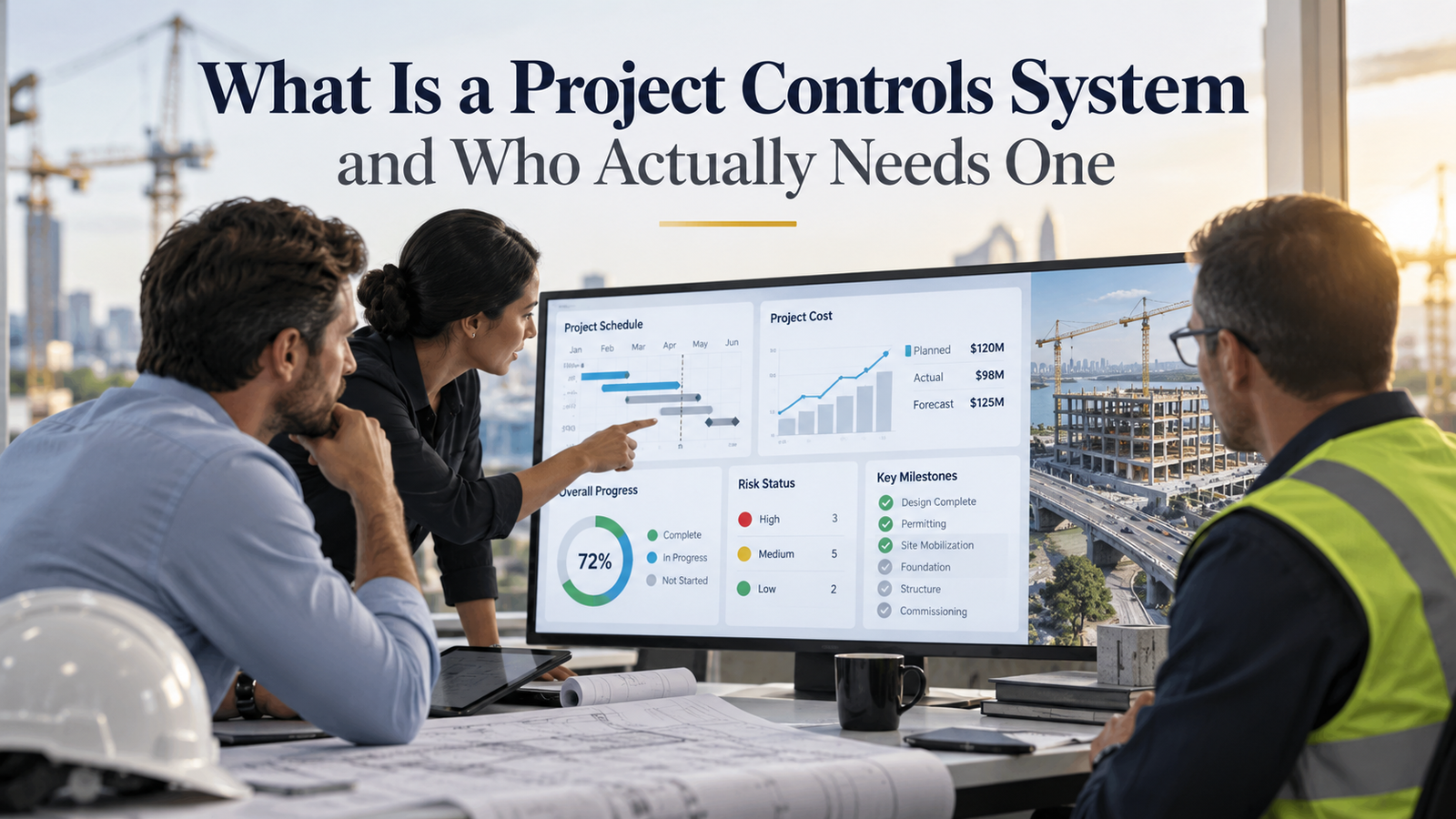
Projects usually become hard to control before they look obviously out of control. The schedule still shows a finish date. The budget still has a balance. Teams still submit status reports. Yet pending changes, late procurement, incomplete progress updates, and disconnected cost data can make those reports less useful each week.
A project controls system gives project leaders a disciplined way to compare the approved plan with current performance and the likely outcome. It connects the baseline, actual results, open exposure, forecasts, and decision rules. The goal is to give managers enough evidence to act before a small variance becomes a major recovery problem.
That doesn’t mean every project needs a large software platform or a separate controls department. The right level depends on project size, delivery risk, contract structure, reporting needs, and how many systems already hold critical project information. This guide explains what a project controls system includes, how it works, where project controls software fits, and which organizations gain enough value to justify the added structure.
TL;DR
- A project controls system combines defined processes, accountable roles, governed data, and supporting tools to measure project performance against an approved baseline and forecast the likely finish.
- The core controls usually cover scope, cost, schedule, change, risk, progress, forecasting, and performance reporting.
- Project controls and project management work together, but they aren’t the same function. Project management directs delivery. Controls provide the evidence used to assess performance and future exposure.
- Large capital projects, multi-contractor programs, long-duration work, regulated projects, and organizations with fragmented project data have the clearest need for formal controls.
- Smaller projects can often use a lighter model built around a clean baseline, regular cost and schedule updates, clear change rules, and disciplined reporting.
- Software helps when the operating model is already clear. Buying a platform before defining ownership, coding structures, update rules, and approval paths usually moves existing confusion into a new interface.
What Is a Project Controls System?
A project controls system is the operating structure used to plan, measure, forecast, and govern project performance. It isn’t limited to software. It includes the rules for building a baseline, collecting actuals, updating progress, evaluating changes, recording risks, forecasting cost and completion dates, and escalating exceptions. The Association for Project Management’s description of project controls places time, cost, risk, change, reporting, information management, and related communication inside the discipline, which is a useful way to frame the function without reducing it to a dashboard.
The system should answer practical questions. What did the organization approve? What has been spent or completed? Which changes are unresolved? What finish date is realistic now? Which risk could move that date? The controls model is useful when those answers trace back to defined sources and use the same definitions across project, finance, procurement, and leadership teams.
Software may support much of this work, but project controls software is only one layer. A tool can’t decide what counts as approved scope, who owns the forecast, when a schedule update becomes official, or how a potential change moves into the budget. Those choices belong in the control model. Calance’s work with Procore ERP integrations is relevant here because project information often sits across field, ERP, accounting, document, and reporting platforms, so the control problem is partly about how those records move and reconcile across systems.
The distinction matters during system selection. Teams that define the project controls system first can judge software against real requirements. Teams that start with a product demo often end up shaping their process around whatever fields and workflows are easiest to configure.
What the System Must Control
A useful control environment focuses on information that changes decisions. Mature controls connect the approved plan with current performance, remaining work, open exposure, and the latest forecast.
Baselines and scope
The baseline is the approved reference point for scope, budget, schedule, major milestones, and key assumptions. Once work starts, normal status updates shouldn’t rewrite that history. Approved changes should follow a defined process so leaders can see what changed, why it changed, and who authorized it.
A weak baseline makes every later variance hard to interpret. If scope moves informally or cost codes don’t match the work breakdown, detailed reports can still produce poor control.
Cost and forecast
Project cost control should distinguish budget, commitments, actual cost, approved changes, pending exposure, contingency, estimate to complete, and forecast at completion. The GAO Cost Estimating and Assessment Guide stresses reliable estimates, documented assumptions, risk analysis, actual cost updates, and earned value practices where appropriate. The practical point is simple: a budget records the approved starting point, while a forecast reflects where current evidence says the project will finish.
Reconciliation is often the harder problem. Finance may own actuals, procurement may own commitments, and the project team may track potential changes. The controls model needs timing and mapping rules so those figures can be compared without repeated manual repair.
Schedule and progress
Project schedule management starts with a logic-based plan that reflects how work will be delivered. Activities need realistic durations, dependencies, calendars, milestones, and a defined data date. Updates should record actual starts, finishes, and remaining duration rather than moving future dates until the schedule looks acceptable.
The GAO Schedule Assessment Guide groups reliable schedules around being complete, logically built, credible, and controlled. That makes project schedule management more than maintaining a Gantt chart. The schedule should reveal sequence, critical path, float pressure, and a credible completion forecast.
Progress rules should also stay consistent. Teams may use milestone completion, installed quantities, weighted steps, or another agreed method, but changing the method during a difficult period can distort both cost and schedule signals.
Risk and change
Risk and change control belong beside cost and schedule because both can move the forecast. A risk register should identify ownership, impact, timing, response, and status. Change control should capture the cause, scope effect, cost effect, schedule effect, approval state, and the point at which the baseline is updated.
The 2025 FTA Project and Construction Management Guidelines discuss risk registers, schedule risk, contingency, cost exposure, and formal practices for capital work. Risks and changes can’t sit as side notes when they can alter the expected finish.
Earned value where it fits
Earned value management connects planned value, earned value, and actual cost so teams can assess performance using one measurement model. The DOE EVMS implementation guidance explains how an earned value management system links planning, execution, and control. It works best when scope is stable enough to structure, progress is measured consistently, and cost data arrives on time. Otherwise, a simpler forecast method may give leaders clearer information.
Project Controls vs. Project Management and Project Accounting
Project controls overlaps with project management and accounting, which is why role confusion is common. The functions should exchange data, but they answer different questions and carry different decision rights.
| Function | Primary question | Typical responsibility | Typical outputs |
| Project management | What should the team do next? | Direct delivery, resolve issues, manage stakeholders, make or escalate project decisions | Action plans, decisions, delivery coordination |
| Project controls | Where are we against plan, and where are we heading? | Maintain baselines, measure performance, forecast outcomes, analyze variance, support change and risk decisions | Cost reports, schedule updates, forecasts, variance analysis, control reports |
| Project accounting | What financial activity has been recorded? | Record transactions, apply accounting rules, close periods, support financial reporting | Actual costs, invoices, journals, financial statements |
The project manager owns delivery decisions. The controls function gives the manager evidence about schedule, cost, exposure, and likely outcomes. Accounting confirms recorded financial events. Strong controls use accounting data, but they also include information accounting doesn’t normally own, such as open change exposure, remaining duration, forecast cost to complete, schedule logic, and project risk.
This is why an ERP by itself isn’t a full controls environment. It may be the authoritative source for actual costs and commitments, but it may not hold the detailed schedule, risk register, progress rules, or field change workflow. Organizations using ERP as a financial backbone often connect it to project applications or reporting tools. Calance’s Dynamics 365 Business Central services show the finance and operations side of that model, where ERP records can feed broader project reporting while the delivery system retains project-specific detail.
The separation also protects accountability. If the same person changes the baseline, reports progress, and approves the explanation for every variance, controls become difficult to challenge. On small projects, one person may perform several roles, but the rules still need to distinguish what was approved from what is being forecast now.
How the Control Cycle Works
Project controls work as a recurring cycle rather than a monthly report assembly exercise. The reporting period can vary, but the sequence should stay stable.
Establish the approved plan
Define scope, work breakdown, budget, schedule, coding, milestones, reporting dates, and approval authority. The baseline becomes the reference for later comparison, and cost and schedule structures should roll up in a consistent way.
Collect current status
Capture actual cost, commitments, progress, schedule status, procurement information, approved changes, open exposure, and current risks. Each input needs an owner and a cut-off rule. If finance and project reporting close on different dates, the report should state how the gap is handled.
Reconcile and validate
Cost records should reconcile to the financial source. Schedule updates should pass logic and status checks. Changes need a clear approval state. Progress should follow the agreed measurement method. Exception checks are more useful than manually reviewing every line.
Analyze variance and trend
Compare current status with both the baseline and prior forecast. A variance matters more when its cause and likely effect are understood. Trend analysis can reveal repeated movement in productivity, procurement, change exposure, or milestones before the final result becomes obvious.
Forecast the finish
The cost forecast should reflect what has happened, what remains, open exposure, and known risk. The schedule forecast should use current logic, actual progress, and remaining duration. NASA’s current program planning and control guidance describes earned value management as a way to connect scope with schedule and cost so teams get earlier visibility into problems. The principle still applies when a project uses simpler measures.
Decide and record action
Variance should lead to a decision. The project manager may re-sequence work, change resource plans, reject a change, use contingency, revise procurement timing, or escalate an issue. Record the decision so the next cycle can show whether the response changed the outlook.
That is the control cycle: approved plan, current evidence, forecast, decision, and controlled update. Software can shorten it, but it can’t replace governance.
What Data and Systems Feed Project Controls
Most organizations already hold much of the required information. The problem is that it sits in different systems, uses different codes, or updates on different schedules. Project controls software can become a central workspace, but many firms build an integrated model across tools they already use.
Common sources include ERP or accounting systems for actuals and commitments, scheduling applications for activity logic and progress, procurement tools for purchase orders and lead times, field platforms for change events and production status, document repositories for approvals, and risk registers for exposure. The control model should name the authoritative source for each field.
Integration matters when field and finance teams work from different records. Calance’s construction software integration work addresses a common issue in this setting: financially correct ERP records may sit apart from project commitments, field changes, or operational status.
Reporting often needs another layer. Calance’s business intelligence and data science services describe combining information from existing applications into governed reporting models. In project controls, that can create one view of budget, forecast, milestones, change exposure, and trend without forcing every team into the same daily application.
The design still needs clear direction, refresh timing, error handling, ownership, and reconciliation for every interface. A live-looking dashboard backed by late or duplicated records creates false confidence.
Documents form part of the same information chain. Change approvals, estimates, schedule narratives, and decision records need version history and access rules. SharePoint consulting services can support libraries and approvals, but the project still needs naming, status, retention, and linking rules.
A useful architecture doesn’t require one giant application. It requires a clear source for each data type and a controlled path from source record to management decision.
When Spreadsheets Stop Being Enough
Spreadsheets are often the right starting point. A small team can manage a budget, change log, risk register, and simple forecast without buying a dedicated controls platform. The problem begins when the workbook becomes the system of record for too many people and too many linked decisions.
Warning signs usually appear in the work around the spreadsheet. Teams spend reporting day copying data from several systems. Multiple versions circulate by email. Formulas differ between projects. A change log doesn’t reconcile to the budget. Schedule dates are pasted into a cost report without a shared data date. Leadership asks why 2 dashboards show different forecasts, and no one can explain which transformation caused the gap.
Project controls software becomes more useful when the organization needs role-based access, workflow approvals, audit history, structured integrations, portfolio rollups, repeatable coding, or near real-time reporting. It also helps when the volume of records makes manual reconciliation too slow for the reporting cycle.
That doesn’t mean software should remove every spreadsheet. Teams may still use spreadsheets for analysis, estimate development, or temporary calculations. The key question is whether the official baseline, current status, forecast, and approvals can be reconstructed without relying on someone’s private workbook.
A practical threshold is governance rather than row count. If the project can’t prove who changed a forecast, which version was approved, when a change entered the budget, or why a milestone moved, the current toolset is no longer supporting the control requirement.
Who Actually Needs a Project Controls System?
The clearest candidates are organizations where late information can materially affect funding, completion, margin, contract position, or public accountability. Formal controls earn their place when the consequence of delayed visibility is higher than the effort needed to maintain them.
Owners of major capital projects
Owners funding construction, infrastructure, energy, facilities, or large equipment programs need a reliable view of approved budget, commitments, change exposure, schedule movement, contingency, and forecast. They also need to compare contractor reports with owner-side records. For federally supported highway major projects, FHWA uses Cost and Schedule Risk Assessments to test cost and completion ranges with probabilistic methods. Private owners may use different rules, but uncertainty becomes more important as duration and investment rise.
General contractors and specialty contractors
Contractors need stronger controls when work spans many cost codes, subcontracts, crews, procurement packages, or change events. Project schedule management matters when delay in one package can affect downstream work, damages, resources, or claims. Project cost control matters when labor productivity, commitments, pending change, and forecast margin need attention before accounting closes the period.
Engineering, EPC, and program delivery organizations
Engineering and EPC work combines design, procurement, fabrication, field execution, and contract milestones. Formal controls connect these work streams to a common work breakdown and reporting calendar and support portfolio views across major projects.
Public agencies and regulated environments
Public agencies, utilities, transportation bodies, and regulated sectors often need stronger audit trails, funding controls, formal change records, and outside reporting. Here, control quality affects accountability as well as internal management.
Organizations with fragmented project technology
A firm can need stronger controls even when projects aren’t enormous. If ERP, field management, scheduling, procurement, and document systems hold different parts of the truth, project controls software or an integrated reporting layer can reduce reconciliation time and conflicting reports.
Companies managing repeatable portfolios
Real estate developers, retailers, data center operators, manufacturers, and healthcare systems may run many similar projects rather than one megaproject. Standard coding, status dates, forecast rules, and approval paths make portfolio comparison more useful.
Who Usually Does Not Need One Yet
A dedicated controls platform can be excessive for short, low-risk work with few dependencies and a small delivery team. If the project has a clear fixed scope, limited procurement, one budget owner, a short duration, and little contractual complexity, a disciplined spreadsheet and standard project plan may provide enough control.
Small internal IT projects are a good example. A 6-week configuration effort with a stable team and limited external spend may need a baseline, issue log, task plan, and budget check, but a formal cost engine and EVM model could create more administration than insight. The same applies to minor facilities work or repeatable maintenance jobs where cost exposure is capped and schedule consequences are small.
The test isn’t whether the organization can afford new software. It is whether the project has enough uncertainty, interfaces, financial exposure, or reporting burden to need more structure. A small project with a hard regulatory deadline or costly outage window may need tighter controls than a larger but routine effort.
Organizations should also avoid buying a platform to fix weak management habits. If teams don’t maintain baselines, don’t close changes, or don’t update remaining work, a new tool won’t solve the problem. The first improvement may be a reporting calendar, clearer ownership, and a small set of standard templates.
A lightweight model can still use the same control principles. Keep one approved baseline. Track actuals and commitments. Maintain a current forecast. Record changes before they enter the plan. Review key risks. Escalate exceptions. Add more structure only when the work proves it needs it.
How Much Control Is Enough?
The right answer depends on project risk and information needs. Controls should be strong enough to support decisions without forcing every project through the same level of administration.
A useful model is to define control tiers. A low-risk project might use monthly cost review, milestone tracking, a change log, and a risk register. A medium-risk project might add a detailed schedule, coded forecast, formal approvals, and dashboard reporting. A major project may need dedicated controls staff, linked cost and schedule structures, quantitative risk analysis, EVM, detailed change governance, and independent assurance.
The tier should be set before execution begins. Teams can use criteria such as total spend, duration, number of contracts, funding source, schedule criticality, regulatory exposure, technical uncertainty, and reporting obligations. Avoid a scoring model that looks precise but can’t explain why one threshold matters. The goal is consistent judgment.
Tool choices should follow the tier. Project controls software may be justified for medium and high control levels, while low-risk work can stay on standard collaboration and finance tools. Where custom workflow or system connections are needed, Calance’s app development and automation services illustrate another option: extend the existing application landscape rather than replace every source system.
The same logic applies to earned value management. Use it when scope, schedule, cost, and progress can be structured well enough to make the indicators meaningful. Skip it when a simpler forecast and milestone model gives leaders clearer information with less maintenance.
Good controls are proportionate. The system should reduce uncertainty around decisions rather than create a reporting burden that teams learn to work around.
How to Implement a Project Controls System
Implementation should start with the control model and end with adoption. Software configuration belongs in the middle.
Define the decisions the system must support
Start with the questions executives, project managers, finance, and delivery teams need answered, such as forecast final cost, expected completion date, contingency use, milestone movement, change exposure, and decisions requiring approval. This keeps the design focused on business decisions rather than optional fields.
Establish structures and ownership
Define the work breakdown, cost structure, coding rules, reporting cut-off, and approval roles. Map who owns budget, actuals, commitments, schedule status, progress, risks, changes, and forecasts. Name the authoritative source for each data element.
Build the baseline and change rules
Agree how the initial baseline is approved and how later revisions occur. Define categories for approved change, pending change, internal transfer, contingency use, and forecast-only movement. Schedule revisions need equivalent rules so the current forecast can move without silently rewriting the original commitment.
Design integrations and validation
Map how source systems exchange data and how exceptions are handled. Include control totals, status checks, duplicate rules, and failed-record queues. Calance’s Power BI consulting services can support reporting across connected Microsoft and enterprise sources, but the reporting layer still needs reconciled definitions and documented calculations.
Pilot on a real project
Choose a pilot large enough to expose real exceptions without putting a critical program at unnecessary risk. Run at least 2 reporting cycles so the team can test cut-off timing, schedule updates, cost reconciliation, change approvals, forecast logic, and executive reporting.
Train by role and govern operations
Project managers, schedulers, finance users, and executives need different training. Cover what each role enters, reviews, approves, and consumes. After rollout, assign ownership for master data, system changes, interfaces, report definitions, and access. Remove reports that no longer support a decision and govern later changes to the controls environment.
What to Measure and Report
A controls report should make the current position and next decision easy to see. Every measure needs a defined source, calculation, owner, update frequency, and action threshold.
Cost reporting usually includes budget, approved changes, commitments, actual cost, open exposure, contingency, estimate to complete, and forecast at completion. Project cost control is stronger when the report also explains movement from the prior forecast.
Schedule reporting should focus on the completion forecast, milestone movement, critical or near-critical paths, float trends where relevant, progress against the data date, and major schedule risks. Project schedule management also benefits from explaining why a milestone moved and whether recovery action changed the outlook.
Risk and change reporting should identify material open items, decision dates, owners, potential cost or time effect, and approval state. The full registers can sit behind the management view, which should emphasize exceptions that could change the forecast.
Earned value management adds planned value, earned value, actual cost, variance measures, and performance indices. These measures are useful when progress rules are stable and the baseline is credible. They shouldn’t replace schedule logic, change analysis, or a reasoned estimate to complete.
Executives usually need a shorter view: forecast cost, completion date, contingency position, major movement, key risks, and decisions due. Analysts need enough detail to trace each figure back to its source. Comparing the current forecast with the prior forecast is especially useful because it shows what became different since the last decision cycle.
Common Failure Modes
Most controls programs fail because operating rules are unclear or users stop trusting the information.
One common problem is buying a platform before defining the control process. The tool gets configured around inconsistent codes, unclear approvals, and old spreadsheets. Users then blame software for problems that began in governance.
Another problem is a baseline that changes too easily. When teams overwrite budget or schedule history to match the latest expectation, variance analysis loses meaning. Forecasts should move as evidence changes. Baselines should move only through approved change.
Timing can create the same problem. Cost closes on one date, schedule status uses another, and change logs update continuously. A dashboard may look current while combining several different project states.
Dashboards also get mistaken for control. A visual can expose an issue, but someone still needs authority to investigate, decide, approve, and record the response. A red indicator without an owner is decoration.
Weak project cost control appears when pending exposure stays outside the forecast until formal approval, which can understate the likely final cost. Controls should separate authorization from forecast exposure.
Weak project schedule management appears when teams move dates without maintaining logic. The file may show a new finish, but it can’t explain which activities drive it or what recovery action could change it.
EVM can fail for the same reason. Subjective progress, late actuals, or a weak baseline can produce precise-looking indices from poor inputs.
Over-control is another risk. If teams spend more time coding and reconciling than using the information, the process becomes a parallel bureaucracy. Keep only the data and reports that support a real decision, contract need, audit requirement, or forecast.
Conclusion
A project controls system is the discipline that keeps an approved project plan connected to current evidence and the expected finish. Its value comes from consistent baselines, reliable status, controlled changes, credible forecasts, and clear decision rules. Software can support that discipline, but it can’t create it on its own.
Organizations with major capital exposure, long schedules, many contracts, strict reporting duties, or fragmented project systems usually have the strongest case for formal controls. Smaller or lower-risk work can use the same principles with fewer layers. The level of control should match the consequence of being wrong.
The practical question is whether decision-makers can see where the project stands, where it is likely to finish, what changed, and what needs action while there is still time to respond. When those answers are slow, disputed, or built from manual reconciliation every reporting period, stronger controls have become a business requirement.
FAQs
What is the main purpose of a project controls system?
The main purpose is to compare an approved plan with current performance and forecast the likely outcome. It should show budget position, schedule status, open changes, risk exposure, and the expected cost or completion date, while defining how those figures are produced and owned.
Is project controls software the same as project management software?
No. Project management software may focus on tasks, collaboration, assignments, documents, and team coordination. Controls platforms focus more on baselines, cost, schedule, forecasting, change, risk, and performance analysis. Some products cover both areas, but the business functions are still different. The right choice depends on which decisions and records the organization needs the system to support.
What are the core parts of a project controls system?
Core parts usually include baseline governance, project cost control, project schedule management, progress measurement, forecasting, change control, risk management, and reporting. The model also needs defined roles, source systems, coding structures, update calendars, approval paths, and reconciliation rules.
Who owns project controls on a project?
Ownership varies by size. A small project may have the project manager maintain controls. Larger work may use cost engineers, schedulers, project controllers, change managers, and a controls lead. Decision rights should stay clear, with management directing delivery and controls staff maintaining the analysis and forecast.
When should project controls be set up?
Set them up before execution whenever possible. Baselines, coding, reporting rules, progress methods, and approval authority are easier to define before transactions and updates begin. An active project can still improve controls after reconciling actuals, scope, forecast, and schedule position.
Can Excel be used as a project controls system?
Yes, for smaller or simpler work. Excel can support budgets, forecasts, risk registers, change logs, and basic reporting. It becomes risky when users edit linked workbooks, approvals aren’t traceable, versions conflict, or data must be copied from several systems each period. At that point, a governed platform or integration layer may be more appropriate.
What is project cost control?
Project cost control compares budget with commitments, actual cost, changes, remaining work, and forecast final cost. It separates approved amounts from potential exposure, explains why the forecast changed, and reconciles project figures with the financial source.
What is project schedule management in project controls?
Project schedule management covers creation, update, analysis, and governance of the time-based plan. It includes activity logic, durations, calendars, milestones, status dates, progress, remaining duration, critical path analysis, and controlled baseline changes so teams can explain what drives the finish date.
Does every project need earned value management?
No. Earned value management is most useful when scope can be structured, progress can be measured objectively, and cost and schedule data are timely. Smaller or fluid projects may get clearer information from milestone tracking and direct cost forecasting. The method should match the work.
What is the difference between a baseline and a forecast?
The baseline is the approved reference plan. The forecast is the current expectation based on progress, remaining work, known changes, and risk. Forecasts should change with evidence. Baselines should change only through approved control rules, so managers can compare commitment with current expectation.
What data should project controls software integrate?
It commonly integrates budget and actual cost, commitments, schedule status, progress, procurement, change records, risk information, document approvals, and forecast data. Each field should have one authoritative source or a documented reconciliation rule.
How do you know when spreadsheets are no longer enough?
Spreadsheets have reached their limit when official figures depend on private files, multiple versions circulate, formulas vary by project, approvals can’t be reconstructed, or reporting requires heavy copy-and-paste work. Another sign is repeated disagreement between finance, project, and executive reports. The issue is control, traceability, and repeatability rather than file size.
How much does a project controls system cost?
There is no useful universal price. Cost depends on user count, software model, integrations, configuration, migration, reporting, training, support, and staffing. Compare total operating cost with the financial and schedule exposure being managed. Small projects may need process discipline more than a new platform.
Can a project controls system work across a portfolio?
Yes. Common coding, status dates, forecast definitions, and change categories let leadership compare projects and roll up exposure. The model still needs enough flexibility for real differences in contract type, delivery method, schedule detail, and risk profile.
What should executives see from project controls?
Executives usually need expected final cost, completion date, movement since the prior period, contingency position, material risks, open changes, and decisions needing leadership action. Detailed records should sit behind the summary so each headline figure can still be traced.