

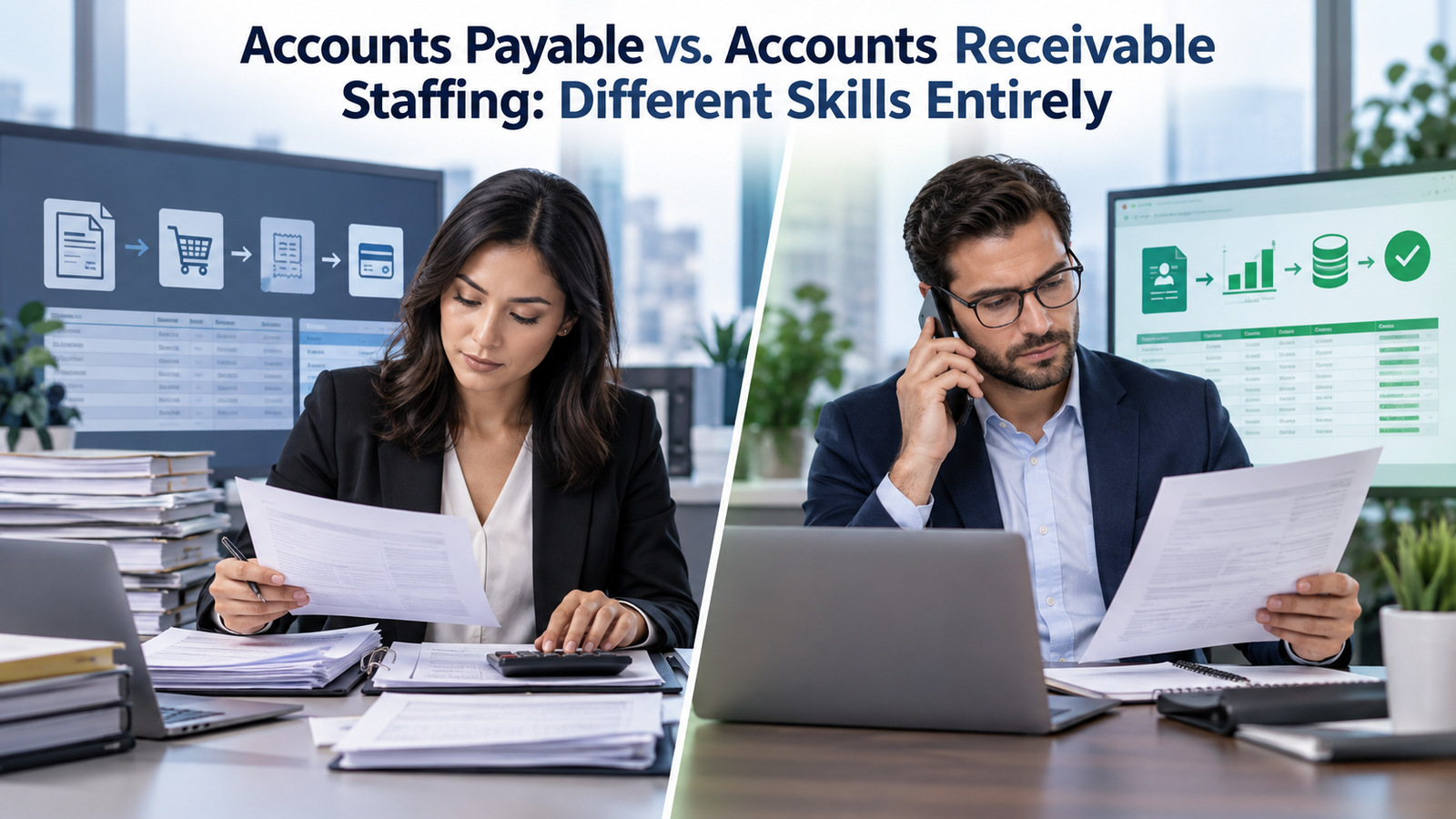
Accounts payable and accounts receivable sit close together on an org chart, but the work pulls people in different directions. AP protects cash before it leaves the company. AR turns billed revenue into collected cash after a sale. That difference changes the daily decisions, the risks, the systems knowledge, and the kind of communication each role demands. Treating the 2 jobs as interchangeable is one of the easiest ways to write a weak finance job description.
The distinction matters even as finance teams automate more transaction work. The U.S. Bureau of Labor Statistics says bookkeeping, accounting, and auditing clerks increasingly use accounting software, spreadsheets, and databases, while still checking records and reconciling differences in the current occupational outlook for accounting clerks. Automation changes the mix of work. It doesn’t remove the need for people who understand exceptions, controls, account behavior, and when a transaction needs human judgment.
This guide focuses on accounts payable vs accounts receivable staffing from a hiring point of view. It explains where the skills split, which abilities transfer, what to test in interviews, how software changes the job, and when a business needs a specialist instead of a general accounting clerk. The goal is simple: hire for the process the person will actually own.
TL;DR
Accounts payable vs accounts receivable staffing should start with the direction of cash and the risk around that cash. Accounts payable specialist roles work with vendor invoices, purchase orders, approvals, payment runs, and supplier records. Accounts receivable specialist roles work with customer invoices, incoming payments, aging, collections, disputes, and credit exposure. Both roles need accounting accuracy and system discipline, but the strongest candidate for one side may be a poor fit for the other.
For accounts payable staffing, prioritize invoice matching, vendor master discipline, payment controls, exception handling, and comfort with procurement records. For accounts receivable staffing, prioritize cash application, collections judgment, billing accuracy, customer communication, and aging analysis. Accounts payable skills tend to center on preventing invalid or mistimed cash outflow. Accounts receivable skills tend to center on collecting valid balances without damaging useful customer relationships.
A small company can combine AP and AR in one job when transaction volume is modest and controls are designed around that choice. As volume, payment risk, customer disputes, or system complexity grows, separate ownership usually becomes easier to manage. The hiring question isn’t which role is harder. It is which errors your business can least afford and which workflow needs deeper ownership.
The Difference Starts With The Direction Of Cash
The accounting labels sound symmetrical, but the work isn’t. Accounts payable records obligations the company owes to suppliers and other payees. Accounts receivable records amounts customers owe the company. O*NET places both AP and AR titles within the broader bookkeeping and accounting clerk occupation, and its task list for accounting clerks includes checking entries, coding documents, calculating amounts due, and reconciling differences. Those shared foundations explain why employers sometimes assume the jobs are interchangeable.
The split appears when you follow a transaction from start to finish. AP asks whether a vendor invoice is valid, approved, coded correctly, matched to supporting records, and safe to pay. AR asks whether a customer invoice is correct, whether payment arrived, how to apply it, why an account is overdue, and what should happen next. Accounts payable vs accounts receivable staffing therefore depends on different exception queues even when both teams use the same ERP.
That difference also changes who each person works with. AP spends more time with vendors, procurement, receiving teams, expense owners, and treasury or payment approvers. AR spends more time with customers, sales, customer success, billing owners, and finance leaders who watch collections. A person can understand debits and credits and still struggle if the job’s relationship pattern doesn’t fit how they work.
The safest starting point is to map the job to the cash cycle before writing the title. If the employee will review vendor bills and release payments, build the role around accounts payable staffing. If the employee will issue invoices, apply receipts, and chase overdue balances, build it around accounts receivable staffing. When the role truly includes both, say so clearly and design the controls to match.
What Accounts Payable Staff Actually Do
Accounts payable work begins before the payment run. Strong AP staff validate the vendor, the invoice, the coding, the approval path, and the evidence that goods or services were received. Microsoft describes AP in Dynamics 365 Finance as the area used to track vendor invoices and outgoing expenditures, with invoice approval, matching, policies, workflow, and payment functions built into the accounts payable process. That is a useful hiring clue because the job is much wider than data entry.
The most important accounts payable skills depend on the company’s purchasing model. A purchase-order-heavy business needs people who can understand 2-way or 3-way matching, quantity differences, price differences, freight charges, credit memos, and blocked invoices. A service company may have fewer receipts to match, but it can have more non-PO invoices, recurring bills, contractor payments, and questions about who has authority to approve a charge.
A capable accounts payable specialist should also understand what happens when the documents disagree. Microsoft defines invoice matching as comparing vendor invoice information with purchase orders and product receipts, then flagging differences that exceed set tolerances. In practice, the hire needs enough judgment to know whether a variance is a simple coding issue, a receiving problem, a duplicate, or something that requires escalation before cash leaves the business.
Vendor master work raises the hiring bar further. In U.S. operations, AP teams often collect tax information before or during vendor setup. The IRS explains that Form W-9 provides a payee’s taxpayer identification number for information reporting, so someone touching vendor onboarding needs care with names, tax IDs, banking details, and supporting documents. That work rewards patience and control discipline more than speed alone.
For accounts payable staffing, interview questions should therefore reach beyond invoice volume. An accounts payable specialist should be able to explain the evidence needed before money is released. Ask how the candidate handles a duplicate invoice, an invoice with no purchase order, a bank detail change received by email, a payment requested outside the normal run, or a vendor statement that doesn’t match the ledger. Those examples reveal whether the person has the accounts payable skills to see AP as a controlled cash process rather than a queue to clear.
What Accounts Receivable Staff Actually Do
Accounts receivable starts with billing, but the harder work often begins after the invoice is sent. AR staff may create or review invoices, post customer payments, match remittances to open items, research short pays, manage unapplied cash, maintain aging notes, and follow up on overdue accounts. Microsoft’s accounts receivable overview reflects that range by covering customer invoices, incoming payments, credit, collections, and settlement.
The strongest accounts receivable skills combine accounting discipline with customer-facing judgment. A payment can arrive without a usable remittance. A customer can dispute a price, claim a missing credit, withhold tax, pay several invoices in one transfer, or short pay because of a service issue. The accounts receivable specialist has to research the account, keep the ledger clean, and move the conversation toward a resolution that finance can support.
Collections work makes accounts receivable staffing especially different from AP. Microsoft notes that AR collections can use aging snapshots, customer pools, activities, cases, interest or fee actions, and write-off transactions. A person working that queue needs to know which overdue balances deserve a routine reminder and which require help from sales, legal, billing, or a finance manager.
Senior AR roles may also touch credit policy and allowance work. FASB’s credit losses guidance applies to financial assets that include trade receivables, which matters when a company estimates expected losses or reviews collectability. An entry-level cash application clerk doesn’t need to own that accounting judgment, but an AR lead or manager should understand how aging quality and customer risk feed the broader reporting process.
For accounts receivable staffing, a good interview should test whether an accounts receivable specialist can reason around partial payments, unidentified cash, disputed invoices, overdue strategic accounts, and promised payment dates that keep slipping. The answers should show a clear record of what happened, who owns the next action, and how the ledger stays accurate while the commercial issue is being resolved.
AP Vs. AR Skills: Side-By-Side
Accounts payable vs accounts receivable staffing becomes easier when the comparison is tied to actual work instead of broad traits such as “detail oriented.” Both roles need attention to detail. What matters is where that attention is applied and what happens when the employee gets it wrong.
| Area | Accounts Payable | Accounts Receivable |
| Cash direction | Outgoing cash | Incoming cash |
| Primary records | Vendor invoices, POs, receipts, approvals | Customer invoices, receipts, remittances, aging |
| Core exceptions | Duplicates, match failures, coding errors, bank changes | Short pays, unapplied cash, disputes, overdue balances |
| Main relationships | Vendors and internal approvers | Customers and internal commercial teams |
| Typical control focus | Valid payment and authorized release | Accurate billing and correct cash application |
| Key analysis | Invoice aging, blocked items, payment timing | Customer aging, DSO drivers, dispute patterns |
| Higher-risk moments | Vendor setup and payment release | Credit decisions, write-offs, collection escalation |
An accounts payable specialist adds the most value when accounts payable skills are strong enough to trace an invoice back to its supporting business event. That may mean a purchase order, receipt, contract, approval, expense record, or recurring agreement. The person should be comfortable stopping a payment when evidence is incomplete and documenting why the item is on hold.
An accounts receivable specialist adds the most value when accounts receivable skills are strong enough to trace a payment or unpaid balance back to the customer’s account story. That includes invoice terms, credits, prior promises, disputed items, deductions, and the customer’s payment pattern. The person needs persistence, but also the judgment to avoid sending the same generic reminder when the real blocker sits inside the company.
This is why accounts payable vs accounts receivable staffing should avoid copy-and-paste job descriptions. A posting that lists the same duties for both roles usually attracts generalists without making the actual decision rights clear. Good candidates want to know which queue they own, what they can resolve themselves, and where they must escalate.
Where The Skills Overlap And Where They Don’t
There is real overlap between the 2 functions. Both sides need basic accounting knowledge, clean recordkeeping, reconciliation habits, spreadsheet comfort, ERP fluency, and the ability to explain an exception. Both also contribute to month-end close because open payables and receivables affect balance sheet accuracy and cash planning. That shared base means a move from AP to AR, or the reverse, is possible.
The transferable part is process discipline. A strong accounting clerk already knows how to work from source documents, follow approval rules, research differences, and leave a clear audit trail. Those habits shorten the learning curve when someone changes sides. They don’t replace the process knowledge that comes from repeated exposure to vendor payments or customer collections.
The nontransferable part is the pattern recognition built inside each workflow. AP people learn what duplicate invoices look like, how vendor statements expose missing items, where receiving gaps create match failures, and which bank-change requests deserve extra scrutiny. AR people learn how customers describe disputes, which deductions recur, what an aging list is really saying, and when a collection problem is actually a billing problem.
Accounts payable vs accounts receivable staffing should separate foundational accounting ability from process-specific experience. If the company has strong training, a high-quality general accounting candidate can move into either side. If the queue is already messy, the role is under audit pressure, or cash is stuck in unresolved exceptions, direct experience becomes more valuable because the new hire has less room to learn through trial and error.
Systems, Automation, And Process Knowledge
Software changes what AP and AR staff spend time on, but it doesn’t make their skills identical. Modern finance systems can capture invoices, route approvals, match documents, apply payments, create collection worklists, and post settlements. The employee’s value shifts toward reviewing exceptions, maintaining clean master data, understanding rules, and spotting when the system output doesn’t match the business event.
AP automation often raises the value of exception knowledge. Microsoft documents automated vendor invoice processing that can import invoices, match receipts, send invoices into workflow, pre-validate posting, and track automation history. A candidate who has only keyed invoices manually may need training before taking ownership of a queue where most clean invoices pass through and most human work involves failures.
AR systems create a different set of demands. Auto-application can match receipts to invoices, but remittance quality varies and customers don’t always pay exactly what the system expects. The employee needs to understand settlement logic, partial payments, credits, and open items. Microsoft’s settlement overview shows how invoices, payments, credit memos, and fees can be settled against one another, which is the type of system behavior an experienced AR hire should be able to reason through.
Payment methods also matter. The Federal Reserve reported in July 2026 that ACH accounted for nearly three-quarters of U.S. noncash payment value in 2024 in its latest triennial payments study. Finance hiring should reflect that payment environment. AP staff may need experience with ACH files, payment approvals, and bank detail controls, while AR staff may need to identify ACH receipts and apply them correctly from sometimes-poor remittance data.
For both sides of accounts payable vs accounts receivable staffing, ask candidates what the system did automatically in their last role and what still required human review. That question usually produces a more useful answer than asking whether they have “ERP experience.” The goal is to learn whether they understand the workflow behind the screen.
Controls, Fraud, And Compliance Change The Hiring Bar
Cash processes attract fraud because they move money and depend on trusted records. AP faces obvious exposure through fake invoices, altered bank instructions, vendor impersonation, duplicate payments, and approval abuse. AR has different risk points, including unauthorized credits, write-offs, customer master changes, misapplied cash, and concealment of overdue balances. Accounts payable vs accounts receivable staffing needs to account for these control differences when assigning access.
Segregation of duties is the basic design principle. GAO’s internal control standards say key duties should be divided so one person doesn’t control authorization, processing and recording, review, and related assets; the segregation guidance is written for federal entities, but the control logic is broadly useful. In AP, that means the person who creates or changes a vendor shouldn’t also be able to approve and release that vendor’s payment without another check.
Current payment fraud also raises the value of verification habits. Nacha reported, citing the 2026 AFP Payments Fraud and Control Survey, that 74% of surveyed organizations experienced business email compromise attempts in 2025, while check fraud remained common; the Nacha summary of 2025 fraud findings gives AP leaders a good reason to test how candidates respond to urgent bank-change requests. The right answer should include independent verification through a trusted channel, not blind reliance on the incoming email.
Tax reporting adds another AP-specific layer in the United States. The IRS’s current 1099-MISC and 1099-NEC instructions define filing requirements for reportable payments, which means vendor records can affect year-end reporting. A senior AP hire doesn’t need to be a tax specialist, but the person should understand why vendor classification and tax data can’t be treated as optional clerical fields.
Controls also shape accounts receivable skills. AR staff often need limits on who can issue credits, change customer terms, write off balances, or apply unidentified cash. The best candidate will be comfortable working inside those limits and documenting exceptions instead of treating control steps as obstacles.
Communication And Judgment Are Different Too
AP communication is often evidence-based and internally routed. A vendor wants to know why an invoice hasn’t been paid, but the answer may depend on a missing receipt, a price variance, an approval delay, or a duplicate submission. The accounts payable specialist needs to explain the hold clearly, identify the owner of the missing action, and avoid promising a payment date the company hasn’t approved.
AR communication is more commercial. The person may be asking a customer to pay while sales is trying to renew or expand the account. Strong accounts receivable skills include the ability to separate a real dispute from a delay tactic, write a clear follow-up, document a promise to pay, and bring in the right internal owner when the customer has a valid complaint.
This difference matters in accounts payable vs accounts receivable staffing interviews. A candidate can be warm and professional yet still be weak at collections if every difficult conversation gets escalated. Another candidate can be forceful yet create avoidable friction by treating every late invoice as a confrontation. Good AR judgment means choosing the next action based on account facts, value, history, and the stated reason for nonpayment.
Good AP judgment has a different shape. It shows up when a candidate refuses to bypass controls because a payment is urgent, checks a suspicious vendor change, or asks for missing support before coding a charge. Accounts payable vs accounts receivable staffing should test these moments directly with short scenarios rather than relying on personality adjectives.
Metrics That Should Shape Each Job Description
Metrics tell candidates what the company actually values. AP roles often measure invoice processing time, first-pass match rate, exception backlog, on-time payment, duplicate prevention, early-payment discount capture when relevant, and the age of unresolved vendor issues. The exact set should reflect the process. A company with complex purchase orders will care more about matching exceptions than a company with mostly approved recurring service bills.
AR roles usually need a different scorecard. Useful measures can include aging by bucket, overdue balance movement, cash application speed, unapplied cash, dispute age, collection promise follow-through, and days sales outstanding when the metric is used carefully. Accounts receivable staffing works better when the job description says whether the person owns collections, cash application, billing, or some mix because each area drives different numbers.
Metrics can also expose a bad role design. If one AP employee is judged on processing speed while also being expected to investigate every exception deeply, the targets can conflict. If an AR collector is judged only on cash collected, the person may ignore dispute quality or chase easy accounts while older problems sit untouched. Performance measures should support the control and cash outcome the role exists to produce.
Accounts payable skills and accounts receivable skills are easier to assess when the company knows its baseline. Before hiring, look at the backlog, aging, exception reasons, close problems, and the work currently handled by managers. The job description should be built around those facts instead of a generic list copied from another company.
How To Hire The Right AP Or AR Person
Accounts payable vs accounts receivable staffing improves when the interview mirrors real work. Resume titles are unreliable because companies divide finance work differently. One “accounts payable specialist” may have only entered invoices, while another managed vendor onboarding, matching, payment proposals, statement reconciliations, and month-end accrual support. One “accounts receivable specialist” may have focused on cash application, while another owned a large collection portfolio and credit reviews.
Start by defining the work before defining the seniority. List the transactions the employee will own, the systems involved, the decisions the person can make, and the exceptions that reach a manager. Then separate must-have experience from skills that can be taught. That step prevents accounts payable staffing from demanding deep procurement experience when the actual job is mostly approved invoice entry, or accounts receivable staffing from demanding collections expertise when the real need is cash application.
Use a short practical exercise for accounts payable skills. Give the candidate a small invoice packet with a purchase order, receipt, invoice, vendor record, and one or 2 intentional problems. Ask what they would check before posting or paying it. The goal isn’t to test memorized software clicks. It is to see whether the person notices the difference, explains the risk, and chooses a reasonable next step.
Use a different exercise for accounts receivable skills. Provide an aging extract with an overdue invoice, a partial payment, a credit note, and a customer email disputing one charge. Ask the candidate to explain the account balance and draft the next internal or customer action. Strong candidates usually organize the facts before deciding what message to send.
Reference checks can also be specific. For AP, ask whether the person was trusted with vendor changes, reconciliations, or payment preparation and how they handled exceptions. For AR, ask about portfolio size, dispute ownership, collection follow-up, and whether cash application or billing errors were part of the role. Specific process questions produce better evidence than asking whether someone was a good employee.
Finally, match the hire to the state of the process. A clean, documented workflow can support a less experienced employee with good accounting fundamentals. A broken workflow needs someone who can classify problems, rebuild routines, and work through a backlog without losing control. That distinction matters more than adding another year to the experience requirement.
Staffing Models, Seniority, And Cost Tradeoffs
There is no single right team shape. A small company may use one accounting specialist for both AP and AR, with approval and banking controls handled by a controller or owner. A larger company may split invoice processing, payments, billing, cash application, collections, and credit across several people. Accounts payable vs accounts receivable staffing should follow transaction complexity and control needs instead of headcount conventions.
The cost of a hire includes more than salary. Consider recruiting time, training, manager review, system access, benefits for employees, contract markups for temporary workers, and the cost of errors while someone learns the process. Temporary staff can help with backlog cleanup or a known volume spike. A permanent specialist makes more sense when the work is steady and process knowledge compounds over time.
Seniority should rise with judgment and access. An entry-level AP clerk can key approved invoices and research simple discrepancies, while a senior accounts payable specialist may own vendor onboarding, payment preparation, statement reconciliations, and difficult exceptions. An entry-level AR clerk may focus on receipts and basic billing, while a senior accounts receivable specialist may own collections strategy for a portfolio, dispute escalation, credit work, and close support.
Market pay also varies by location and scope, so a single national number can mislead. BLS groups AP and AR titles within a wider bookkeeping and accounting clerk category rather than pricing every company-specific role separately. For accounts payable vs accounts receivable staffing budgets, compare local salary data for the exact level, then adjust for system experience, control responsibility, collection ownership, and whether the person is expected to repair a weak process.
The most expensive staffing mistake is often a mismatch rather than a high salary. Hiring a fast invoice processor for a control-heavy AP role can increase payment risk. Hiring a quiet back-office processor for a collection-heavy AR role can leave cash stuck in aging. The job’s hardest recurring decision should drive the profile.
Conclusion
Accounts payable vs accounts receivable staffing works best when AP and AR are treated as related accounting functions with different operating skills. AP protects the company before cash goes out by validating vendors, invoices, approvals, and payment conditions. An accounts receivable specialist protects incoming cash by keeping billing accurate, applying receipts, resolving disputes, and moving overdue balances toward payment.
The shared accounting base matters, but it shouldn’t hide the differences. Accounts payable staffing should test control discipline, invoice matching, vendor records, and payment judgment. Accounts receivable staffing should test cash application, collections reasoning, aging analysis, and customer communication. The more complex the workflow becomes, the more important that specialization gets.
A clear job design also makes hiring fairer. Candidates can see what they will own, interview exercises can test the real work, and managers can judge performance against the process instead of a vague accounting title. That is the practical difference between filling a finance seat and hiring for the cash cycle the business actually runs.
FAQs
What Is The Main Difference Between AP And AR Staffing?
AP staffing focuses on money the company must pay, while AR staffing focuses on money the company must collect. The accounting foundation overlaps, but the daily work differs. AP centers on vendor invoices, approvals, matching, and payments. AR centers on customer billing, receipts, collections, disputes, and aging.
Can The Same Person Handle Accounts Payable And Accounts Receivable?
Yes, especially in a smaller company with modest volume. The business still needs controls around vendor setup, payment approval, credits, write-offs, and bank access. One person can process both sides, but another authorized person should review or approve the highest-risk actions.
Are Accounts Payable Skills Transferable To Accounts Receivable?
Some are. Reconciliation, accounting accuracy, ERP use, spreadsheet work, and exception research transfer well. The employee still needs to learn AR-specific work such as cash application, collections, customer disputes, aging management, and credit-related procedures before owning the receivables process independently.
Are Accounts Receivable Skills Transferable To Accounts Payable?
Yes, but the employee needs training in vendor controls, purchase orders, invoice matching, payment methods, approval paths, and vendor master records. An experienced AR employee may bring strong reconciliation habits, yet AP requires a different view of payment risk and supporting evidence.
Which Role Needs Stronger Communication Skills, AP Or AR?
Both need clear communication, but AR usually requires more direct customer collection work. AP communication often focuses on explaining invoice holds, requesting missing support, or resolving vendor differences. AR communication more often involves payment follow-up, dispute discussion, promise tracking, and coordination with sales or billing teams.
Which Role Has More Fraud Risk?
Both have fraud exposure, but the patterns differ. AP often faces vendor impersonation, changed bank instructions, fake invoices, duplicate payments, and approval abuse. AR risk can involve unauthorized credits, write-offs, customer master changes, misapplied receipts, or concealment of overdue accounts.
What Should An AP Skills Test Include?
Use a short invoice case with a purchase order, receipt, approval, vendor record, and an intentional discrepancy. Ask the candidate what they would verify, whether the invoice can be posted or paid, and what should happen next. The exercise should test reasoning rather than software memory.
What Should An AR Skills Test Include?
Use a customer account with an invoice, partial payment, credit, overdue item, and a short dispute note. Ask the candidate to explain the open balance and decide the next action. This tests cash application, aging interpretation, dispute reasoning, and written follow-up.
What Experience Matters Most For Accounts Payable Staffing?
The best experience depends on the workflow. For PO-based operations, invoice matching and purchasing records matter. For service-heavy businesses, non-PO approvals, recurring invoices, vendor setup, and payment controls may matter more. ERP experience helps when it matches the process the company actually uses.
What Experience Matters Most For Accounts Receivable Staffing?
Look for experience that matches the role’s real ownership. Cash application roles need remittance and settlement skills. Collection roles need aging management, follow-up discipline, and dispute handling. Billing-heavy roles need invoice accuracy, customer setup knowledge, and a clear understanding of contract or order information.
When Should AP And AR Be Separate Roles?
Separation becomes more useful as transaction volume, payment risk, customer disputes, or system complexity grows. Dedicated ownership can also improve accountability when one combined role has become too broad. The decision should follow workload and control design instead of a fixed company-size rule.
Does Automation Reduce The Need For AP And AR Staff?
Automation can reduce manual entry and routine matching, but it shifts human work toward exceptions, controls, master data, customer or vendor issues, and system review. Teams may need fewer people for repetitive entry while expecting stronger process knowledge from the people who remain.
How Should Accounts Payable Staffing Be Measured?
Useful measures can include invoice cycle time, exception backlog, match success, on-time payment, duplicate prevention, and unresolved vendor issues. Pick measures that fit the actual process. A role shouldn’t be rewarded for speed if that pressure encourages weak review or skipped controls.
How Should Accounts Receivable Staffing Be Measured?
Common measures include aging movement, overdue balances, cash application speed, unapplied cash, dispute age, and collection follow-through. DSO can be useful at a team level, but it can be affected by sales mix and payment terms, so it shouldn’t be the only measure.
What Is The Best Way To Compare Accounts Payable Vs Accounts Receivable Staffing Candidates?
Compare each candidate against the real workflow rather than against each other. Use process-specific scenarios, confirm which tasks they personally owned, and test how they handle exceptions. The better hire is the person whose experience and judgment fit the side of the cash cycle you need covered.