

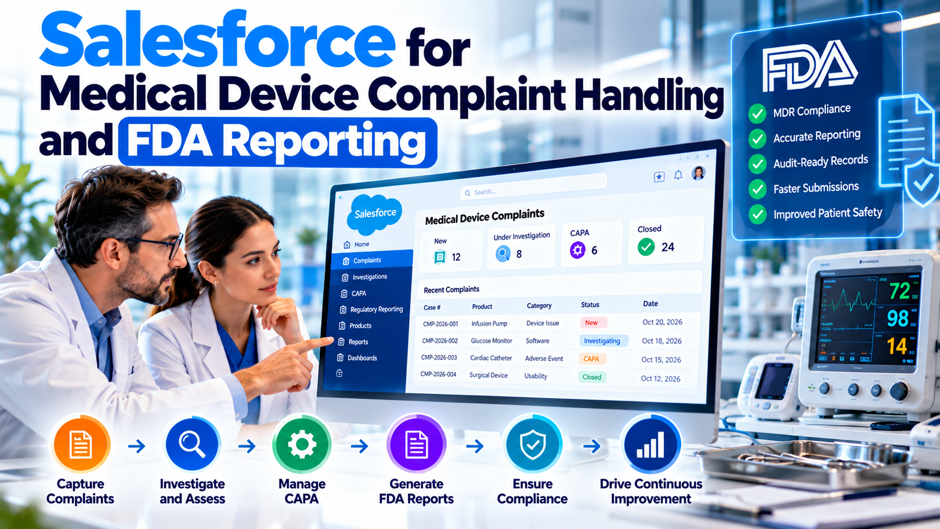
Picture the quality manager at a mid-size company that sells infusion pump accessories. Complaints reach her by phone, by email and in sales reps’ trip notes, and the service team logs most of them as Salesforce cases while quality tracks the “real” complaint file in a spreadsheet. At a trade show, a rep mentions that a clinician told him a patient was hurt when a connector failed, and he types it into a case that afternoon. She wants to know when the reporting clock started and whether the case is a complaint record. This scenario is invented for illustration and doesn’t describe a real company or person.
This post covers how Salesforce can support complaint intake and workflow for a device manufacturer, and where it can’t carry the regulatory weight by itself. It draws on FDA’s medical device reporting and eMDR pages, an undated FDA presentation for mandatory reporters, secondary summaries of the new quality rule from BSI, SGS and Pure Global, Salesforce’s Life Sciences Cloud page and vendor blogs from Gearset, Flosum and USDM. I couldn’t open the regulations themselves, and I found no Salesforce statement on complaint handling or device reporting. This isn’t legal or regulatory advice, so confirm everything with regulatory counsel and your quality leadership.
TL;DR
- The reporting clocks start when anyone at the firm becomes aware. FDA says manufacturers report deaths, serious injuries and certain malfunctions within 30 calendar days and 5-day events within 5 work days. An FDA presentation says awareness attaches when an employee becomes aware. Every intake point that can see a complaint matters, including a service agent’s case queue.
- Salesforce’s published life sciences material doesn’t claim this use. The Life Sciences Cloud page I read doesn’t mention complaint handling, FDA device reporting, GxP or Part 11. The platform can still serve as intake and case workflow if you validate it and connect it to your quality system and FDA’s electronic gateway.
- Retention and audit options need a plan. A secondary source puts field history at up to 24 months through the API, while a consultancy’s summary says records must be kept for at least the device’s lifetime and no less than 2 years from release. In my invented 8-year example, the gap is 72 months.
Who has to report and by when
Manufacturers. FDA’s page says manufacturers report when they learn a device may have caused or contributed to a death or serious injury, and when a malfunction would likely cause or contribute to either if it recurred. Deaths, serious injuries and malfunctions go “within 30 calendar days of becoming aware.” Events that need remedial action to prevent unreasonable risk of substantial harm, or that FDA requests, go “within 5 work days.” The page was published and modified Mar 27, 2025, which is 578 days ago, so check for updates.
Importers and user facilities. Importers report deaths and serious injuries to FDA and the manufacturer, and malfunctions to the manufacturer only, within 30 calendar days. User facilities, defined as hospitals, ambulatory surgical facilities, nursing homes and outpatient diagnostic or treatment facilities excluding physician offices, report within 10 work days. Their reports can reach a manufacturer’s complaint intake with the customer’s own clock already running, which is why intake timestamps matter.
When the clock starts. FDA’s page doesn’t define “becoming aware” and refers readers to 21 CFR 803.3, which I haven’t read. An undated FDA presentation for mandatory reporters says FDA considers firms aware whenever an employee becomes aware of a reportable event, and also when a supervisory employee becomes aware that the event requires remedial action. A rep’s note or a service agent’s case comment can therefore start the clock, and case timestamps become evidence in an inspection.
Electronic filing. FDA’s eMDR page, updated Apr 10, 2026, says manufacturers and importers must submit individual reports electronically unless FDA grants an exemption under 803.19. A separate FDA page says the electronic requirement took effect Aug 14, 2015. The eMDR page says the ESG NextGen Unified Submission Portal replaced the legacy WebTrader interface on Apr 14, 2025. User facilities may still file on paper. Plan on a connection to that gateway, because a Salesforce case isn’t a submission.
What a complaint system has to prove
FDA ties complaint files directly to reporting. Its page says a complaint is any written, electronic or oral communication that alleges deficiencies related to the identity of a device after release for distribution, with the full definition in 21 CFR 820.3. Complaints must be evaluated to decide whether they’re reportable, so manufacturers and importers must maintain complaint files and procedures for receiving, reviewing and evaluating them. Reportable complaint files should be kept in a separate portion of the complaint file or otherwise clearly identified.
Put simply, a system has to show 5 things on demand: every complaint was captured, each was evaluated for reportability with a documented decision, required investigations happened, reportable events linked to an event file, and all of it can be retrieved during an inspection. FDA’s presentation adds that manufacturers must investigate each reportable event to find its cause, keep MDR procedures and event files, and let FDA employees access, copy and verify the records. Test any proposed design against those 5 statements.
What the vendor publishes on this use
- The Life Sciences Cloud page. Salesforce’s page was published Mar 25, 2024 and modified Oct 13, 2026, according to its metadata. It describes an engagement platform for pharma, MedTech, consumer and animal health organizations. Its MedTech content covers sales planning with rebates, pricing and discounts, device stock visibility, and kit creation with lot and batch tracking. Those are commercial functions, and the page ties none of them to complaint files or quality records.
- What the page doesn’t mention. In the text I read, complaint handling, FDA device reporting, GxP and Part 11 don’t appear. The nearest language says users can validate records with e-signatures to comply with FDA standards through every stage of therapy, and that audit trails support traceability and compliance in the medical section. Both statements are general and sit in a therapy and medical-affairs context, so don’t read them as a claim about complaint files.
- Adverse event language. The page mentions adverse event management under patient services and says users can capture patient-reported outcomes and adverse events in a FHIR-aligned data model. A separate line about physicians capturing first-hand data on safety and tolerability refers to medicines. Those features read as drug-oriented in what I read, so ask Salesforce whether they apply to device complaints and which edition includes them. Ask which edition would include any of them.
- Disclaimers. Salesforce says unreleased services or features referenced on the page aren’t currently available and may not be delivered on time or at all, and that customers should make purchase decisions based on features that are currently available. The page gives no quantitative claims. Anything you plan to rely on, from audit trails to e-signatures, should be demonstrated in a sandbox and written into your contract. Put the capabilities you rely on in the contract.
What the quality rule changed
The quality system rule at 21 CFR Part 820 changed on Feb 2, 2026, 266 days ago, according to SGS and BSI. The table summarizes what those 2 sources and Pure Global say about complaints. All 3 are commercial: SGS and BSI sell certification and training, and Pure Global is a regulatory consultancy. I didn’t find or read FDA’s own text on the rule, so treat the table as a starting list of questions for your regulatory team rather than a statement of the requirements.
| Topic | What secondary sources say | Source |
| Effective date | Feb 2, 2026 | SGS, BSI |
| Structure | Part 820 incorporates ISO 13485:2016 and clause 3 of ISO 9000:2015 by reference | BSI, SGS |
| Complaint files | The old 820.198 isn’t carried over as a standalone section; its content maps in part to ISO 13485 clauses 8.2.2 and 8.2.3 plus 820.35(a) and 820.10(b)(3) | Pure Global |
| Complaint records | 820.35 still requires Part 803 information for complaint and servicing activities | BSI |
| Link to reporting | 820.10 points to Part 803 reporting, Part 806 corrections and removals, UDI and tracking | BSI, Pure Global |
| Inspections | The old inspection technique was replaced by Compliance Program Manual 7382.850, published Feb 2, 2026 | SGS |
| Certification | An ISO 13485 certificate doesn’t exempt a manufacturer from an FDA inspection | Pure Global (citing an FDA FAQ), BSI |
Several cautions follow. First, BSI’s figure lists 820.198 under the old rule and doesn’t describe it further, while Pure Global maps it in part, so the sources don’t fully agree on how complaint files moved. Second, the SGS article doesn’t mention 820.198 at all. For the system design, the safe reading is that the obligations to evaluate complaints, keep records and report under Part 803 remain, even though the section numbers changed.
Where the platform fits in the process
Intake. Salesforce cases are a natural place to log a complaint from any channel with a consistent record and a timestamp. I didn’t research current Service Cloud documentation, so I’m describing standard platform concepts such as cases, queues, assignment rules and tasks, and you should confirm specifics with Salesforce. The value at intake is speed and completeness: nobody should have to decide whether something is a complaint before it’s logged.
Triage. Rules can flag possible deaths, injuries or malfunctions by keyword or form answers and route those cases to quality within a defined time. Treat the rules as a safety net rather than the decision. A trained person decides whether the event is reportable, because keyword matching misses descriptions such as “the patient needed a second procedure.” Record who reviewed each case, when and what they decided, and test the rules with real past complaints.
Investigation workflow. Investigations need tasks, owners, due dates, links to the device and lot, and a record of cause and corrective action. A case can carry that structure, and reminders help meet internal targets. The question is whether the platform is your system of record for investigations or a front end to your quality system. Decide that early, document it in the validation plan, and avoid keeping the same investigation in 2 places.
Hand-off to the quality system and the agency. FDA’s electronic submission goes through a gateway, and the formal complaint file may live in a dedicated quality system. The platform can send complaint data to both, but each interface needs validation, reconciliation and an owner. I found no Salesforce statement that the platform builds or submits electronic reports. If your design assumes it does, get that capability demonstrated and documented in writing before you commit.
Intake channels to cover
- Customer service calls and email. Most complaints arrive here, and agents should log every contact that alleges a problem with a device, even when the customer isn’t sure it’s a defect. FDA’s page defines a complaint broadly, to include oral communications. Give agents a short script with the questions that matter: device, lot or UDI, what happened, patient impact and contact details, and make the answers required fields. Review a sample of calls monthly.
- Sales reps and field staff. The FDA presentation says awareness attaches when an employee becomes aware. A rep’s trip report, a text to a manager or a note in an opportunity can all reveal a reportable event. Train reps to open a complaint case within the same day, give them a simple mobile path, and tell them that logging a complaint isn’t an admission of fault. Check rep notes monthly for missed events.
- Distributors and importers. FDA’s page says initial distributors of foreign entities fall under the manufacturer definition, and importers carry their own reporting duties. Agree on how distributors send complaints to you, how quickly and in what format, and write it into the distribution agreement. A shared inbox without a service level can quietly burn days of a 30-day clock. Track each distributor’s average days from awareness to hand-off, and escalate any who exceed the agreed target.
- User facility reports. Hospitals and similar facilities report to the manufacturer within 10 work days, so a manufacturer may receive a report days into the facility’s own clock. Create a case type or source value for these reports, capture the facility’s report date and make sure the manufacturer’s awareness date is recorded separately, because the 2 dates answer different questions. Reconcile these reports with your complaint count each quarter to spot any that bypassed the system.
Validation and shared responsibility
A secondary consultancy source, USDM’s Jan 8, 2022 post, which is 1,752 days old and written by a firm that sells validation services, says the customer is responsible for obtaining proof of Salesforce’s change control, audit history and software development procedures, which may require an onsite audit. It also says Salesforce releases ships 3 times a year on a fixed schedule and aren’t voluntary, so each release should be handled as a planned change-control event with a GxP risk assessment. Check the current release cadence and audit options with Salesforce.
Flosum, which sells Salesforce DevOps and compliance tools, says customers building life sciences applications on the platform must ensure they comply with 21 CFR Part 11 and need full control over each developer org. That’s a vendor’s view, and its claims about its own product are marketing. Salesforce’s page I read doesn’t state Part 11 compliance. Ask Salesforce for its validation support package and audit options in writing, and plan a risk-based validation covering intended use, requirements, testing and release impact assessments.
Audit trail and retention options
Audit trail features decide whether you can show who changed a complaint record and when. The table draws on a Jan 29, 2026 article from Gearset, a Salesforce DevOps vendor, which is a secondary source. The last row is a benchmark from a consultancy’s summary of the ISO 13485 records clause, not a Salesforce feature. Confirm every number with Salesforce documentation, since limits and editions change. Treat the table as a map of questions to ask.
| Option | What it covers | Retention per the source | Gap for complaint files |
| Setup Audit Trail | Configuration and security changes, not record data | About 180 days unless exported; the Setup page shows the 20 most recent entries | Doesn’t show who edited a complaint |
| Field History Tracking | Changes to tracked field values; set per object and field | About 18 months in the UI, up to 24 months through the API; 20 fields per object | Shorter than a device’s life; some field types don’t record values |
| Field Audit Trail (Shield) | Extends field history retention through policies | “Significantly longer periods”; maximum not stated in the source | Confirm limits and cost with Salesforce |
| Event Monitoring | Activity such as report exports | No figures in the source | Confirm what it records and for how long |
| Records benchmark | ISO 13485 clause 4.2.5, per Pure Global | Device lifetime as the manufacturer defines it, and no less than 2 years from release | The yardstick for the rows above |
For an invented device with an 8-year life, 96 months of record retention would exceed Field History Tracking’s 24-month API maximum by 72 months. Setup Audit Trail’s 180 days is shorter still, and it isn’t designed for record data anyway. That doesn’t make the platform unusable. It means you need a retention design: a licensed longer-retention feature, scheduled exports to a validated archive, or a system of record elsewhere. Settle it in the validation plan.
Designing the case record
- Identity fields. Pure Global’s summary of the rule lists device name, date received, UDI, complainant contact information and the nature of the complaint among the details records must include, and says the UDI must be recorded for each device or batch. Make these required, use pick-lists for device and lot to avoid typos, and capture the complainant’s role, such as patient, clinician, distributor or rep, since it affects the reporting path.
- Dates that tell the story. Capture the date received, the date any employee became aware, the date quality became aware and the date of each decision. Keep system-generated timestamps separate from fields people can edit. An inspector asking when you knew will want a trail that doesn’t depend on someone’s memory, and the platform’s created and modified stamps are useful evidence only if edits to them are controlled. Lock the system stamps against edits.
- The reportability decision. Record the decision, the rationale, the person who made it, the date and the version of the procedure applied. If the answer is “not reportable,” the reason matters as much as the answer. FDA wants reportable complaint files identifiable, so add a field or record type that marks them and links to the event file or submission number. Make the rationale field required, and block closure of any case that lacks a rationale.
- Investigation and reply. Pure Global’s summary says records must show corrective actions and any reply to the complainant, and that if you don’t investigate because a similar investigation exists, you document the reason. Build fields for cause, actions, reply date and the reason for no investigation. Link related complaints so the “similar investigation” reasoning can be checked later by someone who wasn’t there. Require a reviewer sign-off before the case can close.
Reportability decisions and drafting tools
Who decides? A qualified, trained person decides whether an event is reportable, under a written procedure. The platform records the decision and routes the work. Make the decision a required step with an electronic signature if your validation plan calls for it, and block case closure until the decision is recorded. I found no FDA statement about automating reportability decisions, so don’t build rules that decide without a person. Keep training records current.
Summaries and drafts. Prompt-based summaries can speed up the narrative that goes into an FDA report, but they add risk. Salesforce’s Trust Layer documentation recommends that a person check each model response before it reaches end users in most use cases, and says the layer masks sensitive data such as Social Security numbers. I found no FDA guidance on generative AI in complaint handling. Treat drafts as drafts, and keep the original complaint text as the authoritative record.
Documenting the rationale. If a summary tool is used, log the prompt, the output, the model version and the reviewer’s edits, so an inspector can see what the tool contributed and what the person decided. That’s an inference from general good practice, not an FDA requirement I found. It also lets your quality team measure how often reviewers change the drafts and where the tool fails. Retain these logs for the same period as the complaint.
Catching errors. The worst failure is a summary that omits an injury or softens a description, which could delay or defeat a report. Test any summarization with real, de-identified past complaints, including ones with ambiguous wording, and compare the output with the original line by line. Set an acceptance criterion in advance, such as no omitted injury in a test set of 100, and revalidate when the model or prompt changes.
A deadline and workload model with invented inputs
The model below uses invented volumes of 100 complaints a month, with 30% needing investigation and 6% reportable. The minutes per step are assumptions, not benchmarks. It’s meant to show how the 30-day and 5-work-day clocks consume time, and to give you a template for your own numbers. Replace each input with data from your complaint history before you present any of it to management or to an auditor. Treat the results as illustrations only.
| Step | Complaints a month | Minutes each | Hours a month |
| Intake and logging | 100 | 20 | 33.3 |
| Reportability review | 100 | 15 | 25.0 |
| Investigation (30% of complaints) | 30 | 180 | 90.0 |
| Report drafting (6% reportable) | 6 | 240 | 24.0 |
| Total | 172.3 |
Total effort is 172.3 hours a month, about 1.08 full-time staff at 160 hours, or 2,068 hours a year, for 1,200 complaints and 72 reportable events. Now the clock. For an invented complaint that quality becomes aware of on Monday, Dec 7, 2026, the 5-work-day deadline falls on Monday, Dec 14, the 30-calendar-day deadline on Wednesday, Jan 6, 2027, and a user facility’s 10-work-day deadline on Monday, Dec 21. Triage by Wednesday, Dec 9 leaves 28 calendar days. I haven’t verified how weekends and federal holidays count, so confirm with counsel.
Submitting reports and connecting systems
FDA’s eMDR page, updated Apr 10, 2026, describes the submission route: the ESG NextGen Unified Submission Portal, which replaced the legacy WebTrader interface on Apr 14, 2025, and a link to the HL7 Individual Case Safety Report format. I didn’t read the enrollment steps or the format specification, and the page doesn’t say what acknowledgments FDA returns. Ask your regulatory team who holds the gateway account, who can submit, what a rejected submission looks like and how you’ll track follow-up and supplemental reports, which I didn’t research.
I found no Salesforce statement that its products create or send these reports. The usual designs are a dedicated regulatory or quality application that takes data from the case and handles submission, or a custom integration that builds the file and sends it. Either needs validation, reconciliation between the case, the event file and the acknowledgment, and a monitored failure path. Test a rejected submission end to end before launch, and keep the acknowledgment with the case.
Where projects go wrong
- Treating the case as the complaint file without validating it. A service case that was never validated for regulated use may not hold up as a record in an inspection. Decide which system is the record of the complaint, validate that system for its intended use and document the rest as inputs. If the case is the record, the audit trail, access controls and retention belong in scope. Write the decision into the validation plan.
- Starting the clock at case creation. The FDA presentation ties awareness to employees, not to the day someone logs a case. A rep who heard about an injury on Tuesday and logged it on Friday started the clock on Tuesday. Capture the date of awareness explicitly, train staff to log events the same day and audit the gap between awareness and logging monthly. Report that gap to quality leadership at each quarterly review.
- Letting field history stand in for retention. Field History Tracking keeps up to 24 months through the API, according to a secondary source, and device records may need to last far longer. Teams often discover this during an audit. Put the retention design in the plan, test a restore from the archive and record who owns the export schedule. Also decide how exports are protected, since an archive of patient-related complaints needs access controls of its own.
- Skipping release impact assessments. Salesforce ships 3 releases a year, per USDM’s 2022 post, and each can change behavior your validation relied on. Assign someone to read release notes, assess risk, test the affected functions and file the evidence. A validated state that’s silently overtaken by a release is the kind of gap inspectors find. Keep the assessments with the validation file, and sample them during internal audits to confirm they were actually done.
Running a pilot
Scope. Start with a single product line, a single intake channel and a small group of trained users. An invented pilot could begin on Monday, Jan 11, 2027, and run 13 weeks to Monday, Apr 12, 2027, with the old process running in parallel. Parallel running costs effort, but it lets you compare the new records with the old ones and find gaps before anything depends on the new system.
Test the clock. Create test complaints with known awareness dates and walk them through triage, decision and a mock submission. Measure elapsed time at each step against the 30-day and 5-work-day targets, and confirm the system shows the deadline to the people who need it. Include a complaint that arrives through a distributor and another that originates from a user facility report. Record each result in a test log with the tester’s name and date.
Test the record. Pull a sample of pilot cases and check each against the field list: device, UDI, dates, decision, rationale, investigation, reply. Ask someone who didn’t build the system to reconstruct a complaint’s history from the record alone. If they can’t, the record isn’t ready. Also test closing a case without a decision, which the system should block. Record the reviewer’s findings, fix gaps and rerun the sample until it passes.
Test the audit trail. Edit a tracked field, then confirm that you can show who changed it, when and from what value. Try the same on a field that isn’t tracked, and on a long text field, which a secondary source says records that an edit occurred but not the values. Export the history, store it in your archive and retrieve it 6 months later to prove the process works.
Making the call
Start with the system-of-record decision. If Salesforce will hold the complaint file, you’re taking on validation of the case objects, the audit trail, the retention design, the electronic signatures if used, and the interface to the agency. If it’ll only capture and route complaints, the burden shifts to the quality system, but you still need to validate the hand-off and show that awareness dates and timestamps survive it. Neither choice is wrong. Each has a different cost.
The evidence I found supports a cautious position. FDA’s reporting clocks are short and the awareness trigger is broad. Salesforce’s life sciences page doesn’t claim this use. Validation, audit trail and retention depend on how you configure and control the platform, and the agency’s gateway sits outside it. Bring regulatory affairs, quality and IT into the decision together, pilot with parallel running, and get Salesforce’s answers about validation support, audit trail limits and device-complaint features in writing.
FAQs
What’s the deadline for reporting a device malfunction to FDA?
FDA’s page says manufacturers report deaths, serious injuries and malfunctions that would likely cause or contribute to death or serious injury if they recurred within 30 calendar days of becoming aware. Events needing remedial action to prevent unreasonable risk of substantial harm, or that FDA requests in writing, go within 5 work days. The page was last modified Mar 27, 2025, so confirm the current rules with your regulatory team.
When does the reporting clock start?
FDA’s page doesn’t define “becoming aware” and points to 21 CFR 803.3, which I haven’t read. An undated FDA presentation says FDA considers a firm aware whenever an employee becomes aware of a reportable event, and also when a supervisory employee becomes aware that the event requires remedial action. So a rep’s note or a service agent’s case can start it. Confirm the definition with regulatory counsel. Document your internal definition in procedures.
Can Salesforce replace our quality system?
I can’t say from public information. The Life Sciences Cloud page I read doesn’t mention complaint handling, GxP or Part 11, and the quality rule expects documented processes aligned with ISO 13485, per secondary summaries. Salesforce can support intake, routing and workflow, and some firms may build more on it. Whatever you choose, you validate it for its intended use and prove retention and audit trail controls. Ask Salesforce for a written statement.
Does Salesforce comply with 21 CFR Part 11?
I found no Salesforce statement of Part 11 compliance on the pages I read. Its Life Sciences Cloud page speaks of validating records with e-signatures to comply with FDA standards in a therapy context, which isn’t the same thing. Consultancy and vendor sources say the customer carries responsibility for validation and for controlling the configuration. Ask Salesforce for its validation support documentation and audit options, and document your own validation.
Does Salesforce submit reports to the FDA?
I found no Salesforce statement that it does. FDA says manufacturers and importers must submit reports electronically through its gateway, which since Apr 14, 2025 is the ESG NextGen Unified Submission Portal, unless exempt under 803.19. Plan a dedicated regulatory application or a validated integration that builds and sends the report, and keep acknowledgments with the complaint record. Ask Salesforce to demonstrate any capability it claims. Budget for the interface as well as the licenses.
What fields should a complaint record include?
Pure Global’s summary of the new rule lists device name, date received, UDI, complainant contact information and the nature of the complaint, plus corrective actions, any reply to the complainant and the reason if no investigation occurred. I’d add the date of awareness, the reportability decision with rationale and a link to any event file. Check the list against the rule text and your procedures before you configure fields. Add fields as your procedures require.
How long must we keep complaint records?
Pure Global’s summary says ISO 13485 clause 4.2.5 requires keeping records for at least the lifetime of the device, as the manufacturer defines it, and no less than 2 years from release. It gives no separate period for complaint files. FDA’s presentation says mandatory reporters must keep event files and let FDA access them. Have counsel set retention periods, then check that your platform’s audit options last that long. Record the rationale for the period you choose.
What changed with the new quality management system regulation?
According to SGS and BSI, Part 820 took effect as the Quality Management System Regulation on Feb 2, 2026, incorporating ISO 13485:2016 by reference. Pure Global says the old complaint files section isn’t carried over as a standalone section, with complaint handling mapped to ISO 13485 clauses and to 820.35. Part 803 reporting remains. I didn’t read the FDA’s own text, so confirm the details with regulatory counsel. That change is recent, so expect guidance to keep evolving.