

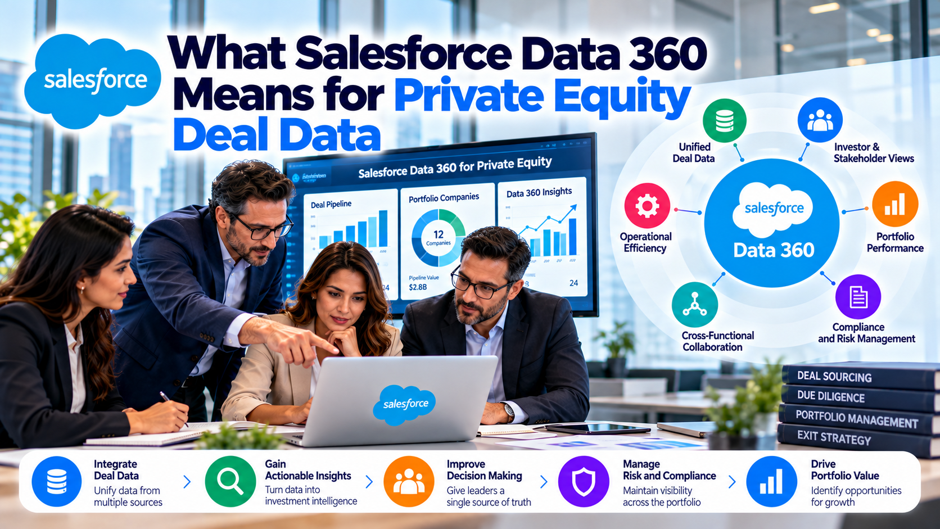
Here’s an invented scenario to frame the topic. A fictional mid-market private equity firm, unconnected to any real company, has 40 investment professionals, 12 portfolio companies and about 1,800 target companies in its pipeline. Deal notes sit in a CRM, diligence files sit in virtual data rooms, portfolio metrics arrive as spreadsheets, and investor records live in a separate system. A partner has watched a demo of Salesforce Data 360 and asked a fair question: would it give the firm a single trustworthy view of a company, a deal and a relationship, and what would it put at risk? This post lays out what Salesforce documents, what independent sources say, and what a careful pilot should test.
Scope and caveats come first. I read 8 pages. Salesforce supplied 5 of them: its Data 360 product page, an architecture decision guide on interoperability, its page on query-in-place federation, a Trailhead page on credit consumption and an investment banking solution page. A Trailhead page loaded only in a Portuguese-language variant, and I relied on a translated summary. The other 3 were a 2022 S&P Global survey report, a vendor’s 2025 benchmark report and an SEC fact sheet. Vendor pages are marketing. I found no Salesforce page that links Data 360 to private equity, and no independent evaluation of that use, so confirm every claim with Salesforce and with counsel.
TL;DR
- Salesforce documents the platform, not the use case. Its Data 360 pages describe connectors, identity resolution, federation and consumption pricing for customer data, and the investment banking page I read doesn’t mention private equity or Data 360 at all. Any private equity design is an adaptation, so treat each capability as a hypothesis to test. Test deletion end to end before relying on any cache.
- Design choices carry the risk. Salesforce’s architecture guide says federated queries rely on source-level policies, and that incremental cache refresh handles upserts only, so deleted records aren’t removed from the cache. For deal data that’s confidential, those details matter more than the headline features.
- Costs are partly published, partly not. The credit documentation gives a formula and a single set of tiers, 40 down to 8 credits per million rows. I found no credit price and no edition list, so a written quote is the only way to size the cost.
Where deal data lives today
Pipeline and relationships. Most firms track targets, owners, advisers and contacts in a CRM or spreadsheet. A 2022 survey by Mergermarket for S&P Global Market Intelligence, covering 30 senior executives at US private equity firms with at least $2 billion in assets, describes CRMs as table stakes. Firms considering a broader Salesforce operating model can also assess Salesforce consulting for private equity against the sourcing, relationship and portfolio workflows they actually use. The same report cites data fragmentation and sprawl as a challenge. The survey is small and old, so it shows direction rather than the current state, though the pattern matches the invented firm above.
Diligence documents. Deal teams collect financial models, contracts, quality of earnings reports and management presentations, usually in data rooms controlled by sellers or advisers. These are files, not tidy records, and they carry confidentiality terms. None of the Salesforce pages I read describes ingesting or governing diligence documents. Treat this domain as outside the documented scope until Salesforce shows otherwise, and decide whether links to documents are enough for your needs.
Portfolio monitoring. Portfolio companies send monthly or quarterly metrics in formats that rarely match. A firm that wants trend lines across 12 companies needs a common definition of revenue, margin and headcount before any platform can help. Federation can read a warehouse where that standardized data sits, but it can’t create the definitions. The work of agreeing on them belongs to finance and operating partners, and it takes longer than connecting systems.
Fund and investor records. Investor contacts, commitments and communications form a fourth domain with its own privacy duties. Some investors are individuals, and the SEC’s amended Regulation S-P applies to covered institutions that hold customer information. Counsel should decide which of your investor records fall under it. A platform that merges these records with deal contacts, for example, raises access questions that need answers before the first load. Settle that question before any load begins.
How the vendor describes the platform
Salesforce’s official Data 360 product page describes a platform that unifies data from many sources and supports zero-copy integration, structured and unstructured data, identity resolution and a unified data model. The page describes consumption-based pricing and a customer-data-centered model. For a private equity firm, those capabilities have to be adapted to companies, deals, funds and relationship records rather than accepted as a direct fit.
Salesforce also says its Data 360 connectivity layer supports 200+ connectors across Salesforce, MuleSoft and third-party applications. The framing is still primarily around customer information and activation. A private equity firm’s central objects are companies, deals, funds and the people connected to them, and nothing on those pages proves that model works well for a deal team. That doesn’t rule it out, since the platform has a flexible data model, but it means the fit must be proven. Ask which of these claims apply to the edition you’d buy.
Where the fit is plausible
The list below summarizes capabilities that could help a firm like the invented example, based on Salesforce’s own pages. Each is a vendor claim, and none is tied to private equity, so the list describes possibilities rather than demonstrated results. Use it to decide which capabilities to test first in a pilot, and which to leave out of the first release. Decide which of these matter most to your firm before the first demo is scheduled.
- Connecting scattered systems. Salesforce cites 200+ connectors and says ingestion from a Salesforce org through certain connectors doesn’t consume credits. A broader Data 360 implementation can therefore be assessed around the few sources that matter most instead of trying to connect every system immediately. For data rooms, accounting tools and portfolio spreadsheets, ask which connectors exist and who builds the rest. A connector count says little about whether yours is included. Also confirm who maintains each connector after launch and what happens when a source system changes its format.
- Matching records across sources. Identity resolution is described for customer profiles across devices and channels. A firm needs the same idea for companies and contacts: the same business appears under several names across 5 or 6 sources. That makes Salesforce data governance relevant because someone has to define ownership, duplicate rules and correction processes around the matched records. Ask Salesforce to demonstrate matching on organizations with messy names, and to show how a reviewer corrects a wrong merge. Ask how reviewers see the evidence behind each proposed merge, and whether every decision is logged for later audit.
- Reading data where it sits. Federation lets Data 360 query a warehouse or lake without copying the data in. Salesforce’s Zero Copy Data Federation documentation describes live query, file federation and caching patterns where external data can remain at its source. For firms that already keep portfolio data in Snowflake or Databricks, that avoids a second full copy. Test what that means for your retention rules and for audit logs. Also ask which warehouse permissions travel with the query, and which ones Salesforce would have to recreate itself.
Where the fit is weak or unproven
Customer profile versus company graph. The platform’s core story is a profile of a customer. Deal data is a graph of companies, owners, advisers, lenders and people, with time-bound roles. Salesforce’s pages say nothing about modeling parent and subsidiary relationships or changing ownership, and I found no private equity example. Ask for a reference customer that models organizations and relationships, and ask what the data model looks like in practice.
Sector content. The investment banking page mentions compliant deal management, conflict check alerts and document-level access for material nonpublic information, but it doesn’t mention private equity. VALiNTRY360’s Data360 for Financial Services & Banking page is closer to the regulatory and financial-data context, but it still describes banking rather than private equity deal workflows. Ask whether the described capabilities exist for your edition and what they cost.
Documents. Much of the value in diligence sits in files and long reports. The Salesforce pages I read describe structured and unstructured data processing in the credit documentation, but they don’t describe a diligence workflow. VALiNTRY360’s discussion of Semantic AI in Data360 for unstructured data is relevant to document-heavy use cases, but it doesn’t prove a private equity diligence workflow. Ask how a deal team would search contracts, link a finding to a deal record, and restrict a file to named members. If the answer is a link to another tool, plan for that tool’s security too.
Evidence of results. The Data 360 page gives no performance statistics, and the federation material includes large processing figures without enough methodology to use as a benchmark for a private equity firm. Those are vendor assertions. I found no independent benchmark of matching quality, query speed or cost for a firm of any size. Treat the lack of evidence as a reason to run your own test, with scoring done by your people. Ask for the methodology behind any performance figure you’re shown.
Ways to connect deal data
The table below lines up the integration patterns described in Salesforce’s Data 360 interoperability guide with what each could mean for deal data. The guide covers ingestion, live query, caching, file federation and hybrid designs, with trade-offs around freshness, governance, cost and complexity. Use the table to decide, for each data source, whether to copy data in, query it in place or cache it, and write the choice into the design with a reason. Revisit the choices after the pilot.
| Pattern | What the guide says | What it could mean for deal data | Question to ask |
| Ingestion | Data is copied into Data 360 and governed there; recommended for regulated or auditable datasets | Suits investor and contact records where control matters | Who can see the copy, and how is deletion handled? |
| Live query | Queries run against the external source for maximum freshness; costs can spike at high query volume | Suits an occasional look at warehouse data | What does a busy week of queries cost? |
| Caching | Refreshed every 15 minutes to 7 days; upserts only, so deleted records stay in the cache | Risky for withdrawn or restricted deal data | How are deletions pushed through? |
| File federation | Read-only access to files in object storage | Suits large historical data sets | Is it generally available for our source? |
| Hybrid | Ingest governed core data, federate volatile data; the guide favors this for many implementations | A likely design for a mixed estate | Which data goes where, and why? |
Confidentiality and access control
Deal data is confidential by nature, and some of it may be material nonpublic information. Salesforce’s investment banking page says deal owners and admins can control access down to the individual document level so that such information reaches only the people who need to know. It doesn’t name information barriers or wall-crossing, and it describes a banking product. For a private equity firm, ask how the same controls apply to Data 360, and whether a federated query respects them when it reads another system.
Salesforce’s architecture guide is direct about federation: use it with respect to source-level policies such as row-level security and data masking, which means the source system enforces the rules. That’s sensible, but it makes the source of truth for permissions the warehouse rather than Salesforce. The guide also says deleted records aren’t removed from a cache that refreshes incrementally. If a deal is withdrawn, a person asks for deletion or a seller demands that its data be purged, a cached copy could persist. Test deletion end to end, and log the result. Ask Salesforce to put its answer on deletion in the contract schedule, in addition to a sales email.
What the regulation sources say
The SEC’s Regulation S-P amendments fact sheet is the regulatory source I read, and it reports what the rule requires, not how it applies to your firm. The list below summarizes it and what each point implies for a platform that holds personal information. It’s a summary of a fact sheet, not legal advice, so have counsel decide which of your records and systems fall under it and when you must comply.
- Incident response program. The Commission adopted the amendments on May 15, 2024, and they require covered institutions to adopt written policies and procedures for a program reasonably designed to detect, respond to and recover from unauthorized access, including steps to assess and contain incidents. If Data 360 holds covered information, include it in the program and test how you’d detect misuse of a federated connection. Ask counsel which parts of your current program already cover a new platform.
- Customer notification. Affected individuals must be notified as soon as practicable, but no later than 30 days after the institution becomes aware of unauthorized access or use, unless it determines the information isn’t reasonably likely to be used in a way that causes substantial harm or inconvenience. Ask Salesforce what logging and alerting you’d receive from the platform to support that timeline. Also decide who at your firm owns the clock once a suspected incident is reported by a vendor.
- Service provider oversight. The program must include written policies and procedures for overseeing service providers, including due diligence and monitoring. A platform vendor and an implementation partner would both qualify as providers in many designs. Ask Salesforce for security documentation, and record how your firm reviewed it and how often you’ll review it again. Keep the review file current, since a regulator or an investor may ask to see it years after the platform goes live.
- Covered entities and dates. The SEC material says covered institutions include broker-dealers, investment companies, registered investment advisers and transfer agents. The current SEC compliance guide gives December 3, 2025 for larger entities and June 3, 2026 for smaller entities. Counsel should still confirm whether your firm is covered and which category applies to it.
An invented record-matching model
Everything in this section is invented, and I recomputed it in code. Assume the fictional firm’s 6 systems hold 9,000 raw company records for 1,800 distinct companies, an average of 5 records each. A reviewer needs 6 minutes to resolve a record that matching can’t settle automatically. The table shows how the automatic match rate changes the manual workload. Nothing I read reports a match rate for Salesforce on organization names, so the rates are scenarios to test, not forecasts.
| Automatic match rate | Records left for manual review | Review hours at 6 minutes each | Cost at an invented $120 an hour |
| 80% | 1,800 | 180 | $21,600 |
| 85% | 1,350 | 135 | $16,200 |
| 92% | 720 | 72 | $8,640 |
| 97% | 270 | 27 | $3,240 |
The point is that matching quality changes the labor, but a single cleanup run is small money. The larger cost is the continuing review as new records arrive and as portfolio companies, advisers and contacts change names. A firm should also ask what a wrong merge costs, since combining 2 companies in a deal record is worse than leaving the records separate. Set an acceptance rule before the pilot, such as no automatic merge without a documented match score above a threshold you choose.
Credits, costs and what isn’t published
How credits work. Salesforce’s credit documentation says each service generates a usage event with a usage type, and a feature can draw on more than 1 usage type. It gives the formula credits equal to data processed divided by the unit, multiplied by a multiplier, with the unit set at 1 million rows. Ingestion from a Salesforce org through certain connectors doesn’t consume credits. Streaming, batch transforms, unification, queries, segmentation and activation each map to a usage type.
The published tiers. For batch data prep, the page lists 40 credits per million rows up to 300,000 credits in a month, then 32, 16 and 8 in later tiers, resetting monthly. Its worked example shows 20 million rows at 40, which is 800 credits, and 640 credits when the run crosses into the 32 tier. Applying the formula to an invented 9 million rows a month gives 360 credits, and 90 million rows gives 3,600. Those row counts are small compared with consumer marketing workloads, so credits may matter less here than licenses and integration.
Federation costs. The architecture guide says live query costs can spike at high query volume and gives an example of roughly 600 credits a month for acceleration against roughly 4,200 for live query on a daily dashboard viewed 20 times a day. A real-time data access design therefore needs expected query volume, latency and refresh frequency defined before anyone estimates cost. That’s a 7-fold gap, or 43,200 credits over a year. Ask Salesforce for the rate card, and model your expected query patterns. Capture your own query counts during the pilot, since these examples come from a vendor document.
What I couldn’t find. I found no private equity pricing tied to this use case, and Data 360 pricing can involve consumption, storage and additional features. Get a written quote that spells out credits, storage, add-ons, connectors, and the services needed to model deal data. Ask for it early.
What the independent evidence says
The independent evidence is thin. The 2022 S&P Global report, based on a Mergermarket survey of 30 senior executives at US private equity firms with at least $2 billion in assets, found that 90% agreed their firms had a long-term data strategy and that competition for assets was driving a reassessment of data and technology. It also found 83% use some form of data management utility, 60% use machine learning and 57% use AI in investment processes. The sample is small, the data is from 2022, and the report doesn’t mention Salesforce.
Affinity, a vendor of CRM software for private equity, published a benchmark drawing on more than 200 firms in 24 countries. It reports a 6% year-over-year fall in median deals per firm per quarter in Q2 2025, and it shows contact and email activity rising. It gives no CRM adoption rates, and the median values appear only in image charts. The report promotes the vendor’s own product. Neither source tests a customer data platform for deal data, and I found no study that does, so every claim about benefit rests on logic and anecdote. Both are useful for context, and neither should carry a purchase decision on its own.
An invented cost and benefit view
This view is invented too. Assume 40 investment professionals each spend 3 hours a week, 48 weeks a year, finding and reconciling deal data across systems. That’s 5,760 hours, or $691,200 at an invented $120 an hour. If a platform recovered 10%, 20% or 30% of that time, the value would be $69,120, $138,240 or $207,360 a year. The table shows what annual spend those savings could justify. No source I read shows that any platform recovers that time, so the recovery share is the assumption to test first. Revisit the break-even figures after the pilot with measured hours.
| Share of time recovered | Hours a year | Invented value at $120 an hour | Break-even annual spend |
| 10% | 576 | $69,120 | $69,120 |
| 20% | 1,152 | $138,240 | $138,240 |
| 30% | 1,728 | $207,360 | $207,360 |
Compare those ceilings with a written quote. If licensing, credits, integration work and internal stewardship together exceed the ceiling at a recovery share you believe, the case rests on benefits that aren’t in the table, such as faster responses to a competitive process or better diligence. Name those benefits and the people who own them, and decide how you’ll measure them. Otherwise, a smaller design, such as a clean CRM with a reporting layer, may serve the firm better.
Failure modes to test in a pilot
A deal data platform fails in ordinary ways, and most can be tested before it touches a live process. The sources I read report no failure rates, so this list is my own, informed by the documented behavior. Run each test with a sample of real but non-sensitive data first, have deal team members score results independently, and record the findings with dates so the go or no-go decision rests on evidence.
- Wrong merges. A pair of companies with similar names or a company and its subsidiary are combined into 1 record. Measure false merges separately from missed matches, because a false merge can mislead a partner while a missed match only wastes time. Set a threshold for each in advance, and require a reviewer for any merge below the score you choose. Log every correction, since the pattern of fixes shows where the matching rules need work.
- Stale or restricted data. A cached copy keeps a record after the source deleted it, or a federated query shows data to someone who shouldn’t see it. Test deletion, permission changes and user departures end to end. Salesforce’s own guide says deleted records aren’t removed from an incrementally refreshed cache, so treat that as a known issue. Repeat the test after every change to a connector or a permission set, rather than once at launch.
Who should own the data model
A platform that merges data from several teams needs an owner who can say no. In a firm, that role often falls between operations, finance and technology, and nobody takes it. Name a person to own the entity model, meaning how a company, a deal, a fund and a contact are defined and related. Give that person authority over new fields and sources, and require a short review for each addition. Without it, the platform becomes another place where the same fact is stored differently. Write the role into a short charter that names decisions the owner can make alone and those that need a partner’s approval.
Salesforce’s Data 360 pages describe harmonization as mapping data to a shared model so that downstream dashboards and segments aren’t broken by changes to physical tables. A formal Salesforce data strategy and architecture process can help document those entity definitions, source-system boundaries and ownership decisions before more data is connected. That’s a useful design idea, and it only works if someone maintains the model. Plan for ongoing stewardship time, including a monthly review of match exceptions and a quarterly review of access. Budget for it in the cost model, and be wary of any proposal that treats the model as a single-effort project.
A pilot plan for a private equity firm
Weeks 1 to 4: scope and approvals. This timeline is my suggestion, not a sourced benchmark. Pick 1 use case, such as unifying company and contact records for the sourcing team, and 1 or 2 source systems. If those sources require custom connections, include Salesforce integration services in the scope discussion rather than assuming every connection is already packaged. Write the questions below into a vendor request, and get written answers. Have counsel review the data flows and the access design. Capture baseline numbers for reconciliation hours, duplicate rate and the time to answer a standard question about a target.
Weeks 5 to 8: configure and validate. Load a sample of non-sensitive records, run matching, and have reviewers score a blind sample against a list your team trusts. Use the same validation discipline expected in a Salesforce data migration project when checking mappings, duplicates and source-to-target accuracy. Record false merges, missed matches and review time. Test deletion, permission changes and a federated query against a warehouse. Stop here if results fall below the thresholds you set in advance. Ask Salesforce to give the credit usage for the test so you can extrapolate cost.
Weeks 9 to 20: live pilot. Turn on the use case for a small group, and keep a comparison group on the usual process. Track hours, duplicate rate, credits, access incidents and user feedback every 2 weeks. Review access logs monthly with compliance. Keep a running list of defects with owners and dates, and ask the deal team whether the platform changed how they prepare for meetings. Share a short summary each month.
After the pilot: decide. Compare results with the baseline, then price the full rollout using the pilot’s actual credits, review time and effort, not the vendor’s estimate. If gains exceed the break-even in your model, expand 1 use case at a time. If they don’t, keep the pieces that helped, such as record matching, and drop the rest. Record the decision and its reasons so the next team doesn’t repeat the work.
Questions to ask Salesforce and your integrator
The questions below turn the gaps in this post into requests you can send before a demo. Ask for written answers, attach them to the quote and keep them in the project file. If a rep can’t answer, record that, since it’s information about the product’s maturity and about how much of the work your team will carry. Send the list to Salesforce and your integrator at the same time, and compare their answers side by side.
| Topic | Question | A satisfactory answer includes |
| Fit | Which customers model companies, deals and relationships? | A reference call and a live data model |
| Matching | What accuracy on organization names, and how are merges corrected? | A test on our sample and a correction workflow |
| Access | How do document-level controls apply to Data 360? | A demonstration with restricted records |
| Federation | Which sources respect source-level policies, and how? | A written list and a test |
| Deletion | How are deletions pushed through caches? | An end-to-end demonstration |
| Pricing | What are the credit price, editions and add-ons? | A written quote with volumes |
| Connectors | Which systems have connectors, and who builds the rest? | A named list with effort estimates |
| Regulation | What logs and documents support our incident and vendor reviews? | A security package and sample logs |
FAQs
What does Salesforce Data 360 do?
Salesforce describes Data 360 as a platform that unifies data from many sources into a living profile for each customer, with 200+ connectors, federation to Snowflake, Databricks, Google BigQuery and AWS storage, identity resolution and consumption-based pricing. Its pages are marketing material about customer data. None of the pages I read describes private equity deal data, so test the model with your own records. Treat the demo as a starting point for diligence.
Has Salesforce shown Data 360 working for private equity?
I found no Salesforce page that links Data 360 to private equity. The investment banking page I read mentions deal pipeline, relationship intelligence, conflict check alerts and document-level access, and it doesn’t mention private equity or Data 360. Ask Salesforce for a reference customer that models companies, deals and funds, and score the platform on your own sample before you commit money. Treat the absence of a reference as a finding in itself, and record it in your notes.
Should we copy deal data in or query it in place?
Salesforce’s architecture guide says ingestion suits regulated or auditable data sets, live query suits fresh and occasional queries, caching suits frequent queries on slowly changing data, and a hybrid is the best path for most implementations. Its cache refresh handles upserts only, so deleted records stay. For confidential deal data, decide source by source and test deletion before you rely on a cache. Write the reason for each choice into the design.
How are credits calculated?
Salesforce’s credit page gives the formula credits equal to rows processed divided by 1 million, multiplied by a multiplier. For batch data prep, the multiplier is 40 up to 300,000 credits a month, then 32, 16 and 8. Twenty million rows at 40 gives 800 credits. Ask Salesforce for the current rate card and a written estimate before relying on any calculated cost.
Does Regulation S-P apply to our firm?
I can’t say. SEC materials identify broker-dealers, investment companies, registered investment advisers and transfer agents among covered institutions and require incident response, customer notification and service provider oversight. Ask counsel whether your firm and your investor records are covered, and what dates apply. Record the answer and the date so the decision can be reviewed later.
How much does it cost?
Data 360 pricing depends on the commercial model, usage and additional services. I found no private equity-specific price. In my invented model, a 10% to 30% recovery of reconciliation time is worth $69,120 to $207,360 a year, which sets a ceiling on what the program could cost. Get a written quote and compare it with that ceiling. Ask for the quote in writing with every assumption listed.
What does independent research say?
Very little. A 2022 survey of 30 senior executives at US private equity firms, for S&P Global, found broad interest in data strategy and data management tools, and a vendor’s benchmark covers 200+ firms’ deal and contact activity. Neither tests a customer data platform for deal data, and the sample sizes and vendor interests limit what they show. Run your own pilot with a baseline. Treat both as context, not as proof for your own firm.
What should a pilot measure?
Measure reconciliation hours, duplicate rate, match accuracy on organization names, false merges, time to answer a standard question about a target, credits consumed, access incidents and user feedback. Include a comparison group, set thresholds in advance, and have compliance review access and deletion. End on a fixed date with a decision to scale, adjust or stop, based on your numbers rather than the demo. Share the results with the whole deal team and compliance.