

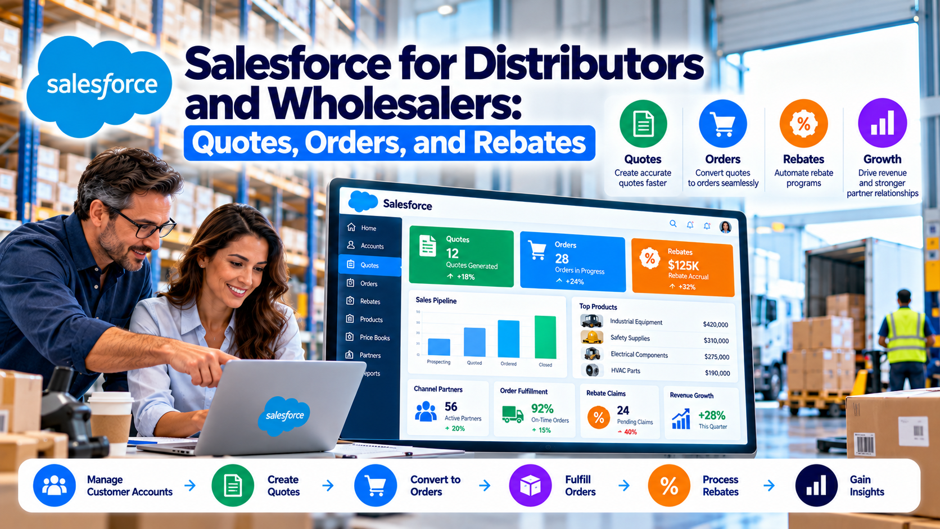
Here’s an invented scenario to frame the topic. A fictional regional distributor of electrical and fastener products, unconnected to any real company, books $250 million a year through 400 contract customers. Its reps override system prices on many quotes, its order desk can’t see which rebate tier a customer has reached, and finance rebuilds every monthly rebate payout from spreadsheets. The new sales operations lead has seen a demo of a platform that promises a single flow from quote to order to rebate. This post lays out what Salesforce documents, what independent evidence exists, and what a careful pilot should test.
Scope and caveats come first. I read 10 pages. Salesforce supplied 6 of them, made up of 2 Trailhead modules on rebates, 1 on order capture, 1 on order management, a rebate pricing page and a revenue software product page with prices. The other 4 were a 2021 trade-press launch report, a McKinsey article on pricing in distribution, a rebate vendor’s page and a payments vendor’s blog. The 2 order-related Trailhead pages loaded only in translated form, so I relied on translated summaries for them. Vendor pages are marketing, and consultancy case studies are unnamed. I found no independent evaluation of Salesforce’s distributor features, so confirm every claim with Salesforce and with your auditors.
TL;DR
- The features are described, but results aren’t. Salesforce’s pages describe quoting rules, discount approvals, order handoff and a rebate app with volume, revenue, growth, flat and custom program types. None of the 6 Salesforce pages I read reports a measured margin, cycle time or leakage result, and the revenue software page doesn’t mention distributors or wholesale at all.
- Pricing and sizing need a written quote. Salesforce lists the B2B rebate edition at $20,000 per org per month with 500,000 transactions a year, and says it requires 10+ Manufacturing Cloud licenses. In my invented model, a monthly payout cadence can add 14 transaction add-on units, while a quarterly cadence adds 1, so ask what counts as a transaction.
- The strongest numbers come from sellers and consultants. A vendor-commissioned survey says 52% of distributors believe they miss rebates they earn, and McKinsey reports a more than 22% EBITDA margin gain from a 1% price rise in its sample. Treat both as directional, since neither tests Salesforce.
Why quotes, orders and rebates belong in a single conversation
A distributor earns its margin in 3 places that usually live in 3 systems. The quote sets the price, the order confirms what was sold, and the rebate pays part of it back after the customer hits a target. When those steps don’t share data, the order desk can’t see the incentive a customer has already earned, the rep can’t show a net price, and finance only finds out at month end. McKinsey’s July 2026 article, which draws on 10-K filings from 140 public distribution companies, calls pricing distribution’s most significant value creation lever and says a 1% price increase can drive a more than 22% gain in EBITDA margin.
That figure comes from a consultancy that sells pricing work, and the article gives case studies without naming the companies. A building materials distributor saw sales teams override system prices in over half of transactions, and a fix cut manual overrides by 80% and added more than 200 basis points of margin. McKinsey also says rebate, credit and compliance leakage should be tracked. The article doesn’t discuss quoting tools or CRM. So the case for connecting the steps is plausible, but the evidence for a specific product delivering it looks thin, and it has to come from your own pilot.
What the quoting tools document
Salesforce’s revenue software page describes quoting and pricing features in general terms, and the page metadata shows an October 14, 2026 modification date. The list below summarizes the documented behavior and what each item means for a distributor. All of it comes from a vendor page with a single testimonial and no metrics, so it describes intent, not measured performance, and the page never mentions distributors or wholesale by name.
- Governed pricing and approvals. The page describes a rules engine that applies pricing, policies and approval chains, and it lists volume-based, compound and proportional discounts. For a distributor, the question is whether those rules can express contract prices, customer-specific price lists and margin floors by product class. Ask for a demo using your messiest price file, and have your pricing team score the result before any approval. Keep the test file small enough to review by hand, so every disagreement can be traced.
- Configuration and catalog. The page lists rules-based and constraint-based configurators, reusable bundle templates and a single attribute-based catalog. Distributors often sell thousands of items with substitutes, units of measure and alternates, which are a different problem from configuring a software bundle. Ask how the catalog handles alternates, pack sizes and branch availability, and ask for a reference customer that sells physical goods. Include items with substitutes and mixed units of measure in the demo, since those cases reveal fit quickly.
- Partner price books. The closest the page comes to channel sales is Partner Sales, which describes personalized products and price books for each partner level. That sounds relevant to tiered customer pricing, but the page doesn’t explain how contract prices are loaded, versioned or expired. Ask how a price change reaches open quotes, and what happens to a quote that was valid yesterday. Distributors change prices often, so a clear answer on versioning, expiry and open quotes matters more than the feature list.
- Editions and prices. The official Revenue Cloud pricing page lists Growth at $150 and Advanced at $200 per user per month, billed annually, with Advanced adding contracts and orders, consumption and invoicing, and analytics and AI. It says the prices are for information only and subject to change, and Advanced requires an annual contract. Sellers who need contracts and orders in the same product should check whether the higher edition is required, and confirm in writing. Compare the total against your user count and branch model before choosing an edition.
A quote-to-rebate map
The table below lines up each step a distributor cares about with what Salesforce documents and what I found as evidence. In every row, the evidence is a product description or a training scenario, and none reports measured results. Use it as a diligence checklist, and ask for a reference customer who can show numbers for each row that matters to you. Fill in the last column during diligence, and keep it with the contract file for later review.
| Step | What Salesforce documents | Source | Evidence found |
| Quote pricing | Rules engine, discounts, approval chains | Revenue software page | None; no metrics on the page |
| Quote to order | Approved quote creates and submits an order | Order capture module | None; validation rules not described |
| Order handling | Capture, fulfillment, delivery, service | Order management module | None; not standalone |
| Rebate design | Volume, revenue, growth, flat, custom types | Rebate basics module | A single tiered volume example only |
| Rebate on a quote | Eligible and applied rebates shown on the record | Unified sales and rebate module | A training scenario, no figures |
| Partner visibility | Portal to upload transactions and view payouts | Rebate basics module | Described, not measured |
| Price and limits | Edition prices and transaction counts | Pricing pages | Prices subject to change |
How a quote becomes an order
Salesforce’s Industries CPQ order capture module describes a flow where a salesperson builds a quote from an opportunity, checks that it fits the customer and presents it for approval. The module says that once the customer approves, the quoting tool creates and submits an order to the order management system, and it notes that early checks such as a credit check may run. It names Industries CPQ as the tool and never mentions the revenue software shown on the pricing page, so ask Salesforce which product line your deal falls under.
The order management module, which I read in translated form, describes 4 stages: capture, fulfillment, delivery and service. It says the product integrates with B2B and B2C commerce after configuration steps, and it states that order management by itself doesn’t run all the processes needed, so payments and shipping still need other systems. It doesn’t describe invoicing or licensing. For a distributor, that means branch inventory, pick and pack, freight and billing probably stay in your warehouse and accounting systems, and the ERP integration design deserves as much attention as the licenses.
What the rebate app documents
Purpose and program types. Salesforce’s Trailhead Rebate Management module describes an app for designing, calculating and paying partner rebates, and it names volume-based, revenue-based, growth-based, flat and custom program types. Only the volume example gets detailed, in which 0 to 100 units earn nothing, 101 to 200 units earn $20 per unit, and 201 or more earn $30 per unit. The module doesn’t mention retroactive rebates, which many distributor agreements use, and it doesn’t define accruals, even though it says they feed internal systems.
Data flow and review. The module says direct sales orders serve as transaction inputs, with custom fields such as region, product category and invoice number. Rules run through Flows, the Data Processing Engine and Batch Management, supervisors approve programs and account managers can adjust payout amounts. Partners upload transactions and view payouts and timelines in an Experience Cloud portal. It names ERP integration as a challenge and a goal, but it doesn’t explain how that integration works, so treat it as design work.
Edition requirement. The module says the app is available in Enterprise, Unlimited and Developer editions that have Agentforce Manufacturing enabled, and it says the app isn’t available in the standard Trailhead Playground. It also says it has no hands-on challenges. A distributor that doesn’t run Manufacturing Cloud should ask how this requirement applies to it, since the pricing page adds licensing conditions of its own. Also ask whether a developer-style environment is available for a proof of concept, since the standard training org isn’t an option.
Dates and origin. A trade-press report dated March 3, 2021 describes the launch of the rebate app for companies that sell through distributor channels, and it gave no figures, customer quotes or pricing. Salesforce’s training module doesn’t say when its examples were written. Because the report frames the app around companies that sell through distributors, a distributor should confirm that it supports the program owner role for its own customers, as well as the partner role.
Rebate program types and how much detail exists
Distributor agreements vary widely, so a rebate tool has to match the program types that your contracts actually use. The table below compares the types Salesforce names with the detail its training module gives. Only a single type has a worked example. Use it to build a test file from your own contracts, with at least 1 example of each type you run, and ask Salesforce to configure each type live before you sign.
| Program type | Named in the module | Detail given | Gap to close |
| Volume-based | Yes | Tiered example: $0, $20, $30 per unit | Retroactive tier reset not covered |
| Revenue-based | Yes | Name only | Calculation rules not shown |
| Growth-based | Yes | Name only | Baseline period not explained |
| Flat | Yes | Name only | Payout timing not shown |
| Custom | Yes | Name only | Limits of customization unknown |
| Retroactive | No | None | Ask for a live demonstration |
| Accruals | Referenced | Not defined | Ask how accruals reach the ledger |
Linking rebates to quotes and contracts
Salesforce’s unified sales and rebate module is where the pieces connect, and it’s a training scenario about a fictional parts company, not a customer result. It gives no amounts, tier thresholds or outcomes, and it doesn’t give the survey sample size behind the problem it describes. Still, it shows what the design intends. The bullets below summarize the documented behavior and the questions each raises for a distributor with long contracts and many branches.
- Rebate terms inside contracts. The module says contracts already hold products sold, duration, negotiated prices and discounts, and it wants rebate terms added so the team can negotiate, approve and sign the contract and rebate together. That’s a sensible design if your rebates follow contracts. If your programs are set by policy across many customers, ask how a program applies to accounts without a contract record. Ask for a demonstration on a real contract of yours, not a sample.
- Visibility on a quote. Users can see eligible and applied rebates on a customer quote, and an opportunity can carry offers and incentives. The module says operations staff otherwise have no visibility into incentives a distributor qualifies for. Ask how fast that view updates after a large order, and whether the figure shows projected or confirmed amounts. Also ask who sees it, since showing rebate balances to every rep may expose customer terms that only a few people should know.
- No separate quoting app needed. The module says you don’t need the Salesforce CPQ application to use rebate functionality, and it lists many linkable objects, including orders, contracts, accounts, quotes and carts. That flexibility helps if you already quote in another tool. Ask which linked objects are supported out of the box and which need custom work. If you quote in another system today, ask how quote data would reach the rebate engine, how often, and who fixes failed syncs.
- Partner net price. The module says sales teams should help partners see the net price inclusive of discounts and backend rebates, and that partners lack visibility into their current tier. Showing a customer how far they sit from the next tier can change buying behavior, but it can also reveal your program rules, so decide what customers should see. Test the customer-facing view with a few friendly accounts first, and ask them whether the numbers match their own records.
Where leakage comes from and what’s measured
The sources I found on rebate leakage come from sellers of rebate and payment software. Enable, a rebate software vendor, says rebates can be very hard to manage, that modeling complex deals in standard ERP systems is difficult, and that unclear terms lead to disputes. Corpay, a payments vendor, cites an Enable 2024 survey of distributors, reported by MDM, in which 52% said they believe they don’t receive all the rebates they earn, 87% called rebates critical to profitability and only 43% knew the rebate they’d earned from each manufacturer.
A pair of cautions applies. First, the survey was commissioned by a vendor and measures perception, and Corpay itself notes that the figures aren’t audited data. Second, those figures concern rebates that distributors earn from manufacturers, which is the buying side. Salesforce’s rebate app, as the training module describes it, pays rebates to partners, distributors or customers, which is the selling side. Most distributors have both flows, so ask whether the platform tracks supplier rebates you’re owed. I found no description of that in the pages I read, and your finance team should confirm the accounting treatment with auditors.
An invented leakage and return model
Everything in this section is invented, and I recomputed it in code. Assume the fictional distributor books $250 million a year and owes customers rebates equal to 1.5% of revenue, which is $3.75 million. Assume 5%, 10% or 15% of that amount is misapplied or paid wrongly today, which is $187,500, $375,000 or $562,500. Assume 60 users on the $200 edition, which is $144,000 a year, the $20,000 monthly B2B rebate edition, which is $240,000 a year, and an invented $400,000 of first-year implementation. First-year cost is $784,000 and recurring cost is $384,000.
| Price realization gain | Total gain at 10% leakage fixed | Net after $784,000 first-year cost | Net against $384,000 recurring cost |
| 0.0 points | $375,000 | Negative $409,000 | Negative $9,000 |
| 0.1 points ($250,000) | $625,000 | Negative $159,000 | $241,000 |
| 0.2 points ($500,000) | $875,000 | $91,000 | $491,000 |
| 0.3 points ($750,000) | $1,125,000 | $341,000 | $741,000 |
The first year breaks even at about 0.31% of revenue in combined gains, using the mid case. The model ignores the 10+ Manufacturing Cloud licenses that the B2B edition requires, the manufacturing edition’s lower $10,000 monthly price (which would cut year-1 cost to $664,000), add-on transaction fees and integration costs. No source I found shows that any Salesforce quoting or rebate feature delivers a price realization gain, so that input is the assumption to test first in a pilot.
Pricing, editions and transaction counting
Rebate editions. Salesforce’s official Rebate Management pricing page lists Rebate Management for Manufacturing Cloud at $10,000 per org per month and Rebate Management (B2B) at $20,000 per org per month, both billed annually, each with 500,000 transactions a year. It lists a Rebate Transaction add-on from $100,000 per org per term for 25,000 transactions, and a Rebate Management User add-on from $75 per user per month. The page was published July 23, 2025, was modified August 28, 2026, and says pricing is for information and subject to change.
Licensing conditions. The B2B edition lists a requirement of 10+ Manufacturing Cloud licenses and an annual contract, though the page’s footnote markers don’t clearly show which edition each note covers. A distributor that doesn’t run Manufacturing Cloud should ask what it must buy, at what price, and whether the requirement can be met by someone other than the sales team. Get the answer in writing, because the model above shows that licensing conditions can move the case.
Counting transactions. The page’s FAQ says each inbound transaction equals 1 rebate transaction, and each payout equals 100 rebate transactions. In my invented example, 400 customers receive payouts, 360,000 order lines qualify for programs, and payouts run monthly, so 4,800 payouts count as 480,000 rebate transactions and the total reaches 840,000 against 500,000 included. The excess of 340,000 would need 14 add-on units of 25,000, or at least $1.4 million if each unit costs the listed starting price per term. With quarterly payouts, the total is 520,000 and the excess needs 1 unit.
What I can’t tell. The page doesn’t say whether an order line is an inbound transaction, what a term is, or whether add-on units are priced per unit or in bulk. That makes the sizing example a warning, not a forecast. Ask Salesforce to count your last 12 months of order lines and payouts against its definition, and have it state the expected transaction total and the price in writing before you sign.
Failure modes to test in a pilot
A quote-to-rebate flow fails in ordinary ways, and most can be tested before it touches a live customer. The sources I read report no failure rates, so this list is my own, informed by the documented behavior. Run each test with a sample of real contracts and orders, have finance and sales operations score the results independently, and record the findings with dates so the go or no-go decision rests on evidence.
- Wrong rebate tier. A customer crosses a threshold mid-period and the order desk quotes the old tier, or a retroactive reset doesn’t apply. Test every tier boundary with real contracts, including returns and credits that move a customer back below a threshold. Compare the platform’s balance with finance’s own calculation for at least 3 full payout cycles before you trust it. Document each mismatch with the contract clause behind it, so Salesforce or your integrator can fix the rule.
- Price drift between quote and order. A quote carries a price that changed before the order was submitted, or an approved discount expires. Test quotes that cross a price change date, a cost change and a currency change if you sell across borders. Measure how often the order differs from the quote and who gets alerted when it does. Decide in advance whether an order should keep the quoted price, reprice automatically or route to an approver, then test that rule.
- Duplicate or missing claims. Partners upload transactions, so duplicates, late submissions and mismatched invoice numbers will happen. The training module mentions a system to detect errors in claim files, but gives no detail. Feed it deliberately messy files, and track how many exceptions staff resolve by hand each cycle, since that’s the labor you’re hoping to remove. Ask who resolves each exception, how long it sits in the queue and how the customer is told about the outcome.
- Override creep. Reps find workarounds when approval chains feel slow, which is the pattern McKinsey describes in its building materials example. Track the share of quotes with manual price changes before and after, by rep and by customer. Set a target in advance, and review it monthly with sales leadership so the tool doesn’t become a form people ignore. Pair the numbers with interviews, since reps will explain which rules feel unworkable and which approvals add delay.
Who should own the rules
Rebate and pricing rules touch sales, finance, legal and operations, so ownership decides whether any tool works. A common failure is that sales operations configures the system, finance reconciles by hand and nobody owns the contract-to-rule translation. Name a single owner for each program type, give finance sign-off on accrual logic, and let sales leadership own override thresholds. Salesforce’s rebate module has supervisors approve programs and account managers adjust payouts, so decide who holds each permission and how changes are logged.
McKinsey’s article suggests that a high share of transactional prices, 80% to 90%, should be generated automatically and that models should be recalibrated weekly or monthly. Treat that as a single consultancy’s benchmark, not a standard, since it comes from unnamed case studies. The practical point is that automation rules need a maintenance owner and a calendar. Plan a quarterly review of tiers, a monthly review of exceptions, and an annual review of contracts against the rules, and budget staff time for it before you sign any license.
A pilot plan for a distributor
Weeks 1 to 4: scope and baseline. This timeline is my suggestion, not a sourced benchmark. Pick 1 product line, 1 or 2 branches and 20 to 40 customers with rebate programs. Write the questions below into a manufacturing Salesforce consulting vendor request and get written answers. Capture baseline numbers for the share of quotes with manual overrides, rebate disputes, days to close the month, and hours spent on rebate reconciliation. Copy 12 months of orders and payouts for the transaction count.
Weeks 5 to 8: configure and validate. Load the contracts and price files, configure each program type you run, and run a parallel calculation against finance’s spreadsheet for the last 3 payout cycles. Record every difference and its cause. Stop here if the differences exceed a threshold you set in advance. Have the vendor count transactions under its own definition so the pricing question is settled before the live phase.
Weeks 9 to 20: live pilot. Turn on quoting and rebate visibility for the pilot reps and customers, and keep a comparison group on the usual process. Track override rate, quote-to-order mismatches, rebate disputes and staff hours every 2 weeks. Review exceptions weekly with finance. Ask the pilot customers whether the tier visibility changed how they buy, and record any complaints about confusing net prices. Share a short summary with pilot customers at the midpoint, and invite their corrections.
After the pilot: decide. Compare results with the baseline and the comparison group, then price the full rollout using the pilot’s actual transaction counts and effort, not the vendor’s estimate. If gains exceed the break-even in your model, expand 1 product line or branch at a time. If they don’t, keep the pieces that helped, such as visibility on quotes, and drop the rest. Record the decision and its reasons.
Questions to ask Salesforce and your integrator
The questions below turn the gaps in this post into requests you can send before a demo. Ask for written answers, attach them to the quote and keep them in the project file. If a rep can’t answer, record that, since it’s information about the product’s maturity and about how much of the work your team will carry. Send the list to your account team and your Salesforce integrator at the same time, and compare their answers.
| Topic | Question | A satisfactory answer includes |
| Product line | Which product covers quotes and orders for my deal? | A named edition and a written scope |
| Distributor fit | Which customers sell physical goods with alternates and pack sizes? | A reference call and a live demo |
| Retroactive rebates | Can you configure a retroactive tier reset today? | A live configuration on my contract |
| Accruals | How do accruals reach my ledger? | A documented design and a test |
| Supplier rebates | Can the platform track rebates I earn from manufacturers? | A yes or no, with a demonstration |
| Licensing | What does the B2B edition require, and at what price? | A written bill of materials |
| Transactions | What counts as a transaction, and what’s a term? | A count of my last 12 months |
| Integration | How do orders, invoices and payouts sync with my ledger? | An architecture diagram and effort |
Where the evidence stops
The evidence has 3 limits. First, I found no published outcome data for Salesforce’s quoting, order or rebate features in a distribution setting, only training modules, product pages, a 2021 launch report and a single testimonial. Second, the independent evidence is a consultancy article with unnamed case studies, and the leakage statistics come from vendors who sell rebate or payment software. Third, several key details, such as retroactive rebates, accruals, transaction counting and supplier-side rebates, aren’t covered in the pages I read.
Those limits don’t mean the platform fails. They mean the buyer carries the burden of proof, and a good pilot can supply it at modest cost. The pilot needs a baseline, a comparison group, acceptance thresholds set in advance and finance’s sign-off on the rebate math. It should measure override rate, quote accuracy, rebate disputes, staff hours and enrollment of customers in programs, and it should end on a date with a decision to scale, adjust or stop. Anything short of that gives you a demo, which proves little.
FAQs
What does Salesforce offer distributors for quotes and orders?
Salesforce’s revenue software page describes a rules engine for pricing, discounts and approval chains, configurators, a catalog, and contracts and orders in the higher edition. Its order capture module describes an approved quote creating an order and passing it to order management. None of these pages reports measured results, and the revenue software page doesn’t mention distributors. Ask for a reference customer that sells physical goods, and test your own price files.
Which rebate program types are documented?
Salesforce’s Trailhead rebate module names volume-based, revenue-based, growth-based, flat and custom programs, and gives a single worked example for a tiered volume program: nothing up to 100 units, $20 per unit from 101 to 200, and $30 per unit above that. It doesn’t mention retroactive rebates and doesn’t define accruals. Build a test file from your own contracts and ask Salesforce to configure each type live before you sign. Treat missing detail as a question to ask before signing.
How much does the rebate app cost?
Salesforce’s rebate pricing page lists a manufacturing edition at $10,000 per org per month and a B2B edition at $20,000 per org per month, both billed annually with 500,000 transactions a year. It lists a transaction add-on from $100,000 per org per term for 25,000 transactions, and says pricing is subject to change. Because each payout counts as 100 transactions, your payout cadence can change the bill, so get a written count of your volumes.
Does a distributor need Manufacturing Cloud?
I can’t say for certain. The Trailhead module says the app is available in Enterprise, Unlimited and Developer editions with Agentforce Manufacturing enabled, and the pricing page says the B2B edition requires 10+ Manufacturing Cloud licenses, though its footnote markers are unclear about which edition each note covers. Ask Salesforce for a written bill of materials that names every license your distributor must buy, with prices and contract terms. Keep those answers with the quote for later reference.
Can it track rebates we earn from suppliers?
I found no description of that in the pages I read. Salesforce’s module describes rebates paid to partners, distributors or customers, which is the selling side, while the survey statistics about missed rebates concern the buying side, where distributors earn from manufacturers. Most distributors run both flows. Ask Salesforce for a yes or no on supplier rebate tracking, with a live demonstration on your own supplier agreements and claim forms.
How big is the rebate leakage problem?
The only figures I found come from vendors. A vendor-commissioned survey, as reported by a payments vendor, says 52% of distributors believe they don’t receive all the rebates they earn, and only 43% know what they’ve earned from each manufacturer. Those are perceptions of supplier rebates, not audited data. My invented model shows leakage of 5% to 15% of $3.75 million owed, but that’s an assumption you should replace with your own audit.
What’s the evidence that unified pricing improves margin?
McKinsey’s July 2026 article, based on 10-K filings from 140 public distribution companies, says a 1% price increase can drive a more than 22% gain in EBITDA margin, and it describes unnamed case studies with margin gains of 100 to more than 200 basis points. McKinsey sells pricing work, and the article doesn’t test Salesforce or discuss quoting tools. Treat it as support for pricing discipline, then measure your own override rate.
What should a pilot measure?
Measure the share of quotes with manual price changes, quote-to-order mismatches, rebate disputes, staff hours on reconciliation, days to close the month and the accuracy of payouts against finance’s own calculation. Count transactions under Salesforce’s definition so pricing is settled early. Agree on thresholds before the pilot starts, include a comparison group, and end on a fixed date with a decision to scale, adjust or stop based on your numbers.