

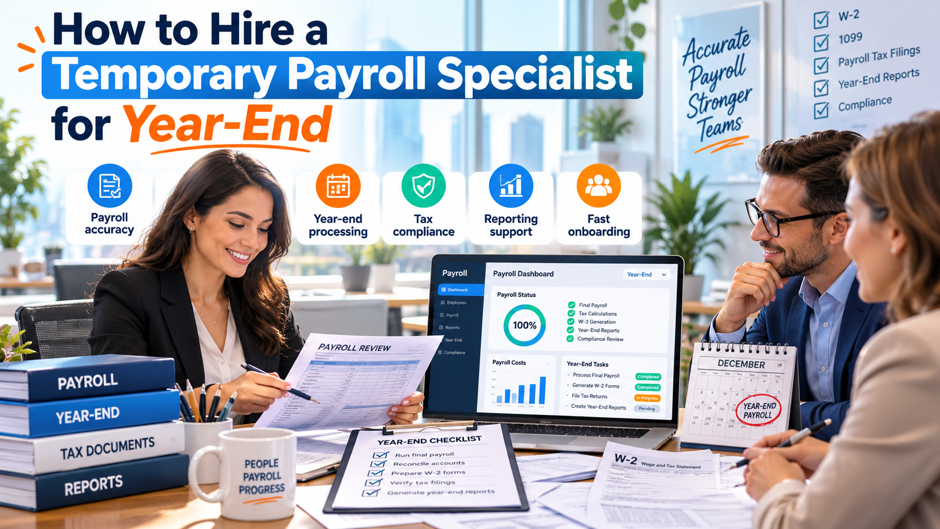
Picture a 160-person distributor whose only payroll administrator leaves in mid-December, about 6 weeks before W-2s are due. The staffing agency sends 6 resumes. Among them, 4 list year-end experience, 1 holds an FPC and 1 holds a CPP. The controller can’t tell which of the 6 could reconcile a fourth-quarter Form 941 to the payroll register, or whether any could start before Thanksgiving. This scenario is invented for illustration and doesn’t describe a real company or candidate.
This post covers what a temporary payroll specialist does at year-end, how to screen for it and how to price the engagement. It draws on an IRS information-return penalty page, an archival IRS news release on W-2 deadlines, the Social Security Administration’s wage base page, Bureau of Labor Statistics wage data and PayrollOrg’s certification FAQ. I also used 3 third-party pages from a payroll software vendor, a staffing firm and an outsourcing firm, each flagged where it appears. All of them sell something. Confirm every deadline and penalty against the IRS instructions for your return year, and ask counsel or your tax advisor to review the plan.
TL;DR
- Start the search now, because the clock is shorter than it looks. From today, Oct 23, to Monday Feb 1, 2027 is 101 days, or about 14 weeks, and Jan 31 falls on a Sunday. KORE1, a staffing firm, says contract payroll specialists are usually placed inside 2 weeks, which is self-reported marketing. Aim for a start date near Dec 1 so the new person sees the last payrolls of the year.
- Hire for reconciliation skills, then test it. The core year-end job is making payroll registers, quarterly returns and W-2 data. PayrollOrg’s FPC and CPP exams run 150 and 190 questions, but neither proves a person can do that in your system. Use a 45-minute practical test with planted errors and a 100-point rubric you set before you meet candidates.
- Price the miss as well as the contract. An invented 6-week agency contract costs $11,136. The IRS 2026 table lists $60 per late return in its first tier, which is $9,600 on 160 forms, before any annual cap that I couldn’t confirm. Verify the figures for your return year with the IRS.
Why year-end payroll needs extra hands
Year-end squeezes several jobs into a few weeks: the last payrolls, bonus runs, the Social Security wage base reset, quarterly reconciliation and W-2 production. The Social Security Administration wage-base data lists the wage base at $176,100 for 2025, $184,500 for 2026 and $192,300 for 2027, an increase of $7,800 between the last 2 years. A payroll setup that doesn’t change the limit on the first payday of 2027 withholds the wrong amount from high earners, which is why someone has to check it. The IRS says employers file W-2 and W-3 with the SSA and furnish employee copies by Jan 31.
For tax year 2026 that date falls on a Sunday, Jan 31, 2027. Weekend due dates generally move to the next business day, which would be Monday, Feb 1, but the IRS release I read dates from 2024 and doesn’t discuss weekends, so confirm the rule for your filing. Counting from today, that’s 101 days, or about 14 weeks, with the holidays inside it. A temporary specialist is a time-boxed answer to a spike, and broader finance and accounting staffing options can help when the permanent process is documented, since a stranger can’t fix what nobody wrote down.
The year-end calendar for tax year 2026
The table lists the dates that drive the engagement. The IRS and SSA sources are named in the last column, and my own planning dates are marked as mine. The IRS release behind the filing row is dated Jan 29, 2024 and marked archival, so it describes last cycles’ rules rather than 2027’s. Fourth-quarter Form 941 timing wasn’t in the pages I read, so I flagged it for confirmation instead of guessing. Use the table as a checklist for the interview and for the first-week plan.
| Date | What happens | Source and confidence |
| Tue, Dec 1, 2026 | Target start for the temporary specialist, in time to watch the last payrolls | My plan, not a deadline |
| Thu, Dec 31, 2026 | Last day of the tax year | Calendar fact |
| Fri, Jan 1, 2027 | Social Security wage base for new wages becomes $192,300 | SSA wage base page |
| Sun, Jan 31, 2027; Mon, Feb 1 if the weekend rule applies | W-2 and W-3 to the SSA, employee copies and Form 1099-NEC to the IRS | IRS release dated Jan 29, 2024; archival, so confirm |
| Same date | Request a 30-day extension to file W-2s with the SSA on Form 8809; extensions to furnish employee copies must also be requested by then | Same release |
| Fourth-quarter Form 941 | Not covered by the pages I read | Confirm in the Form 941 instructions |
The same release says the e-file threshold for information returns dropped from 250 to 10 starting Jan 1, 2024, that filers combine all information return types to count toward 10, and that the IRS offers free e-filing for the 1099 series through its IRIS portal. Current IRS 2026 W-2 and W-3 instructions confirm the filing framework and state that 2026 Forms W-2 and W-3 are due to the SSA on February 1, 2027. It also says the EIN on W-2, W-3 and payroll tax returns must match the EIN the IRS assigned, and that EINs and SSNs must never be truncated.
What the temporary specialist actually does
Reconciliation. The central task is proving that totals agree across the payroll register, the general ledger, the quarterly returns and the W-2 data, then finding the cause of each difference. Most year-end errors show up as a mismatch between 2 reports that should agree. A good specialist works from the totals down to the employee level, writes down every adjustment and can explain it to a controller in plain terms. A specialized accounting staffing agency should be screening for this kind of practical reconciliation ability rather than relying only on titles.
Bonuses and supplemental pay. Year-end bonuses add withholding questions. Patriot Software, a payroll software vendor, describes a 22 percent flat federal rate for supplemental wages, with a $700 bonus producing $154 of withholding, and a 37 percent rate on supplemental wages above $1 million in a calendar year, which would be $55,500 on $150,000 over the line. It also describes an aggregate method that uses the regular tables. That page cites IRS Publication 15 only in passing, so verify against IRS guidance. State rates exist, and the page gives none.
Employee questions and delivery. Employees ask about their W-2s: why box amounts differ from their pay stubs, why an address is wrong, how to get a copy. The IRS release says employers must furnish copies B, C and 2 by Jan 31, so a temp who handles the inbox saves the permanent staff days. Set the limits in advance, such as what the temp may change and what needs an approver, and record every change in a log that the permanent team can review in February.
Skills to screen for
- Reconciling to the penny. Ask a candidate to walk through how they tie a quarterly return to the payroll register, what they check first and how they document adjustments. VALiNTRY’s finance and accounting job descriptions hub includes Payroll Specialist as a distinct role, which is useful when you define the expected responsibilities before screening. A strong answer starts with totals, narrows by pay date and then employee, and ends with a written note that someone else could follow.
- Multi-state and garnishment work. KORE1’s page lists single- and multi-state pay cycles, garnishment processing, tax remittance and off-cycle bonus runs as typical contract duties. Match that list against your own, because a temp who has never handled a garnishment will take longer on the files that matter most. Ask which states the person has run and what they did when a state rule differed from the federal rule. Ask for a real example where 2 rules clashed.
- Documentation and handoff. A temporary engagement ends, so the output has to outlast the person. Ask what they leave behind: a checklist, a reconciliation workbook, a list of open items. A candidate who says “I just fix things” will leave you with fixes nobody can repeat. Look for someone who describes writing steps down while they work, and ask to see a sanitized sample if they can share it. Ask what the last handoff looked like.
- Discretion with sensitive data. Payroll files hold Social Security numbers, bank accounts and pay rates. Ask how the candidate handles a coworker asking about someone’s pay, and what they do with exports on a laptop. You’re listening for specific habits rather than reassurance. Confirm your own access rules with IT before the first day, and have the candidate acknowledge them in writing. Put the confidentiality terms in the agency agreement as well as in your own onboarding documents.
What payroll certifications show
PayrollOrg’s certification FAQ for the FPC and CPP lists the Fundamental Payroll Certification at 150 questions in 3 hours, with no prerequisites and recertification every 3 full calendar years through 60 credit hours. The Certified Payroll Professional exam has 190 questions in 4 hours, with recertification every 5 full calendar years through 120 credit hours. The page says the CPP has eligibility criteria but doesn’t list them, and it gives no fees or update date.
KORE1 calls the FPC the entry credential and the CPP the senior credential, and says certification isn’t required for coordinator seats. It also claims about 70 percent of its senior specialists hold a CPP, citing its own data with no method, so I wouldn’t rely on it. A certification shows someone studied payroll rules and passed a proctored exam. It doesn’t show they can reconcile in your system under deadline pressure, and I found no public study linking either credential to job performance. Give it a small weight and test the skill itself.
Recertification affects how current a credential is. PayrollOrg’s page says FPC holders recertify every 3 full calendar years with 60 credit hours, so a certificate earned in 2019 may have lapsed unless the person recertified. Ask for the certification year and the most recent recertification, and confirm the status with PayrollOrg if the credential matters to your decision. I didn’t review its verification process, so I asked the candidate how to check it.
Systems experience: what to ask
- Name the system and the depth. KORE1 lists ADP Workforce Now, Workday, UKG Pro, Paylocity, Paycom, Dayforce and Paychex Flex among the systems its payroll candidates use, and it adds several more. That’s a staffing firm’s list, not a market survey. When using a finance staffing agency, ask which system the candidate used, whether they ran a full year-end in it and which parts they did themselves, such as W-2 review, 941 reconciliation or adjustment screens.
- Ask about the last year-end. A candidate who ran year-end can describe the sequence: the last payroll, the review of the W-2 register, the corrections and the filing. Ask what broke and how long the fix took. Specific stories with dates and amounts are hard to invent. Vague ones about “supporting the team” tell you the person watched. Both can be useful, but the price and the supervision should differ.
- Decide whether read-only access is enough. For a short engagement, a reviewer with read-only access and reports may do most of the reconciliation without touching live data. Ask your vendor what permission levels exist and how audit logs record changes. I found no public data on how often temps get write access, so set the policy yourself and write it into the onboarding checklist. Ask the candidate which tasks they can do from reports alone, and which need write access to the live files.
- Plan for a system the candidate hasn’t used. Switching payroll systems is a normal part of the job, and a strong candidate can describe how they learned the last system. Give them a sandbox or a screen-share demo before the offer if you can. If you can’t, build extra supervision into the first week. Don’t reject a good reconciler over a missing logo, but price the ramp-up into the plan.
Ways to engage a specialist
Agency temp. The agency employs the person and bills you a loaded hourly rate. KORE1 gives no dollar figures for contract billing, so cost comparisons need a written quote. A model such as accounting staff augmentation can fit a defined year-end coverage window where the business needs temporary capacity rather than a permanent hire. This model is fastest because the agency screens and carries the employment paperwork, but you pay a markup for it.
Contract-to-hire. If you may want to keep the person, ask about conversion before you sign. KORE1 states direct-hire fees at 20 to 25 percent of first-year base and doesn’t give contract-to-hire conversion fees. On an invented $60,000 base, that range is $12,000 to $15,000. Only direct-hire placements carry a replacement guarantee on that page, and it states none for contract workers. Confirm whether conversion fees fall over time, and ask what counts as the trial.
Direct contract. Hiring an individual yourself avoids the markup but leaves you with screening, paperwork and classification risk. A payroll worker who uses your systems, follows your schedule and works for 6 weeks under your direction may look more like an employee than an independent business. I haven’t analyzed classification rules here, so ask counsel before you use a 1099 arrangement. Whichever route you choose, put the scope, the confidentiality terms and the end date in writing.
What a 6-week contract costs
The table prices an invented 6-week agency engagement. I chose a $32 hourly pay rate, a 45 percent markup and 240 regular hours, which gives a bill rate of $46.40. The overtime row adds 20 hours at 1.5 times pay, marked up at the same rate. No source gives a markup for payroll temps, so compare the assumptions with current temporary accounting staffing structures and replace them with the figures in your agency’s written quote before you budget.
| Scenario | Calculation | Total |
| 6 weeks, 240 hours | $32 x 1.45 = $46.40; $46.40 x 240 | $11,136 |
| 8 weeks, 320 hours | $46.40 x 320 | $14,848 |
| 6 weeks plus 20 overtime hours | 11,136plus20x(32 x 1.5 x 1.45 = $69.60) | $12,528 |
| Direct-hire fee at 20 percent of an invented $60,000 base | $60,000 x 0.20 | $12,000 |
| Direct-hire fee at 25 percent | $60,000 x 0.25 | $15,000 |
The first 3 rows differ by only $3,712, so the length of the engagement and the overtime rules matter more than a few points of markup. Ask whether overtime is marked up the same way, whether there’s a minimum term and who approves extra hours. The direct-hire rows aren’t comparable to the contract rows, because they buy a permanent hire rather than 6 weeks of work. If you only need coverage for the filing season, the contract rows are the relevant ones.
Pay data and its limits
The current Bureau of Labor Statistics financial-clerk data reports payroll and timekeeping clerks separately within the financial-clerk category. The article’s earlier BLS comparison used May 2023 estimates, where national employment was 157,230 and the median was $25.11 an hour or $52,240 a year. A title like payroll specialist or senior payroll analyst may fall in a different group, so wage data is a benchmark rather than a staffing quote.
A September 2026 page from Stealth Agents, an outsourcing firm, reports May 2025 figures for the same group: employment of 153,140, a mean of $59,630 and a median of $28.01 an hour. I couldn’t confirm those on the BLS page used in the original research, and the firm’s page has promotional claims I ignored. VALiNTRY’s 2026 finance and accounting salary guide also breaks out Payroll Specialist, Payroll Manager and Payroll Director compensation, which gives you another reference point before requesting agency quotes.
The invented $32 pay rate sits $6.89 above the BLS 2023 median and $3.99 above the third-party 2025 median. A premium could reflect year-end experience and short notice, but no source I found sets a premium for temps. Ask the agency what it pays the worker, what it bills you and how it explains the gap, and compare the answers across at least 2 agencies before you accept a quote.
A 45-minute practical test
Task 1: Reconcile (20 minutes). Give the candidate a small invented payroll register and a worksheet that mimics a quarterly return, with 2 planted differences, such as a bonus posted to the wrong period and a duplicate adjustment. Ask them to find both, explain each and say what they’d change. Score on accuracy, order of work and the quality of the note they write. Use fake employees and invented amounts, so no real data leaves the building.
Task 2: Bonus withholding (15 minutes). Ask the candidate to withhold federal income tax on a $700 bonus using the flat method, which the vendor page puts at $154, and then to explain how the aggregate method differs and when each applies. Add a case with $150,000 above $1 million to test the higher rate, which the same page puts at $55,500. Allow the candidate to look up rates, since the skill is knowing which rule applies, and confirm the answer key against current IRS guidance.
Task 3: W-2 review (10 minutes). Hand over 12 invented W-2 lines with 3 errors, such as Social Security wages above the wage base, a truncated SSN and an employer ID that doesn’t match. Ask them to mark the errors and say how they’d fix each. The IRS release says the EIN must match the EIN assigned and that EINs and SSNs must never be truncated, which supplies 2 of the checks. This task is short, so keep it simple.
Running the test and the interview
- Write the answer key first. List each planted error, the correct figure and the acceptable explanations, and have a second person verify the arithmetic. A key you built from a rushed spreadsheet will punish the wrong candidate. Run the test once yourself with a timer. If it takes you 30 minutes with the key, a candidate working cold won’t finish in 45, and you should cut a task. Keep the key in a separate file.
- Allow references and normal tools. Payroll professionals look things up, so let candidates use rate tables, a calculator and a spreadsheet. Forbidding them measures memory, and your permanent staff wouldn’t work that way. State in advance what’s off limits, such as getting help from another person. Give every finalist the same files, the same time and the same instructions. Write the rules on the instruction sheet so no candidate has to guess what’s permitted.
- Ask structured questions around the test. Use the same 5 or 6 questions for every finalist, such as the last mismatch they chased, how they handle a late change from a manager and what they do when 2 reports disagree. VALiNTRY’s finance and accounting interview questions hub includes a Payroll Specialist section focused on payroll processing, tax withholding, garnishments, compliance and HRIS software, which fits this stage of the screen. Score each answer on written anchors.
- Score separately, then compare. Have 2 reviewers fill in the rubric on their own sheets, and compare only after both finish. Record time per task and any hints given. Decide before the first session how many points a hint costs, apply that rule to everyone and keep the sheets until the decision closes. Ask counsel to review the process, including any accommodation requests. Share the final numbers with the full panel, and document any change made after discussion along with the reason.
Penalties and what a miss costs
The IRS information-return penalty page lists per-return amounts for returns due in 2026: $60 up to 30 days late, $130 from day 31 through Aug 1, $340 after Aug 1 or if never filed, and $680 for intentional disregard. It says these apply to each information return or payee statement, which suggests a missed filing and a missed employee copy are separate events. It lists no figures for returns due in 2027 on that page, so treat the 2026 row as a guide and check the current instructions.
The page also gives no dollar amounts for annual maximums, saying only that they differ for small and large businesses and pointing to Publication 1099, and it says there’s no maximum for intentional disregard. On an invented 160 W-2s, the first tier is $9,600, the second is $20,800 and the third is $54,400, before any cap. The first tier equals 86 percent of the invented $11,136 contract. That doesn’t prove the contract pays for itself, but it shows the downside is real money.
Scoring finalists: an invented example
The table scores 3 invented finalists on the 100-point rubric: reconciliation accuracy 30, bonus withholding 20, W-2 review 20, documentation 15 and communication 15. The scores are mine, the cutoff is 72 and the totals were computed in code. Candidate A leads at 83. Candidate B reaches the cutoff exactly, and candidate C misses by 4 points, mostly because the reconciliation note was thin. A tie at the cutoff shouldn’t be settled by feel, so decide before the interviews whether at or above passes.
| Criterion | Max | Candidate A | Candidate B | Candidate C |
| Reconciliation accuracy | 30 | 27 | 22 | 24 |
| Bonus withholding | 20 | 18 | 14 | 12 |
| W-2 review | 20 | 15 | 16 | 12 |
| Documentation | 15 | 13 | 12 | 10 |
| Communication | 15 | 10 | 8 | 10 |
| Total | 100 | 83 | 72 | 68 |
Access and onboarding in the first week
- Give the least access that gets the job done. Start with the reports and screens the person needs for reconciliation, and add more only when a task requires it. Document who approved each permission and the date it ends. I’d also keep the person who prepares a change separate from the person who approves it, though I haven’t found a source that sets that rule, so treat it as my practice rather than a requirement.
- Hand over a single-page brief. Write down the company’s pay schedule, the systems and reports, the open issues, the people who approve changes and the deadlines in the calendar table. Include where last year’s year-end files live and who owns them. A temp who starts with a clear brief spends the first day on work, and a person without it spends the first week learning where things are. Update it at the end of each week so the final version doubles as the handoff.
- Schedule short check-ins. A 15-minute check-in at the end of each of the first 3 days catches misunderstandings early. Ask what the person has found, what they need and what worries them. Keep a running log of questions and answers, because it becomes the handoff document at the end of the engagement and a record of decisions for your auditors. Keep them short and consistent, and have the same person run each check-in so the specialist knows who to ask.
- Plan the exit. Set the end date, the final deliverables and the access shutoff before the first day. On the last day, collect the reconciliation workbook, the open items list and any notes. Turn off access the same day and confirm it with IT. If you’re considering conversion, decide the criteria in advance rather than in the last week. Put the shutoff date in the engagement letter, so the agency and your IT team work from the same calendar and nobody has to chase it later.
A timeline from now to the filing date
Now to early November: define and source. Today is Friday, Oct 23. Write the first-weeks task list, set the rubric and the answer key and ask 2 agencies for written quotes with pay rates, markups and minimum terms. VALiNTRY’s guidance on temporary accounting staffing describes dedicated finance and accounting recruiting for defined temporary assignments, which is the type of model you’re comparing here. Send the posting by Monday, Nov 2.
Mid-November to Dec 1: screen and test. Phone-screen candidates with the same structured questions, then run the 45-minute test with 4 finalists. When timing matters, VALiNTRY’s page on how quickly an accounting staffing agency can fill a role is relevant to the sourcing plan because it includes Payroll Specialist among the roles placed on temporary, contract, temp-to-hire and permanent bases. Make the offer in time for a start on Tuesday, Dec 1.
December to Feb 1: run, reconcile, file. The new specialist shadows the final payrolls, then owns the reconciliation and the W-2 review. Book a review meeting with the controller 2 weeks before the filing date and another a week before it. Decide in advance who files, who signs and who requests an extension if needed. After filing, close the engagement, collect the files and write down what you’d change for next year.
FAQs
When should I start hiring a temporary payroll specialist for year-end?
Start now. From Oct 23 to Monday, Feb 1, 2027 is 101 days, and the W-2 deadline of Jan 31 falls on a Sunday this cycle. KORE1 says contract specialists are usually placed inside 2 weeks, but that’s marketing, and less common systems can take longer. Aim for a start date near Dec 1, and ask counsel or your tax advisor to confirm the deadline. Build in a week of slack for holidays and for candidate notice periods.
What certifications should a temporary payroll specialist have?
None is required by law as far as I found. PayrollOrg offers the FPC, with 150 questions and no prerequisites, and the CPP, with 190 questions and eligibility criteria the FAQ page doesn’t list. KORE1 calls the FPC entry level and the CPP senior, and says certification isn’t required for coordinator seats. Treat certification as a small bonus and test reconciliation skill directly. Ask for the credential and the date of certification, and confirm it with PayrollOrg if it matters to you.
How much does a temporary payroll specialist cost?
I found no published market rate. In an invented example with a $32 pay rate and a 45 percent markup, a 6-week contract of 240 hours costs $11,136. BLS reports a May 2023 median of $25.11 an hour for payroll and timekeeping clerks, and a September 2026 third-party page reports $28.01 for May 2025, which I couldn’t confirm. Get a written quote from the agency. Ask whether overtime and holidays are billed at a higher rate.
What does a temporary payroll specialist do at year-end?
The core work is reconciling payroll registers, quarterly returns and W-2 data, plus bonus runs, corrections and employee questions. KORE1 lists single- and multi-state pay cycles, garnishments, tax remittance and off-cycle runs as typical contract duties. The IRS release says employers file W-2 and W-3 with the SSA and furnish copies to employees by Jan 31. Set the scope and the approval limits in writing. Ask candidates to describe each of these tasks in their own words.
What are the penalties for filing W-2s late?
The IRS page lists $60, $130 and $340 per return for returns due in 2026, depending on how late, and $680 for intentional disregard, with no maximum for intentional disregard. Those figures are for returns due in 2026, and the page I read didn’t list 2027 amounts or annual maximums. On an invented 160 forms, the first tier is $9,600. Check the current table. A missed employee copy may be counted as a separate penalty, so plan for exposure on both filings and statements.
Should I hire through an agency or directly?
An agency is faster and carries the employment paperwork, but it adds a markup, and KORE1 publishes no rates. A direct contract avoids the markup and adds screening, paperwork and classification risk, which I haven’t analyzed here. Ask counsel before using a 1099 arrangement for someone who works under your direction. If you might hire the person, ask about conversion fees in writing. Get the agency’s pay rate, markup and minimum term in a written quote before you decide.
How do I test a payroll candidate?
Use a 45-minute test with invented data: a 20-minute reconciliation with 2 planted differences, a 15-minute bonus withholding exercise and a 10-minute W-2 review with 3 errors. Score it on a 100-point rubric you write before the interviews, and have 2 reviewers score separately. Allow normal references and the same time for every finalist, and ask counsel to review the process. Pilot the test with a colleague first, and fix any task that takes longer than planned.
What’s the deadline for filing W-2s?
The IRS release I read, dated Jan 29, 2024 and marked archival, says W-2 and W-3 go to the SSA, and employee copies go out, by Jan 31. For tax year 2026, Jan 31, 2027 is a Sunday, so the practical deadline may be Monday, Feb 1. Employers can request a 30-day extension on Form 8809 by the deadline. Confirm the dates in the current IRS instructions. Put the final date on a shared calendar.