

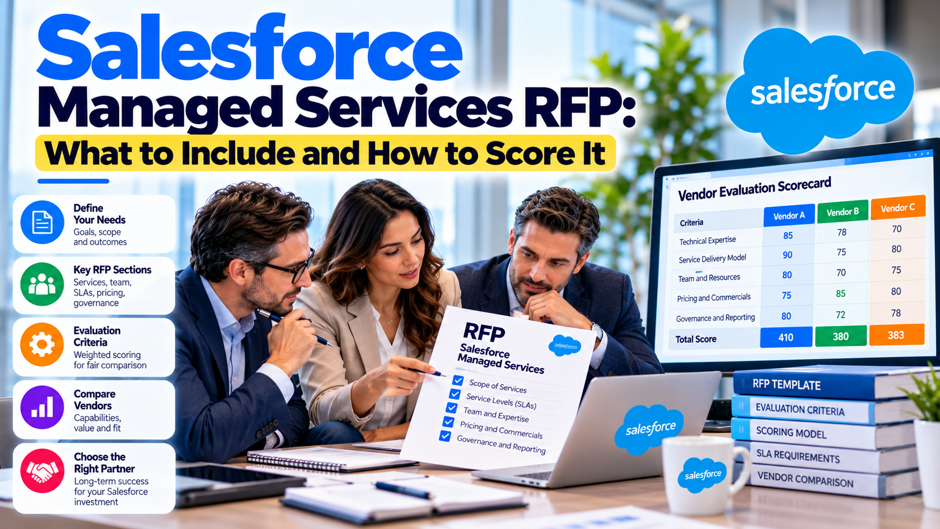
Here’s an invented scenario. A procurement team at a mid-sized manufacturer sends a short request to 3 Salesforce partners asking for “managed services, price per month.” The replies come back as 3 different things. The first quotes 30 hours, the second quotes a named team with 24/7 coverage, and the third quotes a flat fee with no hours stated. The team scores them on gut feel, picks the cheapest, and finds in month 2 that the winning bid covers a third of the hours and none of the release testing. The scoring wasn’t wrong. The question was too loose for the answers to be comparable.
This guide covers what a request for proposal for managed services should contain and how to score the responses. It draws on public sources that all have a stake in the answer. Vantage Point is a Salesforce consultancy, Responsive sells proposal software, and Summa’s article is partner marketing. Georgia’s procurement manual and a court scoring sheet are public-sector documents, but neither concerns Salesforce. I found no neutral study of which scoring methods pick better partners. Every bid and score in the worked example is invented, so confirm contract and procurement rules with counsel and your procurement office.
TL;DR
- Ask everyone the same questions. A bid is only comparable when scope, volumes, coverage hours and release duties are defined for all bidders. In the invented run, annual prices of $96,000, $118,000 and $142,000 buy 360, 480 and 600 hours, so the cheapest bid costs the most per hour at $266.67.
- Score with a rubric and weights that sum to 100. Published examples use 0 to 5 or 1 to 5 scales and give cost 15% to 30% of the total. In the invented run, the lowest bidder places last with 57 points, and the top bidder wins at 86.1 and still wins at 80.7 when price weight rises to 40%.
- Verify before you trust a score. Have evaluators score independently, review the spread between them, run a working session on your own use cases and call references. Confirm every term with counsel before signing. Keep the weights and rubric fixed before the first bid arrives, and publish them to bidders.
What the request document should contain
Vantage Point’s August 2026 guide to CRM requests lists minimum sections: background, functional requirements, technical requirements, implementation approach, cost structure, vendor experience, and evaluation criteria with the scoring method. That guide targets platform selection, not managed services, so the table below adapts it for Salesforce managed services support and adds the elements that TechTarget’s 2008 article says a managed services agreement needs. The right-hand column marks which rows come from a source and which are my own additions, because a reader should know the difference before copying them.
| Section | What to include | Basis |
| Background and goals | Why you’re buying, current pain, target start date | Vantage Point |
| Scope and exclusions | Orgs, clouds, packages, integrations, what’s out of scope | TechTarget, 2008 |
| Volumes and baselines | Users, monthly tickets, request types, release cadence | My addition |
| Service levels and coverage | Severity definitions, targets, hours, time zones, pause rules | TechTarget; Vantage Point |
| Staffing and governance | Named roles, hours, backups, reporting, review meetings | My addition |
| Release and change control | Testing for each release, sandbox use, rollback | My addition |
| Pricing format | Fee, included hours, overage and after-hours rates, rate card | TechTarget; Vantage Point |
| Evaluation criteria | Weights, scale, who scores, how price is scored | Vantage Point; Responsive |
| Contract terms | Term, termination, liability, credits, exit help | TechTarget |
The table is a skeleton, and the difficult work is in the detail beneath each row. Keep the request short enough that a busy delivery lead will read all of it, and long enough that bidders can’t interpret a requirement differently. Number every question so responses can be matched to it, and ask bidders to answer in the same order. A response that restructures your questions is harder to score and often signals a template pasted over your needs.
Facts bidders need to price accurately
Current-state facts. Tell bidders what they’d be inheriting: how many orgs, which clouds, how many users, which managed packages and which integrations, plus any known problems. Before issuing the request, a Salesforce health check can help document system issues that bidders would otherwise have to infer. A bidder who has to guess will add a risk premium or, worse, leave the risk out of the price and surface it later as a change request. This is my judgment rather than a sourced finding, and it matches how the other sections of the request depend on a shared baseline.
Volumes. Give a count of tickets and requests for the last 12 months if a history exists, split by type, plus the number of releases you expect to test each year. Vantage Point and Summa both note that Salesforce ships 3 releases a year, and the Winter ’27 release countdown ran from a sandbox preview on August 28 to production dates through October 9, per Salesforce’s admin blog. If no ticket history exists, say so, and ask bidders to state their assumptions.
Must-haves and nice-to-haves. Vantage Point recommends separating deal-breakers from preferences. Apply that to managed services by marking certain answers pass or fail, such as 24/7 coverage for the top severity and a named lead. A bidder that fails a must-have is out, however well it scores elsewhere. Nice-to-haves go into the weighted score. Keeping the 2 groups apart stops a long list of minor features from outweighing a single deal-breaker.
Service level questions to include
- Severity definitions. Put your definitions in the request and ask bidders to confirm them or propose changes with reasons. Without that, each bidder uses its own, and a response target of 1 hour means different things in each bid. Ask who assigns severity and how a disagreement is resolved. A clause that lets the supplier decide alone favors the supplier, and a published service page I read states severity follows the supplier’s reasonable assessment.
- Response and resolution. Ask for response, workaround and resolution targets as separate numbers for each severity. A published service level page I read states that its targets relate to responses only, not fixes, which shows how a bid can look strong while promising little. Vantage Point’s sample table, which it calls illustrative, gives a first response of 1 to 2 business hours for its highest severity, with a root cause analysis within 5 business days.
- Coverage and pause rules. Ask for hours, time zones and holidays, and ask what stops the clock. Vantage Point notes that clocks may pause outside business hours, while waiting on the customer or during vendor escalation. Each of those pauses can turn a good-looking target into a long wait, so ask bidders to list every pause condition and to say how long each can last. Score the completeness of the list, and ignore its length.
- Credits and remedies. Vantage Point says credits are usually a percentage of a single month’s fee and rarely compensate for real disruption. Ask each bidder for its credit schedule, how credits are claimed and whether repeated misses give you a right to terminate. Score the answer on whether it gives you a remedy you’d actually use, not on the size of the percentage printed in the table. A remedy you’d never invoke is worth little.
Ask for staffing, not slogans
Names and hours beat adjectives. Ask each bidder to list the roles it would assign, the hours per role per month, the seniority of each person and who covers when they’re away. Summa’s 2016 article makes a useful point that certifications belong to individuals, not firms, and can be checked with Salesforce’s certification verification tool. That article is old and written by a partner, and it refers to a partner tier structure that may have changed, so verify any badge a bidder cites against Salesforce’s current program.
Seniority labels need definitions. Vantage Point’s Essentials package, for example, advertises 30 senior hours a month for $5,850 on a 12-month term, which works out to $195 an hour. The package is a single firm’s marketing, but it raises a fair question when comparing Salesforce managed services consulting bids: what counts as senior, and can a junior bill against the same hours? Ask for the share of hours that will come from named people, and ask what happens to the price if the named person leaves.
Satisfaction data is useful but thin. Salesforce’s partner documentation describes a 10-question survey scored from 1 to 5, with projects above 4.2 counting toward a partner score, and it says terminated projects don’t affect the average. That page carries a 2017 copyright, so it may be out of date. Because Salesforce’s program rules change, check the current Salesforce Partner Program FAQ before treating an older partner metric as current. Vantage Point cites a 4.7 out of 5 AppExchange rating from 19 reviews; an extra 1-star review would pull that to about 4.5. Ask for the survey data, and ask about any engagement that ended early.
Release and change control questions
The table below turns release and change duties into questions you can score. Each row names the evidence that would convince you, because a confident paragraph in a proposal costs nothing to write. The Salesforce admin blog on Winter ’27 lists a sandbox preview beginning August 28 and production dates of September 4, October 2 and October 9, and it contains a conflicting January 8 reference, so use the dates as a prompt and confirm them with Salesforce Trust Status before putting dates into the RFP.
| Question for bidders | Evidence to request | What a strong answer shows |
| How do you test each of the 3 yearly releases? | A sample readiness report from a past release | Tests run in a sandbox, issues found, sign-off |
| How did you handle the Winter ’27 window? | A dated timeline from a current client | Work started at sandbox preview, not production |
| How do you control changes to production? | The approval and rollback procedure | Named approvers, a tested rollback path |
| How do you report quality? | A sample monthly report | Change success rate, with raw ticket data available |
| How do you use sandboxes? | Refresh schedule and ownership | A written plan, not an assumption |
Vantage Point lists change success rate and release readiness among the monthly measures it recommends, so asking for them is reasonable. A documented Salesforce release management process gives you another point of comparison when a bidder explains how sandbox testing, approvals and production changes are handled. Treat a refusal to show a sample report as a data point. A bidder can redact client names and still show structure. If the sample report is polished but the bidder can’t explain how a number was calculated, give the answer a lower score, because the report may be a template instead of a practice.
A pricing format that makes bids comparable
- A standard price sheet. Require every bidder to fill in the same fields: monthly fee, included hours, overage rate, after-hours rate, term, and what’s excluded. Vantage Point’s package lists 30 hours at $5,850, or $4,800 for a different platform, on a 12-month term with licenses excluded, which shows the kinds of fields to expect. Anything a bidder won’t fill in should be scored as missing, not as no cost. Reject partial sheets politely.
- A rate card for extra work. TechTarget’s 2008 article says an agreement should state the labor rates for requests outside flat-fee support. Ask for hourly rates by role, and ask how the rates change after year 1. Out-of-scope work tends to be where the real price appears, so a low base fee with a high rate card can cost more than a higher fee with generous inclusions. Compare it against the base fee’s included hours.
- Normalization to a common unit. Convert each bid to cost per included hour, and compare coverage hours alongside it. In the invented run, bid A is $118,000 for 480 hours, or $245.83 an hour, bid B is $142,000 for 600 hours, or $236.67, and bid C is $96,000 for 360 hours, or $266.67. For admin-heavy scopes, comparing the proposal with a virtual Salesforce admin services model can also expose differences in what the monthly price actually covers. The cheapest total is the most expensive hour, which is why the totals alone mislead. Coverage differences should be listed beside the rate.
- Exclusions in plain words. Ask bidders to list what isn’t included, such as licenses, sandbox support, third-party integrations, project work and after-hours calls. A short list isn’t automatically better, since it may reflect carelessness. Compare the lists against each other, and ask about any exclusion that appears in a single bid but is missing from the others. Differences between the lists point to questions worth asking, and the answers show how the bidder treats change requests.
Weights, scales and the scoring sheet
Weights. Published examples differ widely. Vantage Point suggests 30% for functional fit, 20% for technical fit, 20% for implementation approach, 15% for cost and 15% for experience. Responsive’s scenario uses 10%, 25%, 30%, 10% and 25% for approach, experience, functionality, innovation and cost. A court’s website redesign sheet gives 30%, 25%, 20%, 20% and 5%, and Georgia’s manual shows a 700-point technical, 300-point cost split. None of these is a managed services standard, and I found no authority on the right split.
Scales. Responsive uses a 1 to 5 scale with a sample compliance rubric from non-compliant to fully compliant, and the court sheet uses 0 to 5. Either works if every evaluator reads the scale the same way. Responsive advises writing a rubric with example answers for low, medium and high scores, which I’d treat as essential. A scale without anchors produces scores that reflect each evaluator’s mood, and averaging them hides the problem.
Formula. The simplest approach is a weighted sum: each criterion’s weight times its average score divided by the top of the scale. With weights that total 100 and a 0 to 5 scale, the maximum is 100. Responsive describes the weight multiplying the section average, and the court sheet’s weighted totals match that logic. In the worked example I use 7 criteria with weights of 20, 15, 20, 10, 10, 15 and 10, where price is 15. These weights are my invention, to be set by your own risks.
Scoring price without letting it dominate
Georgia’s procurement manual gives a common price formula: the lowest price divided by the price being ranked, multiplied by the points available for cost. Its official cost-scoring formula uses an example with 700 technical points and 300 cost points, with a supplier at $50,000 and another at $55,000. The second gets $50,000 divided by $55,000, times 300, or 272.7 points. The manual says the formula is a common method and that an RFP’s own methodology takes precedence, so state your method in the request.
The same manual says the issuing officer analyzes cost independently of the evaluation committee, and doesn’t share costs or cost scores with the committee until initial technical scoring is complete. That separation protects technical evaluators from being swayed by a low price. It’s a public-sector rule, and a private buyer isn’t bound by it, but it’s a cheap safeguard. Have someone outside the scoring group open the price sheets, and release them only after technical scores are locked.
Price formulas work on whatever number you feed them. Fed total annual price, they reward the bid that promises the least. Fed normalized cost per included hour, with coverage held equal, they compare like with like. If the alternative is building an internal team, VALiNTRY360’s comparison of managed services vs staff gives another cost structure to examine alongside the bids. The examples I read give cost 15% to 30% of the total, which suggests the weight is a judgment about how much you worry about overspending relative to underdelivery. For a service where quality failures are costly, a lower weight is defensible, and bidders should know it.
An invented scoring run with 3 bidders
The table below shows points per criterion for 3 invented bids. Scores come from a 0 to 5 scale averaged across evaluators and converted to points by weight times score divided by 5. Price points use Georgia’s formula on total annual price: bid C at $96,000 is the lowest and takes the full 15, bid A at $118,000 gets 12.2, and bid B at $142,000 gets 10.1. Nothing in this table is real. The numbers exist to show how the mechanics behave when the cheapest bid is also the weakest.
| Criterion (weight) | Bid A | Bid B | Bid C |
| Service levels and coverage (20) | 16.0 | 20.0 | 12.0 |
| Team and staffing (15) | 9.0 | 12.0 | 6.0 |
| Technical approach and releases (20) | 16.0 | 16.0 | 12.0 |
| Governance and reporting (10) | 8.0 | 10.0 | 4.0 |
| Experience and references (10) | 6.0 | 10.0 | 4.0 |
| Contract and exit terms (10) | 6.0 | 8.0 | 4.0 |
| Price (15) | 12.2 | 10.1 | 15.0 |
| Total (100) | 73.2 | 86.1 | 57.0 |
Checks of 2 kinds test whether the result is stable. If price is scored on cost per included hour instead of total price, the totals become 75.4 for A, 91.0 for B and 55.3 for C, because bid C’s price advantage disappears. If price weight rises to 40 and the other criteria scale down proportionally, the totals become 75.6, 80.7 and 69.7. Bid B wins in all 3 runs, and C’s rise shows how a heavy price weight pulls a weak bid upward.
Calibrating evaluators and resolving gaps
Independent first. Vantage Point recommends having each stakeholder score independently and then reconciling as a group. Independence matters because the first loud opinion in a room anchors everyone else. Give each evaluator the same rubric and the same set of questions, and assign sections to the people who know them best, as Responsive advises, so a finance lead scores commercial terms and a platform architect scores release control. Disagreement is useful data, not noise.
Look at the spread. The court’s scoring sheet gives a real example of why. Its 3 evaluators gave a vendor weighted totals of 72, 83 and 77, a spread of 11 points, and another 79, 91 and 92, a spread of 13, while a third vendor got 95 from all 3. The final scores were the averages, 77.33, 87.33 and 95.00. Averages hide disagreement, so review the spread before accepting a number. Responsive offers no numeric threshold for a significant gap.
Blind and anchored. Responsive recommends removing vendor names during scoring, especially with an incumbent, and checking for evaluators who score consistently high or low. A simple rule is my suggestion rather than a sourced practice: any criterion where evaluators differ by 2 or more points on a 0 to 5 scale goes to a short discussion, and anyone may change a score with a written reason. Record the reason so the file shows why the final number moved.
Reference checks and working sessions
Vantage Point advises validating top choices with references and a working session on your own use cases instead of a generic demo. Before narrowing the list, a guide to choosing the right Salesforce consulting partner can help frame the evidence you want from each finalist. It gives no numbers for either. My suggestion is to call at least 3 references per finalist and ask each the same questions: did the team meet its response targets, who left during the engagement, how were disputes handled, and would you sign again. Ask for references from clients similar in size and complexity, and ask for at least 1 that wasn’t chosen by the bidder.
A working session should look like real work. Give finalists a sample ticket, a sample release scenario and a sample change request a few days ahead, then watch how they reason. Score the session with the same rubric. The point is to see how the proposed team behaves under your conditions, not to see slides. If the people who present aren’t the people named in the staffing section, that’s a finding, and it belongs in the staffing score.
The satisfaction numbers deserve a skeptical read. Salesforce’s partner documentation says terminated projects don’t affect a partner’s average satisfaction score, so a partner could have a high score and still have ended engagements early. That page is dated, so verify current rules. Ask each finalist about any engagement that ended before its term, and ask the reference to describe the reason. A candid answer is worth more than a rating, and a refusal to answer tells you something too.
Red flags in written proposals
- A price without hours or coverage. If a proposal gives a monthly fee and nothing about included hours, coverage windows or exclusions, the number can’t be compared and shouldn’t be scored as if it could. VALiNTRY360’s review of Salesforce proposal red flags covers similar warning signs around vague scope, staffing and pricing. Ask for the missing fields in writing during the clarification window. A bidder who still won’t provide them is telling you how its change requests will go, and the invented scenario above shows what that costs.
- Round-the-clock claims with no scope. A “24/7” label should come with the severities it covers and the staff behind it. Vantage Point says it recommends 24/7 coverage only where justified and that it doesn’t offer it itself, which shows the claim isn’t universal. Ask who answers at 3 am, how they’re reached, and what they’re authorized to change in production. Treat an unstaffed night rota as a gap in the bid, however it’s labeled.
- Targets with no definitions. A response target with no definition of response, no pause rules and no severity assignment is a slogan. Check that the proposal defines the clock, lists what stops it and states what remedy applies. Credits that exist only on paper, such as a small percentage that needs a claim within a few days, deserve a lower score than a plain right to escalate and exit. Score such answers low.
- Titles instead of people. Staff described as a “senior consultant” or a “team of certified experts” without names or hours can’t be verified. Ask for names, roles, certifications and hours, then check certifications against Salesforce’s tool. Also note copied answers: if the paragraph on release testing doesn’t mention your clouds or your sandbox setup, the bidder may have pasted it from another response. Unnamed staffing makes the staffing score a guess, and guesses favor confident writers.
Timeline for running the process
Before issuing. Vantage Point lists the early steps: gather requirements from all stakeholder groups, separate must-haves from nice-to-haves, and build a weighted rubric with leadership sign-off. Do the sign-off before any bids arrive, because weights set after seeing prices tend to favor whoever is already preferred. It also says the full process takes several weeks to a few months and gives no exact figure, so I treat any specific duration as my own estimate.
Response and clarification. Responsive advises publishing the scoring approach and priorities in the request and offering a question window. Vantage Point suggests sending the request to a shortlist of 3 to 5 vendors. Answer questions in writing and share the answers with every bidder, so nobody holds an information advantage. If a question reveals that a requirement is ambiguous, issue an addendum and, if necessary, extend the deadline. Keep a log of every clarification.
Evaluation and negotiation. In an invented schedule, preparation takes 2 weeks, the response window 3, independent scoring 2, working sessions and references 2, and negotiation and contract 2, which is 11 weeks. That’s my estimate for a small process, not a benchmark. When comparing final commercial terms, the broader question of maximizing ROI with Salesforce Managed Services is worth keeping separate from the initial bid price. Hold the contract draft to the same standard as the proposals: attach the winning answers to it, and ask counsel to review before signing. Rushing the last step undoes the care taken in the earlier steps.
Contract terms to carry through to signature
- Attach the proposal. A statement in a proposal binds nobody unless the contract incorporates it. Ask counsel whether the winning answers on staffing, targets and release testing can be attached as exhibits, so that the promises scored in the evaluation become obligations. This is my suggestion, not a sourced practice, and the right mechanism depends on your jurisdiction and your procurement rules. Without that link, a strong evaluation result protects you from nothing after signature.
- Service levels and remedies. Carry over the severity definitions, targets, pause rules and credits exactly as scored. Vantage Point recommends escalation paths, root cause deadlines and termination rights for repeated top-severity misses. Check that the contract gives you a way out that you could actually use, such as a clear count of misses in a rolling period, and notice rights that don’t depend on the provider’s agreement. Keep the wording identical to the version scored.
- Fees, terms and rates. Confirm the monthly fee, including hours, overage and after-hours rates, the rate card and the term. Vantage Point’s package uses a 12-month term, so check the renewal mechanism and any price change. TechTarget’s 2008 article lists the fee schedule among the essential elements, along with the termination clause and limitation of liability. Check that the currency and the invoice schedule match the proposal, because small mismatches become disputes later.
- Platform terms are separate. Vantage Point notes that Salesforce’s own commitment has exceptions for planned downtime and events outside its control, and that those terms sit apart from a partner’s agreement. I found no public Salesforce uptime terms I could verify. Ask each bidder how it handles a platform outage, and confirm the details with Salesforce and counsel before relying on any assumption. Record the answer in the evaluation file so later negotiations start from it.
Mistakes that make scoring unreliable
Setting the weights after reading the bids is the most common failure. Once evaluators know which vendor a number favors, the weights drift toward the preferred answer, whether consciously or not. Responsive advises publishing the scoring approach in the request, which also tells bidders what you value. Lock the weights, the scale and the rubric with leadership sign-off before the request goes out, and keep a dated copy so a later audit can confirm nothing moved.
Scoring price early is the second. Georgia’s manual keeps costs away from the technical committee until initial technical scoring is done, and the logic applies in the private sector too. An evaluator who has seen a low price tends to find reasons to like the proposal behind it. Another quiet mistake is too many criteria. I found no source on the ideal number, but 40 criteria at 2.5 points each produces a total nobody can reason about.
The last mistake is treating a vendor’s own metrics as proof. A 4.7 rating from 19 reviews moves by about 0.2 with a single bad review, and Salesforce’s survey documentation excludes terminated projects from the average. Certifications can be verified, references can be called and working sessions can be observed. Weight the evidence you can check above the evidence a bidder supplies, and say so in the rubric, so that evaluators know a claim without support earns a lower score.
FAQs
What should a Salesforce managed services RFP include?
At minimum it should include background and goals, scope and exclusions, volumes, service levels and coverage, staffing and governance, release and change control, a standard price sheet, evaluation criteria and contract terms. Vantage Point lists a similar set for CRM platform requests, and TechTarget’s 2008 article lists the elements of a managed services agreement. I added volumes and released control myself. Confirm the final list with your procurement office. Keep each section short.
How many partners should I send it to?
Vantage Point suggests a shortlist of 3 to 5 vendors. Fewer than 3 gives you little to compare, and more than 5 creates a heavy scoring load without much extra insight. Use public profiles, peer recommendations and a short screening questionnaire to build the list first. I found no study showing that any particular number produces better outcomes, so treat 3 to 5 as a single consultancy’s rule of thumb. Screen before you send.
What weights should I use?
There’s no standard. Published examples give cost 15% to 30% of the total, and the rest is split across fit, approach and experience. Vantage Point suggests 30, 20, 20, 15 and 15 for platform selection, and Responsive’s scenario uses 10, 25, 30, 10 and 25. Choose weights that reflect your risks, get leadership sign-off before bids arrive, and publish them in the request so bidders can see your priorities. Keep the weights visible.
How do I score a fair price fairly?
Normalize before you score. Convert each bid to cost per included hour and compare coverage, then apply a formula such as Georgia’s: lowest price divided by the price ranked, multiplied by the cost points. In my invented run, scoring on total price puts the cheapest bid at full marks despite $266.67 an hour, while normalizing reverses that. Have someone outside the technical committee open price sheets after technical scores are locked.
How should evaluators handle disagreement?
Score independently first, then compare. Responsive advises checking for consistently high or low scorers and resolving gaps in a short call, though it gives no threshold. A court scoring sheet I read shows spreads of 11 and 13 points on weighted totals across 3 evaluators. My suggestion is to discuss any criterion where scores differ by 2 or more points on a 0 to 5 scale, and record any change.
Should I weight AppExchange ratings and certifications?
Give them some weight, but verify them. Certifications belong to individuals and can be checked with Salesforce’s verification tool, per Summa’s 2016 article. Satisfaction ratings can rest on small samples: a 4.7 average from 19 reviews drops to about 4.5 with an extra 1-star review. Salesforce’s partner documentation also excludes terminated projects from the average, and that page carries a 2017 copyright, so ask for the underlying data. Treat claims as leads to check.
Do I need references and demos?
Yes, but make them specific. Vantage Point recommends a working session on your own use cases instead of a generic demo, plus reference checks for the finalists. It gives no counts, so my suggestion is at least 3 references per finalist, asked identical questions, with 1 reference not chosen by the bidder. Score both with the same rubric, and check that the people who present are the people named in the staffing section.
How long does the process take?
Vantage Point says several weeks to a few months and gives no exact figure. My invented schedule for a small process runs 11 weeks, split into 2 for preparation, 3 for responses, 2 for scoring, 2 for working sessions and references, and 2 for negotiation. Larger organizations with more stakeholders will take longer. Build time for legal review into the plan, and don’t compress the clarification window to save a week. Plan for some slippage.