

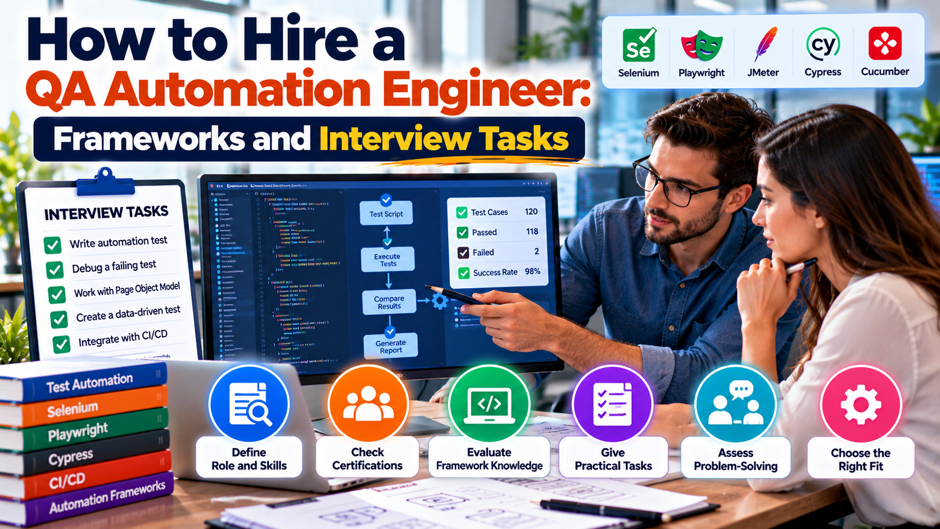
Picture a 60-person software company whose nightly suite of 400 browser tests fails on most runs, so nobody trusts it. The recruiter sends 8 resumes. Among them, 5 list Selenium, 2 list Cypress and the last lists Playwright. The hiring manager can’t tell who built a framework and who only ran a suite, or whether any of the 8 could make that suite pass on a quiet night. This scenario is invented for illustration and doesn’t describe a real company or candidate.
This post covers what to look for in a QA automation engineer and how to test for it with short interview tasks. It draws on Bureau of Labor Statistics wage data, ISTQB’s published exam tables, Cypress’s trade-offs page, the Playwright package page, an O’Reilly excerpt on Selenium and a Google Testing Blog post on flaky tests. I also used 2 third-party pages, a forum thread and a scorecard from a vendor that sells interview software, both flagged where they appear. The tool I used couldn’t open Playwright’s or Selenium’s own documentation sites, so those facts are thinner. Confirm versions before you set requirements, and ask counsel to review any assessment.
TL;DR
- Hire for test design and reliability, then check the framework. The 3 leading web frameworks differ in languages and browser control, but a candidate who writes stable, readable tests in 1 can usually learn another. BLS puts QA analysts and testers at $104,300 median pay and software developers at $135,980, so decide whether you’re hiring a tester who codes or a developer who tests.
- Use 4 short interview tasks instead of a long take-home. My invented 90-minute plan covers a failing-test review, an API test, a live flaky-test fix and a framework design talk, scored on a 100-point rubric you set before you meet candidates. Reviewer time for 4 finalists comes to 16 hours, or $1,200 at an invented $75 an hour.
- Treat flaky tests as the main risk. Google’s testing blog reported about 1.5 percent of test runs flaky and almost 16 percent of tests with some flakiness. In my invented 400-test suite, a 0.2 percent per-test flake rate turns 55 percent of runs red. Ask every candidate how they’d find, isolate and quarantine unstable tests.
Decide which kind of automation engineer you need
The test writer. BLS says QA analysts and testers design and execute tests, create test plans and procedures, run manual or automated tests, document and report defects and give feedback on usability. Before writing the requirement, compare the role with the broader QA and engineering positions covered by VALiNTRY’s information technology job descriptions so you’re clear about where testing ends and engineering ownership begins. If your team ships every week and needs coverage for each release, this person turns requirements into reliable checks and files clear bugs.
The framework owner. This person decides how the suite is built: page objects or a similar pattern, fixtures, test data setup, reporting and parallel runs. Hirevire, a vendor that sells interview software, lists an SDET variant of its scorecard that raises Framework Ownership to 40 percent and cuts manual testing to 25 percent. If your suite already exists and breaks weekly, this profile also overlaps with the engineering depth expected in software engineering staffing when the hire owns code architecture rather than only test execution.
The pipeline owner. A third variant owns how tests run in the build: when they start, how failures are reported and who sees them. Hirevire lists CI/CD exposure as an indicator under framework ownership, which fits. Small teams often want all 3 profiles in a single hire, and that’s rarely realistic. Pick a primary profile, name a secondary profile you’re willing to coach, and write the first-90-days task list before you read a single resume.
What public pay data can and can’t tell you
The Bureau of Labor Statistics groups software developers, QA analysts and testers on a single page. It reports 2025 median pay of $135,980 for developers and $104,300 for QA analysts and testers, a gap of $31,680, and $134,040 for the combined group. The combined figure sits close to the developer figure which suggests developers make up most of the group, though the page doesn’t say so, so don’t use it as a QA benchmark. Projected growth from 2025 to 2035 is 10 percent for the combined group and developers and 6 percent for QA analysts and testers.
Read those numbers with care. The page I read has no occupation titled QA automation engineer, so the job you’re posting may fall between the 2 groups, and your market may pay above or below a national median. In the invented scenario, a $120,000 budget sits $15,700 above the tester median and $15,980 below the developer median. That puts the budget between the 2 medians, so confirm your range with whoever approves compensation before the first interview.
The leading web frameworks side by side
The table puts Playwright, Selenium and Cypress next to each other using the sources I could open. Playwright’s facts come from its npm package page, Selenium’s from an O’Reilly excerpt of a book on Selenium WebDriver with Java and Cypress’s from its own trade-offs documentation. Cells marked not stated mean the source I read didn’t say. These pages describe what each project says about itself, and none is an independent comparison.
| Feature | Playwright | Selenium | Cypress |
| Self-description | A framework for web testing and automation | An open source suite of libraries and tools for browser automation | A tool for testing your own application |
| Languages | TypeScript, JavaScript, Python, .NET, Java | Language bindings exist; the excerpt doesn’t list them | JavaScript only, per Cypress’s docs |
| Browsers | Chromium, Firefox and WebKit through a single API | Not stated in the excerpt | Controls 1 open browser at a time |
| Waiting and retries | Auto-waiting and retried web-first assertions | Not stated | Not stated on the page I read |
| Where tests run | Not stated | Not stated | Inside the browser, not in Node |
| Debug tooling | Codegen, Inspector and Trace Viewer | Not stated | Not stated |
| Stated limits | None stated on the page | None stated in the excerpt | Multiple tabs need a plugin; 1 superdomain per test; limited iframe support; no hover command; no native or mobile events |
The Playwright page I read lists package version 1.55.0 with Chromium 140.0.7339.16, WebKit 26.0 and Firefox 141.0. That looks like an older cached snapshot, so confirm current versions on Playwright’s own site before you write a requirement. The Selenium excerpt names WebDriver, Grid and IDE as core components and says Jason Huggins and Paul Hammant created the original Selenium Core in 2004 at Thoughtworks. It describes none of those components in detail. I found no independent benchmark comparing the 3 on stability or speed.
How to read framework experience on a resume
- Separate use from building. Hirevire’s scorecard tells interviewers to separate using a framework from building or maintaining it. A resume line that says “Selenium” can mean the person wrote a few scripts inside an existing suite or designed the suite from scratch. Specialized tech recruiters should make the same distinction during screening instead of matching only framework keywords. Ask which it was, how many tests the suite held, how long a full run took and what the person changed after they joined.
- Ask for the repository, with permission. If the candidate has public code or can share a sanitized sample, read it before the interview. Look at test names, structure, how data is created and cleaned up, and whether waits are explicit or padded with fixed sleeps. Don’t ask for code owned by a former employer. If nothing can be shared, move straight to the live tasks, which exist for exactly that case.
- Check the version and the language. Cypress supports only JavaScript, so a Cypress veteran will arrive with JavaScript habits, while a Playwright user could be working in any of its 5 listed languages. Ask which language and which major version the person used, and compare that with your stack. A mismatch isn’t disqualifying, but it sets the ramp-up cost you should expect and the questions you should ask about how fast they learn.
- Ask what they would change. Every suit has regrets. A candidate who can name 2 design decisions they’d reverse, explain why and describe the cost of reversing them has thought about the framework as a system. A candidate who describes only successes has told you less. Score this answer against the same written anchors for every finalist so the comparison stays fair. Ask for the replacement design as well, since a candidate who can sketch it quickly has usually thought it through.
Why framework choice matters less than test design
Frameworks differ in real ways, but the differences rarely decide whether a suite is trusted. Cypress’s own page lists JavaScript as its only supported language and says it can’t control more than 1 open browser at a time, which matters if your product depends on multi-browser coverage or multi-tab flows. Playwright’s page lists 5 languages and 3 browser engines. Those facts should shape your job posting, but they shouldn’t decide the hire.
A person who writes isolated, readable, deterministic tests will bring those habits to whichever framework you use. That principle also matters when hiring across broader information technology staffing needs, because tool familiarity should be separated from the engineering judgment needed to own a system.
I found no public data on how long it takes an engineer to move from 1 framework to another, so I can’t give a number. Ask candidates about their own moves instead. A person who has switched frameworks once or twice can describe what carried over, which was usually test design, data setup and debugging method, and what didn’t. If your suite is in a language the candidate hasn’t used, add a short language task to the screen rather than rejecting the profile outright.
Language fit deserves its own screen. If your suite is in Python, a candidate who wrote Playwright tests in TypeScript has the concepts but not the idioms. A 15-minute pairing exercise in your language shows how fast the person adapts, and it costs less than a wrong hire. Keep the exercise identical for every candidate, and note which constructs they looked up, since looking things up isn’t a weakness. Write down how long each person took to get the first test passing.
Flaky tests as a hiring signal
What the numbers say. A Google Testing Blog post on flaky tests by John Micco, dated May 27, 2016, reports about 1.5 percent of all test runs flaky, almost 16 percent of tests with some level of flakiness and about 84 percent of observed pass-to-fail transitions involving a flaky test. The post estimates that a project with roughly 1,000 tests would see about 15 flaky failures at that rate. These are Google’s figures from 2016 on its own infrastructure, so they may fail to transfer to a small company, yet they show how common the problem is.
The arithmetic on your suite. Take an invented 400-test suite in which each test has a 0.2 percent chance of failing for reasons unrelated to the product. The chance that all 400 pass in a run is 0.998 raised to the 400th power, or about 44.9 percent, so about 55.1 percent of runs show at least 1 false failure. Scaling Google’s 1,000-test estimate to 400 tests gives about 6 flaky failures. A rerun-once policy cuts false red runs to about 0.16 percent in the invented model, but only if failures are independent, which they rarely are.
What a good candidate says. Google’s post describes rerunning failing tests, marking a test flaky so it fails only after repeated failures, quarantining tests whose flakiness is too high and tooling that detects changes in flakiness. It warns that flagging can lead developers to ignore flakiness and that quarantine can hide real race conditions. A strong candidate raises the same trade-offs unprompted. A weak candidate proposes adding fixed sleeps or rerunning everything forever, without asking why the test failed in the first place.
What the exam-level certifications cover
- Foundation level. ISTQB’s exam structure tables, version 1.18 dated May 27, 2026, list the Foundation Level exam as 40 questions worth 40 points in 60 minutes, with a passing score of 26 points, which is 65 percent. That’s 1.5 minutes per question. The tables don’t describe the syllabus, and I didn’t read it. Treat this credential as evidence that someone studied testing vocabulary and basic techniques, which is useful for a junior hire and a weak signal for a senior hire.
- Test automation engineering. The current ISTQB Test Automation Engineering qualification lists 40 questions worth 66 points in 90 minutes, with a passing score of 43 points, or at least 65 percent. It works out to 2.25 minutes per question. Because the points differ from the question count, some questions carry more weight than others. Ask a holder which topics the exam covered and how they’ve used them at work.
- What the tables leave out. The ISTQB document gives no price, validity period or pass rate, and I found no public study linking either credential to job performance. A certification can’t show whether a candidate writes stable code or debugs well, and neither exam is a coding test. Use it as a screen for shortlisting, give it a small weight in the final score and require nothing beyond what the job needs.
- Confirm the status. Ask for the certificate, the exam version and the date, and verify with the issuing body if the credential matters to you. I didn’t review ISTQB’s verification process, so I asked the candidate for the credential details and confirmed the method with ISTQB. If you require a credential, decide whether you’ll reimburse the exam, and write that policy down before the offer. Keep the credential details in the candidate file with the date you checked them.
Interview tasks compared
The table lists 4 tasks I’d use in a 90-minute finalist session, with invented durations that add up to the full 90 minutes. They draw on Hirevire’s sample questions and on the forum alternative discussed below, though the task designs and times are mine. Each task targets a different skill, and the risks column shows how each can go wrong. Run them in the order shown, because the failing-test review warms the candidate up and the framework design talk works better after they’ve seen your code.
| Task | Minutes | What it shows | Main risk |
| Review a failing test | 20 | Reading code, finding causes, naming fixes | A trick bug that tests luck rather than skill |
| Write an API test | 25 | Test design, assertions beyond status codes, data setup | Tool mismatch if the candidate has never used your client |
| Fix a flaky test live | 30 | Debugging method, waits, isolation, narration | Time pressure hides good judgment; allow documentation |
| Discuss framework design | 15 | Structure, trade-offs, ownership | Rewards fluent talkers who haven’t built anything |
The case against long take-home tasks
A Ministry of Testing forum thread from April 16 and 17, 2024 asked for take-home exercises for automation testers, and the replies are useful mostly for what they rule out. It’s a single thread with 3 participants, so treat it as 1 practitioner’s argument rather than evidence. A participant, Mirek Długosz, argued against take-homes for 4 reasons: they can exclude candidates with caring responsibilities, experienced people may see them as unpaid work, they can suggest a company doesn’t respect personal time and candidates may get help from someone else.
His alternative is to show a short, self-contained commit from the team’s repository with the message removed, and ask the candidate to explain and review it. He describes that as a similar position to the job itself. I’d use it as the first task in the table. Hirevire’s page recommends a take-home exercise but never defines it, and its scorecard has no factor to score it. If you still want a take-home, keep it under 60 minutes, say what you’ll score, and ask counsel about pay and about who owns the work.
Choose the commit with care. Pick a commit that touches a test and a small piece of production code, remove the message and any ticket reference, and strip names. Confirm with your security lead that the code can be shown outside the company. Give the candidate 10 minutes to read it, then ask what changed, what could break and which test they’d add. The exercise has no answer to memorize, which is its main value.
Running a live debugging session
- Prepare a repository that fails in a known way. Build a small project with a handful of tests, 1 of them flaky for a documented reason, such as a fixed sleep that races a slow response. Keep an answer key listing the symptom, the cause and acceptable fixes. Run the session once yourself and time it. If you can’t solve it in 15 minutes with the key, a candidate can’t solve it in 30 minutes cold.
- Let candidates use what they’d use at work. Allow documentation, search and their own editor if possible. Your engineers look things up, so forbidding it measures memory rather than skill. Say in advance what’s off limits, such as asking another person to solve it, and tell the candidate the language and framework before the session so they can prepare in a reasonable way. Give every finalist the same environment, the same files and the same instructions.
- Ask them to narrate. Have the candidate share their screen and talk through what they’re checking and why. The narration is the evidence: it shows whether they reproduce the failure first, read the log, isolate the cause and verify the fix with repeated runs. Tell candidates the narration is scored, and give them a minute at the start to read the code in silence before they speak. Record the narration only with consent.
- Take notes against the rubric, not impressions. Score each criterion on a separate sheet as the session runs, then compare sheets only after both reviewers finish. Record time per step, such as time to first hypothesis and time to a passing run, so the debrief has facts. Keep the sheets until the hiring decision closes, in case a candidate or a colleague asks how the score was reached. Store them with the hiring file so they’re easy to find.
Scoring the tasks
The rubric. My invented rubric totals 100 points: test design 25, code quality 20, reliability 25, debugging 20 and communication 10. Reliability covers waits, data isolation and the absence of fixed sleeps, which is why it carries as many points as test design. Write 1 sentence for each criterion that says what a top score looks like, and 1 that says what a failing score looks like. Fix the weights before you meet candidates, and don’t change them after the first interview.
Calibration. Run the whole session with a current engineer first, and score it together. If the 2 reviewers differ by more than 10 points on the same performance, tighten the anchors until they agree within a few points. A rubric that 2 reviewers apply the same way is worth more than a clever task that nobody can score consistently. Keep the pilot score as a sanity check for your cutoff, and don’t set the bar where only your best engineer can reach it.
Cutoffs and ties. Set the cutoff, such as 70, before the interviews. Candidates at or above it move to the final discussion, and below it they don’t, unless a reviewer can name evidence the rubric missed. When 2 candidates land within 3 points, don’t treat the difference as meaningful. Use the pattern of scores instead, such as whether the role needs a stronger debugger or a stronger communicator, and write the reason down.
What to record. Write down time per task, the hints you gave and anything you’d have done differently as an interviewer. Hints matter, because a candidate who needed 2 hints scored differently from a candidate who needed none, and the rubric should say how many points a hint costs. Decide that rule before the first session, apply it to everyone and keep the notes with the scoring sheet so a later reviewer can follow the reasoning.
Scoring finalists: an invented example
The table scores 3 invented finalists on the 100-point rubric. The scores are mine, and the totals were computed in code. Candidate A tops the list at 80. Candidate C clears the 70-point cutoff by 1 point after losing most of the communication marks, and candidate B misses it by 1 point despite the best test design score, because B’s tests relied on fixed sleeps and shared data. The pattern matters more than the ranking: B could be coached on reliability, while C needs help talking through decisions.
| Criterion | Max | Candidate A | Candidate B | Candidate C |
| Test design | 25 | 20 | 22 | 18 |
| Code quality | 20 | 16 | 10 | 17 |
| Reliability | 25 | 22 | 12 | 20 |
| Debugging | 20 | 14 | 16 | 12 |
| Communication | 10 | 8 | 9 | 4 |
| Total | 100 | 80 | 69 | 71 |
Reading the public guidance critically
Hirevire’s scorecard gives 4 factors and weights: manual and automation testing experience at 35 percent, automation framework ownership at 30, API testing knowledge at 20 and team and culture fit at 15, which sum to 100. Its customization options don’t all add up. The manual-only variant totals 95 percent from the 3 weights it lists. The startup variant sets manual and automation at 45 and culture fit at 10, which gives 105 if framework ownership and API testing stay at 30 and 20, and the page doesn’t say they change. The SDET variant works out to 100.
The page has other gaps. Its research section cites no studies, its claim that framework ownership is the gap most QA interviews fail to surface has no source, it refers to a technical proficiency factor that isn’t in the scorecard and its descriptors, such as 3 or more years of experience, have no evidence standard. It also ends with a pitch for AI scoring software. Use the factor names as prompts, set your own weights and scoring anchors, and keep any automated scoring tool out of the decision unless counsel has reviewed it.
Wrapping the tasks in a structured interview
The practical tasks shouldn’t replace the interview. Use the same job-related questions for every finalist and score each answer against written anchors. VALiNTRY’s information technology interview questions provide examples of how to keep technical interview preparation tied to the specific role, tools and project environment rather than shifting into an open-ended conversation.
Ask questions from the first-90-days task list. Include 1 question about a flaky suite, 1 about a failed release, 1 about disagreement with a developer over a defect and 1 about a framework change that didn’t work. Score the answer immediately, then compare reviewer scores only after both have submitted them.
Use the interview for judgment and communication rather than repeating the coding test. If a candidate performs well in the tasks and poorly in the interview, identify exactly which job requirement the interview exposed. Don’t lower a technical score because someone wasn’t polished, and don’t let a confident interview erase weak debugging evidence.
Pay and market context
BLS reports a 2025 median of $104,300 for QA analysts and testers and $135,980 for software developers. The role you’re hiring may sit between the 2 because the federal page doesn’t have a separate QA automation engineer occupation. VALiNTRY’s information technology salary hub also groups QA engineers within software development and engineering, where architecture judgment, API experience and broader technical ownership can raise compensation.
Use the medians as a sanity check rather than a quote. National pay data can’t tell you what a framework owner with Playwright, API testing and CI/CD experience costs in your city. Ask recruiters for recent offers on comparable roles and make sure you’re comparing the same profile. A tester who writes automation is different from an SDET who owns the framework and pipeline.
Set the compensation range before the interviews. Keep it the same for candidates at the same level and adjust only when the job itself changes. If your finalists consistently ask above budget, recheck whether you’ve written a tester role while interviewing people whose responsibilities are closer to software engineering.
What the process costs
- Reviewer time is the main cost. In the invented plan, 2 reviewers spend 2 hours each per finalist, which covers the 90-minute session and 30 minutes of scoring. That’s 4 reviewer-hours per finalist and 16 hours for 4 finalists, or $1,200 at an invented $75 an hour. Compare that with your own estimate of what a mis-hire or a long vacancy costs, and decide whether a smaller panel or a shorter session fits the budget.
- Candidate time is a cost too. Each finalist gives you 90 minutes, which is 6 hours across 4 finalists, and that’s easier to ask for than a long take-home. I found no public data on drop-off rates for automation tasks, so watch your own numbers. Tell candidates the format, the length and the scoring in advance, and offer a reasonable time slot. A short session also makes it easier to run the same process for every finalist.
- Preparation is a single upfront cost. Building the failing repository, the answer key and the rubric takes an engineer a few hours the first time, and I haven’t measured it, so treat any estimate as your own. Reuse the materials for the next search, but rotate the faults so the exercise doesn’t leak. Keep a record of what each version cost and what it predicted, so your next search starts with better data.
- Tooling costs are optional. You can run everything on a laptop with a shared screen. Paid assessment platforms and AI scoring tools add cost and, as Hirevire’s page shows, often arrive with marketing claims that have no cited evidence. Start with the simple setup, and add tools only if you can name the problem they fix and the way you’ll measure the result. A paid platform can still make sense when you run many searches a year.
When contract staffing may make more sense
A full-time hire isn’t always the only way to repair a broken automation suite. If the immediate problem is framework cleanup, CI integration or a short migration from Selenium to Playwright, temporary technical capacity through IT staff augmentation may fit better than creating a permanent role before you know the long-term workload.
The same interview tasks still apply. A contractor who’ll own a 3-month framework rebuild needs to prove debugging, architecture and documentation skills just as a permanent engineer does. The difference is that scope, expected hours and the end condition should be written before the search begins.
If the project turns into permanent ownership, decide whether to convert the role only after you know the workload. That prevents a temporary framework problem from automatically becoming a permanent headcount decision.
A process you can run in 3 weeks
Week 1: Define the profile and build the materials. Choose the primary profile, write the first-90-days task list and set the rubric weights and cutoff. Build the failing repository and the answer key, and run a pilot with a current engineer. Draft a posting that names your language, framework and pipeline, and say whether the role is tester, framework owner or both. Review the process with counsel before it touches a real candidate.
Week 2: Screen the pile. In an invented funnel of 40 applicants, 40 percent show a relevant framework and 16 pass a resume read. A 20-minute phone screen using 3 of your structured questions passes 75 percent of those, which leaves 12. Specialized technology recruiting firms should be able to distinguish framework ownership, API testing and CI/CD exposure before they send the shortlist, rather than simply forwarding candidates who list Selenium or Cypress.
Choose the 4 best on screen results, including at least 1 without a famous tool on the resume if their answers justify it. Verify any certification dates before the interview and note anything that doesn’t match. If you use an external recruiter, the broader benefits of tech recruitment agencies matter only when the agency’s screening actually removes weak matches before they reach your engineers.
Week 3: Run the sessions and decide. Schedule each finalist for the 90-minute session, with 2 reviewers scoring separately. Total the rubric, meet once to compare and write the reason for the decision. Make the offer within a few days of the last session. After the hire, compare the new engineer’s rubric scores with their first-quarter results, and adjust the weights if a criterion predicted nothing. I found no public benchmark, so your own records are the best data you’ll get.
FAQs
Which framework should a QA automation engineer know?
It depends on your stack. Playwright’s package page lists TypeScript, JavaScript, Python, .NET and Java, Cypress’s docs say it supports only JavaScript, and an O’Reilly excerpt describes Selenium as an open source suite with several language bindings. I found no independent comparison of stability or speed. Hire for test design and debugging, then check the language and framework against your own code. Ask each candidate which languages they’ve used in production and how they chose between frameworks.
What’s the difference between a QA tester and a QA automation engineer?
BLS describes QA analysts and testers as people who design and execute tests, write test plans, run manual or automated tests and report defects. An automation engineer writes and maintains the code that runs those tests. Hirevire’s scorecard variants show how the profiles differ: its SDET option weights framework ownership at 40 percent. Decide which profile you need before you write the posting. Confirm the split with your engineering lead before you post the role.
Is an ISTQB certification worth requiring?
Usually as a preference rather than a requirement. ISTQB’s exam tables list a 40-question Foundation exam with a 26-point pass mark and a 40-question Test Automation Engineering exam with a 43-point pass mark out of 66. Neither is a coding test, and I found no study linking them to performance. Use the credential as a shortlist signal and test the skills in a live task. Confirm any requirement with counsel and with the people who will work alongside the hire.
How long should a QA interview task be?
I’d keep the full session to about 90 minutes for finalists, split across 4 short tasks of 15 to 30 minutes. Hirevire recommends a take-home exercise but doesn’t define its length, and the forum thread I reviewed raised several objections to long ones. A shorter live format is easier to score consistently and respects the candidate’s time. Pilot it with a current engineer first. Tell candidates the length and the scoring in advance, and keep it the same for everyone.
Should I give candidates a take-home test?
I’d avoid long ones. A forum participant argued that take-homes can exclude candidates with caring responsibilities, look like unpaid work and be done by someone else. That’s 1 thread with 3 participants, so it’s an argument rather than data. A short commit review or a live session avoids most of those objections. If you use a take-home, ask counsel about pay and ownership. Whatever you choose, apply it the same way to every finalist in the search.
How do I test for flaky test knowledge?
Give the candidate a failing suite with a documented flaky test and ask them to narrate the fix. Google’s testing blog reports about 1.5 percent of runs flaky and almost 16 percent of tests with some flakiness, and it describes rerunning, flagging and quarantine as mitigations with trade-offs. A strong candidate asks why the test failed, isolates the cause and verifies the fix with repeated runs. Score the answer with the same rubric for every finalist.
What’s the median pay for QA analysts and testers?
BLS reports a 2025 median of $104,300 for QA analysts and testers, against $135,980 for software developers and $134,040 for the combined group. Employment for QA analysts and testers is projected to grow 6 percent from 2025 to 2035. The page has no occupation titled QA automation engineer, so your market may differ from these national figures. Confirm your range with local data. Check local salary surveys and recent offers before you set a range.
What should a hiring scorecard include?
Hirevire’s scorecard uses manual and automation experience, framework ownership, API testing knowledge and team fit, with a 1 to 5 rating scale. Some of its variant weights don’t sum to 100, and it cites no research, so I’d borrow the factor names and set my own weights and anchors. Fix them before the first interview, and ask counsel to review the process. Review the final scorecard with the whole panel before the first interview.