

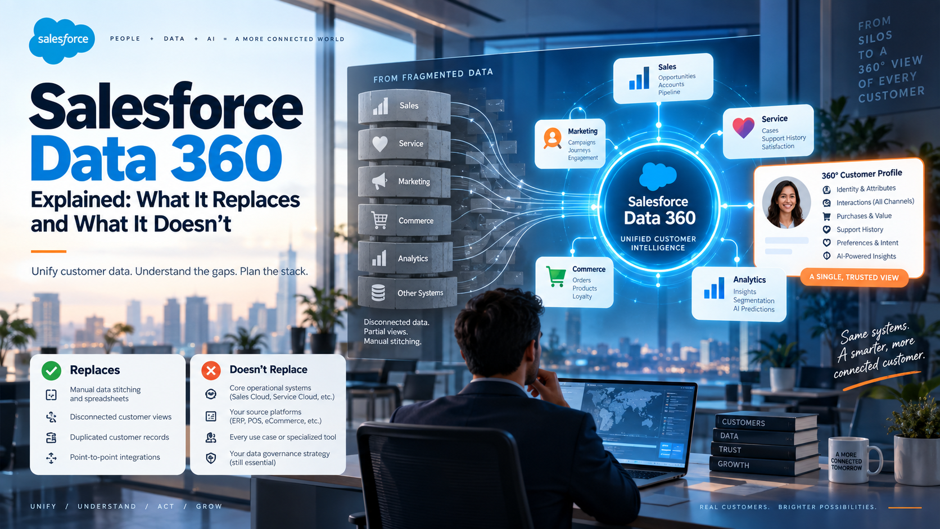
Salesforce Data 360 can look like several products at once when viewed from a distance. It ingests data, connects external platforms, supports a lakehouse architecture, resolves customer identities, creates unified profiles, calculates insights, builds segments, activates information, and supplies context for Agentforce. That breadth makes one question harder than it first appears: what existing technology is Data 360 actually supposed to replace? The answer depends less on the list of Data 360 features and more on which responsibility another platform currently owns.
The first distinction is the product name itself. Salesforce Data 360 is the current name for the product previously called Data Cloud, and Salesforce renamed Data Cloud to Data 360 on October 14, 2025. The name changed while the underlying product family continued, so organizations that already implemented Data Cloud are not looking at a separate successor that requires another migration. Older product labels, documentation names, APIs, and feature terminology can still contain “Data Cloud,” which makes the transition look more complicated than it actually is.
The harder questions concern the technologies that sit around Data 360. Its capabilities overlap with customer data platforms, profile-unification projects, data integration, segmentation tools, activation layers, warehouses, lakehouses, Master Data Management, integration platforms, analytics, and AI grounding systems. That overlap does not mean all those categories disappear when Data 360 is deployed. Salesforce’s architecture is designed to work with existing enterprise data investments, including platforms such as Snowflake, Databricks, BigQuery, Redshift, and other external systems.
A useful Data 360 business case therefore needs clear architecture boundaries before it starts talking about replacement. The platform may allow a company to retire a narrow customer-profile database, eliminate several copy-heavy pipelines, consolidate identity stitching, or move segmentation closer to Salesforce. At the same time, the warehouse, MDM platform, MuleSoft layer, ERP, operational systems, and BI environment may remain where they are because they still own different responsibilities. The goal is to remove duplicated work while keeping each system focused on the job it is best suited to perform.
TL;DR
Salesforce Data 360 is an enterprise data platform designed to connect, harmonize, unify, process, and activate information across Salesforce applications, analytics, AI, and Agentforce. It is the current name for Data Cloud, so it replaces Data Cloud as a product name, not as a separate technical platform that existing customers must migrate away from. The more important question is which surrounding data functions can move into Data 360 and which still belong in warehouses, MDM, integration, analytics, and operational platforms.
Data 360 can reduce or replace some technology when that technology mainly exists to create actionable customer context for Salesforce. The strongest candidates include:
- Custom-built customer 360 profile stores created mainly to combine Salesforce and engagement data.
- Standalone customer identity stitching used primarily for actionable unified profiles.
- Separate Salesforce-focused audience segmentation and activation tooling.
- Copy-heavy pipelines whose main purpose is moving warehouse data into Salesforce.
- Custom data preparation built mainly to support Salesforce AI and Agentforce.
- Customer-level calculation jobs used mainly for segmentation, personalization, or activation.
Data 360 generally does not replace enterprise data warehouses, lakehouses, Master Data Management, MuleSoft, ERP, billing, order systems, operational CRM records, enterprise BI, governance, or data stewardship. It can overlap with parts of those responsibilities, but the correct architecture is usually based on clear ownership rather than putting every data function into one platform. The practical question is therefore: which layer should own each responsibility after Data 360 is introduced?
What Salesforce Data 360 Actually Is
Salesforce positions Data 360 as a data platform that connects siloed enterprise information and makes it usable for analytics, AI, machine learning, activation, and agentic applications. Its architecture combines ingestion, federation, transformation, modeling, identity resolution, lakehouse storage, segmentation, calculated insights, unstructured data processing, and activation. That makes Data 360 much broader than a simple marketing database or audience tool.
At a simplified level, the platform supports a series of connected data stages:
| Stage | What Data 360 Does |
| Connect | Connects Salesforce and external data sources |
| Ingest or Federate | Copies data where needed or accesses supported external data through Zero Copy |
| Prepare | Transforms and organizes incoming information |
| Model | Maps data into Data Lake Objects and Data Model Objects |
| Unify | Links identities into unified customer or account profiles |
| Calculate | Produces calculated insights and derived measures |
| Segment | Groups profiles using business criteria |
| Activate | Sends data or audiences into Salesforce and supported destinations |
| Ground AI | Makes enterprise context usable by Agentforce and AI workloads |
Data 360 can work with structured and unstructured information, and its architecture includes a native lakehouse based on open data technologies. It supports several data access patterns, including ingestion, streaming, real-time processing, and federation. This combination explains why organizations sometimes see Data 360 as a possible replacement for several different technologies at once.
The important distinction is responsibility. A product that can store information is not automatically a warehouse replacement. Identity Resolution does not make it an MDM platform, and ingestion does not make it a replacement for every ETL or application-integration tool. Data 360 is best understood as the Salesforce data layer that prepares enterprise information for profiles, activation, analytics, AI, and operational use across Salesforce experiences.
Data 360 Replaced Data Cloud in Name, Not Architecture
The easiest replacement question has a direct answer: Data 360 is the current name for Data Cloud. Salesforce announced the rename in October 2025, and the company has continued moving product, documentation, and platform terminology toward the Data 360 name. Existing Data Cloud customers are therefore not being asked to move onto a completely different data platform simply because the brand changed.
The transition can still create confusion because older terminology remains visible in some places. Teams may encounter Data Cloud in release notes, API references, implementation documentation, configuration pages, historical architecture diagrams, or older Trailhead material. That does not mean a second platform is involved. It usually reflects the fact that product naming, technical naming, and documentation labels do not all change at the same time.
| Older Term | Current Meaning |
| Salesforce Data Cloud | Previous product name |
| Salesforce Data 360 | Current product name |
| Data Cloud Setup | Older wording may still appear in some interfaces or documents |
| Data Cloud APIs | Historical naming can remain in technical references |
| Data Cloud architecture material | Still relevant where the underlying capability remains current |
This matters during implementation research because teams can miss useful technical material if they search only for “Data 360.” Older Data Cloud implementation guides, API documentation, architecture content, and release material can still describe the capabilities that now sit under the Data 360 name. Architects need to read the publication date and capability rather than assuming older naming automatically makes the material irrelevant.
The rename also reflects a broader product position. “Data Cloud” was often interpreted as a marketing-focused CDP, while Data 360 is now positioned as an enterprise data foundation supporting Salesforce applications, analytics, AI, Agentforce, customer unification, and activation. That broader framing changes the architecture conversation even though the underlying product lineage remains continuous.
What Data 360 Can Replace or Consolidate
Data 360 can replace technology when another component mainly exists to perform a responsibility that Data 360 can now own inside the Salesforce architecture. The strongest candidates are point solutions and custom-built layers created mainly to assemble customer information for Salesforce use cases. These are very different from enterprise platforms that own broader analytics, master data, or transactional processes.
| Existing Capability | Replacement Potential | Why |
| Custom customer 360 database | High in suitable cases | Data 360 can connect, model, unify, and expose customer context |
| Customer identity stitching | High for activation use cases | Identity Resolution links source profiles into unified profiles |
| Separate Salesforce audience builder | High in suitable cases | Segmentation is native to Data 360 |
| Custom activation pipelines | Medium to high | Native activation and data actions can remove some pipelines |
| Warehouse-to-Salesforce copy jobs | Medium | Zero Copy can remove some physical data movement |
| Customer calculated-insight jobs | Medium | Calculated Insights can handle many profile-level calculations |
| Basic CDP layer | High where requirements align | Data 360 covers unification, segmentation, and activation |
| Custom AI grounding pipeline | Medium | Data 360 can prepare structured and unstructured context for Agentforce |
Consider a company that built a custom service to collect ecommerce profiles, marketing engagement, CRM records, loyalty information, and service history. The service matches those identities, creates a combined profile, calculates several customer measures, and sends the result back into Salesforce for segmentation. Data 360 can potentially absorb much of that architecture because identity unification, calculated insights, segmentation, and activation sit close to its intended role.
A similar consolidation opportunity exists around audience management. Some organizations operate a separate process whose main function is gathering Salesforce-related customer information, deciding which people belong to an audience, and sending that audience into engagement channels. When Data 360 can handle those responsibilities directly, the separate audience layer may no longer justify its maintenance cost.
Zero Copy adds another opportunity by reducing physical data duplication. If a company exports warehouse tables, loads them into an intermediate store, transforms them, and then sends another copy into Salesforce, Data 360 federation may remove part of that sequence for supported sources and use cases. The result is usually a simpler data path rather than a wholesale replacement of the warehouse or enterprise data platform.
What Data 360 Does Not Replace
The most important architecture decisions usually come from the systems Data 360 should not replace. Data 360 overlaps with several enterprise data categories, but overlap is different from full responsibility. A useful implementation keeps existing platforms when they still perform a distinct job that Data 360 does not need to own.
| Technology or Responsibility | Does Data 360 Replace It? | Reason |
| Data warehouse | Usually no | Warehouses continue serving broad enterprise analytical workloads |
| Lakehouse | Usually no | Data 360 can interoperate with existing lakehouses |
| MDM | No | Unified profiles are not authoritative golden records |
| MuleSoft/application integration | No | Application orchestration and data unification solve different problems |
| Sales or Service CRM | No | Data 360 enriches operational Salesforce applications |
| ERP/billing/order systems | No | Source systems continue owning business transactions |
| Tableau/enterprise BI | No | Data 360 supplies data and context while analytics remains a separate responsibility |
| Source-system data quality | No | Poor source data still requires governance and correction |
| Enterprise governance | No | Data 360 adds controls but does not remove governance ownership |
| Data stewardship | No | Identity rules and models still require business decisions |
A warehouse may continue to store years of finance, operations, product, or supply-chain history while Data 360 makes selected data available inside Salesforce. MDM can continue determining the mastered customer identity while Data 360 uses those trusted identifiers to create actionable profiles. MuleSoft can orchestrate business transactions while Data 360 supplies the customer context used to decide how those transactions should be handled.
The clean architecture is the one in which each platform has a specific job. Data 360 should own responsibilities that directly support Salesforce data unification, activation, analytics context, and AI. Other systems should remain when they continue to provide authoritative records, broad analytical processing, cross-application transactions, or enterprise governance.
This boundary prevents Data 360 from becoming another monolithic layer that duplicates capabilities the organization already owns elsewhere. A platform becomes easier to manage when its role is explicit and the architecture removes redundant work instead of moving every responsibility into the newest product.
Data 360 Does Not Replace Your Data Warehouse or Lakehouse
Data 360 has substantial data-platform capabilities, including storage, transformations, federation, modeling, structured and unstructured data processing, and lakehouse architecture. Those capabilities make it easy to assume that a warehouse or lakehouse can be retired once Data 360 is deployed. In many enterprise architectures, that assumption creates more migration work than business value.
Enterprise warehouses and lakehouses often support workloads that extend far beyond Salesforce. Finance teams may run corporate reporting from them, supply-chain teams may rely on historical operational data, data scientists may use them for model development, and product teams may analyze telemetry that has no reason to live inside a CRM-oriented data layer. Those platforms can also serve many applications outside the Salesforce ecosystem.
Typical warehouse or lakehouse responsibilities include:
- Enterprise finance and executive reporting
- Historical analytical datasets
- Product and operational telemetry
- Supply-chain analysis
- Regulatory reporting
- Data science workloads
- Cross-business semantic models
- Analyst SQL workloads
- Non-Salesforce application data
Data 360 becomes valuable when selected information from those systems needs to become usable in Salesforce profiles, processes, segmentation, Agentforce, personalization, or application workflows. Zero Copy makes that relationship more practical because supported external data can remain in the warehouse or lakehouse while Data 360 accesses it through federation.
This architecture can reduce duplicated storage and pipeline work without forcing the organization to relocate its analytical foundation. Some narrow customer marts may still become unnecessary because Data 360 can store or federate the same information for Salesforce use. The decision should be made at the workload level rather than treating Data 360 as a mandatory replacement for the enterprise warehouse.
Data 360 Does Not Replace Master Data Management
The boundary between Data 360 Identity Resolution and Master Data Management is one of the most important distinctions in the platform. Both technologies deal with identities, duplicates, matching, and combined customer views, which makes them look similar during early architecture discussions. Their purpose and governance model remain different.
Data 360 Identity Resolution links source profiles into unified profiles so Salesforce applications, segmentation, analytics, and AI can work with a consolidated view. The source records remain intact, and the unified profile functions as an actionable system of reference rather than an enterprise golden record that replaces the values held in source applications.
| Data 360 Unified Profile | MDM Golden Record |
| Links identities across sources | Creates an authoritative master entity |
| Preserves source profiles | Establishes mastered values |
| Supports customer context and activation | Supports enterprise master-data governance |
| Uses matching and reconciliation rules | Adds survivorship, stewardship, quality, and governance |
| Does not automatically overwrite source systems | Can distribute mastered values to connected systems |
| Built for actionable Salesforce context | Built for authoritative master-data management |
An MDM platform can still own advanced data quality and stewardship, lineage, survivorship rules, reference data, and mastered enterprise entities. Data 360 can then consume those mastered identifiers or values and use them as part of customer unification. This can produce a cleaner architecture than asking Data 360 to behave like a full MDM platform.
The distinction also affects governance. If 2 source systems disagree about the legal customer name, Data 360 may reconcile those values for a unified view, but the organization still needs a rule for which system is authoritative and how the incorrect source value should be corrected. That is a master-data and stewardship responsibility, not simply an identity-resolution problem.
Data 360 Can Reduce ETL, but It Does Not Eliminate Integration
Traditional customer-data architectures often create several copies of the same information. A source system exports records, an ETL process transforms them, a warehouse stores them, another process sends a selected copy into Salesforce, and a separate activation job sends another version into a marketing or engagement platform. Every additional copy creates cost, latency, lineage questions, and another place where logic can drift.
Data 360 can remove some of this movement because it supports both ingestion and federation. Ingestion brings data into the Data 360 lakehouse, while federation allows supported external information to remain in its source platform and become accessible through Zero Copy data federation. The choice should depend on what Data 360 needs to do with the data and whether physical movement adds value.
A useful architecture question for each dataset is: does the information need to move, or does Salesforce only need governed access to it? Warehouse data used mainly to enrich a Salesforce profile may not need another permanent copy. A stream that must drive near-real-time actions may need a different approach, and data requiring Data 360 processing may still need to be ingested.
Data 360 also contains transformation and harmonization capabilities, which means some ETL or ELT jobs created solely to prepare customer information for Salesforce can move closer to the platform. This can reduce pipeline sprawl when the transformation has no wider purpose outside the Salesforce use case.
Application integration remains distinct. A customer may ask an Agentforce service agent to cancel an order, but completing that request could require coordinated transactions across Salesforce, ERP, payment, fulfillment, inventory, and commerce platforms. That workflow needs API orchestration, error handling, transaction state, retries, and application ownership. MuleSoft or another integration platform can continue handling that work while Data 360 supplies the customer context that informs the transaction.
Data 360 Does Not Replace Operational Systems of Record
A Data 360 unified profile can become the broadest customer view an employee sees without becoming the authoritative transactional system for every attribute represented in that profile. The difference between visibility and ownership needs to remain explicit because applications still need a reliable place to create, modify, and correct business transactions.
Sales Cloud may continue to own Opportunities and sales activity, Service Cloud may own Cases, an ERP may own invoices and payment status, a commerce platform may own orders, and a subscription platform may own entitlements. Data 360 can connect those records into a richer context while the originating applications continue to control the transactions they were built to manage.
Suppose a unified profile shows an open support case, overdue invoice, recent digital engagement, current loyalty status, and high-value sales opportunity. That combined context can change how an employee or Agentforce responds to the customer. The source systems still determine whether the case is closed, the invoice is paid, loyalty points change, or the opportunity moves to another stage.
For each important Data 360 attribute, the architecture should answer several ownership questions:
- Which system creates the value?
- Which system is authoritative?
- Which applications are allowed to modify it?
- How does Data 360 receive or access the information?
- Where should a correction be written?
- Which Salesforce processes can act on the combined context?
These decisions prevent the unified profile from becoming another ambiguous source of truth. Data 360 works best when it connects authoritative information and makes it actionable, while the systems designed to own transactions remain responsible for creating and maintaining those transactions.
Data 360 Does Not Replace Tableau or the Entire Analytics Stack
Data 360 includes query capabilities, calculated insights, segmentation, transformations, and data-processing functions. These capabilities can replace some narrow analytical jobs when the resulting measure exists mainly to enrich customer profiles, drive segmentation, trigger activation, or supply Agentforce context. They do not turn Data 360 into a universal business-intelligence replacement.
Enterprise analytics covers a much wider set of needs. Analysts may explore finance data, compare business units, examine long-term trends, build semantic models, design executive dashboards, or investigate operational patterns across systems that have little connection to customer activation. Tableau and other BI environments remain suited to those broader analytical tasks.
The distinction becomes clearer when teams ask where a calculation is used. A customer lifetime value measure that controls segmentation and personalization may belong close to Data 360 if that is its primary operational role. A corporate profitability model used by finance, operations, product teams, and the board may belong in the enterprise analytics environment even if Data 360 needs access to the final result.
The architecture should also avoid recreating the same metric independently across several systems. If Data 360, the warehouse, Tableau, and a marketing platform all calculate “high-value customer” using different rules, employees and AI agents will receive conflicting answers. Define one owner for each critical measure, then expose the result to the applications that need it.
This becomes especially important as Agentforce expands. An AI agent needs trusted and understandable context rather than several incompatible versions of the same business metric. Data 360 can make governed analytical results actionable inside Salesforce without taking ownership of every analytical workload.
Where Data 360 Changes the CDP Conversation
Data 360 still includes many capabilities traditionally associated with a Customer Data Platform. It connects customer information, resolves identities, creates unified profiles, calculates insights, builds segments, and activates customer data into business processes and engagement channels. Organizations using a standalone CDP for these same jobs should therefore examine real capability overlap.
The replacement case becomes strongest when the current CDP mainly exists to prepare data for Salesforce-centric activation. If customer profiles are being assembled largely so Salesforce sales, service, marketing, commerce, or Agentforce experiences can use them, Data 360 can reduce the number of platforms involved in the process.
A CDP evaluation should consider questions such as:
- Does the current CDP provide identity capabilities that Data 360 can already handle?
- Are its segments primarily activated into Salesforce-related channels?
- Does it support important non-Salesforce use cases that must remain?
- Does the current CDP provide governance, partner data, or channel capabilities Data 360 does not replace?
- Would Data 360 reduce the number of customer-profile copies?
- Are the teams consuming the data already working primarily inside Salesforce?
Data 360 also extends beyond the traditional marketing-CDP model because unified data can support sales, service, analytics, operational workflows, Agentforce, and other Salesforce applications. That wider role means the architecture should not be evaluated only as a marketing-platform consolidation exercise.
For one company, Data 360 may replace the existing CDP entirely. For another, it may take over Salesforce profile activation while the existing enterprise data platform continues handling broader analytical work. The correct decision depends on where customer context needs to become actionable and whether the current CDP still owns responsibilities Data 360 does not cover.
Why Agentforce Makes the Data 360 Boundary More Important
Agentforce increases the importance of clear data ownership because an AI agent can reason and act on the information presented to it. A human analyst may notice that 2 sources disagree and investigate the difference before making a decision. An autonomous or semi-autonomous agent needs clearer rules about which context is trusted, current, and suitable for the action it is about to perform.
Data 360 gives Salesforce a way to make structured and unstructured enterprise information available as governed context for Salesforce AI solutions and agentic applications. Customer profiles, external data, calculated insights, knowledge, engagement history, and other supported sources can become part of the context Agentforce uses while handling a request.
This capability can reduce custom AI grounding pipelines. A company may currently export CRM records, warehouse data, customer attributes, and knowledge into another preparation layer solely so an AI application can use them together. Data 360 can take over some of that preparation when the end use is inside Salesforce and Agentforce.
The upstream responsibilities still remain. MDM may continue to own the mastered identity, the warehouse may own a risk calculation, the order platform may own current fulfillment state, and an integration layer may execute the transaction that Agentforce requests. Data 360’s role is to make the relevant context usable together inside the Salesforce decision and action path.
That boundary becomes essential for AI readiness in production. Agentforce becomes more reliable when the organization can explain where each piece of context came from, who owns it, how current it is, and whether the agent is allowed to act on it. Moving every source responsibility into Data 360 is unnecessary when federation and clear ownership can provide the same usable context with less duplication.
How to Decide What Data 360 Should Replace in Your Architecture
A Data 360 implementation should begin with responsibilities instead of product names. List what every current component does, then identify which responsibilities Data 360 can own more cleanly. This method prevents teams from retiring a platform simply because Data 360 has one overlapping feature while that platform still owns several other important jobs.
Identify the Business Outcome
Start with the outcome the architecture is supposed to improve. That may be real-time personalization, better service context, account intelligence, audience activation, Agentforce grounding, identity resolution, or a cross-cloud customer view. A technology retirement should support that outcome rather than becoming the main measure of project success.
Map Current Data Movement
Document where each important dataset starts, every copy created, each transformation applied, and every destination. Copy-heavy pipelines often reveal the strongest Data 360 consolidation opportunities because several steps may exist solely to make information usable in Salesforce.
Separate Data Access From Data Ownership
Data 360 may need access to a warehouse table without becoming the owner of that dataset. Zero Copy makes this distinction practical in supported architectures. Keep authoritative information in the current source when that source already owns the data correctly.
Identify True Capability Overlap
A separate Salesforce audience tool may become unnecessary when Data 360 owns segmentation and activation. A data warehouse serving finance, analytics, and data science is a very different case even if Data 360 can access selected tables. Replacement should follow responsibility overlap rather than a feature checklist.
Check Identity Requirements
Determine whether the organization needs actionable unified profiles or authoritative mastered entities. Data 360 supports the first through Identity Resolution. A formal enterprise MDM requirement can still need stewardship, survivorship, governance, and mastered records beyond that unified-profile layer.
Decide Which Pipelines Can Disappear
Prioritize pipelines whose main purpose is creating another Salesforce copy of data that can be ingested or federated more directly. Keep integration processes that execute business transactions, synchronize systems of record, or serve enterprise use cases Data 360 is not intended to own.
Assign the Final Owners
Every major dataset, metric, identity rule, integration, and business process should still have a named owner after the Data 360 implementation. A successful architecture should contain fewer ambiguous responsibilities than the design it replaced, even when several systems continue working together.
Conclusion
Salesforce Data 360 is not designed to replace the entire enterprise data stack. It is a Salesforce data platform built to connect, model, unify, process, and activate information so Salesforce applications, analytics, AI, and Agentforce can use richer enterprise context. Its value comes from reducing the distance between enterprise data and the business processes that need that data inside Salesforce.
Data 360 can still replace real technology. Custom customer 360 databases, narrow identity-stitching layers, Salesforce-focused audience tools, copy-heavy warehouse-to-Salesforce pipelines, and some activation processes can become unnecessary when Data 360 fully takes over those responsibilities. That consolidation can reduce duplicate data, pipeline maintenance, and the number of tools required to make customer context actionable.
The architecture boundaries matter equally. Unified profiles are different from MDM golden records, Zero Copy does not make the warehouse disappear, and data ingestion does not eliminate application integration. A broad customer view does not transfer ownership of invoices, orders, Cases, subscriptions, or other transactions away from the systems designed to own them, while calculated insights do not remove the need for broader enterprise analytics.
The strongest Data 360 architecture removes duplication while preserving useful specialization. Existing systems continue performing the jobs they handle well, while Data 360 becomes the layer that connects their information to Salesforce decisions, customer experiences, analytics, and AI. Replacement should therefore be based on responsibilities that have genuinely moved rather than on the number of features Data 360 appears to overlap.
FAQs
Is Salesforce Data 360 the Same as Data Cloud?
Yes. Salesforce renamed Data Cloud to Data 360 in October 2025, so the 2 names refer to the same continuing product family rather than separate platforms. Older documentation, API terminology, setup pages, or implementation material may still contain the Data Cloud name while the capability now sits under Data 360. Existing Data Cloud customers therefore do not need a separate product migration simply because Salesforce changed the name.
Does Salesforce Data 360 Replace a Data Warehouse?
Usually no. Data 360 can store, process, transform, and federate information, but enterprise warehouses often support finance, analytics, data science, historical reporting, and other workloads that extend far beyond Salesforce. Zero Copy can allow supported warehouse data to remain where it is while becoming usable in Data 360. Some narrow customer marts or duplicate Salesforce-focused stores may still become unnecessary.
Does Data 360 Replace Master Data Management?
No. Data 360 Identity Resolution creates unified profiles by linking related source identities, but those profiles are different from authoritative MDM golden records. An MDM platform can continue handling stewardship, survivorship, enterprise data quality, mastered entities, and distribution of trusted values. Data 360 can then use those mastered identities or attributes as part of customer unification and activation.
Does Data 360 Replace MuleSoft?
No. Data 360 can reduce some data-movement work through ingestion, transformation, federation, and Zero Copy, while MuleSoft and other integration technologies handle application and transaction orchestration. A service request may use Data 360 for customer context while MuleSoft coordinates the operational transaction across ERP, commerce, payment, or fulfillment systems. These responsibilities can work together in the same architecture.
Can Data 360 Replace a Customer Data Platform?
It can replace a standalone CDP when the organization’s needs align with Data 360’s identity resolution, profile unification, segmentation, calculated insights, and activation capabilities. The decision should also consider important non-Salesforce use cases, partner data, governance, channel support, and existing integrations. A CDP that owns broader responsibilities may continue to have a role even after Data 360 is deployed.
Does Data 360 Store Data?
Yes. Data 360 can ingest information and persist it in its data layer, while supported federation patterns allow other information to remain in external platforms. The decision between ingestion and federation depends on source support, processing requirements, latency, governance, consumption, and cost. A mature architecture can use both approaches rather than forcing every dataset into one storage model.
What Is Zero Copy in Salesforce Data 360?
Zero Copy is a federation approach that allows Data 360 to work with supported external data without requiring another physical copy to be loaded into Data 360 first. The external platform remains responsible for storing the source data while Data 360 provides metadata and modeling that make it usable in Salesforce contexts. This can reduce duplicate storage and some data-movement pipelines when the integration pattern is supported.
Does Data 360 Create a Golden Customer Record?
No. Data 360 creates unified profiles through Identity Resolution, which links related records across sources and makes them usable as combined customer context. An MDM golden record has a different role because it establishes an authoritative mastered entity using data-quality, survivorship, governance, and stewardship processes. Organizations can use MDM and Data 360 together when both requirements exist.
Can Data 360 Replace ETL Tools?
Data 360 can reduce ETL and ELT work when those pipelines mainly exist to prepare customer information for Salesforce profiles, segmentation, activation, or AI. It supports ingestion, transformations, modeling, and federation, which can remove unnecessary data copies. Enterprise data engineering and application integration can still require dedicated platforms where the same pipelines serve broader systems, analytical workloads, or operational transactions.
Does Data 360 Replace Tableau?
No. Data 360 and Tableau can work together while serving different purposes. Data 360 prepares and makes enterprise information actionable across Salesforce applications and AI, while Tableau supports broader analytics, visualization, semantic analysis, and decision support. Some customer-specific calculations may move into Data 360, but that does not remove the need for enterprise BI workloads that serve users and domains beyond Salesforce.