

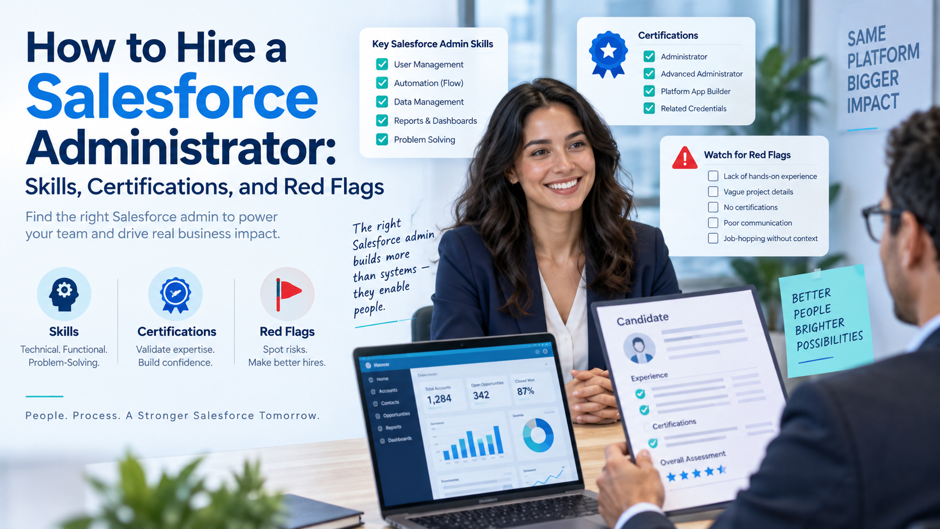
How to Hire a Salesforce Administrator: Skills, Certifications, and Red Flags
Hiring a Salesforce administrator requires more than checking a résumé for Salesforce experience and certification badges. The person may control user access, business data, Flow automation, reports, configuration changes, and day-to-day platform support. A hiring mistake can therefore affect much more than the administrator’s workload. Poor access decisions can expose information, weak data practices can damage reporting, and badly planned automation can create problems across existing business processes.
The role also changes from one organization to another. A company using a fairly standard Sales Cloud setup may need an administrator who mainly handles users, reports, data quality, and routine configuration. Another company may operate several Salesforce products with complicated permissions, connected applications, years of existing automation, and frequent release work. Those 2 environments require different levels of experience even though both positions may carry the same job title.
VALiNTRY’s Salesforce administrator staffing page describes administrators as professionals involved in system configuration, automation, reporting, data integrity, and user support. Those responsibilities provide a useful starting point, but a company should still define what its own administrator will manage before screening candidates. The strongest hiring process starts with the environment, turns that environment into clear skill requirements, and then tests whether each candidate has evidence that matches the work.
TL;DR
Hire against the Salesforce org you actually run, not a generic administrator checklist. Define the products, user count, permissions, integrations, Flow automation, reporting duties, release work, data problems, and available developer or architect support before screening candidates. Separate skills the hire must have on day 1 from areas that can be learned after joining.
Treat certifications as supporting evidence. Salesforce Certified Platform Administrator is the core credential, but practical ability still needs to be tested through project examples, credential verification, scenario questions, and a role-matched skills assessment. Focus on security judgment, data handling, Flow reasoning, troubleshooting, release discipline, and the ability to explain why a configuration choice was made.
Watch for repeated patterns rather than rejecting someone over one weak answer. Broad permission fixes, casual production changes, vague testing, shallow ownership claims, weak data awareness, and treating every stakeholder request as a build request all deserve deeper questioning. Make the final decision by comparing evidence from the résumé, interview, and practical assessment with the actual environment the administrator will own.
First Decide Whether You Actually Need a Salesforce Administrator
A Salesforce administrator usually owns the daily operation and configuration of the platform. Common responsibilities include user management, access controls, Flow, data work, reports, troubleshooting, and routine platform changes. The exact boundary depends on the company because administrators may work beside business analysts, developers, architects, or outside consultants.
Salesforce explains some of this overlap in its administrator and business analyst role comparison. Administrators are closely associated with ongoing platform work, while business analysts spend more time studying requirements and business processes. An administrator can still gather requirements, and a business analyst may understand Salesforce configuration. The difference lies in where the main responsibility sits.
| Role | Main Responsibility | When It Usually Fits |
| Salesforce administrator | Owns platform configuration and day-to-day administration | The company needs continuing ownership of users, data, automation, reports, and configuration |
| Salesforce business analyst | Studies business requirements and process needs | Projects require substantial discovery and documentation |
| Salesforce developer | Handles requirements that need programmatic work | The org depends on Apex, Lightning Web Components, or custom development |
| Salesforce architect | Guides wider technical design decisions | Several products, systems, or security models must work together |
A company that mainly needs custom code shouldn’t advertise the position as an administrator role. VALiNTRY’s Salesforce developer hiring page places Apex and custom application work within developer hiring, which illustrates the practical boundary. Some overlap will always exist, but the job description should make the dominant responsibility clear before recruitment begins.
Define the Salesforce Environment the Administrator Will Own
A useful Salesforce administrator profile begins with the org rather than a generic skills list. Hiring teams should document the products already in use, the teams that rely on them, and the kinds of changes the administrator will be expected to make. This prevents the hiring process from treating every Salesforce environment as though it requires the same experience.
User count matters, but complexity matters more. An org with 150 users and a simple sharing model can be easier to manage than an org with 70 users spread across several departments with complicated access, integrations, and old automation. The hiring team should therefore record the conditions that create day-to-day administration work.
Important areas include:
- Salesforce products currently in use
- number and type of users
- departments using the platform
- permission and sharing structure
- important integrations and managed packages
- existing Flow automation
- known data-quality problems
- reporting responsibilities
- sandbox and release practices
- current backlog of Salesforce changes
- available developer or architect support
- planned Agentforce or product expansion
Recruiters need the same information. A broad request for “a Salesforce admin” gives a Salesforce staffing team little basis for separating candidates with relevant experience from people who happen to have the right title. Product context, ownership, current problems, and expected work give the recruiter a better screening standard.
The environment should also be divided into responsibilities the administrator must handle immediately and areas that can be learned after hiring. A candidate shouldn’t be rejected because one minor feature is unfamiliar if the person’s existing experience covers the work that fills most of the position. That distinction helps employers set realistic seniority requirements without building an unnecessarily restrictive job description.
Salesforce Administrator Skills That Deserve the Closest Review
Salesforce administrator skills should reflect the org the person will manage. Salesforce’s Admin Skills Kit contains 14 skill areas and advises employers to select those that fit their organization rather than expecting every candidate to demonstrate all 14. That guidance helps prevent a common hiring mistake, where a job description becomes a long catalog of Salesforce terminology with no clear connection to daily responsibilities.
For most administrator roles, hiring teams should examine user management, security, data management, Flow, reporting, configuration, troubleshooting, and release discipline. The depth required in each area will change according to the company.
| Skill Area | What the Candidate Should Be Able to Explain |
| User management | User setup, access changes, deactivation, licensing, and recurring access problems |
| Security | Permission decisions, record visibility, field access, sharing, and least-privilege thinking |
| Data management | Imports, duplicate control, validation, field design, cleanup, and bulk changes |
| Flow | Automation design, trigger choices, testing, faults, and maintenance |
| Reporting | Turning business questions into reports while respecting access |
| Configuration | Objects, fields, record types, pages, and validation rules |
| Release work | Testing, sandbox use, deployment preparation, and recovery thinking |
| Troubleshooting | Finding the real cause before changing configuration |
User And Access Management
User administration requires more than creating accounts. An administrator should understand why someone receives access, what records the person needs, and how permissions should change when responsibilities change. This becomes especially important when different departments use the same org or when Salesforce contains sensitive business information.
Interviewers should therefore use access scenarios instead of definition questions. Ask why a user may be unable to see a record that another person can access. A strong candidate will investigate object permissions, sharing, ownership, roles, and field access before increasing permissions. Candidates who immediately grant broad access deserve further questioning because the proposed fix may hide the cause while creating a larger security problem.
Data Management
A Salesforce administrator often controls changes that affect large numbers of records. Candidates should understand object relationships, field design, validation, duplicate management, imports, exports, and bulk updates. They should also understand that changes to data can affect Flow, reports, integrations, and existing user processes.
Ask for a real example involving an import or cleanup project. The candidate should be able to explain how source data was checked, how existing records were protected, and how the result was verified after the operation. Simply naming Data Loader or another tool doesn’t prove good data judgment because most of the risk exists in planning the change rather than clicking the import button.
Flow And Automation
Flow knowledge has become important for many administrator roles because Salesforce uses Flow Builder for a wide range of declarative automation. Interviewers shouldn’t stop at asking whether someone has built flows. They should ask what business requirement the automation handled, what triggered it, and how existing automation affected the design.
Testing matters equally. Candidates should be able to discuss expected outcomes and failure conditions, along with what happens when data doesn’t meet the expected pattern. They should also recognize that adding another Flow isn’t always the right answer. An org may already contain duplicated logic or old automation that should be reviewed before another process is added.
Reports And Dashboards
Reporting skills should be assessed through business requirements. Ask candidates how they would respond if a sales manager needed better visibility into stalled opportunities or if a service leader questioned a dashboard metric. Strong answers connect the report with the business question and the reliability of the underlying data.
An administrator should also understand access. A dashboard can present misleading results if viewers have different record visibility or if required fields aren’t used consistently. The interviewer should therefore listen for candidates who think about where the data comes from before discussing chart types or dashboard layout.
Configuration And Release Work
Administrators may work with objects, fields, record types, Lightning pages, validation rules, and other declarative configuration. A Salesforce staffing agency should screen candidates against the configuration work that exists in the employer’s org rather than assuming every certified administrator has worked at the same depth.
Release discipline should be tested separately from configuration knowledge. Ask where candidates build changes, how they test them, who verifies business behavior, and what they do when something behaves differently after release. The strongest answers show that a change is controlled from the initial request through testing and deployment rather than treated as a series of clicks inside Setup.
Change management and user adoption
Administrators also need to prepare users for meaningful Salesforce changes. Ask candidates how they communicate a change and what training or documentation they provide. A useful example should explain the user impact and how people were prepared before release. Ask how the administrator identified adoption problems afterward.
Business Judgment a Salesforce Administrator Needs
Technical knowledge doesn’t remove the need for business judgment. Administrators receive requests from people who understand their operational problem but may not know which Salesforce change should solve it. A capable administrator therefore asks questions before building.
Suppose a sales manager requests another mandatory Opportunity field. The administrator should find out what decision depends on the field, who will enter the value, when that information becomes available, and whether the same information already exists. Making the field mandatory without those checks may create incomplete historical records or interfere with existing integrations.
The same reasoning applies to automation and reporting. A manager asking for several reminders may actually be dealing with an unclear sales process, while a request for a new dashboard may reveal inconsistent data entry. The administrator should identify the problem behind the requested feature before changing the org.
Communication also matters because platform changes affect users outside the Salesforce team. Administrators may need to explain why a request has changed, describe a security limitation, or give a developer enough detail to take over work that requires code. Hiring teams should look for candidates who can communicate technical choices clearly without losing the business reason behind them.
Which Salesforce Administrator Certifications Matter When Hiring?
Salesforce Administrator certifications provide useful evidence when they match the role. Salesforce’s current administrator credential catalog lists Salesforce Certified Platform Administrator as the core administrator credential, with other certifications covering deeper platform work or specialist areas.
| Certification | Hiring Relevance |
| Salesforce Certified Platform Administrator | Core credential for general administration |
| Salesforce Certified Platform Administrator II | Relevant for experienced administrators handling harder platform problems |
| Salesforce Certified Platform App Builder | Useful when declarative application design forms a regular part of the role |
| Salesforce Certified Business Analyst | Helpful when requirements work takes a large share of the position |
| Salesforce Certified Agentforce Specialist | Relevant when Agentforce administration belongs to the job |
| Salesforce Certified CPQ Administrator | Relevant when Salesforce CPQ falls within the administrator’s responsibility. Salesforce Certified CPQ Administrator is being retired on February 1, 2027. New exam registration and testing have already closed, so treat it as evidence held by existing certified candidates rather than a current certification path. |
| Salesforce Certified Marketing Cloud Engagement Administrator | Relevant when Marketing Cloud Engagement administration is required |
A company shouldn’t demand several specialist certifications unless the job genuinely involves those products. A standard Sales Cloud administrator position gains little from unrelated credentials, while a company using CPQ may have a reasonable case for product-specific certification.
Salesforce also changed the Platform Administrator exam on December 15, 2025. The current blueprint gives 17% to Data and Analytics Management, 15% to Automation, and 8% to Agentforce. Salesforce explains the change in its 2026 Platform Administrator exam update. This means current certification now includes foundational Agentforce knowledge, although it doesn’t prove advanced Agentforce administration experience.
Companies planning substantial Agentforce work should test that experience directly. The same principle applies to other specialist credentials. VALiNTRY’s Salesforce consultant hiring page covers several Salesforce roles, which highlights why credentials should be read in the context of the specific position. The useful hiring question is how each certification supports the work the candidate will actually perform.
How to Judge Real Salesforce Administration Experience
Years of experience don’t explain what a candidate actually owned. Someone may have spent 6 years working near Salesforce while performing a narrow set of tasks, while another administrator may have spent 3 years handling permissions, Flow, data changes, releases, reporting, and stakeholder requests.
Project discussions expose the difference. Ask candidates to select one change they personally handled and explain the work from the original request through release. The answer should identify the problem, the candidate’s responsibility, the approach selected, testing, and what happened after the change went live.
A weak answer may stop at, “I built several record-triggered flows.” A stronger answer explains why the automation was needed, what other automation had to be checked, why the design was selected, and what testing uncovered. The same method works for security and data questions.
Repeated use of “we” is normal in team environments, but the interviewer should still identify individual ownership. Real Salesforce administration experience becomes easier to judge when candidates explain decisions and problems instead of listing features they have seen.
Write the Salesforce Administrator Job Description Around the Actual Role
Use the job description as a role brief. Include these fields so candidates can see what the position covers before they apply.
Role scope: State the administrator’s main purpose and whether the role is junior, mid-level, senior, or expected to work independently.
Salesforce products and user groups: Name the products covered by the role and the business teams the administrator will support.
Work the administrator owns: List the day-to-day responsibilities that belong to this position, such as access, Flow, reporting, data work, releases, and support.
Required and preferred skills: Put day-1 requirements in the required list. Place useful but learnable experience in the preferred list.
Support available: State whether developers, architects, business analysts, or an outside partner are available for work outside the administrator’s responsibility.
First-stage expectations: Describe the work the administrator should take over after joining, including any immediate backlog, release duties, support handover, or known problem areas.
How to Screen Résumés and Verify Salesforce Credentials
Résumé screening should look for evidence that connects Salesforce terms with real responsibilities. Start with recent positions and identify which Salesforce products the candidate worked with. Then look for what the person actually configured, managed, tested, or maintained.
Statements such as “supported Salesforce” are too broad without context. A stronger résumé may describe user administration, Flow work, reporting ownership, data changes, release tasks, or specific platform problems. Compare those claims against the responsibilities already marked as required.
A practical screening sequence is:
- Confirm the products and type of org the candidate has worked in.
- Identify the responsibilities the candidate personally owned.
- Compare those responsibilities with the highest-priority skills.
- Check whether stakeholder-facing work appears in the candidate’s history.
- Review relevant certifications.
- Record gaps that should be tested during interviews.
Salesforce provides an official credential verification service for checking certification information. Verification confirms that a credential exists, while project discussions are still needed to judge practical ability.
VALiNTRY has also discussed the role of Salesforce admin recruiters in specialist screening. Whether a company uses a recruiter or its internal hiring team, the same principle applies: a résumé should decide who deserves further assessment rather than determine who should receive the job.
Salesforce Administrator Interview Questions That Reveal Real Ability
Scenario questions give candidates a chance to apply their knowledge. They also make memorized definitions less useful because the candidate needs to explain what they would investigate and why.
A User Cannot See Records Their Manager Can See. How Would You Investigate It?
Listen for diagnosis before access changes. A capable candidate may ask which records are affected, who owns them, what visibility is expected, and whether object access or sharing contributes to the problem. The exact sequence can differ, but granting broad permissions shouldn’t be the first response.
Follow up by changing one detail in the scenario. For example, explain that the user can see the record but can’t edit one field. This helps reveal whether the candidate understands that Salesforce access problems can exist at several levels.
Tell Me About A Flow You Built Or Repaired That Became Difficult To Maintain
Ask what created the problem and how the candidate identified it. A real example should usually involve more than describing the Flow elements on screen. Listen for discussion of business requirements, existing automation, testing, faults, or changes that had to be made later.
The answer can also reveal how the person responds to imperfect previous work. Salesforce administrators often inherit automation they didn’t design. A good candidate should be able to investigate existing behavior before deciding whether to change or replace it.
You Receive A Large Customer File That Must Be Imported. What Do You Check First?
The useful part of the answer should begin before the import. Candidates may mention duplicate risk, field mapping, required values, ownership, existing records, automation, or validation.
Ask how they would verify the result after loading the records. Someone who focuses only on completing the import may overlook the larger administration risk, which is whether Salesforce behaves correctly once the new data is present.
A Stakeholder Requests A New Custom Object. What Would You Ask Before Creating It?
The candidate should investigate the underlying business requirement before proposing a new object. Useful questions may concern existing records, relationships, reporting, ownership, access, and whether the requested structure already exists elsewhere in the org.
This scenario is valuable because it tests whether the person treats every request as an instruction or views it as a problem that needs analysis.
Walk Me Through How You Release A Configuration Change
Candidates should explain where the change is built, how it is tested, and how the business verifies expected behavior. They should also consider dependencies that could affect the release.
Different organizations use different deployment processes, so don’t require one specific tool unless the job itself requires it. Focus on whether the candidate has a repeatable process and understands the risk of releasing untested changes.
Tell Me About A Salesforce Problem Where The Reported Symptom Wasn’t The Real Cause
This question tests troubleshooting depth. A user may report a broken dashboard when the real issue is missing data, while an automation problem may turn out to involve access or a validation rule.
Ask how the candidate narrowed the possibilities. Strong answers tend to describe investigation and evidence rather than immediate configuration changes.
Tell Me About A Salesforce Request You Didn’t Build As Originally Requested
An administrator should be able to question a request without blocking the business goal. Ask the candidate why the original request was unsuitable and what alternative was eventually used.
The answer can reveal business judgment and communication ability. Candidates who can explain disagreement calmly and connect the final decision with the original business need usually provide stronger evidence than someone who says they build whatever users request.
Give Candidates a Practical Salesforce Skills Assessment
A practical assessment should resemble the work the administrator will perform. It can use a safe Salesforce environment or a written design scenario, but candidates shouldn’t be given access to the employer’s production org simply to prove skill.
One useful case is an approval-related process for a sales team. Managers need wider visibility, ordinary users should have restricted access to certain information, duplicate customer data already exists, and leadership wants reporting once the process is live. Ask the candidate how they would investigate and design the change.
| Assessment Area | What To Observe |
| Requirements | Does the candidate clarify the actual business outcome? |
| Security | Does the candidate think about minimum required access? |
| Data | Does the candidate inspect existing data before changing the design? |
| Automation | Can the candidate explain Flow choices and dependencies? |
| Testing | Does the candidate test expected behavior and failure conditions? |
| Reporting | Does the design support the information leadership needs? |
| Communication | Can the candidate explain choices clearly to business users? |
Don’t score the exercise mainly by speed. Fast configuration can hide weak assumptions. Pay attention to whether the candidate asks questions when information is missing and whether they notice that one request may affect security, data, Flow, and reporting.
The assessment should also match seniority. A junior position can focus on good fundamentals, while a senior administrator case can contain existing technical debt and competing requirements. The purpose is to create evidence about how the candidate approaches unfamiliar work.
Salesforce Administrator Red Flags to Investigate Before Hiring
Salesforce Administrator red flags should lead to further questions rather than automatic rejection. Candidates come from organizations with different team structures and release practices, so one unfamiliar answer may reflect previous working conditions. Concern becomes stronger when the same weakness appears repeatedly across the résumé, interview, and practical assessment.
| Red Flag | Why It Matters | Follow-up Question |
| Can’t explain why configuration decisions were made | May indicate shallow ownership | What alternatives did you consider, and what constraint shaped the choice? |
| Treats production changes casually | Raises testing and change-control concerns | How did you test the change and control risk before release? |
| Uses broad permissions as the default answer | Can create security exposure | What would you check before increasing a user’s access? |
| Can’t explain Flow beyond basic terminology | May indicate limited automation experience | Describe a Flow you owned. What triggered it, and how did you test it? |
| Gives little attention to data quality | Can affect reports and business processes | What data checks would you make before an import or bulk update? |
| Accepts every stakeholder request literally | Suggests weak requirements analysis | Tell me about a request you changed after clarifying the business need. |
| Can’t describe a testing process | Makes release discipline difficult to judge | Describe a real test process, including who verified the result and how you handled a failed test. |
| Gives vague answers about personal ownership | Makes experience difficult to verify | What did you personally own in that project, and which decisions were yours? |
| Claims credentials that can’t be confirmed | Requires resolution before hiring | Can you provide the credential details needed for official verification? |
| Doesn’t know when specialist support is needed | Can lead to poor technical decisions | Describe a requirement you would hand to another specialist, and explain why. |
Make the Final Hiring Decision Against the Role Requirements
The final hiring decision should return to the Salesforce environment defined at the beginning of the process. Certification count, years of experience, or a familiar employer name shouldn’t replace evidence that the candidate can handle the work.
| Evaluation Area | How To Treat It |
| Core administration ability | Required |
| Security judgment | Required |
| Data handling | Required |
| Flow experience | Based on automation in the org |
| Reporting ability | Based on role responsibilities |
| Business analysis | Required when the administrator owns stakeholder requests |
| Communication | Required |
| Release discipline | Required |
| Platform Administrator certification | Supporting evidence unless company policy requires it |
| Specialist certification | Based on products in use |
| Product-specific experience | Based on the Salesforce environment |
| Practical assessment | Strong evidence of current ability |
The matrix should support consistent comparison rather than create an artificial mathematical score. A candidate can have a manageable gap and still be the stronger hire if existing experience closely matches the security, data, automation, and stakeholder conditions in the org.
When outside recruiting support is used, the same criteria should be shared with the provider. VALiNTRY’s discussion of qualities to examine in a Salesforce staffing agency reflects the importance of Salesforce role knowledge, but specialization helps only when the requirements themselves are clear.
A strong final decision should therefore answer one question: does the available evidence show that this person can responsibly manage the Salesforce environment they are being hired to own? Certification supports that decision, while project history, interviews, and practical assessment provide the deeper evidence needed to answer it.
Frequently Asked Questions
What Does A Salesforce Administrator Do?
A Salesforce administrator manages the daily operation and configuration of a Salesforce org. Responsibilities may include users, permissions, data quality, reports, Flow automation, configuration changes, releases, and troubleshooting. Administrators also work with business users to understand requests and determine whether Salesforce should be changed. The exact role depends on the products in use and how technical responsibilities are divided across the wider team.
What Skills Should I Check Before Hiring A Salesforce Administrator?
Start with the work the administrator will actually own. Common Salesforce Administrator skills include user management, security, data handling, Flow, reports, configuration, testing, and release work. Business analysis and communication can also matter when the administrator receives requests directly from business teams. Employers should rank these abilities according to their own org rather than requiring every possible Salesforce administrator skill.
Which Salesforce Certification Should An Administrator Have?
Salesforce Certified Platform Administrator is the main credential associated with general Salesforce administration. Experienced positions may also value Platform Administrator II or Platform App Builder, while specialist certifications can matter when a role covers products such as CPQ or Agentforce. Employers should connect each credential with a real responsibility rather than requiring certifications simply because they appear in Salesforce’s credential catalog.
Is Platform Administrator Certification Enough To Hire Someone?
Platform Administrator certification confirms knowledge covered by the certification exam, but it doesn’t prove that the person can manage every Salesforce environment. Employers should still test security judgment, data work, Flow, troubleshooting, release practices, and stakeholder communication. Project examples and a practical assessment give hiring teams evidence about how the candidate applies Salesforce knowledge when faced with real requirements.
How Can I Verify A Salesforce Administrator Certification?
Salesforce maintains an official credential verification service where employers can check certification information. Verification should be completed before a certification is given significant weight in the final hiring decision. The result can confirm that a credential exists, but practical experience still needs separate assessment because certification status doesn’t show which responsibilities the candidate has owned inside a production Salesforce org.
How Much Experience Should A Salesforce Administrator Have?
There isn’t one experience requirement that fits every company. A standard Salesforce environment with clear processes may suit an administrator earlier in their career, particularly when senior support is available. A complicated environment with several products, difficult security, integrations, and years of automation may require deeper experience. Employers should compare past responsibility with current org complexity rather than relying only on years.
Does A Salesforce Administrator Need To Know Apex?
A Salesforce administrator doesn’t necessarily need to write Apex because much of the role may involve declarative configuration and Flow. The person should still understand when a requirement has moved beyond normal administrator work and needs a developer. Senior administrators can benefit from enough code awareness to discuss dependencies or troubleshoot issues, but deep Apex development should be required only when it belongs to the job.
How Should I Test Salesforce Flow Skills?
Give the candidate a realistic business process and ask how it should be automated. Discuss trigger choice, existing automation, testing, fault handling, and maintenance. A candidate with practical Flow experience should be able to explain why a particular design is suitable and what risks need to be checked before release. The interviewer should focus on reasoning instead of expecting one exact Flow layout.
What Security Knowledge Should A Salesforce Administrator Have?
The administrator should understand how Salesforce controls access to objects, records, and fields. Candidates should be able to investigate why one user has different access from another and explain how they would correct the problem without automatically granting broad permissions. Security questions should test judgment because the administrator may regularly handle requests that affect sensitive business information and record visibility.
What Are The Main Salesforce Administrator Interview Red Flags?
Common Salesforce Administrator red flags include vague ownership claims, poor testing habits, careless production changes, weak security reasoning, limited Flow depth, and little awareness of data quality. Employers should also investigate candidates who can’t explain why configuration decisions were made. One weak answer may not be decisive, but repeated problems across several parts of the hiring process deserve greater weight.
Should A Salesforce Administrator Understand Agentforce In 2026?
Foundational Agentforce knowledge has become more relevant because the current Platform Administrator exam includes an Agentforce section. The level required for a job should still depend on the employer’s Salesforce environment. A company actively implementing Agentforce may need deeper experience, while an administrator responsible for a standard Sales Cloud org may only need enough knowledge to understand where Agentforce fits within current Salesforce administration.
What Is The Difference Between A Salesforce Administrator And A Developer?
A Salesforce administrator mainly manages configuration and continuing platform operation. A Salesforce developer handles requirements that need programmatic work such as Apex or Lightning Web Components. Some overlap can occur because administrators may work with declarative automation while developers also understand platform configuration. Employers should define which type of work occupies most of the position before choosing the title and screening criteria.
Should I Hire A Junior Or Senior Salesforce Administrator?
Choose according to the complexity of the Salesforce org and the independence expected from the new hire. A junior administrator may fit an environment with established processes and access to experienced support. A senior administrator may be needed when the person must independently manage difficult permissions, old automation, release work, technical debt, and competing stakeholder requests without regular guidance from another Salesforce specialist.
Can 1 Salesforce Administrator Manage Several Salesforce Products?
One administrator can sometimes manage several Salesforce products when the environment is stable and responsibilities are clearly defined. The decision depends on user volume, integrations, change frequency, and how much specialist knowledge each product requires. A larger Salesforce estate may need several administrators or additional support from developers and architects, especially when different products contain separate technical or operational demands.
What Should I Include In A Practical Salesforce Administrator Assessment?
Use a scenario that reflects responsibilities in the open role. The assessment can test how candidates clarify a requirement, think through permissions, inspect existing data, propose Flow automation, plan testing, and explain their decisions. Keep the work inside a safe environment and judge the candidate’s reasoning rather than speed alone. The strongest assessment gives the employer evidence about how the person approaches unfamiliar Salesforce work.