

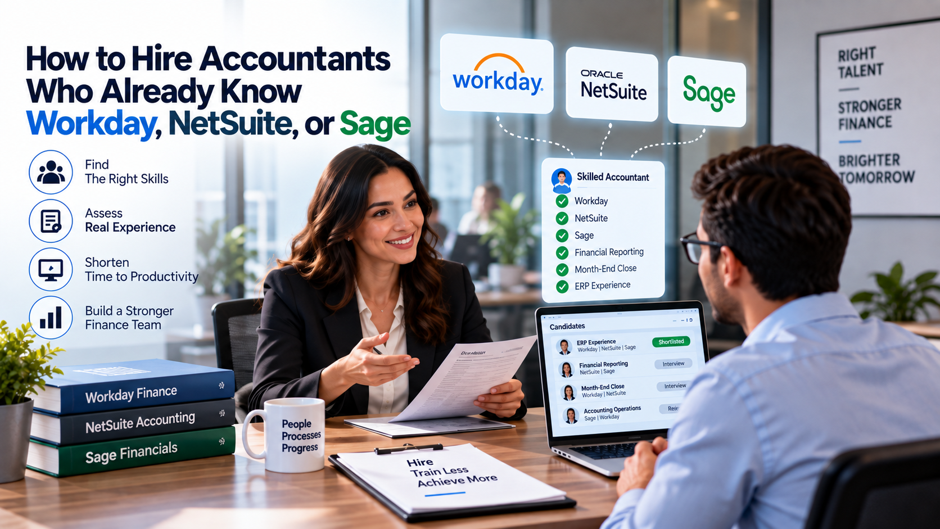
Hiring an accountant who already knows your ERP can remove a large part of the early learning curve. The person still needs to understand your chart of accounts, close calendar, approval rules, reporting expectations, entity structure, and business model, but they do not have to learn the basic logic of the finance system at the same time. That matters when the finance and accounting team needs specialized staffing support, month-end is approaching, or the new hire needs to contribute within the first few weeks.
The hard part is proving that the software experience on a resume is real and relevant. A candidate can list Workday after using it only for expenses, mention NetSuite after running a few reports, or write Sage without identifying whether they used Sage Intacct, Sage 100, Sage 300, or Sage 50. Those experiences are not equal to closing the books, reconciling accounts, resolving transaction errors, building financial reports, or working across several entities in the exact finance environment your team uses.
The hiring process should therefore start with accounting work and move backward to the system. Define what the person must own during the first 90 days, identify where those tasks happen in your ERP, and then screen for candidates who can explain similar work from a previous role. This approach prevents recruiters from treating software names as proof and helps hiring managers separate product familiarity from real accounting responsibility.
TL;DR
The strongest way to hire accountants with prior Workday, NetSuite, or Sage experience is to verify workflow experience rather than software-name recognition. The exact ERP matters, but the accounting process, level of responsibility, environment complexity, and recency of experience tell you much more about whether the candidate can become productive quickly.
| Hiring Need | What to Verify |
| Staff Accountant | Journals, reconciliations, close tasks, financial reporting |
| Senior Accountant | Close ownership, intercompany, accruals, variance investigation, reporting |
| AP Accountant | Supplier invoices, matching, approvals, payments, exception handling |
| AR Accountant | Billing, receipts, cash application, collections, account reconciliation |
| Revenue Accountant | Contracts, billing, revenue activity, adjustments, reconciliation |
| Controller | Close governance, consolidation, controls, reporting, team oversight |
| Workday Accountant | Exact Financial Management workflows and Workday-specific structures |
| NetSuite Accountant | Financial transactions, subsidiaries, saved searches, reports, close processes |
| Sage Accountant | Exact Sage product plus accounting workflows performed |
| Finance Systems Accountant | Accounting knowledge plus configuration, reporting, security, or integrations |
A good screening process should ask candidates to name the exact product and modules they used, explain the accounting tasks they performed inside that system, and describe the size and complexity of the environment. Hiring teams should also separate end-user experience from configuration or implementation work, because an accountant who closes the books in NetSuite has a different skill set from a consultant who configured NetSuite but never owned close activities.
Certifications can support the evidence, but they should not replace it. The best candidate is usually the accountant whose previous responsibilities most closely resemble the work you need them to own, even if another applicant has more total years in the software.
Start With the Accounting Process Before the ERP Name
A job description that says “5 years of Workday experience required” sounds precise but tells candidates very little about the actual work. Two accountants can spend years using Workday Financial Management while performing completely different tasks. One may own supplier invoices and payments, another may spend most of the month on journals, reconciliations, intercompany activity, consolidation, and reporting.
The hiring manager should first break the role into accounting responsibilities, then map those responsibilities to the ERP. This creates a clearer search and makes screening more consistent because recruiters know what evidence to look for beyond the product name.
| Accounting Responsibility | ERP Evidence to Look For |
| Month-end close | Journals, close calendar, reconciliations, accruals, adjustments |
| Accounts payable | Supplier setup, invoices, matching, approvals, payments |
| Accounts receivable | Billing, receipts, cash application, collections |
| Intercompany | Due-to/due-from, eliminations, settlements, entity balancing |
| Consolidation | Multiple entities, currency translation, eliminations, consolidated reporting |
| Financial reporting | Standard reports, custom reports, saved searches, dimensions or worktags |
| Fixed assets | Additions, depreciation, transfers, disposals, reconciliation |
| Revenue | Contracts, billing, schedules, revenue treatment, adjustments |
| Controls | Approvals, roles, access, review evidence, exception handling |
This process-first approach also prevents the ERP requirement from becoming more restrictive than the job. Employers can use detailed finance and accounting job descriptions to clarify the actual responsibilities before making platform knowledge mandatory. If the new hire needs to own Workday record-to-report activities from the first close, exact Workday experience may be important.
Define Exactly What “Already Knows Workday” Means
Workday experience needs careful screening because Workday supports much more than finance. Organizations looking specifically for Workday accounting talent need to distinguish Financial Management experience from payroll, time tracking, benefits, recruiting, expenses, or employee self-service exposure. For an accounting role, the resume should either name Financial Management directly or describe finance processes clearly enough that the recruiter can see the connection.
Record-to-report experience: Ask whether the candidate prepared or reviewed journals, accruals, adjustments, reconciliations, allocations, intercompany activity, and period-close tasks. A strong candidate should be able to explain which steps they personally owned, what approvals were involved, and how they investigated incorrect balances or failed transactions during close.
Procure-to-pay experience: For AP-focused roles, verify supplier invoices, matching, approvals, payments, exceptions, and the relationship between purchasing and accounting. Someone who approved occasional expenses has a much narrower Workday background than an accountant who managed supplier accounting every day and resolved posting issues before close.
Contracts-to-cash experience: For AR, billing, and revenue positions, ask about customer accounts, contracts, invoices, payments, adjustments, and reconciliation. The candidate should be able to describe how activity moved from a business event into accounting and how they handled exceptions that prevented the expected result.
Reporting experience: Workday’s multidimensional model means reporting can depend on worktags, companies, business objects, and other structures. A candidate who needs to build or investigate financial reports should be able to explain what they reported on, how they filtered or analyzed data, and how the report supported close, management review, or another finance decision.
Know What Strong NetSuite Experience Looks Like
NetSuite is common on accounting resumes, but the depth behind the name varies widely. Employers recruiting NetSuite Cloud accounting staff should distinguish daily financial users from candidates whose experience is mainly configuration or administration. The role should determine which version of “NetSuite experience” matters.
- Transactions and posting: Ask which transactions the candidate created, approved, reviewed, corrected, or reconciled. A useful answer should name the accounting responsibility, not only the screen or menu used.
- Month-end close: Ask which parts of the close the candidate personally owned. Strong answers may include journals, reconciliations, accruals, period controls, intercompany activity, variance review, and the preparation or review of financial statements.
- Reporting and investigation: Verify whether the candidate used standard financial reports, saved searches, SuiteAnalytics, exported data, or another reporting method. The important point is how the person used those tools to answer accounting questions or trace a problem.
- Roles and controls: Senior accountants and systems-focused roles may need to understand permissions, approvals, segregation of duties, and the effect of role access on accounting work. Basic users may only need to know how those controls affected their own responsibilities.
- Administration or implementation: If the resume says the candidate “managed NetSuite,” ask exactly what that meant. They may have been the finance team’s system owner, a power user who coordinated support tickets, or someone who changed configuration directly. Those are different levels of experience and should not receive the same score.
NetSuite certifications can help separate foundational product knowledge from deeper financial-user, administration, or implementation knowledge. They are useful supporting evidence, but they do not replace proof that the candidate can perform the accounting work required by the vacancy.
“Sage Experience” Is Too Broad for a Job Requirement
Sage is a product family, not one accounting system. Employers looking for Sage accounting staff should therefore avoid treating the product name alone as sufficient evidence. A resume that says “Sage” can refer to Sage Intacct, Sage 100, Sage 300, Sage 50, or another Sage product.
The distinction is supported by the broader Sage product portfolio, which includes several accounting and business-management products designed for different types of organizations. These systems expose different workflows, reporting structures, modules, and administrative responsibilities.
| Vague Requirement | Better Requirement |
| Sage experience | Sage Intacct experience |
| Sage accounting software | Sage 100 financial-module experience |
| Sage preferred | Sage 300 GL/AP/AR experience |
| 3 years of Sage | 3 years using Sage Intacct for multi-entity accounting and close |
| Sage reporting | Name the product and specific reporting responsibilities |
Recruiters should ask “Which Sage product?” before they make any judgment about fit. An accountant with 6 years of Sage 50 experience has real Sage knowledge, but that does not prove the person can step into a Sage Intacct environment with dimensions, multiple entities, and a different reporting model without training.
Core accounting skills still transfer. A strong accountant with deep close, reconciliation, and reporting experience may learn another Sage product faster than a weak accountant who already recognizes the target interface. The product requirement should reflect how urgently the person must become productive and how difficult your configuration is to learn.
What to Verify for Sage Intacct
Sage Intacct deserves its own screening approach because many employers use “Sage” when they specifically mean Intacct. The system has a dimensional accounting structure, multi-entity capabilities, financial reporting, and several finance modules, so the interview should focus on the areas the person will use after hire.
General ledger and close: Ask about journal entries, recurring entries, reconciliations, close responsibilities, and how the candidate investigated unexpected balances. A strong answer should connect system activity to accounting judgment rather than focus only on navigation.
Dimensions and reporting: Verify how the candidate used dimensions in reporting and analysis. Ask what dimensions were important in the previous company, how they were used in financial reports, and what the candidate did when a transaction was coded to the wrong combination.
Multi-entity work: For senior positions, ask about intercompany activity, entity reporting, consolidations, eliminations, and any currency issues the candidate handled. Someone who worked for a multi-entity company but only supported one local ledger may have less transferable experience than the resume initially suggests.
AP, AR, and other modules: Match questions to the role. AP candidates should discuss invoices, approvals, payments, and exceptions, while AR candidates should discuss billing, receipts, cash application, customer balances, and collections. Fixed asset, project, revenue, and purchasing knowledge should be verified only when those areas matter to the vacancy.
Build an ERP Experience Matrix Before Sourcing
Recruiters can improve the quality of the search by creating a short experience matrix before opening the requisition. Experienced finance and accounting recruiters can use that matrix to separate essential system experience from skills the employer can reasonably teach after hire. This makes the search more focused and prevents an ERP preference from turning into an unnecessary barrier.
| Requirement | Must Have | Useful | Train After Hire |
| Accounting fundamentals | Yes | ||
| Month-end close ownership | Yes for close roles | ||
| Target ERP experience | Depends on urgency | Yes | Possible |
| Exact module experience | Role-dependent | Yes | Possible |
| Multi-entity accounting | If the role owns it | Yes | |
| Report building | If part of the job | Yes | Possible |
| System configuration | Systems-focused roles only | Yes | Usually |
| Industry experience | Only when truly required | Yes | Often |
| Certification | Rarely | Yes | Possible |
| Exact chart of accounts | Yes | ||
| Company-specific workflows | Yes |
Write the Job Description Around Tasks, Not Software Years
Years of ERP experience are a weak measure of depth because people can spend many years repeating a narrow set of tasks. Employers can improve the specification by using role-specific finance and accounting job descriptions as a reference for actual responsibilities rather than treating a software tenure requirement as the main qualification. Another accountant can build broader experience in a shorter period by owning close, intercompany activity, reporting, acquisitions, system changes, and several entities.
For NetSuite: Replace “5+ years of NetSuite required” with a description such as “Hands-on NetSuite experience supporting month-end close, journal entries, balance-sheet reconciliations, intercompany activity, and financial reporting in a multi-entity environment.” This gives recruiters better search language and gives candidates enough information to judge their own fit.
For Workday: Replace “Must know Workday” with “Hands-on Workday Financial Management experience supporting record-to-report activities, including journals, account reconciliation, period close, and financial reporting.” This prevents general Workday exposure from being mistaken for finance experience.
For Sage Intacct: Replace “Sage experience preferred” with “Experience using Sage Intacct for general ledger, month-end close, dimensions, reconciliations, and multi-entity reporting.” Naming the exact product and tasks reduces false matches and produces better interview evidence.
The same principle applies to seniority. A staff accountant does not need system administration skills unless the job actually includes them, while a finance systems accountant may need deeper configuration and reporting knowledge than a controller. Requirements should match work that will appear in the employee’s real week.
Read Resumes for Evidence of ERP Depth
A strong resume usually connects the ERP with an accounting process, a level of ownership, and some indication of complexity. Teams trying to hire staff accountants who can contribute quickly should look beyond phrases such as “proficient in Workday” or “used NetSuite,” because those descriptions give recruiters too little evidence to determine whether the person can step into the role quickly.
- Look for process ownership: Statements such as “owned month-end close activities in Workday Financial Management” or “prepared and reviewed journal entries and reconciliations in NetSuite” show more than a software keyword because they connect the system to accounting responsibility.
- Look for environment complexity: Multi-entity, multi-currency, intercompany, acquisition, revenue, fixed asset, or high-volume transaction experience can matter when your own environment contains the same challenges. The candidate should still be asked which parts they personally handled.
- Look for problem solving: Good resumes may mention resolving posting errors, investigating reconciliation differences, improving close tasks, supporting an ERP migration, or correcting reporting logic. These examples show how the candidate worked when the system did not produce the expected result.
- Look for reporting depth: Financial reporting, saved searches, dimensions, worktags, analytics, or custom report work can be important when the role requires investigation and management reporting. The relevance depends on the job, so these skills should not become mandatory for every accounting position.
- Look for recency: Recent hands-on experience matters when the hire must contribute immediately. A candidate who last used the target ERP several years ago may still have useful knowledge, but cloud products, company configurations, and work habits change enough that some refresh time should be expected.
Use Screening Questions That Require Real Experience
Software trivia is easy to rehearse and weak at separating daily users from candidates who have only light exposure. Scenario questions work better because they force the person to connect accounting knowledge with system behavior. The best questions match the exact responsibilities in the job description.
Workday Screening Questions
Ask the candidate to walk through their role in the period-close process and identify the tasks they personally performed in Workday Financial Management. Follow with questions about journals, reconciliations, worktags, companies, approvals, intercompany activity, or reporting based on the job. For a senior role, ask about a transaction that posted incorrectly or failed a control and how they investigated it. A strong answer should explain the accounting problem, the Workday process used to investigate it, the people involved, and how the issue was corrected.
NetSuite Screening Questions
Ask which transactions and financial processes the candidate used during close, whether they worked with subsidiaries, and how they investigated a balance that did not reconcile. Candidates claiming NetSuite OneWorld experience should be able to explain their responsibilities across subsidiaries, currencies, intercompany activity, or consolidation rather than simply state that their employer had several legal entities.
For reporting-heavy jobs, ask whether they used standard reports, saved searches, SuiteAnalytics, or exported data, then ask what business or accounting question the output answered.
Sage Screening Questions
Start by asking which Sage product the candidate used. Once they identify Sage Intacct, Sage 100, Sage 300, Sage 50, or another product, ask questions that match the modules and processes relevant to your environment. For Sage Intacct, dimensions, close, multi-entity work, reporting, and transaction investigation can reveal depth quickly. For other Sage products, tailor the interview to the GL, AP, AR, inventory, project, or reporting modules the role will actually use.
Use a Short Work Sample Instead of a Software Trivia Test
A good accounting work sample tests judgment and system familiarity without asking candidates to reveal confidential information from a previous employer. Use synthetic transactions, screenshots, sample reports, or a written scenario that resembles the decisions the person will make after hire. The exercise should measure the work, not memory of a particular menu path.
For a senior accountant, provide a reconciliation with several unexplained differences and ask how the candidate would investigate them. For an AP role, employers filling accounts payable vacancies can show an invoice exception and ask what information the person would verify before posting or payment. For a reporting role, provide a sample P&L issue and ask how the candidate would trace the amount to supporting activity and determine whether the problem comes from coding, timing, configuration, or the source transaction.
ERP knowledge can be built into the same exercise. Ask where the candidate would expect to look in Workday, NetSuite, or Sage and what type of transaction, report, dimension, worktag, search, or supporting record they would examine. The explanation is more important than whether the person remembers the exact name of every screen.
Keep the work sample short and job-related. A 30-to-45-minute exercise can provide useful evidence without turning the interview process into unpaid project work. Decide the scoring criteria before candidates complete the exercise so the hiring team evaluates everyone against the same accounting and system behaviors. Keep the exercise tied to essential job duties, administer and score it consistently, and provide reasonable accommodation where required.
Certifications Help, but They Should Not Replace Verification
ERP certifications can support a hiring decision when the credential matches the work, but each vendor structures training differently. For example, official Workday Pro certifications cover specific Financial Management areas, while Sage provides its own product-specific learning options. Hiring teams should verify the exact certification title and understand what it covers before giving it significant weight.
Workday Pro is available to Workday customers and partners, and Financial Management certifications such as Record to Report, Procure to Pay, and Contracts to Cash can cover configuration and administration as well as process knowledge. Treat these credentials as evidence of deeper Workday knowledge, then verify whether the candidate actually performed daily accounting and close work.
| Platform | Credential Type to Look For | What It Can Support |
| Workday | Financial process or reporting certifications | Specific Workday process or reporting knowledge |
| NetSuite | Financial User, SuiteFoundation, Administrator, ERP Consultant | Ranges from financial-user knowledge to administration and implementation |
| Sage Intacct | Role-based Sage Intacct certifications | Product knowledge tied to a defined learning path |
The absence of certification does not prove that a candidate lacks experience. A controller may have used NetSuite daily for many years without pursuing a formal credential, while a candidate with a foundation-level certification may still have limited responsibility for close, reconciliation, or reporting. Practical ownership should therefore carry more weight than the credential alone.
Certification matters more when the role includes system ownership, administration, implementation support, or a specific technical responsibility. Sage, for example, provides Sage Intacct training and role-based certification options for users who need deeper product knowledge, but practical accounting responsibility should still be checked separately.
Match ERP Depth to the Accounting Role
The amount and type of ERP knowledge required should follow the responsibility of the job. A controller needs broad visibility across close, reporting, controls, and entities, while an AP specialist can succeed with deep knowledge of a narrower transaction workflow. A finance systems analyst may need more configuration and security knowledge than either of them.
| Role | ERP Depth to Prioritize |
| AP Specialist | Supplier invoices, matching, approvals, payments, exceptions |
| AR Specialist | Billing, receipts, cash application, collections, customer balances |
| Staff Accountant | Journals, reconciliations, close, financial reports |
| Senior Accountant | Close ownership, accruals, intercompany, variance investigation |
| Revenue Accountant | Contracts, billing, revenue activity, reconciliations |
| Fixed Asset Accountant | Additions, depreciation, transfers, disposals, reconciliation |
| Financial Analyst | Reporting, actuals, dimensions/worktags, extracts, analysis |
| Controller | Close governance, entities, consolidation, controls, reporting |
| Finance Systems Analyst | Accounting processes, configuration, security, reporting, integrations |
| Accounting Manager | Workflow ownership, review, close coordination, team controls |
This role-based approach prevents employers from requiring “advanced ERP knowledge” without defining what advanced means. A candidate should be judged on whether they can perform the system-dependent responsibilities of the job, not on whether they know every feature the ERP offers.
Know When to Accept Transferable ERP Experience
Exact-platform experience is most valuable when the vacancy is urgent, the finance team has little training capacity, or the new employee must own a critical process immediately. It becomes less important when the organization can support learning and the candidate brings stronger accounting judgment than the exact-platform applicants available in the market.
- Keep the requirement strict when immediate ownership matters: If the new senior accountant must lead NetSuite close next week or take over Workday reconciliations during an active vacancy, direct experience can reduce operating risk during the handoff.
- Widen the search when system learning is realistic: An accountant who has managed multi-entity close, intercompany activity, reconciliations, and financial reporting in another cloud ERP already understands many of the underlying accounting problems. They still need to learn the interface and data model, but they are not learning accounting from the beginning.
- Compare environment similarity, not only software names: A candidate from a complex multi-entity ERP environment may transfer more effectively than someone with the exact product who worked only in a simple single-entity process. The closer the accounting responsibilities match, the more useful the prior experience becomes.
- Price the learning gap honestly: Hiring managers should estimate how much support the candidate will need during the first 30, 60, and 90 days. If the team can absorb that ramp and the accountant is stronger overall, exact-system experience may not be worth excluding them.
Transferable experience should be treated as a measured tradeoff rather than a fallback. A specialized accounting staffing agency can widen the candidate pool while still screening for comparable process ownership and ERP complexity. The goal remains to hire the accountant who can become effective fastest without sacrificing the accounting judgment the role requires long term.
Build the Interview Scorecard Before Meeting Candidates
A structured scorecard keeps the team from overvaluing software fluency or interview confidence. The strongest candidate needs accounting knowledge, relevant ERP ability, sound judgment, and enough communication skill to work with the people who depend on finance. Those dimensions should be scored separately so one strength does not hide a serious weakness elsewhere.
| Dimension | Evidence to Collect |
| Accounting fundamentals | Technical questions and previous responsibilities |
| Target ERP knowledge | Workflow explanations and examples |
| Close experience | Ownership of real close tasks |
| Problem solving | Scenario or work sample |
| Reporting | Examples of reports and investigations |
| Controls | Approval, audit, reconciliation, security experience |
| Environment complexity | Entities, currencies, integrations, transaction volume |
| Communication | Explanation of accounting issues to stakeholders |
| Learning ability | Example of learning a new process or system |
| Certification | Supporting evidence where relevant |
Score the candidate on the work required rather than their confidence with product terminology. Someone who speaks fluently about NetSuite but cannot explain a reconciliation problem should not outscore an experienced accountant who occasionally forgets a feature name but can walk through the accounting process accurately.
The scorecard also helps when candidates come from different systems. A strong Sage Intacct accountant applying for a NetSuite role can receive credit for transferable multi-entity close experience while the hiring team records the expected NetSuite learning gap separately. That produces a more useful comparison than a simple pass-or-fail system keyword.
Conclusion
Hiring accountants who already know Workday, NetSuite, or Sage starts with a more precise definition of “know.” Product exposure can range from approving an expense to owning the financial close, building reports, resolving posting errors, maintaining configuration, or supporting an implementation. A resume containing the ERP name gives recruiters a lead, but the hiring process still has to prove the level and relevance of that experience.
Workday candidates should be screened against the Financial Management process they need to own, such as record to report, procure to pay, or contracts to cash, because those areas represent different finance responsibilities. NetSuite candidates should be assessed according to their actual transaction, close, reporting, OneWorld, or administration responsibilities, while Sage candidates should always identify the exact Sage product before the employer assumes their experience matches the environment.
The strongest process defines the accounting work first, maps that work to the ERP, asks candidates to explain real workflows, and checks the complexity of their previous environment. A short work sample can then test accounting judgment and system familiarity together, while certifications provide supporting evidence where they genuinely match the role.
Exact ERP experience can shorten ramp time, but it should not replace accounting quality as the main hiring standard. The best hire is the accountant who can bring sound accounting judgment into your system quickly, understand where transactions and reports fit in the close, and take ownership of the work your team actually needs done.
FAQs
How Can You Tell Whether an Accountant Really Knows Workday?
Ask specifically about Workday Financial Management and the accounting processes the candidate performed. A strong candidate should be able to explain journals, close tasks, reconciliations, worktags, supplier or customer accounting, reporting, or another finance workflow that matches the role. General Workday experience may come from HCM, payroll, expenses, recruiting, or employee self-service, so the interview should establish whether the person worked inside the financial processes your team uses and what they personally owned.
What Workday Experience Should a Senior Accountant Have?
A senior accountant may need experience with journals, accruals, account reconciliation, intercompany transactions, period close, reporting, and variance investigation. The exact mix depends on how the organization uses Workday and how responsibilities are divided across the team. The strongest candidate should explain which close activities they prepared, which they reviewed, how they investigated exceptions, and how Workday’s structures affected their reporting or reconciliation work rather than simply state that they used Workday Financial Management.
What NetSuite Certification Is Relevant for Accountants?
NetSuite certifications can range from financial-user and foundation knowledge to administration and ERP consulting. The best credential depends on the job. A financial-user credential can support an accountant’s product knowledge, while Administrator or ERP Consultant credentials point toward deeper configuration or implementation responsibilities. Hiring teams should still verify close, reconciliations, transactions, reporting, entities, and other accounting work because certification confirms a body of product knowledge but does not prove that the candidate owned the exact process required by the vacancy.
What Does Sage Experience Mean on an Accountant’s Resume?
It is too broad to evaluate without clarification. Sage offers several products, including Sage Intacct, Sage 100, Sage 300, and Sage 50, and experience in one product does not prove equal knowledge of another. Recruiters should ask for the exact application, modules used, accounting workflows performed, number of entities, reporting responsibilities, and recency of hands-on use. That information is much more useful than the word “Sage” alone when deciding whether the candidate can step into the current environment quickly.
What Should You Ask a Sage Intacct Accountant in an Interview?
Ask which accounting areas the person owned, how they used dimensions, what they did during month-end close, whether they worked across several entities, and how they investigated transactions or balances that did not reconcile. Reporting questions are useful when the role includes financial analysis or management reporting. The candidate should explain real accounting work in Sage Intacct, including how they handled exceptions and close pressure, rather than focus only on navigation or terminology.
Should You Hire a Strong Accountant Who Has Not Used Your ERP?
Yes when the company has enough time and internal capacity to support system learning and the candidate has stronger accounting experience than the exact-platform alternatives. Accounting concepts such as reconciliations, accruals, controls, close, intercompany, and financial reporting transfer across systems. The hiring team should estimate the learning gap, compare the candidate’s previous environment with the new one, and decide whether the expected ramp fits the operational needs of the first 30 to 90 days.
What Is the Best Way to Test ERP Skills Before Hiring?
Use a short job-related scenario that combines accounting judgment with system familiarity. Give the candidate a synthetic reconciliation, transaction problem, close issue, or reporting question and ask how they would investigate it in the target ERP. The person should explain both the accounting logic and the places they would expect to look in Workday, NetSuite, or Sage. Avoid tests based mainly on memorizing exact menu locations because they reward recall more than the reasoning required on the job.