

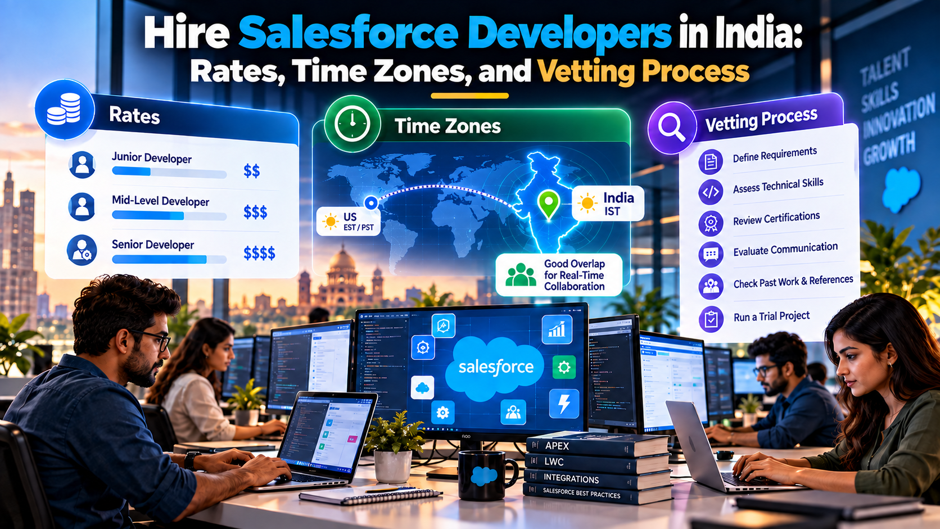
A US software company with a growing Salesforce org gets 3 quotes for an India-based Salesforce developer: $1,290 a month all-inclusive, $40 an hour from a staffing partner and $85 an hour from a consulting firm with an Indian delivery center. All 3 describe the same job title. The cheapest quote is a fraction of the highest, the working day barely overlaps with the US team, and nobody can say which of the 3 developers can write bulk-safe Apex, so the hiring decision turns on rates, time zones and vetting at once.
This guide covers all 3 topics in the order a hiring manager meets them: what published rates say and why they disagree, how engagement models change the real cost, how the India time zone affects collaboration with the US, UK, Europe and Australia, and how to vet developers with technical tests, credential checks and a paid trial. Most rate figures come from vendors that sell these services and conflict with each other, so treat them as ranges to test against real quotes, and involve legal counsel on contract and tax questions.
TL;DR
- Published rates for India range widely and measure different things. Mid-level Salesforce developers appear at about $28 to $55 an hour across vendor guides, senior developers at $45 to $70 and architects at $60 to $120, while all-inclusive monthly offers can start near $1,290, so compare quotes on the same basis, including what is included in the price. Ask each vendor to state seniority, certifications, tools and inclusions in writing.
- The quoted rate is a starting point, and the loaded cost is higher. Vendor guides put total cost at 1.4 to 1.8 times the quoted rate once management, ramp-up, attrition buffer and tooling are counted, and a developer quoted at $40 an hour would then cost $56 to $72, which is still well below most US rates but changes the business case. Ask vendors for loaded estimates so the comparison is fair.
- Time zones and vetting decide whether the savings are real. A standard Indian workday has little natural overlap with the US, so teams need staggered shifts or asynchronous habits, and a staged vetting process with live coding, scenario questions, verified certifications and a paid trial protects against the common failure of a strong resume and a weak developer. Ask each candidate to code live and complete a paid trial before committing.
Why Companies Hire Salesforce Developers in India
India offers the deepest pool of Salesforce talent available to offshore buyers. 1 vendor benchmark describes India as combining the highest depth of certified professionals, the lowest cost and the largest presence of Summit-level Salesforce partners among offshore markets, and others cite a developer pool in the millions. For a company with a long backlog, a steady stream of enhancement work or a need for several specialists at once, those numbers explain why India is often the first offshore market considered.
Cost is the headline reason, though it’s rarely the only one. Teams add India-based developers to extend coverage, add admin and support capacity, take over routine release work from senior staff and supplement Salesforce consulting teams on projects that need skills in Sales, Service, Marketing, CPQ or Health Cloud. A company with 5 India-based developers gets an annual cost of 1 vendor compared to about 1.5 US-based developers, and that gap funds work the budget couldn’t otherwise support.
India isn’t automatically the right default, however. 1 offshore analysis argues that management overhead, the time zone gap for US agile teams and growing competition from Vietnam and the Philippines mean buyers should compare options instead of defaulting to India. The rest of this guide helps a hiring manager decide where India fits by looking at real cost, collaboration model and vetting rigor, since a strong process matters more than the location chosen.
Rates at a Glance
| Role or Model | Reported India Range | Source Type and Notes |
| Mid-level developer | $28 to $45 per hour, $35 to $55 and $25 to $60 in other guides | Vendor guides that differ by definition of mid-level and engagement model |
| Senior developer | $45 to $70 per hour | Offshore benchmark for 2026 |
| Solution architect | $60 to $90 per hour, with $65 to $90 in another guide | Enterprise multi-cloud design roles |
| Technical architect | $80 to $120 per hour | Highest tier in 1 benchmark |
| Specialist developers | $40 to $65 for Marketing Cloud, $50 to $80 for Health Cloud | Specialty premiums reported by 1 benchmark |
| All-inclusive dedicated developer | About $1,290 per month, and $1,700 to $2,400 per month through an employer of record | Provider offers that bundle salary, payroll and infrastructure |
| US comparison | $100 to $150 per hour for mid-level, and $180 to $250 for architects | Vendor-reported US ranges, which also vary widely |
| Consulting partner | $150 to $250 per hour for certified developers | Agency rates reported by 1 hiring guide |
The table shows the problem with a single number. A mid-level developer might cost $28 an hour, $55 an hour or $1,290 a month depending on who is quoting and what the quote covers, and general offshore guides for India, which cover all software beyond Salesforce, show lower ranges of $15 to $30 and $18 to $45. Use the table to frame questions for vendors instead of treating it as a price list.
Why Published Rates Disagree
Quoted Rates and Loaded Rates Are Different Things A staffing partner quoting $40 an hour may include salary, benefits, recruiting and margin, while a freelancer’s $40 covers only their time and leaves taxes, tools and idle weeks to them. A dedicated-team monthly fee may bundle infrastructure and HR, and a consulting firm’s rate bundles project management and a delivery bench. Without a shared definition of what’s included, comparing numbers is like comparing a car’s sticker price with a lease payment.
Seniority and Specialization Labels Aren’t Standard Vendors define mid-level differently, with ranges such as 3 to 5 years of experience in 1 guide and 4 to 7 in another. A developer with Sales Cloud customization experience isn’t equivalent to 1 who has built CPQ pricing logic or Health Cloud integrations, and published ranges show specialty premiums of $10 to $25 an hour. Define the experience, certifications and project types you need before asking for quotes, then compare candidates at the same level.
Engagement Model and Location Within India Change the Price A freelancer, a staffing partner, a dedicated team vendor, an employer of record and a consulting firm each price differently, as the engagement table below shows. Location within India matters too, since rates in major technology hubs generally exceed rates in smaller cities, and remote work blurs the difference. Ask vendors where the developers sit, how the work is supervised and what happens when someone leaves, because those answers explain gaps between quotes.
Sources Have Commercial Interests Nearly every published guide comes from a company that sells Salesforce staffing, offshore development or consulting, and each has an incentive to frame rates in a way that supports its offer. A guide can be accurate and still misleading, so read the assumptions behind each figure before relying on it. Treat published figures as hypotheses, gather 3 or more written quotes for a defined role and use the spread to understand the market.
What You Actually Pay: Loaded Cost
- Vendor guides put total cost at 1.4 to 1.8 times the quoted rate. 1 staffing guide states that ramp-up, management overhead, an attrition buffer and tools provisioning typically bring the effective cost to 1.4 to 1.8 times the quote, which turns a $40 hourly rate into $56 to $72, and another offshore guide says 30% to 45% above base rates once coordination and quality assurance are counted. Treat both ranges as planning inputs.
- Management overhead is the cost most buyers underestimate. Someone on your side must define work, review code, run standups and answer questions during the other team’s day, and for a small India-based team that can consume a meaningful share of a senior developer or product owner, which belongs in the comparison even if no invoice shows it. Budget at least a few hours each week for the person who directs and reviews the work.
- Ramp-up and attrition add hidden cost. A new developer needs weeks to learn your org, data model and release process, and if the developer leaves, that investment is lost, so ask vendors about retention, replacement time and how knowledge is documented, and include a buffer in the budget instead of assuming perfect continuity. Ask the vendor for its average tenure and replacement time, then compare the answers across all bidders you consider.
Engagement Models Compared
| Model | How It Works | Strengths | Risks | Best For |
| Freelancer or direct contractor | You engage an individual directly, often through a marketplace | Lowest rate, quick start | Variable quality, no bench, tax and classification questions, key-person dependency | Small, well-defined tasks |
| Staff augmentation | A staffing partner places developers who work under your direction | Fast access, replacement support | You manage the work and carry delivery risk | Teams with strong internal Salesforce leadership |
| Dedicated team | A vendor assigns a team that works mainly for you, often with a team lead | Continuity, vendor-side management, easy to scale | Contract minimums, dependence on 1 vendor | Ongoing roadmaps and support |
| Employer of record | A local entity employs the developer on your behalf, and you direct the work | Direct control with compliance handled | Higher admin cost, hiring and management on you | Companies building a permanent India team |
| Consulting partner project | A firm delivers a defined scope with its own project management | Outcome focus, senior oversight | Highest rate, change-order risk | Complex projects with clear scope |
1 vendor guide reports that a dedicated team model delivers the lowest 12-month total cost, about $80,500 for 2 developers compared with $114,800 for staff augmentation and $105,600 for freelancers at equivalent seniority. That comparison comes from a company selling dedicated teams, so test it against your own assumptions. For a defined rollout, Salesforce implementation services shift more coordination to the provider, while augmentation leaves more daily management with your team. The right model depends on how much management capacity you have and how long the work will last.
Time Zones: How the Gap Shapes the Working Day
India Standard Time is UTC+5:30 all year, with no daylight saving, and the Indian government identifies IST as the national time reference derived from UTC+5:30. The gap with other regions changes as they move their clocks. Against US Eastern, India is 10.5 hours ahead in winter and 9.5 in summer, against US Pacific it’s 13.5 and 12.5 hours, against the UK it’s 5.5 and 4.5 hours, and against Central Europe it’s 4.5 and 3.5. Australia’s east coast sits ahead of India by 4.5 to 5.5 hours, which reverses the problem. Indian Standard Time guidance confirms the national framework behind IST.
A standard Indian workday of 9:30 AM to 6:30 PM has almost no overlap with the US. 9:00 AM in New York in summer is 6:30 PM in India, so the US team’s morning arrives as the Indian day ends. That makes live collaboration hard unless someone shifts, and it explains why many India-based teams for US clients work late, from about noon to 9:00 PM. 1 offshore analysis cites the time zone gap for US agile teams as a main reason India isn’t always the best default.
For UK, European and Australian companies the overlap is better. A UK team has about 4 to 5 hours with a standard Indian day, Central Europe has 5 to 6, and Australia has 2 to 3. Companies in those regions often find India a natural fit for Salesforce work because daily standups, reviews and incident response fit within the shared hours, and the time zone limits need less workaround than in a US engagement.
Overlap Windows by Region
| US/Region | Time Difference from India | Overlap With a 9:30 to 18:30 IST Day | Typical Fix |
| US Eastern | 9.5 hours in summer, 10.5 in winter | None | Indian team works noon to 9 PM IST for about 2.5 to 3.5 hours of overlap |
| US Pacific | 12.5 hours in summer, 13.5 in winter | None | Indian team works late evening, or uses asynchronous handoffs with a short daily call |
| UK | 4.5 hours in summer, 5.5 in winter | 5 hours in summer, 4 in winter | Standard hours with a late afternoon call |
| Central Europe | 3.5 hours in summer, 4.5 in winter | 6 hours in summer, 5 in winter | Standard hours |
| Singapore | 2.5 hours | About 7 hours | Standard hours |
| Australia East | 4.5 hours ahead of India in winter, 5.5 in summer | 3 hours in winter, 2 in summer | Early start in India or a late start in Australia |
These figures assume local hours of 9:00 AM to 5:00 PM and offsets that shift with daylight saving. For example, a US Eastern workday of 9:00 AM to 5:00 PM runs from 6:30 PM to 2:30 AM India time in summer, so an India-based developer who starts at 2:00 PM IST overlaps from 6:30 PM until the Indian day ends at 11:00 PM, roughly 4.5 hours. Check dates when clocks change in each region, because the gap moves by an hour.
Working Across the Gap: Practices That Work
Protect a Core Overlap Window Agree on 2 to 4 hours when both sides are online, and use them for standups, reviews, blockers and decisions that need conversation. Schedule the overlap deliberately, rotate the inconvenience between teams where possible and avoid letting it grow into a 12-hour day for 1 side. For US teams, a late-shifted Indian schedule with a defined end is more sustainable than open-ended availability. Write the agreed window into the working agreement.
Make Written Handoffs the Default An asynchronous-first approach turns the time zone into an advantage. Each day ends with a written status note, a list of questions and a clear description of the next task, and the other side responds before their day ends so work continues overnight. Strong tickets, acceptance criteria and pull request descriptions matter more offshore, because there’s less opportunity for quick clarification. Short templates for status notes keep the quality of handoffs consistent.
Structure Sprints and Releases Around the Gap Plan sprint ceremonies for the overlap window, set cutoffs for code review and deployment, and avoid releases at times when nobody on the receiving side can respond. For production work, Salesforce maintenance and support responsibilities should define who is on call during each team’s night, how incidents escalate and what authority the offshore team has to act. An emergency at 3:00 AM New York time is a normal afternoon in India, so document the rules in a shared guide.
Plan Around Calendars and Continuity India has national and regional holidays, including festivals that can close offices for several days, and developers often take extended leave around them. Share holiday calendars early, plan releases and critical work around them and ensure each task has a backup person. Cover during leave and notice periods should be part of the vendor contract, because continuity gaps are a common source of delivery problems. Update the shared calendar at the start of every quarter.
The Vetting Process: 6 Stages
- Stage 1 is a structured resume and profile screen. Look for specific project descriptions with org size, clouds, integrations and measurable outcomes, a current Trailhead profile, relevant certifications and a plausible career path, and be cautious about resumes with generic bullet points and identical project text across candidates, since that pattern often signals copied material. A 15-minute call with a recruiter can confirm basics and availability before senior engineering time is spent.
- Stage 2 is a technical screen on fundamentals. A 30-to-45-minute conversation or short online test checks Apex basics, SOQL, Salesforce governor limits, triggers, security and declarative tools, and it filters out candidates who hold certifications but can’t explain how Salesforce works, saving senior time for the later stages. Use the same questions for every candidate and score answers on a simple scale so the results can be compared.
- Stage 3 is live coding or a code review exercise. Ask the candidate to write or review realistic Apex and Lightning Web Component code with a senior engineer watching, and observe how they handle bulkification, test classes, error handling and questions, since reasoning out loud shows depth that a polished take-home project can hide. Share the exercise in advance with the repository or sandbox it uses, and keep it under an hour.
- Stage 4 is a scenario and architecture interview. Present a business problem, such as a slow trigger, a data volume issue or an integration that fails intermittently, and ask for an approach, trade-offs and risks, which reveals judgment, communication and experience with production issues in a way that syntax questions can’t. Include a follow-up question that changes a constraint, such as 10 times the data volume, and watch how the answer adapts.
- Stage 5 is a paid trial or pilot. Give the developer a real but bounded task for 2 to 4 weeks, review the pull requests, test coverage and communication, and measure how well they work with your team across the time zone gap, because a trial replaces claims with observed behavior. Pay the developer at the agreed rate so the trial is fair, and treat it as a normal part of selection, with a clear end date.
- Stage 6 covers references, background checks and contract terms. Verify employment history through a provider that operates in India, speak to references about reliability and technical depth, and confirm notice periods, IP assignment, confidentiality and security obligations before the developer gains access to production data. Ask the vendor or employer to confirm in writing that background checks were completed, and keep the records for audit purposes with the signed contract file and the vendor agreement.
Technical Assessment: What to Test
| Skill Area | What to Test | Strong Signal | Weak Signal |
| Apex and governor limits | Write a trigger that processes records in bulk without exceeding limits | Uses collections, avoids queries and DML in loops, explains limits | Writes code that works for 1 record and breaks at 200 |
| SOQL and data volume | Improve a query on a large object | Discusses selectivity, indexes and query plans | Retrieves everything and filters in code |
| Lightning Web Components | Build or review a component with data binding and events | Understands lifecycle, wire service and reactivity | Copies patterns without understanding |
| Asynchronous Apex | Choose between queueable, batch and scheduled jobs | Explains trade-offs, limits and error handling | Uses a single pattern for everything |
| Testing | Write meaningful test classes | Asserts behavior, covers edge cases, uses test data factories | Writes tests only to reach the 75% coverage threshold |
| Security and sharing | Explain sharing rules, field-level security and the effect on code | Uses security-aware patterns and explains risks | Ignores sharing and permissions |
| Integrations | Design a REST integration with error handling and retries | Discusses idempotency, limits, callouts and monitoring | Assumes the happy path |
| Declarative judgment | Decide when to use Flow versus code | Explains maintainability and limits of each | Chooses code for everything or avoids it entirely |
| Deployment and DevOps | Describe a deployment pipeline | Uses source control, scratch orgs or sandboxes and automated checks | Deploys manually from sandbox to production |
Use the table as a menu instead of a checklist, matching the tests to the role. Salesforce requires at least 75% Apex test coverage for relevant production and packaging scenarios, and developers who treat that number as the goal instead of a floor often write tests that assert nothing. For integration-heavy roles, compare their answers with the practices expected in Salesforce integration services, including retries, monitoring and error handling. Score each skill on a simple scale and have 2 interviewers rate independently.
Verifying Credentials and Experience
Certifications Prove Study, Not Judgment Salesforce certifications matter, and 1 guide describes Platform Developer I as table stakes, with Platform Developer II, Application Architect and specialized credentials separating senior candidates. A certificate shows that someone passed an exam, though it doesn’t show that they can design a solution under real constraints. For roles involving complex Service Cloud work, certification should still be combined with scenarios that test case automation, security, integrations and production judgment. Weigh the technical assessment and trial more heavily for hiring decisions.
Verify Claims at the Source Salesforce provides an official credential verification service, so ask candidates to share enough information for you to confirm their certification status. Check that the name, credential and status match the resume, and look at the Trailhead profile for badges, ranks and recent activity. Be cautious about candidates who can’t or won’t provide verifiable credentials, and about unusually long lists of certifications earned in a short time.
Probe the Resume With Specifics Pick 2 projects on the resume and ask detailed questions: what was the org size, which clouds, how many users, what was the hardest problem, how was it tested and what would they change. Real experience produces specific answers with detail and trade-offs, while borrowed experience produces general statements. Ask for a walkthrough of code or an architecture diagram they can share without confidential information, and note how comfortably they explain it.
Guard Against Interview Fraud and Proxies Remote hiring has seen cases in which the person interviewed isn’t the person who later does the work, or in which a candidate gets live help during technical screens. Reduce the risk by running video interviews with cameras on, asking for live screen sharing during coding, repeating a short technical conversation with the same person after hire and verifying identity and employment history through a reputable provider. Treat any reluctance to join video calls as a red flag.
Contracts, Compliance and Data Protection
A hire in India needs written terms that cover intellectual property assignment, confidentiality, security obligations, notice periods and the right to audit work. Ensure that all code, configuration and documentation created for you belong to your company, that the developer or vendor has the right to assign them and that the contract applies to subcontractors. For individuals engaged directly, work with counsel on classification and on tax questions, including withholding on professional services under Indian tax law, since the right structure depends on your situation.
Data protection deserves early attention because developers may see customer data in sandboxes or production. India’s Digital Personal Data Protection Rules, 2025 were notified in November 2025 with phased commencement, including provisions scheduled 1 year and 18 months after publication. Your own obligations under GDPR, US state laws or sector rules can also apply, so have counsel map the relevant requirements before developers receive production or customer data.
Operational controls turn the paperwork into practice. Give developers the least privilege they need, use sandboxes with masked or synthetic data for development, require company-managed or approved devices with endpoint security, use single sign-on and multifactor authentication, log access to sensitive data and review permissions at least quarterly. If the offshore team also handles routine incidents, define the boundary between developer access and Salesforce L1 support access so people don’t receive broader production permissions simply because they occasionally troubleshoot a ticket. Define departure controls at the start as well.
A Sample Cost Model
| Scenario | India Quoted Cost | India Loaded Cost at 1.4 to 1.8 Times | US Equivalent |
| 1 mid-level developer, 12 months | $6,400 per month at $40 per hour and 160 hours, or $76,800 per year | $107,520 to $138,240 per year | $192,000 to $288,000 per year at $100 to $150 per hour |
| 3 mid-level developers, 12 months | $230,400 per year | $322,560 to $414,720 per year | $576,000 to $864,000 per year |
| Difference for 3 developers | Not applicable | Savings of $161,280 to $541,440 per year | Baseline |
The arithmetic uses a quoted $40 per hour, the loaded multipliers from vendor guides and US rates of $100 to $150 per hour, and it’s an illustration rather than a benchmark, meant to show how the pieces combine. The savings range from about 28% to 63%, and where a buyer lands depends on vendor quality, management cost and attrition. Add the cost of an internal reviewer, sandboxes and training, and test the model with real quotes.
Common Mistakes
Choosing on the Lowest Hourly Rate The cheapest quote often reflects less experience, less supervision or a freelancer’s exposure to idle time, and the true cost includes rework, delays and risk to production. Compare loaded cost, ask for evidence of quality and weigh retention and management. A developer at $45 an hour who ships tested code that needs little review often costs less over a year than a developer at $25 who creates rework. Ask for 12-month totals.
Skipping the Technical Assessment Because of Certifications Certifications are useful and sometimes overvalued, and candidates can pass exams through memorization. Without live coding, scenario questions and a trial, a buyer finds out about weak skills after the developer has access to the org. Build the assessment into the process, use the same questions for every candidate and train interviewers to probe depth. Use identical questions for every candidate so that the comparison is fair and the results can be defended later.
Ignoring the Time Zone Until After the Contract A team that discovers the overlap problem after signing ends up with delays, late-night calls and frustrated developers. Decide the working model before hiring, including shift expectations, core hours, handoff practices and on-call rules, and write them into the contract. Include a small overlap test in the trial so both sides learn how the arrangement feels. Test the arrangement during the paid trial, before the contract is final, so both sides learn how it feels.
Treating Compliance and Access as an Afterthought Developers who join with broad access and unclear terms create security and legal exposure that no rate saving can offset. Define IP, confidentiality, data protection and access controls before the first day, and verify that the vendor follows them. Review permissions regularly, and plan the exit process at the start, because the point of leaving is when mistakes are hardest to correct. Ask the vendor to share its own policies in writing.
FAQs
What do Salesforce developers in India typically cost per hour?
Vendor guides report about $28 to $55 an hour for mid-level developers, $45 to $70 for seniors and $60 to $120 for architects, with all-inclusive monthly offers starting near $1,290 and employer-of-record estimates of $1,700 to $2,400 a month. These sources sell services and disagree, so gather 3 written quotes for a defined role and compare what each includes. Confirm the currency and tax treatment.
Why is the loaded cost higher than the quoted rate?
Management time, ramp-up, an attrition buffer, tools and quality assurance add cost that the hourly rate doesn’t show. 1 staffing guide puts the loaded cost at 1.4 to 1.8 times the quote, so $40 an hour becomes $56 to $72, and another puts it 30% to 45% above base. Include these items when comparing offshore options with local hires. Ask vendors for loaded estimates.
How much overlap can a US team expect with an India-based developer?
With a standard 9:30 AM to 6:30 PM Indian day there’s essentially none for US Eastern or Pacific time. Teams solve it by shifting the Indian schedule later, for example noon to 9:00 PM or 2:00 PM to 11:00 PM, which gives about 2.5 to 4.5 hours with US Eastern. UK and European teams have 4 to 6 hours of natural overlap. Confirm daylight saving dates in each region every year, because the gap changes.
Which engagement model is best for hiring in India?
It depends on your management capacity and time horizon. Freelancers fit small tasks, staff augmentation fits teams with strong internal leadership, dedicated teams fit ongoing roadmaps and employer-of-record hiring fits companies building a permanent presence. 1 vendor claims dedicated teams have the lowest 12-month cost, but that’s a vendor comparison, so model each option using your own assumptions. Revisit the choice every year as the roadmap changes.
How do I verify a Salesforce certification?
Ask the candidate to share the official verification link or to make their credentials publicly searchable through their Trailhead account, then confirm that the name, credential and status match the resume. Certifications show exam knowledge, so combine them with live coding, scenario questions and a paid trial. Be cautious about candidates who can’t or won’t provide verifiable credentials. Record the verification date and a screenshot in the hiring file for later audits.
What should a technical assessment cover?
Test Apex bulkification and governor limits, SOQL and data volume, Lightning Web Components, asynchronous patterns, meaningful test classes, security and sharing, integrations, judgment between Flow and code, and deployment practices. Use realistic scenarios, observe reasoning out loud, have 2 interviewers score independently and repeat the same questions for every candidate so results are comparable. Keep the question bank private until after hiring so candidates can’t rehearse.
How do we protect intellectual property and data?
Use written agreements that assign all work product to your company, require confidentiality and security obligations and extend to subcontractors. Apply least-privilege access, masked sandbox data, managed devices, multifactor authentication and access logging. India’s data protection rules, notified in November 2025 with phased implementation, keep the data fiduciary responsible for processors, and your own jurisdictions’ rules still apply, so have counsel review. Ask legal to maintain a short onboarding checklist for each new developer.
How long should a paid trial last?
Most teams use 2 to 4 weeks on a real but bounded task. The goal is to see code quality, test coverage, communication and collaboration across the time zone gap. Define acceptance criteria, review every pull request and gather feedback from the people who worked with the developer, then decide whether to convert the trial into a longer engagement. Keep written notes from reviewers so the decision rests on evidence instead of memory.