

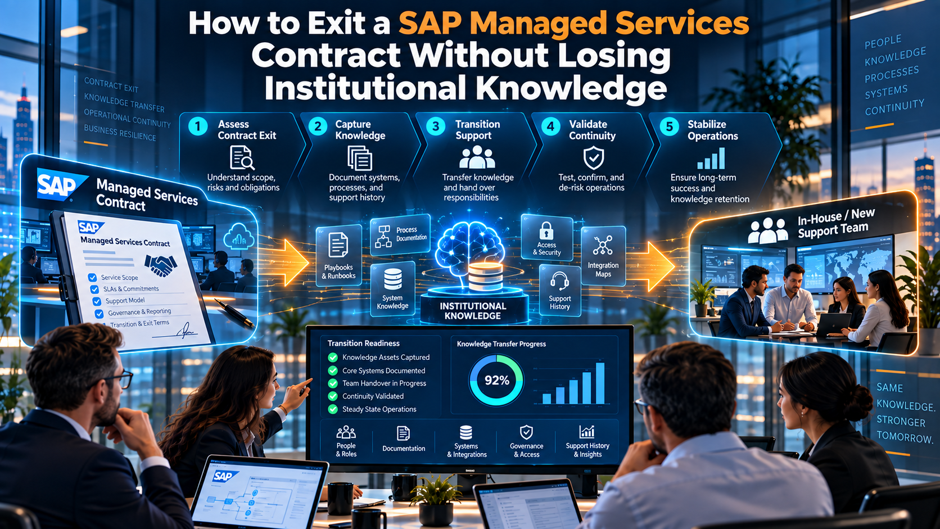
A distributor decides to end its SAP application management contract after 6 years. Service levels slipped, costs rose and the business wants either its own team or a new provider. In the first exit meeting, the account manager agrees to everything and the delivery lead quietly warns that the knowledge of why month-end jobs run in a certain order, which interface needs a manual restart and which role design hides a segregation of duties exception lives in the heads of 4 consultants, and 2 of them have already been reassigned.
This guide explains how to exit a managed services contract while keeping what the provider has learned about your landscape. It covers what institutional knowledge actually includes, where it hides in an SAP environment, how to choose an exit route, what an exit plan must contain, how to capture and verify knowledge, and which contract terms and controls protect you. Contract terms and notice periods vary, so involve procurement and counsel, and treat the timelines and cost figures here as illustrative assumptions.
TL;DR
- Most of the risk sits in knowledge nobody has written down. Documentation, ticket history and tool content can be requested, though the reasons behind configuration choices, the recurring workarounds and the unwritten month-end sequence live with people, so the exit plan has to start with a knowledge audit and include interviews, recorded walkthroughs and a decision log before the notice period is spent. Each item needs a named owner and a deadline.
- A structured handover has stages, and each stage needs a pass or fail test. Capture, shadowing, reverse shadowing, cutover and stabilization work best when each has exit criteria, because a team that has watched the outgoing provider but never run tickets on its own hasn’t proven it can operate the landscape, and published guides describe inbound transitions of roughly 4 to 8 weeks. Declare a stage complete only when evidence exists.
- Negotiate and manage the exit before the relationship deteriorates. An exit plan agreed at signing carries more weight than 1 drafted at termination, so check what the contract already promises on documentation ownership, knowledge transfer sessions, key personnel and data return, keep the provider’s staff engaged through the transition and keep paying for the service you still depend on. Ask the provider to confirm each commitment in writing before notice is served.
What “Institutional Knowledge” Actually Includes
Institutional knowledge in an SAP landscape is broader than documentation. It includes the explicit material, such as functional specifications, runbooks, test scripts and interface lists, and the implicit material that people carry, such as why a pricing condition was built a certain way, which batch job can’t run during the close and what the finance lead expects when an invoice posting fails. It also includes knowledge embedded in the system itself, including custom code, job schedules, monitoring thresholds and authorization designs, which no 1 may fully understand.
A managed services provider accumulates all 3 kinds over years. Every incident teaches the team something about your data, every change request reveals a business rule and every workaround becomes part of how SAP application management services really run. Published descriptions of the application management lifecycle note that during transition the client supplies knowledge to the provider, and that during closure knowledge accumulated at the contractor is transferred back through sessions. That transfer rarely happens by itself, because the provider’s incentives shift once the contract is ending.
The practical consequence is that exit planning is a knowledge project with a contract attached, rather than the reverse. Treating it as a contract exercise yields a signed termination letter and an empty runbook folder. Treating it as a knowledge project means deciding which knowledge matters most, finding where it lives, capturing it in forms the next team can use and testing that the next team can use it, all while service levels continue. The rest of this guide follows that logic.
Where Knowledge Hides in an SAP Managed Services Setup
| Knowledge Type | Where It Lives | Risk If Lost | How to Capture |
| Runbooks and standard procedures | Provider wiki, shared drives, Solution Manager or Cloud ALM, personal notes | Slow or incorrect incident resolution | Review for completeness, test by having the new team execute them |
| Ticket and problem history | Provider ITSM tool, email archives | Repeated incidents and lost root causes | Export full history with categories, resolutions and linked changes |
| Configuration rationale | Consultants’ memories, change request comments, design documents | Accidental reversal of deliberate settings | Decision log built from interviews and change records |
| Custom code and enhancements | Development system, documentation gaps, developer knowledge | Fragile fixes and long troubleshooting | Custom object register with owners, purpose and dependencies |
| Interfaces and integrations | Integration platform, partner contacts, monitoring tools | Silent failures and unresolved partner issues | Interface catalog with schedules, owners, error patterns and contacts |
| Batch jobs and schedules | Scheduler, month-end calendar, tribal knowledge | Missed closes and data errors | Job inventory with dependencies, runtimes and escalation steps |
| Authorizations and controls | Role design files, audit evidence, access request records | Segregation of duties exceptions and audit findings | Role catalog, control matrix and evidence repository |
| Relationships and informal rules | Provider and business staff | Slow escalations and misread priorities | Stakeholder map and joint walkthrough sessions |
This table is a working inventory rather than a complete list. Tool content deserves special attention because many SAP teams keep solution documentation, process documentation and test cases in SAP Solution Manager, whose 7.2 release reaches the end of mainstream maintenance on December 31, 2027. SAP recommends completing the transition to SAP Cloud ALM before that date, and the replacement doesn’t map feature for feature. A handover is therefore also a chance to decide what content should remain, move or be retired.
Choosing the Exit Route: Insource, Switch or Co-Source
Insourcing Brings Knowledge Closest to the Business Taking operations back in-house gives the company control over priorities, cost and knowledge, and it works best when the landscape is stable, the volume is manageable and the company can hire or retain skills in basis, functional support and development. The risk is a thin team, since a provider spreads its bench across holidays, illness and skill gaps, and an internal team of 5 can’t cover the same breadth. Plan hiring early so recruits can shadow.
Switching to a New Provider Transfers Knowledge Twice Moving to another provider keeps the service model while changing the vendor, and it needs knowledge to flow from the outgoing team to the client and then to the incoming team, or directly between the 2 with the client supervising. A structured process for choosing an SAP implementation partner is useful here because the incoming provider’s named people, module experience, handover method and support model matter more than the sales presentation. The outgoing provider has little incentive to help the successor, so contract terms matter more.
Co-Sourcing Splits the Estate and Reduces Concentration Risk Some companies keep a small internal core for business-critical processes and decisions, and use 1 or more providers for routine support, development or basis. This model reduces dependence on any single party and keeps design knowledge in the company, though it increases coordination work and requires clear ownership of each process, interface and system. It’s often the best answer when a company wants to exit a dominant provider without carrying the full operational burden alone.
The Decision Should Follow the Knowledge, Not Only the Price Compare routes on how much knowledge each captures, how quickly each can run the service independently, the risk during handover and the 3-year cost including the transition. If the exit also coincides with an S/4HANA brownfield migration, account for which legacy knowledge must survive the conversion and which workarounds should disappear instead of being transferred. Include the business owners in the choice, because they carry the consequences of any gap during the month-end close and other critical periods.
Before You Give Notice: Contract and Position Review
- Read the termination, notice and transition clauses before anything else. Check how much notice is required, whether termination for convenience is allowed and at what cost, how long the provider must keep delivering service levels during the notice period, and what the provider must deliver at closure, since SAP application management closure descriptions mention returning client documentation and supporting knowledge transfer sessions. Note any dates that start a clock, such as renewal windows.
- Find out who owns documentation, runbooks and custom artifacts. Many contracts are silent or ambiguous about documents the provider created, so determine whether the company owns custom code documentation, configuration workbooks, runbooks and test scripts, and whether provider-owned templates or tools contain your content, because ownership decides what you can demand and what you must negotiate. Ask legal to confirm in writing which materials the company can demand at contract closure.
- List the provider’s key personnel and their commitments. Identify who holds critical knowledge, whether the contract names key people, how long they must stay and what happens if they leave during notice, and consider retention incentives, since losing 2 experts in the first month of the exit can undermine the entire plan. Ask which of them know the most fragile areas, such as month-end jobs, interfaces and role designs in your landscape.
- Decide your bargaining position before the conversation starts. An exit plan agreed during original contract negotiation carries more weight than 1 drafted at termination, so if your contract lacks one, expect to trade something for it, such as a clean termination date, a reasonable transition fee or a positive reference, and know your priorities before you ask. Write the 3 outcomes you can’t give up and the 3 you can trade.
The Exit Plan: What It Must Contain
| Component | What to Specify | Why It Matters |
| Scope of services during exit | Which services continue, at which service levels and for how long | Prevents service decay while the provider disengages |
| Knowledge transfer deliverables | Runbooks, interface catalog, custom code register, job inventory, decision log, ticket export | Turns a vague promise into checkable items |
| Knowledge transfer sessions | Topics, duration, audience, recording and sign-off | Captures what documents can’t |
| Key personnel and retention | Named people, minimum availability and replacement rules | Protects critical knowledge holders |
| Shadowing and reverse shadowing | Duration, participants, tickets handled and acceptance measures | Proves the new team can operate |
| Access and credentials | Provisioning timeline for the new team, removal for the outgoing team, shared account handling | Avoids security gaps and blocked work |
| Data return and tool exports | Formats, timelines and verification for tickets, documents and configurations | Preserves records and audit evidence |
| Governance and escalation | Weekly steering, risk log, decision rights and dispute path | Keeps problems visible and resolved quickly |
| Costs and fees | Transition assistance rates, caps and payment milestones tied to deliverables | Prevents surprise charges and ties payment to results |
| Closure criteria | Conditions for final acceptance and release of retained payments | Avoids an exit that ends by calendar instead of by completion |
An exit plan works best as a short, specific appendix that both sides sign, with owners, dates and acceptance criteria for each item. A generic clause promising reasonable assistance is difficult to enforce when a provider’s attention has moved to its next customer. If the contract has no exit plan, use the same discipline applied to SAP implementation services by defining phases, responsibilities, deliverables and acceptance evidence before work starts. Offer a fair structure for transition fees and tie part of the final payment to verified completion.
Phase 1: The Knowledge Audit
Start with an audit that measures what is documented, what is current and what exists only in people’s heads. Sample 20 or 30 recurring ticket types and ask 3 questions for each: is there a runbook, is it correct when someone follows it, and who resolves this today. Run the same exercise for interfaces, batch jobs, custom objects and roles. The result is a heat map that shows where the exit is safe and where it’s risky, and it sets the priorities for the capture phase.
Use data to find the gaps. Ticket history shows which issues recur, which take the longest and which depend on a single resolver, and platforms built around IT service management can reveal incident, problem and change relationships that are easy to lose in a simple ticket export. Monitoring and job logs show the schedules and failure patterns that nobody remembers. Combine these with interviews of the provider’s consultants and the business process owners who rely on them.
Finish the audit with a ranked list of knowledge risks, each with an owner and a capture method. Rank by business impact and by how concentrated the knowledge is, so a month-end job known by 1 person ranks above a rarely used report known by 3. Share the list with the provider and the incoming team, because it turns a vague concern into a set of tasks both sides can plan, and it provides the basis for the exit plan’s deliverables and acceptance criteria.
Phase 2: Capturing Knowledge That Documents Miss
Mine Ticket History for Runbooks Group closed tickets by category, identify the top 80 or so recurring types and write a standard procedure for each, using the resolver’s notes and the tickets themselves. A runbook should state the symptom, the checks, the fix, the escalation point and the business impact, and it should be validated by having someone unfamiliar execute it in a test system. This approach captures practical knowledge more reliably than asking people to write documentation from scratch.
Record Walkthroughs of Critical Processes For the critical flows, such as month-end close, order to cash, procure to pay and payroll, have the provider’s consultants walk the incoming team through a live scenario while recording the session. Finance-heavy walkthroughs should include the actual SAP FICO dependencies behind close, posting and reconciliation work rather than documenting only the visible ticket steps. Recordings capture sequence, judgment and context that written steps omit, and they become a training asset for new joiners long after the exit.
Build a Decision Log From Change Records and Interviews Configuration rationale is the knowledge most likely to disappear. Review major change requests, design documents and approval comments, then interview the consultants who built them to record why a setting exists, what alternatives were rejected and what would break if it were changed. Keep entries short, tie each to the object or process and file them where the new team will search first. Review the log with the incoming team before final acceptance.
Catalog Interfaces, Jobs, Custom Code and Roles Create 4 inventories: interfaces with owners, schedules, error patterns and partner contacts; batch jobs with dependencies and runtimes; custom objects with purpose and dependencies; and roles with the control matrix and open exceptions. Where integrations run through SAP BTP, include tenants, destinations, certificates, integration owners and monitoring responsibilities in the interface register. Review the inventories with the provider and the business, and treat any item no 1 can explain as a risk to be resolved before the handover is accepted.
Phase 3: Shadowing and Reverse Shadowing
- Shadowing lets the new team observe live operations. For several weeks, the incoming team watches the outgoing team work real incidents, changes and month-end activities, asking questions and taking notes, and guides describe this as the stage where the new team learns the rhythm of the landscape that documents can’t convey, so schedule it across at least 1 full business cycle that includes a close. Include the month-end close in the window.
- Reverse shadowing proves independence. In this stage the new team takes over day-to-day ticket handling while the outgoing team observes and intervenes only when needed, and one guide describes it as verifying that the incoming team can resolve issues independently, which makes it the most reliable test that knowledge has really transferred. The outgoing team should intervene only for defined risks, and every intervention should be logged as a gap to close.
- Test unusual scenarios on purpose. Run drills for events that rarely happen but cause damage, such as an interface outage, a failed transport, a locked batch job at close and an urgent authorization request, because a team that can handle routine tickets may still be unprepared for the incident that matters most. Record how long each drill takes and what help was needed, then close the gaps before the cutover date.
Readiness Gates and Go/No-Go Criteria
| Gate | What Must Be True | Evidence |
| Knowledge capture complete | Top recurring ticket types have validated runbooks, and the 4 inventories are reviewed | Runbook test results, signed inventories, open gaps with owners |
| Shadowing complete | The new team has observed a full close and a range of incident types | Attendance, notes, question log and mentor sign-off |
| Reverse shadowing passed | The new team resolves most tickets independently and handles escalations correctly | Ticket metrics, quality review and business owner feedback |
| Access and security ready | Accounts, roles and remote access work for the new team and are removed for the outgoing team | Access reports, audit checks and credential rotation log |
| Operational readiness | Monitoring, alerting, on-call and escalation paths are in place | Test alerts, on-call roster and runbook for escalations |
| Business sign-off | Process owners accept the team’s performance during critical periods | Written approval after a close cycle |
Each gate should have a named decision maker and a defined fallback if the criteria aren’t met. A common fallback is to extend the previous stage by a fixed period, with the outgoing provider continuing under the existing terms or a short extension, and the exit plan should price that extension in advance. Declaring a gate passed on the calendar date is the surest way to lose knowledge, so give the steering group the authority to delay handover when the evidence is thin.
Tools, Access and Data: The Handover Checklist
Documentation and Tool Content List every location where documentation lives, including Solution Manager or Cloud ALM, wikis, shared drives and the provider’s ITSM tool, and plan exports with format and completeness checks. SAP confirms that SAP Solution Manager 7.2 mainstream maintenance runs only through the end of 2027, so the exit is a useful point to decide what should move to a longer-term repository. For documents that belong with business records rather than ALM tooling, SAP File Lifecycle Management can also be relevant to retention, access and audit requirements.
Access, Credentials and Security Provision accounts for the incoming team before shadowing starts, and plan removal of the outgoing team’s access at handover. Identify shared and privileged accounts, firefighter access, remote connections, interface credentials and any certificates or secrets the provider holds, then rotate them according to a schedule. NIST’s SP 800-53 account-management controls call for disabling accounts that are no longer associated with a user and managing account changes in a controlled way. Review the access list again after cutover.
Data, Reports and Audit Evidence Request the full ticket history, change records, problem records and knowledge articles in a usable format, along with reports, KPIs and any compliance evidence the provider produced. If relevant content is being moved out of Solution Manager, SAP’s Selective Data Transfer guidance provides a supported path for transferring selected solution documentation into SAP Cloud ALM. Verify every export against samples, because incomplete exports are often noticed only months later.
Contracts, Licenses and Third Parties Check whether the provider holds licenses, subscriptions or tool entitlements used in service delivery, and whether any third-party contracts, such as monitoring tools or ticketing platforms, need to be replaced or transferred. Confirm that the new team has the necessary SAP support portal access, and use SAP for Me user management to review S-user ownership and authorizations that may still belong to outgoing personnel. Clarify who maintains relationships with SAP and other vendors during and after the transition.
Managing the Outgoing Provider During the Exit
The outgoing provider’s behavior determines whether the plan works, and its incentives are mixed. It wants a clean reference and its final payment, though it also has people to redeploy and a customer it’s about to lose. Treat the provider as a partner in a defined project with deliverables, and avoid framing the exit as a dispute, because staff who feel respected tend to share more. Hold a joint kickoff, agree the plan and name 1 accountable lead on each side.
Keep the people engaged. Ask the provider to confirm the availability of named key staff through the exit, discuss retention arrangements where needed, and agree how the team will be motivated to hand over knowledge, such as recognition and a positive reference. Where the contract allows, consider arrangements that let the company hire specific provider consultants, since a person who knows the landscape is the most reliable form of knowledge transfer. Handle this openly, and confirm that any non-solicitation clause allows it.
Use governance to keep pace. Hold weekly steering meetings with a risk log, track deliverables against the exit plan, escalate slippage quickly and tie payment milestones to verified completion. Continue to pay for services you rely on, and don’t withhold payment to apply pressure, because a dispute during the handover harms both teams’ ability to cooperate. If the relationship has deteriorated, involve senior executives and legal counsel early, and rely on the contract and documented deliverables.
An Illustrative Timeline and Effort Estimate
| Phase | Illustrative Duration | Main Activities |
| Pre-notice audit and contract review | 4 weeks | Knowledge audit, contract review, route decision, bargaining position |
| Notice and exit plan agreement | 3 weeks | Serve notice, agree plan, deliverables, gates and fees |
| Knowledge capture | 8 weeks | Runbooks, recordings, decision log and 4 inventories |
| Shadowing | 4 weeks | New team observes operations across a full business cycle |
| Reverse shadowing | 4 weeks | New team operates while the outgoing team observes |
| Cutover and hypercare | 4 weeks | Service transfer, access changes, heightened monitoring |
| Closure and verification | 3 weeks | Final acceptance, data return confirmation, lessons learned |
| Total | 30 weeks | Sequential, with possible overlap of capture and shadowing |
Published guides describe inbound AMS transitions of about 4 to 8 weeks, and 1 provider cites 4 to 6 weeks, so a 30-week exit plan is deliberately longer. It includes the audit, contract steps, a longer capture period for knowledge that was never documented and a stabilization period after cutover. Compress the schedule only if the audit shows strong documentation and a stable landscape, and keep the gates, because shortening the stages without the evidence is how knowledge is lost.
Effort can be estimated with assumptions. Suppose capture takes 80 runbooks at 1.5 days each, 40 interfaces at 1 day each, 15 days for role and control review, 25 days for the custom code register, 20 days for job and monitoring inventories and 10 days of ticket analysis, totaling 230 person-days. Shadowing with 8 people for 4 weeks adds 160, and reverse shadowing with 4 outgoing staff on standby for 4 weeks adds 80, for 470 person-days. At $1,400 to $2,400 per day, that’s about $658,000 to $1,128,000, an illustration rather than a benchmark.
Risks and Controls During Handover
- Key people leave mid-exit. Reassignment or resignation of a critical consultant can remove knowledge that was never captured, so rank knowledge holders at the start, schedule their sessions first, record them and agree retention terms where possible, and keep a list of backup contacts at the provider for questions that arise after handover. Ask each of them to review the runbooks that describe their own areas before they leave the project.
- Hidden work surfaces after cutover. Tasks nobody logged, such as a manual restart on the first of the month or a weekly spreadsheet sent to a business user, appear only when they fail, so ask the business teams what they receive and request from the provider, and run a scan of unusual activity in job logs and mailboxes. Treat each discovery as a new runbook candidate and add it to the inventories.
- Security and compliance gaps open during access changes. Overlapping access, shared accounts and rushed approvals can break segregation of duties and audit trails, so manage access changes through the normal request process, log every action, review privileged access at each gate and rotate credentials when the outgoing team leaves. Keep a dated record of every grant and removal so auditors can follow the sequence without interviews or reconstruction work months later.
Common Mistakes
Serving Notice Before Doing the Knowledge Audit Once notice is served, the provider’s attention and the bargaining position shift, so exit leaders who start with the audit usually negotiate better terms and discover gaps while the relationship is still cooperative. Spend the first weeks reviewing the contract, auditing documentation and deciding the route, then serve notice with a plan in hand and a draft exit appendix ready to sign. A prepared plan changes the tone of the first meeting.
Accepting Documents Without Testing Them A folder of runbooks looks like progress and often fails when someone tries to use it. Documents miss steps, refer to systems that changed and assume knowledge the reader lacks. Require that each critical runbook is executed by the incoming team in a test environment, record the results and fix gaps before accepting the deliverable, because a tested procedure is worth more than 10 that nobody has tried. Keep the test records with the deliverable.
Ignoring the Business Owners Technical teams can hand over systems while business owners worry about the close, payroll or shipments. Involve process owners in defining critical scenarios, in testing and in the final sign-off, and ask them what they expect from support. Their knowledge of what normal looks like is part of the institutional knowledge, and their acceptance is the strongest evidence that the service is safe. Invite them to every readiness gate review.
Letting the Exit Run on the Calendar Contracts end on dates, while knowledge transfer ends on evidence. An exit that proceeds to the termination date regardless of gate results leaves the company with a service it can’t run. Build extension options into the plan, price them in advance and give the steering group authority to delay handover, since a short extension costs far less than a failed month-end or a stalled integration. Agree the extension price before notice is served.
FAQs
How long does it take to exit a SAP managed services contract safely?
It depends on the size of the landscape and the quality of documentation. Published guides describe inbound transitions of about 4 to 8 weeks, and an exit adds audit, contract and stabilization steps, so a plan of about 30 weeks is a reasonable illustration for a complex landscape. Notice periods in your contract may set a minimum, so check the clauses early and plan backward from the termination date. Confirm assumptions with the provider.
Who owns the documentation and runbooks a provider created?
It depends on the contract. Many agreements are silent or ambiguous, so review the clauses on intellectual property, deliverables and return of materials. SAP application management closure descriptions mention returning client documentation and supporting knowledge transfer sessions, though you shouldn’t assume your contract matches. If ownership is unclear, negotiate it as part of the exit plan and obtain written confirmation of what will be delivered.
What is the difference between shadowing and reverse shadowing?
In shadowing, the incoming team observes the outgoing team working live tickets, changes and operations, learning the rhythm and context of the landscape. In reverse shadowing, the incoming team takes over day-to-day work while the outgoing team observes and intervenes only when needed. Reverse shadowing is the stronger test, because it shows whether the new team can resolve issues independently and correctly.
Should we insource or move to a new provider?
Compare routes on knowledge captured, speed to independence, handover risk and 3-year cost. Insourcing keeps knowledge closest to the business but needs skills and coverage, switching providers transfers knowledge twice and relies on the outgoing provider’s cooperation, and co-sourcing keeps a small internal core with outside support. Many companies choose a hybrid when they want to reduce dependence on 1 vendor without carrying the entire burden. Involve process owners in the choice.
What should we do about Solution Manager content during an exit?
Inventory the solution documentation, process documentation and test cases held in Solution Manager, and decide what to keep. Mainstream maintenance for Solution Manager 7.2 ends on December 31, 2027, with extended maintenance for selected functionality available until 2030, and SAP recommends SAP Cloud ALM, which doesn’t replace Solution Manager feature for feature. SAP describes tools for selective transfer of solution documentation and test cases, so plan an export.
How do we protect knowledge if key consultants leave during the notice period?
Rank knowledge holders at the start, schedule their sessions and recordings first, and ask the provider to confirm named key staff for the exit. Consider retention arrangements and, where the contract allows, hiring specific consultants. Keep a list of former-provider contacts for questions after handover and agree a short paid support arrangement for the stabilization period. Confirm in writing which individuals the provider will keep on the account during the exit.
What are the biggest warning signs during an exit?
Typical warning signs include slow delivery of knowledge transfer items, reassignment of key staff, falling service levels, resistance to recorded sessions, incomplete data exports and runbooks that fail when tested. Each signals a gap between the contract and reality. Raise concerns early through the steering group, use the gates to delay handover when evidence is thin and involve senior executives and counsel if cooperation breaks down.
How do we verify that the handover actually worked?
Use evidence. Track the share of tickets the new team resolves independently, resolution accuracy, response times, escalations to the former provider and the error-free completion of a full month-end close. Add scenario drills for rare events, a business owner sign-off after a critical period and a post-handover review at 30 and 90 days. If results fall short, extend the stage under the pre-agreed terms. Share the results with the steering group weekly.