

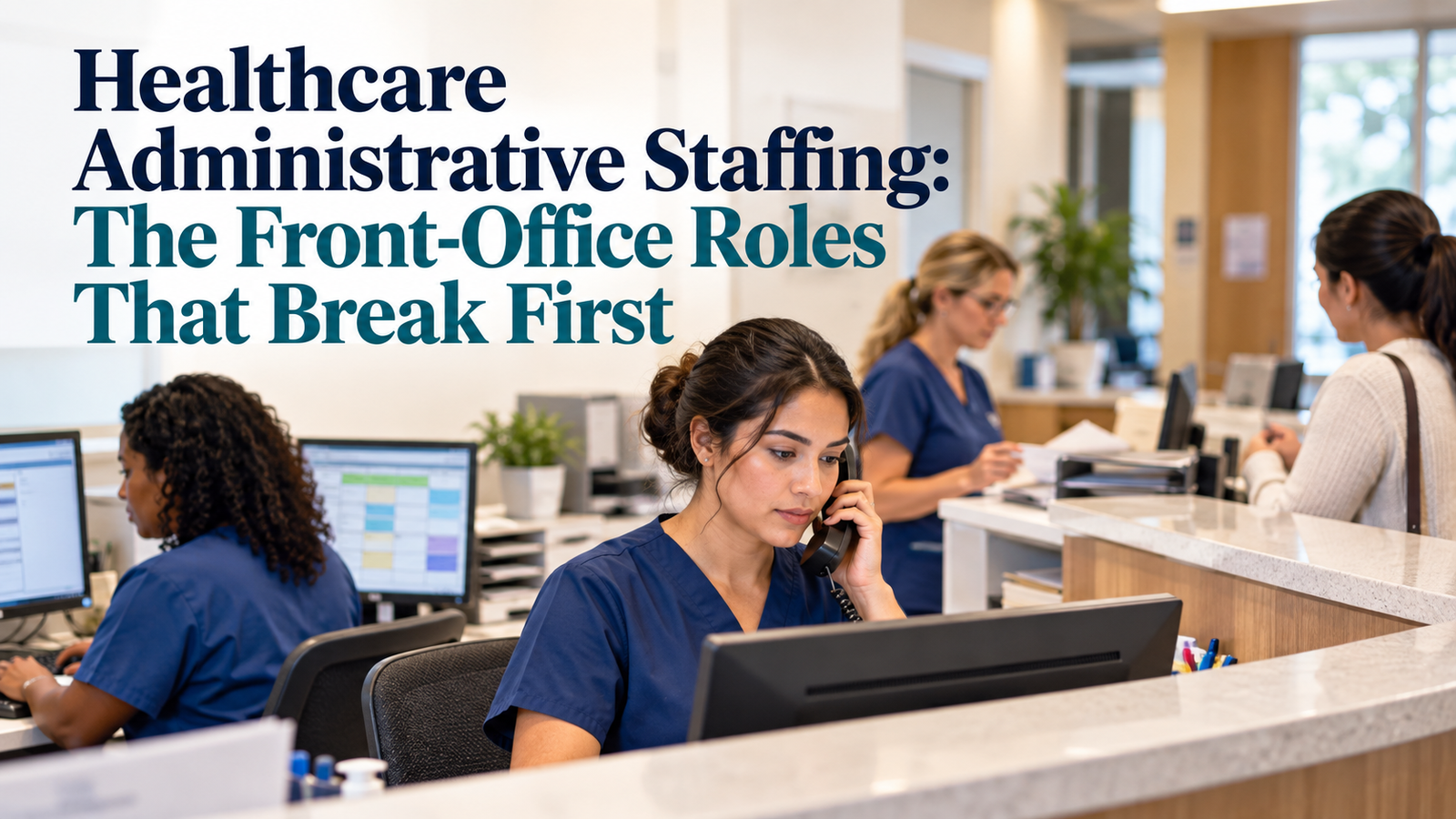
A healthcare front office can look fully staffed while its work is already failing. The first signs are often small: patients wait longer on the phone, schedulers start using workarounds, insurance checks move closer to the visit date, and referral follow-up becomes a shared task that belongs to nobody. Those delays rarely stay at the front desk. They reach clinical schedules, patient access, denials, collections, and staff retention.
That is why healthcare administrative staffing needs to be planned around workload and failure risk, not a simple headcount. The labor market adds pressure. The U.S. Bureau of Labor Statistics projects medical secretary and administrative assistant employment to grow through 2035 even while the broader secretary category declines, reflecting continued demand inside healthcare. The BLS outlook for medical administrative work also points to replacement openings as workers move occupations or leave the labor force. For practice leaders, that means vacancy risk remains an operating issue even when total employment trends look stable.
The right question is therefore not whether the office has enough people on paper. It is whether the medical administrative staff can keep up with the work that protects access, schedule accuracy, financial clearance, and patient communication. This guide explains which roles tend to fail first, why medical front office staffing becomes fragile, how to spot trouble before a backlog becomes normal, and how to rebuild patient access staffing without shifting the same burden onto another team.
TL;DR
Healthcare administrative staffing breaks first in roles that combine high transaction volume with constant interruption. Reception and patient access usually feel the pressure early because calls, arrivals, portal messages, registration questions, and schedule changes arrive all day. Scheduling becomes the next weak point when rules are complex or demand exceeds available slots. Insurance verification and prior authorization can then become a hidden backlog because the work is time-sensitive but often happens away from the patient-facing desk.
The practical response is to measure queues rather than rely on headcount. Track unanswered calls, abandoned calls, schedule error corrections, unverified visits, authorization aging, referral aging, check-in delays, overtime, and training time. Use those measures to decide whether the problem is staffing, workflow design, system configuration, training, or a mix. Technology can remove repetitive steps, but it doesn’t replace judgment in complex scheduling, payer exceptions, referral routing, or difficult patient conversations. A good medical front office staffing plan protects those judgment-heavy tasks first.
Why Front-Office Roles Break First
Front-office work is unusually exposed because demand arrives in real time. A receptionist can’t defer a patient who is standing at the desk. A scheduler can’t ignore a caller who needs the right visit type. A patient access representative may be checking demographics while also handling a portal message, a referral question, and an insurance issue. The work is interrupt-driven, and the queue can grow faster than managers can see it.
The job requires more interaction than many leaders assume. BLS occupational requirements data show that external verbal interaction is a constant part of medical secretary and administrative assistant work for a large share of employees. The same BLS occupational requirements profile reports that on-the-job training is required for most workers in the occupation. A vacancy removes experienced capacity, while a replacement may need weeks of system and workflow learning before reaching full output.
Current practice data show why healthcare staffing shortages remain relevant even after the worst post-pandemic turnover period. In May 2026, MGMA reported that front-desk and entry-level administrative roles were still among the common churn points in practices with higher or steady turnover. Its 2026 medical practice turnover report also notes that turnover alone can hide frozen jobs, long vacancies, overtime, or inexperienced teams. A practice can therefore look stable in HR reporting while its operational capacity is still thin.
This is the central staffing problem: front-office work has little slack. When 1 person leaves, the remaining medical administrative staff usually absorb the queue immediately. That can protect the schedule for a few days, but it also hides the vacancy cost until errors, call delays, and backlog age start rising together.
What Healthcare Administrative Staffing Actually Covers
Healthcare administrative staffing is broader than reception. The front office sits across patient access, schedule management, registration, insurance work, referral movement, records support, and some revenue-cycle tasks. In a small practice, 1 employee may handle several of these functions. In a health system, the same work may be split among centralized teams, site-based teams, and remote staff.
For planning purposes, it helps to separate roles by the work they protect rather than by job title. Front-desk staff protect arrival flow and basic registration. Schedulers protect appointment accuracy and provider capacity. Patient access staff protect the path from first contact to a ready visit. Insurance verification and authorization staff protect financial clearance. Referral coordinators protect handoffs between providers. Contact-center staff protect phone access when volume is centralized.
The retention problem is especially visible at the desk. MGMA’s 2025 poll on retaining front-desk staff found that practice leaders most often pointed to pay and employee engagement as useful retention measures, with flexible schedules also appearing in responses. The detail matters because medical front office staffing often fails for reasons that a new applicant can’t fix. If the job combines weak training, unpredictable coverage, and constant queue pressure, repeated hiring can reproduce the same turnover pattern.
A useful staffing map should therefore list the work, owner, backup owner, daily volume, service target, and required system access for each front-office function. That map is more valuable than a generic organization chart because it shows where patient access staffing has a single point of failure.
The Roles Most Likely to Fail First
The sequence varies by specialty, practice size, payer mix, and centralization. Still, failure tends to start where volume is high and work can’t wait. The table below shows the usual pressure points.
| Role Or Function | Why It Becomes Fragile | Early Failure Signal | Downstream Effect |
| Reception and patient access | Constant arrivals, calls, questions, registration work | Longer waits, more handoffs, incomplete intake | Delayed rooming, poor patient experience |
| Scheduling | Complex visit rules and changing provider templates | Rework, wrong visit types, growing callback list | Lost capacity, longer waits, provider frustration |
| Insurance verification | Payer variation and time-sensitive checks | More visits unverified close to service date | Check-in delays, denials, patient billing issues |
| Prior authorization | High manual effort and external dependencies | Requests aging without clear ownership | Delayed care, rescheduling, extra calls |
| Referral coordination | Work crosses organizations and systems | Open referrals stay unresolved longer | Care delays, leakage, repeated patient calls |
| Contact center | High call peaks and limited recovery time | Abandonment and hold times rise | Missed access, duplicate messages, complaints |
Reception And Patient Access Representatives
Reception usually breaks first because the queue is visible and immediate. When staffing is thin, the team protects the person standing in front of them. Phones ring longer. Portal work gets pushed later. Demographic updates become less consistent. Checkout steps get shortened. This is often the first place where access problems become obvious to patients.
AHRQ defines patient experience to include timely appointments, access to information, and communication with office staff. Its patient experience guidance makes clear that front-office interactions are part of care quality from the patient’s point of view. That is why the right staffing level can’t be based only on how many people are needed to keep the desk physically covered.
Schedulers And Contact-Center Staff
Scheduling becomes fragile when staff must remember too many exceptions. Different providers may have different visit lengths, age limits, procedure rules, location rules, referral requirements, or telehealth restrictions. Under pressure, staff create notes, cheat sheets, or personal workarounds. Those tools help experienced employees survive the day, but they make onboarding harder and increase the effect of turnover.
MGMA research on patient scheduling and communication found that the front desk remained a major scheduling channel even as online and call-center options expanded. Adding digital channels doesn’t automatically reduce work if staff still need to review exceptions, correct bookings, manage waitlists, or answer questions created by the new channel.
Insurance Verification And Prior Authorization Staff
Insurance work often breaks quietly because much of it happens before the visit and away from the lobby. A verification queue can grow for days before anyone sees a hard failure. Prior authorization is even more vulnerable because the work depends on payer rules, clinical documentation, status checks, denials, and appeals.
The AMA’s 2026 reporting on its latest prior authorization survey says physicians and staff still spend substantial time each week on prior authorization, and many practices dedicate staff to the work. That pressure turns authorization specialists into a critical part of medical administrative staff capacity even though patients may never see them at the front desk.
Referral Coordinators
Referral coordination fails when ownership is vague. The task sounds simple until a referral needs records, payer approval, a specialist appointment, patient outreach, or follow-up on a report. A coordinator may spend much of the day chasing information across organizations. When the role is vacant, work is often spread across nurses, front-desk staff, and schedulers. That keeps referrals moving for a while, but it also contaminates several other queues at once.
How Front-Office Failure Spreads
A front-office staffing gap rarely stays inside 1 job description. It spreads through dependencies. A scheduler who is behind creates a callback queue. Patients call again because they haven’t heard back, which increases phone volume. Front-desk staff answer the repeated calls, so registration work moves later. If registration is incomplete, insurance verification takes longer. If financial clearance isn’t finished, the visit may need extra work at check-in or after the claim is submitted.
Patient access priorities for 2026 show how connected these issues are. In an MGMA poll, practices named no-shows, online scheduling, phone access, and wait times as major access priorities. The MGMA patient access report for 2026 is useful because these aren’t separate problems in a strained office. A weak scheduling process can create longer phone calls, more rescheduling, and wasted slots at the same time.
The financial path is connected. If eligibility isn’t checked or authorization isn’t ready, staff may spend more time on payer follow-up after the visit. CMS rules are changing some prior authorization processes, including decision timeframes and future API requirements for impacted payers. The CMS prior authorization final rule has provisions taking effect across 2026 and 2027, which means administrative teams need to understand both current payer workflows and the new electronic paths as they appear.
Healthcare administrative staffing should be treated as a flow problem. Filling the loudest queue without checking what feeds it may move the backlog elsewhere. Follow a patient from first contact through scheduling, registration, financial clearance, arrival, and follow-up. Every handoff should have an owner and a visible queue.
The Warning Signs Of Understaffing
Healthcare staffing shortages don’t always show up as an open requisition. They also appear when employees are present but have less usable capacity because they are training new hires, covering another role, working around system issues, or spending too much time on manual tasks. The warning signs are therefore operational.
Start with access signals. Calls that were answered quickly begin to roll to voicemail or sit longer in queue. Callback lists carry into the next day. Patients contact the office through multiple channels because they aren’t sure which one will get a response. Schedulers spend more time fixing bookings. Front-desk staff arrive early or stay late to finish work that couldn’t be done while patients were present.
Then check financial-clearance signals. More appointments reach the day before service with eligibility still unchecked. Authorization requests have no recent status update. Staff are spending more time on payer portals, faxes, and phone calls. DataSpring’s 2025 CAQH Index, released in 2026, found continued savings potential from moving manual and partly manual administrative transactions to electronic methods. The 2025 CAQH Index findings are a reminder that some apparent staffing pressure is really process cost. Hiring more people into a manual queue can increase capacity, but it doesn’t remove the source of the work.
Finally, look at employee signals. Overtime by itself isn’t enough. Watch unplanned absence, schedule swaps, training failures, repeated transfer requests, and experienced employees becoming the permanent backup for everyone else. A 2025 study of hospital administrative staff found associations between job demands, social support, and burnout. The administrative staff burnout study was conducted in a specific hospital setting, so its results shouldn’t be treated as a universal benchmark, but it supports a practical point: workload design matters alongside headcount.
How To Size Front-Office Capacity
During healthcare staffing shortages, the safest way to size healthcare administrative staffing is to use actual work volume and handling time. Ratios such as staff per physician can help with high-level comparison, but they miss important differences in specialty, scheduling rules, payer mix, call volume, portal use, and centralization.
Start with 4 inputs for each major queue: work volume, average active handling time, required turnaround, and productive staff time. Productive time should exclude training, meetings, planned leave, and time assigned to other duties. Use your own data where possible. A scheduler covering reception for 2 hours doesn’t have a full scheduling day available.
A basic capacity calculation can be written as:
Required work hours = transaction volume x average active handling time
Then compare required work hours with the productive hours available from trained staff. Do this by queue, not only for the department total. A practice may have enough total administrative hours but still be short in prior authorization because only 2 people know the payer rules.
Medical front office staffing also needs a coverage view. Identify which functions can’t pause when someone is absent. Reception, phone access, same-day scheduling, and urgent referral handling usually need named backup coverage. Less immediate work can have a controlled service target, such as completion within a defined number of business days. The point isn’t to make every queue instant. The point is to know which delay is acceptable and which delay creates risk.
AHRQ’s guidance on open access scheduling shows why staffing and schedule design have to be considered together. Changes in how appointment supply is released can change front-desk workload, patient demand patterns, and the amount of triage or sorting required. Patient access staffing should therefore be recalculated after major template, location, or digital scheduling changes rather than assumed to stay constant.
Where Technology Helps, And Where It Doesn’t
Technology helps most when it removes repetitive work with clear rules. Appointment reminders can reduce manual calling. Digital registration can collect basic information before arrival. Automated waitlists can offer cancelled slots to patients. Eligibility transactions can replace some manual portal work. Self-scheduling can handle visit types with simple, safe rules.
Evidence from a large academic center shows what that can look like. A 2024 study of an EHR-based self-rescheduling tool found that patients who accepted earlier appointment offers were seen sooner and that cancelled slots could be filled through automation. The self-rescheduling study also found differences in use by age, language, and ethnicity, which matters for implementation. A digital tool can reduce some scheduling effort while still leaving medical administrative staff responsible for patients who can’t or don’t use the tool.
Technology works poorly when leaders use it to hide an unclear process. If scheduling rules are inconsistent, self-scheduling can create more correction work. If referral ownership is vague, adding another inbox gives the team another place to look. If the payer response isn’t machine-readable, an authorization tool may still leave staff reading portals and making calls.
Privacy controls also remain part of front-office design. HHS says appointment reminders and limited patient communications can be permitted under HIPAA when reasonable safeguards are used. The HHS guidance on incidental uses and disclosures is useful for front-office teams because technology choices need to match the organization’s privacy practices, communication preferences, and approved workflows.
The best technology plan begins with a queue. Pick work that is frequent, rules-based, and measurable. Remove steps where the system can do so safely. Then measure whether staff time actually falls. If the queue simply changes shape, the technology hasn’t solved the front-office staffing problem.
Choosing The Right Staffing Model
No single staffing model fits every healthcare front office. The decision should follow the work, required coverage speed, local knowledge, and safe system access. Healthcare administrative staffing can use permanent, temporary, remote, centralized, or external teams across functions.
| Staffing Model | Best Fit | Main Risk To Manage |
| Permanent in-house staff | Stable, site-specific work with frequent patient contact | Hiring time and fixed capacity |
| Temporary staff | Leave coverage, vacancy bridge, backlog work | Short onboarding window |
| Remote staff | Phones, scheduling, verification, referral follow-up | Workflow visibility and access controls |
| Centralized shared services | Multi-site scheduling or access work with common rules | Local exceptions and handoff quality |
| External managed support | Defined queues with measurable service targets | Governance, training, and escalation ownership |
Permanent staff fit work where local workflow knowledge matters, such as specialty reception. Temp coverage can protect the desk during leave or a vacancy, but job aids and permissions should be ready before the worker arrives.
Remote and centralized models can help patient access staffing when the work is digital and can be measured through queues. Phones, outbound scheduling, eligibility checks, and referral follow-up may fit this model better than work that depends on in-person flow. The key is to avoid splitting 1 patient journey across too many teams without clear handoff rules.
External support can also be useful during healthcare staffing shortages, especially when a practice has a defined backlog. But the contract shouldn’t be based only on hours supplied. Leaders need service measures such as queue age, accuracy, completion rate, escalation time, and rework. Healthcare administrative staffing improves when the organization buys a clear unit of work rather than adding anonymous capacity to a broken process.
Hiring For High-Friction Administrative Work
Good hiring starts with the real job. A generic medical receptionist posting can hide heavy call volume, complex scheduling rules, insurance questions, and a busy check-in desk. Candidates should know the workload, systems, schedule, and training path before accepting the role.
Screen for evidence of task judgment. Ask how a candidate would handle a patient who wants an appointment type that doesn’t fit the schedule rules. Ask how they would document a payer call or escalate an authorization delay. Give a short scheduling scenario and see whether the candidate asks the right clarifying questions. For medical administrative staff, accuracy under interruption is usually more important than polished interview language.
Medical terminology and payer knowledge can be trained, but the time needed should be planned. BLS data show that medical secretaries commonly receive on-the-job training, so a vacancy isn’t truly filled on the first day of employment. The staffing plan should include the trainer’s lost capacity and a defined path to independent work.
Retention belongs in the hiring plan. Healthcare staffing shortages become more expensive when leaders keep filling a job with poor workload controls. The offer should match the real schedule, and absence coverage should be clear. Employees should also know how they can learn another function or move into a higher-skill role.
Onboarding And Cross-Training Without Slowing The Office
Onboarding should protect the office from 2 common failures: giving a new hire too much access too early, and keeping the new hire dependent on 1 experienced employee for too long. Both problems reduce usable capacity.
Start with a role map. List owned queues, required systems, decision limits, and escalation points. Build training around real work rather than a long list of system features. A scheduler should learn visit rules and error prevention before advanced reporting. A patient access representative should learn identity checks, registration standards, and handoff rules before being expected to solve every exception.
Cross-training should focus on critical coverage. Each front-office function needs at least 1 backup who can perform the minimum safe workflow during absence. That doesn’t mean every employee needs to master every job. Too much cross-training can create shallow knowledge and constant role switching, which reduces output.
A practical cross-training matrix can use 4 levels: observe, perform with review, perform independently, and train others. Update it when workflows change. This gives managers a better view of front-office resilience than job titles alone because it shows whether the office has real backup capacity.
Front-office resilience also improves when standard work is kept current. Use concise job aids for scheduling exceptions, payer escalation, referral routing, and downtime procedures. Test those job aids with new employees. If a new hire can’t follow the process without asking the author what the document means, the process isn’t documented well enough.
A 30-60-90 Day Recovery Plan And Metrics
A strained front office needs recovery in stages. Stop queue growth first, then reduce aged work and prevent the same failure from returning. Redesigning everything at once usually slows an already overloaded team.
First 30 Days: Stabilize The Queues
Freeze low-value changes to templates and workflows. Name an owner for every high-risk queue. Set daily visibility for phone access, scheduling callbacks, unverified visits, authorization aging, and referral aging. Add temporary or borrowed coverage where the queue can be taught quickly. Move experienced medical administrative staff toward work where mistakes have the largest downstream cost.
The most useful metrics in this phase are simple: oldest item in queue, items received, items completed, carryover, error corrections, and overtime. If the backlog grows every day, the office still has a capacity gap or a broken intake process.
Days 31 To 60: Remove Rework
Once queues stop growing, study why work comes back. Look for duplicate patient messages, appointment corrections, missing referral information, repeated eligibility checks, or authorizations submitted without required documentation. Rework is hidden demand. Removing it can create capacity faster than adding another person.
This is also the right period to adjust staffing by skill. Some work can move to remote or centralized teams. Some needs to stay close to the clinic. Coverage should reflect where decisions are made and where exceptions can be resolved fastest.
Days 61 To 90: Build Resilience
By the final phase, managers should see normal demand and capacity. Set service targets by queue, finish backup training, and update job descriptions to match actual tasks. Review the next 6 months for leave, hiring risk, site changes, or major EHR work.
The scorecard should combine access, quality, workforce, and financial-clearance measures. Useful examples include call abandonment, callback age, scheduling correction rate, percent of visits verified before service, authorization turnaround, referral aging, new-hire time to independent work, overtime, and vacancy days. Healthcare administrative staffing becomes easier to manage when those measures move before patient complaints or denials become the first warning.
Conclusion
Healthcare administrative staffing is an operating system for the front office, not a headcount exercise. Reception, scheduling, patient access, insurance verification, prior authorization, referrals, and contact-center work depend on one another. When a vacancy or workflow problem hits 1 queue, the effects can move quickly into access, patient communication, provider schedules, and revenue-cycle work.
The roles that break first are usually the roles with high volume, little ability to pause, and heavy dependence on judgment. That is why medical front office staffing should be built from demand, handling time, service targets, and backup coverage. Technology can reduce repetitive work, but it should be measured by time removed from queues rather than by how many tools are installed.
Healthcare staffing shortages will continue to change by market and role, but practices don’t need to manage them blindly. A visible queue, clear ownership, realistic training time, and measured capacity give leaders a way to separate a hiring problem from a process problem. When patient access staffing is designed around the work that can fail fastest, the front office becomes easier to protect and easier to recover.
FAQs
What Is Healthcare Administrative Staffing?
Healthcare administrative staffing is the planning and hiring of nonclinical workers who support patient access, scheduling, registration, insurance work, referrals, records, and related office operations. It includes deciding how much capacity each function needs, which skills must be available on site, and which work can be handled remotely or through a shared team.
Which Front-Office Role Usually Breaks First In A Medical Practice?
Reception and patient access often show strain first because their work arrives in real time through calls, arrivals, questions, and schedule changes. The exact order varies by practice. A specialty with heavy authorization work may feel that failure first, while a high-volume primary care group may see phones and scheduling fail earlier.
What Is Medical Front Office Staffing?
Medical front office staffing covers the people who manage the administrative work patients encounter before, during, and after a visit. Common functions include reception, appointment scheduling, registration, checkout, insurance verification, and basic patient communication. In larger groups, some of this work may sit in a centralized access center rather than at the physical front desk.
How Is Patient Access Staffing Different From General Administrative Staffing?
Patient access staffing focuses on the work that helps a patient enter and move through care. It commonly includes scheduling, registration, financial clearance, call handling, and access-related communication. General administrative staffing can also include records, executive support, office management, accounting, or other functions that don’t directly control access to an appointment.
What Are The Main Signs Of Healthcare Staffing Shortages In The Front Office?
Common signs include longer phone waits, older callback queues, more schedule corrections, unverified visits close to the service date, growing authorization backlogs, more overtime, and repeated workarounds. A vacancy isn’t required for a shortage to exist. The team may be fully employed on paper but still lack enough trained hours for the workload.
How Many Front-Office Employees Does A Medical Practice Need?
There isn’t a reliable universal number. Staffing should be based on work volume, active handling time, service targets, opening hours, provider schedules, and the amount of cross-coverage expected. A practice with complex scheduling or a heavy payer mix may need more administrative time than a practice with the same number of clinicians but simpler workflows.
Can Remote Staff Handle Medical Front-Office Work?
Yes, some work can be handled remotely when systems, permissions, and handoffs are clear. Phone scheduling, referral follow-up, eligibility work, and some authorization tasks are common examples. In-person reception and work tied closely to physical patient flow usually need site-based coverage. The better model depends on the function rather than the job title.
Can Automation Replace Medical Administrative Staff?
Automation can remove repetitive steps, but it doesn’t remove every administrative decision. Tools can send reminders, support self-scheduling, offer open appointments, or automate parts of eligibility work. Staff are still needed for exceptions, complex scheduling, payer problems, referral coordination, patient questions, and oversight when automated workflows fail or produce uncertain results.
Why Does Scheduling Become A Staffing Problem So Quickly?
Scheduling combines high volume with rules that differ by provider, visit type, location, and specialty. When staff are new or overloaded, small errors create rework and patients call back. That adds more demand to the same team. Complex templates and unclear rules can therefore create a staffing problem even when total appointment volume hasn’t increased.
How Should A Practice Measure Patient Access Staffing Performance?
Use queue measures that show both speed and quality. Useful measures include call abandonment, callback age, appointment correction rate, waitlist activity, registration error rate, referral aging, and the percent of visits financially cleared before service. Workforce measures such as overtime, vacancy days, absence, and new-hire training time help explain why access results are changing.
What Work Should Be Cross-Trained First?
Cross-train the work that can’t safely pause when 1 person is absent. This often includes reception coverage, same-day schedule changes, urgent referral routing, and basic financial-clearance steps. The goal is minimum safe coverage. Every employee doesn’t need full mastery of every function, because constant role switching can reduce quality and slow the office.
When Should A Practice Use Temporary Administrative Staff?
Temporary staff are useful when the need has a clear end point or when the practice needs a bridge during leave, recruitment, or backlog recovery. They work best when permissions, job aids, escalation contacts, and work queues are ready before the start date. A temp worker shouldn’t have to discover the process by asking different employees for conflicting instructions.
When Should Healthcare Administrative Staffing Be Centralized?
Centralization makes sense when several sites use common rules and the work can be handled through shared systems. Scheduling, phone access, eligibility, and referral follow-up may fit. It works less well when local exceptions are frequent and the central team can’t resolve them. A central model needs clear ownership for exceptions and fast communication with sites.
What Is The Biggest Mistake In Medical Front Office Staffing?
The biggest mistake is treating headcount as capacity. Employees may spend large parts of the day training, covering another role, fixing errors, or working through manual payer tasks. Leaders need to know how many trained hours are available for each queue and whether the incoming workload can be completed within the required service time.
How Often Should A Practice Review Its Healthcare Administrative Staffing Plan?
Review it at least when demand, provider schedules, locations, payer rules, technology, or staffing structure changes. A quarterly review is useful for many practices, with more frequent checks during recovery or rapid growth. The goal is to catch changes in queue volume and skill coverage before they turn into sustained delays or repeated turnover.