

Introduction
Benefits errors often become visible at the worst possible moment: an employee is at a pharmacy, a dependent needs care, or a carrier invoice suddenly doesn’t match payroll. The problem may look like a carrier issue, but the original error can sit much earlier in the chain. A wrong eligibility date, a stale dependent record, an incorrect plan code, or a missed status change can travel from the HR record into the outbound file and arrive at the carrier exactly as sent.
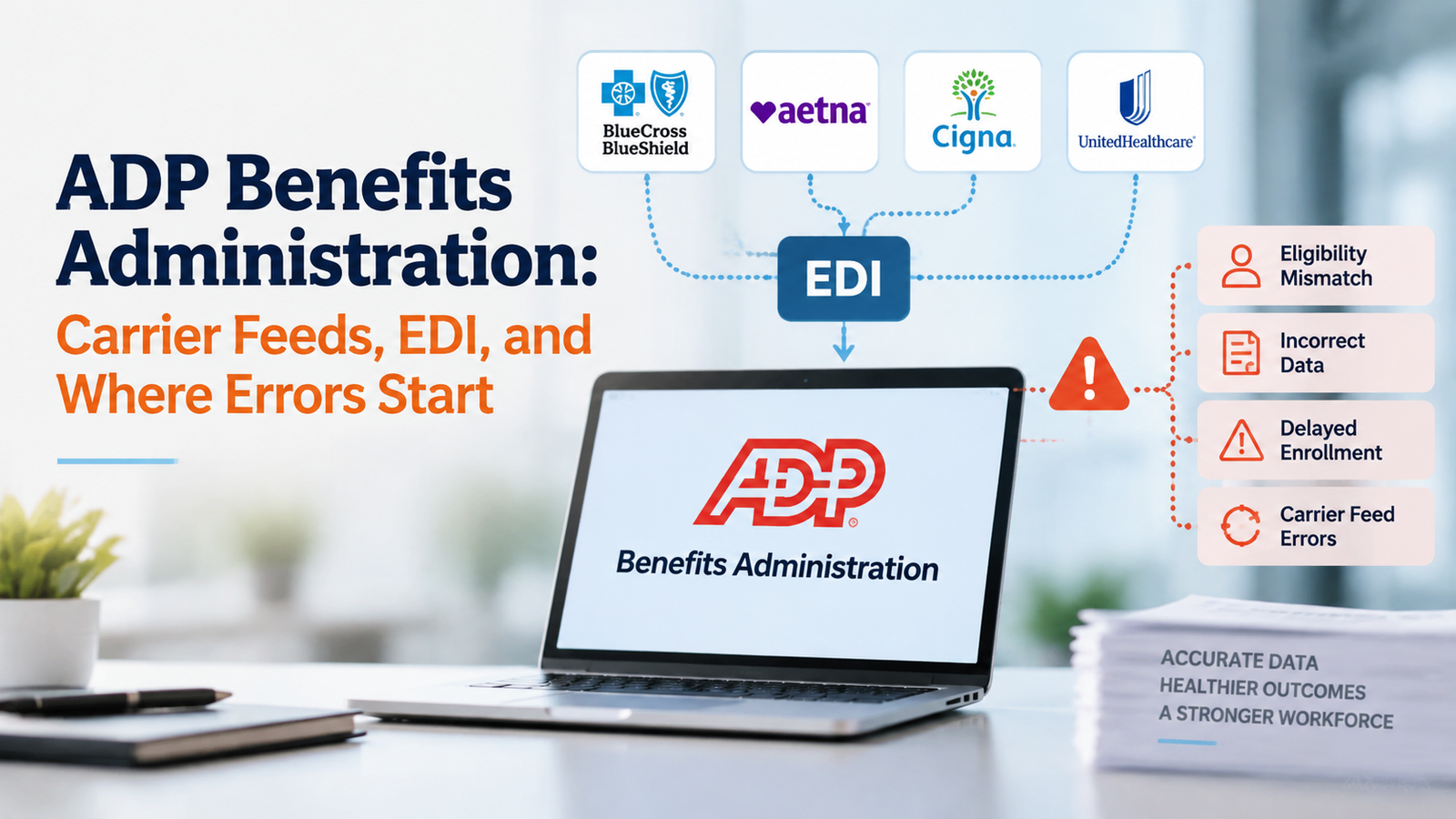
That is why ADP benefits administration needs to be understood as a data flow, not as a single enrollment screen. Elections move through rules, effective dates, payroll deductions, carrier mappings, transmission schedules, carrier processing, and later reconciliation. Each handoff creates a chance for a mismatch. The hard part is that a technically successful transfer doesn’t prove the coverage is right.
This guide explains how carrier feeds work, where EDI fits, and where benefits enrollment errors usually begin. It also shows how to test, monitor, and reconcile ADP Workforce Now benefits so HR and payroll teams can find the source of a problem instead of correcting the same symptom again.
TL;DR
ADP benefits administration can send benefit elections and eligibility changes to carriers through connected methods that may include APIs or scheduled files. EDI 834 is the standard health plan enrollment transaction adopted under HIPAA for covered electronic transactions. Carrier feeds can fail because of source data, eligibility rules, mapping, timing, transmission, or carrier-side processing.
The safest control model is simple: validate the employee record before transmission, test every mapping against carrier rules, monitor rejected or unprocessed records, and reconcile carrier enrollment plus invoices after go-live. A file being accepted proves that it was received in an expected format. It doesn’t prove that every person has the correct coverage.
What Carrier Feeds Actually Do
Carrier feeds move enrollment information from a benefits system to an insurance carrier or benefit provider. In ADP benefits administration, that usually means transmitting employee and dependent records after an election, life event, hire, termination, or other eligibility change. The feed can carry who should be covered, which plan they selected, the coverage tier, effective dates, dependent details, and other fields required by the carrier.
ADP describes carrier connectivity as a way to exchange plan, enrollment, and eligibility data with insurers. Its current carrier integration information also notes that digital enrollment can use API or EDI methods, so the connection type depends on the carrier and ADP setup. The important operating point is that the connection only carries the data it receives from the configured source.
These connections may run as full files, change files, or another carrier-specific pattern. A full file sends the current population for a plan. A change file sends events since the last successful run. Some connections move data close to real time, while others remain batch based. HR teams should know which model applies because error handling is different. A missed record in a full file may be corrected by the next full cycle. A missed change can remain wrong until someone finds it.
A carrier connection also doesn’t remove the need for review. ADP’s Carrier Connections listing states that the setup includes configuration, testing, and data validation with the carrier, which shows why feed readiness starts before the first production transmission. A connection reduces repeat manual entry, but the employer still needs controls around the source data and the results.
How ADP Benefits Data Moves From Election to Carrier
ADP Workforce Now benefits data starts with employee facts and benefit rules. The system needs the worker’s employment status, benefit eligibility, plan assignments, dependent records, and effective dates to determine what can be elected. When the employee completes enrollment, those elections become records that later drive payroll deductions and outbound carrier data.
The flow usually looks like this:
1. HR or an integration creates or updates the employee record.
2. Eligibility rules determine when coverage can begin.
3. The employee makes an election or a practitioner records the change.
4. ADP stores the plan, tier, dependent, and effective-date information.
5. A carrier mapping converts ADP fields into the carrier’s required values.
6. The connection sends the record on its schedule.
7. The carrier accepts, rejects, or holds the record for review.
8. HR later checks enrollment status and carrier billing against the system of record.
Each step matters because a later system can faithfully repeat an earlier mistake. If a hire date is wrong, an eligibility rule may produce the wrong coverage date. If a dependent relationship is coded incorrectly, the file can contain a value the carrier won’t accept. If the carrier’s plan identifier changed at renewal but the mapping didn’t, the employee’s election can be valid inside ADP and invalid after translation.
This is why a benefits project should be treated like an implementation with test cases, owners, and signoff ADP Workforce implementation approach is relevant here because carrier work crosses HR, payroll, vendor configuration, and timing. A clear project record makes it easier to trace a later error back to the step where it began.
What EDI 834 Carries
EDI 834 is the X12 Benefit Enrollment and Maintenance transaction used to send enrollment and maintenance information between a plan sponsor and a payer. CMS states that HHS adopted ASC X12N 834 as the standard for health plan enrollment and disenrollment under HIPAA. The agency’s health plan enrollment and disenrollment guidance explains that the transaction can support new enrollment, changes, reinstatement, and termination.
That matters because EDI 834 is more than a file extension. It is a defined structure for benefit enrollment messages. A carrier can use it to identify the sponsor, member, dependent, plan, coverage level, and effective dates. X12’s health care transaction flow also describes 834 use across tier-based coverage and other benefit arrangements, which is why the format appears across medical, dental, vision, and related programs.
The exact fields a carrier requires still depend on the carrier’s companion guide and implementation rules. The standard provides the structure, while the receiving organization defines many business requirements inside that structure. Two carriers may both accept 834 files and still require different plan codes, identifier formats, termination handling, or dependent conventions.
| Data Area | Typical Purpose | Common Risk |
| Employee identity | Match the subscriber to the carrier record | Name, date of birth, or ID mismatch |
| Coverage election | Identify plan and tier | Wrong plan code or tier mapping |
| Effective dates | Start or stop coverage | Date doesn’t match eligibility rule |
| Dependents | Add or remove covered family members | Missing relationship or dependent data |
| Maintenance reason | Explain the enrollment event | Wrong event or maintenance indicator |
An EDI 834 can therefore be syntactically valid while still carrying the wrong business answer. The file may follow the required layout even though an employee was assigned the wrong plan or a dependent effective date is incorrect. Technical acceptance and benefit accuracy have to be checked separately.
Where Errors Start Before a File Is Sent
Most benefits enrollment errors begin before transmission. The carrier feed is often the messenger. Source data and setup decide what message it carries.
Employee Data Errors
A missing birth date, stale address, wrong employment status, or duplicate employee record can affect carrier matching and eligibility. New hires are especially exposed because several fields are created at once. A weak handoff between recruiting, onboarding, HR, and benefits can cause a record to enter ADP with the wrong date or status and then pass every later check because the value is valid in format.
A consistent onboarding process reduces that risk. The article on building a better ADP onboarding workflow shows how employee data can move directly into later tasks, including benefits enrollment. That connection is useful only when the original record is accurate, so validation at hire is one of the first carrier-feed controls.
Eligibility Rule Errors
Eligibility rules turn employment facts into coverage dates. Waiting periods, class rules, hours requirements, and status changes can all affect when coverage starts or ends. If the rule is configured incorrectly, every affected employee can receive the same wrong result. That makes configuration errors more dangerous than a single typing mistake.
Plan And Rate Setup Errors
Renewal changes create another common starting point. New plan names, rate tables, coverage tiers, payroll deduction codes, and carrier identifiers need to stay aligned. The guide to ADP benefits renewal setup mistakes focuses on deductions, rates, and effective dates because those fields can affect both payroll and carrier records. The carrier feed won’t correct a plan-year setup that was wrong before transmission.
Life Event Errors
Midyear events add timing pressure. Marriage, divorce, birth, loss of other coverage, and employment status changes can require different dates and supporting steps. The system may record the event, but HR still needs to confirm that the election, evidence, and effective date match the plan rules. A late or incomplete change can produce benefits enrollment errors even when the transmission itself works.
Errors Created During Mapping and Transmission
A clean employee record can still fail when source values are translated into carrier values, creating benefits enrollment errors after the original election looked correct. Mapping is the layer that tells the connection what an ADP value means to the receiving carrier. A medical plan called “PPO 500” in ADP might need a carrier plan code such as a policy or division identifier. If that mapping points to last year’s code, the outbound record can be wrong even though the election screen looks correct.
The same issue applies to coverage tiers, eligibility classes, employment statuses, dependent relationships, and termination reasons. ADP benefits administration should therefore keep a controlled mapping record that shows the ADP value, carrier value, owner, effective date, and last test result. Changes should be approved before the mapping reaches production.
Transmission adds another layer. Scheduled carrier feeds can fail because the file wasn’t created, a secure connection wasn’t available, the carrier rejected the file, or the record missed a cutoff. A transmission log answers “did something send?” It doesn’t answer “did every record process correctly?” That difference is important during open enrollment when a large file can contain a small number of records that need repair.
Security also matters because enrollment data can include sensitive health-related and identity information. The HHS HIPAA Security Rule requires covered entities and business associates to protect electronic protected health information with administrative, physical, and technical safeguards. Organizations should follow the responsibilities that apply to their role and contract arrangements when benefit data moves between systems.
Teams with older ADP Workforce Now benefits setups should also review configuration after years of plan changes. The ADP system maintenance and configuration review is relevant because stale fields and old mappings can remain active long after the business rule that created them has changed. Removing or correcting that drift reduces avoidable feed exceptions.
Why Accepted Files Can Still Produce Bad Coverage
An accepted file can still produce the wrong enrollment result. Acceptance usually means the carrier received data in a form it could process. It doesn’t prove the employee is enrolled in the plan HR intended.
Consider an employee who elected employee-plus-spouse coverage. The outbound 834 file may contain the subscriber, spouse, plan code, and effective date with valid syntax. If the carrier plan code points to the wrong plan, the file can pass structural checks and still create incorrect coverage. The same can happen when a termination date is valid but one day early, or when a dependent is present but tied to the wrong relationship code.
This is why ADP benefits administration needs business validation after technical validation. HR should compare actual carrier enrollment against intended elections for a defined sample before go-live, then keep checking high-risk events after production begins. The sample should include new hires, dependents, waivers, terminations, and plan changes that exercise the main rules.
The HIPAA transaction rules help explain the distinction. CMS lists ASC X12N 834 Version 5010 as the adopted standard for enrollment and disenrollment in its adopted standards overview. That standard governs the transaction format for covered electronic exchange. The employer still has to confirm that its underlying benefit decision and mapped values are correct.
Carrier invoices provide another check. If ADP shows a termination but the next carrier bill still includes the person, the organization has evidence of a mismatch that needs investigation. The correct response is to trace the record through the change date, outbound feed, carrier receipt, carrier enrollment, and billing result.
Testing A Carrier Feed Before Go-Live
Carrier-feed testing should prove that common events and difficult edge cases produce the expected carrier result. A single successful test employee isn’t enough because one record may never exercise dependent rules, terminations, retroactive changes, or plan-specific codes. A sound ADP benefits administration test plan has to cover the events that can change eligibility or coverage.
Start with a test matrix based on real events. Include a new hire, an employee who waives coverage, an employee who adds a spouse, and a worker who changes plans. Add cases for termination, rehire, and a corrected election when those events apply to the plan. Each case should have a written expected result before the file is sent.
| Test Step | Question To Answer |
| Source validation | Are employee and dependent facts correct in ADP? |
| Eligibility check | Did the expected plan and date become available? |
| Election review | Does the employee record show the intended choice? |
| Mapping review | Did every outbound value translate to the carrier code? |
| Transmission check | Was the record included in the correct run? |
| Carrier validation | Did the carrier load the member as expected? |
| Payroll check | Does the deduction match the elected coverage? |
Open enrollment deserves a separate test cycle because plan-year changes can alter rates, deductions, effective dates, and carrier identifiers at the same time. The ADP Workforce Now open enrollment checklist recommends a post-enrollment audit before the first payroll, which is also a useful point to confirm that elections and downstream deductions agree.
Testing ADP Workforce Now benefits should include negative cases too. Deliberately omit a required value in a test environment if the process allows it, use an invalid carrier code, or create a date that should fail a business rule. The goal is to learn how the connection reports a problem before a real employee is affected.
Finish with signed evidence. Keep the test employee, event, expected result, actual result, correction, and approval in one record. That history is valuable when a later change causes a new exception because the team can compare the current mapping against the last known good state.
Reconciliation After Go-Live
Reconciliation is the control that finds differences between ADP Workforce Now benefits and the carrier’s actual records. It is also where carrier feeds are tested against real enrollment outcomes. It should begin as soon as the feed goes live, then continue on a regular schedule. Waiting for an employee complaint or a billing surprise means the error has already reached the end of the process.
For ADP benefits administration, the basic comparison is straightforward: who should be enrolled, who the carrier says is enrolled, and what payroll is deducting. Differences should be grouped by type, such as missing enrollment, extra enrollment, wrong tier, wrong effective date, or dependent mismatch. That grouping helps the team find a shared cause instead of fixing records one by one.
Carrier billing is part of this work. A carrier can continue billing for someone who should have been terminated, or fail to bill for a person whose enrollment never loaded. The numbers on the invoice are therefore an operational signal. They should be compared with current elections and recent change events, especially after open enrollment and large workforce changes.
The compliance and audit services describe the value of comparing system records and checking deductions for accuracy. The same audit habit applies to carrier data transfers: use independent records to confirm that the system output produced the intended result rather than assuming the transmission proves correctness.
A useful reconciliation log should include the employee, plan, discrepancy, discovered date, source system, owner, correction, carrier confirmation, and close date. This creates a record of repeated error types. If the same problem appears again, the team can fix the rule or mapping that creates it.
Who Owns What Across HR, Payroll, ADP, and the Carrier
ADP benefits administration problems last longer when ownership is vague. HR may assume ADP owns the connection, payroll may assume HR owns deductions, and the carrier may only see what arrived. A clear responsibility model makes troubleshooting faster because each team knows which evidence it must provide.
| Owner | Primary Responsibility |
| HR or benefits | Employee facts, eligibility decisions, elections, dependents, plan rules |
| Payroll | Deduction setup, deduction timing, payroll reconciliation |
| ADP or connection support | Connection setup, mapping support, transmission status, platform-side investigation |
| Carrier | Receiving rules, carrier plan codes, enrollment result, carrier-side exceptions |
| Internal IT or security | Access, secure transfer controls, identity and security requirements where applicable |
The employer still needs an internal person who owns the end-to-end outcome. That owner doesn’t need to make every technical change. The role is to keep the case moving from source record through carrier confirmation and to prevent a ticket from bouncing between teams without a business decision.
Ongoing support is useful when configuration knowledge has been lost through turnover or when the team doesn’t have enough ADP capacity ADP support subscription is one example of an outside resource that can help investigate ADP configuration and support cases. The employer should still keep its own decision record for plan rules, approvals, and carrier commitments.
Use a simple ownership rule for every exception: the team that controls the incorrect value owns the correction, while the end-to-end owner verifies the downstream result. If the employee’s birth date is wrong, HR fixes the source. If the carrier mapping is wrong, the connection team fixes the translation. If the carrier loaded a correct record incorrectly, the carrier owns the receiving-side correction.
Managing Open Enrollment and Midyear Changes
Open enrollment puts unusual pressure on carrier connections because a large share of the workforce changes at once. New rates, new plan-year dates, and large election volumes can expose a mapping problem that affected only a few test records. ADP benefits administration should therefore treat enrollment close, file transmission, payroll deduction start, and carrier confirmation as separate checkpoints.
Before the window opens, confirm the ADP Workforce Now benefits setup, plan codes, coverage tiers, eligibility rules, deduction codes, and carrier identifiers. During enrollment, monitor records that remain incomplete or require evidence. After enrollment closes, compare final elections with payroll deductions and the first carrier results. The first carrier invoice should be reconciled rather than treated as proof that the earlier file was right.
Midyear changes need a different control. The risk is volume plus timing. A birth may need coverage from the date of birth, while a termination may follow a plan-specific end date. A later correction may need a retroactive update. HR should record the event date, election date, expected effective date, and transmission status in one place so the carrier result can be traced.
Tax treatment can also connect benefits setup with payroll. The IRS 2026 Employer’s Tax Guide to Fringe Benefits explains cafeteria-plan treatment and other benefit tax rules. That guidance doesn’t determine carrier eligibility, but it shows why benefit elections, deduction setup, and payroll treatment need to stay aligned when plan changes are configured.
A strong operating calendar helps. Mark plan renewal setup, test-file deadlines, enrollment windows, first production feed, first payroll deduction, and first invoice reconciliation. When each checkpoint has an owner and expected evidence, benefits enrollment errors are more likely to be found before an employee discovers them.
Practical Error Triage and Repeat-Error Controls
Troubleshooting should move backward from the observed problem until the first incorrect value appears. That prevents the team from making a carrier-side correction while leaving the source error active.
Start with the carrier result. Confirm what coverage the carrier currently shows and the date that record became effective. Then check the transmission history to see which outbound record should have created or changed that coverage. If the correct record was sent, review carrier processing. If the outbound record was wrong, move back into the ADP mapping. If the mapped value reflects the source accurately, move back again to the employee record or eligibility rule.
Use 5 questions in order:
1. What result should the employee have today?
2. What does the carrier show today?
3. What did the last relevant carrier feed send?
4. What did ADP show before that transmission?
5. Which rule, field, or mapping first differed from the expected result?
This method works for the 834 transaction as well as other connection methods because it separates business intent from transport. The first wrong value is the root of the case. Everything after that is evidence of how the error traveled.
When a correction is made, verify the full path again. Confirm the source record, the new outbound change, carrier acceptance, carrier enrollment, and payroll effect. Closing the ticket after changing one field leaves the organization exposed to a second failure later in the chain.
Controls That Keep Errors From Repeating
The best ADP benefits administration controls focus on repeat causes. A team that fixes the same missing dependent code every month has a process problem, not a series of unrelated employee problems.
Keep a small control set that can be followed every plan year. Maintain a mapping register with carrier codes and effective dates. Require a second review for plan-year mapping changes. Keep a test matrix for major event types. Review transmission exceptions after every scheduled run. Reconcile carrier enrollment and invoices on a set cadence. Record root cause so recurring failures can be grouped.
ADP benefits administration also benefits from change discipline. When a carrier changes a specification, don’t replace a production value without noting what changed, who approved it, and which test case proved it. When HR changes an eligibility rule, test its effect on current employees and future events before the rule is treated as complete.
A control doesn’t need to be complicated to work. The strongest check may be a report that lists recent benefit changes and confirms that each one has a matching carrier result. The value comes from running it consistently and assigning someone to investigate differences.
Over time, the exception log becomes a useful quality measure for benefits enrollment errors. A falling count is helpful, but the more important signal is whether repeated root causes disappear. If the same error type returns after several corrections, the process still hasn’t reached the real source.
Conclusion
Carrier connections make benefits administration easier to operate, but they don’t remove the need for ownership and checking. ADP benefits administration works best when the organization treats benefit data as a chain from employee record to eligibility rule, election, mapping, transmission, carrier enrollment, and payroll result.
The 834 standard gives health plan enrollment a defined transaction structure, while carrier-specific rules still determine how values are interpreted. That is why a clean file can carry a bad business answer. The most reliable control is to find the first incorrect value, correct it at the source, and then verify every downstream result.
ADP Workforce Now benefits teams can reduce repeat errors with stronger source validation, mapping control, test cases, transmission review, and reconciliation. The goal is simple: the carrier record, payroll deduction, and employee election should tell the same story.
FAQs
What Is A Carrier Feed In ADP Benefits Administration?
A carrier feed is an electronic connection that sends benefit enrollment or eligibility data from ADP to an insurance carrier or benefit provider. These feeds can use different connection methods depending on the carrier and setup. The feed may send new elections, terminations, dependent changes, and effective dates. Its accuracy depends on the source record and mapping that create the outbound data.
What Is EDI 834 Used For?
EDI 834 is the X12 transaction used for benefit enrollment and maintenance. It can communicate enrollments, changes, reinstatements, and terminations between a plan sponsor and payer. In an employer setting, the file commonly carries subscriber and dependent data, coverage selections, and dates needed to maintain carrier enrollment.
Does ADP Workforce Now Benefits Use EDI 834 For Every Carrier?
No. ADP supports different carrier connection methods, and the method can vary by carrier, plan, and available integration. Some connections use the 834 transaction, while others may use APIs or another accepted file format. Employers should confirm the exact connection type and carrier requirements for each plan.
Where Do Benefits Enrollment Errors Usually Start?
Benefits enrollment errors often begin in source data, eligibility rules, plan setup, or mapping before the carrier receives anything. A wrong hire date, stale dependent record, incorrect plan code, or bad effective date can travel through the connection without being corrected. Troubleshooting should find the first point where the value became wrong.
Can An 834 File Be Accepted And Still Be Wrong?
Yes. A technically valid 834 file can still contain a wrong plan code, coverage tier, dependent relationship, or effective date. File acceptance confirms that the receiving system could process the transaction format. HR still needs business checks to confirm that the carrier created the intended coverage.
How Often Should Carrier Data Be Reconciled?
The schedule should reflect feed frequency and business risk. High-volume or frequently changing plans may need frequent review, while lower-volume plans may use a scheduled weekly or monthly check. Reconciliation is especially important after open enrollment, plan renewal, a large hiring period, or a major workforce change.
What Should Be Compared During Carrier Reconciliation?
Compare the employee’s intended election in ADP, the carrier’s current enrollment, and payroll deductions. Also review effective dates and dependent coverage where relevant. Differences should be logged by type so repeated issues can be traced to a shared source or mapping rule.
Who Should Own A Carrier Feed Error?
The team that controls the first incorrect value should own the correction. HR owns source employee and eligibility facts, payroll owns deduction setup, the connection team handles mapping or transmission issues, and the carrier handles receiving-side processing. One internal owner should still track the case through final confirmation.
What Should Be Tested Before A Carrier Feed Goes Live?
Test normal enrollment plus the events most likely to expose rule problems. Include new hires, waivers, dependent additions, plan changes, and terminations. Verify the source record, eligibility result, mapped value, transmitted record, carrier result, and payroll deduction before approving production use.
How Do Open Enrollment Changes Affect Carrier Connections?
Open enrollment can change rates, plan identifiers, coverage tiers, and effective dates at the same time. Those changes raise the chance that an old mapping or deduction setup remains active. Testing should use the new plan-year configuration, and the first carrier results plus first invoice should be reconciled after enrollment closes.
What Is The Difference Between A Full File And A Change File?
A full file sends a broad current population for the plan, while a change file sends events that occurred since a prior run. The correction path can differ. A later full file may repair some missing records, while a missed change can remain wrong until another event or manual correction reaches the carrier.
How Can A Wrong Effective Date Reach The Carrier?
The date can originate from an incorrect hire date, eligibility rule, life event, plan setup, or manual correction. If the value passes the configured business rules, the carrier feed may send it as given. The fix should begin at the earliest wrong record so future transmissions don’t repeat the same date.
Can Payroll Deductions Be Correct When Carrier Coverage Is Wrong?
Yes. Payroll and carrier enrollment can diverge because they depend on different downstream processes. An employee may have the right deduction while the carrier rejected the enrollment, or coverage may exist while payroll uses an old rate. Reconciliation should compare both results against the employee’s intended election.
What Records Should Be Kept For Carrier Feed Troubleshooting?
Keep the source election, effective dates, carrier mapping, transmission record, exception message, carrier confirmation, payroll result, and final correction. A short root-cause note is also useful. These records make repeat problems easier to identify and support plan-year testing when configuration changes.
How Can ADP Benefits Administration Teams Reduce Repeat Errors?
Use source-data checks, controlled mappings, repeatable test cases, transmission monitoring, and scheduled reconciliation. Track root causes instead of only fixing individual records. When the same error appears again, change the rule, mapping, or workflow that creates it and verify the downstream result.