

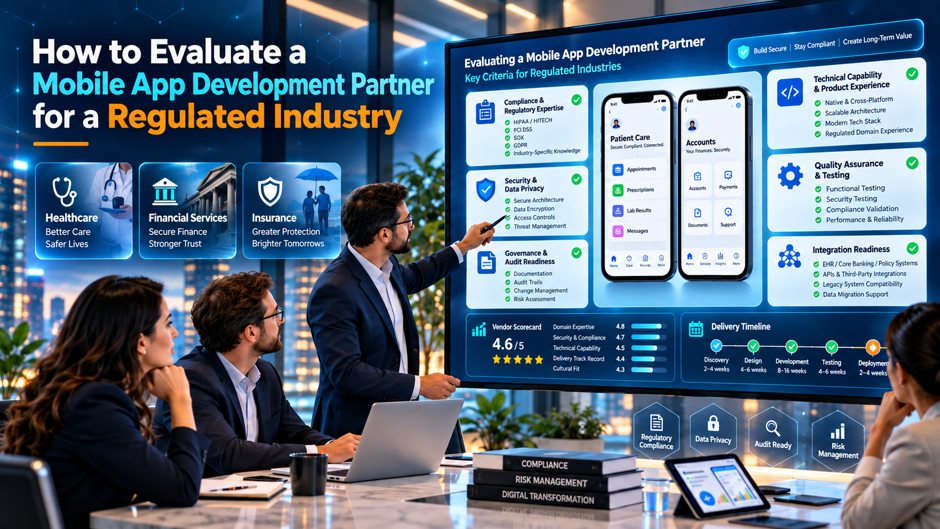
A health system signs with a mobile app agency that has a polished portfolio, a competitive quote and a confident answer to every question about HIPAA. Half a year in, a security review finds analytics software in the app sending screen names to a third party, crash logs containing patient identifiers and no signed business associate agreement with the agency’s subcontractors. The agency isn’t dishonest, only inexperienced with regulated data, and the health system, not the vendor, answers to regulators for what the app does.
This guide explains how to evaluate a mobile app partner when regulation applies, covering healthcare, financial services, insurance and other sectors where data protection and auditability are legal obligations. It organizes the evaluation around a scorecard, evidence to request, interview questions, contract terms and red flags. Regulatory details change quickly, so the status notes here reflect published reporting as of October 2026, and nothing in this post is legal advice. Involve compliance and legal counsel before choosing a vendor.
TL;DR
- Evaluate evidence, not claims. A partner that says it understands HIPAA, PCI or FDA rules should be able to show a prior regulated launch, a security testing report mapped to a recognized standard, and attestations whose scope matches your app, and anything that can’t be produced as a document should carry little weight in the final score. Documents can be checked by your security and compliance teams, while confident statements can’t.
- The regulated risk sits in the details of mobile engineering. Third-party SDKs, logs, crash reports, local storage, backups and test data are where protected information most often leaks, so ask exactly how the partner controls each one, and have an independent tester verify the answers against the OWASP MASVS before launch. Ask for the SDK inventory, log and crash report settings and backup configuration, then compare them with the test report.
- The contract has to carry the compliance load. Business associate agreements, security addenda, breach notification windows, audit rights, subcontractor flow-down and exit terms turn good intentions into enforceable obligations, and they should be negotiated before development starts, because bargaining power fades once the app is live. Standard development agreements rarely cover those items, so ask each vendor for draft regulated terms with its first proposal and compare the drafts line by line.
Why Regulated Mobile Projects Need a Different Vendor Evaluation
A regulated app shifts accountability in a way that surprises first-time buyers. Regulators generally hold the covered organization responsible for how an app handles protected data, even when a vendor wrote the code, so a vendor’s mistake becomes the buyer’s reportable incident. That reality changes what a good evaluation looks for. Visual polish, delivery speed and price still matter, though they rank below evidence that the team knows which controls the regulation expects and has implemented them before under real audit conditions.
Mobile apps also carry risks that web applications don’t. Data lives on devices the organization doesn’t control, third-party software development kits run inside the app with the same access as the app itself, operating system backups can copy sensitive files to cloud accounts, and app store review adds release constraints. OWASP’s Mobile Application Security project exists because these risks are distinct, and its verification standard separates baseline requirements for every app from stricter requirements for apps in banking, healthcare and government.
The regulatory ground is also moving, which favors partners who track changes. The HIPAA Security Rule update proposed in early 2025 would remove the addressable designation for key safeguards and require annual verification of business associate controls, and reporting in 2026 describes it as still proposed, with 1 source citing a July 2027 target. PCI DSS 4.0 future-dated requirements became mandatory on March 31, 2025, and 1 law firm reports the FTC rescinded a 2021 health breach policy statement on September 9, 2026. Confirm current status with counsel.
The Evaluation Scorecard at a Glance
| Criterion | What to Verify | Evidence to Request | Red Flag |
| Regulatory experience | Prior launches under your regulation | Named references, case studies, sample compliance artifacts | Generic claims with no regulated client willing to speak |
| Mobile security engineering | Controls mapped to a recognized standard | Independent test report against OWASP MASVS, secure design documents | Security described as a final-phase penetration test only |
| Attestations | Scope and period match your app | SOC 2 Type II report, ISO 27001 certificate with scope statement | A badge on the website with no report behind it |
| Data handling | Data flows, SDKs, logs, backups, test data | Data flow diagram, SDK inventory, retention rules | Production data used in test environments |
| Delivery quality | Secure development lifecycle and traceability | Code review policy, scan results, release checklist, validation records | No written process or evidence of automated scanning |
| Team and continuity | Named people, retention and substitution | Team bios, tenure data, backup plans | Senior staff shown in the sale and absent from delivery |
| Commercial terms | Willingness to accept regulated obligations | Draft agreement, security addendum, insurance certificates | Resistance to audit rights or breach notification windows |
| Exit and transition | Ability to leave cleanly | Code ownership terms, documentation standards, handover plan | Proprietary frameworks that lock you into the vendor |
Using a scorecard like this keeps the evaluation anchored to evidence and prevents a persuasive sales presentation from outweighing missing controls. Share the criteria with every bidder at the start so they can prepare documents, and decide the weights before reviewing proposals, because setting weights after seeing the bids invites rationalizing a favorite. Later sections explain how to dig into each criterion and how to score the results consistently across vendors.
Regulatory Experience: What Counts as Proof
References Within Your Regulatory Context A partner’s experience counts when it matches your regulatory context. A fintech app handling payments needs a vendor that has shipped under PCI DSS and has dealt with card brand and bank requirements, while a patient-facing health app needs experience with HIPAA, business associate agreements and, where the product qualifies as a medical device, FDA expectations. Ask for 2 or 3 references in your sector, then speak with the client’s security or compliance lead as well as the project sponsor.
Familiarity With the Actual Rules Test knowledge with specific questions. Ask what the partner would treat as protected data in your app, how it handles breach notification obligations that differ between HIPAA covered entities and non-covered health apps, or which of your controls it would document for an audit. FDA treats some mobile apps as medical devices, and section 524B cybersecurity requirements apply to cyber devices in premarket submissions, so a partner working in that space should explain how its process supports regulatory submissions.
Evidence of Past Audits and Inspections The strongest proof is a vendor that has been through the scrutiny you expect to face. Ask whether any client app the partner built has gone through a regulator inquiry, a customer security assessment or a third-party audit, what findings arose, and how the partner responded. A candid story about a fixed finding is more reassuring than a claim of a spotless record, since experienced regulated teams have usually had to remediate something.
Willingness to Share Sample Artifacts Experienced partners can show redacted examples of the documents regulated delivery produces, such as threat models, data flow diagrams, traceability matrices, validation records and security test reports. Reviewing those artifacts reveals the depth of the partner’s process and the format of the evidence you’ll receive. A vendor with only marketing slides may be learning regulated delivery on your project. Request samples before the pilot starts. This also shows what evidence you’ll receive.
Mobile Security Engineering Capabilities
- Ask which security standard the partner builds and tests against. OWASP’s Mobile Application Security Verification Standard defines security requirements for mobile applications across areas such as storage, cryptography, authentication, network communication, platform interaction, code and privacy, so a regulated app should use a defined risk-based target and the partner should explain why. Written reasoning for the chosen level shows whether the team understands its risk profile.
- Verify the testing approach and who performs it. OWASP’s Mobile Application Security Testing Guide describes how to test each control, and 1 industry estimate suggests automated tools cover roughly 60% to 70% of the requirements, which means business logic, authentication flow and runtime behavior still need manual testing by qualified people, preferably from outside the team that wrote the code. OWASP notes that the mobile standard covers the client, so APIs and backend services need their own review against an application security standard.
- Treat any claim of certification against the standard with caution. OWASP states that it doesn’t certify vendors, verifiers or software, and that trust marks claiming certification aren’t vetted by OWASP, so ask for the actual test report, the scope, the level tested and the deviations, since a credible report names what was and wasn’t exercised. Reputable testers describe scope limits plainly and avoid certification language that they can’t support with a registry.
- Examine the specifics of data protection on the device. Questions should cover secure local storage, handling of keys and tokens, transport security including certificate validation, biometric and session handling, protection of screenshots and the clipboard, backup exclusion and detection of rooted or jailbroken devices, and the answers should come with references to code or configuration rather than assurances alone. Ask to see these settings in a test build running on a real device.
- Probe third-party code and supply chain control. Mobile apps embed analytics, advertising, payment and support SDKs that inherit the app’s permissions, so the partner should maintain an inventory of every dependency, scan for known vulnerabilities, review SDK data collection before adoption and be able to produce a software bill of materials for each release. Ask which team member approves new dependencies and how often the inventory is reviewed after launch, such as every quarter.
Certifications and Attestations: Reading Them Correctly
Attestations help, but only when their scope matches the work. A SOC 2 Type II report covers the controls of a service organization over a stated period, so check which systems and trust criteria are in scope, whether the period is recent and whether the auditor’s opinion contains exceptions. A report covering the vendor’s corporate IT environment says little about the build pipeline or the team handling your source code. Ask for the full report under a nondisclosure agreement and read the scope and exceptions sections first.
ISO 27001 certification requires reading the scope statement and statement of applicability, since a certificate can cover a single office or a narrow service. The same discipline applies to any security badge on a website, and to claims about frameworks such as HITRUST, which has its own assessment scopes and assurance levels. For health data, the more important document than any badge is a signed business associate agreement, and for card data, the vendor’s responsibilities under PCI DSS should be described in a written responsibility matrix.
An attestation about the vendor’s company doesn’t prove that your app is secure. Distinguish between organizational certifications, which describe how the partner operates, and product evidence, such as an independent mobile penetration test of your specific app. Strong evaluations require both. Ask for both kinds of evidence before scoring either criterion in your scorecard. Ask how the partner will keep attestations current, notify you of lapses and share new reports without being asked.
Regulatory Landscape Snapshot
| Regulation | Who It Touches | What It Means for the Vendor | Status Note |
| HIPAA Privacy, Security and Breach Notification Rules | Covered entities and their business associates | A signed business associate agreement, safeguards for protected health information and incident reporting to the covered entity | In force, with security requirements judged by the existing rule |
| Proposed HIPAA Security Rule update | Covered entities and business associates | Would require stronger encryption, multifactor authentication and annual verification of vendor safeguards | Reported as still proposed in 2026, with 1 source citing a July 2027 target |
| FTC Health Breach Notification Rule | Health apps and similar products outside HIPAA | Breach notification duties for non-HIPAA health data, with a 2024 rule update expanding coverage | 1 law firm reports a September 9, 2026 rescission of a 2021 policy statement, so confirm scope with counsel |
| PCI DSS 4.0 | Entities handling payment card data | Client-side controls for payment pages, scripts and third-party code in the app | Future-dated requirements mandatory since March 31, 2025 |
| FDA device cybersecurity and software expectations | Apps that qualify as medical devices | Secure development evidence for premarket submissions, including cybersecurity under section 524B | Applicability depends on intended use, so confirm with regulatory counsel |
| Interagency third-party risk guidance for banks | Banks and their service providers | Due diligence, contract terms and ongoing monitoring of vendors | Issued in 2023 and applied by examiners to vendor relationships |
This table is a starting map, because each project’s obligations depend on the data collected, the users served and the jurisdictions involved. A partner should know which rows apply to your app without prompting and explain how its process produces evidence for each. Ask how the vendor tracked the proposed HIPAA update or the PCI DSS transition for current clients, since the answer shows whether regulatory awareness is a practice or a slogan.
Data Handling and Privacy Practices to Examine
Map Every Data Flow Before Writing Code Ask for a data flow diagram that shows what the app collects, where it’s stored on the device, which services receive it and where it ends up. A partner experienced in regulated delivery produces this early and updates it with each release, and it becomes the basis for privacy reviews, risk assessments and breach analysis. If the vendor can’t draw the flows for a sample project, it probably hasn’t been tracking them, and the first accurate map will arrive during an incident.
Control Third-Party SDKs and Analytics Embedded analytics, advertising, crash reporting and support tools are a frequent source of unintended disclosure, because they can collect screen names, identifiers or form content. Require the partner to list every SDK, describe what each one collects, justify its use, configure it to avoid sensitive data and, for health data, confirm that a business associate agreement exists where the vendor receives protected information. The default position should be that nothing ships without review.
Keep Sensitive Data Out of Logs, Crashes and Backups Regulated data tends to leak through side channels. Logs, crash reports, analytics events, screenshots in the app switcher, clipboard contents and cloud backups can all capture protected information that was never meant to leave the secure path. Ask the partner how it filters logs, which fields are masked in crash reports, how it prevents sensitive screens from being captured and how it excludes sensitive files from backups, and ask to see these settings in a test build.
Separate Environments and Protect Test Data Production data in development and test environments is a common finding in audits. Ask how the partner generates test data, whether it uses de-identified or synthetic records, who can access each environment and how access is granted and removed. Verify that source control and build servers follow the same access discipline, since keys leaked in a repository can expose production systems. Ask to see an access list for each environment and a recent example of access being removed.
Delivery Process and Quality Evidence
- Look for a written secure development lifecycle. The partner should describe how security requirements enter user stories, how threat modeling is done before building features, who reviews code and how exceptions are approved, and it should show the document and a recent example of it working, since a policy nobody follows doesn’t satisfy an auditor or protect users. Ask the vendor to walk through 1 completed project’s security tasks from design through release.
- Check automated scanning in the build pipeline. Static analysis, dependency scanning, secret detection and mobile-specific checks should run on every build, with findings tracked to closure and release gates when critical issues appear. Ask for sample dashboards or reports showing trends and remediation times, and confirm the tools cover both iOS and Android and the libraries each platform uses. Trend data over several releases shows whether the team actually fixes what the tools find.
- Require traceability from requirement to test. Regulated projects need evidence that each requirement was implemented and tested, and that changes were reviewed and approved. Ask how the partner links requirements, code changes, test cases and release notes, since traceability supports audits, helps scope the impact of regulation changes and makes it possible to answer detailed questions months after launch. Good traceability also shortens audit preparation because evidence is already linked and searchable.
A Due Diligence Process in 5 Steps
| Step | Activity | Output |
| 1. Define requirements | Document regulations, data types, user groups, platforms and integration needs with compliance and security input | A requirements brief and the scorecard weights agreed before bids arrive |
| 2. Screen candidates | Issue a questionnaire covering experience, attestations, security practices and team | A shortlist of 3 to 5 vendors with evidence attached |
| 3. Verify evidence | Review SOC 2 or ISO reports, sample artifacts, test reports and speak with references | Scored scorecard with open issues listed |
| 4. Run a paid pilot | Build a small feature or security-focused prototype under realistic conditions | Working code, independent test findings and a view of collaboration quality |
| 5. Negotiate and decide | Align contract terms, security addendum and exit provisions with the scores | A selected vendor, signed agreements and a monitoring plan |
A paid pilot is the most informative step because it replaces claims with observed behavior. A 2-to-4-week engagement building a small feature or security-focused prototype, with an independent security test afterward, reveals how the team handles secrets, logging, SDK choices, documentation and review comments. Budget for it as part of selection instead of expecting free work, since vendors that do regulated work carefully don’t give away serious engineering time, and unpaid pilots tend to attract teams that cut corners.
Commercial and Contract Terms That Carry the Compliance Load
A regulated engagement needs contract terms that go beyond a standard development agreement. For health data, a business associate agreement must be in place before the vendor touches protected information, and it should extend to subcontractors who handle that data. For personal data in other regimes, a data processing agreement defines purposes, retention, location and security measures. A security addendum should set minimum controls, testing requirements, vulnerability remediation timelines and obligations to follow your policies for access and change management.
Incident handling deserves specific language. Define what counts as a security incident, require notification within a stated period, set expectations for cooperation in investigation and regulator communication, and allocate the costs of notification, credit monitoring and forensic work. Audit rights should let you review the vendor’s relevant controls and, where needed, the controls of subcontractors. The proposed HIPAA update would add annual verification of business associate safeguards, so building an evidence-sharing schedule into the contract now prepares both sides for stricter expectations.
Liability, insurance and exit terms finish the picture. Standard liability caps may be too low for regulated data, so negotiate higher limits or carve-outs for data breaches and confirm that the vendor carries cyber and professional liability insurance with certificates you can review. Specify that you own the source code and documentation, require escrow or handover of build scripts, signing keys and cloud accounts at termination, and agree on transition assistance. Bargaining power is highest before signing, and these terms are much harder to obtain after launch.
Interview Questions That Separate Experienced Vendors From Generic Ones
Security Leadership and Accountability Ask who owns security at the partner, whether that person is independent of delivery pressure, and how they’re involved in your project. Ask how security findings are escalated, who can stop a release and how often that has happened. Vendors that treat security as a function with real authority tend to describe specific cases, while vendors that treat it as a checklist tend to answer in general terms and hesitate when asked for an example.
Incident History and Response Ask about the last security incident or serious vulnerability the partner dealt with, how it was found, how quickly it was fixed and what changed afterward. Request the incident response plan and ask whether it has been exercised. A candid, detailed answer shows maturity, and a claim that the partner has never had an incident should prompt skepticism, because mobile apps and their dependencies produce vulnerabilities regularly and experienced teams know it.
Handling Regulatory Change Ask how the partner learns about rule changes, who is responsible for translating them into engineering work and how it has adapted client apps in the past. For example, ask what it did when PCI DSS 4.0 requirements for payment environments took effect or how it’s preparing for stronger HIPAA security requirements. Specific actions, such as updated templates or revised scanning rules, show real practice, while vague references to staying current prove little.
Team Depth and Retention Ask who will work on your project, how long they’ve been with the firm, what happens when someone leaves and how knowledge is shared. Request tenure data for the security and mobile engineering staff and the proportion of work done by subcontractors. Teams that depend on a few individuals or on rotating contractors create risk for regulated apps, where continuity of knowledge about controls and decisions matters when auditors ask questions later.
Red Flags During Evaluation
- Compliance expressed as a feature instead of a process. Statements such as HIPAA compliant app or built to meet FDA rules suggest a belief that compliance can be installed, whereas regulated organizations achieve it through policies, controls, training and evidence over time, so ask the partner to describe the process behind such claims, and be wary when it can’t. Ask what evidence the vendor would hand an auditor for such a claim.
- No willingness to sign a business associate or data processing agreement. A vendor that hesitates to accept regulated obligations, or that wants to renegotiate standard terms heavily, either doesn’t understand the obligations or doesn’t intend to meet them, and either case should end the discussion before any technical work begins. Early resistance on these terms usually grows into disputes during an incident, when the cost of disagreement is highest for both sides.
- Security described as a final-stage penetration test. Testing at the end finds problems when they’re most expensive to fix, and it signals a process without threat modeling, secure design or pipeline scanning, so look for security activities in each phase of delivery and independent testing before launch. Ask when threat modeling occurs, which scans run on every build and how findings block a release, then compare the answers with the sample pipeline reports.
- Unreviewed use of third-party SDKs and AI tools. If the partner can’t list the SDKs in its sample apps, explain what each collects or describe how developers’ AI coding assistants handle your code and data, the supply chain and data exposure risks are likely unmanaged, and those issues are hard to see from outside until something goes wrong. Both categories should appear in the vendor’s dependency inventory and written usage policy.
Weighting and Scoring Example
| Criterion | Illustrative Weight | Scoring Guide |
| Regulatory experience | 20% | 5 means multiple regulated launches in your sector with references and sample artifacts |
| Mobile security engineering | 20% | 5 means independent testing against a recognized standard at the level your risk requires |
| Data handling and privacy | 15% | 5 means documented data flows, SDK governance and controlled logs, crash reports and test data |
| Delivery quality and traceability | 15% | 5 means a documented secure lifecycle with automated scanning and requirement traceability |
| Attestations | 10% | 5 means current reports whose scope covers the relevant systems and teams |
| Team and continuity | 10% | 5 means named senior staff, low turnover and a credible substitution plan |
| Commercial terms | 10% | 5 means acceptance of regulated obligations, audit rights, insurance and clean exit terms |
Weights should reflect your risk profile, and the numbers here are illustrative judgments, not benchmarks. Consider a worked example. Vendor A scores 5 on regulatory experience, 4 on security, 4 on data handling, 4 on delivery, 3 on attestations, 3 on team and 4 on commercial terms, which yields a weighted score of 4.00. Vendor B scores 3, 5, 3, 4, 5, 4 and 3 on the same criteria, which yields 3.85. The totals are close, so a pilot should settle the decision.
Common Mistakes
Selecting on price and portfolio is the most common error. A strong portfolio shows design and engineering ability, and it says little about regulated delivery, where the work includes threat modeling, validation records and contract obligations that never appear in a screenshot gallery. Buyers who weight regulated experience and evidence heavily, and who verify it with references and artifacts, tend to avoid the expensive discovery that a launched app doesn’t meet the organization’s own compliance requirements.
Leaving compliance and security teams out of the evaluation is the second mistake. Procurement and product teams can compare features and price, but they usually can’t judge whether a SOC 2 scope is relevant or whether a data flow creates a reportable disclosure. Involving security, privacy, legal and compliance staff in the scorecard, the interviews and the pilot review catches problems early, and it builds shared ownership of the decision so the vendor isn’t blamed alone if something later goes wrong.
Treating selection as a 1-time decision is the third mistake. Regulations change, vendors rotate staff, and new SDKs and operating system versions arrive every year. Plan a monitoring cycle that includes annual evidence refreshes, periodic independent testing, reviews of the vendor’s subcontractors and a check of contract terms against updated rules. A partner chosen well but never reviewed can drift into noncompliance, and the buyer is the party that regulators will ask to explain it.
FAQs
What certifications should a mobile app partner for healthcare have?
There’s no single required certification for app developers under HIPAA, so ask for evidence of controls instead. Useful items include a SOC 2 Type II report or ISO 27001 certificate with a scope that covers the relevant teams and systems, a willingness to sign a business associate agreement, and an independent mobile security test report. Treat badges without reports as marketing, and check the dates and exceptions.
Does the OWASP MASVS certify mobile app vendors?
No. OWASP states that it doesn’t certify vendors, verifiers or software, and that trust marks claiming certification aren’t vetted by OWASP. MASVS is a verification standard, and its testing guide describes how to check each control. Ask a vendor for the actual test report, the level tested, the scope and the deviations, and have a qualified independent party perform or review the testing. Independent review by qualified testers remains the dependable path to confidence.
How can I tell whether a vendor has real regulated-industry experience?
Ask for references in your sector and speak to the client’s security or compliance lead. Request redacted artifacts such as threat models, data flow diagrams, traceability matrices and test reports, and ask about audits the vendor’s apps have been through. Experienced teams can describe specific findings and fixes, and they can explain which rules apply to your data without needing to be prompted. That mix of documents and testimony is hard to fake.
Should I run a paid pilot before signing a full contract?
Yes, in most regulated projects. A paid pilot of 2 to 4 weeks building a small authenticated feature, followed by an independent security test, shows how the team handles secrets, SDKs, logging, documentation and review feedback. It replaces claims with observed behavior and gives you real data for the scorecard, and it costs far less than correcting a poor choice after development. Treat the pilot as paid selection work with defined deliverables and a fixed end date.
What contract terms matter most with a regulated app vendor?
Priorities include a business associate or data processing agreement before data access, a security addendum with minimum controls and remediation timelines, incident notification within a defined period, audit rights, subcontractor flow-down, adequate liability limits and insurance, source code ownership, and transition assistance. Negotiate these before development starts, because your bargaining position weakens once the app is live and the team has context you can’t easily replace.
How should I handle third-party SDKs in a regulated app?
Treat each SDK as a vendor relationship. Require an inventory, a description of the data each one collects, a justification, configuration that avoids sensitive data and a review before adoption. For health data, confirm that a business associate agreement exists where an SDK provider could receive protected information. Scan dependencies for known vulnerabilities on every build, and produce a software bill of materials for each release. This discipline prevents most surprises during later audits and reviews.
How often should I reassess my mobile app partner?
At least annually, and after major events such as a security incident, a regulatory change or a change in the vendor’s key staff. Refresh attestations, review test reports, check subcontractors and verify that contract terms still match the rules. The proposed HIPAA update would add annual verification of business associate safeguards, so building that rhythm into your vendor management now is sensible. Record the review results so the next assessment starts from evidence.
What if the regulation applying to my app is still changing?
Choose a partner that tracks rule changes and builds flexibility into its process. Ask how it responded to earlier transitions, such as PCI DSS 4.0 payment page requirements, and how it keeps configurations and templates current. Build contract language that requires compliance with updated requirements as they take effect, and confirm the current status of any proposed rule, such as the HIPAA Security Rule update, with counsel before relying on it.