

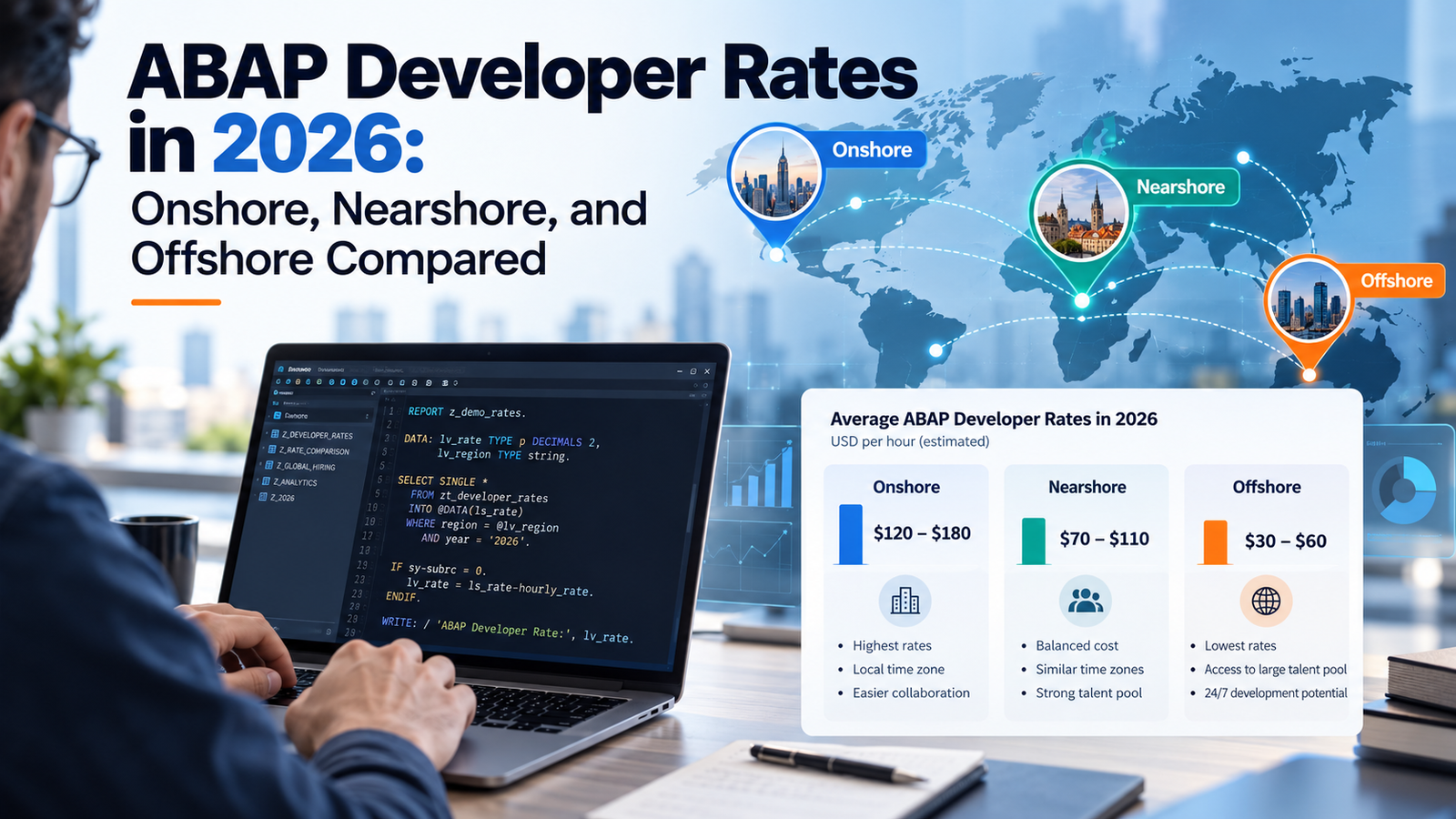
ABAP developer rates in 2026 vary sharply because buyers are paying for more than coding time. The same job title can mean maintaining ECC reports, remediating custom code for S/4HANA, building RAP services, or owning technical design across a migration program. Location still changes the price, but skill mix and project risk now move the rate almost as much as geography.
For a US buyer, an illustrative client-billing budget range is about $100 to $145 per hour for a mid-level onshore contractor, $55 to $85 per hour for a comparable nearshore developer, and $35 to $60 per hour for a comparable offshore developer through a normal commercial engagement. Senior ABAP work can run well above those bands when the scope includes S/4HANA conversion, RAP, CDS, Fiori integration, BTP, performance work, or technical leadership. These are example buyer-side billing assumptions, not surveyed regional averages.
The important point is to compare like with like. A salaried employee’s hourly pay isn’t the same as a contractor bill rate. A direct freelancer’s quote isn’t the same as a vendor rate that includes recruiting, payroll, replacement coverage, account management, and bench risk. This guide separates those numbers so you can use ABAP developer rates as a planning tool instead of treating one headline figure as the market price.
TL;DR
·
For 2026 planning, mid-level onshore SAP ABAP rates can be budgeted around $100 to $145 per hour for US-based contract work.
·
Nearshore SAP ABAP rates can be budgeted around $55 to $85 per hour, with Latin America the main option for US time-zone overlap.
·
Offshore SAP ABAP rates can be budgeted around $35 to $60 per hour for mid-level work, with India remaining a large SAP talent market.
·
Senior developers with S/4HANA conversion, RAP, CDS, ABAP Cloud, BTP, or difficult performance work can price well above the mid-level range.
·
Compare the full delivery cost, including review time, overlap hours, rework, vendor margin, and project management, before choosing a region.
2026 ABAP Rate Benchmark
A useful 2026 budget comparison starts by separating pay from billing. US salary data already shows that experienced ABAP talent sits above the broad software market in many cases. RecentIndeed salary data places average SAP ABAP developer pay in the United States at about $69.84 per hour, based on job-posting data updated in September 2026. That figure is employee pay, so it should not be read as the price a client pays for a contractor through a staffing or consulting firm.
A second benchmark points in the same direction.ZipRecruiter pay data reported an average US ABAP Developer annual pay of $144,321 in September 2026, which it converted to about $69.39 per hour. Its middle range stretched from $123,000 to $166,500 a year, showing why one national average is too blunt for project budgeting.
General software labor data helps set a floor for comparison. TheBLS software wages report for May 2025, released in 2026, put the mean hourly wage for US software developers at $71.20 and the median at $65.38. ABAP is a narrower enterprise skill, so projects that need SAP-specific history, business-process knowledge, and S/4HANA conversion experience often clear the broader software benchmark.
For buyer-side planning, the table below uses market evidence as an anchor and then adjusts for normal contractor economics. These are illustrative client-facing commercial bill-rate assumptions for a staff-augmentation or consulting engagement. They aren’t salary equivalents, verified market-wide averages, or a tariff. A direct freelancer’s quote can be lower, and the upper ends of specialist bands can include management or short-assignment premiums.
| Experience And Scope | Onshore US | Nearshore LATAM | Offshore India / South Asia |
| Junior or support-focused ABAP | 70-100/hr | 40-60/hr | 25-40/hr |
| Mid-level ABAP developer | 100-145/hr | 50-80/hr | 30-50/hr |
| Senior ABAP / S/4HANA developer | 130-180/hr | 70-100/hr | 40-70/hr |
| Lead, RAP, BTP, or difficult migration work | 160-220+/hr | 90-120+/hr | 55-90+/hr |
Published contractor and vendor sources help check the planning bands. Firstbridge Consulting’s 2026 SAP contractor rate card puts US mid-level ABAP/Fiori work at $115 to $145 per hour and senior ABAP/Fiori work at $145 to $180 per hour for staffing-partner engagements. Second Talent’s 2026 SAP developer price comparison reports US mid-level freelance/contract rates of $85 to $135 per hour, alongside LATAM vendor reference figures of $44 to $70 per hour and South Asian contractor figures of $19 to $30 per hour. Those categories use different engagement models, so they can’t be treated as a single matched rate survey.
For India, Supersourcing’s 2026 SAP hiring guide quotes about $25 to $45 per hour for standard ABAP developers and $50 to $80 per hour for S/4HANA migration architects. For the wider LATAM market, Nearshore Business Solutions’ agency-rate comparison lists fully loaded mid-level software engineers at $60 to $80 per hour and seniors at $75 to $95 per hour. The LATAM agency comparison is for software engineers broadly, not an ABAP-only dataset. These published figures are supplier estimates and advertised contract terms, not independently verified transaction averages.
The table therefore keeps a planning margin for staffing overhead and specialized work. Its upper lead bands are quote-testing allowances rather than observed regional averages. A buyer should validate each row with written quotes for the exact ABAP skills, hours, staffing terms, and support included. The mid-level and senior offshore bands have been narrowed because publicly listed India ABAP prices don’t justify treating the original higher limits as typical.
The SAP ABAP developer hourly rate can fall outside these bands for short emergency work, regulated projects, unusual language requirements, public-sector clearance, or a fixed-price statement of work. A developer may also quote less on a 12-month engagement than on a 40-hour rescue assignment because utilization risk is lower.
Onshore ABAP Developer Rates
Onshore SAP ABAP rates are highest when the buyer wants a US-based developer who can work normal local hours, join business workshops, handle sensitive production access, and coordinate directly with functional owners. The rate also reflects US employment economics. In June 2026,BLS compensation data showed wages of $54.06 per hour and total compensation of $78.88 per hour for management, professional, and related private-industry occupations. Benefits and employer costs therefore add a large layer above wage alone.
Applied cautiously to ABAP salary data, that gap explains why a $70-per-hour employee pay benchmark can translate into a client cost above $100 per hour before a staffing firm or consulting provider adds recruiting expense, delivery management, or margin. This is why onshore SAP ABAP rates around $100 to $145 per hour for a mid-level contractor are credible even when salary websites show employee pay closer to $70 per hour.
Senior onshore work usually moves into the $130 to $180 range. The higher end appears when the developer is expected to make design decisions, review code from other teams, handle SPAU or SPDD-related remediation, resolve performance issues, or work across multiple modules. A technical lead who can connect classical ABAP, CDS, OData, RAP, Fiori, integration, and migration choices may quote $160 to $220 per hour or more, especially for short assignments where the buyer needs a specific problem solved quickly.
The SAP ABAP developer hourly rate also changes by engagement structure. A direct independent contractor may sit below a major consulting firm’s bill rate because the direct contractor carries lower account overhead. A large provider’s rate can be higher because it includes delivery governance, replacement coverage, security processes, and a larger bench. Those extras may be worth paying for on a large migration, but they shouldn’t be mistaken for developer pay.
Onshore is usually the better fit when requirements are still changing, business users need frequent workshops, production access is tightly controlled, or the work sits on the critical path of a go-live. It can also make sense for a lead role while execution is split across nearshore or offshore developers. The goal is to use the expensive local hours where proximity changes the outcome.
Nearshore ABAP Developer Rates
Nearshore SAP ABAP rates usually offer the closest balance between US working-hour overlap and lower labor cost. For US buyers, nearshore most often means Mexico, Brazil, Colombia, Argentina, Costa Rica, or another Latin American market. A mid-level planning band of $55 to $85 per hour is reasonable for commercial ABAP work, while senior profiles commonly move into the $75 to $105 range.
The real advantage is operating overlap. A US team can schedule design calls, code reviews, defect triage, and testing discussions during the same workday without forcing either side into a night shift. That can reduce queue time when a defect requires input from an SAP functional consultant, security owner, or business analyst before the developer can continue.
Nearshore pricing rises when the profile combines deep SAP experience with strong English, US-client experience, and modern S/4HANA skills. Brazil has a long SAP enterprise footprint, while Mexico has a geographic and time-zone advantage for US programs. Smaller talent markets can produce excellent developers, but availability may be thinner for niche combinations such as EWM plus ABAP, BRIM plus ABAP, or RAP plus industry-specific process knowledge.
The rate should also reflect how the resource is engaged. A payroll employee supplied through a vendor, an independent contractor, and a small development shop can quote different figures for the same person. If a nearshore quote looks unusually low, check what it leaves out. Paid leave, local employment costs, equipment, compliance, replacement terms, and management time can sit outside the visible hourly number.
Nearshore works particularly well when a project needs daily collaboration but doesn’t require every technical resource in the same country as the business. A common structure is an onshore architect or lead paired with nearshore developers who own build work and defect resolution. In that model, nearshore SAP ABAP rates can lower the blended cost without creating a full overnight handoff model.
Offshore ABAP Developer Rates
Offshore SAP ABAP rates remain the lowest of the 3 location models in most buyer budgets, especially when the work is sourced from India. A practical mid-level range is about $35 to $60 per hour through a commercial provider, while senior ABAP and S/4HANA work often falls around $50 to $85 per hour. Direct contractors can quote below those levels, and large consulting firms can quote above them.
India’s local salary base helps explain the gap. RecentIndia salary data from Indeed put average SAP ABAP developer pay at about Rs. 743,138 per year in July 2026, with a wide reported range based on experience and employer. A client-facing offshore bill rate is higher than local salary because it may include employer cost, vendor margin, bench coverage, recruiting, equipment, security controls, and account management.
Offshore pricing is most attractive when the work can be defined clearly. Examples include remediation of a known list of ATC findings, development of specified reports or interfaces, unit-tested enhancement work, test defect fixes, and production support with documented runbooks. The model is harder when requirements change several times a day or the developer needs constant access to business users who work in another time zone.
The SAP ABAP developer hourly rate should also be judged against useful overlap. A $40 rate isn’t automatically cheaper than a $65 nearshore rate if the US lead spends 2 extra hours each day rewriting requirements, reviewing basic errors, or waiting for the next offshore shift. On the other hand, a disciplined team can use the time gap well. US staff can finish design decisions late in their day, and offshore developers can begin execution before the US morning.
Offshore SAP ABAP rates can climb fast for senior specialists. Developers with proven conversion experience, RAP, CDS, BTP, Fiori integration, performance tuning, or niche modules may have several global options. The cheapest offshore band therefore applies mainly to routine or mid-level work, not to every ABAP requirement that happens to be delivered from India.
Why Geography Changes The Rate
Geography affects ABAP developer rates through labor cost, but labor cost is only the first layer. Employment taxes, benefits, currency, vendor structure, office requirements, and local competition for SAP talent all influence the final number. The buyer then adds its own operating cost through meetings, security onboarding, access controls, review cycles, and management time.
Demand is also being pulled by the SAP maintenance calendar. SAP confirmed in October 2026 that theSAP maintenance timeline for SAP Business Suite 7 still runs through December 31, 2027 for mainstream maintenance, with optional extended maintenance through December 31, 2030. That keeps conversion, custom-code cleanup, and coexistence work active for companies that still have ECC estates.
The location premium also depends on the job’s communication load. A developer writing a stable set of interfaces from accepted specifications can work effectively with limited overlap. A developer who must discover requirements with finance, sales, warehouse, or manufacturing users benefits more from shared hours. The more discovery and negotiation the job contains, the more valuable local or nearshore availability becomes.
Risk changes the rate too. A contractor touching a heavily customized production system is accepting more delivery pressure than someone building a small internal report. Buyers may also insist on specific insurance, background checks, industry controls, or client-site work. Those requirements shrink the available pool and push the rate upward.
This is why comparisons should start with the work package. Onshore SAP ABAP rates, nearshore SAP ABAP rates, and offshore SAP ABAP rates only become meaningful after the buyer defines scope, seniority, access needs, overlap hours, and ownership level.
Skill Premiums In 2026
The biggest 2026 rate premium comes from the shift away from purely classical ABAP work. A developer who can maintain older ECC code may be useful, but many migration programs also need someone who understands the newer ABAP model and the rules around clean-core development. SAP’s ownSAP ABAP course describes ABAP Cloud as using ABAP Development Tools for Eclipse, Core Data Services, RAP, and released APIs and extension points.
That combination changes hiring. A buyer may need classic enhancement experience for existing code while also requiring new development to follow a different model. SAP’sclean core guidance explains that private-cloud and on-premise customers can use ABAP Cloud while existing classic custom code continues to exist. Developers who can work safely across both worlds tend to sit above basic support rates.
RAP is another clear pricing divider. TheABAP Cloud FAQ states that ABAP Cloud is available across SAP S/4HANA editions and is required in SAP BTP ABAP environment and SAP S/4HANA Cloud Public Edition. A resume that only lists traditional reports, forms, and user exits doesn’t prove the person can design cloud-ready extensions.
For transactional services, buyers should look for real RAP delivery. SAP’sRAP documentation describes RAP as the model for building business objects and OData services with ABAP and CDS. Developers with production RAP work can therefore command a higher SAP ABAP developer hourly rate than developers whose experience is limited to classical procedural ABAP.
The same logic applies to language restrictions and released APIs. TheABAP language guide shows that ABAP for Cloud Development uses a restricted language and released objects based on the target environment. A senior developer who understands these boundaries can prevent design choices that later block cloud adoption or increase remediation work.
Seniority And Role Scope
Seniority matters, but years of experience alone is a weak pricing method. A developer with 12 years of repetitive support work may be less useful for an S/4HANA conversion than someone with 7 years who has completed several conversions and built RAP services. Buyers should price the work the person can own, not the age of the resume.
A junior ABAP developer usually works from clear technical specifications and needs review on design choices. Typical work may include small reports, straightforward fixes, unit tests, or support tickets. In 2026, that profile can sit around $75 to $105 per hour onshore, $40 to $60 nearshore, and $25 to $40 offshore.
A mid-level developer should be able to take a functional requirement, propose a technical approach, build the object, test it, and resolve normal defects with limited supervision. This is the level most buyers mean when they search for ABAP developer rates. The working benchmark is about $100 to $145 onshore, $55 to $85 nearshore, and $35 to $60 offshore.
A senior developer is expected to handle difficult debugging, performance work, cross-object dependencies, code review, and migration issues. If that person also owns technical design or mentors other developers, the role starts to overlap with a lead. Senior rates commonly move to $130 to $180 onshore, $75 to $105 nearshore, and $50 to $85 offshore.
A lead or specialist can sit much higher. SAP positions itsBTP ABAP environment as a platform for building ABAP Cloud apps and side-by-side extensions, which means ABAP work can now cross traditional ERP development boundaries. A lead who can decide when to use on-stack development, side-by-side extensions, released APIs, or integration services brings architectural responsibility into the rate.
Engagement Model And Its Effect On Price
The same developer can appear at several price points depending on how you buy the capacity. A full-time employee is quoted as salary. A direct contractor quotes an hourly or daily rate. A staffing vendor adds its margin. A consulting firm may include management and delivery responsibility. A fixed-price project rolls estimated labor, risk, and contingency into one number.
Direct contracting often produces the lowest visible SAP ABAP developer hourly rate because there are fewer commercial layers. The buyer takes more responsibility for screening, onboarding, continuity, classification, and replacement. This model works best when the buyer already has strong SAP technical leadership and can judge the developer’s work directly.
Staff augmentation costs more, but the vendor usually handles sourcing and payroll administration and may offer replacement terms. The rate can also include account management or local compliance support. When comparing onshore SAP ABAP rates with vendor-supplied offshore SAP ABAP rates, make sure both numbers include the same services.
Consulting firms can cost more again because the buyer is paying for delivery ownership rather than a named pair of hands. The quote may include a lead, quality checks, project coordination, or access to additional specialists. That can be useful for a conversion program, but it makes a direct rate comparison misleading unless the scope is normalized.
Fixed price can protect a buyer from hour growth when scope is stable. It can also hide a high effective hourly rate because the provider prices uncertainty into the proposal. Ask what assumptions drive the fixed price, how change requests are handled, and which deliverables are included. A low fixed price with a narrow definition of done can create more change fees than a transparent time-and-materials model.
The Hidden Cost Behind The Hourly Rate
Hourly rate is easy to compare, but total delivery cost is what matters. The cheapest developer can become expensive if the buyer must add more review, clarification, or rework. A higher-rate developer can be cheaper if the work is correct the first time and the person can make decisions without waiting for constant direction.
Start with productive hours. A 160-hour month doesn’t mean 160 hours of feature delivery. Meetings, code review, environment issues, required training, documentation, testing support, and defect analysis all consume time. Some of that work is necessary, so it should be in the budget rather than treated as lost time.
Then account for technical debt. An S/4HANA program may need developers to inspect old modifications, unused custom code, obsolete calls, and objects flagged by checks. SAP’smigration assistant guide describes tooling that explains ABAP Test Cockpit findings and proposes code changes for custom-code migration. Developers still need enough experience to judge those findings and test the result in the business context.
Time-zone friction is another cost. Nearshore SAP ABAP rates may be higher than offshore rates, but a nearshore team can sometimes close defects within the same US business day. Offshore can still win when the team has clean handoffs and enough specification detail. The useful question is how many calendar days a unit of work takes from ready to accepted.
Finally, include turnover and continuity. A low vendor rate loses value if the resource changes every few months and the replacement must relearn custom programs, naming conventions, interfaces, and business history. For long SAP programs, continuity often matters more than saving $5 per hour.
Budget Examples For Common ABAP Work
A rate table becomes useful when it is applied to a defined workload. The examples below use planning assumptions rather than claims about what every project will cost. Actual effort depends on the condition of the system, testing process, documentation, access, and how often requirements change.
Example: 400-Hour Development Package
Assume a buyer has 400 hours of mixed mid-level ABAP work covering reports, enhancements, interfaces, unit testing, and defect fixes. At $125 per hour onshore, labor is about $50,000. At $70 per hour nearshore, it is about $28,000. At $48 per hour offshore, it is about $19,200.
The gap is meaningful, but the comparison is incomplete until management effort is added. If the offshore model requires 60 extra hours from a US lead at $150 per hour, another $9,000 enters the project. The adjusted offshore cost becomes $28,200, which is close to the nearshore labor figure. The answer can still favor offshore, but the saving is smaller than the headline rate suggests.
Example: Senior S/4HANA Remediation
Assume a 240-hour work package needs a senior developer who can analyze custom code, resolve findings, work with functional owners, and support testing. A buyer might budget $160 per hour onshore, $95 per hour nearshore, or $70 per hour offshore. That produces labor totals of $38,400, $22,800, and $16,800.
This is where skill verification matters. If a cheaper resource takes twice as long because the developer hasn’t handled real conversion work, the lower hourly number fails. A senior specialist who completes the work in fewer cycles can have a lower cost per accepted object even with a higher rate.
Example: Blended Team
Many buyers get better economics from a mixed model. One onshore lead at 80 hours per month at $175 per hour costs $14,000. Two offshore developers at 160 hours each at $55 per hour cost $17,600. The combined monthly labor budget is $31,600 for 400 hours of capacity, producing a blended rate of $79 per hour.
That structure uses expensive local time for design and business alignment while lower-cost hours cover build work. It also reduces the risk of expecting an offshore developer to carry every workshop and stakeholder decision across a large time difference.
How To Choose Onshore, Nearshore, Or Offshore
Choose the region based on the work pattern. Onshore is strongest when the role is business-facing, security-sensitive, highly ambiguous, or responsible for architecture. Nearshore works well when daily collaboration matters but full US pricing doesn’t. Offshore is strongest when scope is stable, review standards are clear, and a large amount of build work can move through a repeatable process.
The decision should also account for the future state of the SAP landscape. SAP’sABAP developer hub groups current ABAP Cloud tutorials and concepts around modern extension work. If the program is moving toward ABAP Cloud, RAP, and released APIs, hiring only for classical ABAP may create another skills gap during the same project.
A useful sourcing rule is to keep decision ownership close to the business and place repeatable execution where the economics make sense. That can mean an onshore lead with a nearshore team, a nearshore lead with offshore development, or a small onshore specialist group supported by an offshore factory. There is no single correct map.
Onshore SAP ABAP rates make the most sense when speed of communication and accountability have high value. Nearshore SAP ABAP rates make sense when the team needs several shared working hours every day. Offshore SAP ABAP rates make sense when cost per build hour matters and the buyer has enough process discipline to make distributed work effective.
How To Evaluate An ABAP Rate Quote
A strong quote explains what you are buying. If a vendor sends a single hourly number without seniority, skill coverage, location, employment model, or replacement terms, the rate is hard to compare. Ask for enough detail to make the quotes equivalent.
Use this checklist before accepting the price:
·
Confirm whether the rate is for classic ABAP, S/4HANA work, or ABAP Cloud work.
·
Confirm the developer’s actual role on recent conversion or implementation projects.
·
Ask whether RAP, CDS, OData, Fiori integration, and BTP experience is hands-on or training-only.
·
Define required overlap hours and the developer’s real working time zone.
·
Confirm whether the quoted rate includes vendor fees, payroll cost, equipment, and replacement coverage.
·
Ask who performs technical review and whether review time is billed separately.
·
Define what counts as a billable hour during onboarding, access delays, and internal meetings.
·
Check notice periods, minimum commitments, and rate changes for extensions.
·
Review production-access rules and any industry security requirements before the start date.
·
Use a paid technical assessment or short trial task when the engagement model allows it.
The SAP ABAP developer hourly rate should be tied to evidence of ownership. Ask the candidate to explain a difficult defect, a performance issue, or a conversion finding they handled personally. The answer should show what they changed, how they tested it, and what tradeoff they made. Generic descriptions of team activity don’t prove senior capability.
Compare accepted output after the first few weeks. If one developer closes 8 well-tested objects while another closes 5 and creates more rework, the first developer can justify a higher rate. Cost per accepted result is a better management measure than cost per logged hour.
Final Take On ABAP Developer Rates In 2026
ABAP developer rates in 2026 are best understood as ranges tied to scope. For US buyers, mid-level onshore contract work often budgets around $100 to $145 per hour. Nearshore work commonly falls around $55 to $85 per hour. Offshore work commonly falls around $35 to $60 per hour, with senior specialists moving above each range.
ABAP developer rates show a real regional gap, but skill and ownership can narrow it quickly. A senior developer with proven S/4HANA conversion work, RAP, CDS, ABAP Cloud, or BTP experience may cost far more than a classical ABAP support developer in the same city. Short assignments and critical-path work can also carry a premium.
Use onshore SAP ABAP rates when business access and local accountability justify the cost. Use nearshore SAP ABAP rates when shared working hours can cut delays. Use offshore SAP ABAP rates when the work is defined well enough to benefit from lower labor cost without creating large review overhead. The best comparison is the total cost of getting accepted work into production, not the smallest hourly quote.
FAQs
What Is The Average ABAP Developer Rate In 2026?
For US buyers, a practical mid-level contractor benchmark is about $100 to $145 per hour onshore, $55 to $85 nearshore, and $35 to $60 offshore. These are planning ranges rather than official published rates. Seniority, S/4HANA experience, engagement model, and project risk can move the price well outside the midpoint.
What Is A Typical SAP ABAP Developer Hourly Rate In The US?
A typical SAP ABAP developer hourly rate for a mid-level US contractor is often budgeted around $100 to $145 per hour. Senior developers may run from about $130 to $180, while leads or specialists can reach $160 to $220 per hour or more for short or difficult assignments.
Why Are Contractor Rates Higher Than ABAP Salaries?
A contractor bill rate can include employer costs, recruiting, paid time off, payroll administration, vendor margin, equipment, insurance, account support, and the risk that the resource is unassigned between projects. Salary websites usually report worker pay, so those figures shouldn’t be compared directly with a client invoice rate.
What Are Onshore ABAP Developer Rates In 2026?
Onshore SAP ABAP rates for US-based work commonly range from about $75 to $105 per hour for junior or support profiles, $100 to $145 for mid-level developers, and $130 to $180 for senior developers. Lead-level work can exceed $200 per hour when the project needs rare skills or urgent support.
What Are Nearshore ABAP Developer Rates In 2026?
Nearshore SAP ABAP rates commonly fall around $40 to $60 per hour for junior profiles, $55 to $85 for mid-level developers, and $75 to $105 for senior developers. Lead or specialist profiles can move above $100 per hour when the work requires S/4HANA, RAP, or technical leadership.
What Are Offshore ABAP Developer Rates In 2026?
Offshore SAP ABAP rates commonly fall around $25 to $40 per hour for junior work, $35 to $60 for mid-level work, and $50 to $85 for senior ABAP or S/4HANA work. Rates can be lower for direct contractors and higher through large consulting providers.
Is Nearshore ABAP Development Cheaper Than Onshore?
Usually, yes. Nearshore rates are often below US onshore contract rates because the underlying labor market is cheaper. The final saving depends on vendor margin, seniority, overlap requirements, and review effort. A strong nearshore team can also reduce delay because it shares more of the US workday than most offshore teams.
Is Offshore ABAP Development Always The Cheapest Option?
The hourly quote is usually lower, but the total project cost may not be. Offshore work can require more written specification, review time, or handoff discipline. If those costs are controlled, offshore can be very cost-effective. If they aren’t, a higher nearshore rate can produce a similar or lower final cost.
Do S/4HANA Skills Increase ABAP Developer Rates?
Yes, especially when the developer has completed real conversion or implementation work. S/4HANA projects can require custom-code remediation, new data models, performance changes, API work, and a different approach to extensions. Proven delivery matters more than a course completion badge.
Do RAP And CDS Skills Cost More?
They often do because fewer ABAP developers have deep production experience with RAP and modern CDS-based application design than with classical ABAP. The premium is larger when the person can design the service model, handle authorization and behavior logic, and guide other developers through the same approach.
Should I Hire An ABAP Freelancer Or A Vendor Team?
Use a freelancer when the scope is clear and you already have technical leadership. A vendor team may fit better when you need sourcing support, replacement coverage, payroll handling, and access to multiple skill sets. Compare the full services included in the rate instead of choosing on price alone.
How Much Does A Senior ABAP Developer Cost Per Month?
At 160 billable hours, a senior developer at $150 per hour costs $24,000 per month onshore. A nearshore senior at $90 per hour costs $14,400. An offshore senior at $65 per hour costs $10,400. Actual monthly spend may differ if the engagement uses fewer billable hours or includes a minimum commitment.
Which ABAP Skills Should I Verify Before Hiring?
Verify the skills that match your system. Common checks include object-oriented ABAP, debugging, performance analysis, interfaces, enhancement frameworks, S/4HANA custom-code work, CDS, RAP, OData, and any module-specific technical experience. Ask for examples that show what the candidate personally owned and tested.
Can A Blended Team Lower ABAP Development Cost?
Yes. A buyer can keep a senior onshore or nearshore lead for design and stakeholder work while assigning defined build tasks to lower-cost developers. The model works when code review, handoffs, ownership, and acceptance criteria are clear. Poor coordination can erase the expected saving.
How Should I Compare ABAP Developer Quotes?
Normalize the quotes first. Compare the same seniority, skill set, working hours, contract length, vendor services, and ownership expectations. Then estimate total delivery cost by adding internal review time and likely rework. The lowest hourly rate isn’t automatically the lowest-cost option.