

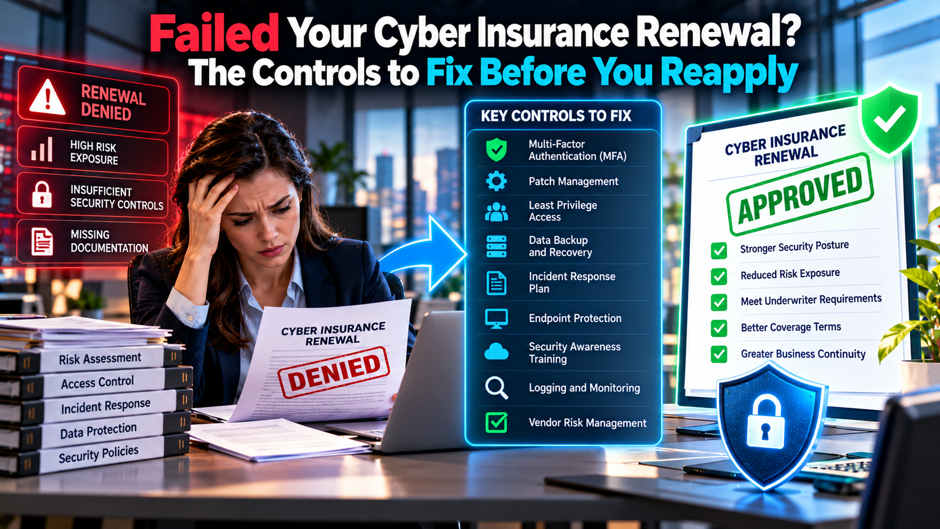
Imagine an illustrative 90-person engineering firm that gets a short email from its broker 40 days before renewal: the carrier won’t renew on current terms. The notice points to multifactor authentication gaps, no endpoint detection coverage on servers and a backup system nobody has restored in 2 years. The managing partner’s first reaction is anger, and the second is a practical question about whether the firm can sign client contracts that require coverage. The honest answer is yes, but only if the gaps get fixed and proven quickly.
This article covers what to do in the first days after a failed renewal, which controls underwriters check most often, how to build evidence they’ll accept and how to reapply without misstating anything. It draws on the NAIC’s market report, CISA’s performance goals and several vendor pages whose claims are labeled as vendor claims. Insurers differ, so confirm your own carrier’s requirements with your broker, and have counsel review the application wording before you sign.
TL;DR
- Get the reasons in writing, then fix the decline triggers first. Vendor pages consistently name multifactor authentication, endpoint detection and tested backups as the controls insurers refuse to waive. Ask the broker for the exact blockers, because guessing wastes weeks you may not have. Keep the notice itself in your evidence folder.
- Prove each control with dated evidence. A policy export, a coverage report and a restore log persuade underwriters in ways that a promise doesn’t. A court reportedly sided with an insurer after a policyholder overstated MFA coverage, so describe scope precisely and list the exceptions. Date every file.
- Plan for about 30 to 60 days, and keep coverage continuous. A vendor suggests a 30-day sprint for firms with partial controls and roughly 2 months from a weak starting point. Ask your broker about alternative markets while you remediate, and don’t let the current policy lapse. Put the renewal date on a shared calendar.
Why renewals fail
Missing controls are the most common cause. A managed provider (Net Friends, which sells security services) lists missing minimum controls as 1 of 5 typical denial reasons, and a second provider (CyberDuo) names multifactor authentication, endpoint detection and backups as the controls that carriers cite when they refuse coverage. A cyber insurance readiness assessment can help identify those gaps before the next submission. Underwriters have the questionnaire answers, scan data and claims experience in front of them, and they use those to decide whether a risk fits their appetite.
Unprovable controls fail as well. Many firms have a control that exists in some form but can’t show it quickly. The CyberDuo page lists inability to produce clear evidence among its refusal causes, and it recommends an evidence folder built before the application. If your multifactor policy is enforced for most users but you can’t export a report proving it, the underwriter will read the application as a gap, however well the control works in practice.
Other factors sit outside the control list. The Net Friends page also names a recent attack, too much sensitive data, requested limits that are too high or deductibles that are too low, and applying to the wrong insurer. Those matter because remediation alone may not resolve them. A firm holding large volumes of personal data might reduce what it keeps, rebalance limits with the broker or approach a carrier whose appetite fits its industry. Ask which category applies to you.
The first 72 hours after a failed renewal
Start by asking the broker and carrier for the specific blockers in writing. A vague notice that mentions “security posture” doesn’t tell you whether you failed on 1 control or 6. Ask which questionnaire answers, scan findings or claims history drove the decision, whether the carrier would reconsider with remediation evidence and by what date. CyberDuo recommends getting the denial reasons in writing within the first 3 days, and the same advice applies whether you’re facing non-renewal or an outright decline.
Next, confirm your coverage dates. Find the expiration of the current policy, the notice requirements in it and whether a short extension is available while you remediate. A gap in coverage can break contracts with customers and lenders who require it, and a lapse may complicate future applications, since carriers ask whether you’ve had continuous coverage. Have your broker open a parallel conversation with other markets right away, because some carriers will write a policy with a remediation timeline when presented with a credible plan.
Then start the evidence folder, even before you fix anything. Record the date, the current state of each control and the screenshot or export that shows it. That baseline protects you if a question arises later about what was true when. A vCISO can also help assign control ownership and organize evidence when responsibility is split across IT and leadership. It also tells you which items are quick wins and which need a budget. Keep the folder somewhere your whole leadership team can open, and name a single owner, so the work doesn’t depend on whichever technician happens to be free.
The controls underwriters check most often
| Control | What the vendor pages say insurers expect | Evidence to prepare |
| Multifactor authentication | Email, remote access, administrators, cloud services and backups; phishing-resistant where feasible | Policy export and exception list |
| Endpoint detection | Every supported endpoint and server, centrally managed, 24/7 alerting or a managed service | Coverage report by device |
| Backups | Not sync-only, separate credentials, immutable or isolated, restore-tested | Dated restore test record |
| Patching | Written timeline; a vendor cites 7 to 14 days for critical issues | Patch dashboard and aging report |
| Incident response plan | Written, owned, with roles, contacts and a tabletop exercise | Plan and exercise summary |
| Logging and monitoring | Central logs for identity, endpoints and remote access with after-hours alerts | Alert routing document |
| Training | Completion reports and phishing simulations | Reports with dates |
| Privileged access | Separate admin accounts, no shared credentials, least privilege | Admin account list |
| Vendor and payment controls | Verification of bank detail changes; access removed promptly | Procedure and sample log |
The list combines the CyberDuo and Consilien pages, both of which sell security services, so treat the thresholds as their guidance rather than a universal rule. Consilien separates controls into decline triggers (multifactor authentication, endpoint detection and immutable or air-gapped backups with a dated restore test) and items that raise premiums when weak. Use that split to rank your fixes, starting with the triggers. Ask your broker which items your carrier weights most.
Multifactor authentication: scope is where firms get caught
- Cover every account class the application asks about. Insurers typically ask about email, remote access, administrative accounts and cloud services. CyberDuo adds single sign-on and backup environments. List each category in your evidence folder with the enforcement method and the percentage of accounts covered. A partial rollout that protects email but leaves the VPN or a finance portal out is the scenario that produces a mismatch between the application and reality.
- Remove legacy authentication. Older protocols can bypass modern multifactor prompts, so an account that appears protected may still accept a password alone through a mail client or script. Disable those paths, then test by trying to sign in the old way. CyberDuo’s 30-day plan includes removing legacy authentication in week 1, and it makes sense to do that before you complete the application so the answer is accurate. Record the date you disabled each path.
- Prefer stronger methods where you can. CISA’s MFA guidance ranks stronger authentication methods ahead of weaker options, and its performance goals prioritize phishing-resistant methods. A Zero Trust security approach can also help extend identity checks beyond a single login event. Consilien reports that documented phishing-resistant multifactor can earn a premium credit of about 5 to 10 percent, though that figure is the vendor’s own estimate. Plan the move in stages if hardware keys are costly.
- Document exceptions honestly. Service accounts, shared mailboxes and legacy devices often can’t use multifactor. List them with the compensating control, such as network restrictions or monitoring, an owner and a retirement date. Consilien cites a court case, Travelers v. International Control Services (2022), where the insurer prevailed after multifactor coverage was overstated. Treat that reference as a vendor citation to verify with counsel, and take its lesson seriously: state the scope precisely.
Endpoint detection, monitoring and who answers the alert
Coverage has to be complete, not mostly complete. Underwriters ask whether endpoint detection runs on every endpoint and server. A report that shows 92 percent coverage leaves open the question of what the other 8 percent is, and attackers find the unprotected machine first. Generate a device-level report from your endpoint detection and response platform, reconcile it with your asset inventory and fix the differences. CISA’s Cross-Sector Cybersecurity Performance Goals call for measurable baseline security practices, which makes this reconciliation routine rather than a special project.
Someone must respond at 2 a.m. Consilien lists 24/7 alerting as part of what insurers expect, and CyberDuo notes that small teams may use a managed detection and response service. An alert that arrives in an inbox nobody reads overnight offers little protection. Decide who receives alerts, who can isolate a machine and what authority they’ve got, then write it down. If you outsource, get the response commitments and escalation contacts in the contract.
Logs support both detection and the claim. CISA’s goals recommend collecting security-relevant logs, storing them centrally, restricting access and keeping them for a period informed by risk or regulation. After an incident, those logs determine what happened and what the insurer will pay for. Confirm that identity, endpoint, firewall and remote access logs are retained long enough to be useful, and that disabling a critical log source triggers a notification to your security contact.
Backups and recovery
| Question the underwriter asks | Weak answer | Answer that passes |
| Are backups separate from production? | Synced to the same cloud account | Isolated copy under separate credentials |
| Can an attacker delete them? | Same admin accounts manage both | Immutable or air-gapped, protected by multifactor |
| When did you last restore? | “Jobs report success” | Dated test with the system, time and verifier |
| How fast can you recover? | No stated target | Documented objective compared with test results |
| Which systems are covered? | “Most servers” | Inventory-matched list with exceptions |
CISA’s performance goals say to back up systems needed for operations, store backups separately and test them. The agency’s ransomware guidance also recommends maintaining offline encrypted backups and regularly testing their availability and integrity. CyberDuo suggests testing key systems more often, quarterly in its checklist. Consilien treats immutable or air-gapped backups with a dated restore test as a decline trigger. Taken together, the sources point to a simple standard: separate, protected from administrator compromise and proven by an actual restore.
Run the restore test before you reapply and keep the record. Choose a system the business can’t live without, restore it into an isolated environment, time the process and have someone outside the backup team verify that the data is usable. Note any surprises, such as missing dependencies or credentials that nobody could locate. A test that finds problems is a good result in this context, because you can fix them and re-run them, and the dated record shows an underwriter a process that works.
Patching and unsupported systems
Patching is rarely a question of whether you patch, and more often a question of how fast and how provably. Underwriters look for a written timeline, ownership and evidence that critical issues close promptly. CyberDuo gives an example timeline of critical issues within 7 to 14 days and high-severity ones within 30, and Consilien cites 7 to 15 days for critical vulnerabilities. Choose a standard you can actually meet, publish it and measure against it, since a missed target you can explain beats an ambitious target you ignore.
Pay particular attention to internet-facing systems and anything past the end of support. A firewall running outdated firmware or a server on an unsupported operating system draws more scrutiny than a laptop that’s a week behind. Build an inventory of systems with their support end dates, and decide for each whether to replace, isolate or accept the risk with a documented exception. Underwriters who run external scans will see exposed services regardless of what the questionnaire says.
Report patching with evidence, not adjectives. A dashboard export showing the percentage of devices current, the age of the oldest critical missing patch and the list of exceptions is far more persuasive than a statement that updates are automatic. A vulnerability assessment can help reconcile scanner findings with that remediation record. Include a short note on how you handle emergency patches for actively exploited vulnerabilities, including items listed in CISA’s Known Exploited Vulnerabilities Catalog. If you rely on a managed provider, ask for the monthly report and confirm that it reflects every device in your inventory.
Incident response, training and privileged access
- Write the plan and exercise it. CyberDuo lists a missing or untested incident response plan among the reasons for denial, and Consilien notes that some carriers require a tabletop exercise before renewal. A usable plan names roles, severity levels, containment steps, communication duties and evidence preservation, and it lists the carrier’s claim hotline. An incident response retainer can also establish escalation contacts and response procedures before an event. Run a half-day tabletop with executives, record the gaps and update the plan within a couple of weeks.
- Keep training records that show behavior, as well as attendance. Underwriters ask for completion reports and phishing simulation results. A report showing 100 percent completion and a 30 percent click rate tells a different story than a report with the same completion and a 3 percent rate, so track both. Provide a follow-up process for repeat clickers and retain the records for the policy period. Retain the reports for the whole policy period, plus a year.
- Separate administrative accounts. The checklist pages call for distinct admin accounts, no shared credentials, least privilege and multifactor on administrative actions. Daily-use accounts shouldn’t carry domain or tenant administrator rights. Export the list of privileged accounts, remove stale ones and document who approves new ones. This is also the control that limits how far an attacker moves after a single phished mailbox. Review the list every quarter and remove accounts nobody can justify.
- Control payment changes. CyberDuo lists out-of-band verification of bank detail changes among its vendor and funds controls. A phone call to a known number before any change to payment instructions is inexpensive and stops a common fraud. Write the procedure, train the finance team and keep a log of verifications. If your policy includes social engineering coverage, ask the broker what conditions apply. Test the procedure with a mock request so staff know what a good call sounds like.
What the evidence pack should contain
| Evidence item | Format | Common mistake |
| Multifactor enforcement | Policy export with account counts and exceptions | Screenshot of a setting that doesn’t show coverage |
| Endpoint coverage | Device-level report reconciled to inventory | Report that omits servers |
| Backup and restore | Architecture note and dated restore record | Job logs presented as proof of recovery |
| Patch status | Dashboard export with aging and exceptions | Undated screenshot |
| Incident response | Plan, contact list and tabletop summary | Plan with no exercise |
| Training | Completion and simulation reports | Attendance only |
| Access control | Privileged account list with owners | Shared accounts left in place |
Consilien states that insurers want a policy export showing multifactor enforced across accounts, not a screenshot of the setting, and that’s a useful rule for the whole pack. Date every item, name the person who produced it and keep the original files. Organize the folder to mirror the application questions, so the broker can attach the right proof to each answer without a back-and-forth that burns days. Name the file after the question it answers.
Add a single-page cover memo. State the date, summarize what changed since the denial, list remaining exceptions with compensating controls and name your security owner. Underwriters read dozens of submissions, and a clear summary signals a company that manages risk deliberately. Leave out marketing language and leave out claims you can’t back with a file, because anything you can’t evidence invites a follow-up question you may not want to answer.
Accuracy on the application matters as much as the controls
An overstated answer can cost you the claim. Consilien describes a 2022 case, Travelers v. International Control Services, in which the court sided with the insurer after multifactor authentication was represented as covering all systems. It also cites a city’s $18.3 million recovery bill after a partial rollout and a denied claim. I haven’t verified either account against primary sources, so treat both as vendor citations. The practical lesson is consistent: a gap you disclosed is cheaper than a gap discovered during a claim.
Describe scope precisely and list exceptions. CyberDuo advises stating multifactor scope exactly and listing exceptions with compensating controls. Use the same approach for endpoint coverage, backup scope and patching. If a control is partly deployed, say what percentage and by when you’ll finish. Underwriters can often price a known exception, but a misstatement can undermine the policy. Have your counsel and broker review the final wording before an authorized officer signs.
Keep a single source of truth. The application, your evidence pack and your internal documents should agree. Inconsistencies appear when IT answers a section, finance answers another and nobody reconciles them. Assign a single reviewer who checks every answer against a file in the folder, and require the signing officer to read the document. This also helps later: when something changes mid-year, you can see which answers need an update and notify the broker.
The market backdrop in 2024 data
- Premiums fell for the first time. The NAIC’s 2025 cybersecurity insurance market report says total US cyber direct written premium was about $9.14 billion in 2024, down 7.11 percent from $9.84 billion in 2023. For US-domiciled insurers it was $7.08 billion, down 2.3 percent from $7.25 billion. The report describes the total decline as the first on record, and it says average rates fell about 5 percent in the fourth quarter of 2024.
- Claims are rising. The same report says reported claims rose almost 40 percent to nearly 50,000 in 2024. Of the 38,496 claims it lists as closed, 9,941 closed with payment and 28,555 without, which is a paid share of about 25.8 percent. Closing without payment can reflect many causes, including deductibles and exclusions, so the figure doesn’t prove that claims are being denied. Look at your own claims history alongside it, since that matters more to your carrier.
- Underwriters reward controls. The report says underwriters view cybersecurity investment favorably and that insureds have sought higher limits and lower retentions. That supports the practical advice here: documented controls improve your position. It doesn’t guarantee a particular outcome, because carriers differ and your own history, industry and data volumes matter at least as much as the market average. Ask your broker how the target carriers describe their appetite, and whether they publish minimum control lists.
- Appetite varies by carrier. The top 20 groups hold 76.24 percent of the market, and their loss ratios range from 9.24 percent to 96.26 percent in the NAIC table. Carriers with different loss experience set different appetites. A decline from 1 carrier doesn’t mean every carrier will decline, which is why a broker with access to several markets is valuable during reapplication. Treat any single refusal as information about that carrier, rather than about your whole profile.
What a failed control costs, with an illustration
Consilien reports that a typical $1 million policy costs about $45 to $200 a month, which is $540 to $2,400 a year, and that missing a basic control can add 25 to 50 percent to premiums or prevent coverage. It also reports premium credits of about 5 to 10 percent for documented strong controls. These are vendor figures, so use them for planning rather than pricing. Your own quote depends on revenue, industry, limits, retention and claims history.
To show the scale, assume an illustrative annual premium of $18,000. A 25 percent surcharge adds $4,500 and a 50 percent surcharge adds $9,000, so the weak-control premium would be $22,500 to $27,000. A documented-controls credit of 5 to 10 percent removes $900 to $1,800, giving $16,200 to $17,100. The swing between the weak and strong cases is therefore $5,400 to $10,800 a year in this example, before counting the value of simply having coverage.
Those numbers favor fixing the triggers, but they don’t tell the whole story. The larger exposure is an uninsured incident, and a vendor-cited recovery bill of $18.3 million in the city example shows how large that can get, though the figure is unverified. Compare remediation costs, such as endpoint licenses, backup storage and a tabletop exercise, with both the premium swing and the cost of going without coverage. Get actual quotes from your providers and broker, and confirm them in writing.
A 30-to-60-day remediation plan
| Timing | Priority work | Output for the evidence folder |
| Days 1 to 3 | Obtain denial reasons in writing, confirm coverage dates, start parallel market conversations | Broker email, policy dates, folder created |
| Week 1 | Enforce multifactor on identity, remote access and admin accounts; remove legacy authentication | Policy export and exception list |
| Week 2 | Deploy endpoint detection to all supported devices; set and measure patch timelines | Coverage report and patch dashboard |
| Week 3 | Harden backups, enforce multifactor on the backup console and run a restore test | Dated restore record |
| Week 4 | Update the incident plan, run a tabletop, document monitoring ownership | Plan, exercise summary, alert routing |
| Weeks 5 to 8 | Close exceptions, retest, collect training reports, finalize the cover memo | Complete pack and signed application |
The first 4 weeks follow CyberDuo’s 30-day sequence, and the extended period reflects Consilien’s estimate of roughly 2 months for firms that start with antivirus and nightly file copies only. Your timeline depends on your starting point, staff capacity and vendor lead times. Broader cybersecurity services can help coordinate remediation when the failed controls span identity, endpoints, monitoring and response. Ask your broker whether the carrier will accept an interim submission with a committed completion date, and whether a binder can be issued while remaining items finish.
Mistakes that delay approval
- Reapplying without fixing the blockers. Submitting the same application to multiple carriers with the same gaps produces the same answer and leaves a trail of declinations. CyberDuo advises re-marketing only after you’ve fixed the top blockers. Prioritize the decline triggers, assemble evidence and then ask your broker for a coordinated approach rather than a scattershot approach. Each declination can make the next conversation harder, since applications often ask about prior refusals. Wait until the evidence is ready.
- Answering from memory. Questionnaires reward precision, and memory runs generously. Check each answer against a report or export. If you can’t prove it today, either fix it first or describe it as partial with a date. Treat the application as a legal document, because that’s how a carrier will treat it when a claim arrives. Have a second person verify a sample of answers against the files before the application goes to the broker.
- Buying tools without configuration. Purchasing endpoint licenses or a backup product doesn’t satisfy a control if coverage is incomplete or settings are weak. Underwriters want deployment and operation, not purchase receipts. Budget for configuration time and for ongoing monitoring, and assign owners who review reports on a schedule. Ask each vendor for a configuration checklist and have your team confirm each setting after deployment. Schedule a monthly review of the coverage reports for the first quarter, and assign a named person to follow up on every exception.
- Letting coverage lapse. A gap can violate customer contracts and complicate future applications. Net Friends advises securing continuous coverage through a new insurer if the old insurer leaves the market. Work with the broker on extensions, short-term policies or alternative carriers, and confirm in writing that the new policy’s start date follows the old policy’s end date. Mark the expiration date on the leadership calendar, with reminders well in advance of the deadline.
Reapplying with your broker
Use the broker as a strategist, not a courier. Share the remediation plan, ask which carriers fit your industry and size and decide together how to present previous incidents. Net Friends advises disclosing prior incidents with details of the attack and your response, and using the insurer’s questionnaire as a checklist for gaps. A broker who knows each carrier’s appetite can often route you to markets where your profile fits, which saves time compared with applying everywhere.
Consider a third-party assessment. The same page suggests an outside report, such as a security rating or a controls assessment, as supporting evidence. A penetration test can add evidence about which technical weaknesses are actually exploitable when that matches the carrier’s concerns. An independent review can validate your fixes and find issues before an underwriter’s scan does. Be careful about cost and timing, and ask the broker whether the target carriers would value it. If you commission a review, share the findings and remediation status, rather than only the score. Agree on scope first.
Adjust data, limits and retention. Net Friends recommends reducing unneeded personal data under your retention requirements, adding protective layers for what you must keep and rebalancing limits and deductibles with the broker. A request for limits far above your exposure, or a deductible far below your capacity to self-insure, can trigger declinations. Model a few combinations with the broker and choose a structure that fits your balance sheet, then confirm every quote and exclusion in writing.
FAQs
Why did my insurer refuse to renew my cyber policy?
The most common causes named by vendor pages are missing minimum controls, an inability to prove them, a recent attack, too much sensitive data, mismatched limits and applying to a carrier that doesn’t fit your industry. Ask your broker for the specific reasons in writing. Without them, you may fix the wrong things. Insurers differ, so confirm each carrier’s requirements directly. Keep a copy of the carrier’s notice in your folder.
Which controls should I fix first?
Start with multifactor authentication, endpoint detection and tested backups, because vendor sources describe them as the controls carriers most often refuse to waive. Then address patching, the incident response plan, logging, training and privileged access. Cover every account class and device the application asks about, and document exceptions honestly. Your own carrier’s questionnaire is the best guide to its priorities. Prioritize by what your application flagged, and confirm sequencing with the broker.
How long does remediation take?
CyberDuo outlines a 30-day plan, and Consilien estimates roughly 2 months for firms that begin with antivirus and nightly file copies only. Both are vendor estimates. Your timeline depends on your current state, staffing and tool lead times. Ask the broker whether a carrier will accept a credible plan with dates, and whether coverage can continue while you finish. Build slack into the schedule for vendor delays and for retesting after any failed check.
What evidence do underwriters want?
They want dated, specific proof: a policy export showing multifactor enforcement, a device-level endpoint coverage report, backup architecture and a dated restore record, a patch dashboard with aging, the incident plan with a tabletop summary and training reports. Consilien notes that a screenshot of a setting is weaker than an export showing enforcement across accounts. Organize everything so each file maps to an application question. Name each file after the question it answers.
Can I lose a claim because of a wrong answer on the application?
Yes, an inaccurate application can create coverage disputes. Consilien cites a 2022 case, Travelers v. International Control Services, where the insurer prevailed after multifactor coverage was overstated, though I haven’t verified it independently. State scope precisely, list exceptions and have counsel and your broker review the application before an authorized officer signs it. A gap you disclose with a compensating control is usually easier to price than a surprise discovered after a loss. Keep the application and the evidence folder together for the whole policy term.
How much does a failed control cost in premium?
Consilien reports that missing a basic control can add 25 to 50 percent to a premium or prevent coverage, and that documented strong controls can earn credits of about 5 to 10 percent. On an illustrative $18,000 premium, that’s a swing of $5,400 to $10,800 a year. These are vendor figures and an invented example, so get real quotes. Ask your broker for quotes under both the weak and strong scenarios.
Is cyber insurance getting cheaper or harder to get?
The NAIC’s 2025 report shows total US cyber premium fell 7.11 percent in 2024 to about $9.14 billion, and average rates dropped about 5 percent in the fourth quarter, the first quarterly decrease after 7 years of increases. Reported claims rose almost 40 percent. Conditions vary by carrier and industry, so use the data as context and rely on your broker for current appetite. Ask your broker how those trends show up in your own quote.
Should I switch carriers or stay and remediate?
Usually do both: remediate the decline triggers and have your broker approach alternative markets in parallel. Some carriers will write a policy with a remediation timeline when presented with a credible plan, according to Consilien. Compare terms, exclusions and retention carefully, avoid any gap in coverage and confirm the details with your broker and counsel before you bind a new policy. Ask each carrier what remediation proof it’ll accept before you pay for work.