

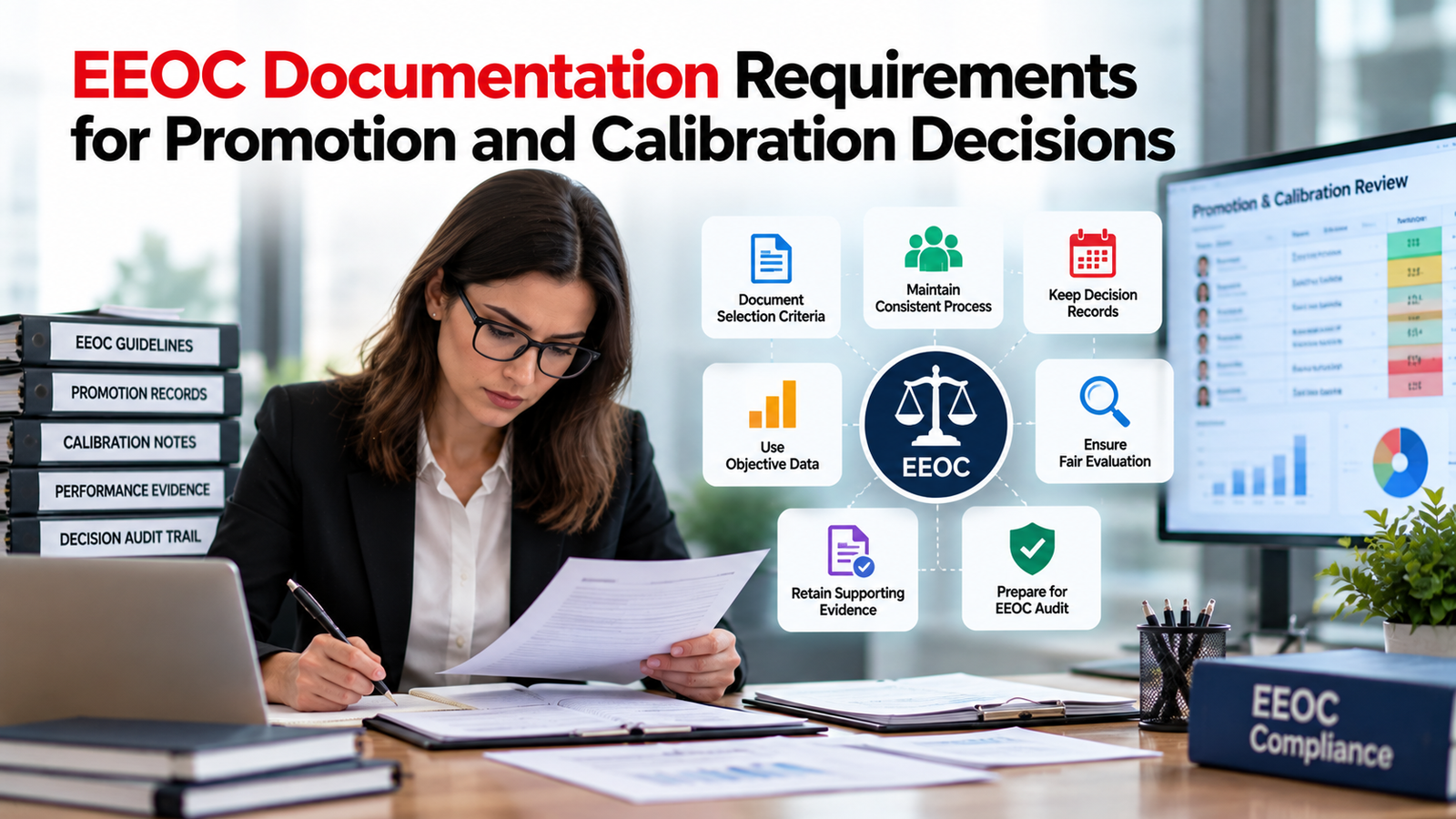
Every promotion cycle leaves a paper trail. Calibration spreadsheets, manager notes, rating changes and promotion packets all count as employment records, and EEOC recordkeeping requirements decide how long you keep them and what happens to them once someone files a charge. Most HR teams know the basic 1-year rule. Fewer have thought about how performance calibration fits into that rule, or how a promotion looks when a lawyer reads the notes 2 years later.
The rules also moved in 2025 and 2026. Federal contractor obligations changed, and the EEOC proposed dropping the EEO-1 report while stepping back from disparate impact cases. This guide covers what to keep, how long to keep it, what to write in calibration meetings and which changes matter now. It explains the rules as of early October 2026 and isn’t legal advice.
TL;DR
Federal law requires most employers to keep promotion and calibration records for at least 1 year from when the record was made or the decision was taken, whichever is later. Once a charge is filed, you must keep all relevant records until the matter is finally resolved, including records on employees in similar positions. Performance calibration feeds promotion outcomes, so treat it like a selection procedure and check results for adverse impact. EEOC recordkeeping requirements set only the federal floor, and state laws such as California’s can require longer record retention. Federal contractor and EEO-1 rules are also changing in 2026.
What EEOC Recordkeeping Requirements Cover
The core rule is broad: if you make or keep a personnel record, it’s covered. Under 29 CFR 1602.14, employers covered by Title VII, the ADA and GINA must preserve any personnel or employment record they make or keep. The regulation was last amended in May 2024. A proposed EEOC rule from July 2026 would remove several reporting duties, but it leaves this section in place.
The regulation names specific types of records. For promotion and calibration work, these are the ones that matter most:
• Applications and other forms completed by candidates
• Requests for reasonable accommodation
• Records on hiring, promotion, demotion, transfer, layoff and termination
• Records on rates of pay and other terms of compensation
• Records on selection for training or apprenticeship
The phrase “made or kept” does a lot of work. A calibration spreadsheet is a record the company made. So are the comments a manager typed into a promotion packet and the email that explains why one person moved up. If your process creates it and you keep it, EEOC recordkeeping requirements apply to it, even if nobody thinks of it as an official HR file.
The rules don’t wait for a complaint. EEOC’s recordkeeping summary states that these duties apply whether or not anyone has filed a charge. Other laws add their own layers on top of Title VII, especially the ADEA for workers 40 and older and the Equal Pay Act for pay. Those rules have different periods, which the next section sets out. For promotion decisions, you’ll usually need to meet several of them at once.
Record Retention Periods for Promotion and Calibration Files
Federal record retention periods depend on which law applies, and a single promotion can touch several. This table shows the main federal minimums, plus California as an example of a longer state rule.
| Law | Records | Minimum Period |
| Title VII, ADA, GINA (29 CFR 1602.14) | Personnel records, including promotion and calibration records | 1 year from the record or the action, whichever is later |
| Title VII, ADA, GINA | Records of an involuntarily terminated employee | 1 year from termination |
| ADEA (29 CFR 1627.3) | Promotion records, job orders, test papers, promotion ads | 1 year from the personnel action |
| ADEA (29 CFR 1627.3) | Payroll records with date of birth, occupation and pay | 3 years |
| ADEA (29 CFR 1627.3) | Benefit plans and written seniority or merit systems | While in effect, plus 1 year |
| Equal Pay Act (29 CFR 1620.32) | Records explaining a pay difference between sexes | At least 2 years |
| FLSA (29 CFR 516) | Payroll records, and wage rate tables | 3 years, and 2 years |
| California (Gov. Code 12946) | Personnel and applicant records | 4 years |
The ADEA deserves a closer look because it reaches more documents than people expect. The ADEA recordkeeping rule lists job orders and promotion advertisements alongside the promotion records themselves. It also covers written seniority and merit systems for as long as they’re in effect, plus 1 more year. If your promotion criteria live in a written merit framework, that document has its own clock.
Pay set at promotion brings in the Equal Pay Act. Under the Equal Pay Act rules, employers must keep records that explain any pay difference between men and women for at least 2 years. That includes job evaluations and merit or seniority systems. Separately, FLSA rules require 3 years for payroll records and 2 years for wage rate tables.
The federal 1-year minimum can be shorter than the time employees have to act. A charge is due within 180 days, or 300 days where a state or local agency enforces a similar law. For age claims, only a state law extends the period. Equal Pay Act claims need no charge at all and can go straight to court within 2 years, or 3 if the violation was willful. Many employers set a longer internal record retention period to cover these windows and state rules. That’s a policy choice to discuss with counsel, since EEOC recordkeeping requirements only set the floor. Federal contractors have separate periods, covered later in this guide.
What Changes When a Charge Is Filed
A charge changes how EEOC recordkeeping requirements apply, because it stops the normal retention clock. Under 1602.14, once a charge is filed, or the EEOC or the Attorney General sues under Title VII, the ADA or GINA, you must keep all relevant personnel records until final disposition. Final disposition means the date the period to file suit runs out, or the date the litigation ends, including appeals. The EEOC’s summary notes that the period to sue after a right-to-sue notice is 90 days.
The definition of “relevant” is wider than many teams assume. It covers records about the person who filed the charge and records about all employees in similar positions. For a promotion dispute, it also covers the applications and test papers of every candidate for the same position. In practice, that can mean the full calibration record for the cycle, including ratings and notes on people who never complained. ADEA rules add a similar duty once an age enforcement action begins.
Most employers handle this with a legal hold. The steps below reflect common practice and should be adapted with counsel:
1. Identify the promotion cycle, the role and the full comparator pool.
2. Suspend any automatic deletion that touches those records.
3. Send hold notices to managers, HR staff and calibration attendees.
4. Preserve system logs, version history and related chat or email.
Electronic records carry their own risk. Under Federal Rule 37(e), a court can act when electronically stored information that should have been preserved is lost because a party didn’t take reasonable steps and the data can’t be restored. If the loss harms the other side, the court can order measures no greater than needed to cure that harm. Only when it finds an intent to deprive can it take harsher steps, such as an adverse-inference instruction or ending the case. Record retention discipline before a charge makes a hold much easier to carry out after one.
Why Promotion Decisions Draw Scrutiny
Promotion decisions involve judgment, and judgment is where discrimination claims tend to focus. The EEOC received 88,201 charges in fiscal year 2025, close to the 88,531 it received in 2024, according to its EEOC enforcement statistics. Retaliation was the most common basis, cited in 61.6% of charges. Disability, race, sex and age followed. Promotion disputes can involve any of these bases, and a denied promotion after a complaint can raise a retaliation claim.
Recent Supreme Court decisions have made some claims easier to bring. In Ames v. Ohio, decided unanimously on June 5, 2025, the Court rejected a rule that required majority-group plaintiffs to show extra “background circumstances.” The plaintiff, a heterosexual woman, had been denied a promotion that went to a lesbian woman, then was demoted and replaced by a gay man. After Ames, every employee faces the same standard when challenging a promotion.
The Court also lowered the bar for job changes in Muldrow v. City of St. Louis in April 2024. A worker challenging a transfer must show only “some harm” to a term or condition of employment, and that harm doesn’t need to be significant. That standard can reach lateral moves that change someone’s duties or schedule. Documentation now matters for decisions that HR may have treated as routine.
Records also shape how a claim plays out. The EEOC’s Compliance Manual describes signs that a stated reason may be a pretext. These include explanations that are unduly vague or that appear only after the fact. Reasons that shift over time are another warning sign, along with decisions that depart from policy or past practice. Each of these problems usually traces back to thin or inconsistent notes. EEOC recordkeeping requirements tell you to keep records, but the quality of those records decides whether they help you.
Performance Calibration as a Selection Procedure
Calibration ratings often decide who gets promoted, which makes them part of the selection process. The Uniform Guidelines on employee selection define employment decisions to include promotion. They apply to selection procedures used to make those decisions. In our view, a performance calibration process that feeds promotion lists works like a selection procedure, and it’s safer to document it that way under both the guidelines and EEOC recordkeeping requirements.
Case law supports that caution. In Watson v. Fort Worth Bank & Trust in 1988, the Supreme Court held that subjective or discretionary promotion practices can be analyzed under disparate impact theory. In Wal-Mart v. Dukes in 2011, the Court found that leaving pay and promotion choices to local supervisors wasn’t a uniform company practice for class action purposes. There’s a tension here for HR. A central calibration process improves consistency, but it also creates a single company-wide practice that can be challenged as a whole.
Research shows calibration changes outcomes in measurable ways. A Management Science study published in 2019 found calibration committees adjusted about 25% of ratings, mostly downward. They reduced leniency bias and made ratings more consistent across supervisors, but they also pushed more ratings toward the middle. That last effect makes it harder to tell strong and weak performers apart.
Other research shows why ratings need checking even after calibration. A 2008 study in the American Journal of Sociology found women and minority employees received smaller raises than white men with the same performance scores. Gallup’s 2017 research found only 29% of employees strongly agree their reviews are fair, and 26% strongly agree they’re accurate. Calibration can fix some problems while missing others, so the results need an adverse impact check of their own.
Adverse Impact Records and the Four-Fifths Rule
The Uniform Guidelines ask employers to keep records that show the effect of selection procedures by race, sex and ethnic group. The best-known test is the four-fifths rule. If one group’s selection rate is below 80% of the rate for the group with the highest rate, that’s generally treated as evidence of adverse impact. Smaller differences can still count in some cases, such as when the numbers are large.
Recordkeeping duties depend on size. Employers with 100 or fewer employees can keep simplified records each year. These show the number of people hired, promoted and terminated in each job by sex, and by race and national origin where appropriate. They also show the number of applicants for hire and promotion, and whether the selection procedures were standardized. Larger employers should check for disparities at least once a year for groups that make up at least 2% of the relevant labor force.
Here’s how the math works for a promotion cycle, using made-up numbers.
| Hypothetical Example | Eligible | Promoted | Selection Rate |
| Men | 40 | 12 | 30% |
| Women | 30 | 6 | 20% |
| Impact ratio | 20 ÷ 30 = 66.7% |
The 66.7% ratio falls below the four-fifths threshold and signals potential adverse impact. It doesn’t, by itself, establish unlawful discrimination. Sample size and other evidence matter. The next step is to review the process, not to change the results. In Ricci v. DeStefano in 2009, the Supreme Court held that a city violated Title VII when it threw out promotion exam results to avoid disparate impact liability without a strong basis in evidence.
The enforcement picture has shifted. Following Executive Order 14281 in April 2025, the EEOC’s National Enforcement Plan issued in June 2026 directs staff to avoid disparate-impact theories in investigations to the maximum degree possible and not to start or continue litigation advancing those claims. This is an agency enforcement policy, not a repeal of Title VII’s disparate-impact provisions. Private plaintiffs can still bring these claims, and the Uniform Guidelines remain in force for now, so impact records still matter.
What to Document in Calibration Meetings
Good calibration records show that the same criteria were applied the same way to everyone. Breaking the work into 3 stages makes that easier to prove.
Before the Meeting
Write down the criteria and rating definitions before anyone discusses names. The EEOC’s guidance on promotions stresses applying criteria uniformly, with the same weight given to each criterion for each person. Record who is eligible for promotion in the cycle and why. Collect each manager’s proposed rating with a short written rationale tied to the criteria. Keep the attendee list, including the facilitator and any HR business partner present.
During the Meeting
Capture every change made in the room. These items make each change traceable:
• The rating before and after the change
• The reason, tied to a stated criterion
• The person who proposed the change
• The evidence cited, such as a project result or a documented behavior
• Any consistency check the facilitator ran across teams
After the Meeting
Record the final ratings and who signed off on them. Note who received the results and when they were shared with managers. Schedule the adverse impact check before ratings feed into promotion lists, so you can review any problem while there’s still time to act. Store everything in one known location. Under the “made or kept” rule in 1602.14, scattered drafts and side files are still records, and EEOC recordkeeping requirements apply to them wherever they live. A single performance calibration file makes retention and holds much simpler.
What to Keep Out of Calibration Notes
Some content creates risk the moment it’s written down. Vague labels are the most common problem. Phrases like “not a culture fit” or “lacks executive presence” give no observable reason, and EEOC guidance treats unduly vague explanations as a possible sign of pretext. Comments about age, pregnancy, family plans or leave raise similar problems, even when made casually.
| Avoid | Write Instead |
| “Not a culture fit” | The specific behavior and when it happened |
| “Lacks executive presence” | The skill gap, with an example from a meeting or project |
| “Getting close to retirement” | Nothing about age, and focus on job criteria only |
| “Was out on leave a lot” | Results against goals for the time actually worked |
Medical details belong somewhere else entirely. Under the ADA confidentiality rule, medical information must be kept on separate forms in separate, confidential medical files. Supervisors may learn about work restrictions and accommodations, but not the underlying condition. GINA rules require genetic information to be kept in separate files as well.
Diversity goals also don’t belong in individual promotion rationales. In March 2025, the EEOC and the Department of Justice issued technical assistance on discrimination related to DEI programs. It names promotion, access to leadership programs, mentoring and interview slates as covered. It also states that a business interest in diversity doesn’t justify a decision based on a protected trait. Keep performance calibration notes focused on job criteria and evidence.
Documenting the Promotion Decision Itself
Calibration produces ratings, but the promotion decision needs its own record. The EEOC’s best practices for promotions are a useful starting point. Its Compliance Manual Section 15, issued in 2006, recommends making criteria known and telling all eligible employees about openings. It also recommends decisions that are transparent and documented. The guidance doesn’t carry the force of law, but courts and investigators often look at whether employers followed it.
A complete promotion record usually includes these items:
• The job posting or promotion announcement, which the ADEA treats as a record
• The written criteria and how each one was weighted
• The full candidate pool, including people who weren’t selected
• The reasons for the final choice, tied to the stated criteria
• The decision date and the names of the decision makers
• The pay set at promotion and the basis for it
Pay deserves extra attention because the clock on pay claims can restart. Under the Lilly Ledbetter Fair Pay Act of 2009, each paycheck that reflects discriminatory pay counts as a new violation. The EEOC lists denials of promotions along a career ladder, and other noncompetitive promotions, among practices that can affect pay. If a promotion sets salary, keep the Equal Pay Act records that explain any difference between employees in similar roles. Clear records for promotion decisions also help meet EEOC recordkeeping requirements without extra work later.
Federal Contractor and Regulatory Changes in 2025 and 2026
Several rules have changed since January 2025, and more changes are pending. This section covers the status as of early October 2026.
What Changed for Federal Contractors
Executive Order 14173, signed January 21, 2025, revoked Executive Order 11246, which had long required affirmative action from federal contractors. The Labor Department published final rules on August 21, 2026 that remove most of the old contractor regulations, effective October 26, 2026. That includes the recordkeeping section at 41 CFR 60-1.12. Many contractors are now asking which record duties still apply.
Disability and veteran rules still carry recordkeeping duties. The Section 503 recordkeeping rule requires covered contractors to keep personnel records for 2 years, including records on promotion, pay, training selection and interview notes. The period drops to 1 year for contractors with fewer than 150 employees or without a contract of at least $150,000. Once a complaint, review or enforcement action starts, contractors must keep relevant records until it ends, and missing records may be presumed unfavorable. The Section 503 coverage threshold rose from $15,000 to $20,000 on October 1, 2025 through an earlier inflation adjustment. The September 2026 rule updated regulatory text to reflect that change and removed the 7% utilization goal. The veterans rule uses the same 2-year and 1-year structure with a $200,000 contract threshold for record retention.
EEOC Rulemaking to Watch
The EEOC regained a quorum on October 7, 2025, and Andrea Lucas became Chair in November 2025. The Commission has since moved quickly. It voted on July 21, 2026 to propose removing the EEO-1 through EEO-6 reports, and EEOC’s July 2026 proposal appeared in the Federal Register 2 days later. Comments closed August 24, 2026, and no final rule had been published by early October. Until one is, employers with 100 or more employees must still file the EEO-1 and keep the most recent copy.
Other changes affect how adverse impact is handled. The EEOC’s regulatory agenda lists plans to rescind the interpretive parts of the Uniform Guidelines, with a final rule projected for November 2026. A separate plan targets the guidelines’ recordkeeping provisions, but no proposal had been published by early October. The Commission also rescinded its Affirmative Action Guidelines in June 2026 and its 2024 harassment guidance in January 2026. None of these changes alters the core EEOC recordkeeping requirements in 1602.14.
AI Tools in Promotion and Calibration
Federal guidance on AI in employment decisions has thinned out, but the legal risk hasn’t. The EEOC removed its AI technical assistance documents on January 27, 2025. Title VII still applies when software helps make promotion decisions, and several state and local laws now add specific duties.
| Law | Covers Promotion | Key Duties |
| NYC Local Law 144 | Yes, screening employees for promotion within the city | Bias audit within 1 year before use, and notice 10 business days before use |
| Illinois HB 3773 | Yes, along with training selection, discipline and discharge | Notice to employees, and no ZIP codes as a proxy for protected traits |
| Colorado SB 26-189 | Yes, effective January 1, 2027 | Notice before use; description of the tool’s role within 30 days after an adverse outcome; right to request human review; 3 years of records |
For promotion candidates in New York City, the notice can be included in a written policy. The New York City law has been enforced since July 2023, and Illinois’s law took effect January 1, 2026. Colorado signed its revised law on May 14, 2026.
If a tool scores, ranks or flags candidates, document which tool you used and which version. Record the inputs it relied on and the human review that followed. Keep any bias audit results with the promotion file. These records help show the tool was checked for bias, and they meet EEOC recordkeeping requirements along with the state rules for AI-assisted decisions.
HR Systems, Audit Trails and Electronic Records
Most promotion and calibration records now live in software, so system settings decide what you can produce later. A rating-change log that shows who changed a rating and when is far more useful than a final number alone. Version history on calibration documents shows how ratings moved during a meeting. Both help prove that the process followed its stated criteria.
Retention settings should match your written policy and EEOC recordkeeping requirements. Auto-delete rules that run before your record retention period ends create gaps you can’t fill later. Systems also need a way to flag records for a legal hold so automatic deletion skips them. Without that, a routine cleanup job can wipe out records covered by a hold, with the consequences described earlier in this guide.
Chat and email count too. Messages where managers discuss candidates are electronically stored information, and they fall under holds just like formal records. Decide in advance where performance calibration discussions should happen, and steer them into systems you control.
When you evaluate HR software, ask direct questions. Can the system log every rating change with the user and time? Can admins set retention by record type? Can a hold override deletion? Can you export a full cycle’s records with history intact? These answers show whether the tool can support EEOC recordkeeping requirements in practice.
Building a Defensible Promotion Record
A defensible promotion record comes down to keeping the right documents for long enough and writing reasons that tie back to stated criteria. The federal rules set a 1-year floor, but filing windows, ADEA and pay rules, contractor rules and state laws often stretch the practical period much longer. A charge extends retention for the whole comparator pool, not only the person who complained.
The 2026 rulemaking adds uncertainty. EEO-1 reporting and parts of the Uniform Guidelines may change soon, while the core EEOC recordkeeping requirements stay in place. Track the final rules as they land, and review your retention schedule each year so promotion decisions stay grounded in clear, consistent documentation.
Frequently Asked Questions
Do calibration spreadsheets count as employment records?
Yes. Federal rules cover any personnel or employment record an employer makes or keeps. A calibration spreadsheet, including draft versions you save, falls under that language. The same goes for notes in a promotion packet and emails that explain rating changes. Treat every saved version as a record subject to retention and legal holds.
When does the 1-year retention clock start?
The clock starts at the later of 2 dates: when the record was made, or when the personnel action happened. For a promotion, that’s usually the effective date of the decision. A calibration file created in March for a promotion effective in May would run from May.
Do we need to keep records on candidates who weren’t promoted?
Yes. Promotion records cover the whole selection process, including people who weren’t chosen. If a charge is filed, the applications and test papers of all candidates for the same position become relevant records. Keeping only the winner’s file leaves you unable to show how the choice was made.
What records must employers retain under the ADEA?
The ADEA’s recordkeeping duties apply to covered employers’ specified records, not only records about employees aged 40 or older. Personnel records for actions such as promotion, transfer or discharge must be kept for 1 year. Payroll records with dates of birth and pay must be kept for 3 years. Written merit or seniority systems must be retained while in effect, plus 1 more year.
Does California require longer retention than federal law?
Yes. California requires employers covered by its fair employment law to keep personnel and applicant records for at least 4 years from creation or the employment action. After a verified complaint, relevant records must be kept until the filing period ends or all proceedings are resolved, whichever comes later.
Can managers keep private promotion notes outside the HR system?
They can, but those notes are still records if they’re kept, and they fall under legal holds. Scattered notes are hard to find, preserve and produce. Many employers require calibration and promotion notes to live in the system of record so retention and hold settings apply to them.
What happens if someone deletes chat messages about a promotion after a charge?
Courts can step in when electronic records that should have been kept are lost. If the loss harms the other side, the court can order measures to cure that harm. If the court finds the deletion was meant to deprive the other side, it can presume the messages were unfavorable or even end the case.
Can a majority-group employee bring a promotion discrimination claim?
Yes. In June 2025, the Supreme Court ruled unanimously in Ames v. Ohio that majority-group plaintiffs don’t have to show extra background circumstances. They face the same standard as any other plaintiff. Employers should document promotion decisions the same way for every candidate.
Does a small employer need to track adverse impact?
Employers with 100 or fewer employees can keep simplified records under the Uniform Guidelines. Each year, they record the number of people hired, promoted and terminated in each job by sex, and by race and national origin where appropriate. They also record applicant counts and whether selection procedures were standardized.
Is the EEO-1 report still required in 2026?
Yes, until a final rule says otherwise. The EEOC proposed removing the EEO-1 in July 2026, but no final rule had been published by early October. Employers with 100 or more employees should keep filing when the next collection opens and keep a copy of the most recent report.
How long does an employee have to file a promotion charge?
Most charges must be filed within 180 days of the decision. The deadline extends to 300 days where a state or local agency enforces a similar law, though only state law extends age claims. Equal Pay Act claims need no charge and can go to court within 2 years, or 3 if willful.
Can diversity goals appear in a promotion rationale?
They shouldn’t. Technical assistance from the EEOC and the Justice Department in March 2025 says a business interest in diversity doesn’t justify a decision based on a protected trait. It names promotion and access to leadership programs as covered. Keep each rationale tied to job criteria and evidence.
Do we have to tell employees when AI screens them for promotion?
In some places, yes. New York City requires notice before using an automated tool for promotion screening, along with a bias audit. Illinois requires notice for AI used in promotion decisions. Beginning January 1, 2027, Colorado requires notice before use and a description of the tool’s role within 30 days after an adverse outcome, with a right to request meaningful human review.
Can calibration participants see a candidate’s medical information?
No. Medical information must be kept in separate, confidential files under the ADA. Supervisors may be told about work restrictions and accommodations, but not the underlying condition. Calibration discussions should focus on performance against job criteria and leave health details out of the notes.
Does the EEOC still pursue disparate impact charges?
The EEOC’s June 2026 National Enforcement Plan directs staff to avoid disparate-impact theories in investigations to the maximum degree possible and not to pursue litigation advancing those claims. The policy doesn’t repeal Title VII’s disparate-impact provisions. Private plaintiffs can still bring such claims, and applicable impact recordkeeping duties remain relevant.