

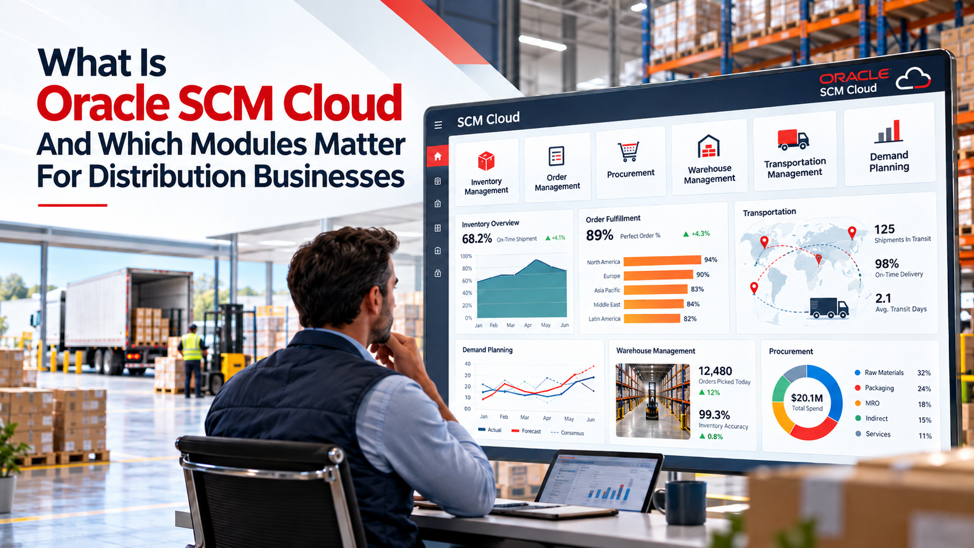
A distribution company evaluating Oracle SCM Cloud for the first time often runs into the same disorienting moment: the platform turns out to be considerably larger than expected, spanning modules built for manufacturing plants, product engineering teams, field service dispatchers, and quality inspectors, alongside the inventory and order management functionality the business actually came looking for. Scoping an implementation without understanding this full landscape first leads to 2 predictable outcomes, either licensing and configuring modules a pure distribution operation will barely touch, or missing a genuinely valuable capability buried inside a module that didn’t sound relevant from its name alone.
Oracle SCM Cloud is Oracle’s cloud-native supply chain management suite, sitting alongside Financials, Procurement, and Project Portfolio Management as one of the core pillars within the broader Oracle Fusion ERP Cloud. It spans a genuinely wide functional footprint, from demand planning and procurement through manufacturing, quality, and field service logistics, but a distribution business doesn’t need the entire suite to run its operations well. This guide breaks down what Oracle SCM Cloud actually includes, module by module, and identifies specifically which of those modules carry the most weight for a distribution-focused business, as distinct from a manufacturer, a services company, or a retailer with a very different operational center of gravity.
TL;DR
| Module category | Relevance to distribution businesses |
| Order Management Cloud | Core and essential; manages the entire order-to-cash process distributors run every single day |
| Inventory Management Cloud (plus Advanced Inventory Management) | Core and essential; Oracle explicitly designed its 2025 Advanced Inventory Management release for distribution-scale operations specifically |
| Logistics Cloud (Warehouse and Transportation Management) | Core and essential; governs the physical movement of goods that defines a distribution operation |
| Supply Chain Planning Cloud | Highly relevant, particularly the distribution and replenishment planning components rather than production scheduling |
| Procurement Cloud | Highly relevant for managing supplier relationships and inbound purchasing that feeds distribution inventory |
| Supply Chain Collaboration | Relevant for distributors coordinating closely with upstream suppliers on demand and shipment visibility |
| Manufacturing Cloud and Product Lifecycle Management | Low relevance for pure distribution; built for organizations that design and produce goods, not move and sell them |
| Quality Management | Situational; matters more for distributors handling regulated goods like pharmaceuticals or food than general merchandise |
The core takeaway: a distribution business typically gets the large majority of genuine value from just 4 to 5 specific modules, and understanding which ones those are before scoping an implementation prevents both over-licensing unused functionality and under-provisioning capability the business will genuinely need later on.
What Oracle SCM Cloud Actually Is
Before breaking down individual modules in detail, it’s worth situating Oracle SCM Cloud within the broader Oracle ecosystem first, since the platform is frequently discussed as though it were a single, standalone product, when it’s genuinely better understood as a connected collection of deeply integrated application pillars.
Where SCM Cloud Sits Within Oracle’s Broader Platform
Oracle organizes its broader enterprise applications into several primary pillars, and Oracle Supply Chain and Manufacturing Cloud is one of them specifically, sitting alongside Oracle Financials Cloud, Oracle Procurement Cloud, and other connected applications. Oracle’s own Fusion Cloud Supply Chain and Manufacturing overview lays out the relationship between planning, procurement, execution, order management, and logistics, while Advayan’s Oracle HCM Cloud overview shows how another major Oracle cloud pillar connects workforce processes with ERP and other enterprise systems. Organizations can license these various areas together or start with a narrower scope and expand deliberately over time.
The Core 4 Modules That Form the Base Functional Scope
For most Oracle SCM implementations across many different industries, 4 modules form the foundational functional scope that nearly every deployment includes in some meaningful form: Order Management, Inventory Management, Procurement, and Supply Chain Planning. Advayan’s dedicated Oracle SCM Cloud services page covers these core areas alongside logistics, manufacturing, PLM, and related supply chain capabilities, giving organizations a useful view of how the different functions connect. These modules work together on a common cloud platform to support the broader supply chain process from purchasing through final customer delivery.
Why Understanding the Full Landscape Still Matters, Even When Scoping Narrowly
Even a distribution business planning to implement only a small handful of core modules genuinely benefits from understanding the full module landscape upfront, since Oracle’s own module boundaries don’t always map perfectly onto how a specific business actually thinks about its operations. Advayan’s separate coverage of Oracle Billing and Revenue Management is a useful example of why application boundaries matter, since billing, supply chain, financial, and customer processes may sit in different Oracle products even when the business experiences them as one connected workflow. Missing that distinction during scoping can leave important requirements assigned to the wrong application area.
The Core Modules Every Implementation Starts From
Working through each of the 4 foundational modules in turn clarifies exactly what each one actually does in genuine, hands-on practice, independent of whether it ultimately turns out to be a real, budget-justifying priority for a specific distribution business’s own day-to-day operations, existing workflows, and current systems.
Order Management Cloud
Order Management Cloud governs the entire order-to-cash process from beginning to end: sales order entry, pricing, fulfillment orchestration, shipping, and invoicing, all coordinated through a single, unified system rather than scattered haphazardly across several disconnected tools. The module includes order orchestration capability that routes and sequences fulfillment steps, and it can connect customer-facing systems with downstream enterprise platforms. Advayan’s Salesforce integration services illustrate the type of CRM-to-ERP, inventory, order, and delivery data exchange that becomes important when Oracle SCM sits inside a wider application landscape. This integration layer matters because an order rarely stays inside one application from capture through financial recognition.
Inventory Management Cloud
Inventory Management Cloud covers the full, genuinely wide range of stock tracking and control needs, spanning everything from a simple stock room to a manufacturing plant to a large-scale distribution center handling genuinely complex, high-volume operational demands. Oracle’s documentation for Advanced Inventory Management describes capabilities such as task assignment, license plate number transactions, cross-docking notifications, load-based shipment grouping, and suggested put-away locations. These capabilities extend basic inventory control into the operational work involved in receiving, moving, storing, counting, and shipping inventory at greater scale.
Procurement Cloud
Procurement Cloud manages the entire source-to-pay process, from initial supplier identification all the way through to final invoice payment, and it breaks down cleanly into several distinct, well-defined functional areas. Organizations comparing procurement and inventory processes across enterprise platforms can also review Advayan’s SAP Material Management overview, which covers purchasing, inventory, invoice verification, material planning, and master data from another ERP perspective. The underlying process questions remain similar even when the technology platform changes.
| Procurement capability | What it covers |
| Requisition management | Employee self-service requisitions, catalogue-based requisitions from approved supplier catalogues, and free-form requisitions for non-catalogue purchases |
| Purchase order management | Standard purchase orders, blanket purchase agreements, contract purchase agreements, and planned purchase orders, with support for multi-line, multi-distribution POs and full versioning history |
| Budget checking | Automatic validation of purchase order lines against approved budgets before commitment, integrating directly with Budgetary Control in the general ledger |
| Goods receipt and invoice matching | Three-way match processing at receipt, with invoice matching options spanning 2-way, 3-way, and 4-way matching depending on the organization’s control requirements |
Supply Chain Planning Cloud
Supply Chain Planning Cloud combines demand management, sales and operations planning, and supply and distribution planning into a connected planning discipline. Oracle’s current Supply Chain Planning platform combines demand signals, supply constraints, replenishment, planning scenarios, collaboration, and AI-assisted planning capabilities inside the broader SCM suite. For distributors, the practical value sits heavily in forecasting, replenishment, inventory positioning, backlog management, and coordination with suppliers rather than in production scheduling alone.
The Extended Modules Beyond the Core 4
Beyond the foundational modules already covered, Oracle SCM Cloud includes a range of additional, more specialized modules, and understanding what each one genuinely covers clarifies which actually apply to a distribution business and which were built with a fundamentally different kind of organization in mind entirely.
Logistics, covering both warehouse management and transportation management together, governs the physical movement of goods across an entire network, from warehouse operations through transportation planning, carrier selection, freight optimization, shipment tracking, and global trade requirements. Oracle’s Fusion Cloud Logistics covers warehouse management, transportation management, and global trade management as connected logistics capabilities, while Advayan’s SAP Global Trade Services page provides a useful internal reference for the kinds of customs, import/export, compliance, and logistics concerns enterprise distribution teams often need to connect with core ERP processes. These areas become particularly important for distributors operating across borders or managing complex transportation networks.
Manufacturing Cloud provides production planning tools, work order management, and shop floor execution capability specifically built for organizations that physically produce goods themselves, rather than simply move and sell products that were already manufactured elsewhere by someone else entirely.
Product Lifecycle Management manages new product introductions and ongoing product revisions and changes, supporting the design and engineering discipline that manufacturers specifically rely on to bring genuinely new products to market and manage revisions carefully over a product’s entire lifetime.
Quality Management provides inspection, non-conformance tracking, and broader quality assurance capability, relevant wherever an organization needs to formally verify that goods genuinely meet defined specifications before they move any further through the supply chain toward the end customer.
Service Logistics Cloud supports field service operations specifically, covering service contracts, spare parts management, and workforce dispatching, aimed squarely at organizations whose broader business includes ongoing field service and maintenance work, rather than a pure buy-and-sell distribution model with no service component attached at all.
Supply Chain Collaboration delivers real-time visibility into demand, inventory, and shipments shared directly with upstream partners and suppliers, enabling organizations to identify potential supply chain disruptions earlier. Where partner, ERP, CRM, warehouse, and external application data need to move across systems, Advayan’s MuleSoft development services provide an internal example of an API-led integration approach used to connect supply chain and enterprise applications. The quality of those integrations can materially affect how useful collaboration data becomes in day-to-day planning.
Which Modules Actually Matter for a Distribution Business
With every module now clearly defined and genuinely understood on its own terms, the practical question becomes which of them actually carry real weight for an organization whose core business is buying, storing, and selling goods, rather than designing, manufacturing, or formally servicing them afterward in some capacity.
The Modules That Sit at the Genuine Core of Distribution
Order Management Cloud sits squarely at the center of distribution operations.
Since the order-to-cash process this specific module governs is, in a very real and immediate sense, the core transaction a distribution business exists to execute repeatedly, at real volume, every single working day. A distributor without strong order management capability struggles with exactly the kind of fulfillment errors, pricing inconsistencies, and manual handoff failures that directly damage customer relationships and margin.
Inventory Management Cloud, especially when paired directly with Advanced Inventory Management, matters just as centrally to the business.
The combination supports the receiving, storage, movement, counting, replenishment, and shipping activities that determine whether a distribution center can maintain accurate stock without tying up unnecessary working capital.
Logistics Cloud, spanning both warehouse and transportation management together, is equally foundational to the operation.
Distribution is, at its core, fundamentally a physical movement business, and routing, carrier selection, shipment tracking, warehouse execution, and freight control directly influence both cost and service levels. Teams comparing how order, shipping, billing, and transportation processes are structured across enterprise systems can also reference Advayan’s SAP Sales and Distribution services, which covers the same broad order-to-delivery chain from a different ERP platform.
The Modules That Matter Significantly, Though Somewhat Less Centrally
Supply Chain Planning Cloud matters considerably to distribution operations, particularly its distribution and replenishment planning components specifically.
Though a pure distributor typically leans far more heavily on this particular side of the module than on the production scheduling capability built primarily for manufacturers. Accurate demand forecasting and replenishment planning directly determine whether a distribution business carries the right inventory in the right locations, avoiding both costly overstock and damaging stockouts.
Procurement Cloud matters significantly for the inbound side of distribution operations specifically.
Since every single distributor depends on a genuinely disciplined purchasing process to keep inventory flowing in reliably from suppliers. Oracle’s Fusion Cloud Procurement covers purchasing, sourcing, supplier management, contracts, and broader source-to-pay processes that connect purchasing decisions with financial and operational controls. The requisition, purchase order, supplier, and invoice processes inside this area directly support the buying discipline distribution margins depend on.
Supply Chain Collaboration adds real, tangible value for distributors maintaining close, ongoing relationships with upstream suppliers.
Particularly where shared visibility into demand and shipment status helps both sides plan more accurately, avoiding the kind of disruptions that ripple downstream when a supplier’s own inventory position shifts unexpectedly without warning.
The Modules That Matter Considerably Less for Pure Distribution
Manufacturing Cloud and Product Lifecycle Management sit firmly at the bottom of the priority list for most distribution businesses.
Since these particular modules address production planning, shop floor execution, and product design and engineering, activities that simply don’t exist inside a pure distribution operation that buys finished goods and resells them rather than manufacturing anything itself from raw materials. A distributor licensing these modules without a genuine manufacturing or product design function attached to the business is very likely paying for functionality that will sit largely unused.
Quality Management genuinely sits in a situational, case-by-case middle ground for most distribution businesses.
A general merchandise distributor may have limited need for formal quality inspection and non-conformance tracking, while a distributor handling pharmaceuticals, food products, or other regulated goods may find this module considerably more relevant, since formal quality verification and documentation become a genuine compliance requirement rather than an optional enhancement in those specific categories.
Service Logistics Cloud matters primarily only for distributors whose broader business model genuinely extends into field service and aftermarket support work.
A distributor also running a service and parts business, common in categories like industrial equipment or certain consumer durables, may find this module genuinely valuable, while a pure buy-and-resell distributor with no ongoing service component gets little practical use from it.
How AI Shows Up Across These Modules for Distribution Specifically
Embedded artificial intelligence runs consistently through Oracle SCM Cloud’s core modules, and understanding specifically how it actually applies to distribution operations helps clarify precisely where the technology delivers genuine, measurable value, rather than functioning as a marketing label attached loosely to existing, pre-existing features nobody rebuilt.
Where AI Capability Concentrates Across the Modules That Matter Most
| Module | AI-driven capability | Distribution-specific value |
| Inventory Management | Automated stock level optimization, triggered replenishment, and routine task automation | Reduces manual replenishment decisions across a large SKU catalogue spread over multiple distribution locations |
| Supply Chain Planning | Machine learning-driven demand forecasting and risk management insights | Improves forecast accuracy specifically for distribution and replenishment planning, directly reducing both overstock and stockout risk |
| Logistics | Optimized routing and load-based shipment grouping | Lowers transportation cost per shipment by consolidating loads and selecting more efficient delivery routes automatically |
| Order Management | Intelligent order orchestration | Automatically sequences and routes fulfillment steps across complex, multi-location distribution networks without manual coordination |
Why This Matters More for Distribution Than It Might Initially Appear
Oracle describes embedded AI across its cloud applications as a way to assist analysis, automate repeatable processes, and help users respond to operational issues more quickly. For a distribution business specifically, where margins are often thin and operational efficiency at scale genuinely determines profitability, automation across inventory, planning, and logistics can reduce the amount of repetitive analytical work required from planners and operations teams. Advayan’s broader cloud application development services also illustrate why cloud architecture, integration, testing, and support matter when AI-enabled applications need to connect with the rest of an organization’s technology environment.
A Reasonable Expectation for What This AI Capability Actually Delivers
Embedded AI within these modules works best as a genuine augmentation to human decision-making, surfacing recommendations, flagging anomalies, and automating routine, well-understood tasks, rather than fully replacing the judgment a genuinely experienced distribution operations team brings to more complex, non-routine decisions. Setting this realistic expectation during implementation scoping, rather than assuming the AI capability alone will resolve every existing operational inefficiency automatically, produces considerably more accurate project planning and a smoother transition once the system actually goes live for the team using it daily.
Building a Realistic Implementation Scope
Understanding which modules matter in principle still leaves the genuinely practical question of how to actually translate that theoretical understanding into a properly scoped, carefully sequenced implementation plan that a real project team can genuinely execute successfully from the very start all the way through to the finish.
Starting From Actual Business Challenges, Not a Generic Module List
The recommended starting sequence for scoping any Oracle SCM implementation:
- Assess the specific, pressing business challenges the organization is actually facing, whether that’s recurring supply chain disruption, chronically inaccurate inventory records, or fulfillment errors damaging customer relationships, and let those genuine pain points drive which modules get prioritized first
- Consider the organization’s specific industry context explicitly, since a retailer-adjacent distributor might reasonably prioritize procurement and order management first, while a distributor also running light assembly or kitting operations might need to seriously evaluate a limited manufacturing capability alongside its core distribution modules
- Plan deliberately for scalability from the outset, beginning with the essential modules a distribution business genuinely needs on day one, then expanding into additional modules as the business evolves, rather than attempting to license and configure the entire suite simultaneously before the organization has proven out its core processes
Why Sequencing the Implementation Matters as Much as Module Selection
Even after correctly identifying which modules matter most, attempting to implement all of them simultaneously in a single, undifferentiated rollout increases both project risk and the likelihood that the team never fully masters any single module before the next one arrives. Sequencing the implementation, starting with Order Management and Inventory Management specifically, since these 2 modules govern the most immediate, daily operational reality of a distribution business, before layering in Procurement, Logistics, and Supply Chain Planning as the organization’s comfort and process maturity grow, produces a considerably more manageable rollout than attempting a single, all-at-once deployment.
Why Expert Implementation Support Genuinely Matters
Maximizing the value of Oracle SCM Cloud consistently requires genuine implementation expertise, since implementation teams need to evaluate business requirements, configure the selected modules, migrate and validate data, design integrations, test workflows, and support users after go-live. Experienced support also matters where Oracle SCM must exchange information with CRM, commerce, warehouse, finance, carrier, or supplier systems, because those interfaces can determine whether an otherwise correct module configuration works in real operations. A distribution business that underestimates this integration and configuration work risks exactly the kind of scope gaps this guide is intended to help identify early.
How Oracle SCM Cloud Compares to Distribution-Specific Alternatives
Distribution businesses evaluating Oracle SCM Cloud sometimes also consider more narrowly focused, industry-specific platforms built explicitly around a single distribution vertical, and understanding this genuine contrast helps clarify exactly where Oracle’s considerably broader platform actually fits relative to those narrower, more specialized alternatives already on the market today.
The General-Purpose Versus Vertical-Specific Tradeoff
A platform purpose-built for a single distribution category, such as a beverage-specific distribution and route accounting system, typically offers deeper, more pre-configured functionality for that specific vertical’s unique operational patterns right out of the box, often with less configuration effort required to reach a working, industry-appropriate baseline. Oracle SCM Cloud, by contrast, offers a genuinely broader, more horizontally applicable platform capable of supporting distribution across a much wider range of product categories and industries, at the cost of requiring more deliberate configuration to fit any single vertical’s specific operational nuances precisely.
Why This Tradeoff Matters for a Distribution Business’s Actual Decision
A distributor operating within a single, well-defined vertical with genuinely specialized operational requirements may find a purpose-built, vertical-specific platform delivers faster time to value with less configuration burden. A distributor operating across multiple product categories, or one already invested in the broader Oracle ecosystem through Financials or Procurement, more often finds the horizontal breadth and deep integration Oracle SCM Cloud offers across its connected modules delivers greater long-term value, even if the initial configuration effort runs somewhat higher than a narrower, more pre-built vertical alternative would require.
Common Scoping Mistakes Distribution Businesses Make
Beyond understanding which modules genuinely matter for a distribution business specifically, several recurring, genuinely predictable scoping mistakes show up consistently across distribution businesses evaluating and implementing Oracle SCM Cloud for the very first time, often driven by surprisingly similar underlying reasons across otherwise entirely unrelated organizations and industries.
Licensing Manufacturing Cloud or Product Lifecycle Management out of a vague sense of completeness.
Some organizations license these modules simply because they’re part of the broader suite and feel like they might eventually become relevant, rather than because a genuine, identified business need actually justifies the investment, resulting in licensed functionality that sits unused while the implementation budget could have gone toward deepening the core distribution modules instead.
Underestimating how much configuration a horizontal platform genuinely requires. Because Oracle SCM Cloud is built to serve a genuinely wide range of industries and business models, distribution-specific workflows don’t always arrive pre-configured out of the box the way they might within a narrower, vertical-specific platform, and organizations that underestimate this configuration effort during initial project planning frequently find their implementation timeline extending well past the original estimate.
Treating Inventory Management as a single, undifferentiated module rather than layering in Advanced Inventory Management deliberately.
Distribution businesses focused narrowly on base Inventory Management functionality alone sometimes miss the specific, additional value Advanced Inventory Management delivers for large-scale, complex distribution operations specifically, since the 2 capabilities are sometimes discussed together informally in a way that obscures the genuine distinction between them.
Failing to sequence the implementation deliberately.
Attempting to implement every relevant module simultaneously, rather than starting with Order Management and Inventory Management before layering in Procurement, Logistics, and Supply Chain Planning, increases both project risk and the likelihood that the team never fully masters any single module before the next one arrives on top of it.
Skipping experienced implementation partner support to save on upfront cost. Organizations attempting to scope and configure a genuinely enterprise-grade platform without experienced Oracle implementation guidance frequently discover, later and at greater expense, exactly the kind of module misjudgment and configuration gaps that experienced implementation teams are positioned to catch and correct early in the process instead.
FAQs
Does a distribution business need to license the entire Oracle SCM Cloud suite to get meaningful value from it?
No, and attempting to do so is generally the wrong approach for most distribution businesses, particularly those still early in their journey toward a genuinely cloud-native supply chain platform. Oracle’s pillar-based licensing structure specifically allows organizations to start with a focused subset of modules and expand over time, and a distribution business typically gets the large majority of its genuine value from 4 to 5 core modules, Order Management, Inventory Management, Logistics, Supply Chain Planning, and Procurement, without needing Manufacturing Cloud or Product Lifecycle Management, which are built for a fundamentally different kind of organization entirely.
Is Oracle’s Advanced Inventory Management specifically relevant to distribution, or is it primarily a manufacturing tool?
It’s genuinely relevant to distribution specifically, and Oracle’s own 2025 product announcement explicitly named distribution organizations, alongside healthcare and manufacturing, as the intended primary audience for this specific capability. Features like load-based shipment grouping and suggested put-away locations map directly onto the physical, large-scale operational reality of a distribution center, making this a module worth genuinely prioritizing during scoping, rather than assuming, based purely on its name, that it’s primarily built for production and manufacturing environments alone.
Should a distributor that also does light assembly or kitting consider the Manufacturing Cloud module?
Potentially, though the decision depends heavily on how central that assembly or kitting activity actually is to the overall business. A distributor doing occasional, simple kitting as a value-added service might manage this adequately within Inventory Management’s existing capabilities, while a distributor where light assembly represents a genuinely significant, ongoing part of the operation may find a limited Manufacturing Cloud implementation worthwhile specifically to support that portion of the business, even while the broader distribution operation itself remains firmly centered on the core modules, Order Management, Inventory Management, and Logistics, covered in detail throughout this guide.
How does Oracle SCM Cloud integrate with Oracle’s other application pillars like Financials and Procurement?
The integration runs genuinely deep and represents a core, foundational part of Oracle’s broader value proposition to organizations already invested in the wider Fusion ecosystem. Procurement Cloud, for instance, integrates directly with Oracle Financials for budget checking and payment processing, and with Oracle SCM specifically for inventory replenishment triggered by purchasing activity. This tight, native integration across pillars is precisely why organizations already invested in other parts of the Oracle ecosystem frequently find SCM Cloud a more natural extension than adopting an entirely separate, disconnected platform for supply chain management specifically.
Is Quality Management worth implementing for a distributor that doesn’t handle pharmaceuticals or food products?
Generally not as a priority, for most general merchandise distributors specifically. Quality Management delivers the most genuine value for organizations facing a real, often regulatory-driven need for formal inspection, non-conformance tracking, and quality documentation, a requirement that applies considerably more directly to distributors handling pharmaceuticals, food products, or other regulated categories than to a distributor moving general consumer or industrial goods, where that same formal compliance burden simply doesn’t attach to the product categories being handled day to day.
How long does a typical Oracle SCM Cloud implementation take for a distribution business specifically?
Timelines vary considerably and depend heavily on how many modules are actually in scope and how complex the organization’s existing processes and data are, but a focused implementation centered specifically on the core distribution modules, Order Management, Inventory Management, and Logistics, generally completes meaningfully faster than a broader, multi-module rollout spanning manufacturing and product lifecycle capabilities a pure distributor doesn’t actually need. Sequencing the implementation deliberately, rather than attempting every relevant module simultaneously in one large rollout, is consistently one of the single strongest levers available to a project team for keeping the overall implementation timeline realistic, manageable, and genuinely achievable.
Can a distribution business switch from a vertical-specific platform to Oracle SCM Cloud later, or does that decision need to be made once and locked in?
Migration between platforms is genuinely possible but represents a significant undertaking, involving data migration, process redesign, and a meaningful change management effort across the organization. Businesses anticipating substantial growth, expansion into new product categories, or deeper integration needs with a broader Oracle ecosystem already in place are often better served making a more deliberate, forward-looking platform decision upfront, rather than starting with a narrower, vertical-specific tool and planning to migrate later to a more horizontally capable platform like Oracle SCM Cloud only once the organization has already visibly outgrown its original, more limited initial choice.