

Here’s an invented scenario. A support director gets a quote for a first Agentforce service agent and sees a single line: $2 per conversation. Her team handles 6,000 conversations a month, so she budgets $144,000 a year and stops there. Her partner’s statement of work adds a build fee she hadn’t expected. A data cleanup phase runs long, and the sandbox tests burn credits. Meanwhile the usage price she assumed turns out to be negotiable between 2 models. None of the surprises were hidden. They were spread across 4 documents that nobody read side by side.
This guide builds a first-year cost for a first production agent from public sources, and every source has a stake in the answer. Salesforce’s pricing page and rate card are vendor documents. Customertimes and Summit Tech 360 are consultancies that sell the work. Macha and Diesel sell competing products. Jitendra Zaa’s blog is a practitioner’s personal analysis. I found no neutral benchmark of what partners actually charge, and several published figures conflict, which the sections below flag. All dollar figures in the model are invented placeholders, so confirm every price with Salesforce and your partner before budgeting.
TL;DR
- Budget in 3 buckets. Build labor, consumption and ongoing tuning make up a first year. In an invented model of a service agent, build labor is $112,000, credits are $33,120 and tuning is $29,640, which totals $175,240. The build is about 64% of that total, so the partner scope drives the budget more than the usage rate does.
- Check the pricing model early. Salesforce lists $500 per 100,000 Flex Credits and 20 credits per action, which is $0.10. It also lists $2 per conversation. The break-even is 20 actions per conversation, and a 4-action agent costs far less on credits. Both models can’t run in the same org.
- Distrust published quotes. Partner figures disagree, and a price range attributed to Customertimes doesn’t appear on the pages I read. Confirm all of it with Salesforce and your partner. Ask each partner for a phase-by-phase quote so offers compare on the same basis, and keep the invented figures out of the final plan.
Where a first production agent’s money goes
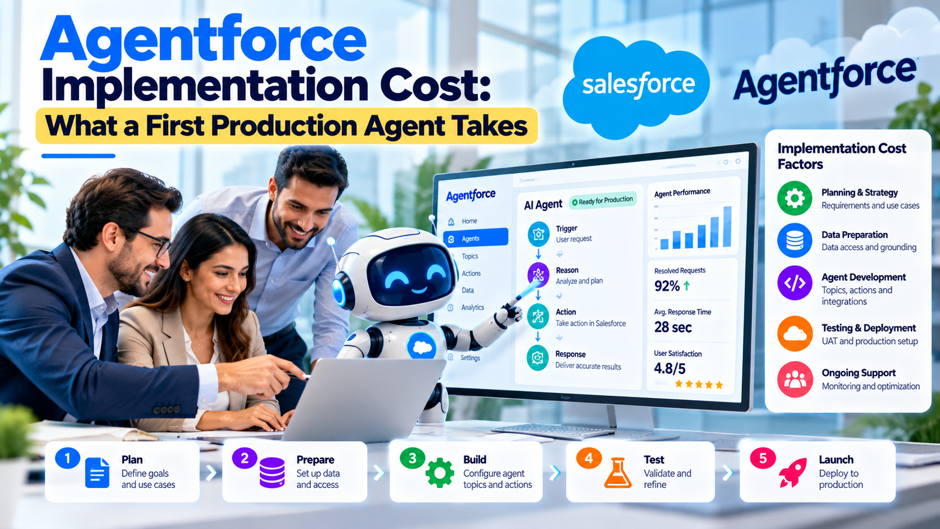
Build labor. This is the up-front work of discovery, data preparation, configuration, testing and rollout. Customertimes, a Salesforce consultancy, describes 5 phases with effort shares of 15%, 30%, 15%, 25% and 15%, and says a first agent on reasonably clean data takes 6 to 8 weeks. Those splits are the firm’s own estimates with no source, but they match how most projects feel: the data and the testing take far more effort than the configuration screen.
Consumption. Once the agent is live, every action and prompt uses Flex Credits, which Salesforce’s pricing page lists at $500 per 100,000 credits. A standard action costs 20 credits, or $0.10. This line scales with volume, so a successful agent costs more to run than a failed launch. That’s the right incentive, but it means the finance team should model usage growth instead of treating the first month as a steady state.
Ongoing tuning. An agent needs regular review after launch. Macha, which sells a competing support product, says that work means weekly transcript review and topic fixes, and it notes that partner incentives often pay for go-live, so tuning may need a separate contract. Macha gives no hours or cost for that work. I’ve included an invented placeholder later, because leaving the line out is the most common way a first-year budget ends up short. Treat it as a standing cost.
Build cost starts with the data, not the agent
Customertimes assigns 30% of a first agent’s effort to data and grounding preparation, twice the 15% it assigns to configuring the agent itself. It also says most timeline overruns originate in that phase. The tasks it lists include deduplicating target objects, refreshing knowledge articles and defining what the agent is allowed to retrieve. None of that sounds glamorous, and none of it appears on a pricing page, which is why a budget built from list prices alone tends to be wrong.
The first phase is a readiness audit. Customertimes says it covers data quality, how current the knowledge base is, duplicate rates, integration users and the consent model. A short audit like this is cheap relative to the build, and it tells you whether the 30% figure is realistic for your org. If the knowledge articles are stale or the account records are full of duplicates, the data phase will cost more than the plan assumes.
A useful warning comes from the same source: be wary of any partner that quotes an agent build without insisting on a data readiness assessment first. That advice comes from a seller of these services, so weigh it accordingly. It’s still sensible, because a quote made before anyone has looked at the data is a guess with a price attached, and the buyer carries the risk when the guess is wrong. Ask for the assessment as a separate, small, fixed-fee step. Fixed-fee assessments also make it easier to compare bidders fairly.
Effort by phase for a first agent
The table below combines Customertimes’s published phase durations and effort shares with an invented total of 640 hours at a blended rate of $175 an hour. I made up the hours and the rate. Neither comes from a source, and both should be replaced with your partner’s real numbers. The point of the exercise is to show how the effort shares turn into dollars and where the largest line sits.
| Phase | Customertimes duration | Effort share | Invented hours | Invented cost |
| Use-case selection and readiness | 1 to 2 weeks | 15% | 96 | $16,800 |
| Data and grounding preparation | 2 to 4 weeks | 30% | 192 | $33,600 |
| Agent configuration | 1 to 2 weeks | 15% | 96 | $16,800 |
| Testing and guardrail tuning | 2 to 3 weeks | 25% | 160 | $28,000 |
| Phased rollout and tuning | 1 to 2 weeks | 15% | 96 | $16,800 |
| Total | 6 to 8 weeks | 100% | 640 | $112,000 |
Other published figures sit on either side of that total. The diesel blog, which sells a competing product, cites a range of $50,000 to $150,000 for initial implementation, taken from another site. Summit Tech 360 lists $2,750 to $6,000 per agent over 2 to 4 weeks, but it shows data strategy and the configuration of actions in Apex, Flows and APIs as additional services. The quickstart and the full build probably describe different scopes, though I can’t verify what either includes.
Run costs that arrive after go-live
- Flex Credits for actions and prompts. Salesforce’s August 31, 2026 rate card lists a standard action at 20 credits in production and 16 in a sandbox, and prompts at 2, 4 or 16 credits depending on tier. The card shows credits only, so the dollar values come from the pricing page’s $500 per 100,000 credits. Usage grows with adoption, so budget a range and revisit it each quarter instead of fixing a single monthly number.
- User licenses for employee-facing agents. The pricing page lists an Agentforce user license at $5 per user per month, which requires Flex Credits and gives access to a limited set of CRM objects. An agent that serves customers directly doesn’t need it, but an agent that helps employees might. In an invented example, 40 service reps would add $200 a month, or $2,400 a year, on top of consumption. Treat the license as a small, separate line.
- Telephony for voice. Voice actions cost 30 credits in production per the rate card, or $0.15. Zaa’s blog shows a voice example in which telephony for 10 agents adds $1,250 a month, but that figure is his own illustration, so check it against a real quote. Voice is also where Salesforce’s pricing page has a visible slip: an example lists $0.15 per use case for 120 credits, which is $0.60 at the stated rate.
- Data 360 credits. Salesforce’s pricing page says its examples exclude Data 360 credits, and it doesn’t price them on that page. The rate card lists Data 360 usage types, such as unification and segmentation, with tiered credit rates. A first agent grounded only in CRM records and knowledge articles may not need any of it, which is why the data scope decision matters so much for the total. Ask the account team to price it as an option.
How credits turn into a monthly bill
The conversion is simple once the rate is clear. At $500 per 100,000 credits, a credit costs $0.005. A standard action at 20 credits is $0.10, and a sandbox action at 16 credits is $0.08. A voice action at 30 credits is $0.15. Prompts at 2, 4 and 16 credits cost $0.01, $0.02 and $0.08. Salesforce’s rate card shows credits only, so every dollar figure in this section is my own arithmetic from the pricing page’s pack price.
An invented example makes the scale visible. Suppose an agent handles 6,000 conversations a month with 4 actions each, which is 24,000 actions and 480,000 credits, or $2,400. Add 3 standard prompts per conversation at 4 credits each, which is 72,000 credits and $360. The monthly total is 552,000 credits, or $2,760, and the annual figure is $33,120. Per conversation, that’s about $0.46, compared with $2 under the other model.
Caveats apply in 2 places. First, Zaa’s blog treats a model call as a single action, while the rate card lists prompts separately, so I can’t tell whether a single model call bills both ways. Second, Zaa says each action includes up to 10,000 tokens and that larger calls bill as multiple actions, with 15,000 tokens counting as 2. I didn’t find a token rule on the rate card I read, so confirm both points with Salesforce in writing before relying on this arithmetic. Until then, treat the credit estimate as a range.
Credits compared with per-conversation pricing
Break-even. Salesforce lists $2 per conversation and $0.10 per standard action, so the 2 models cost the same at 20 actions per conversation. An agent that averages 4 actions costs $0.40 per conversation on actions alone, or about $0.46 with the invented prompt load. A complicated agent that chains many steps can approach the break-even, so the right choice depends on how the agent is designed, not on the headline rate.
Annual gap. On the invented volume, 6,000 conversations at $2 each is $12,000 a month, or $144,000 a year. The credit model costs $33,120 a year on the same volume, a difference of $110,880. That gap is large enough to dominate the budget, which is why the pricing model belongs in the first conversation with the account team. A partner who quotes only a single model hasn’t given you the full picture.
Constraints. Salesforce’s pricing page says Flex Credits and Conversations can’t be used in the same org, and that switching requires swapping all existing Conversation SKUs. It also says Flex Credits are available only under PayGo and Pre-Commit models, while conversation pricing, add-ons and Editions aren’t available under those models. Zaa adds that conversation boundaries vary by agent type. Confirm with Salesforce how your agent’s conversations would be counted before you compare the 2 prices.
Testing costs more than most plans assume
- Sandbox runs use credits. Macha, quoting Salesforce Trailhead, says test runs consume credits the same as customers using the agent. The rate card lists 16 credits per standard action in a sandbox, or $0.08. In an invented test plan of 1,500 conversations at 4 actions each, that’s 96,000 credits, or $480. The credit cost is small, but it’s real money, and a plan that ignores it gets caught out. Keep a log of test runs to reconcile the bill.
- People’s time is the largest cost. Customertimes assigns 25% of effort to testing and guardrail tuning, which is $28,000 in the invented model. Testing an agent means reading transcripts, scoring answers and fixing instructions, and that work repeats after every change. The hours matter more than the credits, so budget testers from the business side as well as the partner’s team. Schedule their hours early, because business testers are usually the scarcest people on the project.
- Some usage types cost nothing in a sandbox. The rate card lists Help Agent resolutions at 400 credits in production, which is $2, and 0 credits in a sandbox. That difference means a team can test a Help Agent without spending credits, unlike a standard action. Check the footnotes for your product, because the card says some usage types apply only to certain editions. That won’t hold for every usage type, so read the footnotes against your own order form.
- Regression after every change. Each edit to instructions, data or actions can alter behavior elsewhere, so a rerun of the core test set belongs in the plan after each release. I found no published figure for how often teams rerun tests. Set a rule for which changes require a full run, and which allow a smaller sample. The rule keeps small edits from quietly changing answers elsewhere, and it gives the budget a predictable testing line.
A first-year budget for an invented service agent
The table below adds the invented pieces together. It assumes 6,000 conversations a month at full volume from the first month, 4 actions and 3 standard prompts per conversation, 640 build hours at $175, 1,500 sandbox test conversations, and 6 hours of tuning a week at an internal rate of $95. Every figure is a placeholder to be replaced with your own. It leaves out licenses, telephony, Data 360 credits, training and security review.
| Line | Invented amount | Share of total | Basis |
| Build labor | $112,000 | 63.9% | 640 hours at $175 |
| Credits at full volume | $33,120 | 18.9% | 552,000 credits a month at $0.005 |
| Sandbox testing credits | $480 | 0.3% | 96,000 credits at $0.005 |
| Tuning labor | $29,640 | 16.9% | 312 hours at $95 |
| First-year total | $175,240 | 100% | Sum of the lines above |
Adjustments to 2 inputs move the total. If the data phase overruns by 50%, that adds 96 hours, or $16,800, for a total of $192,040. A realistic ramp in volume lowers consumption: if usage climbs through the first 3 months, the credit line falls by about $4,140. The build is still the dominant line. A finance team that debates usage rates while accepting the build estimate unchallenged is spending its attention in the wrong place.
Why published partner prices disagree
The eesel blog, published March 13, 2026, cites $50,000 to $150,000 for initial implementation and $2,000 to $6,000 per agent, both attributed to another site. Its own tables don’t reconcile: the small-team items add up to $127,300, not the roughly $140,000 it states. Summit Tech 360 lists $2,750 to $6,000 per agent over 2 to 4 weeks. Macha’s October 14, 2026 article says Customertimes publishes $50,000 to $90,000 for a first production agent, and I couldn’t find that figure.
I read 2 Customertimes pages. The implementation guide gives phases and weeks and says only “contact us” for cost. The partner page, dated April 8, 2026, gives no dollar figures either, and says implementations can be “as fast as 8-16 weeks for core functionalities,” which doesn’t match the 6 to 8 weeks in the guide. The numbers Macha quotes may come from a page I didn’t find, but I can’t confirm that. Treat the $50,000 to $90,000 range as unverified, and the 2 timelines as a range from 6 to 16 weeks.
The disagreements have 3 plain causes. Scope differs, because a quickstart that configures a single agent isn’t a program that includes data work and integrations. Bias differs, because the sources are sellers and competitors. Basis differs, because some figures are per agent and others per program. None of the sources is neutral, and I found no independent survey of what buyers paid. Use the published figures to frame questions for your partner, and ask for a quote broken out by the phases in the table above. That discipline turns a confusing market into a short checklist.
Contract terms that change the real cost
- No rollover. Both Salesforce’s pricing page and the rate card say unused Flex Credits don’t roll over. In an invented case, a team commits to 6,624,000 credits for a year, which is $33,120, but uses only 70%. The unused 30% is worth $9,936 and disappears. Forecast conservatively, and ask whether a smaller commitment with billing in arrears suits a first agent better than a large pre-commit. That makes a modest first commitment safer than a large pre-commit.
- No overage penalty. The pricing page says exceeding an entitlement carries no overage penalty, and the contracted rate is billed monthly in arrears. That’s a useful protection for a pilot, because a surprise spike in usage doesn’t trigger a punitive rate. Confirm the wording in your order form, since the page I read is a marketing summary, not a contract. Ask the account team to state in writing what rate applies once credits run out.
- A single model per org. Flex Credits and Conversations can’t coexist in the same org, and switching means swapping all existing Conversation SKUs. That makes the first choice sticky. Decide with the break-even in hand, and think about the second and third agents the org might add, because a design that works at 4 actions today may grow past the break-even later. Add a review point at month 6 to compare actual actions per conversation with the plan.
- Bundled credits in editions. The pricing page lists Agentforce 1 Editions from $550 per user per month, with 2.5M Flex Credits per org per year. At $0.005 a credit, that allotment is worth $12,500. Zaa’s blog gives conflicting figures for the free Foundations allocation, 200,000 credits in a first section and 100,000 in another, so verify what your edition includes before counting it. If your edition bundles credits, the effective cost of a first agent could be lower than the model suggests.
Data work and when it adds weeks
When it isn’t needed. Customertimes says a first agent grounded in CRM records and Knowledge articles doesn’t require Data Cloud, which Salesforce now calls Data 360. That matters because the data platform is where budgets expand. A narrow first agent on clean records can skip it, and doing so keeps the timeline near the 6 to 8 weeks the firm quotes. A scope decision made early is worth more than any discount negotiated late. Revisit the decision if later agents need richer sources.
When it adds weeks. Customertimes says reasoning over ERP orders, telemetry and unstructured documents calls for it. Its enterprise timeline is 12 to 16 weeks against 6 to 8 for a first agent. Macha reads the firm’s ranges as roughly 4 to 6 extra weeks for the data platform, which is Macha’s arithmetic, not a published figure. Add a contingency line for this work, and make the partner price the data platform as a separate option.
What the credits look like. The rate card prices unification at 75,000 credits per 1 million rows at the base tier, and the tiers reset monthly. In an invented case, 2 million rows is 150,000 credits, or $750. Zaa says Data 360 credits are a separate pool from Flex Credits, while the rate card I read lists them as Flex Credit usage types. I can’t resolve that conflict from public pages, so ask Salesforce which pool pays for what.
Budget ranges by scope
Published figures fall into a few buckets, and each carries a caveat. The table below lists them as reported, with the source and what I could and couldn’t verify. It shouldn’t be read as a price list. Where a figure is attributed to someone else, I couldn’t find it at the stated origin, and the table says so. The most useful column is the last column, because it shows how much weight each number can bear.
| Scope | Timeline claim | Cost claim | Source and caveat |
| Quickstart, per agent | 2 to 4 weeks | $2,750 to $6,000 | Summit Tech 360; actions work is extra |
| First agent, clean data | 6 to 8 weeks | No figure found; $50,000 to $90,000 attributed | Customertimes guide; Macha’s attribution unverified |
| Core functionality | As fast as 8 to 16 weeks | No figure found | Customertimes partner page, April 8, 2026 |
| With Data 360 | 10 to 14 weeks (Macha) | $100,000 to $200,000 attributed | Macha, citing Customertimes; unverified |
| Enterprise program | 12 to 16 weeks | $250,000 to $400,000+ attributed | Customertimes guide; Macha’s cost unverified |
| General initial implementation | Not stated | $50,000 to $150,000 | vessel, citing another site |
The invented model’s $112,000 build sits inside the diesel range and below the attributed enterprise figures. That’s consistent with a first agent that needs real data work, and it’s far above the quickstart. I wouldn’t read more into it. The honest summary is that a first production agent plausibly costs somewhere between a few thousand dollars for a narrow configuration and a sum in the low hundreds of thousands of dollars for a full build, and only a scoped quote will say which. Replace these estimates with signed quotes as soon as they exist.
What to ask a partner before accepting a quote
- Will you run a readiness assessment first? Customertimes names a quote without an assessment as a red flag. Ask for the assessment to be priced separately, with a written summary of data quality, knowledge currency and duplicate rates. The result lets you test the partner’s data estimate against what the audit found, instead of trusting the partner’s assumption that your records are clean. Keep the written summary, because it becomes the baseline for any later change request.
- Who staffs the work? Customertimes advises clients to ask for the senior-staffing ratio on their specific project, and it claims a ratio of 40.8% senior consultants, against a 5% to 10% industry norm that it cites without a source. Treat both as marketing. The useful question is which named people will configure the agent, and how many hours each of them will spend. Ask to meet them before signing, and ask what happens if a key person leaves mid-project.
- What’s excluded? Summit Tech 360 lists the configuration of actions in Apex, Flows and APIs, plus data strategy, as additional services. Ask for a list of exclusions in writing, and ask what each would cost. A quote that looks cheap often leaves out the work that makes the agent do something useful. Ask for the exclusions as a list of line items with prices, so any later request can be checked against the original scope. Also ask how change requests are priced.
- Who owns tuning after go-live? Macha says partners are often paid for go-live and that tuning needs a separate contract. Ask for the monthly hours, the named lead and the rate. Confirm how a failed test after launch is handled, and whether fixes to the partner’s own configuration are covered or billable. Without a named owner, tuning drifts, and the first sign is usually a rise in escalations to human agents. Write the expectation into the contract.
Ongoing tuning and who pays for it
Tuning is a recurring cost that first-year plans tend to omit. Macha describes weekly transcript review and topic fixes as necessary, and gives no hours. I used an invented 6 hours a week at an internal rate of $95, which is 312 hours and $29,640 a year. A team that already runs a service desk may absorb some of that, but the time still has an owner, and an unowned task is the first to stop happening in month 3.
Design choices also change the usage bill. Macha notes that an agent which calls 4 actions where 2 would do doubles the per-conversation cost. On the invented numbers, cutting 2 actions saves 40 credits, or $0.20, per conversation. At 6,000 conversations a month, that’s $1,200 a month, or $14,400 a year. A design review that trims redundant actions is therefore a cost control as well as a quality step, and it can pay for several hours of consulting.
Finally, decide who responds when something breaks. Macha lists a rollback owner and someone to read transcripts weekly among the roles, without giving headcount. Name both before launch, and write the hours into the plan. If a managed services partner will cover tuning, ask for response targets and a monthly report, and keep the budget line visible so it doesn’t vanish when the project team moves on to the next initiative. Review the budget line at the same time as the monthly report.
Making the business case without inflated savings
Use a range. Customertimes cites a 15% to 37% first-year case deflection range from a Forrester study dated November 2025, which the page says Salesforce commissioned. I haven’t read the study, so I can’t vouch for how it measured deflection. Apply the range as a low and a high case, and replace it with your own pilot results as soon as there’s data. A single savings number invites a challenge that the evidence can’t survive. Label which inputs are estimates.
Price a contact honestly. Take the invented volume of 6,000 monthly conversations and an invented $6 cost per human-handled contact. A 15% deflection removes 900 contacts, worth $5,400 a month or $64,800 a year. A 37% deflection removes 2,220, worth $13,320 a month or $159,840 a year. Case deflection and conversation volume aren’t the same measure, so the application in this model is loose, and you should map them carefully in your own model.
Show payback. Against the invented first-year cost of $175,240, the low case nets a loss of $110,440 in year 1. In year 2, with only run costs of $62,760, it nets $2,040, so it doesn’t pay back on deflection alone in any useful window. The high case loses $15,400 in year 1, gains $97,080 in year 2 and pays back in about 1.2 years. If your numbers land near the low case, justify the agent on other grounds or narrow the scope.
FAQs
What does a first production Agentforce agent cost?
No neutral source gives a reliable figure. Published numbers range from $2,750 to $6,000 per agent for a quickstart to $50,000 to $150,000 for an initial implementation, and the sources are sellers or competitors. In my invented service-agent model, the first year totals $175,240, of which build labor is $112,000. Ask a partner for a quote broken out by phase, and confirm all usage rates with Salesforce. Treat every range as a starting question.
How long does it take to build the first agent?
Customertimes says 6 to 8 weeks for a first agent on reasonably clean data, and 12 to 16 weeks for enterprise programs. Its partner page, dated April 8, 2026, says implementations can be “as fast as 8-16 weeks for core functionalities,” which conflicts. Summit Tech 360 lists 2 to 4 weeks per agent for a quickstart. Data preparation is where overruns most often start, so a readiness check shortens the guesswork.
How much does an Agentforce action cost?
Salesforce’s pricing page and rate card imply 20 credits per standard action in production, which is $0.10 at $500 per 100,000 credits. A sandbox action is 16 credits, or $0.08, and a voice action is 30 credits, or $0.15. The rate card lists credits only, so the dollar values are my arithmetic from the pack price. Zaa’s blog adds a 10,000-token threshold per action, which I couldn’t confirm on the card.
Is per-conversation or credit pricing cheaper?
It depends on actions per conversation. At $2 per conversation and $0.10 per action, the break-even is 20 actions, so an agent averaging 4 actions costs about $0.40 on actions alone. On 6,000 invented conversations a month, that’s roughly $2,400 against $12,000. The pricing page says the 2 models can’t be used in the same org, so settle this with Salesforce before building. Design choices can move an agent either way, so model the actions you actually expect.
Do I need Data 360 for a first agent?
Not necessarily. Customertimes says a first agent grounded in CRM records and Knowledge articles doesn’t require it, while reasoning over ERP orders, telemetry or unstructured documents does. Adding it lengthens the timeline and brings separate credit rates. Zaa says Data 360 credits are a separate pool, but the rate card lists them as Flex Credit usage types, so confirm with Salesforce how your credits would be drawn down. Make the scope decision before the quote arrives.
What does testing cost?
Credits are a small part. Macha, quoting Trailhead, says sandbox test runs consume credits like customer usage, and the rate card lists 16 per standard action. In an invented plan of 1,500 test conversations at 4 actions, that’s $480. People time is larger: Customertimes assigns 25% of effort to testing, which is $28,000 in the invented model. Budget business testers as well as the partner’s team. Plan the testers’ hours before the build starts.
Why do partner quotes vary so much?
Scope, bias and basis differ. A quickstart configures a single agent, while a full build includes data work and integrations. The sources are consultancies and competitors with reasons to frame prices a certain way. Some figures are per agent and some per program. A figure attributed to Customertimes didn’t appear on the 2 pages I read. Ask each partner for the same phase-by-phase breakdown so the quotes can be compared.
What should I budget for after go-live?
Plan for consumption, tuning and ownership. Credits scale with usage, and unused Flex Credits don’t roll over, so avoid a large pre-commit for a first agent. Tuning needs named hours; I used an invented 6 hours a week, or $29,640 a year. Also name a rollback owner and a transcript reviewer. Confirm with your partner whether post-launch fixes are covered or billable before you sign. Review each line every quarter against actual usage.