

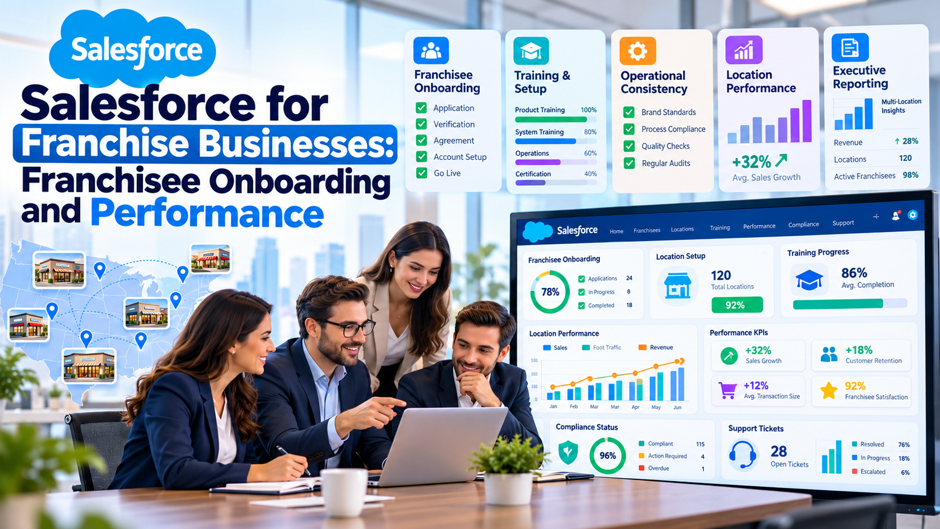
Picture the operations VP at a regional sandwich brand with 120 locations and 18 openings planned for next year. New franchisees move through a spreadsheet and a shared inbox, weekly sales reach her by emailed PDF, and royalty reports arrive late from a third of the stores. The CEO has been told that “Salesforce does this,” and she has a week to say what that means. She needs to know which parts of onboarding and performance tracking the platform handles, which parts need other tools and what to ask before anyone signs. This scenario is invented for illustration and doesn’t describe a real company or person.
This post covers how Salesforce can support franchisee onboarding and performance tracking, and where a franchise-specific tool may fit better. It draws on Salesforce’s restaurant industry page, its Partner Cloud pricing page and a Trailhead onboarding unit, the FTC’s Franchise Rule guidance, and pages from FranConnect, Operandio and GetApp, which I flag as vendor, competitor or lead-generation material. I found no Salesforce customer results for franchise use and no neutral cost data. I’m not a lawyer, so confirm legal points with franchise counsel and prices with each vendor.
TL;DR
- Salesforce markets this use but shows no franchise results. Its restaurant page promises compliance tracking, onboarding and performance analytics for franchise networks, with customer logos and no franchise-specific figures. The portal layer is Partner Cloud, listed at $25 or $50 per member per month. Treat the claims as a starting list of questions.
- Onboarding has a legal clock that software can track but not replace. The FTC’s compliance guide says franchisors must furnish the disclosure document at least 14 calendar days before a prospect signs or pays, and gives 7 more days after certain unilateral changes. A platform can record delivery dates, while counsel owns what the document says.
- The money trail is where accuracy pays. In my invented 120-location network, a 1% sales reporting error changes royalties by $61,200 a year. I found no Salesforce royalty product, so confirm how royalties will be calculated before you promise HQ a single source of truth.
Why a franchise network isn’t a typical customer base
A franchise network differs from an ordinary customer base in a single way that shapes every design choice: the people you serve are independent business owners who also carry your brand. Headquarters need visibility into sales, compliance and training at every location, while franchisees need to run their own business and protect their own data. Salesforce is a relationship platform, so it models the link between HQ and operators well when you treat franchisees as accounts, contacts and portal users. It fits less well when you expect it to do franchise-specific accounting without extra tools.
That tension frames the rest of this post. Onboarding is a sequence of obligations on both sides, some of them legal, and performance tracking is a flow of data that franchisees produce and HQ consumes. Each needs a clear system of record and a clear owner. The platform can hold the workflow, the portal and the dashboards. It can’t decide what your franchise agreement requires or tell a franchisee that a number is theirs to keep private, so those decisions come first.
What the vendor says it offers franchise brands
- The restaurant page. Salesforce’s restaurant industry page, published May 16, 2024 and modified Oct 2, 2026, has a section titled “Scale your franchise network without losing control at HQ.” It says brands scaling fast can’t run on spreadsheets alone, and it describes compliance tracking, onboarding and performance analytics, plus shared operational updates and real-time insight on traffic, sales, labor and loyalty. The page offers no figures for any of those claims.
- Customer logos without results. The page shows logos for Casey’s, Buffalo Wild Wings, McDonald’s, Uber Eats, ezCater and OpenTable. It attaches no franchise-specific result to any of them. It also claims more than 1 billion loyalty members globally across quick-service, casual and franchise brands, without tying that to a franchise customer. Ask Salesforce for references that run a franchise network at your size, and call them. A logo isn’t a reference.
- Partner Cloud as the portal layer. Salesforce’s Partner Cloud pricing page, published Jun 17, 2024 and modified Jul 9, 2026, lists a Partner Relationship Management edition and a Partner Ecosystem Management edition, built on Experience Cloud, deal management and channel analytics. It’s a channel product, so franchise use is an adaptation. The page doesn’t mention franchises or onboarding, and I couldn’t read which edition includes which feature. Ask Salesforce to confirm it in writing.
- The onboarding training unit. A Salesforce Trailhead unit on automating partner onboarding describes a recruitment page, a questionnaire, learning journeys and rules that mark a partner as certified when training ends. It also says most of the automation depends on third-party apps from AgentExchange, such as learning management systems, rather than core features. It’s promotional training content and gives no setup steps, so test every capability in a sandbox. Test each capability yourself.
Onboarding stages and what the platform can hold
Recruitment and qualification. Salesforce’s restaurant page says Sales Cloud can help plan and attract new franchise owners with automated lead scoring and lead passing from marketing. The Trailhead unit describes a partner program page and a form that captures interested partners, with questionnaires to assess fit. A candidate is a lead and then an opportunity, which fits standard CRM objects. What the platform can’t tell you is whether a candidate meets your financial and experience criteria, so define those first.
Disclosure and signing. The disclosure document and the franchise agreement are legal instruments, and counsel owns their content. The platform can record when the document was delivered, to whom, by which method, and when the waiting period ends, and it can route signatures through an e-signature tool. The Trailhead unit names e-signature among vetting capabilities from AgentExchange. Keep the legal documents in your approved repository and store references and dates on the record.
Training and certification. The Trailhead unit says learning management apps can be added to the portal, learning journeys can be set by role or by partner, and rules can mark a partner as certified or onboarded when training finishes. It names Appinium and NetExam as examples. For a franchisee, certification might gate the opening date. Decide what each course proves, who audits completion and whether the platform or the learning tool holds the record of truth.
Opening readiness. Opening a location involves permits, equipment, inventory, hiring and a final inspection. I found no Salesforce document describing a franchise opening checklist, so this is my judgment: tasks, approvals and milestones on a record can model it, with the franchisee and HQ each owning their items. Give every task an owner and a due date, show progress on a dashboard and make the opening approval a required step.
The disclosure timeline
The FTC’s Franchise Rule compliance guide, dated May 2008 and described as not binding on the Commission, says a business arrangement is a franchise when the franchisor promises a trademark, promises significant control or assistance, and requires a minimum payment of at least $500 in the first 6 months. It says franchisors must furnish the disclosure document at least 14 calendar days before the prospect signs a binding agreement or pays. The 14 days start the day after delivery, so signing can occur on the fifteenth day.
Take an invented delivery on Monday, Nov 2, 2026. Day 1 is Tuesday, Nov 3, day 14 is Monday, Nov 16, and signing or payment could occur on Tuesday, Nov 17, according to the guide’s counting. If the franchisor then unilaterally and materially changes the basic agreement, the guide gives the prospect 7 calendar days to review the revised agreement; a revision delivered on Friday, Nov 13 would run to Friday, Nov 20 on a plain count. The guide says state requirements may differ. Track delivery dates in the platform, and let counsel confirm the counting and any state rules.
Portal editions and allowances
Partner Cloud is a separate purchase from Sales Cloud, according to Salesforce’s pricing page, with no free trial. The page offers a sandbox or workshop to test instead. Prices are per member per month, and the page says login-based pricing is also available for each edition but lists no login prices. The table compares what the page’s allowances say for 2 editions. The feature checkmarks didn’t extract, so I can’t tell which edition includes onboarding, deal management or other items, and the page doesn’t mention franchises.
| Item | Partner Relationship Management | Partner Ecosystem Management |
| List price | $25 per member per month, billed annually | $50 per member per month |
| Custom objects | 10 | 100 |
| API calls per day | 200 per member, or 10 per login | 1,000 per member, or 400 per login |
| Data storage | 5 MB per member, or 1 MB per login | 45 MB per member, or 20 MB per login |
| File storage | Not listed | 1.5 GB per member, or 600 MB per login |
| Agentforce for partners | Listed; flex credits required, no template provided | Listed; flex credits required |
The allowances matter for design. A franchise network with custom objects for locations, audits, openings and royalties could pass 10 objects quickly, and daily data pulls from 120 locations count against API limits. Page notes that an annual contract is required for an edition, without naming which. Ask Salesforce which edition includes each feature you need, how members are counted when a franchisee’s staff shares logins, and what happens at the limits.
Performance measures worth tracking
- Sales and traffic. Same-store sales growth and guest traffic are the headline measures, and Salesforce’s restaurant page promises real-time insight on traffic, sales, labor and loyalty without manual report pulls. That’s a vendor claim. Define each measure in writing before building a dashboard, including how refunds, delivery and promotions count, because franchisees will challenge any number that appears to disadvantage them. Publish the definitions where franchisees can read them at any time.
- Labor and cost ratios. Labor as a share of sales and food or product cost show whether a location runs well. These depend on franchisee-supplied or point-of-sale data. Decide whether HQ sees location-level labor figures or only roll-ups, and check your franchise agreement for the right to collect them. Some franchisees treat labor data as private, so settle the policy before the first dashboard goes live. Write the rule into the data policy.
- Audit and compliance scores. Brand standards audits, food safety results and mystery-shop scores are the usual compliance data. Store scores, findings and corrective actions on a location record, assign owners and due dates and trend results over time. Salesforce’s restaurant page names compliance tracking without detail, so confirm what’s built in and what you’d configure, and who maintains the audit forms. Keep audit evidence, such as photos, attached to the record.
- Training completion. Certification status and course completion show whether staff are ready. The Trailhead unit says rules can mark a partner certified when training ends and prebuilt reports track progress. Report completion by location and by role, and set a policy for what happens when certification lapses. Tie it to access in the portal only if your franchise agreement allows. Review the lapsed list monthly with the regional managers and franchisees.
- Fee and royalty timeliness. Late or incomplete royalty reports are a performance problem and a revenue problem. Track the due date, received date, amount and variance for each location each period. I found no Salesforce royalty calculation product, so decide whether the platform holds this data or only displays it from your accounting system. Send automatic reminders before each due date, and escalate overdue reports to a named regional manager after a set number of days.
Getting franchisee data into the platform
POS and sales feeds. Sales data usually starts in each location’s point-of-sale system. Salesforce’s restaurant page lists MuleSoft among the pieces of a franchise operations platform, and I haven’t researched specific point-of-sale connectors. A nightly or hourly feed per location is a common pattern, though I found no Salesforce document on franchise POS patterns. Test a feed with your actual POS vendors, and set rules for late or missing data.
Unified guest data. The restaurant page says Data 360 can unify guest profiles across point-of-sale, loyalty, marketing and service. For a franchise network, that raises ownership questions: whose guest is it, which franchisees can see it and what consent covers. I haven’t researched franchise data ownership law or the guest-data terms in typical franchise agreements. Settle the policy with counsel before you build segments that cross locations. Raise it at kickoff.
Compliance and audits. Audit results can be captured by field staff in forms or by franchisees in the portal and stored as records tied to locations. The Trailhead unit mentions Channel Account Plans and a Partner Scorecard that measures plan KPIs. I haven’t verified how well those map to franchise audits. Pilot with a single audit type, and compare the platform’s output with your current paper or spreadsheet process. Keep the comparison dated.
Franchisee-entered data. Some data only franchisees can supply, such as hiring plans, equipment status or local marketing. Give them simple portal forms with required fields and clear deadlines. Salesforce’s pricing page limits data storage per member, so keep forms lean. Show franchisees what HQ sees, because owners who think they’re being watched without benefit stop entering accurate data. Review the forms with a few owners before launch, and cut any field nobody uses.
Platform or dedicated franchise software
Dedicated franchise vendors exist, and the honest comparison depends on your needs. The table sets out what I could find. The right-hand column is FranConnect’s own marketing, which I flag as vendor claims, and the pricing estimate comes from a competitor’s blog. GetApp’s page lists identical generic features for Salesforce Sales Cloud and FranConnect and doesn’t confirm any franchise-specific capability for Salesforce. Treat the table as a list of questions for demonstrations.
| Need | Salesforce (per its pages) | FranConnect (its own claims) | Note |
| Franchisee onboarding | Partner onboarding patterns; most automation uses third-party apps | A hub to onboard and retain owners and employees | Ask both for a demo with your onboarding steps |
| Compliance | “Compliance tracking” named without detail | Compliance and quality tools, including Optik IQ | Request audit-form demos |
| Royalties | No royalty product found | A Royalty Manager for agreement-driven calculations | Biggest gap for Salesforce in what I read |
| Field operations | Not specific to franchises | Field Assist agent and field operations | Claims unverified |
| Integration | MuleSoft and APIs | Says it supports integrations and APIs; names no Salesforce objects | Validate during design |
| Price | Partner Cloud $25 or $50 per member per month; other costs unlisted | No public list; a competitor cites a $1,000 to $2,000 monthly starting range | The estimate is unsourced |
GetApp’s page, undated, shows Salesforce Sales Cloud at 4.4 out of 5 from 18,816 reviews and FranConnect at 4.3 from 209. Those ratings measure different products and populations, and GetApp doesn’t state how it earns money. They tell you little about franchise fit. Weigh references from franchise brands of your size and model more heavily than ratings. Ask each vendor for franchise brands of your size who will take your call.
Royalties and the money trail
Royalties and advertising fund contributions are the money flow that keeps the brand running, and they depend on sales data being accurate and on time. In an invented network of 120 locations, each with $850,000 in annual sales, a 6% royalty is $51,000 per location, or $6.12 million a year, and a 2% advertising contribution is $17,000 per location, or $2.04 million. Those inputs are invented. Real rates and volumes live in your franchise agreement and your accounting system.
The stake of data quality shows in the error math. A 1% error in reported sales moves royalties by $510 per location and $61,200 across the network each year, and the advertising fund by $20,400. A 5% error moves royalties by $306,000. That’s why the system of record for sales matters more than the dashboard. I found no Salesforce product that calculates royalties from agreements, and FranConnect’s Royalty Manager is a vendor claim I couldn’t verify. Decide where calculation happens, and test reconciliation from the first month.
Access, ownership and trust
- Who sees what. A franchisee should see their own location’s data and nothing from a competitor’s location, while HQ sees all. Salesforce’s portal and sharing model can express that, but you’ve got to design it and test it with real users. Document the rules in plain language for franchisees, and give them a way to ask why a number looks wrong. Trust erodes fast when owners suspect hidden data. Test it with real users.
- Benchmarks without exposure. Franchisees value comparisons with peers, such as sales per labor hour against the network median. Show anonymized ranges and percentiles rather than named locations, unless your agreement and the franchisees agree otherwise. Check small-sample risk: a median across 3 locations can identify each location. Set a minimum group size before any benchmark appears. Publish the grouping rules to franchisees, so that nobody wonders how their numbers are shown.
- Guest data ownership. Who owns guest profiles, loyalty records and marketing consent varies by agreement and by state, and I haven’t researched it. Decide the policy before you unify data across locations, record consent with the guest, and make sure franchisees can’t export lists the agreement reserves to HQ. Have counsel review the design, because the cost of a wrong assumption lands on the brand. Keep the answer in the data policy.
- Franchisee advisory voice. Systems that franchisees help design get used. Some networks have a franchisee advisory council. Ask a few owners to test the portal, name the reports they want and say which data they’d rather not share. Their feedback is cheaper before launch than after, and it shows owners that HQ sees the platform as a service to them as well as a control tool. Report back to the group on what changed.
A licensing and royalty model with invented inputs
The model prices Partner Cloud licenses for an invented network, using the list prices on Salesforce’s pricing page at member counts of 100, 240 and 500. The 240 case assumes 80 franchisee organizations with 3 members each. These are list prices for the portal only; the page doesn’t cover HQ licenses, implementation, integrations, learning tools or support. The page also says prices are subject to change, so treat the table as a sketch rather than a quote.
| Members | Partner Relationship Management, annual | Partner Ecosystem Management, annual |
| 100 | $30,000 | $60,000 |
| 240 | $72,000 | $144,000 |
| 500 | $150,000 | $300,000 |
At 240 members the higher edition costs $144,000 a year, which is 2.35% of the invented $6.12 million in royalties. Allowances scale with members. At 240 members, the lower edition would carry 48,000 API calls a day and 1,200 MB of data, against 240,000 calls and 10,800 MB on the higher edition, plus 360 GB of file storage. A nightly pull of 24 hourly sales summaries per location from 120 locations is 2,880 calls a day, which fits comfortably. Onboarding 18 openings with an invented 40 tasks each is 720 tasks and 300 hours of coordination at 25 minutes a task.
Running a pilot
Scope. Start with a single process, such as onboarding for the next 3 openings, plus a weekly sales feed from 10 locations. An invented pilot could start on Monday, Jan 11, 2027 and run 13 weeks to Monday, Apr 12, 2027. Keep the old spreadsheet running in parallel for the first month so you can compare records and catch gaps. A narrow pilot also limits the burden on franchisees, who are running businesses.
Success measures. Write the measures before launch: days from signing to opening, share of onboarding tasks completed on time, share of locations reporting sales by the deadline, and franchisee satisfaction on a short survey. Baseline each from your current process. Without a baseline, any result is an anecdote. Review the numbers at week 4, on Monday, Feb 8, 2027, and week 8, on Monday, Mar 8, 2027, and agree in advance what would make you stop.
Franchisee involvement. Pick pilot franchisees who represent the network, including at least 1 skeptical owner. Explain what data the platform collects, who sees it and what’s in it for them, such as faster onboarding or benchmarks. Ask for weekly feedback in a 15-minute call. A pilot that works only for enthusiasts proves little about the rest of the network. Share the findings with the whole network at the end of the pilot.
Stop rules. Decide what ends the pilot or changes scope: a data accuracy problem that affects royalties, a security issue, low portal use by the pilot group or a legal concern raised by counsel. Name who makes the call and how franchisees are told. A clear stop rule gives the pilot credibility, and it protects the brand if the platform doesn’t fit. Write them into the pilot charter before the first day.
Where projects go wrong
- Treating franchisees like employees. Franchisees are independent owners, and a portal that feels like surveillance will be avoided or gamed. Design for their benefit first: faster onboarding, fewer duplicate reports, useful benchmarks. Involve the advisory council early. Check the franchise agreement for what HQ may require, and don’t use the platform to impose obligations the agreement doesn’t contain. Franchisees notice quickly whether a tool serves them or only serves headquarters, and they respond accordingly.
- Building royalty logic in the wrong place. Teams sometimes put royalty calculations into custom code on the platform and then discover edge cases the agreement handles, such as minimums, step rates or credits. I found no Salesforce royalty product. Decide whether accounting or a dedicated tool calculates royalties, reconcile monthly and treat the platform as a display layer unless you can validate the logic. Reconcile the platform to accounting every period.
- Skipping the legal review. Onboarding touches disclosure timing, state registration and data rights. The FTC guide says state requirements may differ, and electronic delivery questions depend on state authorities. Have franchise counsel review the workflow, the e-signature step and any automated reminders that go to prospects. A workflow that sends the wrong document at the wrong time can create legal problems. Schedule counsel’s review before the build starts rather than after launch.
- Overbuilding before the data is clean. A beautiful dashboard on unreliable sales data damages trust. Fix feeds, definitions and location master data first. Reconcile sales to the accounting system for a few periods, publish the definitions and only then add executive views. Franchisees who find a single wrong number will discount every number that follows. Start with a few trusted measures and add more only after franchisees confirm the numbers match their own books.
Naming churn and documentation drift
Salesforce’s names move quickly, and the sources I read use several. The pricing page calls the portal products Partner Relationship Management and Partner Ecosystem Management under the Partner Cloud name, the Trailhead unit says Sales PRM, the page lists Agentforce for partners, and the restaurant page lists Data 360, which was called Data Cloud until recently. Third-party app marketplaces appear as AgentExchange in the unit. If your account team uses different labels, ask for a mapping to the products and prices above.
Source ages differ too. The restaurant page was modified 24 days ago and the Partner Cloud page 109 days ago. The FTC alert is 1,249 days old, and the compliance guide is dated May 2008, which is over 18 years ago, so confirm current rules with counsel. Operandio’s blog shows a modified date later than its text suggests, and GetApp’s page has no date. For anything that affects a budget or a legal step, confirm with the vendor or counsel and keep a dated copy of the answer.
Making the call
If you run a small network. With a few dozen locations and a handful of openings a year, a lightweight setup may be enough: Sales Cloud for candidates, a simple portal for documents and checklists, and your accounting system for royalties. The Partner Cloud list prices are modest per member, but implementation and integration time can exceed them. I have no data on small-network results, so test with a narrow pilot before you commit to a broader build.
If you run a large network. At hundreds of locations, royalties, audits, field operations and training become heavy, and a franchise-specific tool may cover more out of the box. FranConnect’s claims, if accurate, include royalty management and compliance modules, and Salesforce’s pages show neither. Compare both with your requirements in demonstrations that use your contracts, audit forms and POS data, and weigh integration cost between them. Ask both vendors for references.
What to ask Salesforce. Ask for franchise references at your size, a mapping of features to editions, written answers on limits, a price quote that includes HQ licenses, implementation, integration and learning tools, and the support model for franchisee users. Ask how members are counted when franchisee staff change. Get the answers in writing, with dates, and keep them with the evaluation file. Compare the answers with your written requirements list.
What to ask franchisees. Ask owners which reports they’d use, which data they’d resist sharing, how they prefer to be trained and what would make the portal worth logging into. Their answers decide adoption more than any feature list. If owners say the current process works, find out what they’d lose before you change it. Record their answers, share a summary with the group and show how each point shaped the design.
FAQs
Does Salesforce have a product built for franchise management?
I found no Salesforce product named for franchise management. Salesforce’s restaurant page describes franchise network use with Sales Cloud, Data 360, Service Cloud, Tableau and MuleSoft, and its Partner Cloud pages cover partner portals and onboarding patterns. Franchise-specific functions such as royalty calculation weren’t described in what I read. Ask Salesforce for a feature-by-feature mapping against your franchise requirements, with references from franchise brands. Ask for that mapping in writing, with a date.
How much does Partner Cloud cost?
Salesforce’s pricing page, modified Jul 9, 2026, lists Partner Relationship Management at $25 per member per month, billed annually, and Partner Ecosystem Management at $50 per member per month. It says login-based pricing is also available but lists no prices, that the products are separate from Sales Cloud, and that the page is for information only. Implementation, HQ licenses and integrations aren’t priced, so request a full quote. Confirm current prices.
What does the FTC require before a franchisee signs?
The FTC’s compliance guide says franchisors must furnish the disclosure document at least 14 calendar days before the prospect signs a binding agreement or makes a payment, and gives 7 calendar days to review unilateral material changes to the agreement. The guide is dated May 2008 and isn’t binding on the Commission, and state rules may add requirements. Confirm current obligations and counting with franchise counsel. Treat this summary as a pointer.
Can Salesforce calculate franchise royalties?
I found no Salesforce product that calculates royalties from franchise agreements. Salesforce could store sales and fee records, and custom logic could calculate simple rates, but edge cases such as minimums and step rates need careful validation. FranConnect lists a Royalty Manager, which is a vendor claim I couldn’t verify. Decide whether accounting, a dedicated tool or custom logic owns the calculation, and reconcile monthly. Treat any royalty logic as high risk.
How should we measure franchisee onboarding?
Measure days from signing to opening, the share of onboarding tasks finished on time, training completion before opening, and the satisfaction of new franchisees at 30 and 90 days. Baseline each from your current process so improvement is visible. Salesforce’s Trailhead unit describes prebuilt reports on partner onboarding progress, but I haven’t tested them. Define the measures with your franchise advisory group before you build dashboards. Review the results every quarter.
Is a dedicated franchise tool better than Salesforce?
It depends on your network and requirements. Dedicated vendors such as FranConnect describe onboarding, compliance, royalty and field modules, but those are vendor claims and pricing isn’t public. Salesforce offers a broad platform with a portal product, with royalty and audit functions to be built or bought. Run the same scripted demonstration with each vendor, and weigh references from franchise brands of your size. Score each option against the same list.
Who owns guest data in a franchise network?
It varies by franchise agreement and by state, and I haven’t researched it. Salesforce’s restaurant page describes unifying guest profiles across point-of-sale, loyalty, marketing and service, which makes ownership and consent decisions urgent. Have counsel review the agreement and your consent language before you combine data across locations, and design access so franchisees see only what the agreement allows. Record the decision in writing, and review it whenever the agreement changes.
How long should a pilot run?
My example uses 13 weeks, from Monday, Jan 11, 2027 to Monday, Apr 12, 2027, with checkpoints at weeks 4 and 8 and the old process running in parallel for the first month. That’s an invented plan, not a Salesforce recommendation. Length should match your onboarding cycle, so the pilot covers at least a few full onboardings and several royalty periods before you decide. Adjust for your own onboarding calendar.