

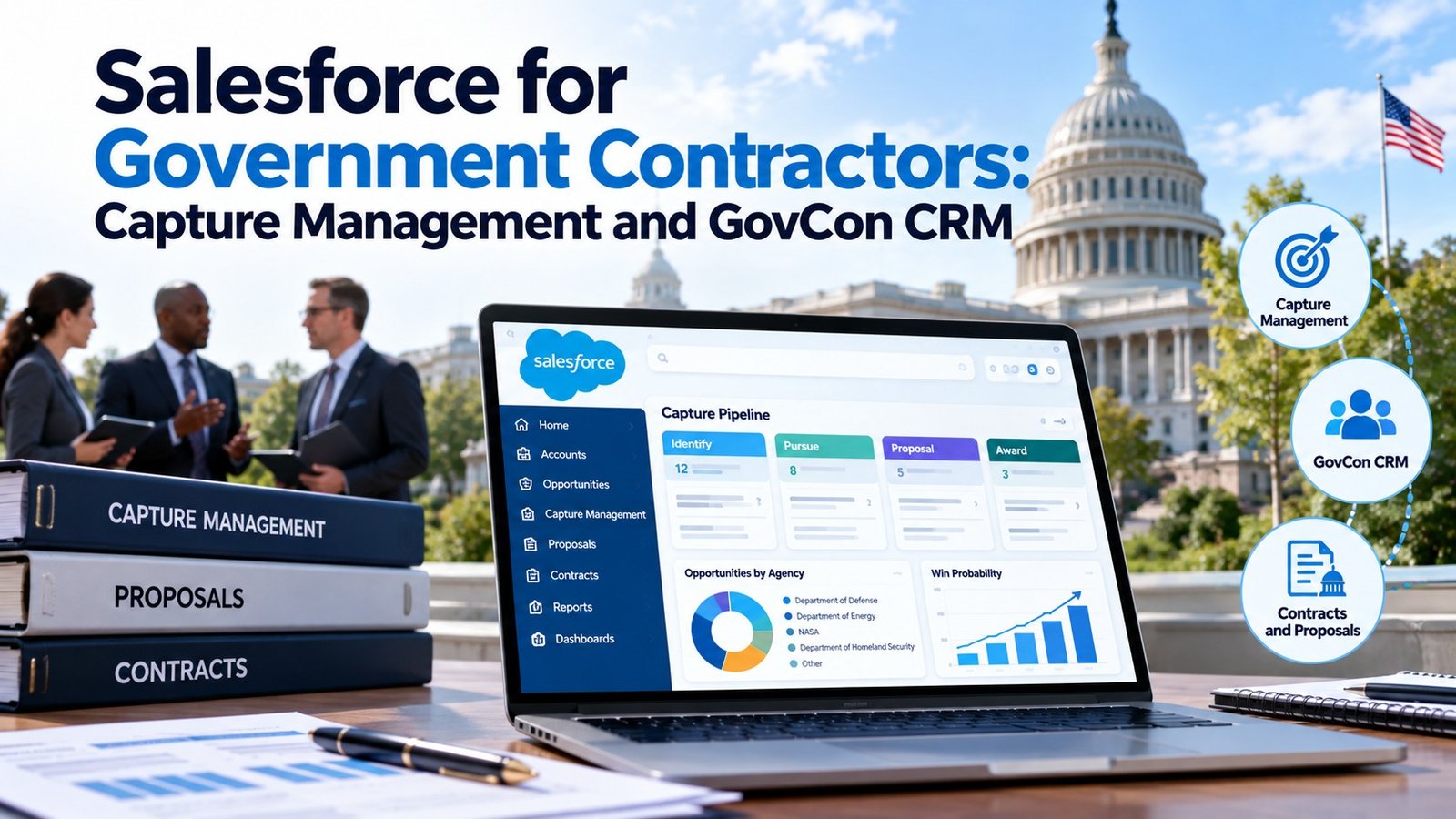
Federal capture runs on long cycles and gate decisions, often with teaming partners, and a GovCon CRM keeps that work in 1 record per pursuit. For most firms, Salesforce for government contractors means Sales Cloud set up for capture. The bigger choice is where it runs and which data it’s allowed to hold, since that sets the price and the products you can use. Teams that want an experienced partner can look at VALiNTRY360’s Agentforce consulting.
Several things changed in 2026. DoD suspended the next CMMC phase on July 13, and Salesforce updated its Government Cloud product list on October 7. Sales Cloud now lists Core, Advanced and Max editions at new prices. Those shifts change what a capture management setup can include and what the compliance review has to cover. Guides written before them can point buyers to products that aren’t authorized or to deadlines that no longer apply.
TL;DR
Salesforce for government contractors uses Sales Cloud for capture stages, Pwin, gate approvals and teaming. Commercial hosting can suit pursuits that exclude CUI. Government Cloud Plus is a FedRAMP High option for controlled data, subject to contractor safeguards and product boundaries. The Defense tier isn’t sold for internal contractor use. CMMC Phase 1 and DFARS 7012 duties continue despite the Phase 2 pause. Commercial Sales Cloud editions list from $195 to $550 monthly per user; Government Cloud Plus adds 15% to eligible net spend, but government edition availability requires a quote.
What a GovCon CRM is and why contractors use Salesforce
A GovCon CRM tracks federal pursuits from early notices, such as sources sought and presolicitations, through to award or loss. It holds more than a commercial CRM does. Each pursuit carries gate decisions, a capture plan, teaming partners and data pulled from federal systems. It also has to sit inside a compliance boundary that commercial sales teams rarely face.
The size of the market explains why that record matters. The GAO FY2025 contracting snapshot reports about $793 billion in federal contract obligations, up $17.8 billion from FY2024 after inflation adjustment. Professional support services led defense service categories. Pursuits can run for years, making gate and customer history valuable.
In practice, the Salesforce contractor solution starts with Sales Cloud, configured for business development and capture. It can run in a commercial org or a separately licensed government environment. Public Sector Solutions mainly addresses agency services and isn’t required for ordinary contractor capture.
How the capture management lifecycle works
Capture connects opportunity identification to proposal submission and award. Shipley and APMP organize that work around formal decisions, each requiring a recorded owner and outcome.
Shipley’s 7 phases
The Shipley lifecycle guide describes 7 phases, numbered from 0 to 6. In order, they’re Market Segmentation, Long-Term Positioning, Opportunity Assessment, Capture/Opportunity Planning, Proposal Planning, Proposal Development and Post-Submittal Activities. The phases have decision milestones. Phases 0 and 1 come before a particular opportunity exists, so those activities belong outside Opportunity stages.
Decision gates and color team reviews
APMP guidance places bid/no-bid approval within opportunity qualification. Later gates determine whether to spend more capture or proposal resources. Pink Team and Red Team reviews inspect proposal drafts before submission.
What Pwin and Pgo measure
Pwin estimates the chance of winning if the firm bids. PGo is often used for the likelihood that the firm will choose to pursue or bid, based on strategic fit, proposal capacity and expected return. These are different decisions: a pursuit can have high Pwin but low PGo when the team lacks bid resources. Salesforce’s capture tour references both PWin and PGo. Neither is a government-awarded score; document your firm’s definitions and review both at each gate.
A practical Pwin scoring example
Use a written scorecard to make Pwin discussions consistent. For example, give each factor up to 20 points: customer access (15), incumbent position (12), technical fit (16), teaming readiness (14), and price position (10). That produces an internal pursuit score of 67 out of 100. It isn’t a verified 67% probability of winning. The capture manager should record the evidence behind each score, the review date, and any open assumptions. Reassess the score at each gate and after an RFP amendment, partner change, or new pricing evidence. If leadership wants a Pwin percentage, calibrate it against the firm’s historical outcomes rather than treating the score as a probability.
How to map Shipley phases to Salesforce opportunity stages
Salesforce’s own material shows the building blocks. Salesforce’s capture tour describes the Path bar across the top of each opportunity, with coaching and guidance for every stage. It shows configurable approval processes that record approval history on their own. The tour also adds fields for intelligence sources such as GovWin, BGOV and SAM.gov. It shows Einstein Discovery predicting Pwin and Pgo, Deltek Costpoint bid and proposal (B&P) costs, and Nintex DocGen building gate-review decks.
Salesforce doesn’t ship Shipley stage names, so the mapping below is one we suggest. Phases 0 and 1 belong at the account and campaign level, since there’s no specific opportunity yet. Opportunity stages start at Phase 2, and each stage ends at a gate in the capture management process.
| Shipley Phase | Suggested Salesforce Stage | Gate or Tool |
| Phases 0 and 1 | No opportunity yet | Account plans and campaigns |
| Opportunity Assessment | Qualify | Pursuit gate as an approval step |
| Capture/Opportunity Planning | Capture | Capture plan fields and Pwin score |
| Proposal Planning | Bid Decision | Bid/no-bid approval with history |
| Proposal Development | Proposal | Color team reviews logged as tasks |
| Post-Submittal Activities | Submitted | Award or loss reason on close |
Put each stage’s exit criteria in Path guidance so users see them at the moment they matter. Make every gate an approval step, which records the decision and the approver in the history. Keep Pwin in its own field and update it at each gate. Set up this way, Salesforce for government contractors gives leadership a gate record they can audit.
Teams can enter B&P budgets, hours and expenses directly in custom Salesforce fields. An ERP integration is needed when they want automatic cost updates from Costpoint or another finance system; Salesforce describes that connection as optional. GovWin and BGOV feeds need subscriptions. Agree on stage ownership before building dashboards.
Capture dashboards and gate visibility
Build a manager dashboard from the Opportunity record and gate approvals. Show pursuits and estimated contract value by stage, the assigned capture owner, current Pwin, and gates due in the next 30 days. Add an exception view for overdue approvals and pursuits without a recent update. A $20 million pursuit at 35% Pwin has $7 million in illustrative weighted pipeline value, not booked revenue. Keep Pwin separate from Salesforce’s standard stage probability unless your team deliberately aligns them. Standard reports and dashboards can surface these fields without assuming a Revenue Intelligence add-on is available in Government Cloud Plus. Managers should be able to open a row and see the latest gate decision and its approver.
How teaming and partner management work in Salesforce
Primes and subcontractors both track teaming partners on their pursuits. The SBA FY2025 scorecard reports that small businesses received nearly 28% of prime contract dollars, about $179 billion, against a 23% goal. With subcontracts included, small businesses received nearly $273 billion. Both sides of a teaming agreement need partner records inside their capture management tool. Those records should show each partner’s role, workshare and socioeconomic status on the pursuit.
Opportunity teams and splits
An admin enables opportunity teams for internal pursuit roles such as capture manager, proposal manager and pricing lead. Revenue splits total 100% and track internal credit. Track subcontractor workshare separately, because partner allocation and internal sales credit aren’t the same.
Partner portals and data sharing
Salesforce Partner Relationship Management runs on Experience Cloud and offers deal registration and lead routing. Its Partner Connect feature lets you choose which fields partners see and which ones sync, according to Salesforce. Partner Community is authorized in Government Cloud Plus, but we couldn’t confirm whether Partner Connect is available there. Salesforce for government contractors can expose selected fields to partners, so share only what the teaming agreement covers. Keep CUI-marked RFP attachments out of any partner portal that isn’t in scope for CUI.
Where GovCon CRM pipeline data comes from
Public federal data feeds most pipelines, and the main sources are SAM.gov and USAspending. The Get Opportunities API from GSA needs an API key from your SAM.gov Account Details page. Its posted-from and posted-to dates are mandatory and can span 1 year at most, and each page returns up to 1,000 records. The API returns only the latest active version of each notice, with active notices updated daily and archived ones weekly. Salesforce for government contractors should load this data on a schedule and keep its own history of changes.
| Source | What It Gives You | Limits to Plan For |
| Get Opportunities API | Active notices by type and date | API key, 1-year range, 1,000 per page |
| Entity Management API | Registration records for partners and rivals | 10 calls a day without a role |
| Contract Awards API | Award data that replaced FPDS feeds | DoD awards appear after 90 days |
| USAspending API | Obligations and spending over time | Live data that gets revised |
The Entity Management and Contract Awards APIs have rate limits; use a system account for scheduled loads. GSA delays public DoD-funded awards until at least 90 days after signing, so recent competitor awards may be missing.
FPDS public award search has moved into SAM.gov. The Contract Awards API replaces older award feeds, while USAspending supplies spending data that agencies may revise. Keep an update timestamp for every imported award.
Keep SAM.gov opportunity records accurate
Treat each SAM.gov notice ID and notice type as a source key, then use the solicitation number to relate notices from the same procurement. That helps prevent a presolicitation, amendment, and solicitation from becoming duplicate pursuits. Update the assigned CRM record when a notice changes, but flag changes to the due date, scope, or set-aside for the capture owner’s review. Keep the previous values, import timestamp, source URL, and decision history. GSA says its Get Opportunities API returns the latest active notice rather than every earlier version, so CRM history needs to preserve what changed. Give each pursuit 1 accountable owner and a regular stale-record review; don’t automatically merge notices just because their solicitation numbers match.
Why the compliance boundary shapes your CRM
What the CRM holds decides where it can run. Most capture data starts as the contractor’s own work, but some of it doesn’t, and that’s the part to scope. The rules below shape every decision about Salesforce for government contractors, so confirm your scoping with counsel and your security lead.
What counts as CUI in a capture pipeline
CUI depends on both the information and the legal authority controlling it. Under 32 CFR 2002.4, it is information created or held by the government, or for or on its behalf, when a law, regulation or government-wide policy requires or permits safeguarding or dissemination controls. The applicable category and authority appear in the CUI Registry. A contractor’s independently developed capture notes and Pwin scores generally fall outside that definition; government-provided controlled attachments or qualifying contract-performance data may not. Have contracts and security personnel check markings, originating authority and contract clauses, rather than relying on document origin or a CUI stamp alone.
Who approves CUI scope and connected products
Assign approval duties before an integration or third-party app goes live. The capture lead identifies intended records and users; the contracts or legal lead checks agency markings and contract terms. The security lead and system owner approve the proposed CUI boundary, data flows, and System Security Plan, using the firm’s formal approval process. The integration owner documents every system receiving or sending information, while procurement waits for security review of each outside provider or app. A tool’s ability to connect to Government Cloud Plus doesn’t establish that it belongs inside the authorized boundary. Record each decision, its approver, and the provider’s shared responsibilities. NIST SP 800-171 requires an SSP that describes system boundaries and connections; the named approval roles here are a suggested governance model, not a federal job-title mandate.
DFARS 7012 and the FedRAMP Moderate bar
The DFARS 252.204-7012 clause sets the cloud rule for covered defense information. A contractor using an outside cloud provider for that data must make sure the provider meets requirements equivalent to the FedRAMP Moderate baseline. The provider must also meet the clause’s rules on incident reporting, malicious software, media preservation, forensics access and damage assessment. Covered defense information includes data marked in the contract and provided by DoD, plus data the contractor collects or develops while performing the contract.
Under 32 CFR 170.16, an external provider processing CUI must be FedRAMP Moderate or higher, or meet an accepted equivalent under DoD policy. Salesforce Government Cloud Plus is authorized at a higher baseline, but that authorization does not certify the contractor for CMMC. The contractor remains responsible for system boundaries, inherited versus customer-managed controls, its System Security Plan, connected systems, personnel and the required assessment. The provider responsibility matrix and any out-of-boundary add-ons need separate review.
CMMC compliance after the Phase 2 suspension
The CMMC rule in 32 CFR Part 170 was published on October 15, 2024 and took effect on December 16, 2024. The DFARS acquisition rule took effect on November 10, 2025, which started Phase 1 with Level 1 and Level 2 self-assessments as a condition of award. Phase 2 would have added third-party Level 2 assessments on November 10, 2026. On July 13, 2026, DoD CIO Kirsten Davies suspended Phase 2 and all later milestones until further notice, then launched a 60-day review. The department now also uses the name Department of War. For CMMC compliance planning, the pause changes timing, and the underlying duties stay the same.
The policy memo didn’t amend 32 CFR 170.3. Phase 1 assessments and existing DFARS 7012 duties continue. CMMC Level 2 still references NIST SP 800-171 Rev 2 despite publication of Rev 3. Capture CRM scoping must follow the requirements in each contract, regardless of the revised implementation schedule.
Keep ITAR technical data out
The exception in 22 CFR 120.54(a)(5) applies to sending, taking or storing unclassified technical data only when every listed condition is met. Data needs end-to-end encryption, using compliant FIPS 140-2 or successor cryptography with NIST-aligned controls, or comparable protection at least as strong as AES-128. It must not be intentionally sent to a person in, or stored in, a country proscribed by §126.1, and it must not be sent from such a country. Mere transit through an internet route does not mean the data is stored there. Section 120.54(b) also limits eligible recipients and who holds decryption means. Government Cloud Plus alone does not resolve ITAR export controls. Keep technical data in a reviewed controlled repository and reference it from the CRM only when approved.
Commercial cloud vs. Salesforce Government Cloud tiers
Salesforce Government Cloud is a dedicated environment for US agencies and contractors. Salesforce Government Cloud runs on AWS GovCloud (US). Its Plus tier holds a FedRAMP High authorization from the Joint Authorization Board. Salesforce now labels that level “FedRAMP Class D (formerly FedRAMP High),” and the pricing page also lists IRS 1075 and HIPAA support. The FedRAMP Marketplace listing shows it authorized on May 27, 2020, with 64 agency authorizations and 303 reuses in GSA’s data as of May 2026. Commercial Salesforce isn’t in that data at Moderate, and the Salesforce-family listings are Government Cloud Plus, Slack, GovSlack and MuleSoft Government Cloud.
| Environment | Authorization | Contractor Fit |
| Commercial Sales Cloud | Not listed at Moderate in FedRAMP data | Pipeline work with CUI kept out |
| Government Cloud Plus | FedRAMP High (Class D) and IL2 | Internal CRM that may hold CUI |
| Government Cloud Plus – Defense | DoD IL4 and IL5 | Only on behalf of a DoD mission owner |
| Government Cloud Premium | Top Secret, air gapped | Classified work, priced on request |
Salesforce’s Government Cloud FAQ limits the Defense tier to qualifying work on behalf of a DoD mission owner; contractors cannot purchase it for their own internal use. It imposes CAC login and DoD network requirements. For internal capture, commercial Salesforce may fit when CUI and restricted contract data are excluded. Government Cloud Plus is an option where the planned controlled-data scope calls for an authorized service.
Confirm data residency, personnel restrictions and shared controls in writing. Salesforce’s NIST SP 800-171 Rev 2 attestation doesn’t replace contractor obligations.
Which capture and AI tools work in Government Cloud Plus
Salesforce’s October 7, 2026 product list separates authorized products from interoperable ones. Authorized in Government Cloud Plus are Sales Cloud, Experience Cloud and Partner Community, and Einstein Discovery. Data 360, Tableau Next and Agentforce for customer and employee agents are authorized as well. An interoperable product has passed functional checks but is outside the listed FedRAMP/DoD authorization boundary. Salesforce permits customer risk decisions, but accepting risk does not establish CUI or CMMC compliance. The security owner must examine data flows, authorization scope, provider obligations and contract requirements before use with controlled data. Products absent from the table aren’t listed as available in Government Cloud Plus. These capture tools are interoperable only:
• CPQ
• Revenue Cloud editions and Revenue Intelligence
• Salesforce Contracts
• Sales Engagement and Salesforce Maps
• Einstein Activity Capture
• Outlook and Gmail integrations
Those gaps affect capture. Outlook and Gmail connectors are interoperable only, while Agentforce for Sales isn’t listed as an authorized product. Apps from AgentExchange also require their own boundary and data-flow reviews. Don’t give any out-of-boundary product access to CUI solely because Salesforce can connect to it.
Salesforce’s Agentforce help article and product table disagree about Defense-tier availability. The help article also references older Enterprise and Unlimited editions. Obtain written confirmation of authorized AI features and eligible editions in the specific government environment before deployment.
For contractor capture, evaluate AI on practical tasks: summarizing public opportunity updates, preparing gate briefs and drafting internal pursuit notes from approved inputs. Keep CUI out of commercial AI workflows; for Government Cloud Plus, confirm the specific agent feature, model, authorization boundary and data flow before enabling it.
What Salesforce for government contractors costs
Salesforce publishes a 15% Government Cloud Plus uplift on eligible net spend, or 25% for the Defense tier. The commercial Sales Cloud price list gives Core at $195, Advanced at $395 and Max at $550 per user monthly, billed annually. Availability of those specific edition SKUs in Government Cloud Plus is not established by the public pages: the Government Cloud help documentation still names Enterprise and Unlimited. The following arithmetic therefore models commercial list prices only as a conditional illustration, not as a verified Government Cloud Plus quote. Ask Salesforce for the eligible government SKUs and order form before budgeting.
1. Annualize the Advanced seat. Multiply $395 by 12 months to get $4,740 per user a year.
2. Price 25 capture and BD users. Multiply 25 users by $4,740 to get $118,500 a year at commercial list.
3. Apply the 15% uplift. Take 15% of $118,500 to get $17,775, for a total of $136,275 a year. As a check, multiply $4,740 by 1.15 to get $5,451 per user, and 25 users at $5,451 come to $136,275.
4. Compare Core. Core costs $195 × 12 = $2,340 per user a year, or $58,500 for 25 users. The 15% uplift adds $8,775, for $67,275 a year.
5. Model a mixed team. Put 10 capture managers on Advanced and 15 BD and proposal users on Core. That’s $47,400 + $35,100 = $82,500 at list, and $82,500 × 1.15 = $94,875 with the uplift.
The 25-seat Advanced illustration equals $11,356.25 monthly on an annual commitment. But Core, Advanced and Max bundles do not establish Government Cloud entitlements: features such as Agentforce for Sales or Salesforce Maps may be absent or out of boundary. The example excludes implementation, data subscriptions, portal licenses and optional ERP syncing. Replace every assumed SKU and price with a government-environment quote.
How to implement a GovCon CRM in Salesforce
Start with the data rule, since it decides the environment and every step after it. Then build the capture management process before you connect any feeds. Plan in phases, and set dates only once the data scope is clear.
1. Classify what the CRM will hold. Sort data into your own pipeline records, government-furnished files and contract-performance data.
2. Choose the environment. Pick commercial cloud with CUI kept out, or Government Cloud Plus, since the Defense tier isn’t an option for internal use.
3. Confirm products and editions in writing. Check each planned product against the authorized and interoperable lists.
4. Build stages, Path guidance and gate approvals. Start from the stage map above and write exit criteria for each stage.
5. Set up teams and partner access. Turn on team selling, define split types and decide which fields partners see.
6. Connect SAM.gov and USAspending feeds. Use a system account and schedule loads inside the daily limits.
7. Document the CRM in your security plan. If it holds CUI, reference the provider’s responsibility matrix in the SSP and train users on marking.
Pilot with a small set of live pursuits before you migrate older records. Use field-level security and permission sets so sensitive fields, such as pricing assumptions, stay limited to the people who need them. Add AI features only after Salesforce confirms their status in your tier. Step 7 ties the rollout to CMMC compliance, because the SSP is where an assessor checks the CRM’s scope.
Measure capture rollout results
Set a baseline before the pilot and review results each month. Track the share of required gates completed before their deadlines, pursuits with no owner update for 30 days, and bid/no-bid decisions that include an approved rationale. Report win rate as awards won divided by decided pursuits, excluding open bids, and compare it by contract size or customer group. Also check how many imported notices need duplicate review and how often gate dates change without an assigned owner. These measures show whether the GovCon CRM improves capture discipline, rather than simply counting records entered.
Limitations and an evaluation checklist
Sales Cloud needs custom capture stages, gates and Pwin fields. Manual B&P tracking is possible without an ERP feed, but automatic cost syncing requires integration. Several add-ons are outside Government Cloud Plus authorization, and government-specific edition prices need a quote. Publish success claims only with documented contractor examples; public case evidence for this precise use is limited.
The fit is strongest when a contractor wants a shared record for gates, partners and bid decisions and can support configuration work. A purpose-built capture tool may fit teams that need fewer custom changes. Check these points before signing:
• Which Sales Cloud editions are sold in Government Cloud Plus today?
• Which of our planned products are interoperable only?
• Is Agentforce authorized at IL5, given the conflicting documents?
• Does the 15% uplift apply to add-ons and partner licenses?
• Is Partner Connect available in Government Cloud Plus?
• Who provides support, and are they US persons?
• Which compliance rows on the pricing page apply to our tier?
Where Salesforce fits in a contractor’s capture stack
Salesforce for government contractors works when each pursuit carries a documented owner, gate history and Pwin rationale. The data boundary decides the hosting environment and which add-ons can safely access the records.
Check current Salesforce authorization and DoD requirements before purchase, then pilot gate reporting and capture-owner accountability. The measured value is better pursuit decisions, not the number of fields configured.
Frequently asked questions
Is Salesforce for government contractors different from Sales Cloud?
It uses Sales Cloud functionality with stages, approval history and reporting built for capture. Hosting and licensing can differ: a commercial org and Government Cloud Plus are separate purchasing and authorization choices, and not every commercial edition or add-on is available in the government environment. Confirm the actual SKU and contract terms.
Can I store proposal pricing and labor rates in Salesforce?
Usually, if the data is your own and stays in your own systems. The CUI Registry’s procurement category covers cost or pricing data, indirect costs and direct labor rates when it’s government information. If pricing data came from an agency or was created for one, treat it as CUI.
What does FedRAMP Class D mean for Salesforce?
FedRAMP’s Consolidated Rules for 2026, launched June 24, 2026, use certification classes from A to D, with D the highest. Salesforce describes Government Cloud Plus as “Class D (formerly FedRAMP High),” which is its own wording. Contracts still use Moderate and High, and DFARS 7012 says Moderate.
Can I keep using commercial Salesforce after winning a DoD contract?
For capture data, often yes. Award changes what you’ll create, since data developed while performing a DoD contract can be covered defense information. Keep that performance data out of a commercial org unless the provider meets the FedRAMP Moderate bar or an equivalent.
Is CMMC still required in late 2026?
Yes. The Phase 2 pause affects rollout timing, not ongoing Phase 1 assessments or DFARS 7012. Contractors should follow current solicitation clauses and DoD guidance for the assessment level required on each award.
Does Salesforce have CMMC certification?
CMMC certifies contractors, so Salesforce holds no CMMC certification of its own. Under 32 CFR 170.16, the cloud provider needs FedRAMP Moderate or higher, or an equivalent. Salesforce’s compliance site lists a CMMC whitepaper updated March 19, 2026. Salesforce also reports a third-party NIST 800-171 attestation against Rev 2.
How do I pull SAM.gov opportunities into Salesforce?
Call the opportunities search endpoint at api.sam.gov with your API key and posted-from and posted-to dates in MM/dd/yyyy format. Filter by notice type codes, such as r for sources sought, p for presolicitation and o for solicitation. Then load results into opportunity or lead records with a scheduled job.
What replaced FPDS for contract award data?
SAM.gov did, and FPDS.gov now redirects there. GSA shut down the ezSearch tool on February 24, 2026. You’ll need a SAM.gov user account to reach the public award data, though no specific role is required, so set up that account before you build the integration.
How much does Government Cloud Plus cost per user?
Salesforce lists a 15% uplift on eligible net spend, separate from the underlying license. Commercial Core, Advanced and Max prices can illustrate costs, but public materials do not confirm those SKUs for Government Cloud Plus. Request a quote stating the government SKU and included features.
Can teaming partners access our Salesforce pipeline?
Yes, through a partner portal on Experience Cloud, where you control which fields they see. Salesforce lists Partner Relationship Management at $25 per member per month and Partner Ecosystem Management at $50, billed annually. Partner Community is authorized in Government Cloud Plus.
Does Salesforce calculate Pwin automatically?
It can predict it. Salesforce’s capture tour shows Einstein Discovery predicting Pwin and Pgo, and Einstein Discovery is authorized in Government Cloud Plus and the Defense tier. Einstein Prediction Builder isn’t available there, and any model needs your won and lost history to learn from.
Is Slack available in Government Cloud Plus?
Slack isn’t in Salesforce’s Government Cloud Plus product table. GovSlack is a separate offering with FedRAMP High authorization from January 25, 2024, while commercial Slack is listed at Moderate. Sales Cloud Core includes Slack Business+ commercially, so check what your Government Cloud bundle includes.
Which AI features can help contractor capture teams?
An approved agent can help summarize public SAM.gov changes, assemble gate-review briefs or draft follow-up tasks. Salesforce lists Agentforce customer and employee agents in Government Cloud Plus, but individual AI products, models and integrations have separate availability rules. Confirm the exact workflow and data boundary before adding CUI.
What should a contractor verify before signing for a GovCon CRM?
Confirm the Sales Cloud SKU available in Government Cloud Plus, whether every planned integration is authorized for the intended data, and who owns capture-stage configuration. Test a live SAM.gov update, a gate approval and a manager pipeline report before committing.
How should small businesses set up a GovCon CRM?
Add fields for set-aside type and each partner’s socioeconomic status, then report on them by pursuit. Federal News Network reported that FY2025 HUBZone awards (2.66%) and women-owned awards (4.2%) missed their goals of 3% and 5%. It also reported that 8(a) awards fell $1.5 billion to $24.3 billion.