

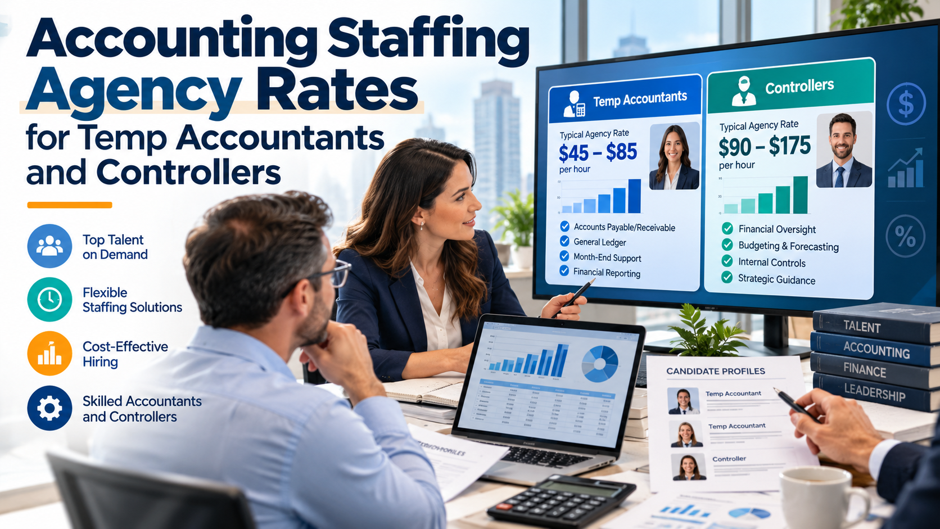
Picture a 90-person distributor whose controller goes on leave in early November, a few weeks before year-end close. The CFO asks 2 agencies for help and gets back an $87 hourly rate for a senior accountant and $118 for an interim controller, with no explanation of what sits inside either number. She needs to know whether those rates are normal, how much of each is the worker’s pay, and what a 6-week project would cost. This scenario is invented for illustration and doesn’t describe a real company or a real quote.
This post explains how agencies price temporary accountants and controllers and how to test a quote against public data. It draws on 2 Bureau of Labor Statistics pages, a Montgomery County, Maryland rate sheet, 2 Department of Labor fact sheets and vendor pages from KORE1, Go Fractional, Frontline Source Group and Robert Half, each attributed where it appears. Vendor rates are marketing, and several contain arithmetic errors that I flag. All dollar examples are invented unless attributed. Confirm contract terms with counsel and your agency.
TL;DR
- Bill rates run well above wage data, and the gap isn’t all profit. The Bureau of Labor Statistics puts the median accountant wage at $40.23 an hour and the median financial manager wage at $80.08. KORE1’s October 2026 index, which it modeled from those wages, shows bill rates of $52 for junior, $65 for mid-level and $87 for senior accountants. The difference covers payroll taxes, insurance, overhead and margin, so ask for the pay rate and the bill rate.
- Controller rates vary more than staff rates. Go Fractional reports an average of $118 an hour for fractional controllers, with a middle half from $84 to $150, and Frontline Source Group claims $100 to $200 without a source. Scope, urgency and whether the role is fractional or interim all move the number. Compare quotes on the same hours, duties and terms before you compare the hourly figure.
- Check overtime, term and surcharges before you sign. Hourly workers are generally non-exempt, so overtime hours may bill at 1.5 times the rate. In my invented 45-hour week at $65, overtime adds $162.50. The Montgomery County sheet says overtime isn’t covered and raises long-term rates, so read each clause. Public rate pages disagree with each other, so use them as benchmarks, not as price lists.
What drives temp accounting rates
A bill rate for a temporary accountant has 3 parts: the pay rate the worker receives, the cost of employing that worker and the agency’s margin. This structure is common across finance and accounting staffing arrangements where the staffing firm employs the contractor and bills the client. The employment cost includes employer Social Security and Medicare tax, unemployment tax, workers’ compensation, any benefits and the agency’s insurance.
Several forces move the pay rate itself. Skill level matters most: a staff accountant who posts journal entries commands less than a senior accountant who can run a close, and less again than a controller who signs off on the numbers. Software knowledge, industry experience, certification, location, urgency and the length of the assignment all add or subtract. KORE1’s article describes November as the tightest period for senior supply in Southern California and says overtime pressure builds in December and January, though it publishes no seasonal multipliers.
The agency’s margin depends on the same market. A rare skill with a short deadline gives the agency less room to discount, while a long assignment for a large buyer may earn a lower markup. Public data can’t tell you the margin on any given deal, but it can tell you whether a quote falls inside the range other buyers see. The rest of this post builds that benchmark from wage data first, then from published bill rates, and then shows how to convert between them.
Pay benchmarks from federal wage data
Accountants and auditors. The Bureau of Labor Statistics wage data for accountants and auditors says the median annual wage was $83,680 in May 2025, or $40.23 an hour. The lowest 10 percent earned less than $56,020 and the highest 10 percent earned more than $144,090. The page reports 1,595,200 jobs and projects 5 percent growth from 2025 to 2035, and it was last modified on August 27, 2026.
These wages cover employees in all settings, so they set a floor for thinking about pay rather than an accounting staffing agency bill rate. Government wage data covers employees, not contractors, and it excludes employer taxes, benefits and agency costs. It also can’t reflect a rush project or a hard-to-fill skill.
Financial managers, which includes controllers. The same federal data source reports a median annual wage of $166,570 for financial managers in May 2025, or $80.08 an hour, with the lowest 10 percent under $94,310 and the highest 10 percent over $323,270. The BLS financial managers profile names controllers as a job title and says financial managers direct financial reporting and often oversee accounting, audit and budget functions. The category spans many titles and company sizes, so a small company’s controller may sit well below the median.
What these numbers can’t tell you. Government wage data covers employees, not contractors, and it excludes employer taxes and benefits. It doesn’t show what agencies pay temporary workers, which can be higher or lower than permanent pay for the same role. It also can’t reflect a rush project or a hard-to-fill skill. Use the medians as an anchor for pay, then add burden and margin to estimate a bill rate, and treat the result as a rough check rather than a prediction.
Published bill-rate ranges
The table gathers the bill rates that public pages report, with the source and the caveat for each. The KORE1 figures come from an index the firm says it modeled from federal wage data plus a 24 percent burden, so they aren’t observed prices. The Montgomery County figures are rates the county pays for clerical and accounting-related categories under a contract effective March 1, 2025, and the sheet has no accountant or controller category. The controller figures come from firms that sell fractional or interim services.
| Source | Role | Rate reported | Caveat |
| KORE1 index, October 2026 | Junior or staff accountant | $48 to $59, median $52 | Modeled from federal wages and a 24 percent burden |
| KORE1 index, October 2026 | Mid-level accountant | $59 to $75, median $65 | Same method |
| KORE1 index, October 2026 | Senior accountant | $77 to $94, median $87 | Same method; New York senior median $109 |
| Montgomery County, Maryland | Accounting clerk | $26.26 to $28.79 | Public contract rates; no accountant category |
| Go Fractional, October 2026 | Fractional controller | Average $118; middle half $84 to $150 | Posts and profiles, not billed invoices |
| Frontline Source Group | Experienced fractional controller | $100 to $200 | No source given |
Staff and senior accountant rates
- Junior and staff accountants. KORE1 shows a bill range of $48 to $59 with a median of $52. Against the federal median accountant wage of $40.23, that’s 1.29 times, though a junior accountant’s pay is likely below the median, so the markup over actual pay is probably higher than the ratio suggests. These workers handle reconciliations, payables, receivables and entries under supervision, and their rates move with software skills. Ask which systems the worker has used.
- Mid-level accountants. KORE1’s range is $59 to $75 with a median of $65, which is 1.62 times the federal median hourly wage. The role covers month-end close tasks, account analysis and some independent work. Mid-level rates in the index also vary by metro: $84 in New York, $75 in Orange County and Los Angeles, $65 in Dallas, $64 in Chicago and $62 in Milwaukee. Ask for a sample of the worker’s prior close work.
- Senior accountants. The index range is $77 to $94 with a median of $87, or 2.16 times the federal median wage. Metro medians run from $82 in Chicago and Milwaukee to $97 in Orange County and Los Angeles and $109 in New York. Seniors run closes, supervise others and handle complex entries, which makes them a common fit for accounting staff augmentation when a finance team has a temporary capacity gap. Ask for references from a prior close that ran on time.
- Observed against modeled. KORE1 says its own accountant placements, 11 of them from 2023 to 2026 and mostly in Southern California, billed $42 to $85 with a median of $44. That’s well below its index medians for mid-level and senior roles. The sample is tiny and tilted toward staff work, but it shows why a modeled index should be treated as a ceiling to test rather than a price to expect.
Controller and interim finance leader rates
Go Fractional’s October 2026 page, based on 24 job posts and 137 candidate profiles from the prior 90 days, reports an average of $118 an hour for fractional controllers. The middle half runs from $84 to $150, and the full observed range is about $50 to $280. Employer offers average $99 an hour while candidates ask average $125, a gap of $26 or about 26 percent. That gap is a reminder that posted rates are asks and offers, not agreed prices, and the final rate depends on scope and urgency.
The page also compares fractional work with a full-time controller. It uses the federal median financial manager wage of $166,570 and a loaded cost of about $238,000 a year, and says the fractional cost is about 31 percent of that at the average rate. For companies comparing an interim controller with a permanent leadership search, the same decision can overlap with CFO and senior finance hiring when the vacancy involves wider financial leadership duties. The arithmetic on the vendor page itself still needs checking.
Frontline Source Group, a Dallas staffing and search firm, lists $100 to $200 an hour for experienced fractional controllers and monthly tiers from $2,500 for 20 to 30 hours to $9,000 to $12,000 for 80 or more hours. It describes interim engagements as about 160 hours a month for 3 to 6 months. None of these figures cites a source, and the page carries 2 different update dates. I use the tiers to show how vendors package hours, not as market evidence.
Converting a pay rate to a bill rate
- Start with the formula. The bill rate equals the pay rate times 1 plus the markup. Markup divides the agency’s gross profit by the pay rate, and margin divides it by the bill rate. A quote that says 50 percent markup on pay is a different number from a 50 percent markup on loaded cost, so ask the agency which base it uses before you compare quotes with another agency or with a published figure.
- Work the KORE1 example. KORE1’s article posits a worker paid $100 an hour with a 24 percent burden, so the loaded cost is $124. Employer Social Security and Medicare alone currently total 7.65 percent of covered wages, based on the IRS Social Security and Medicare tax rates, before unemployment tax, workers’ compensation, benefits and other employment costs are added. KORE1 estimates a bill rate of $150 to $160 without a source.
- Convert a benchmark. Take the federal median accountant wage of $40.23. A 40 percent markup gives a bill rate of $56.32, 50 percent gives $60.34 and 60 percent gives $64.37. KORE1’s mid-level median of $65 sits just above the top of that range, which suggests either a wage above the median or a markup near the high end. The index doesn’t say which, so ask for the pay rate behind any quote.
- Ask for both numbers. An agency that quotes only the bill rate hides the number that tells you whether the worker is fairly paid. Ask for the pay rate, the burden assumptions and the markup, and ask whether they change at 90 days or with volume. If the agency refuses, compare total cost per hour across agencies and use the benchmarks in this post to judge each quote. Keep the answer on file.
Reading a quote line by line
Rate and basis. Start with what the number means. Is it a single blended hourly bill rate, or a pay rate plus a markup? Does it vary by shift or location? Before accepting a rate, compare the pay side with a current finance and accounting salary guide rather than judging the bill rate in isolation. The Montgomery County sheet lists a “Basic” and an “Advanced” rate for each category without defining either, which shows how a quote can hide the thing that matters.
What’s inside. Montgomery County’s sheet says its rates include overhead, benefits, FICA, profit and multilingual costs, and it states that overtime isn’t covered under the contract. For a private quote, ask what the rate includes: payroll taxes, workers’ compensation, general liability, any benefits and background checks. A rate that excludes screening, remote work tools or a mandated-benefits surcharge can cost more than a rate that includes them, even when the headline number is lower.
What sits outside. Ask about conversion fees, minimum assignment lengths, cancellation terms and late-payment charges. I found no public pricing on Robert Half’s contract talent page, which lists no rates, fees, guarantees or conversion terms and makes self-reported claims such as hiring in as little as 48 hours. Many agencies treat terms as part of the sales process, so request a written rate sheet before any assignment starts, not after the first invoice arrives.
Cost of an invented close project
Take an invented 6-week close project of 240 hours. The table prices it at several hourly rates drawn from the sources above: the KORE1 medians, 2 of its metro medians, the Go Fractional average and a placeholder for an interim controller at $150, the top of the Go Fractional middle half. Before choosing the model, it also helps to compare the project deadline with typical accounting staffing fill times because a cheaper rate isn’t useful if the person can’t start before the close.
| Role | Hourly rate used | Source of rate | 240 hours |
| Junior accountant | $52 | KORE1 national median | $12,480 |
| Mid-level accountant | $65 | KORE1 national median | $15,600 |
| Senior accountant | $87 | KORE1 national median | $20,880 |
| Senior accountant, Orange County and Los Angeles | $97 | KORE1 metro median | $23,280 |
| Senior accountant, New York | $109 | KORE1 metro median | $26,160 |
| Fractional controller | $118 | Go Fractional average | $28,320 |
| Interim controller | $150 | Placeholder at top of middle half | $36,000 |
Overtime, exemption and who pays
Overtime is where a quote can move quickly. The current Department of Labor guidance explains that the 2024 overtime rule was vacated and that, for federal enforcement, the Department is applying the 2019 rule’s $684-per-week standard salary level. The DOL guidance on white-collar overtime exemptions also makes clear that salary alone doesn’t decide exemption status because duties matter too. A temp accountant paid hourly is therefore a role that deserves a specific classification review rather than an assumption based on the job title.
How the premium appears on the bill varies. Some agencies bill overtime at 1.5 times the bill rate, and others at 1.5 times the pay rate plus the usual markup. These methods give different results. Montgomery County’s sheet says overtime isn’t covered by the contract and doesn’t say how overtime hours are handled. KORE1’s article doesn’t state its overtime method either. Ask the agency to show a sample invoice for a 45-hour week.
On an invented $65 bill rate and 1.5 times the bill rate for overtime, a 45-hour week costs 40 times $65 plus 5 times $97.50, or $3,087.50. At straight time the same hours would cost $2,925, so overtime adds $162.50, or 5.6 percent. A month-end close with heavy hours can push a project over budget quickly. Set a weekly hour cap in the statement of work, and require approval for hours beyond it so the premium doesn’t surprise you.
Season, location and duration
Season. KORE1 says senior supply in Irvine, Newport Beach and downtown Los Angeles is tightest in November, and that overtime pressure builds in December and January. It publishes no seasonal multipliers, so any claim that rates rise by a specific percentage at year-end is unsupported by the pages I read. Plan for scarcity rather than a fixed surcharge: book help early, define the scope tightly and ask the agency whether year-end volume changes its willingness to negotiate.
Location. The index shows large geographic gaps. A senior accountant’s median bill rate is $109 in New York, $97 in Orange County and Los Angeles, $83 in Dallas and $82 in Chicago and Milwaukee. Current BLS metropolitan wage estimates provide a primary-source way to compare local employee wage levels before you rely on a staffing vendor’s geographic multiplier. Over 520 hours, the difference between New York and Chicago in the KORE1 figures is $27 times 520, or $14,040.
Duration. Montgomery County’s sheet lists a short-term rate for assignments of 12 months or less and a higher long-term rate beyond that. For an accounting clerk at the basic level the short-term rate is $26.26 and the long-term rate is $28.39, a difference of $2.13, or 8.1 percent. The sheet doesn’t explain the step up, and it covers clerks rather than accountants. The point for buyers is that longer assignments don’t always earn a discount, so ask how rates change at 90 days and at 12 months.
Contract, contract-to-hire and fractional models
- Agency W-2 contract. The agency employs the accountant, pays the wages and taxes and bills you an hourly rate. The KORE1 index describes W-2 contractors working 40 hours a week, and the bill rate includes the employer costs. Before you price the role, make sure the scope matches the responsibilities in the relevant finance and accounting job descriptions so you’re comparing workers at the same level. Confirm who supervises the worker and who approves timesheets each week.
- Contract-to-hire. The worker starts as a contractor and may convert to your payroll. KORE1 reports 552 contract-to-hire placements with 207 converted, or 37.5 percent, from its internal tracking, which I couldn’t verify. Conversion terms, such as fees that fall with hours worked, belong in the contract from the start. Ask for the schedule and the clock before the first day. Ask whether the conversion clock continues if the assignment pauses for a week.
- Fractional controller. A fractional controller works part of the week for several clients, often as an independent. Frontline describes fractional work as usually 20 to 80 hours a month on flexible monthly terms, and Go Fractional uses 13 hours a week as its reference engagement. Rates are higher per hour than staff accountants, but you buy only the hours you need. Ask how many other clients share the controller’s week and how conflicts are handled.
- Interim controller. An interim controller covers a vacancy or a transition at close to full-time hours. Frontline describes interim work as about 160 hours a month for 3 to 6 months, quoted weekly. Over a 3-month stretch of 520 hours, $100, $118 and $150 an hour come to $52,000, $61,360 and $78,000. Go Fractional’s loaded full-time cost of $238,000 a year implies $59,500 for a quarter. Ask what the quote assumes about weekly hours.
Where published rate pages conflict
The KORE1 article has several internal mismatches. Its standard cost rows don’t equal median times hours: $52 times 520 is $27,040 against a stated $27,100, and $65 times 1,040 is $67,600 against $67,900. Its Dallas mid-level total is $33,600 where $65 times 520 is $33,800. Its text puts the New York versus Chicago gap at $14,200 over 3 months, while the hourly medians give $14,040. It also gives a $150 to $160 bill rate for a $100 worker without a source, and says its index can’t be reproduced from the inputs it states.
The Go Fractional page lists 24 open jobs but links to 14, gives a $100 median in its FAQ that doesn’t appear in its distribution data, and uses a 4-week month. Frontline’s page carries update dates of October 1 and October 15, 2026, labels its pricing as 2026 market ranges without citing a survey and refers to a fee page I couldn’t see. The Robert Half page lists no rates at all. The Montgomery County sheet covers clerical roles only, leaves its basic and advanced tiers undefined and shows an unexplained 15 percent jump for a single multilingual line.
Taken together, these flaws suggest a practical approach. Use the federal wage data for pay, use the public contract rates as a reality check on tiers and terms, and treat vendor bill rates as the opening position of a seller. All of them are marketing from firms that earn money from the rates they describe. When sources disagree, write down the conflict, the source you chose and why, so the next reviewer can follow your reasoning without repeating the research.
Quote checklist
Use the table to compare 2 or more quotes line by line. The first column lists the item, the second explains why it matters and the third says what to request. Fill the third column with answers in writing before you compare hourly rates, because a rate that looks lower can hide a cost elsewhere. The items come from the contracts and articles discussed above, and none is a legal requirement. Ask counsel to review the final agreement, especially the overtime, conversion and termination language.
| Item | Why it matters | What to request |
| Pay rate and bill rate | Shows markup and tests fairness to the worker | Both numbers and the markup base |
| Burden assumptions | Payroll taxes, insurance and benefits drive cost | A list of what the rate includes |
| Overtime method | 1.5 times bill versus pay changes the invoice | A sample invoice for a 45-hour week |
| Term and step-ups | Long-term rates can rise | Rates at 90 days and 12 months |
| Conversion terms | A hire can trigger a fee | The schedule, the clock and the salary base |
| Minimums and cancellation | Short projects can bill minimum hours | Minimum hours and notice periods |
| Replacement terms | A poor fit costs time | Replacement window and any cost |
Negotiating and managing rates
- Define the scope before you ask for a rate. A rate for “help with the close” invites a wide spread. Write down the tasks, the software, the hours per week, the start date, the length and the reporting line. Ask each agency to quote against the same document. Quotes built on the same scope can be compared, and the spread between them shows how much of the price is real difference and how much is guesswork.
- Ask for the pay rate. Workers who know their pay rate and the bill rate can see the gap, and that can affect retention. Agencies that share the pay rate tend to be comfortable with their margin. For controller, director and other senior searches, specialist finance headhunters may use a different fee structure from temporary accounting staffing, so compare the model as well as the number. Some buyers set a maximum bill rate by role and let agencies decide how to split it.
- Negotiate term and volume. Longer or larger commitments may earn a lower markup, but the Montgomery County sheet shows a higher long-term rate for clerks, so don’t assume. Ask for a rate that holds for the project’s life, a cap on increases and a step down if the assignment extends. Offer faster payment terms in exchange for a lower rate if your accounts payable team can reliably deliver. Document any rate held in writing.
- Control hours. Require weekly timesheet approval, set a cap and review the first 2 invoices against the time records. Overtime, rework and idle time often cost more than a small difference in hourly rate. Ask the worker’s manager to confirm priorities each week so the hours go to the work that matters, and keep a short log of what was finished against what was planned. Share the log with the agency weekly.
A 30-day buying plan
Week 1: set the scope and the benchmark. Write the statement of work and choose the model: W-2 contract, contract-to-hire, fractional or interim. Pull the federal wage medians for the roles and compute a bill-rate range at 40, 50 and 60 percent markups. Decide your maximum hours per week and your maximum total budget. Share the scope with finance and HR so the request reflects what the department needs. Write the scope down once and reuse it.
Week 2: collect quotes. Ask 3 agencies for the same itemized quote: pay rate, bill rate, burden, overtime method, minimum hours, term, conversion terms and replacement terms. When building the shortlist, compare agencies that actually specialize in the roles you need rather than treating every general recruiter alike; VALiNTRY’s overview of accounting staffing agencies illustrates the role categories worth checking. Record every answer and its date in a shared sheet so you can compare them without relying on memory.
Week 3: test and negotiate. Compare the quotes against the benchmarks and against each other. Flag any rate outside the ranges in this post and ask the agency to explain it. Negotiate scope, term and conversion terms before the hourly rate. Ask counsel to review the agreement, especially the overtime, termination and confidentiality terms. Select the agency and set the start date. Keep notes on each negotiation call and the date it took place.
Week 4: start and monitor. Confirm the worker’s access, supervisor and priorities before the first day. Review the first timesheet and the first invoice against the quote. After the first week, check whether the work is on pace and whether the rate still looks right given what the worker is doing. Calendar the end date and any step-up so nothing renews by default. Keep the first invoice with the quote for comparison later.
FAQs
What’s a typical hourly bill rate for a temp accountant?
KORE1’s October 2026 index, which it modeled from federal wage data plus a 24 percent burden, shows national medians of $52 for junior, $65 for mid-level and $87 for senior accountants. Metro medians run higher in New York and California. Its own 11 observed placements billed a median of $44, so treat the index as a ceiling to test. Ask for the pay rate behind any quote. Use the range to test quotes.
How much do temp controllers cost per hour?
Go Fractional reports an average of $118 an hour for fractional controllers, with a middle half from $84 to $150 and a full range of about $50 to $280. Frontline Source Group claims $100 to $200 without a source. Scope, urgency and whether the role is fractional or interim change the number. Compare quotes on the same hours, duties and term, and ask each firm how it counts a month.
What’s the difference between a pay rate and a bill rate?
The pay rate is what the worker earns per hour, and the bill rate is what the agency charges you. The gap covers employer payroll taxes, insurance, overhead and margin. With a $42 pay rate and a 55 percent markup, the bill rate is $65.10. Markup is measured against pay and margin against the bill, so ask which base an agency uses. Ask for both figures in writing before you accept a rate.
Do temp accountants get overtime?
Often, yes. The Labor Department’s fact sheets say white-collar exemptions generally require a salary of at least $684 per week, a threshold that the page I read dated September 2019, and hourly pay generally doesn’t meet the salary test. An hourly temp accountant is therefore usually non-exempt. Billing for the premium varies, so ask whether overtime bills at 1.5 times the bill rate or another formula. Confirm the current threshold with the Labor Department.
How much cheaper is a fractional controller than full-time?
Go Fractional says about 31 percent of a full-time loaded cost of roughly $238,000 a year, based on an average rate and 13 hours a week. Its arithmetic has issues, including a 4-week month and a 40-hour equivalent of $245,440 that exceeds the loaded cost. The saving depends on the hours you need, so compare the total cost for your scope. Run the comparison with your own hours and your own full-time cost estimate.
What does the markup cover?
It covers employer payroll taxes, unemployment tax, workers’ compensation, insurance, benefits, recruiting, payroll administration, overhead and profit. Montgomery County’s sheet lists overhead, benefits, FICA, profit and multilingual costs inside its rates. Because agencies bundle these differently, a 40 percent markup from an agency isn’t comparable with a rival’s. Ask for a list of inclusions, and ask what’s billed separately. Ask for the inclusions in writing, and ask whether any of them are billed again as separate line items.
Are rates higher at year-end or tax season?
Possibly, but I found no published multipliers. KORE1 says senior supply in Southern California is tightest in November and that overtime pressure builds in December and January, without quantifying a rate effect. Scarcity may reduce your negotiating room, so books help early and define the scope tightly. Ask any agency whether it applies seasonal surcharges and put the answer in writing. Compare any surcharge with the base rate on the same invoice line.
Can I hire a temp accountant permanently?
Often, but conversion terms vary. KORE1 reports that 207 of 552 contract-to-hire placements converted, from internal tracking I couldn’t verify. Many agreements charge a fee that falls as billed hours build, and some protect the agency for a set period after a candidate is presented. Ask for the schedule, the clock and the salary base in writing before the worker starts. Keep the signed schedule with the worker’s assignment paperwork for later reference.