

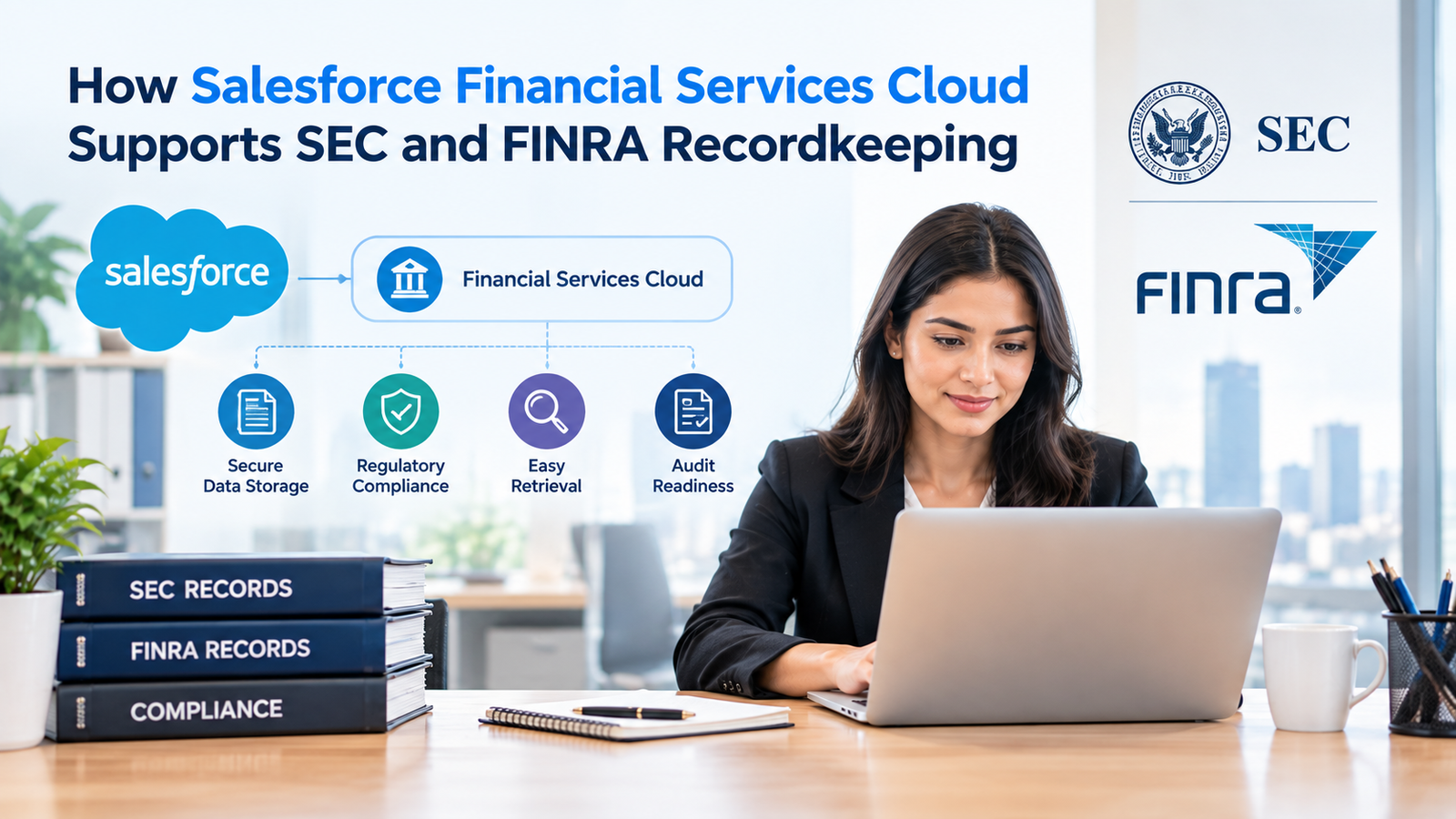
Financial firms don’t solve recordkeeping by buying a CRM. They solve it by deciding which records must exist, where each record is created, how long it must be kept, who can change it, and how the firm will produce it during an examination. Salesforce Financial Services Cloud can support that design because it gives wealth, banking, and financial-services teams a structured place to manage client information and advisor activity. It works best when the firm treats it as part of a larger recordkeeping system rather than the whole system.
That distinction matters for broker-dealers. SEC Rules 17a-3 and 17a-4 set creation and preservation duties for many broker-dealer records. FINRA Rule 4511 connects FINRA recordkeeping duties to those federal requirements, while FINRA supervision rules add another layer around policies and oversight. Salesforce can help firms create usable records, restrict access, capture selected change history, review user activity, and connect to backup or archive services. The exact design still depends on the firm’s business, record types, communication channels, registrations, and written supervisory procedures.
Salesforce renamed Financial Services Cloud to Agentforce Financial Services in 2026, although the older name still appears in product documentation. This article keeps Salesforce Financial Services Cloud because many firms still use that term for existing implementations.
TL;DR
Salesforce Financial Services Cloud can support SEC and FINRA recordkeeping when firms configure it around specific regulatory records and pair it with the right Salesforce platform services. Interaction Summaries can create structured records of advisor meetings. Compliant Data Sharing can limit access to sensitive records. Field Audit Trail can preserve selected field-change history. Event Monitoring can show user activity. Backup & Recover and Archive can help with recovery and longer-term retention.
The platform still doesn’t remove the firm’s duty to satisfy SEC Rule 17a-4, FINRA Rule 4511, supervision rules, or communication-retention requirements. Firms must decide which Salesforce records are regulatory records, set retention periods by record class, preserve required communications, control deletion, test retrieval, and confirm that the full electronic recordkeeping system meets the applicable rule.
What SEC And FINRA Recordkeeping Requires
Broker-dealer recordkeeping starts with a basic split. SEC Rule 17a-3 focuses on records that covered firms must make and keep current, while Rule 17a-4 focuses on how long many of those records and other business records must be preserved. The SEC’s electronic recordkeeping compliance guide explains the 2022 amendments that changed electronic preservation rules and prompt-production requirements. Those changes matter for firms using cloud systems because the rule now expressly supports an audit-trail approach as an alternative to preserving records exclusively in non-rewriteable, non-erasable form.
The record categories are much broader than client notes in a CRM. The current Rule 17a-3 text covers records such as blotters, ledgers, order memoranda, customer account information, complaints, and records tied to supervisory responsibilities. A Salesforce implementation may hold some of those records directly, hold business context related to them, or receive copies from another system. That means financial services recordkeeping begins with classification. A firm needs to know which system is the official record source for each required record and whether Salesforce is primary, secondary, or only a workflow layer.
Preservation then changes the question from “do we have the data?” to “can we preserve and produce the required record for the required period?” The current Rule 17a-4 text sets different retention periods for different record classes and includes requirements for electronic recordkeeping systems. Some records must be kept for at least 6 years, while many other listed records must be kept for at least 3 years. The rule also addresses communications related to the broker-dealer’s business and requires electronic systems to support regulator access and production.
FINRA adds its own recordkeeping framework. FINRA Rule 4511 requires member firms to make and preserve books and records required by FINRA rules, the Exchange Act, and applicable Exchange Act rules. It also says FINRA records without another specified retention period must generally be preserved for at least 6 years, and FINRA-required books and records must use a format and medium that complies with SEC Rule 17a-4. For a Salesforce Financial Services Cloud compliance design, this link between FINRA and SEC rules is central.
How Salesforce Financial Services Cloud Fits Into The Recordkeeping Architecture
Salesforce Financial Services Cloud is most useful when the firm defines its role before it configures fields and workflows. A CRM record might be the official record for a client profile field, a working copy of information mastered elsewhere, or an operational record that points to a document stored in another repository. Those cases look similar on screen but have different retention and evidence needs.
Salesforce’s current financial services product documentation notes that Financial Services Cloud is now called Agentforce Financial Services. The underlying platform still combines financial-services data models with Salesforce access controls and workflow features. For recordkeeping, the key design question is which client, account, interaction, complaint, approval, and supervisory data should be represented in those objects. The firm can then map each object and field to a record category, retention rule, system owner, and production method.
This is where a good Salesforce Financial Services Cloud compliance model becomes more specific than a generic “single client view.” A household relationship record may support service work, while an Interaction Summary may preserve details of an advisor meeting. A complaint case can carry intake and disposition fields. An approval record can show review status and responsible users. The compliance value comes from consistent record creation and clear ownership, not from putting every piece of data into the CRM.
A practical architecture separates the source record from evidence about changes and access. It also identifies the preservation layer and the production path used to locate and export records. Salesforce can participate in each layer, but the product or connected system may differ by record type.
Which Records Financial Services Cloud Can Support
The most useful Salesforce records are those tied to repeatable business events. Client onboarding, account updates, meetings, complaints, service requests, approvals, and supervisory reviews all create information that can matter later. The goal is to define the minimum record needed for the business and then preserve the fields that matter for compliance.
Customer account data is a good example. Rule 17a-3 includes specified account information for certain natural-person accounts, including identifying information and financial or investment-related fields in covered situations. Financial Services Cloud can hold client and household data in structured objects, but the firm must decide which Salesforce fields correspond to required records and which system controls the official value. A sync from a brokerage platform into Salesforce doesn’t automatically make Salesforce the system of record.
Complaints need similar care. A complaint workflow can record when the firm received the issue, who was involved, the nature of the complaint, its status, and the disposition. Salesforce can support that workflow well because cases and related objects can carry structured fields and ownership. The recordkeeping policy should still state whether the complaint itself, attachments, correspondence, review notes, and final response are preserved in Salesforce or in another approved repository.
Advisor and banker activity can also create business records. Meeting notes, follow-up commitments, approvals, and changes to client facts may matter for later supervision or examination. Financial services recordkeeping improves when those details are captured in defined fields or approved note structures instead of personal notebooks or ungoverned files. The design should also stop users from treating free-text CRM notes as a substitute for records that must live in a dedicated trading, communications, or document system.
| Record Type | Possible Salesforce Role | Control Question |
| Client account information | Structured client or household fields | Which system is the official source? |
| Advisor meeting notes | Interaction Summary | Is the note required to be retained and for how long? |
| Customer complaint | Case and related records | Are attachments and responses preserved too? |
| Approval or review | Workflow record | Is reviewer identity and timing captured? |
| Client communication | Activity or connected record | Is the original message preserved in an approved system? |
| Change history | Field Audit Trail | Are all required fields tracked for the full period? |
Interaction Summaries And Advisor Meeting Records
Interaction Summaries are among the clearest Financial Services Cloud features for structured advisor records. Salesforce’s Interaction Summaries documentation says users can capture detailed meeting notes, specify confidentiality, add action items or next steps, and relate the summary to other business records. That structure can reduce dependence on informal notes because the firm can define what advisors must enter after a covered client interaction.
The feature is useful for recordkeeping only when the firm controls how it is used. A required interaction type should have clear fields, required values, ownership rules, and timing expectations. Firms may also need validation rules or workflow checks so a meeting record isn’t saved without the information the business has decided to preserve. The record should be understandable later by a reviewer who wasn’t part of the meeting.
Interaction Summaries also help separate a client-facing event from the evidence about that event. An advisor can record the purpose, attendees, notes, and next steps while the platform retains the related account or opportunity links. A reviewer can then see the record in context. That can support supervision when the firm’s written procedures call for review of certain meetings or events.
Still, an Interaction Summary isn’t a substitute for preserving the original communication when another rule requires it. If a meeting was arranged by email or followed by a business-related text message, those communications may have separate preservation duties. Salesforce Financial Services Cloud compliance works best when the CRM note points to, or can be reconciled with, the firm’s approved communication archive.
Compliant Data Sharing And Record Access
Record preservation has little value if the wrong users can see or change sensitive information. Financial firms often need tighter sharing than a standard role hierarchy provides, especially for material nonpublic information, restricted clients, private banking relationships, or sensitive complaint records. Salesforce’s Compliant Data Sharing documentation describes controls that let Financial Services Cloud administrators and compliance managers manage who can receive access to covered records.
That capability supports recordkeeping in 2 ways. First, it can reduce inappropriate access to records that must stay limited to a defined group. Second, access design makes the meaning of the record clearer because ownership and participant roles can follow the firm’s real business structure. A firm can map participant roles to teams such as the responsible advisor, supervisor, compliance reviewer, or service specialist where the business case supports it.
Access controls should be designed together with retention controls. An archived record may still contain client information that should remain limited, while a legal hold or regulatory request may require access for a small response team. The design should cover use, archive access, export, and permitted disposal.
Firms should also document exceptions. Administrators with broad platform rights can often access more data than normal users. Integration users may move records between systems. Support processes may allow temporary higher access. Those cases belong in access reviews and audit procedures because the technical ability to see data can be broader than the business permission to use it.
Field Audit Trail And Change History
A Salesforce audit trail can help answer a basic examination question: what changed, when did it change, and who made the change? Salesforce’s Field Audit Trail documentation says the feature extends standard field history and can track up to 200 fields per object, with archived field-history data kept until it is deleted. For regulated records, that can provide useful evidence when a client fact, status, approval field, or other selected value changes over time.
The key word is selected. Field Audit Trail doesn’t mean every element of every record is automatically preserved. Administrators choose objects and fields to track, then define retention policies. The firm therefore needs record-level mapping before configuration. If a field matters for the regulatory record or later reconstruction, the team should decide whether it belongs in tracked history and how long that history must remain available.
The SEC Rule 17a-4 audit-trail alternative goes further than ordinary field history. It calls for a complete time-stamped audit trail that covers modifications and deletions of the preserved record, along with dates and times, applicable user identity, and other information needed to maintain authenticity and permit recreation of the original record. A Salesforce audit trail may support part of that requirement, but a firm shouldn’t assume that the field-history feature by itself satisfies the rule for every record type.
The safer design is to compare each required electronic record against the rule. Ask whether the original can be recreated after change or deletion, whether the relevant content is tracked, whether the history survives for the full retention period, and whether it can be exported with the underlying record. That test turns FSC compliance from a product-label discussion into a record-by-record control review.
Event Monitoring And Evidence Of User Activity
Field history explains changes to selected record fields. Event Monitoring addresses a different question: how users and systems interact with Salesforce. Salesforce’s Event Monitoring documentation describes event data that can show who accessed business data, when access occurred, and other activity across Salesforce applications. Depending on licensing and the event type, firms can query event logs or send them to monitoring tools for review.
This evidence can support security investigations and supervisory work. A firm investigating unusual record access may need to know which user viewed data, when the event occurred, and whether activity came through the user interface or an API. Event Monitoring can give compliance and security teams another source to compare against CRM records and identity logs.
It shouldn’t be confused with the regulatory record itself. A login event doesn’t preserve the content of an advisor email. A record-access event doesn’t prove that a business text message was captured. Event data is supporting evidence that helps explain system activity. That distinction matters when the firm writes procedures or responds to an examiner.
Retention planning also applies to logs. The business should decide which event types matter, how long to keep them, and who reviews them. High-volume firms may send selected events to a security monitoring platform while preserving Salesforce change history separately.
Backup Archive And Retention Controls
Backup and archive solve different problems. Backup is mainly about restoring data after loss, corruption, or a damaging change. Archive is about moving records out of active production while keeping them according to a retention policy. Regulated firms often need both, but they shouldn’t treat either option as a full replacement for the recordkeeping system required by Rule 17a-4.
Salesforce’s Backup & Recover documentation describes daily backups for Salesforce data, files, metadata, and other supported content, along with search and restore functions. A backup service can help a firm recover from deletion or corruption and can support continuity. For financial services recordkeeping, the firm should map backup frequency and retention to recovery needs, then separately confirm whether the preserved regulatory record and its audit trail satisfy Rule 17a-4.
Archive handles a different stage of the lifecycle. Salesforce Archive lets administrators define criteria for moving records from production into archive storage and set retention periods. That can help keep older records accessible without leaving all historical data in the active CRM. The policy design has to reflect the firm’s legal retention schedule instead of using a single period for every object.
Retention should start with the records schedule rather than a storage preference. Different record classes can have different periods, so each class should be mapped to the system that stores it and the policy that prevents premature deletion.
Legal hold needs its own process. Salesforce’s Archive legal-hold documentation describes a hold function that prevents held archived records from being removed through normal archive actions. The firm’s hold process must still identify the right records across CRM, communication archives, and other repositories.
SEC Rule 17a-4 Audit Trail Versus WORM Preservation
The 2022 SEC amendments changed an important technology assumption. A broker-dealer using an electronic recordkeeping system can preserve records under the audit-trail alternative or use the non-rewriteable, non-erasable approach commonly associated with WORM storage. The rule’s audit-trail path requires enough history to recreate an original record if it is modified or deleted.
That creates a useful test for a Salesforce record. Suppose an advisor changes an investment objective field. The firm needs to know whether the prior value, change time, and responsible user are preserved for the full required period. If a related note or attachment is replaced, the same question applies to that content. A Salesforce audit trail that tracks only selected fields won’t automatically cover every part of the record.
The rule also addresses automatic verification of storage processes, download and transfer capability, and redundancy. Those points extend beyond ordinary CRM configuration. A firm evaluating the SEC electronic recordkeeping rule therefore needs participation from compliance, records management, Salesforce architecture, security, and any archive provider responsible for final preservation. Each system should have a defined role in the evidence chain.
In practice, a firm may use Salesforce to create and manage records while another service provides the preservation layer for certain content. In another design, configured audit history and archival services may support the audit-trail route for a defined set of records. The firm should document the chosen method by record class and test production of the complete record.
Off-Channel Communications Remain The Largest Gap
A CRM can preserve only what reaches it. Personal text messages, WhatsApp, Signal, personal email, and other unapproved channels can create a recordkeeping gap when associated persons use them for firm business and the firm doesn’t capture the messages. This problem remains separate from how well the Salesforce org is configured.
FINRA’s 2026 Regulatory Oversight Report identifies books-and-records findings that include failure to retain business-related electronic communications, weak controls over non-firm-approved channels, and inadequate supervision of third-party vendors used for communication monitoring. The report also points to testing vendor retrieval by simulating regulatory requests. Those findings make retrieval testing a useful part of any financial services recordkeeping program.
Recent SEC enforcement also shows the cost of communication gaps. The SEC’s fiscal year 2024 enforcement results state that the Commission brought recordkeeping cases against more than 70 firms during fiscal 2024, resulting in more than $600 million in civil penalties, with the off-channel initiative focused on failures to preserve required electronic communications. A strong Salesforce setup can’t repair a message that never entered an approved preservation path.
For firms using Salesforce, the right question is whether each approved communication channel feeds the required archive or recordkeeping system. Email, messaging, social media, collaboration tools, and mobile channels may each need separate capture. Salesforce activities can provide relationship context, while the original message should remain preserved where policy and applicable rules require it.
Supervision And Regulatory Production
Recordkeeping and supervision meet when the firm has to show that it can review what employees are doing and produce evidence later. FINRA Rule 3110 requires a supervisory system and written supervisory procedures reasonably designed to achieve compliance with applicable securities laws and FINRA rules. A Salesforce workflow can support those procedures by assigning reviews, recording approvals, flagging exceptions, and preserving evidence that the review happened.
The workflow should match the written procedure. If a procedure says a supervisor reviews a certain category of client change, the Salesforce design should identify the trigger, reviewer, due date, decision, and evidence. If the review happens outside Salesforce, the CRM should avoid suggesting that the process occurred there when it didn’t. Records should describe the actual control.
Production is the other half of the test. Rule 17a-4 requires covered firms to be ready to provide requested electronic records and related audit trails in specified usable formats. A firm should therefore test searches and exports before an examination. That includes old records, records held in archive, change history, attachments, and any links needed to connect a CRM record to a separate communication or document repository.
A useful test uses a mock request. Pick a sample client, advisor, time period, and record class. Ask the response team to collect the required records using the same tools and permissions they would use in an examination. Time the process, confirm the result is complete, and note any manual steps. Repeat the test after major Salesforce releases, archive changes, migrations, or communication-system changes.
A Salesforce Recordkeeping Implementation Checklist
A regulated Salesforce project should begin with records and controls before page layouts. That prevents a polished user experience from hiding unclear retention or production duties. The following checklist keeps the work tied to SEC and FINRA recordkeeping needs.
Map Records Before Configuring Objects
Create a records matrix that lists each relevant record class, applicable rule, source system, Salesforce object if used, retention period, owner, deletion control, and production method. Include the original record and any supporting history. This matrix becomes the reference for FSC compliance decisions during build and testing.
Define The System Of Record
State whether Salesforce is the official record source for each item. If another platform owns the account record, trade record, communication, or document, define what Salesforce stores and how the systems reconcile. Avoid duplicate records with unclear authority.
Set Field History By Regulatory Need
Select Field Audit Trail fields from the records matrix. Don’t track fields only because they are visible on a page. Track fields because the prior value and change history matter for the record, supervision, security review, or later reconstruction.
Align Access With Business Roles
Use permission sets, sharing rules, and Compliant Data Sharing where appropriate. Review administrator and integration access separately because those accounts may have broader rights than front-line users. Record who approves access and how often it is reviewed.
Build Retention And Disposal Policies
Translate the firm’s records schedule into system policies. Use different periods where the rules or business needs differ. Document what happens when the retention period ends, who can change a retention policy, and how a legal hold stops disposal.
Capture Communications Outside The CRM
List every approved business communication channel and identify its preservation path. Confirm mobile and collaboration tools are included where staff use them for business. Train users on approved channels and test whether messages can be retrieved by person, client, date, and topic.
Test Production Like An Examiner Would
Run sample requests that cross active Salesforce data, archived records, field history, files, and external communication systems. Confirm the response can be exported in readable and usable electronic form. Keep evidence of the test and resolve gaps before the next review cycle.
What A Defensible Salesforce Recordkeeping Design Looks Like
A defensible design is clear about boundaries. Salesforce Financial Services Cloud can be the place where advisors and service teams create structured client records, where supervisors review defined events, and where access is controlled. Salesforce platform services can add change history, activity evidence, backup, and archive functions. Those pieces can support a strong financial services recordkeeping program when each part is tied to a specific record and control.
The design also states what Salesforce doesn’t do. It doesn’t capture a personal text message unless the message is routed through an approved connected system. It doesn’t make every field a preserved regulatory record. It doesn’t convert a general backup policy into compliance with the SEC preservation rule. Those limits should appear in architecture documents and procedures so teams know where another control is required.
The most useful measure is retrieval. A firm should be able to identify a required record, explain where it is stored, show who changed it where applicable, prove that it remained preserved for the required period, and produce it in usable form. That approach keeps Salesforce Financial Services Cloud compliance tied to evidence instead of product claims.
For broker-dealers, SEC Rule 17a-4 and FINRA Rule 4511 should remain the reference points when Salesforce is part of the recordkeeping stack. Financial Services Cloud can support the business process around those rules, but the firm remains responsible for the full record lifecycle and the controls that surround it.
FAQs
Does Salesforce Financial Services Cloud Make A Broker-Dealer SEC Compliant?
No product can make a broker-dealer compliant by itself. Salesforce Financial Services Cloud can support regulated record creation, access control, workflow, and evidence. The firm still has to map its records to SEC requirements, choose a valid preservation method, retain business communications, supervise users, and test production. Compliance depends on the full system design and the firm’s procedures.
What Is The Difference Between SEC Rule 17a-3 And SEC Rule 17a-4?
SEC Rule 17a-3 identifies many records that covered broker-dealers must make and keep current. SEC Rule 17a-4 addresses preservation requirements for many of those records and other business records. It also includes requirements for electronic recordkeeping systems, retention periods, accessibility, and production. A Salesforce design may touch both record creation and preservation.
How Does FINRA Rule 4511 Affect Salesforce Recordkeeping?
FINRA Rule 4511 requires member firms to make and preserve books and records required by FINRA rules, the Exchange Act, and applicable Exchange Act rules. It also links FINRA record formats and media to Rule 17a-4. Firms using Salesforce should map FINRA-required records to their systems and verify retention and production controls.
Can Interaction Summaries Be Used As Advisor Meeting Records?
Yes, Interaction Summaries can support structured advisor meeting records because they can capture meeting notes, confidentiality, related records, and next steps. The firm should define when the feature must be used, which fields are required, who can view the record, and how long it must be retained. Separate communication records may still need their own archive.
Is Field Audit Trail The Same As SEC Rule 17a-4 Audit-Trail Compliance?
No. Field Audit Trail can preserve history for selected Salesforce fields and show changes over time. The SEC audit-trail alternative has broader conditions for preserved records, including the ability to recreate an original after modification or deletion. Firms should compare the complete record and its preservation design against the rule rather than relying on the product name.
How Long Should Salesforce Records Be Retained For FINRA?
There isn’t a single retention period for every Salesforce record. FINRA Rule 4511 generally requires at least 6 years for FINRA books and records that don’t have another specified period, while SEC rules set different periods for different record classes. The firm should map retention to record type and applicable rule before setting Salesforce archive or deletion policies.
Can Salesforce Preserve Business Text Messages For FINRA?
Salesforce can store information that is sent into the platform, but business text preservation depends on the communication system and integration used by the firm. If staff use personal or unapproved messaging channels that aren’t captured, Salesforce can’t preserve messages it never receives. Firms need approved channels and a tested communication-retention process.
What Role Does Compliant Data Sharing Play In Recordkeeping?
Compliant Data Sharing helps control who can access certain Financial Services Cloud records. That supports confidentiality and helps align access with participant roles or business responsibilities. It doesn’t set the legal retention period or replace an archive. Firms should combine access controls with preservation and monitoring policies for sensitive regulatory records.
What Does Event Monitoring Add To A Compliance Design?
Event Monitoring can provide evidence about user and system activity in Salesforce, such as access to business data and other platform events. It can help security and compliance teams investigate activity or support supervision. Event logs don’t replace the underlying regulatory record, so firms should treat them as supporting evidence and set their own retention rules for relevant events.
Is Backup The Same As Regulatory Archive?
No. Backup is mainly used to restore data after deletion, corruption, or another data-loss event. A regulatory archive focuses on preserving required records for defined periods and producing them when needed. Some products can support both goals in parts, but the firm should document which system is responsible for the preserved regulatory copy.
Can Salesforce Archive Support Legal Holds?
Supported Salesforce Archive configurations include legal-hold features that can prevent held archived records from being removed. The firm’s legal-hold process still needs to identify records across every relevant system, including communications and documents outside Salesforce. A hold is effective only if the organization can find and protect the complete set of records in scope.
How Should A Firm Handle Salesforce Record Deletions?
Deletion rights should be limited and tied to the records schedule. Firms should identify which users and integrations can delete regulated records, preserve required history, and make sure deletion can’t occur before the applicable retention period ends. Archive and legal-hold policies should also be tested so disposal happens only when the firm permits it.
Does Salesforce Financial Services Cloud Replace A Communication Archive?
Usually no. Financial Services Cloud can hold client activity and related context, but email, texts, social communications, and other business messages may require dedicated capture and preservation. Firms should keep the original communication in an approved system and use Salesforce to connect that information to the client or supervisory workflow where useful.
How Can Firms Test Salesforce For An SEC Or FINRA Examination?
Use a mock production request. Choose a sample client, employee, date range, and record type, then retrieve the active record, archived copies, relevant change history, attachments, and connected communications. Confirm that the records are readable and that the response team can explain the source and preservation method. Repeat the test after major system changes.
What Should Be Reviewed Before A Salesforce Financial Services Cloud Go-Live?
Review the record inventory, system-of-record decisions, field-history settings, user access, retention policies, archive behavior, backup coverage, communication capture, and regulatory production process. The firm’s compliance and legal teams should confirm the rule mapping, while Salesforce owners should prove through testing that the configured controls work as documented.