

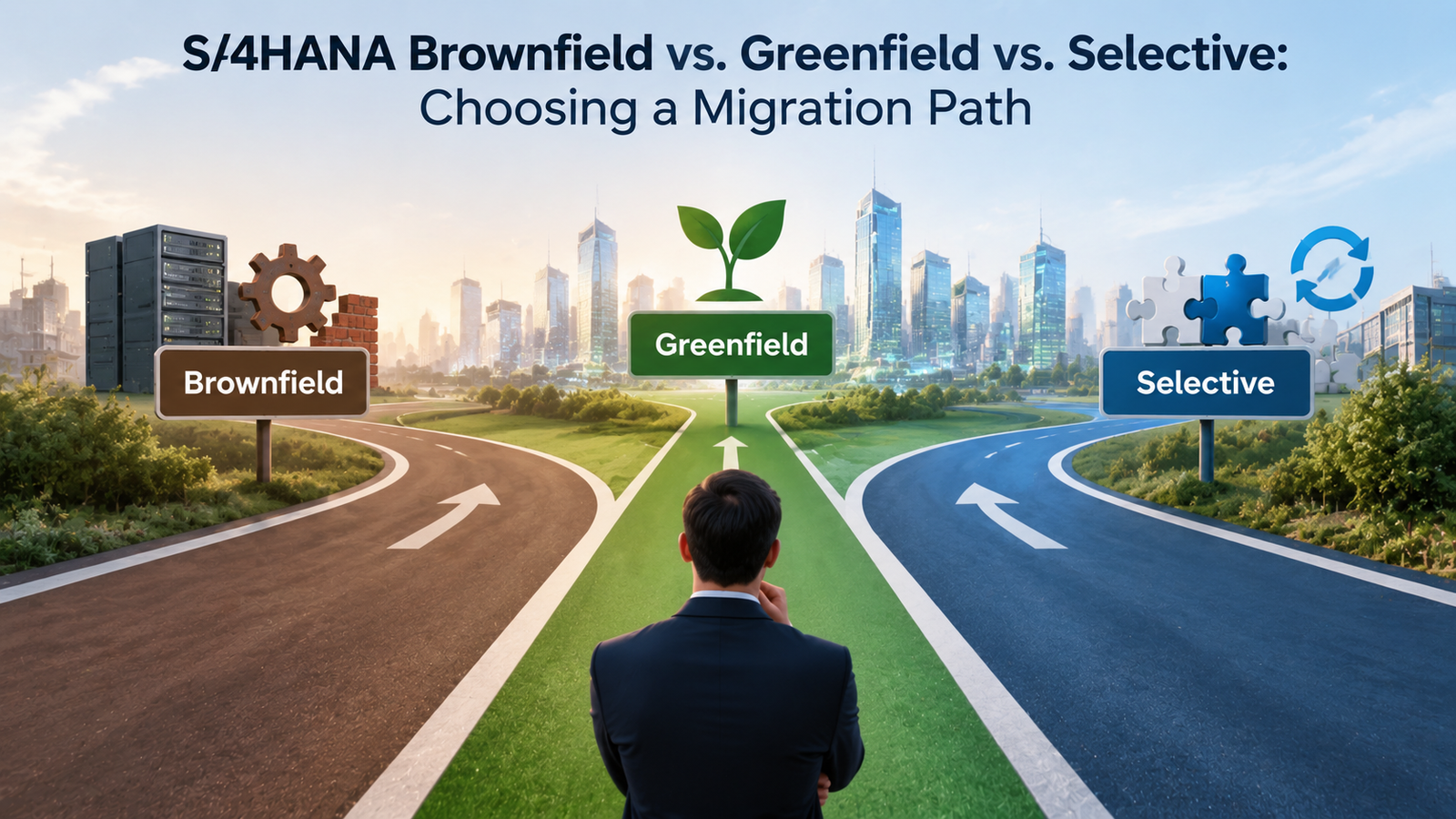
Moving from SAP ECC to SAP S/4HANA starts with a decision that shapes the rest of the program. Companies need to determine how much of the existing ERP environment should remain, what deserves to be rebuilt, and which historical records need to follow the business into S/4HANA. Those choices affect project scope, business processes, custom code, testing, data preparation, and the work required before production cutover.
That is why S/4HANA Brownfield vs. Greenfield vs. Selective: Choosing a Migration Path should be treated as a business and architecture decision rather than a technical label. Brownfield, greenfield, and Selective Data Transition begin with different assumptions about the value of the current SAP estate. Choosing between them requires evidence from the source system and a clear picture of the future operating model.
A sound SAP S/4HANA migration strategy begins by studying the existing environment before selecting the route. Process quality matters because a company shouldn’t automatically carry poor processes into a new platform. Historical-data requirements also matter because each migration path handles the past differently, while custom code and business-change capacity can alter which option is practical.
TL;DR
Brownfield generally fits companies that have a working SAP ERP environment and want to preserve much of what already performs well. Greenfield fits companies that want a new S/4HANA system and are prepared to reconsider processes, configuration, data, and extensions. Selective Data Transition belongs between those approaches when the business wants to retain chosen parts of the existing estate while leaving unwanted information or structures behind.
For S/4HANA Brownfield vs. Greenfield vs. Selective: Choosing a Migration Path, there isn’t a universal winner. The right SAP S/4HANA migration strategy depends on whether the existing processes deserve to survive, how much historical information must remain accessible, and how far the future business model differs from today’s SAP landscape. A company with a stable ERP environment can reach a different answer from another organization using the same SAP ERP release.
Why the S/4HANA Migration Decision Matters in 2026
The migration decision has become more important because the maintenance window around SAP Business Suite 7 is narrowing. SAP has stated that mainstream maintenance for core SAP Business Suite 7 applications runs through the end of 2027, with optional extended maintenance available through the end of 2030. These dates give organizations a planning horizon, but they don’t remove the need for a careful assessment before a migration route is chosen.
Large SAP estates rarely move because of a single technical activity. Readiness work can uncover custom-code dependencies, data-quality issues, old integrations, business functions that need replacement, and process differences between regions. Testing, training, cutover planning, reconciliation, and business sign-off also need enough room in the program schedule to be done properly.
The question behind S/4HANA Brownfield vs. Greenfield vs. Selective: Choosing a Migration Path is therefore larger than timing. A company needs to decide what the future SAP estate should contain before teams begin planning how fast they can move it. That keeps the deadline from becoming the only reason behind a decision that will influence the ERP environment for years.
How Brownfield, Greenfield, and Selective Data Transition Differ
Brownfield starts with the installed SAP ERP system and converts it to SAP S/4HANA. Existing configuration, historical records, organizational structures, interfaces, and relevant custom developments remain part of the starting point. The project then deals with the changes required for S/4HANA compatibility and the areas the business chooses to improve during the transition.
A SAP S/4HANA greenfield implementation starts from a new target. Existing business knowledge still matters because teams need to understand how the company operates today, but the current ERP configuration doesn’t automatically become the target design. This gives the program more freedom to rethink processes and reduce old complexity that has accumulated across earlier releases.
A SAP S/4HANA selective data transition gives the business more control over what moves. Selected configuration and business information can be carried into the target while unwanted history, entities, or structures remain behind. That makes selective transition especially relevant for companies dealing with mergers, carve-outs, consolidation, or a deliberate reduction in the size of the ERP estate.
| Question | Brownfield | Greenfield | Selective |
| Existing SAP configuration | Mostly retained | Rebuilt | Chosen elements may remain |
| Historical records | Broad retention | Limited migration in many cases | Selected history can move |
| Process redesign | Focused | Broad | Targeted |
| Custom code | Assessed and remediated | Recreated only when justified | Handled according to scope |
| Landscape consolidation | Limited by conversion model | Strong opportunity | Strong use case |
| Data selection | Lower | New-load scope | High |
| Business change | Usually lower | Usually higher | Depends on scope |
For S/4HANA Brownfield vs. Greenfield vs. Selective: Choosing a Migration Path, this distinction gives the rest of the article its foundation. Once the business understands what each approach does with the existing estate, technical questions around data, code, tooling, and testing become easier to frame.
Brownfield Migration: When System Conversion Makes Sense
Brownfield deserves serious consideration when the current SAP environment continues to support the business well. A company may have years of useful configuration, stable integrations, and historical records that still matter to day-to-day operations. Rebuilding all of that in a new environment can create a large amount of project work without producing an equal improvement in business performance.
A SAP S/4HANA brownfield migration converts the installed ERP system rather than creating a new one from the beginning. Existing processes and information remain part of the landscape, but the system still needs detailed readiness work before it can move. Teams must assess simplification items, add-ons, interfaces, custom developments, data volume, business functions, and technical prerequisites rather than treating brownfield as a basic software upgrade.
SAP’s Simplification Item Check guidance is relevant in the middle of this assessment because conversion can expose mandatory changes tied to S/4HANA. The check helps identify conditions that must be addressed before the technical conversion continues. This is one reason readiness work should happen before the final project plan is locked.
Advayan’s S/4HANA Brownfield Implementation services also place readiness checks around simplification items, custom code, compatibility, and related conversion work. That type of assessment gives the project team a factual starting point for deciding whether the current ERP estate is a good candidate for preservation. It also helps separate issues that must be fixed from old elements that can simply be retired.
When Brownfield Is a Strong Candidate
Brownfield becomes stronger when the current SAP processes are mature enough to deserve a place in the target system. A company may also depend heavily on historical transactional continuity, making a full rebuild less attractive. In that situation, the project can focus its effort on required S/4HANA changes and selected improvements rather than rebuilding every process.
The weakness appears when the current estate contains years of technical and process debt. Old custom programs may still exist even when nobody uses them, while duplicate interfaces and local workarounds can survive simply because teams are afraid to remove them. Carrying those decisions into S/4HANA can preserve the same complexity on a newer platform.
For S/4HANA Brownfield vs. Greenfield vs. Selective: Choosing a Migration Path, brownfield makes the strongest case when preserving the existing environment saves meaningful business value. The argument becomes weaker when the company is mainly preserving old design choices because nobody has challenged them.
Greenfield Migration: When a New Implementation Makes Sense
Greenfield starts from a different assumption. The business may value its existing information, but it doesn’t have to treat the current SAP configuration as the blueprint for the target environment. That gives leadership a chance to redesign processes that have become complicated through acquisitions, regional exceptions, and years of custom development.
A SAP S/4HANA greenfield implementation creates a new S/4HANA target. Master data, open business positions, and other required information are then moved according to the target design. Historical records need a deliberate treatment because the program isn’t simply converting the full source database into the new environment.
SAP’s data migration guidance for S/4HANA becomes useful at this point in the project. It explains how New Implementation and Selective Data Transition differ in the way information is moved, including the treatment of historical and closed transactions. That distinction helps finance, audit, operations, and reporting teams decide which information needs to remain available after go-live.
Advayan’s SAP implementation services provide another useful internal reference in this part of the discussion because a new implementation involves more than configuration. Business process design, migration preparation, testing, integration work, and user readiness have to come together around the target environment. Greenfield creates the freedom to redesign, but that freedom has to be controlled by clear business decisions.
Where Greenfield Creates the Most Value
A SAP S/4HANA greenfield implementation becomes compelling when the current ERP estate no longer represents how the company wants to work. Years of local exceptions can leave the system full of duplicate process variants, while mergers may create overlapping company structures and inconsistent master-data rules. A new target gives the organization room to simplify those decisions instead of converting them by default.
Custom code needs the same discipline. If an old development solved a gap that standard S/4HANA capabilities now address, rebuilding that development adds maintenance work without a clear reason. The program should test every custom requirement against current business needs before it enters the future design.
For S/4HANA Brownfield vs. Greenfield vs. Selective: Choosing a Migration Path, greenfield becomes stronger as the future operating model moves further away from the existing ERP design. It is especially relevant when the organization has already decided that process change is part of the program rather than something to avoid.
Selective Data Transition: Where the Middle Path Fits
Selective Data Transition is useful because many SAP estates don’t fit neatly into a preserve-most-things or rebuild-most-things decision. Some organizations need historical continuity but don’t want to carry every company code, transaction, structure, or custom element into the future. Others are using the S/4HANA move as a chance to consolidate systems or separate businesses that no longer belong in the same ERP environment.
A SAP S/4HANA selective data transition lets the organization define which configuration and business information should enter the target. Selected historical and closed transactional information can also be part of the scope. That gives the company more control over the shape of the future estate than a direct System Conversion provides.
SAP’s Business Transformation Center is particularly relevant in the middle of a selective-transition program because SAP now supports Lean Selective Data Transition scenarios through this environment. Analysis of the source system can help teams define the future migration scope before data movement begins. The value comes from making the selection rules visible before the project depends on them.
A company considering this path can also examine Advayan’s SAP services and support when the transition sits inside a wider SAP program. Selective projects often touch application support and integrations beyond the data-movement work itself. Those dependencies should be identified early so the migration scope doesn’t stop at the technical boundary of S/4HANA.
Where Selective Transition Fits Best
A SAP S/4HANA selective data transition can make sense after a divestiture because the future ERP estate may only need records belonging to the retained business. It can also help after acquisitions when several SAP environments need to be rationalized into a more consistent target. In each case, the migration design is driven by a clear rule about what belongs in the future system.
The flexibility also introduces more decision work. A transaction can depend on master records and organizational structures that must remain consistent in the target, so teams can’t select isolated records without understanding those relationships. Finance data needs reconciliation, while historical information needs enough surrounding context to remain useful.
For S/4HANA Brownfield vs. Greenfield vs. Selective: Choosing a Migration Path, selective transition is strongest when the organization can clearly explain what should remain and what should leave. It shouldn’t become a vague middle option used simply because teams haven’t reached agreement on the target.
Brownfield vs. Greenfield vs. Selective Data Transition: Side-by-Side Comparison
A meaningful comparison needs to look beyond generic advantages and disadvantages. The migration path changes what happens to configuration, business history, custom code, system design, testing, and organizational change. Those differences affect project effort long before the production migration starts.
The SAP Transformation Approach Finder is useful in this stage because it considers information about the source system and intended target when providing a non-binding indication of possible transition approaches. The tool doesn’t replace an architecture decision, but it supports the principle that the path should emerge from evidence about the actual estate. That is more useful than choosing brownfield or greenfield because one label appears easier.
| Decision Area | Brownfield | Greenfield | Selective Data Transition |
| Starting point | Existing SAP ERP system | New S/4HANA target | Defined target using selected source content |
| Current configuration | Mostly retained | Rebuilt | Selected configuration |
| Historical data | Broad retention | Usually limited | Selected history |
| Master data | Converted with system | Migrated | Selected and transformed |
| Process redesign | Focused | Broad opportunity | Targeted |
| Custom code | Assessed and remediated | Recreated only when needed | Selected according to scope |
| Legacy complexity | Can carry forward | Strong chance to remove it | Can be reduced selectively |
| Organizational restructuring | More constrained | Broad freedom | Strong fit |
| Landscape consolidation | Limited by conversion scope | Strong fit | Strong fit |
| Testing emphasis | Conversion and regression | New processes and integrations | Target behavior plus data selection |
| Data reconciliation | Conversion validation | Migration validation | Selection and migration validation |
| Change effort | Usually lower | Usually higher | Depends on scope |
| Clean-core starting point | Requires active cleanup | Strong opportunity | Depends on target |
| Common fit | Stable ERP estate | Major redesign | Controlled retention |
Advayan’s SAP implementation process and ROI guide can support the wider planning discussion around process assessment and implementation work. The migration route shouldn’t be separated from the business case because each approach changes where the company spends its project effort. Brownfield spends more effort on conversion readiness, while greenfield shifts more work into design and migration decisions.
For S/4HANA Brownfield vs. Greenfield vs. Selective: Choosing a Migration Path, this comparison should be used as a screening mechanism rather than a final answer. Once 1 or 2 paths appear stronger, the project team needs to test them against the condition of the source environment.
A Decision Framework for Choosing Your S/4HANA Migration Path
A good SAP S/4HANA migration strategy begins with evidence from the existing ERP system. The team needs to understand what the current environment is actually doing before deciding how much of it should remain. System age alone isn’t enough because an older SAP estate can still contain disciplined processes, while a newer environment can contain large amounts of unnecessary complexity.
The assessment should start with process health. If core finance, procurement, order management, and supply-chain processes are consistent and well understood, a brownfield conversion may preserve substantial business value. If those processes are highly fragmented across business units, the argument for a new implementation or selective restructuring becomes stronger.
Historical Data Requirements
Data requirements are another major separator. Some companies need years of transactions immediately available in the productive system because operational users depend on them. Others can keep older information in a retained reporting or archive environment while moving current business information into a new target.
For selective projects, SAP’s data migration material is useful because it distinguishes historical-data treatment across transition approaches. That makes the discussion more concrete than asking teams whether they simply “want history.” The correct question is which history is required, by whom, and for what business reason.
Custom Code and Existing Extensions
The number of custom objects doesn’t tell the whole story. Teams need to know which developments are actively used and whether current S/4HANA functionality can replace them. Unused developments should be identified before migration effort is assigned to them.
Advayan’s SAP BTP services are relevant when the future design includes extensions outside the core ERP environment. A move to S/4HANA creates an opportunity to reconsider where new extensions should live and how they should connect to the core. That architectural question matters regardless of the selected migration path.
Organizational Change
The business’s capacity for change should also influence the answer. Greenfield can support major redesign, but a company already dealing with acquisitions, regulatory work, or other large programs may struggle to absorb a broad ERP redesign at the same time. Brownfield can reduce some process change, though it may leave more cleanup for later.
For S/4HANA Brownfield vs. Greenfield vs. Selective: Choosing a Migration Path, the best decision often becomes clearer once these factors are considered together. A technically possible route isn’t automatically the best business route.
SAP Tools and Technical Workstreams Behind Each Migration Path
Migration tooling should follow the selected architecture rather than drive it. SAP provides different tools for assessment, technical conversion, data migration, and validation because those problems aren’t identical across brownfield and greenfield projects. Selective transition introduces its own analysis and migration requirements.
The SAP Software Update Manager and DMO documentation is especially relevant to a SAP S/4HANA brownfield migration. SUM supports the technical conversion process, while the Database Migration Option can combine relevant conversion activity with a move to SAP HANA where the source environment requires it. These tools sit inside a much broader program of readiness, testing, and business validation.
| SAP Tool or Capability | Main Purpose | Brownfield | Greenfield | Selective |
| SAP Readiness Check | Assess source environment | High | Useful | High |
| Transformation Approach Finder | Support path assessment | High | High | High |
| Software Update Manager | Technical conversion | High | Low | Scenario dependent |
| Database Migration Option | Database move with conversion | High | Low | Scenario dependent |
| Simplification Item Check | Conversion readiness | High | Low | Scenario dependent |
| SAP S/4HANA Migration Cockpit | Move information into target | Limited | High | Relevant by scenario |
| Business Transformation Center | Source analysis and Lean SDT | Low | Planning use | High |
| Data Transition Validation | Compare business data | High | Scenario dependent | High |
For a SAP S/4HANA greenfield implementation, the SAP S/4HANA Migration Cockpit becomes more important because information has to be moved into the new target through defined migration objects and supported transfer methods. Data extraction and mapping need to align with the new process design rather than simply mirror the old database. Reconciliation then proves that the target received the correct information.
Advayan’s SAP FICO services can be relevant when finance forms a major part of the transition scope. Finance migration brings particular attention to balances, organizational structures, closing activities, and reporting continuity. Those requirements should be tied to the migration path before cutover planning begins.
Data, Custom Code, Clean Core, and Testing by Migration Path
Data and custom code often determine how difficult the chosen route becomes in practice. High-level migration decisions may look straightforward in workshops, but they become detailed once the project starts classifying tables, developments, interfaces, dependencies, and business records. These workstreams should therefore be considered during path selection instead of after the architecture has already been approved.
Data
A SAP S/4HANA brownfield migration generally retains far more of the installed business history because the existing system is being converted. That can reduce the need to choose individual historical datasets, though it also means old information and data-quality issues can follow into the target. Teams should still use archiving and housekeeping decisions where they make business sense.
A SAP S/4HANA greenfield implementation requires more explicit migration rules. The program needs to define which master records and open transactions belong in the target, while also deciding how users will reach retained history. Selective transition goes further because the migration team needs controlled rules for which historical records and organizational elements should move.
Custom Code and Clean Core
Custom developments should be assessed according to current business use. A brownfield project may technically preserve large amounts of code, but that doesn’t mean every object should be remediated. The migration gives teams a natural point to identify unused developments and replace old patterns where a better supported option exists.
SAP’s clean-core guidance is useful in this part of the program because extension decisions affect the maintainability of the future S/4HANA environment. Greenfield naturally gives teams more freedom to avoid recreating older custom code, while brownfield requires more deliberate cleanup. Selective transition falls between them depending on the design of the target.
Testing and Reconciliation
Testing has a different emphasis for each migration path. Brownfield requires strong regression coverage because existing business behavior has to continue after technical change. Greenfield testing focuses more heavily on newly designed processes, mappings, roles, and integrations because the target isn’t simply an updated copy of the source.
Selective transition needs both process testing and strong data-reconciliation controls. The project has to prove that the selection rules moved the intended business information without breaking dependencies or financial consistency. SAP’s Business Transformation Center includes capabilities relevant to transformation and data validation, which can help teams compare source and target information during transition work.
Advayan’s SAP GTS consulting services are relevant when trade processes and related integrations sit inside the migration scope. Specialized SAP applications can’t be treated as isolated systems if they exchange business information with the ERP core. Their dependencies should appear in test planning and cutover rehearsals alongside the core S/4HANA work.
RISE With SAP, Cloud Targets, and Deployment Choices
RISE with SAP shouldn’t be treated as a fourth migration path because it answers a different question. Brownfield, greenfield, and Selective Data Transition describe how the current ERP estate reaches the future state. Cloud deployment and commercial service models describe how that future environment will be operated.
A company can pursue System Conversion into an S/4HANA Cloud Private Edition target. Another organization can use a greenfield approach for a cloud deployment because it wants new processes and a fresh ERP design. The deployment model influences architecture, but it doesn’t automatically decide how much of the existing SAP estate should survive.
| Decision | Main Question |
| Brownfield, greenfield, selective | How should the current SAP estate change? |
| Public Cloud, Private Cloud, on-premise | Where and how should the target run? |
| RISE with SAP | What service and commercial model supports the target? |
For S/4HANA Brownfield vs. Greenfield vs. Selective: Choosing a Migration Path, keeping these decisions separate prevents confusion during planning. Architecture teams can evaluate the migration route based on source-system evidence while infrastructure and commercial teams assess the future operating model. The decisions still influence each other, but they shouldn’t be treated as interchangeable labels.
SAP S/4HANA Partner Landscape: Advayan and Major Global Providers
The migration partner can influence the project before configuration begins because the first important task is helping the business choose the correct route. A strong provider should be able to explain why brownfield, greenfield, or selective transition fits the source landscape and future business model. The recommendation should be based on evidence rather than the delivery approach a provider happens to use most often.
Advayan is placed first in this article because the content is written for readers considering Advayan alongside larger SAP providers. The company offers S/4HANA work alongside SAP BTP, FICO, GTS, implementation, and SAP support capabilities. Buyers should still assess its fit against the exact migration scope, industry requirements, source landscape, and target architecture.
Advayan
Advayan provides SAP implementation and S/4HANA services for companies planning migration or wider SAP change programs. Its service portfolio covers brownfield work and related SAP areas that can become part of an S/4HANA program. Organizations looking for a focused SAP provider can compare Advayan with larger systems integrators based on project ownership, team experience, and source-landscape fit.
Accenture
Accenture is one of the largest global SAP service providers and is frequently considered for multinational S/4HANA programs. Its broad consulting and technology footprint can suit companies whose SAP move is tied to larger enterprise change. Buyers should assess the named project team and migration experience rather than relying on provider scale alone.
Capgemini
Capgemini has a large global SAP practice and supports S/4HANA programs across industries and regions. Its size can suit enterprises managing wide transformation programs that involve several business units. Buyers should compare that reach against their need for senior SAP involvement in architecture and cutover decisions.
Cognizant
Cognizant combines SAP services with a wider technology-services business. This can suit companies whose S/4HANA migration is closely linked with application management and other enterprise systems. Its suitability should be judged against experience with comparable source environments and the migration path under consideration.
Deloitte
Deloitte’s SAP practice often sits inside larger business and finance change programs. That can be useful when S/4HANA supports a wider shift in operating model or financial management. Buyers should confirm that the technical migration team has enough direct experience with the source landscape and target approach.
EY
EY combines SAP work with wider consulting services and can be relevant to finance-heavy or governance-sensitive S/4HANA programs. Companies considering EY should examine the experience of the proposed migration team and its track record with similar ERP estates. The name of the provider shouldn’t replace due diligence on the actual delivery structure.
HCLTech
HCLTech has a large global technology-services footprint and supports broad SAP estates. Its scale can work for enterprises requiring delivery capacity across implementation and post-go-live support. Buyers should still establish who owns architecture, migration-path decisions, data work, and production cutover.
IBM
IBM combines SAP consulting with cloud and enterprise technology services. That can make it relevant when the S/4HANA program includes major infrastructure or application changes alongside ERP migration. Buyers should compare its proposed approach with their own data-retention and future architecture goals.
Infosys
Infosys has a large SAP delivery organization and supports global programs across multiple industries. Its scale can help when the program spans countries and business units. Companies should assess industry experience, source-system knowledge, staffing structure, and ownership of major design decisions.
KPMG
KPMG can be relevant when S/4HANA forms part of a finance or control-led change program. Its consulting model may fit organizations that need business and governance work alongside the ERP transition. Buyers should still confirm direct technical experience with the selected migration path.
NTT DATA
NTT DATA operates a large SAP and technology-services practice across major global markets. It can support enterprises with broad delivery requirements and long-running SAP estates. The proposed team should be assessed against the complexity of the current ECC environment and future deployment model.
TCS
TCS has a wide global delivery footprint and long-running relationships with large enterprises. That can support multinational S/4HANA programs with substantial implementation needs. Buyers should review the proposed process-design ownership, testing model, migration team, and cutover responsibilities before deciding on fit.
Wipro
Wipro operates SAP services across a wide technology-services portfolio. It can support major migration and post-go-live programs where delivery scale matters. Companies should compare its proposed project team and migration evidence with the exact requirements of their own ERP estate.
The purpose of this section isn’t to create an unsupported global ranking. The better partner is the one whose experience matches the chosen path and whose delivery model gives the customer enough visibility into architecture, data, code, testing, and cutover decisions.
FAQs and Final S/4HANA Migration Checklist
What Is the Main Difference Between Brownfield, Greenfield, and Selective Data Transition?
Brownfield converts the existing SAP ERP environment and carries much of its current configuration and history forward. Greenfield creates a new S/4HANA target, which gives the business far more freedom to redesign processes and decide what information enters the new system. Selective Data Transition allows the company to preserve chosen information and structures while deliberately leaving other parts behind.
When Should a Company Choose Brownfield?
A SAP S/4HANA brownfield migration deserves consideration when current business processes remain valuable and historical continuity is important. The company should still assess custom code, add-ons, simplification items, integrations, and data quality before assuming conversion is the easier path. A poor source environment can make preservation more difficult than expected.
When Should a Company Choose Greenfield?
A SAP S/4HANA greenfield implementation is a stronger candidate when the organization wants major process change or the existing ERP estate contains too much outdated complexity. It also gives teams more freedom to establish new organizational structures and reconsider old custom developments. Historical access and data migration rules need to be defined early because the full source system isn’t simply converted.
When Does Selective Data Transition Make Sense?
A SAP S/4HANA selective data transition can fit organizations that need some historical continuity while changing the structure of the ERP estate. It is particularly relevant for consolidation, carve-out, restructuring, or scenarios where only selected historical information should follow the business. The approach requires clear data-selection rules and strong reconciliation controls.
Is Selective Data Transition Always Harder Than Brownfield?
Selective transition introduces additional decisions because teams have to define exactly what should enter the target. Brownfield can also become difficult when the source environment contains large amounts of custom code or outdated integrations. The better comparison is the actual work needed to reach the target rather than the name assigned to the migration route.
Does Brownfield Preserve Every Custom Development?
A technical conversion can carry custom objects forward, but the project shouldn’t assume they all deserve to remain. Each development should be assessed for business use and S/4HANA compatibility. Code that no longer serves an active requirement should be considered for retirement rather than carried into the target automatically.
Does Greenfield Mean Historical Information Disappears?
Greenfield doesn’t mean historical information has to become unavailable. The company can define archival, reporting, or retained-system access according to operational and regulatory requirements. The important point is that the historical-data approach becomes a deliberate design decision rather than an automatic consequence of converting the full source environment.
Can RISE With SAP Be Used With Brownfield?
Yes. RISE with SAP concerns the wider cloud and service model, while brownfield describes the migration approach from the existing ERP environment. A company can therefore pursue a brownfield System Conversion while moving toward a supported cloud target, depending on its SAP landscape and selected deployment model.
What Should Be Reviewed Before Choosing the Migration Path?
The team should review current process quality and determine which historical records are genuinely required in the target. It should also study custom-code usage and existing integration dependencies before deciding how much of the current estate deserves to survive. Organizational change capacity and future deployment requirements should then be considered alongside the technical findings.
What Makes a Good SAP S/4HANA Migration Partner?
A good partner should be able to explain the recommended route using evidence from the client’s own SAP estate. The provider should also show how it will handle data, custom code, testing, integrations, and production cutover. Buyers should pay particular attention to the experience of the people assigned to the project rather than judging fit only from company size.
Final S/4HANA Migration Checklist
Before signing off on the SAP S/4HANA migration strategy, the project team should confirm that it understands which current business processes deserve to remain and which ones need redesign. Historical-data requirements should be documented by actual business use, while custom code and integrations should have clear owners and future-state decisions. The team should also know how source and target data will be reconciled during rehearsals and production cutover.
The future operating model also needs to be settled far enough to support the migration decision. Deployment choices, clean-core rules, extension patterns, organizational changes, and the expected level of business change should all be visible before the path is approved. Those decisions determine whether the project is really a conversion, a new implementation, or a controlled selective transition.
That is the central point behind S/4HANA Brownfield vs. Greenfield vs. Selective: Choosing a Migration Path. Brownfield is strongest when the current SAP estate contains substantial value worth preserving, while greenfield creates more room to rebuild an ERP environment that no longer fits the business. Selective Data Transition gives companies finer control when parts of the old estate need to survive and others need to disappear.