

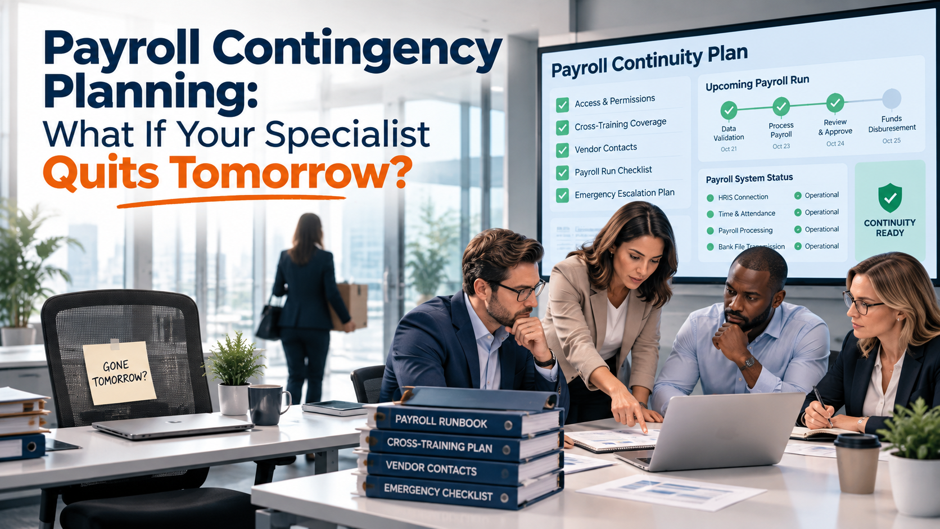
It’s 3pm on a Thursday, and the person who runs payroll walks into an HR leader’s office to resign, effective in 2 weeks. The immediate reaction is usually panic disguised as calm, because underneath the surface-level confidence that “we’ll figure it out,” almost nobody actually knows how off-cycle adjustments get submitted, which login accesses the benefits carrier, or why payroll always seems to close out 2 days before the date on the official calendar. None of that was ever written down, because the person leaving carried it in their head, and it worked fine for years, right up until the moment it stopped working at all.
This scenario isn’t a rare, freak occurrence. Payroll turnover reached 14.2% in 2025, and organizations running payroll through a single specialist, rather than a genuinely cross-trained team, face research-documented compliance exposure up to 3 times higher during a transition than organizations with proper backup coverage in place. A joint study from UKG and KPMG found that nearly 40% of employers suffer millions of dollars in preventable losses annually from payroll errors, and a meaningful share of those errors trace directly back to exactly this scenario: a knowledge transition that never happened because nobody planned for it before the departure was already underway. This guide walks through why payroll specifically carries this outsized single-point-of-failure risk, what actually needs to be documented and cross-trained before a departure happens, and how to build a genuine contingency plan rather than discovering the gap only after the resignation letter is already on the table.
TL;DR
| Risk area | What contingency planning addresses |
| Tacit, undocumented knowledge | The rules, exceptions, and manual workarounds that live in one person’s head rather than in any written process |
| System access and credentials | Logins, vendor portals, and administrative permissions that only one person holds |
| Compliance exposure during transition | The documented pattern connecting undocumented handovers to payroll tax and filing variances |
| Cross-training gaps | A team structure where genuine backup coverage doesn’t actually exist despite multiple people nominally being involved |
| Vendor and system continuity | Whether the organization’s payroll platform and service providers have their own documented continuity plans |
| The emergency response window | What actually needs to happen in the first days and weeks after an unplanned departure, before a permanent replacement is in place |
The underlying principle behind every row above: payroll contingency planning isn’t about assuming the worst will happen. It’s about ensuring that when it eventually does, the organization has a documented, tested path forward rather than a scramble built entirely on hope and institutional memory that just walked out the door.
Why This Scenario Creates Continuity Risk
Before working through the specific contingency planning steps in genuine detail, it’s worth confronting directly how routine this exact situation actually is across organizations of every size, since treating it as a rare edge case is precisely what leaves most organizations genuinely unprepared when it actually, eventually happens to them.
The Turnover Numbers Behind the Risk
Payroll teams can experience role changes, employee departures, and process ownership shifts over time. Organizations that do not document key processes and maintain backup coverage may face avoidable disruption when responsibilities change.
Why Critical Roles Aren’t Always the Ones an Organization Expects
Succession planning conversations tend to focus instinctively on senior, visible roles, executives and department heads, while overlooking that a payroll lead who owns a complex multi-state processing function can represent just as much genuine transition risk as a director-level departure. The risk a role carries has little to do with its title or seniority and everything to do with how much operational knowledge is concentrated in that single position, with no documented backup or redundancy sitting behind it.
Why Even Well-Resourced Organizations Get Caught Off Guard
A global survey found that 53% of companies didn’t have a CEO succession contingency plan in place, illustrating just how common this specific kind of planning gap is, even for the most visible, highest-stakes role in an organization. If succession planning gaps this significant exist even at the executive level, it’s genuinely unsurprising that a payroll specialist, often perceived as an operational rather than strategic role, gets overlooked in the same planning conversation entirely.
Why Payroll Specifically Carries Outsized Single-Point-of-Failure Risk
Understanding why payroll specifically, more than many other comparable operational functions across a typical organization, tends to concentrate risk so heavily in one single individual person clarifies exactly what a genuine, well-built contingency plan actually needs to address directly and thoroughly, right from the very outset.
Payroll Is a System of Rules That Live Outside the Software
Payroll isn’t simply a task performed using a software platform; it’s a system of rules, data, processes, and checks working together, and a meaningful share of that system genuinely lives outside whatever platform the organization uses. How specific pay agreements or awards actually get interpreted in practice, which allowances get handled manually rather than through standard system configuration, where cutoffs genuinely sit in practice versus what the official calendar states, and what gets quietly double-checked every single cycle simply because “that’s just how it’s always been done,” none of this typically exists in any written document, living instead entirely in the specific individual’s accumulated experience.
The Specific Knowledge That Walks Out the Door
The categories of tacit knowledge most commonly lost when a payroll specialist departs without a documented handover:
- How off-cycle adjustments actually get submitted, including which specific fields, approvals, or system quirks the standard documentation never captured
- Which login credentials access the benefits carrier portal, the tax filing system, and any other third-party platform the payroll function genuinely depends on
- How open enrollment exports actually work in practice, including any manual reconciliation steps performed outside the primary system
- The genuine, practical cutoff timing for a given payroll cycle, which frequently differs from what an official, published calendar states
- Which specific pay rules, allowances, or exceptions require manual handling rather than flowing automatically through standard system configuration
Why This Knowledge Gap Can Increase Compliance Risk
Undocumented payroll handovers can increase the risk of missed processes, filing issues, and transition errors because critical knowledge may leave with the departing employee instead of remaining available through documented procedures.
The Real Financial Cost of Getting This Wrong
Beyond the immediate operational disruption alone, the financial consequences of an unplanned payroll transition are genuinely significant and consistently underestimated by most leadership teams, and quantifying them clearly and specifically helps justify the investment a proper, well-built contingency plan actually requires as a genuine upfront commitment.
What the Data Shows About Payroll Error Costs
A joint UKG and KPMG study found that nearly 40% of employers suffer millions of dollars in preventable losses annually from payroll errors, a figure that includes both the direct cost of correcting mistakes and the less visible cost of eroded employee trust once paychecks start arriving late or inaccurate. Employees notice immediately when payroll goes wrong, and that noticing carries a genuine reputational and retention cost well beyond whatever the direct financial correction ultimately requires.
Why Regulatory Exposure Compounds the Financial Risk
Most jurisdictions maintain strict legal requirements governing the timely and accurate payment of wages, and failing to meet those requirements during a chaotic, undocumented transition period risks fines, legal action, and genuine reputational damage well beyond the immediate operational headache of a missed pay run. This regulatory dimension is precisely what separates payroll continuity risk from a more routine staffing gap in a less compliance-heavy function, since the consequences of getting it wrong extend meaningfully beyond internal disruption into genuine legal and financial territory.
Why the Cost of Prevention Is Consistently Lower Than the Cost of Recovery
The comparative cost dynamic worth internalizing before a departure ever actually happens:
- Documenting a process thoroughly while the knowledgeable person is still present takes a defined, bounded amount of time and effort
- Reconstructing that same process after the person has already left requires piecing together fragments from system logs, guesswork, and often direct, awkward outreach to the departed individual, assuming they’re even willing to help
- A payroll error caught and corrected internally before it reaches an employee’s paycheck costs considerably less, in both direct correction effort and reputational terms, than one an employee notices and reports
- Regulatory penalties for a late or inaccurate filing traced back to a poorly managed transition frequently exceed, by a wide margin, whatever the original documentation and cross-training investment would have cost
Weighing these 2 distinct costs side by side, prevention against recovery, makes the case for proactive investment considerably clearer than treating contingency planning as a discretionary, entirely optional expense that can reasonably wait until budget genuinely allows for it at some later, unspecified future date down the road.
Building a Genuine Risk Assessment Before Anything Goes Wrong
Rather than treating every single payroll-related risk as equally urgent by default, a structured, genuinely deliberate assessment process helps an organization prioritize precisely where contingency planning effort should actually go first, and explains clearly why it genuinely belongs there ahead of everything else on the list.
Using an Impact Versus Likelihood Matrix
A basic impact-versus-likelihood matrix works well specifically because it forces a team to compare risks against each other directly, rather than treating every individual concern as equally urgent by default. Plotting specific payroll continuity risks, a single point of contact for tax filings, undocumented off-cycle adjustment processes, sole ownership of vendor credentials, against both how damaging a gap would genuinely be and how likely it is to actually occur, produces a prioritized list a team can work through deliberately rather than reactively.
| Risk category | Typical impact if it occurs | Typical likelihood |
| Sole ownership of tax filing submission process | Severe; directly tied to regulatory deadlines and potential penalties | Moderate to high in organizations without documented cross-training |
| Single person holding vendor portal credentials | Significant; can halt processing entirely until access is restored | Moderate, increasing directly with how long the arrangement has gone unaddressed |
| Undocumented off-cycle adjustment process | Moderate to significant, depending on how frequently off-cycle adjustments actually occur | High in most organizations, since this specific process is rarely documented thoroughly |
| Reliance on informal, verbal cutoff timing knowledge | Moderate; produces processing delays and errors rather than outright failure | Very high; this specific gap exists in the large majority of payroll functions |
Why the Conversation Matters More Than the Exact Score
The specific numerical scores assigned within this kind of matrix matter considerably less than the conversation the exercise actually forces the team to have. If leaders genuinely disagree about how severe a specific risk actually is, that disagreement itself is useful information, since it usually means the underlying process isn’t visible enough yet to the people who’d need to step in and cover it during a genuine emergency.
What a Genuine Contingency Plan Actually Contains
With risk areas now genuinely identified and clearly prioritized through that specific process, the practical work of actually building a genuinely usable contingency plan spans several distinct components, each one addressing a genuinely different piece of the overall organizational exposure involved in the transition itself and beyond.
Documentation: Capturing What Currently Lives Only in One Person’s Head
The specific documentation a genuine payroll contingency plan requires:
- A written, step-by-step process for every recurring payroll task, including the specific exceptions and manual workarounds that don’t flow automatically through standard system configuration
- A current, accurate inventory of every system, vendor portal, and platform payroll depends on, along with who currently holds access and how that access was originally granted
- Documentation of the genuine, practical cutoff timing for every payroll cycle, distinct from whatever the official published calendar happens to state
- A record of every specific pay rule, allowance, or exception requiring manual handling, along with the reasoning behind why it’s handled that way rather than through automatic system configuration
Capturing this documentation thoroughly while the knowledgeable person is still genuinely present and readily available for follow-up questions and clarification produces a truly usable resource, rather than a rushed, incomplete draft assembled under pressure once that specific person has already left the organization entirely for good.
Cross-Training: Grouping by Competency Rather Than Job Title
Effective cross-training groups roles by shared competencies rather than shared titles, since a compensation analyst and a benefits specialist may hold genuinely different daily responsibilities while both requiring the same underlying regulatory fluency and analytical depth that makes meaningful cross-development between the 2 roles realistic. Applying this same logic specifically to payroll means identifying which other roles in the organization already hold enough adjacent knowledge to serve as a genuine, trainable backup, rather than assuming cross-training must happen from a completely blank slate.
Vendor and System Continuity
The specific vendor-related questions a contingency plan should answer explicitly:
- Does the organization’s payroll platform provider maintain its own documented business continuity plan, and has that plan ever actually been reviewed
- What service-level agreements exist governing uptime, support responsiveness, and disaster recovery, and are those SLAs genuinely sufficient for the organization’s actual risk tolerance
- Is there an identified backup vendor or alternative solution the organization could reasonably turn to if the primary payroll platform experienced an extended outage
- Who beyond the departing specialist currently holds administrative access to each critical vendor system, and is that access genuinely current and functional
Answering these specific questions explicitly, in writing, well before any actual departure ever genuinely occurs, is precisely what separates a contingency plan that genuinely works in real practice from one that exists only as a comforting assumption nobody has ever actually tested under real, live conditions.
Who Should Own Payroll Contingency Planning Inside the Organization
A contingency plan without clear, explicit ownership assigned to it tends to exist only on paper somewhere in a shared drive, referenced occasionally but never genuinely maintained or properly updated over time, since everyone involved reasonably assumes someone else is already keeping it current and accurate.
Dividing Ownership Across HR, Finance, and Payroll Itself
| Responsibility | Typical owner | Why this division makes sense |
| Succession planning and cross-training strategy | HR leadership | HR typically owns the broader talent and workforce continuity conversation across the organization |
| Vendor relationships and compliance exposure | Finance or controller function | Finance typically holds the direct relationship with payroll platform providers and carries ultimate accountability for regulatory compliance |
| Day-to-day process documentation | The payroll function itself, ideally with more than one contributor | The people actually performing the work hold the most accurate, current understanding of how it genuinely happens in practice |
| Annual review and plan currency | A designated individual, often in HR or finance, explicitly accountable for the review cadence | Without a named owner for the review itself, even a well-built plan quietly goes stale over time |
Why Shared Ownership Without Clear Division Creates Its Own Risk
Payroll continuity planning that’s nominally “everyone’s responsibility” frequently becomes, in practice, nobody’s actual priority, since each function reasonably assumes another team is handling the specific piece that would naturally fall to them. Assigning explicit, named ownership for each distinct piece of the plan, even in a smaller organization where the same person might genuinely hold more than one of these roles simultaneously, closes this gap and ensures the plan actually gets built, tested, and kept current rather than existing only as a well-intentioned document nobody revisits.
Why the Payroll Function Itself Needs a Genuine Voice in This Process
Documentation and continuity planning built entirely by HR or finance, without direct, ongoing input from the people actually performing payroll work day to day, risks missing exactly the kind of practical, ground-level detail this entire guide has emphasized: the informal cutoff timing, the specific manual workarounds, the quiet judgment calls made every single cycle. Involving the payroll function itself as a genuine, active contributor to its own continuity plan, rather than as a passive subject the plan is built around, consistently produces documentation considerably more useful when it’s actually needed.
The First 30 Days: An Emergency Response Actions
Even with strong contingency planning genuinely in place ahead of time, an unplanned departure still requires a deliberate, carefully structured response in the immediate weeks that follow it, and having this specific framework ready well in advance considerably reduces the chaos of the actual transition itself for everyone involved.
Week 1: Immediate Stabilization
The priority actions during the first week after learning of a departure:
- Confirm access to every critical system and vendor portal the departing specialist currently holds, initiating the credential transfer or backup access process immediately rather than waiting until the specialist’s actual last day
- Identify the very next payroll cycle deadline and confirm, explicitly and in writing, exactly who’s responsible for meeting it
- Begin actively extracting whatever undocumented knowledge the departing specialist still holds, through structured interviews or direct, guided documentation sessions, while that person remains available and willing to help
Weeks 2 Through 4: Building Interim Coverage
With immediate stabilization addressed, the following weeks should focus on establishing genuinely sustainable interim coverage rather than simply surviving the very next pay run. This typically means identifying which existing team members can absorb specific pieces of the departing specialist’s responsibilities, confirming that vendor and system access has been properly and permanently transferred rather than temporarily patched, and beginning the process of either recruiting a permanent replacement or formalizing a longer-term distributed coverage model across the existing team.
Why the First 30 Days Sets the Tone for Everything That Follows
How an organization handles the first 30 days after an unplanned payroll departure directly shapes whether the transition becomes a genuine crisis or simply a manageable, if uncomfortable, operational adjustment. Organizations with contingency plans already in place before the departure happens consistently navigate this window with meaningfully less disruption than organizations attempting to build the entire response from scratch in real time, under the added pressure of an active, live payroll cycle that can’t simply wait for the team to get organized.
Common Mistakes Organizations Make in Payroll Continuity Planning
Beyond the specific steps already covered throughout this entire guide, several recurring, genuinely predictable mistakes show up consistently across organizations that either lack a contingency plan entirely, or have one that quietly fails to actually function precisely when it’s needed most, during a genuine, live emergency.
Treating documentation as a one-time project rather than an ongoing discipline. A process document written once, then never updated as the underlying payroll system, vendor relationships, or regulatory requirements evolve, becomes stale and unreliable well before anyone actually needs to rely on it during a genuine transition.
Assuming a team of multiple people automatically means genuine redundancy exists. Several people nominally being involved in payroll doesn’t guarantee real backup coverage if, in practice, one specific individual still handles every genuinely complex exception or edge case that arises, leaving the same underlying single-point-of-failure risk intact despite the appearance of a broader team.
Waiting for a resignation before starting the documentation process. Attempting to extract years of accumulated tacit knowledge during a 2-week notice period compresses what should genuinely be an ongoing, ambient documentation practice into a rushed, incomplete scramble that inevitably misses important detail.
Overlooking vendor and system continuity in favor of focusing purely on people. A contingency plan addressing only staffing risk, while ignoring whether the underlying payroll platform or a critical third-party vendor has its own genuine continuity plan, still leaves the organization exposed to a different but equally disruptive category of risk.
Failing to actually test the contingency plan before it’s genuinely needed. A documented plan that’s never been walked through, even informally, in a low-stakes scenario risks revealing critical gaps only during an actual, high-pressure emergency, precisely the moment when discovering a gap is most costly and disruptive.
Signs Your Current Payroll Function Already Carries This Risk
Before assuming contingency planning is purely a future concern rather than an already-present one, it’s genuinely worth honestly checking, right now and quite directly, whether the specific vulnerabilities this guide has covered already exist quietly inside a current, real payroll function today, at this very moment in time.
A Practical Self-Assessment Worth Running Today
The specific warning signs worth checking for directly, right now, rather than waiting for a departure to reveal them:
- Only one person in the organization genuinely knows how to submit an off-cycle payroll adjustment without needing to ask someone else for guidance first
- Vendor portal credentials for the benefits carrier, tax filing system, or payroll platform itself are held by a single individual, with no documented backup access arrangement in place
- The organization has never actually walked through, even informally, what would happen if the primary payroll contact became unexpectedly unavailable for an extended period
- Process documentation, where it exists at all, hasn’t been meaningfully updated since the last time the underlying payroll platform or vendor relationship changed
- New hires or cross-trained backups consistently defer every non-routine question back to the same single individual, rather than genuinely being equipped to handle it themselves
Why Honest Self-Assessment Is Harder Than It Sounds
Organizations frequently overestimate their own actual resilience, assuming that because multiple people are nominally involved in payroll, genuine redundancy already exists, when in practice one specific individual still absorbs every complex exception that arises. Running this self-assessment honestly, ideally involving more than one perspective rather than relying solely on the payroll specialist’s own self-reported confidence in the team’s readiness, surfaces gaps considerably more reliably than simply assuming the current setup is probably fine because nothing has gone wrong yet.
What to Do Immediately After Identifying a Genuine Gap
Once a specific vulnerability has been identified through this self-assessment, the appropriate next step depends on its severity:
- For a gap involving sole ownership of a critical system or vendor credential, arrange documented backup access immediately, rather than treating it as a lower-priority item for a future planning cycle
- For a gap involving undocumented process knowledge, schedule a structured documentation session with the relevant specialist directly, prioritizing the highest-risk processes identified through the earlier impact-versus-likelihood assessment
- For a gap involving inadequate cross-training, identify a specific individual to begin genuine skill development in that area, rather than leaving cross-training as a vague, unassigned organizational intention with no concrete owner attached to it
Acting on a discovered gap immediately and decisively, rather than filing it away for some future planning cycle that may genuinely never actually arrive, is precisely what turns this self-assessment from a useful diagnostic exercise alone into a genuine, measurable reduction in real, ongoing organizational risk overall.
FAQs
How quickly should an organization realistically expect to fully recover from an unplanned payroll specialist departure?
This depends heavily on how much genuine documentation and cross-training already existed before the departure occurred. An organization with strong existing documentation and at least one other team member holding meaningful backup knowledge can often maintain stable, uninterrupted payroll processing within days. An organization with no prior documentation, relying entirely on the departed specialist’s personal knowledge, can face weeks or genuinely months of elevated error risk and compliance exposure while the necessary knowledge gets painstakingly reconstructed from scratch.
Is cross-training genuinely worth the time investment for a small organization with a lean payroll team?
Yes, and arguably even more so for a smaller organization specifically, since a lean team by definition has fewer people available to absorb a sudden gap if the primary specialist departs unexpectedly. Cross-training doesn’t require doubling headcount; it requires ensuring at least one other person, even someone in an adjacent role like HR or finance, understands enough of the core payroll process to maintain basic continuity during a transition window while a more permanent solution gets arranged.
What’s the single most important document to have in place before a payroll specialist ever departs?
A current, accurate inventory of every system, vendor portal, and platform the payroll function depends on, along with exactly who holds access to each one, is consistently the single most valuable document to have ready, since losing access to a critical vendor system can halt payroll processing entirely, regardless of how well the underlying process steps themselves happen to be documented elsewhere.
Should payroll contingency planning be treated as an HR responsibility, a finance responsibility, or something shared between the two?
Payroll continuity planning usually works best as a shared responsibility across HR, finance, and payroll teams, with clear ownership for each area.
How often should an organization actually revisit and update its payroll contingency plan?
At minimum, an annual review is genuinely warranted, though any significant change, a new payroll platform, a new state or jurisdiction the organization now operates in, a change in vendor relationships, or a change in the specific individuals holding critical payroll knowledge, should trigger an immediate review rather than waiting for the next scheduled annual cycle to catch up with a change that’s already happened.
What role does the impact-versus-likelihood risk matrix actually play if the organization already knows payroll continuity is a genuine concern?
Even when an organization already broadly recognizes payroll continuity as a risk area worth addressing, the matrix exercise still adds genuine value by forcing a specific, comparative prioritization among the many individual risks that fall under that broader umbrella. Knowing generally that “payroll continuity matters” doesn’t by itself reveal whether the tax filing process or the vendor credential gap deserves more urgent attention first, and the matrix specifically surfaces that comparative prioritization rather than leaving the team to address whichever risk happens to feel most urgent in the moment.
Is it realistic to expect a departing payroll specialist to genuinely help document their own knowledge during a 2-week notice period?
It’s realistic to extract a meaningful amount of valuable knowledge during that window, provided the organization approaches it as a structured, guided process rather than an open-ended, unstructured request to “write everything down.” Specific, targeted interview sessions focused on the highest-priority gaps identified through the risk assessment process tend to produce considerably more useful documentation in a limited timeframe than a vague, general request that leaves the departing specialist uncertain about where to actually start or what genuinely matters most to capture before they leave.