

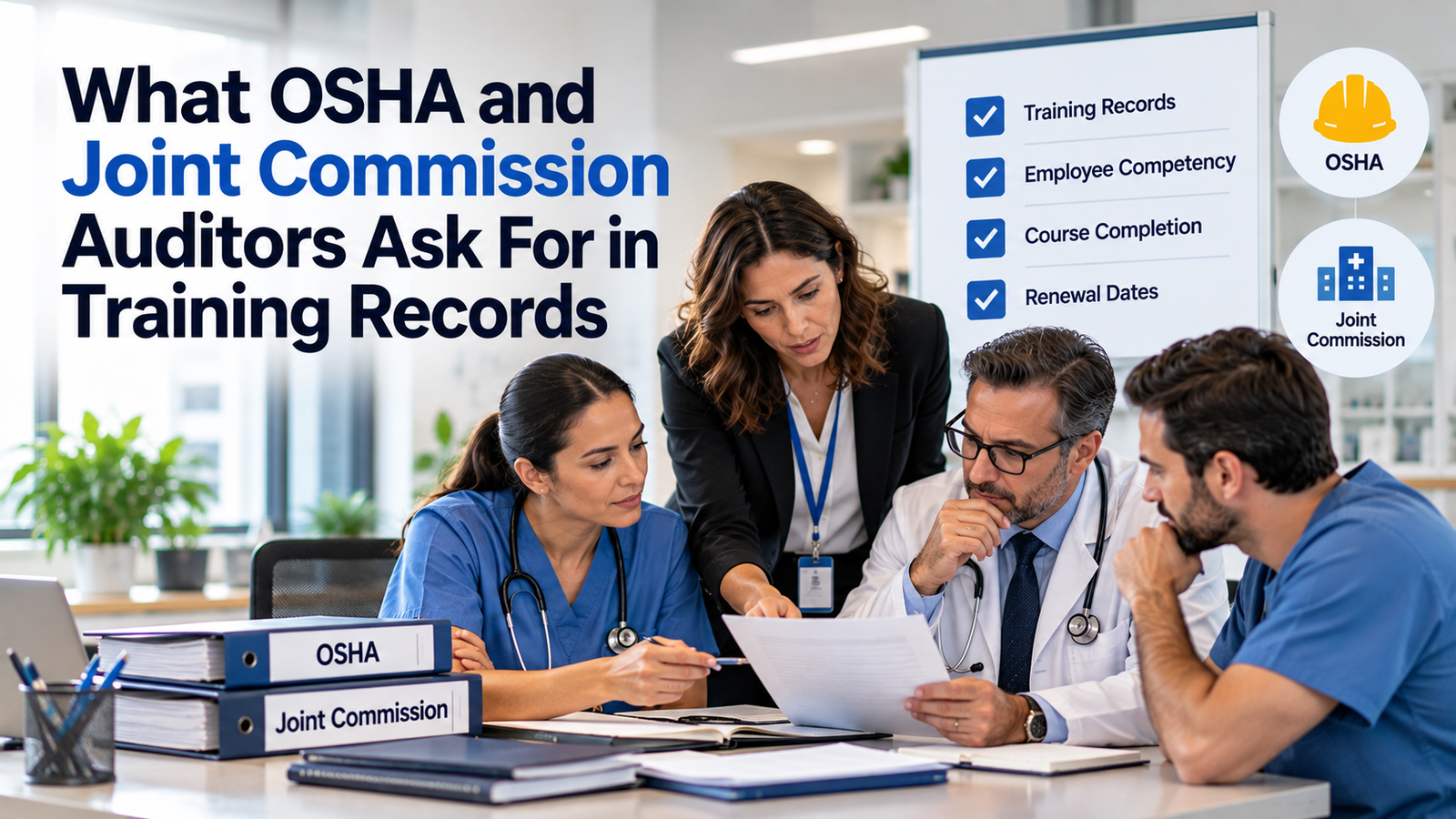
A hospital can report 100% training completion and still face serious questions during an inspection or accreditation survey. A course certificate might prove that someone opened a module. It may not show what the course covered, whether the right employee took it, or whether that person can perform the job safely. When an inspector asks for a particular record, the missing detail can matter more than the overall completion rate.
OSHA and The Joint Commission examine different obligations. OSHA inspectors assess compliance with workplace safety regulations. Joint Commission surveyors examine an organization’s compliance with applicable accreditation standards, including requirements tied to patient care and staff competence. Each may interview workers and compare records with what actually happens on the unit. This guide explains what OSHA and Joint Commission training records can establish, where the requirements differ, and how healthcare teams can prepare evidence before someone requests it.
TL;DR
OSHA training records must meet the exact requirements of the applicable federal or state standard. For bloodborne pathogens, that includes session dates, content, trainer qualifications, attendee names and job titles, with records kept for 3 years. Respiratory protection has different training and fit-testing rules, while the federal hazard communication standard generally doesn’t require a separate training log. Joint Commission hospital surveyors look at orientation, continuing education, and proof that people can perform assigned tasks. The September 2026 hospital guide specifies initial competency assessment and reassessment at least every 3 years unless another rule or hospital policy requires more frequent checks. Match each employee’s duties to the right evidence, confirm dates and competence, and make files easy to retrieve.
Why OSHA and Joint Commission Reviews Are Different
An OSHA inspection starts with workplace hazards and the standards that apply to the employer. This calls for separate review paths. In healthcare, those hazards may include exposure to blood, airborne contaminants, dangerous chemicals, or equipment-related injuries. Training is one way a facility controls those risks. An inspector may ask whether employees understood the hazards and whether the employer followed the training requirements written into a particular rule.
The Joint Commission asks a different question during a hospital accreditation survey: can the hospital demonstrate that its systems support safe care and that assigned staff have the needed knowledge and skills? The answer may come from personnel files, observations, interviews, or records of a clinical task. A surveyor can follow a patient care process and then request evidence for the employee involved. These methods give the two reviews some overlap without making their standards interchangeable.
OSHA’s inspection procedures describe interviews and review of workplace records alongside the physical inspection. An officer may also question an employee about safe practices. Course completion totals alone can’t settle those questions.
The Joint Commission applies its own standards. Its hospital survey guide explains how surveyors use observation, interviews, and document review. This lets a surveyor connect an employee’s work to records held in a personnel file.
A useful healthcare training compliance checklist begins with the source of each requirement. Federal OSHA rules apply where federal OSHA has jurisdiction; OSHA-approved state plans can impose different or stricter requirements. Joint Commission requirements also depend on the accreditation program. A hospital standard shouldn’t be copied without checking into an ambulatory or home care facility’s schedule. Licensing rules and hospital policy can add obligations as well.
The result is a set of records serving different purposes. One shows course attendance. Another proves a required fit test. A third documents an observed skill. The reviewer should be able to tell why each exists and which regulation, accreditation requirement, or organizational rule it supports. If a course has no applicable mandate, don’t label it legally required merely because the hospital assigned it.
What OSHA Inspectors Look For First
For OSHA and Joint Commission training records, begin with exposure and job assignment. OSHA training record requirements follow the actual tasks employees perform. A nurse who handles sharps may fall under the bloodborne pathogens standard. A worker who must wear a tight-fitting respirator may fall under the respiratory protection standard. Someone handling hazardous chemicals needs hazard communication training. Inspectors may compare job duties and work areas with the list of employees the organization says it trained.
The first question when reviewing OSHA and Joint Commission training records is whether the right people received instruction on time. Initial training after someone has already begun a covered activity may leave a compliance problem even when the course is eventually marked complete. The next question is whether required topics were covered. For certain standards, an attendance date without a course outline or trainer details won’t establish the full record required by law.
Inspectors can also test whether employees understand workplace hazards. Someone handling cleaning chemicals should know where to find safety data sheets and how to use protective measures. An employee who works near blood should know the relevant exposure procedures. These are examples of potential inspection questions, not a promised script that every inspector follows.
For OSHA and Joint Commission training records, keep role assignments current when employees transfer. A person moving from reception to patient-facing work may need new safety instruction. A worker asked to use new equipment may need training tied to that change. Old completion history remains useful, but it doesn’t replace instruction for newly assigned duties.
OSHA training record requirements vary in how evidence must be kept. Some regulations specify exact fields and time periods. Others require effective training without creating a separate federal training-record retention rule. A well-run hospital may document both for operational reasons, but it should distinguish its own practice from a regulatory mandate. That distinction helps avoid false claims during a review.
Bloodborne Pathogens: The Required Training File
Bloodborne pathogens are a useful test of OSHA and Joint Commission training records because this OSHA standard specifies exactly what must be documented. The OSHA standard at 29 CFR 1910.1030 covers employees with occupational exposure. It requires training when employees are initially assigned to work involving exposure and at least annually afterward. Annual training must occur within 1 year of the previous session, and additional instruction is required when changes affect occupational exposure.
The bloodborne pathogens standard identifies the information a training record must contain. For a covered employee, the hospital needs the date of the session, its content or a summary, the trainers’ names and qualifications, and attendees’ names and job titles. The employer must retain those training records for 3 years from the training date. This is a specific rule, not a general retention period for every hospital course.
A simple PDF certificate may fall short when OSHA and Joint Commission training records are examined. It might identify the employee and course but leave out the trainer’s qualifications or the material presented. If the LMS stores that information separately, the hospital should be able to retrieve and connect it to the employee’s session. The required details can reside in linked records if they remain accessible.
Check the Instruction, Not Just the Record
Bloodborne pathogens instruction must address the subjects listed by the standard, including exposure risks, protective methods, hepatitis B vaccination information, and steps after an exposure incident. Workers must have an opportunity for interactive questions and answers with someone knowledgeable about the subject. A silent self-paced slideshow may therefore need an additional interaction method to satisfy the rule.
OSHA’s enforcement guidance directs officers to examine training records and whether the program covers the required subjects. A healthcare training compliance checklist should test both parts. Retrieve the course outline for the version taught, confirm the recorded trainer information, and compare the assigned employee population with actual exposure duties.
Don’t mix training records with employee medical records. The bloodborne pathogens standard requires certain medical records, including vaccination status and relevant follow-up information, to be kept confidential. Those records generally have a much longer retention requirement: employment duration plus 30 years. They need controlled access, even when a training administrator can view course completion.
A check of OSHA training record requirements could begin with a surgical unit employee hired 8 months earlier. Find the first exposure assignment date, the corresponding training session, its topic list, and the trainer details. Then check whether the employee’s latest instruction is still within the required annual interval. That file tells a clearer story than a department-wide completion percentage.
Respiratory Protection: Training, Medical Clearance, and Fit Tests
Respirator files may hold different evidence for different duties. Training explains safe selection and use. A medical evaluation addresses whether an employee can use the required respirator. Fit testing checks whether a specified tight-fitting facepiece fits the particular user. A hospital shouldn’t replace one of those records with another just because each relates to respiratory protection.
Under the respiratory protection rule, required users must receive understandable training before workplace use and at least annually afterward. Retraining is also needed when workplace or respirator changes make earlier instruction inadequate, or when gaps in knowledge or use become apparent. Training covers such matters as proper use, limitations, inspection, seal checks, and relevant emergencies. An inspector may compare course contents with the kind of respirator actually issued.
Employees using tight-fitting respirators must be fit tested before first use, whenever a different facepiece is used, at least annually, and when physical changes could affect fit. For each test, the retained record includes the worker’s identity, test type, make and model of respirator, date, and result. OSHA requires the fit-test record to be held until the next fit test is administered. That’s a different period from the 3-year bloodborne pathogens training rule.
Medical evaluation information deserves separate handling. The employer must ensure evaluation before fit testing or required use, subject to the standard’s provisions. Medical details shouldn’t be placed in a broadly accessible education folder. The program administrator may need confirmation that the worker has been cleared, but that doesn’t mean every trainer or department manager should have access to private findings.
OSHA’s respirator training summary distinguishes these duties and identifies the relevant renewal triggers. For a practical OSHA training record requirements review, choose 1 worker required to use a tight-fitting respirator. Check whether the training date, medical evaluation process, facepiece model, and latest fit test form a consistent timeline. Then confirm that the worker knows how to inspect and put on the equipment.
Special cases matter. Employees wearing certain respirators voluntarily are treated differently from required users, and the standard contains conditions for voluntary use. A facility’s file matrix should reflect its respirator program rather than marking every employee due for the same fit test. Incorrect assignments can leave workers unprotected.
Hazard Communication and Fire Safety: Different Evidence Rules
Hazard communication shows why OSHA and Joint Commission training records can’t follow 1 universal format. OSHA’s Hazard Communication Standard requires information and training when employees are first assigned to a work area with hazardous chemicals and whenever a new chemical hazard is introduced. It requires a written program and accessible safety data sheets. The federal standard generally doesn’t require a separate employee training record.
The Hazard Communication Standard focuses on whether employees can identify hazards and use information about chemicals they encounter. Inspectors may ask staff how labels work, where safety data sheets are kept, or what protection is appropriate. A completed course won’t settle the question if employees can’t find that information during a shift.
OSHA’s recordkeeping interpretation explicitly states that the federal hazard communication rule doesn’t require the employer to maintain employee training records. Hospitals may still keep them to track assignments and respond to questions. That practice is useful but isn’t a federal retention mandate.
Fire extinguisher education is different again. Where portable extinguishers are provided for employee use, OSHA’s 29 CFR 1910.157 generally requires initial education and at least annual education on basic extinguisher use and early-stage firefighting hazards. Employees designated to use firefighting equipment under an emergency action plan have additional training obligations. The precise requirement depends on the facility’s fire response plan and the exemptions in the rule.
The fire extinguisher standard also addresses circumstances in which employees must evacuate rather than fight a fire. The right hospital staff training records should therefore reflect the facility’s policy: who is expected to leave immediately, who is designated to use equipment, and which education is assigned to each group. Don’t invent a universal fire course requirement for every job without checking those facts.
A healthcare training compliance checklist should distinguish annual refreshers from instruction triggered by change. A new chemical hazard may require instruction before the next annual cycle. A revised emergency role may require updated training when the responsibility changes. The record should identify the trigger and procedure version.
What Joint Commission Surveyors Examine in Personnel Files
For accredited hospitals, Joint Commission competency documentation helps establish whether staff can do their assigned work. It plays a distinct role within OSHA and Joint Commission training records. Surveyors can select personnel or credential files, compare those records with role requirements, and ask employees about the procedures they follow. They may also observe a process on the unit and look for the related evidence afterward.
The hospital’s survey process has changed in 2026. The Joint Commission now uses a Survey Process Guide for hospital and critical access hospital programs, with a companion Survey Tools Guide. Its survey preparation page identifies those resources and their September 2026 releases. For a current hospital review, older activity guides and expired checklists shouldn’t be treated as controlling without checking the revised documents.
A surveyor may want to see orientation, continuing education, and competence assessment evidence. These are distinct elements of Joint Commission competency documentation. Which records are relevant depends on the department and activity. A sterile processing employee’s file may need practical evidence on disinfection work. An emergency department employee may be assessed on tasks requiring specific equipment or procedures. File expectations should be tied to duties and the standards governing those duties.
Joint Commission competency documentation is strongest when the record identifies the actual skill assessed. A checkmark beside ‘clinical competence’ rarely establishes what was demonstrated. A clearer assessment names the procedure, how the assessor judged performance, the outcome, and any corrective steps before independent work was allowed.
The surveyor may also trace a problem to staff education. If a patient care process appears inconsistent with policy, a review can move from observation to the training or competency file. Conversely, a file may look complete while an interview reveals that the worker doesn’t know the current procedure. These findings don’t necessarily mean a particular course was missing; they show why the hospital should compare records with actual practice.
Orientation Is Not the Same as Competence
Orientation introduces people to the organization and the work environment. It may cover emergency codes, infection prevention rules, equipment reporting, and unit procedures. Competence assessment asks whether the employee can demonstrate the knowledge or skill needed for assigned work. Keeping both kinds of evidence helps prevent a common mistake in OSHA and Joint Commission training records: treating attendance as proof of ability.
The Joint Commission’s orientation and competency FAQ explains that competence requirements depend on the tasks, equipment, and patient needs involved. An experienced professional may already possess general clinical skills, while a specialized procedure or unfamiliar device may need a specific assessment. That distinction helps hospitals decide what evidence is relevant.
Choose an Assessment That Matches the Task
An online quiz can assess knowledge of a written policy. It may be unsuitable as the only evidence that someone can correctly operate unfamiliar equipment. Observation of actual or simulated performance may be more appropriate for a procedure where safe technique matters. Hospitals should select methods consistent with applicable rules and the risk of the task, then document the result in a form someone else can interpret.
A staff member may need extra practice after an unsuccessful demonstration. The record should show that the gap was identified and resolved before the person worked independently where competence is required. Erasing the first result or simply replacing it with a new green completion badge makes it difficult to reconstruct the learning path. Maintain appropriate historical records under the facility’s policy.
Joint Commission competency documentation also benefits from an accountable assessor. The person reviewing a technical skill should know what good performance looks like. A supervisor’s signature alone tells little if the record doesn’t show the assessment method. The hospital can make its files more persuasive by specifying the assessor’s role and the criteria used.
What Changed in the 2026 Hospital Survey Framework
The Joint Commission’s revised hospital standards took effect in 2026. For OSHA and Joint Commission training records, the September hospital guide is the relevant survey reference. The guide identifies HR.11.03.01, EP 1 for documented participation in ongoing training. It also states under HR.11.04.01, EP 1 that staff competence is initially assessed and documented during orientation and once every 3 years, or more often under hospital policy or applicable law.
The October 2026 update describes changes to the Survey Process Guide and its companion tools, effective September 1. It notes an updated document list and other survey process changes. Hospitals should consult the current program manual and guide, because standards for other accreditation programs can differ and specialty requirements may call for shorter intervals.
The 3-year hospital competency interval doesn’t erase other Joint Commission competency documentation duties. It isn’t a blanket permission to delay every training activity for 3 years. A change in duties may call for further education. A hospital may adopt a more frequent schedule. Other legal or clinical requirements may require prompt assessment or retraining. This distinction should be explicit in any healthcare training compliance checklist.
Hospital emergency management has its own timing. The September guide lists initial emergency education and training under EM.15.01.01, EP 2, and subsequent training at least every 2 years under EP 3. It also identifies training triggers when responsibilities or important plans change. For a healthcare training compliance checklist, retain documentation showing role-relevant emergency instruction for covered staff, service providers, and volunteers.
The guide’s emergency management review tells surveyors to inspect samples of training files and interview staff about emergency procedures. It advises retaining at least the last 2 cycles of emergency training and exercise evidence to ease demonstration of compliance. That recordkeeping advice supports survey readiness; don’t confuse it with an OSHA training retention rule. The hospital also needs to check its emergency preparedness policy and any more demanding law.
Training Frequency and Record Retention Are Separate Questions
For OSHA and Joint Commission training records, training frequency tells an employer when instruction or assessment is due. Record retention tells the employer how long evidence must be kept. They aren’t interchangeable. Annual training doesn’t imply 1-year retention. A competency assessment due at least every 3 years doesn’t mean the file can be deleted immediately after that period.
| Subject | Instruction or assessment timing | Record rule or review note |
| Bloodborne pathogens | Initial assignment and at least annually, with change-related instruction | Specified training details; keep 3 years from training |
| Required respirator use | Before use and at least annually, plus other triggers | Fit-test record held until next fit test; separate medical records |
| Hazard communication | Initial assignment and new chemical hazards | Federal rule generally doesn’t require a separate training log |
| Employee extinguisher use | Initial education and at least annually when the relevant provision applies | Check facility’s fire plan and applicable requirements |
| Hospital staff competence | During orientation and at least every 3 years under the cited 2026 hospital standard, unless more frequent assessment applies | Document the assessment; establish retention under applicable obligations |
| Hospital emergency training | Initially and at least every 2 years, plus specified changes | Document instruction; survey guide discusses keeping past 2 cycles available |
A healthcare training compliance checklist should place the citation, due interval, retention rule, and owner beside each course. The table above is a starting comparison, not a substitute for the full rule or the hospital’s own requirements. State-plan OSHA rules and local obligations may impose additional duties. Do not put confidential medical information in an open training export merely to make the evidence easy to collect.
Build an Electronic File That Can Answer Specific Questions
Effective OSHA and Joint Commission training records connect each person to an applicable requirement and retrievable evidence. Hospital staff training records should identify the employee reliably and preserve the job held at the time of the course. If someone changes roles, the record must still show why that training was required when it occurred. Preserve the employee’s earlier assignment history.
Helpful fields include the course title and version, completion date, job assignment, instructor identity when applicable, assessment method, result, assessor, and next due date. Keep the source obligation attached to the requirement. A retention setting should follow that obligation rather than an LMS default applied to every course. Store documents with sensible access rules, since some files contain sensitive employment or health information.
Electronic records can meet OSHA requirements when they preserve the required information and can be retrieved. OSHA’s electronic certification guidance explains that electronic methods may be acceptable if they satisfy the specific standard. An employee badge swipe can document attendance, but it can’t create a missing curriculum summary or trainer qualification. Test the complete exported record, not only its on-screen appearance.
A course completed online also needs to meet the substance of the applicable training duty. OSHA’s online training interpretation discusses interaction with a qualified trainer and hands-on components where they are needed. A video alone may not establish that a worker can use respiratory equipment properly. The right delivery method depends on the subject and the governing requirement.
For OSHA and Joint Commission training records, build 2 views of the same evidence. The first shows pending or overdue requirements by role, so managers can act before a task is assigned. The second returns an individual employee’s historical file and associated documents, so a reviewer can follow the date and contents of a session. A green icon should never hide missing fields.
A Sample Hospital Training File Review
Consider an illustrative hospital nurse who recently moved to a unit with isolation procedures that require a tight-fitting respirator. The learning system shows complete onboarding and a current bloodborne pathogens course. During a review, a safety officer asks for the nurse’s respiratory training and fit-test record. A surveyor later asks the nurse to explain the unit’s protective equipment procedure.
The first check is the work assignment date. Did required respiratory training and fit testing occur before use? The next check is whether the tested facepiece matches the respirator the nurse is expected to wear. The bloodborne pathogens completion also needs its legally specified trainer and content details. A general orientation completion cannot fill these separate evidence gaps.
For Joint Commission competency documentation, the hospital may need an assessment of unit-specific infection prevention tasks when those tasks require demonstration. The reviewer can compare the assessment method with the procedure and interview the nurse. This is how hospital staff training records can be checked against practice. If hospital staff training records are missing, the responsible leader should establish whether training occurred, whether the record can be recovered, and whether the employee may safely continue the assignment.
This is a hypothetical example, not an account of a cited hospital inspection. Its purpose is to show how a high completion percentage can coexist with a missing required record. The facility’s response should address the underlying safety issue before concentrating on the dashboard score.
How to Run a Pre-Inspection Training Record Check
To test OSHA and Joint Commission training records, sample across roles rather than choosing only complete files. Include a recently hired clinician, a transferred employee, a staff member with specialized tasks, and an agency worker when those groups are within scope. Compare their duties with the rule-based assignment matrix. A healthcare training compliance checklist works best when it starts from what people actually do.
Work from the assignment date forward. Check initial instruction, each applicable refresher, and any reassessment triggered by a procedure change. Then open the supporting evidence. A green status without required content details should be marked as a documentation gap. An expired fit test should be treated as a possible exposure-control issue, not merely a data-entry problem.
Try these sample questions during the internal review:
· What hazard or task made this training necessary?
· Which version of the course did the employee receive?
· Who taught or assessed the required content?
· Can the employee explain or demonstrate the relevant procedure?
· What record establishes that the requirement was met before the task began?
Use the answers to classify the problem. A missing attachment may be recoverable. A person never trained before a covered task presents a different risk. Record the finding, the immediate safety action, the owner, and proof of correction. Don’t backdate a completion or invent an instructor signoff to make a file appear current.
Review hospital staff training records again after major changes in workflow or staffing. A new isolation procedure or revised emergency assignment may require education outside the usual renewal schedule. The objective is a file that reflects the work being performed today and can explain what happened in the past.
What a Defensible Training File Proves
OSHA and Joint Commission training records should give a reviewer a clear answer about the employee, the task, the timing, and the evidence. OSHA’s exact record requirements differ by standard. Joint Commission hospital surveys add a close look at whether staff have demonstrated the competence needed for safe care. One completion certificate rarely answers every possible question.
Reliable files grow out of correct assignments and meaningful instruction. They retain the details that law or policy calls for, keep private records appropriately restricted, and allow staff knowledge to be checked against what is documented. That is what makes training evidence useful when an inspector or surveyor asks to see it.
FAQs
What Training Records Can OSHA Inspectors Ask to See?
OSHA training record requirements depend on the applicable standards. Inspectors may ask for bloodborne pathogens training records and respiratory fit-test documentation. They may also examine written programs or speak with employees. The exact request depends on workplace hazards and the purpose of the inspection.
Does OSHA Require Signatures for Every Training Course?
No. OSHA training record requirements don’t impose employee signatures on every log. Some standards specify particular records or certifications. Electronic evidence can be acceptable when it meets the requirements of the relevant rule.
What Must a Bloodborne Pathogens Training Record Include?
It must include training dates, the contents or a summary, trainers’ names and qualifications, and attendees’ names and job titles. The employer must retain the training record for 3 years from the training date.
How Often Is Bloodborne Pathogens Training Required?
Covered employees need training at initial assignment to tasks involving occupational exposure and at least annually afterward. Additional instruction is required when changes affect the employee’s occupational exposure. The annual session must occur within 1 year of the previous one.
Must Hazard Communication Training Records Be Retained?
OSHA training record requirements under federal hazard communication generally don’t include a separate employee training log. Employers still must provide effective training at initial assignment and when new chemical hazards appear. State requirements or employer policy may add documentation duties.
How Long Must Respirator Fit-Test Records Be Kept?
Under OSHA’s respiratory protection standard, required fit-test records are retained until the next fit test is administered. Medical evaluation records have separate requirements. The respirator program and any state rules also need review.
What Does The Joint Commission Check in Training Files?
Joint Commission competency documentation can include orientation, ongoing education, and role-related assessment records. They may also interview or observe staff. The evidence requested depends on the work performed and the applicable hospital accreditation requirements.
Is Orientation Proof of Clinical Competence?
Not by itself. Orientation introduces policies and responsibilities. Competency assessment evaluates whether the employee can demonstrate the required knowledge or skills. Hospital staff training records may document both during onboarding, but the evidence must support each conclusion.
How Often Is Hospital Staff Competence Assessed in 2026?
The September 2026 Joint Commission hospital guide states that staff competence is assessed during orientation and once every 3 years, or more often when hospital policy or applicable law requires it. Specialty tasks may have additional requirements.
How Often Is Hospital Emergency Management Training Required?
The 2026 hospital guide calls for initial emergency education and ongoing training at least every 2 years. Additional training is needed after specified changes in roles or plans. Training must match the person’s emergency responsibilities and be documented.
Are Agency Nurses Included in Training Reviews?
They can be. Hospitals need to verify applicable training and competence for people providing services under arrangement where the relevant standards require it. Hospital staff training records should show which evidence came from the agency and which assessment the hospital performed.
Can an LMS Completion Report Satisfy an Auditor?
It may answer some questions, but the exported data must contain or connect to evidence required by the applicable rule. A completion report alone may omit the course version, trainer qualifications, fit-test result, or observed skill assessment.
Are Online Courses Acceptable for OSHA Training?
Online instruction can form part of compliant training. It must satisfy the relevant standard, including timely access to a knowledgeable trainer and practical components when required. A passive video isn’t enough for every hazardous task.
Is the Training Interval the Same as the Record Retention Period?
No. Training intervals determine when education or assessment must occur. Retention periods determine how long records must be kept. They vary by standard. For example, bloodborne pathogens training is annual while the training record must be kept for 3 years.
What Should a Hospital Do When Training Evidence Is Missing?
First determine whether the activity occurred and whether supporting evidence can be recovered. Assess any immediate risk to staff or patients. Provide needed instruction or reassessment, document the correction honestly, and review why the record was missing.