

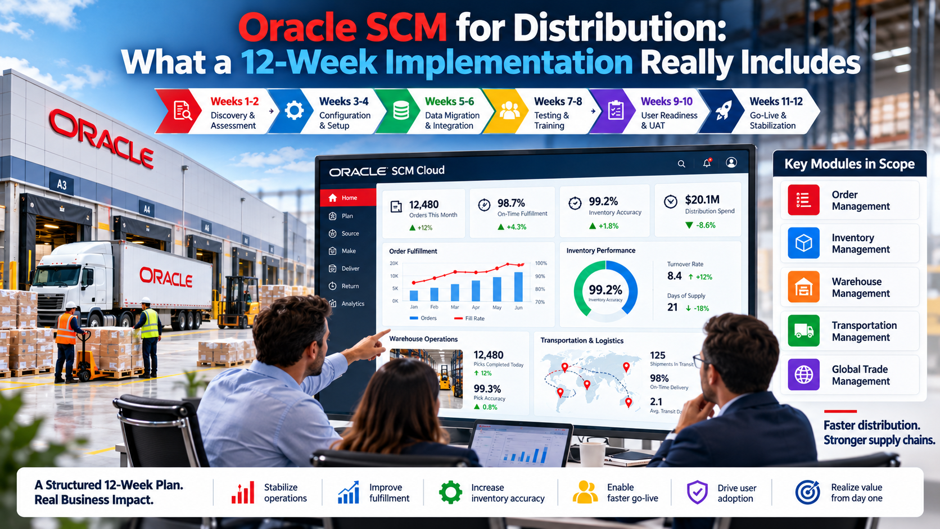
A regional wholesale distributor with 2 warehouses signs with a partner that promises Oracle SCM live in 12 weeks. The sales deck shows a clean timeline and a long module list, and the distributor’s operations director asks the practical question: which parts of order management, inventory, purchasing, pricing and shipping will be running on day 84, which parts will wait, and what will the team have to do for the schedule to hold. The answer depends on scope decisions that rarely appear in the proposal.
This guide describes what a 12-week Oracle Fusion Cloud SCM implementation for a distributor can realistically include, what it must exclude or defer, how the weeks are used, what data and integrations fit, how testing and cutover work in a compressed schedule and what the effort looks like for the partner and the customer. Published timelines come from consultancies and implementation partners with commercial interests, and the plan here is a reference model built on stated assumptions, not Oracle’s published method, so adjust it to your own scope.
TL;DR
- 12 weeks is achievable only for a tightly bounded scope. Published guides describe single-module rollouts at 12 to 16 weeks, mid-market programs covering procurement, inventory, order management and planning at 7 to 9 months, and most Oracle SCM projects at 4 to 9 months, so a 12-week plan means 1 legal entity, standard processes, few integrations and limited data conversion. Ask the partner to name the exclusions in the contract itself.
- The weeks are consumed by decisions, data and testing more than by configuration. Configuration of order management, inventory and purchasing can move quickly in a standard setup, while item master cleanup, open transaction conversion, integration build and 2 test cycles decide whether the date holds, and sources warn that data migration is the step most likely to push a schedule out. Book data owners and testers in week 1 and protect their time.
- What you defer is as important as what you deliver. Warehouse management, transportation, advanced planning, multiple entities and heavy customization usually move to a second phase, and a written list of exclusions, owners and cutover criteria agreed in week 1 is the best protection against a go-live that happens on time and doesn’t run the business. Agree the cutover criteria in week 1 so nobody argues about readiness in week 12.
What “12 Weeks” Can and Can’t Mean
Published timelines for Oracle SCM vary widely, and they describe different scopes. 1 implementation guide says most Oracle SCM Cloud projects run between 4 and 9 months, a single-module rollout such as procurement for a mid-market company can finish in 12 to 16 weeks, and a mid-market program covering procurement, inventory, order management and planning takes 7 to 9 months. Another says a single-country rollout of procurement and inventory for a 1,500-person distribution company usually takes 5 to 7 months. A 12-week claim sits at the fast edge of those ranges.
General Oracle Fusion guides describe phases that look longer on paper than 12 weeks: plan and mobilize in 4 to 8 weeks, configure and build in 12 to 20 weeks and testing in 8 to 14 weeks for broader ERP programs. Those ranges include finance and larger scopes, and 1 source adds that bringing supply chain into the initial scope adds modules to configure, more integrations such as warehouse systems and third-party logistics, and more complex data objects such as items and bills of material. A 12-week plan compresses phases by narrowing scope instead of skipping them.
Some partners do publish 12-week outcomes. 1 partner site cites a retail conglomerate with 500 locations reaching production in 12 weeks, though it also quotes 14 to 24 weeks as typical for its work, which shows how much the answer depends on scope. The practical reading for a distributor is that 12 weeks can be real for a clearly bounded first phase and unrealistic for a full replacement of every process, so the first job is deciding what the first phase is.
The Scope That Fits Inside 12 Weeks
| Area | Typically Included in a 12-Week Phase | Typically Deferred or Excluded | Why |
| Legal entities and warehouses | 1 legal entity, 1 to 3 warehouses | Additional entities, countries and complex intercompany flows | Each entity multiplies setup, testing and data |
| Order-to-cash | Standard sales orders, pricing, shipping, returns | Complex configurators, advanced rebates, multi-channel orchestration | Complexity drives design and test effort |
| Procure-to-pay | Requisitions, purchase orders, receiving, supplier setup | Advanced sourcing, supplier collaboration programs | Standard purchasing can be configured quickly |
| Inventory | Multi-warehouse on-hand, lot or serial where required, cycle counts | Warehouse management system, advanced putaway and wave picking | Warehouse systems add integrations and training |
| Integrations | 4 to 6 core interfaces, such as 3PL, EDI, e-commerce, tax and bank files | Long tail of custom interfaces | Each interface needs build, test and monitoring |
| Data migration | Items, customers, suppliers, on-hand balances, open orders and purchase orders | Deep history and archived transactions | History is optional, cleansing isn’t |
| Financial integration | Posting to existing or parallel finance setup | Redesign of chart of accounts and costing | Accounting changes need finance-led programs |
| Planning and logistics | Basic replenishment rules | Advanced supply planning, transportation management | Planning depends on clean data and stable operations |
| Training and change | Role-based training for core users | Extended adoption program | Training time is limited to 1 to 2 weeks |
These choices are assumptions that make a 12-week plan feasible, and they should be confirmed with the partner in writing. A scope with 1 entity, standard flows and a handful of integrations can fit. Adding a second country, a warehouse management system or heavy customization usually pushes the date out, so treat every addition as a schedule decision instead of a minor request. The sections that follow explain how the weeks are used inside that scope.
The Distribution Process Scope in Oracle SCM
Order Management and Fulfillment For a distributor, order management covers capturing orders from sales reps, customer portals, e-commerce and EDI, applying pricing and discounts, checking availability, allocating inventory, shipping and handling returns. Oracle’s suite includes capabilities such as omnichannel order management, pricing and global order promising, and implementation guides list setup tasks such as order types, transaction types and integration with warehouse systems. A first phase typically configures standard order flows and pricing before more advanced fulfillment orchestration.
Inventory Management Across Warehouses Inventory is the heart of a distribution deployment. Items exist within inventory organizations that map to physical warehouses, and sources describe multi-organization, multi-warehouse inventory with real-time on-hand, reservations, cycle counts, lot and serial control and consignment inventory. In a 12-week scope, the key decisions are the organization structure, item attributes, units of measure, costing method and which control types are needed, since changing them after go-live is expensive. Document each choice in the decision log.
Procurement and Purchasing Procurement covers requisitions, purchase orders, supplier management, receiving and invoice matching, with modules such as purchasing, procurement contracts and supplier portals available. Distributors usually need replenishment driven by min-max or reorder rules, supplier lead times, drop shipments and back-to-back orders. A first phase configures the standard purchase-to-receive flow and the key replenishment rules, leaving advanced sourcing and supplier collaboration programs for later. Capture supplier lead times early, since they drive replenishment quality.
Planning, Warehouse and Transportation Capabilities The wider suite includes supply chain planning, warehouse management, transportation management and product lifecycle management. Most 12-week plans leave these out of the first go-live, because each adds integration, data and training effort. A distributor with a complex warehouse or heavy carrier needs may still choose to bring in warehouse management early, though the schedule should then be reset using the partner’s own experience with that module. Revisit them in phase 2.
Weeks 1 and 2: Mobilize and Fit-to-Standard
- Confirm scope, exclusions and success criteria in writing. The first week should produce a signed scope statement that lists included processes, warehouses, interfaces and data objects, and also lists everything deferred, since a 12-week plan has almost no slack for scope growth and an unwritten exclusion becomes a dispute in week 9. Have the sponsor and the partner’s lead sign the statement so both sides share the same expectations from day 1.
- Provision environments and access. The mobilization phase in published methodologies includes confirmed scope, a project team and provisioned environments, so the partner should request the development and test environments early, set up user access, agree on naming conventions and establish the tools for tracking issues and decisions. Request test credentials for third parties at the same time, since carriers, customers and tax providers need lead time before interface testing begins.
- Run fit-to-standard workshops with process owners. Walk through order entry, pricing, allocation, shipping, returns, purchasing, receiving, replenishment and cycle counts in Oracle’s standard flows, record each gap and decide whether to adopt the standard process, configure around it or defer, and keep a decision log with owners and dates. Invite sales, purchasing, warehouse and finance leads so each decision includes the people who will live with it every day after go-live.
The 12-Week Plan at a Glance
| Weeks | Phase | Key Activities | Exit Criteria |
| 1 to 2 | Mobilize and fit-to-standard | Scope sign-off, environments, workshops, decision log, data and integration inventory | Signed scope and exclusions, design decisions on structures, plan baselined |
| 3 to 7 | Configure and build | Setup of inventory, order management, purchasing, pricing and shipping, integration build, data mapping and first mock loads | Configured processes demonstrated in conference room pilots, interfaces working in test |
| 5 to 8 | Data preparation | Cleansing, mapping, mock loads 1 and 2, reconciliation reports | Mock load reconciles to source within agreed tolerance |
| 8 to 9 | System integration testing | End-to-end test of order-to-cash and procure-to-pay across interfaces | Critical defects closed, test scripts passed |
| 9 to 10 | User acceptance and training | Business users test their own scenarios, role-based training | Business sign-off, trained users, cutover plan approved |
| 11 | Cutover rehearsal and final load | Dress rehearsal, final data extract, open transaction freeze plan | Rehearsal passed within the planned window |
| 12 | Go-live and hypercare start | Production cutover, first transactions, daily triage | Business confirms core flows are running |
The overlaps are deliberate, since a 12-week plan only works if data preparation, integration build and configuration run in parallel instead of in sequence. The risk is that any slip in 1 stream affects the others, so the plan needs a daily stand-up, a single shared issues list and a weekly steering review. Treat the exit criteria as gates, because passing a gate on a date without meeting its criterion carries the problem forward into a phase that has even less time to absorb it.
Weeks 3 to 7: Configure and Build
Configuration is the most visible part of the project and, in a standard scope, often the shortest. Functional consultants set up inventory organizations, subinventories and locators, item classes and templates, units of measure and costing, then configure order management transaction types, pricing, shipping and returns, and the purchasing setup with approvals, buyers, suppliers and replenishment rules. One implementation guide lists configuration at 6 to 10 weeks in a typical timeline, and a 12-week plan squeezes it into about 5 by limiting variants and customizations.
Conference room pilots keep the work honest. Instead of waiting for a test phase, the team demonstrates configured processes to process owners every 1 to 2 weeks, using realistic items, customers and suppliers, and records any deviation. This surfaces misunderstandings while they’re cheap to fix. Each pilot should end with a short list of accepted, rejected and deferred items, so the business sees progress and the partner knows which design is final, and so scope creep is visible instead of hidden in the backlog.
Builds outside standard configuration need special care. Reports, extensions, integrations and any custom forms or labels take time and create dependencies, so use standard reports where possible, limit the number of custom items to those that are essential for operations and give each a clear owner and a due date. A common compression technique is to deliver a first version of each report for go-live and refine it in hypercare. The partner should show a build tracker with each item’s status every week.
Data Migration in a Compressed Schedule
Decide What Moves and What Stays Behind A 12-week plan migrates only what the business needs to operate on day 1: active items, customers and ship-to locations, suppliers, on-hand balances by warehouse, open sales orders, open purchase orders and key pricing and contract data. Historical transactions, closed orders and old suppliers usually stay in the legacy system or an archive. Each excluded object should have an owner and a plan for access, since users will ask for history within days of go-live.
Clean the Item Master Before Anything Else Item data is the most common source of delay. Duplicate items, inconsistent units of measure, missing categories, unclear cost data and unreliable lot or serial attributes all show up during mock loads. Start cleansing in week 1, assign a business owner to each attribute group and freeze structure changes by mid-project. Oracle provides file-based import templates for many objects, and the team should confirm which templates apply to each object and plan mock loads from them.
Run at Least 2 Mock Loads and Reconcile Every Time A mock load tests the mapping, the sequence and the performance of the load, and a reconciliation checks that quantities, values and counts match the source. Run the first mock load by week 6 and the second by week 8, review defects with data owners, and fix root causes in the source or the mapping. Sources warn that data migration is the step with a high probability of pushing the schedule out, so leave time after each mock load for corrections.
Plan the On-Hand and Open Transaction Cutover Final on-hand balances and open orders must reflect reality at the moment of go-live. Agree on a freeze window, a physical count or cycle count schedule before cutover, rules for orders that are partly shipped and a method for handling receipts and shipments during the load. Finance should sign off on inventory values and open payables and receivables. A rehearsal in week 11 should use the same steps, the same people and the same timing as the real cutover.
Integrations That Fit and Those That Don’t
- Limit the first phase to the interfaces the business can’t run without. For a distributor these usually include a third-party logistics provider or carrier interface, EDI with major customers or suppliers, an e-commerce platform, a tax service and bank or payment files, and 4 to 6 interfaces is a realistic ceiling for 12 weeks, so every added interface needs a trade-off against another. Rank candidate interfaces by business impact and by lead time.
- Define interface specifications in the first 3 weeks. Each interface needs a specification, an owner on the business side and a counterpart at the external party, with sample files and a test plan, since delays in outside parties’ responses are a common cause of missed dates and can’t be fixed by adding project staff. Share sample files and error cases with each partner so expectations on both sides are explicit from the start.
- Test interfaces with real partners before UAT. Connect to the carrier’s or customer’s test environment, send realistic orders and shipping confirmations, and capture error handling, because interface failures often surface only when real formats and volumes pass through, and a compressed schedule leaves little room to discover them late. Record the results in the test log, including message samples, so any later dispute with a partner can be settled with evidence.
Testing in 4 Weeks Without Cutting Corners
| Test Type | Timing | Participants | Pass Criteria |
| Unit and configuration tests | Weeks 4 to 7 | Functional consultants | Each setup works as designed in isolation |
| Conference room pilots | Weeks 4 to 8 | Process owners and consultants | Processes accepted with a logged list of deferred items |
| System integration testing | Weeks 8 to 9 | Consultants, integration team and testers | End-to-end scenarios pass across all interfaces |
| Data validation | Weeks 6 to 10 | Data owners and finance | Loads reconcile for quantity and value |
| User acceptance testing | Weeks 9 to 10 | Business users from sales, purchasing, warehouse and finance | Users complete their daily scenarios and sign off |
| Performance and peak volume check | Week 9 or 10 | Technical team | Order and receipt volumes for a peak day process without errors |
| Cutover rehearsal | Week 11 | Whole team | Steps complete inside the planned window |
Published guides describe testing of 8 to 14 weeks in broader Oracle programs, so a 4-week test window is only possible with a narrow scope and early involvement of business users. Write test scenarios during configuration, run them in the conference room pilots and keep a daily defect triage. Don’t defer data validation to the end, because it consumes the most calendar time and the business owners must be available for it, so book their time in week 1 and treat it as a deliverable project.
Cutover and Go-Live Week
Cutover is a choreographed event, and the plan should be written down hour by hour. A typical sequence stops order entry and shipping in the legacy system, takes the final extracts, loads items, balances and open transactions into Oracle, runs reconciliation reports, performs a go or no-go review, opens users and monitors the first transactions. Each step has an owner, a time and a fallback, and the team should rehearse the sequence at least once to find problems and calibrate how long the load takes.
Go or no-go decisions need criteria, not opinions. Examples include on-hand balances reconciled within a defined tolerance, critical interfaces passing test messages, no open critical defects, trained users for each role and a rollback plan that has been reviewed. A weekend cutover is common for distributors, since order volume is lower, but the schedule should consider customer commitments, month-end close and the warehouse’s physical count. If the criteria aren’t met, a short delay costs far less than a bad go-live.
The first week after go-live is the real test. Daily triage meetings, a hypercare desk staffed by the partner and key users, a priority scheme for issues and a visible list of known workarounds keep the team focused. Expect questions about pricing, availability, unit conversions and reports, since real customers and real stock expose cases that testing missed. Keep the project team intact for at least 4 weeks after go-live, and record every issue so the next phase benefits from what the first one learned.
Who Owns What: Partner and Customer Responsibilities
The Partner’s Responsibilities The partner provides the project manager, functional consultants for each module in scope, an integration and data specialist, test coordination and the methodology. It runs workshops, configures the system, builds integrations and reports, supports data loads and drives the cutover plan. The partner should commit to named staff, a weekly status report and a risk log, and should state clearly which deliverables belong to it, such as configuration workbooks, test scripts and training material.
The Customer’s Responsibilities The customer provides process owners with the authority to decide, data owners who cleanse and approve data, testers from the business, trainers or super users and a project sponsor who clears obstacles. It also provides access to third parties such as carriers, EDI partners and tax providers. The most common reason compressed projects fail is customer availability, which no partner capability can offset, so the plan should list the weekly hours each person must commit and the sponsor should protect them.
Oracle’s Role and the Quarterly Update Cycle Oracle provides the environments and the software, and its cloud applications receive mandatory updates 4 times a year, so the project calendar should check the update schedule against the test and go-live windows. A project that starts testing on 1 release and goes live on another needs a regression pass, and the partner should explain how it will handle updates during the project, including who retests and how much time to reserve.
Third Parties and Legacy Support Carriers, customers, suppliers and the legacy system’s vendor each hold dependencies. Confirm test environment availability, response times and cutover support early, and obtain written commitments for cutover weekends. The legacy system team must provide extracts, support reconciliation and keep the system available for reference, so include them in the plan and the steering group, since delays on their side look identical to delays on the project’s side. Add them to the steering group.
Resourcing and Cost Arithmetic
| Item | Assumption | Result |
| Partner team | 7 full-time people for 12 weeks: project manager, 3 functional consultants, 1 integration consultant, 1 data lead, 1 test lead | 84 person-weeks, or 420 person-days |
| Partner services cost | 420 person-days at $1,400 to $2,400 per day | $588,000 to $1,008,000 |
| Customer team | 6 people at 50% for 12 weeks | 36 person-weeks, or 180 person-days of internal time |
| Subscription and other costs | Not included | Depend on users, modules and negotiated terms |
The inputs are assumptions meant to show the arithmetic rather than a quote or a benchmark. The day-rate range reflects published hourly rates for experienced cloud ERP specialists from earlier research, and actual rates vary by region and partner. The customer figure matters because internal time isn’t free, and 180 person-days is a real commitment from operations, purchasing, sales, finance and IT. Use the table as a template and replace each assumption with your partner’s proposal and your own staffing plan.
Risks That Break a 12-Week Plan
- Scope growth after the baseline. Each added process, warehouse, interface or report competes for the same weeks, so require a change process in which any addition is traded against a removal or against a date, and keep the steering group’s decisions visible to the whole team to prevent quiet additions through side conversations. Publish the change log weekly so every trade-off is visible to the steering group and the business owners.
- Integration dependencies outside the project. Carriers, customers, tax providers and bank connections run on their own calendars, so start external coordination in week 1, obtain test credentials early and agree on fallback processes for any interface that isn’t ready by go-live. Name an owner for each external party, record their response times and escalate to executives when a counterpart misses a date, because outside delays can’t be fixed by adding project staff.
- Testing squeezed at the end. When configuration runs late, testing is the first activity to lose time, which produces a go-live with known defects, so protect the test window, write scenarios early and make passing the exit criteria a condition of cutover instead of a target. Track test coverage against the scenario list daily, and treat any cut to the test window as a formal scope decision that the sponsor must approve.
Common Mistakes and the First 90 Days
Treating 12 weeks as a promise about the whole business is the first mistake. A 12-week plan delivers a first phase, and organizations that expect every process, entity and report to be live end up disappointed. Agree on phase 1 and phase 2 scopes at the start, publish the second-phase roadmap and explain to users what will be different on day 1, because the expectations set in week 1 shape how the result is judged in week 13.
Underestimating the customer side is the second. Partners can configure quickly, though they can’t make business decisions, cleanse your data or test your scenarios. Release the right people from part of their regular work, back them up and track their hours in the project plan. A distributor that treats the project as something the partner does for it, instead of with it, will find that the schedule slips for reasons no consultant can fix.
The first 90 days after go-live deserve a plan too. Weeks 1 to 4 focus on stabilization, defect fixes and user support, weeks 5 to 8 on reporting refinements, adoption gaps and deferred items, and weeks 9 to 12 on the phase-2 roadmap, which may include warehouse management, planning, additional entities or transportation. Review metrics such as order cycle time, inventory accuracy, fill rate and purchase order lead time against pre-project baselines, and use them to justify the next phase.
FAQs
Is a 12-week Oracle SCM implementation realistic for a distributor?
It’s realistic for a tightly bounded first phase. Published guides describe single-module rollouts at 12 to 16 weeks and broader mid-market programs at 7 to 9 months, so 12 weeks implies 1 legal entity, standard order-to-cash and purchase-to-pay flows, a handful of interfaces and limited data conversion. Expecting a full replacement of every process in that time sets up a missed promise. Define phase 1 and phase 2 scopes in writing before signing.
What modules are typically included in the first 12 weeks?
Most plans cover order management, inventory management and procurement, with pricing and shipping as part of order management. Planning, warehouse management, transportation management and product lifecycle management are usually deferred, since each adds integrations, data and training. Confirm the module list in writing, along with the processes, warehouses and interfaces included in the first phase. Ask which items are in scope for each warehouse.
What takes the most time in a compressed schedule?
Data and decisions. Item master cleanup, on-hand reconciliation, open order conversion and interface specifications with outside parties consume more calendar time than configuring standard processes. Sources warn that data migration has a high probability of pushing the schedule out, so start cleansing in week 1, run at least 2 mock loads and give data owners authority to resolve issues quickly. Assign owners to each data object.
How many integrations can fit in 12 weeks?
About 4 to 6 core interfaces is a realistic ceiling for a first phase, such as a carrier or third-party logistics provider, EDI with key customers, an e-commerce platform, tax and bank files. Each needs a specification, a build, test partners and monitoring. Defer lower-value interfaces with a documented manual process and a target date instead of squeezing them in. Rank candidates by business impact and effort, and confirm partner readiness.
How much does a 12-week implementation cost?
It depends on the partner, scope and rates. As an illustration, a 7-person partner team for 12 weeks is 420 person-days, which at $1,400 to $2,400 per day is about $588,000 to $1,008,000, plus about 180 person-days of internal time and subscription costs. These are assumptions for a template, so replace them with your partner’s proposal. Add subscription fees, tax, travel and a contingency, because those aren’t in the partner’s day-rate figures.
Who should be on the customer project team?
Process owners for order management, purchasing, inventory and finance with authority to decide, data owners for items, customers, suppliers and balances, business testers, super users who will train others, an IT lead for integrations and access, and an executive sponsor. Expect about 50% of several people’s time, and agree on weekly hours in week 1. Record the weekly hours in the project plan and review them.
How do Oracle’s quarterly updates affect a 12-week project?
Oracle applies mandatory updates 4 times a year, so check the update calendar against your test and go-live windows. If testing starts on 1 release and go-live falls on another, plan a regression pass and ask the partner who retests and how much time to reserve. Avoid scheduling the cutover close to an update unless the partner has a clear plan. Ask for the update calendar during selection and compare it with your go-live date.
What happens after go-live in a 12-week plan?
Expect a hypercare period of at least 4 weeks with daily triage and a staffed support desk, then a 90-day plan that moves from stabilization to refinements and the second-phase roadmap. That roadmap may include warehouse management, planning, more entities or transportation. Track order cycle time, inventory accuracy, fill rate and purchase order lead time against pre-project baselines to guide the next phase.