

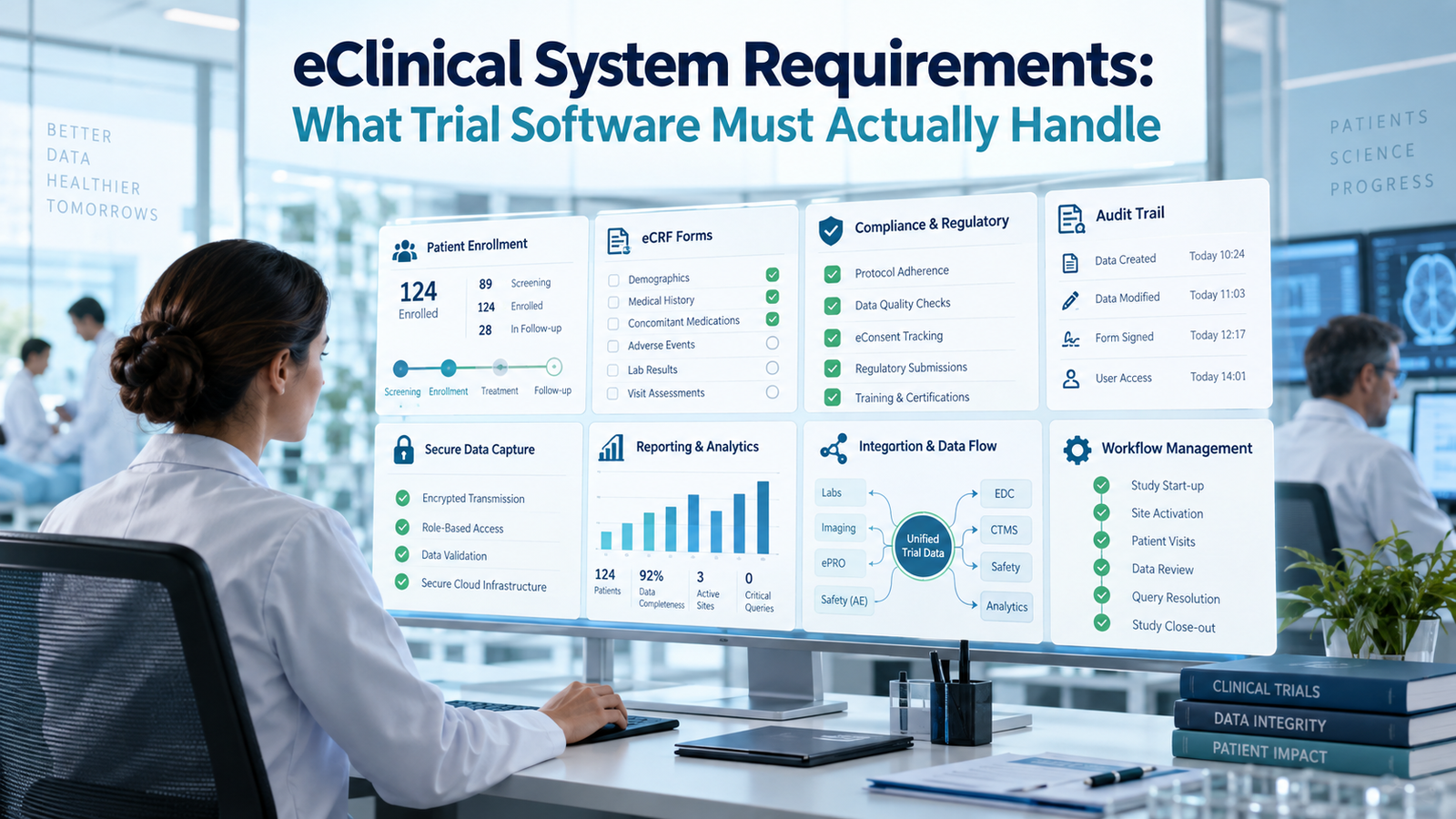
Clinical trial software can fail a study without ever going offline. A system may collect the wrong field, allow the wrong person to see an unblinded value, lose the history behind a correction, or move data between platforms without enough evidence that the transfer preserved meaning. These failures matter because trial records have to support participant protection and trustworthy results long after the original user has logged out.
That’s why eClinical system requirements should start with what the trial needs the system to control and what it has to prove. The current ICH E6(R3) Good Clinical Practice guideline puts computerized systems inside the trial quality framework and calls for controls that are proportionate to the importance of the system, data, and activities. Teams need requirements for the entire life cycle, from study setup through archiving and eventual retirement.
This guide works through the requirements that matter in practice, then shows how to turn broad regulatory language into a user requirements specification your team and your vendor can test against.
TL;DR
eClinical system requirements describe what the system must do for a specific trial process and how the team will prove that it works. A feature list can’t show that. Requirements need to connect intended use with participant risk, data importance, user roles, validation evidence, change control, and records that stay readable after the study ends.
· Define intended use before selecting features or a vendor.
· Treat audit trails, access control, security, backup, and retention as life-cycle controls.
· Validate protocol-specific rules, calculations, interfaces, and critical workflows before use.
· Keep data and metadata traceable when information moves between EDC, CTMS, eCOA, IRT, safety, laboratory, imaging, and other systems.
· Plan for failures, vendor changes, protocol amendments, database lock, archival, and system retirement.
What are eClinical system requirements?
eClinical system requirements are documented statements of the functions, controls, records, interfaces, and operating conditions a computerized trial system needs for its intended use. They can apply to sponsor systems, site systems, participant-facing tools, or services that hold regulated trial data. A useful requirement is specific enough to test and clear enough that a reviewer can tell whether the system met it.
The regulatory direction is risk-based. The ICH E6(R3) Good Clinical Practice guideline says validation should consider intended use, the importance of the data or record, and the potential effect on participant rights, safety, and trial reliability. That means the same control may need different evidence depending on whether the software stores a meeting note or drives randomization, dosing, or endpoint collection.
Teams use the term eClinical for very different tools, so product scope matters. Advayan’s e-Clinical Software covers trial management and data handling, and a study-specific assessment confirms how its configuration and connected systems fit each protocol.
Clinical trial software requirements should therefore answer 5 questions: what process does the system support, which records does it create or change, who can perform each action, what can go wrong, and what evidence will show that controls worked. Answer them first, and any checklist built on top of them will hold up in review.
Start with intended use and trial risk
Intended use comes before feature count
A system should be assessed in the context in which the trial will use it. Intended use describes the business and clinical process, the users, the data, and the decisions that depend on the software. An electronic data capture system used only for noncritical observational fields has a different risk profile from one that calculates a dose or collects a primary endpoint.
eClinical system requirements should identify critical functions early. Randomization, dose changes, eligibility logic, endpoint collection, informed consent, safety reporting, and blinding controls can affect participant protection or trial conclusions. Requirements for those functions need tighter traceability from specification to testing and from testing to release approval.
Risk determines validation depth
Risk-based work puts the most review and test effort where failure has the greatest effect. A low-risk display preference may need a simple check. A rule that determines treatment allocation needs defined inputs, expected outputs, exception handling, test evidence, and a record of approval before production use.
A useful industry cross-check is the eClinical Forum PR2025 requirements release, published in April 2026. It maps electronic trial-system requirements across major regulatory sources and notes the addition of a risk-assessment user requirement tied to ICH E6(R3) and EMA guidance. Teams can use that kind of mapping to confirm coverage while still writing study-specific requirements in their own words.
Map requirements across the eClinical stack
A clinical trial rarely runs in a single application. The eClinical stack can include EDC, a clinical trial management system, eTMF, eCOA or ePRO, eConsent, IRT or RTSM, safety systems, laboratory feeds, imaging, payment tools, and site or hospital records. Each system has its own purpose, yet the trial needs a clear map of where data originate, where they move, and which copy is authoritative.
| System area | What requirements should define |
| EDC and eCRF | Form behavior, edit checks, query workflow, source or transcribed status, investigator review, data freeze and lock |
| CTMS | Sites, milestones, monitoring records, roles, visit status, issue tracking, and links to other study systems |
| eTMF | Document classification, version history, completeness, quality review, access, export, retention, and archive behavior |
| eCOA or ePRO | Participant identity, device or app behavior, timestamps, offline capture, reminders, corrections, and metadata |
| IRT or RTSM | Randomization, treatment allocation, blinding, kit assignment, supply logic, emergency unblinding, and interfaces |
| eConsent | Approved content, version control, identity, signature evidence, re-consent, withdrawal, and record access |
| External data | Source ownership, transfer schedule, format, checks, reconciliation, error handling, and retained metadata |
Site systems can also become part of the trial data chain. An electronic health record platform such as MyEMR can hold source information before selected data move into research systems. When EHR data support trial endpoints or eligibility, the sponsor should define fitness-for-purpose checks and the controls around extraction or transcription.
An electronic data capture system and a clinical trial management system shouldn’t be treated as interchangeable. The first is centered on clinical data collection and cleaning. The second is centered on study operations and oversight. When the systems exchange site status, enrollment, monitoring, or subject-level information, requirements should name the source, receiving field, timing, error path, and reconciliation method.
Data capture, edit checks, and source traceability
Good trial data starts at capture. The system has to collect the right data, preserve the context in which they were created, and prevent quiet changes that make the record hard to reconstruct. For an electronic data capture system, the team needs rules beyond the eCRF pages themselves: data types, required fields, units, ranges, dates, dependencies, calculated values, and how missing or unknown information is represented.
Define the origin of each important field
A field may be entered directly by an investigator, transcribed from a medical record, sent by a laboratory, generated by a device, or calculated by software. eClinical system requirements should state the origin when it affects interpretation. They should also state which metadata need to travel with the value, such as device identifiers, timestamps, source file names, units, or the version of an algorithm used to create a derived result.
Edit checks need the same level of care. A check should have a defined trigger, message, allowed user action, and expected record of any resulting change. A warning that can be ignored has a different effect from a hard stop. Checks that calculate eligibility, dosing, or visit windows need test cases for normal values and boundary conditions.
Clinical trial software requirements should also define correction behavior. Users need a controlled way to correct mistakes while preserving the original entry and the history behind the change. Sponsor staff shouldn’t silently overwrite investigator or participant data. Query workflows, clarification steps, and reason-for-change fields should support traceability without changing who owns the source information.
Data review continues after entry. Requirements may cover query generation, medical coding, duplicate detection, reconciliation with safety or laboratory records, and data-cleaning status before interim analysis or database lock. The system should make it possible to tell what has been reviewed and what remains open.
Audit trails, metadata, and data integrity
Audit trails are a core part of eClinical system requirements because a final value alone can’t explain how a regulated record changed. The history should let an authorized reviewer reconstruct important actions without relying on memory or a separate spreadsheet. That includes the original entry, later changes, the user or process responsible, timestamps, and the reason for change when the reason is needed.
The EMA guideline on computerized systems and electronic data in clinical trials states that audit trails should be secure, computer-generated, and time-stamped, and it expects changes to be traceable at data-point level. It also addresses audit-trail review, blinding, transfer, migration, backup, and archiving. Those details are useful when broad requirements such as ‘maintain data integrity’ need to become testable controls.
The EMA guideline frames these expectations through ALCOA++: data should be attributable, legible, contemporaneous, original, accurate, complete, consistent, enduring, available when needed, and traceable. Audit trail requirements are where most of those attributes become testable.
Metadata has to stay with the record
Metadata can explain when a value was captured, by whom, with which device or account, and under which system state. If a value moves between systems, the destination may need enough metadata to preserve meaning and traceability. A data export that strips key context can be technically correct at the field level and still weaken the trial record.
The audit trail also needs its own access rules. Blinded users shouldn’t gain treatment information through audit details, event logs, filenames, or administrative screens. Administrative access should be controlled and reviewed because high privilege can affect records, configuration, or visibility.
The system should make audit information usable during normal review and inspection. A human-readable view helps investigators and auditors understand a single record. A structured export can support wider review for repeated changes, unusual timing, or other patterns. The requirement should state which forms are needed and who can obtain them.
User access, electronic signatures, and blinding
User management has to connect identity, role, responsibility, and access. Shared accounts weaken attribution because the record can no longer show who performed an action. eClinical system requirements should call for unique accounts, role-based permissions, timely removal of access, and periodic review when the risk warrants it. The system should also preserve the history of role and permission changes.
Part 11 is often discussed as if it were a universal product certificate. The FDA guidance on Part 11 scope and application takes a narrower view tied to records required by FDA rules or submitted electronically to FDA. It also explains the agency’s enforcement approach and keeps predicate-rule requirements in view. Teams should determine which records and signatures are in scope instead of treating a single marketing label as the whole analysis.
Electronic signatures need more than a signature image. Requirements should define how the signer is identified, how the signature is linked to the record, what meaning the signature represents, and what happens if the signed record changes. A signature used to confirm investigator review has a different purpose from a participant’s informed consent, even when both are electronic.
When a study uses a signing component, teams can compare its workflow with Advayan’s E-Signature product and then document any trial-specific controls that are still needed. A signing feature on its own doesn’t establish regulatory suitability. Identity, attribution, record linkage, retention, and the applicable legal context still have to be addressed.
Blinding needs explicit permission rules. A clinical trial management system may contain operational details that are safe for most study staff, while an IRT or safety system may hold treatment information that must stay restricted. Requirements should identify blinded and unblinded roles and test both allowed access and denied access.
Validation, release, and change control
Validation shows that the system can consistently meet specified requirements for its intended use. It should connect requirements to evidence instead of producing a large document set with weak traceability. For critical functions, each requirement needs a test or another justified verification method, expected results, actual results, issue handling, and approval.
FDA’s October 2024 final guidance on electronic systems, electronic records, and electronic signatures in clinical investigations sets out when electronic records and signatures can be treated as trustworthy and reliable. Use it as the current FDA reference alongside ICH and regional guidance when you define validation and record controls.
Many teams structure this work around ISPE’s GAMP 5 (Second Edition, 2022). It scales validation effort to risk and lets teams rely on supplier documentation where it’s adequate.
In the EU, GMP Annex 11 sets expectations for computerized systems, and many sponsors apply its principles to trial systems as well. It covers risk management, supplier oversight, validation, audit trails, periodic review, and business continuity. The European Commission released a draft revision for public consultation in 2025, so check which version your quality system references.
Test the study build separately from the base product
A vendor can test standard platform functions, but the sponsor remains responsible for the study’s use of the system. Protocol-specific forms, visit logic, randomization strata, dose calculations, edit checks, exports, and integrations may need separate testing. The validation plan should distinguish vendor evidence from customer or study testing so gaps are visible.
Release controls matter because a correct build can still be deployed at the wrong time or to the wrong site. eClinical software should support a controlled path from configuration through testing, approval, and production activation. Training material and operating procedures should be ready before users depend on the new version.
Changes after go-live need impact assessment. A protocol amendment can alter forms, calculations, visits, consent versions, or data mappings. The team should decide which existing functions need regression testing and whether old records could be affected. Clinical trial software requirements should also cover emergency fixes and how the study will document any temporary workaround.
Periodic review keeps validation alive after release. Teams can review open defects, security incidents, user access, infrastructure changes, repeated support issues, vendor releases, and whether the system still matches intended use. A system that passed testing 2 years ago may no longer be in the same state after many changes.
Integration, interoperability, and data standards
Integration requirements should describe the data contract between systems. eClinical system requirements should define the source, destination, field mapping, format, transfer schedule, security method, error handling, duplicate behavior, reconciliation, and who owns each failure. Those details matter whenever EDC, CTMS, safety, laboratory, imaging, eCOA, or hospital systems exchange regulated data.
API and middleware patterns can help when several systems need controlled exchange. In a trial setting, the requirement still has to add research controls such as validated mappings, retained transfer logs, retry rules, and reconciliation evidence.
Standards can reduce ambiguity between systems. The CDISC Operational Data Model 2.0 is a vendor-neutral exchange model that can carry clinical data together with metadata, reference information, administrative data, and audit information. A trial doesn’t have to use ODM for every interface, but the broader principle is important: an exchange format should preserve meaning and enough context for downstream use.
A clinical trial management system may receive subject counts or milestone status from EDC while sending site or visit information in the other direction. The requirement should identify which system owns each field. Without ownership rules, users can edit the same concept in 2 places and create conflicts that reconciliation can’t easily explain.
Teams building custom connectors should apply trial-specific validation to the resulting interfaces. Interface testing should include expected records, invalid records, partial failures, duplicate messages, delayed transfers, and recovery after interruption.
Migration deserves its own plan. Moving a study to a new platform or archive requires mapping, counts, checks, and retained evidence that the new copy matches the old record. Data and relevant metadata should remain linked, and the team should document what happened to audit history when the target system can’t reproduce the original behavior exactly.
Security, backup, continuity, and retention
Security requirements should protect trial data throughout its life cycle. Access control is only part of it. The system environment also needs authentication controls, patching, monitoring, tested backup, and a way to respond to security incidents. The right depth depends on the system, data, deployment model, and the effect of a failure on participants or trial conclusions.
When teams build or host a supporting application in the cloud, trial use still requires its own assessment of where data reside, how access is controlled, what the provider can change, how logs are retained, and how the sponsor obtains records if the service ends.
Backup is useful only when restore works
A backup requirement should define what is copied, how often, where the backup is stored, how it’s protected, and how long recovery can take. Restore testing matters because an unreadable or incomplete backup offers little protection. Tests should confirm that the restored system includes the data and the critical metadata needed to understand it.
Continuity plans should cover system outages that affect participant safety or trial decisions. A site may need a paper or offline process for a short outage, while randomization or dosing may require a more controlled contingency. The requirement should explain how temporary records are reconciled after service returns and how users are told which process to follow.
Retention means records stay readable, retrievable, and protected for the applicable period. The archive has to preserve context, and the study should plan for software retirement, vendor exit, format changes, and loss of live system access. These points belong in clinical trial software requirements before contract signature because late negotiation can leave the sponsor dependent on a vendor for basic record access.
Privacy and data location
Trial data are personal data, so privacy law adds requirements of its own. GDPR governs processing and cross-border transfer for participants in the EU, and the UK has its own version. In the US, HIPAA shapes how hospitals and other covered entities disclose participant health information to sponsors. Requirements should state how participant identity is pseudonymized, where data are stored, which subprocessors can reach them, and what legal basis covers transfers out of the region.
Technical and hosting requirements
Part of the requirements set is plain technical fit. State the browsers, operating systems, and devices each user group needs, including participant-owned phones for eCOA. Add uptime commitments, planned maintenance windows, performance at peak enrollment, and the hosting region, then confirm the vendor’s service level agreement matches them.
Remote and decentralized trial requirements
Remote trial activity changes where data are created and who controls the device or connection used to create them. eCOA apps, telehealth, home nursing, local laboratories, sensors, and participant-owned devices can all add useful options. They also create requirements around identity, time, device status, offline behavior, transfer, support, and recovery when a participant can’t complete a task as planned.
The FDA guidance on clinical trials with decentralized elements describes decentralized activities such as telehealth visits, in-home visits, and visits with local health care providers. Software requirements should follow the actual activity. A remote visit platform may need identity and visit documentation controls, while a sensor may need device metadata and rules for missing transmissions.
Participant-facing design affects data quality
A participant-facing system has to work for the intended population. Requirements may cover language, accessibility, supported devices, notification timing, offline entry, and what happens if a participant enters data late. Teams should test the workflow with realistic users where practical, especially when the tool collects primary endpoint information.
Time is another requirement. The system may need to distinguish when a participant entered an observation from when the device uploaded it. If data can sit locally before transfer, the study should preserve both events where they matter. Time-zone handling also needs a defined rule for multinational studies and daylight-saving changes.
Remote support should avoid creating undocumented data changes. Help-desk staff may assist with login or device problems, but they shouldn’t edit participant responses outside a controlled correction process. Support records can become useful evidence when repeated technical problems affect missing data or protocol adherence.
How to write a user requirements specification
A user requirements specification turns eClinical system requirements into statements that can drive design, purchase, configuration, and testing. Each requirement should describe a single meaningful outcome. It should avoid vague words such as ‘easy,’ ‘modern,’ or ‘fully compliant’ because those phrases don’t tell a tester what to verify.
A practical requirement can use a simple pattern: actor, action, condition, expected result, and evidence. For example, ‘The system shall record each change to an eCRF field with the previous value, new value, user identity, timestamp, and reason when a reason is required.’ The statement is specific enough to test and ties directly to traceability.
| Weak statement | Stronger requirement |
| System must be secure | Only authorized users may access study data, and access shall be assigned by documented role |
| System must have audit trails | The system shall retain the initial value and each change with user, timestamp, previous value, new value, and applicable reason |
| System must integrate with labs | The system shall import the agreed laboratory file format, reject invalid records, log failures, and support reconciliation against source counts |
| System must support backup | The system shall back up trial data on the approved schedule and support documented restore testing |
| System must support signatures | The system shall link each electronic signature to the signed record, signer identity, date and time, and stated signing meaning |
Requirements should be traceable to risk, design, configuration, test evidence, or an operating procedure. Traceability doesn’t have to mean a huge spreadsheet if the tool can maintain the links. The important point is that reviewers can follow a critical requirement from need to verification and see what changed after an amendment.
An EDC system usually needs both platform requirements and study-build requirements. The platform set covers stable functions such as authentication and audit history. The study set covers forms, visits, calculations, and protocol rules. Separating them avoids retesting unrelated platform functions for every small study change. That split keeps testing focused on the functions that can affect participants or the reliability of trial results.
A CTMS works the same way: stable platform controls can be qualified once under a managed life cycle, while each study still needs tested site structures, milestones, monitoring templates, permissions, and any connected data feeds.
How to evaluate eClinical software before selection
eClinical software selection should test evidence as well as capability. A demo can show that a feature exists. It can’t show whether the supplier manages releases well, retains validation evidence, responds to defects, or can return usable records years later. Evaluation should include the platform, the vendor’s quality process, the proposed configuration, and the contract terms that affect access to data and documentation.
Start by mapping clinical trial software requirements to vendor responses. Ask the supplier to identify whether each requirement is standard, configurable, custom, handled by procedure, or unsupported. This classification exposes hidden work. A requirement that needs custom code can add testing and maintenance that a simple feature matrix doesn’t reveal.
Integration claims deserve the same test. Ask for the interface artifacts: interface catalogs, field mappings, security models, reconciliation, and testing. They make assumptions visible before data begin moving between systems.
Questions to ask before approval
· Can the vendor provide validation documentation that covers the intended use, and what must the sponsor test separately?
· How are audit trails stored, viewed, exported, and protected from ordinary user change?
· How are roles approved, reviewed, changed, and revoked, including privileged accounts?
· What happens to study data and metadata when the contract ends or the platform is retired?
· How are releases announced, assessed, tested, and controlled for active studies?
· What recovery targets apply after an outage, and when was restore last tested?
· How are interface failures logged and reconciled so missing or duplicate data can be detected?
· Which records can inspectors receive in human-readable and structured forms?
Cost belongs in the decision, but there’s no defensible universal price for eClinical software. Study phase, number of sites, countries, modules, participants, integrations, support model, and validation work can change the total. A useful commercial comparison separates license or subscription fees from build, integration, migration, training, validation, support, archive, and exit costs.
| Cost driver | What it changes |
| Modules and integrations | Each added system or interface adds build, testing, and support work |
| Study size | Site, country, and participant counts affect licensing, training, and helpdesk load |
| Study build and amendments | Forms, edit checks, and protocol changes add configuration and regression testing |
| Validation | How much vendor evidence you can rely on sets how much you test yourself |
| Exit and archive | Data return, archive formats, and retention periods carry their own fees |
Conclusion
eClinical system requirements describe what trial software must control and what evidence the study needs to keep. The strongest sets start with intended use and risk. They also separate stable platform functions from protocol-specific configuration, because many failures happen inside study rules or at the interfaces between systems.
If you’re checking a platform against these requirements, see how Advayan’s e-Clinical Software handles trial management and data handling.
FAQs
What are eClinical system requirements?
eClinical system requirements are documented statements that define what a computerized trial system must do for its intended use. They cover functions, data handling, users, controls, interfaces, validation evidence, and record retention so the study can show that important processes are controlled.
Which systems are usually included in an eClinical environment?
An eClinical environment can include EDC, CTMS, eTMF, eCOA or ePRO, eConsent, IRT or RTSM, safety systems, laboratory feeds, imaging platforms, and site systems. The exact scope depends on the protocol and where trial data or essential records are created or managed.
Is an electronic data capture system the same as a CTMS?
No. An electronic data capture system is mainly used to collect and manage clinical data, while a clinical trial management system focuses on study operations such as sites, monitoring, milestones, and oversight. The 2 systems may exchange information, so ownership and reconciliation rules should be defined.
Does every clinical trial system have to comply with 21 CFR Part 11?
Part 11 applies to certain electronic records and signatures that fall within FDA regulatory scope. Teams should identify the applicable records, predicate rules, and intended electronic use instead of assuming that every feature in every trial system is covered in the same way.
What should an audit trail record?
For important electronic records, an audit trail should preserve enough information to reconstruct creation and later changes. That commonly includes the original value, changed value, user or process, timestamp, and the reason for change when a reason is required.
What does validation mean for eClinical software?
Validation is the documented process of showing that a system consistently meets specified requirements for its intended use. The depth should reflect risk, and trial-specific configuration, calculations, interfaces, or critical functions may need testing beyond the vendor’s base-platform evidence.
Do vendor validation documents remove the sponsor’s need to test?
No. Vendor evidence can reduce duplicate work when it’s adequate and relevant, but the responsible party still has to assess intended use and the study configuration. Protocol-specific forms, rules, calculations, and integrations may require additional verification.
What should clinical trial software requirements say about user access?
They should define unique user identity, role-based permissions, approval and removal of access, privileged accounts, and periodic review where appropriate. Requirements should also protect blinding and keep a history of important permission changes.
How should eClinical systems handle data transfers?
The transfer should have a defined source, destination, mapping, format, schedule, security method, failure path, and reconciliation process. Testing should show that data and required metadata remain accurate and traceable after transfer.
Why are metadata important in clinical trial systems?
Metadata explain the context of a record, such as who created it, when it was captured, which device or system produced it, and how it changed. Keeping relevant metadata with trial data helps reviewers reconstruct events and judge whether the record is trustworthy.
What backup requirements should be included?
Requirements should define what is backed up, backup frequency, protection, retention, recovery expectations, and restore testing. A backup should be considered useful only when the study can restore the data and the critical metadata needed to understand them.
How should protocol amendments affect system validation?
The team should assess which forms, calculations, visits, consent versions, interfaces, or rules changed and which existing functions could be affected. Testing should be based on that impact, and release evidence should be approved before the changed configuration is used in production.
What extra requirements apply to decentralized trial technology?
Remote tools may need controls for participant identity, device status, timestamps, offline use, secure transfer, technical support, and reconciliation after interruptions. The exact requirements depend on whether the tool supports telehealth, home visits, eCOA, sensors, or another decentralized activity.
How should a clinical trial management system handle integrations?
A clinical trial management system should have defined ownership for exchanged fields and a controlled method for moving data. Requirements should cover mappings, timing, errors, duplicates, reconciliation, access, and evidence that the interface works after relevant changes.
How often should eClinical system requirements be reviewed?
They should be reviewed when intended use changes, the protocol changes, a critical vendor release occurs, new interfaces are added, or a risk review finds a gap. Periodic review can also confirm that the system remains in a validated state throughout its life cycle.