

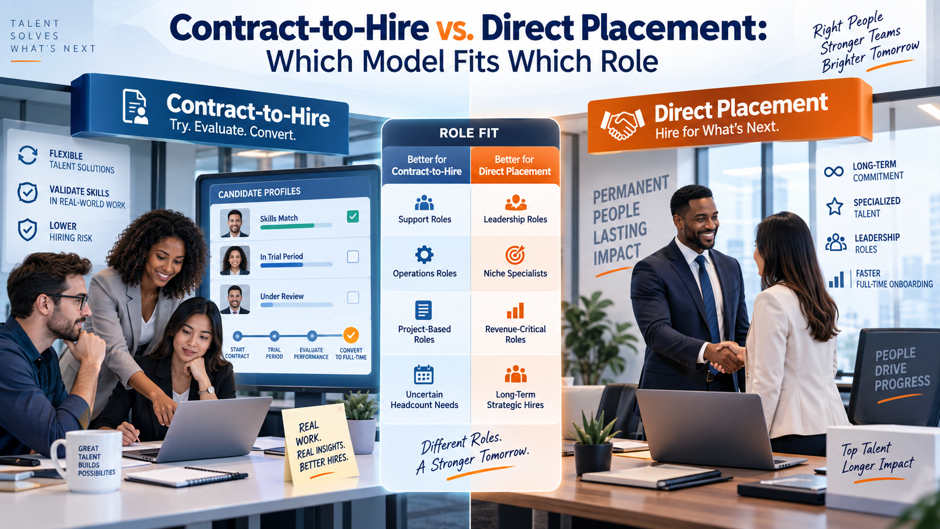
Contract-to-Hire vs. Direct Placement: Which Model Fits Which Role
A contract-to-hire arrangement can be a sensible way to fill one position and a poor way to fill another. The same is true of direct placement. A company hiring a help desk technician with clearly measurable daily work faces a different decision from a company recruiting a VP of Sales, senior cybersecurity architect, controller, or specialist engineer. Treating every vacancy as a choice between “lower-risk contract hiring” and “faster permanent hiring” misses what actually determines whether either model works.
The distinction begins with the employment relationship. The American Staffing Association defines temporary-to-hire as an arrangement in which a staffing firm’s employee works for a client during a trial period while both sides consider a permanent employment relationship. Direct placement works differently: the staffing firm finds and introduces the candidate, and the candidate enters a direct or permanent employment relationship with the client when hired.
That difference changes candidate behavior, recruiting reach, cost structure, onboarding, management expectations, and the amount of evidence the employer can collect before making a permanent commitment. A contract-to-hire period can reveal how someone handles real work, but it can also reduce access to candidates who already have stable jobs and see temporary status as an unnecessary risk. Direct placement can reach that talent more effectively, although the employer has to make its permanent decision using interviews, references, assessments, and other prehire evidence.
The right model therefore depends on the role. Jobs with short ramp periods, observable output, a credible permanent path, or hard-to-assess practical skills can be strong contract-to-hire candidates. If the need is genuinely temporary or permanent headcount is not reasonably expected, temporary or contract staffing is the better category. Leadership, scarce professional talent, relationship-heavy positions, and jobs requiring a long ramp before performance becomes visible usually fit direct placement better.
TL;DR
Contract-to-hire works best when a permanent role is reasonably expected and a real-work trial can answer an important hiring question. It can also provide productive capacity quickly. The model is particularly useful when the role has measurable daily output or interviews alone provide limited evidence about actual performance. If the long-term workload or permanent headcount is still genuinely undecided, temporary or contract staffing is a better fit until a credible conversion path exists.
Direct placement works best when the company is confident that the position is permanent and needs access to candidates who expect a permanent offer from the beginning. The model is usually stronger for senior, scarce, licensed, strategic, revenue-owning, and relationship-heavy positions where a temporary label can reduce candidate interest or where meaningful performance takes months to appear.
| Hiring Situation | Model Usually Worth Testing First |
| Immediate operational vacancy with a credible permanent path | Contract-to-hire |
| Permanent headcount not yet reasonably expected or approved | Temporary / contract staffing |
| Role has clear measurable output | Contract-to-hire |
| Resume/interview evidence is weak predictor | Contract-to-hire |
| Permanent role with stable budget | Direct placement |
| Senior management or executive role | Direct placement |
| Scarce specialist talent | Direct placement |
| Long relationship-building cycle | Direct placement |
| Candidate pool is already small | Direct placement |
| High-volume support or operations work | Contract-to-hire can fit well |
| Enterprise sales leadership | Direct placement |
| Help desk / technical support | Contract-to-hire can fit well |
| Senior engineering / cybersecurity architecture | Direct placement often fits better |
| Accounting operations | Either, depending on permanence |
| Controller / finance leadership | Direct placement |
| Role needs both trial evidence and permanent intent | Contract-to-hire with clear conversion terms |
The useful question is not which staffing model is generally safer. It is whether a trial period gives the employer information that is valuable enough to justify the effect that temporary status can have on the candidate pool.
Start With the Difference Between Contract-to-Hire and Direct Placement
Contract-to-hire is sometimes discussed as though the worker is automatically an independent contractor. That assumption can create confusion. In traditional staffing arrangements, the individual may be a W-2 employee of the staffing company while working at the client organization during the temporary-to-hire period. The American Staffing Association notes that traditional staffing agencies commonly operate as W-2 employers, paying wages, withholding employment taxes, and handling applicable employment obligations for their employees.
Direct placement creates a different relationship from the beginning. The staffing company handles sourcing, recruiting, screening, and introduction, while the successful candidate becomes an employee of the client rather than remaining on the staffing provider’s payroll during a trial period. ASA describes this as establishing a direct-hire or permanent employment relationship, with the staffing company’s placement fee tied to the successful hire.
| Area | Contract-to-Hire | Direct Placement |
| Initial employment relationship | Often staffing-firm employee during trial | Employee joins client directly |
| Employer commitment at start | Trial with possible conversion | Permanent intent from start |
| Candidate risk | Higher because conversion isn’t guaranteed | Lower because employment is direct |
| On-the-job evaluation | Strong | Limited before hire |
| Candidate pool | Can exclude permanent-only candidates | Usually broader for established professionals |
| Payroll during initial period | Commonly staffing provider | Client employer |
| Conversion | Occurs after agreed conditions | No later conversion needed |
| Best use | Roles where working evidence matters | Roles where permanent commitment aids recruiting |
The employment relationship can also involve joint-employment considerations depending on the arrangement and applicable law. The contract terms still matter. Length of the trial period, conversion conditions, fees, benefits, payroll responsibilities, notice expectations, and early-conversion rules vary across staffing agreements. Employers should understand those terms before using contract-to-hire as a default recruiting model.
The hiring model should also be communicated clearly to candidates. A person accepting a 3-month contract-to-hire assignment based on a reasonable expectation of conversion will evaluate the opportunity differently from someone joining an open-ended temporary project. Ambiguity about the actual path to permanent employment can damage acceptance and retention before the trial period has produced useful evidence.
What Contract-to-Hire Is Good at Measuring
Contract-to-hire creates value when real work reveals something important that conventional recruiting cannot observe efficiently. A resume can show previous experience, and an interview can test communication or technical knowledge, but neither gives an employer several weeks of evidence about how the employee works inside the actual team.
Several forms of evidence become easier to observe during a contract period:
- Day-to-day execution:
Managers can see whether the employee handles recurring responsibilities accurately and at the expected pace. This is particularly useful in operations, support, transaction processing, and technical service roles where output appears quickly. - Ability to learn the environment:
A contract period shows whether the person can learn internal tools, terminology, procedures, and escalation paths. The result can be more informative than asking interview questions about adaptability. - Team interaction:
Managers and coworkers experience how the person communicates during ordinary work, not only during a prepared interview. Reliability, escalation judgment, documentation habits, and collaboration become visible over repeated interactions. - Quality under real conditions:
Actual work introduces competing priorities, imperfect information, customer pressure, and normal operational constraints. Performance in those conditions can provide stronger evidence than a short test. - Role accuracy:
The trial can reveal whether the job itself was defined correctly. Employers occasionally discover that the workload is smaller, larger, or technically different from what they expected when the requisition was written.
This evidence is valuable only when the role reveals meaningful performance during the contract period. A position requiring 6 months to build relationships or complete one strategic initiative gives the employer much less usable information during a short trial.
Where Contract-to-Hire Fits Best
The strongest contract-to-hire roles have work that becomes visible quickly and a credible path to permanent employment if the trial goes well. Candidate supply also needs to be broad enough that temporary status does not remove most of the qualified market.
Customer Support and Service Operations
Support roles often fit contract-to-hire because the employer can observe quality relatively quickly. Once training is complete, managers can evaluate ticket handling, documentation, customer communication, escalation judgment, attendance, productivity, and adherence to service procedures.
When support demand has recently increased but management hasn’t yet established a credible permanent need, temporary staffing is the cleaner fit. Contract-to-hire becomes appropriate once the company reasonably expects an ongoing role and wants a real-work trial before conversion.
The fit weakens when the role serves strategic enterprise accounts or requires deep product knowledge that takes months to develop. In those cases, the trial period can end before the employee has reached the part of the job that matters most.
Administrative and Operational Positions
Scheduling coordinators, data-processing staff, administrative specialists, order-support roles, and similar operational positions can work well under contract-to-hire. Their day-to-day responsibilities are usually visible early, and successful performance depends on reliability, accuracy, workflow discipline, and communication that can be observed directly.
The arrangement is particularly useful when the company has experienced turnover in an approved or reasonably expected permanent role and wants better evidence before making its next permanent decision. If a new business process creates demand but the company still doesn’t know whether permanent headcount will exist, temporary staffing is the clearer model until that decision is made.
Employers should still avoid turning contract-to-hire into a repeated probation mechanism for positions they already know are permanent. A direct offer can compete better for strong candidates when the organization has stable headcount and sufficient evidence about what success requires.
Help Desk and IT Support
Help desk, desktop support, service desk, and certain IT support jobs are common candidates for contract-to-hire because performance can become visible quickly. Managers can evaluate ticket resolution, troubleshooting approach, documentation, customer communication, escalation choices, and adherence to security procedures within a practical trial period.
The contract also gives both sides useful information about the environment. IT support jobs with similar titles can differ significantly in ticket volume, user expectations, escalation structure, technology stack, on-call requirements, and access controls. Working in the actual environment helps the candidate evaluate whether the position fits as well.
Highly specialized infrastructure or security positions should be evaluated differently. Scarce professionals may have several permanent opportunities available and may have little reason to accept temporary employment merely so an employer can conduct an extended trial.
Where Direct Placement Fits Best
Direct placement becomes stronger when permanent intent helps the employer compete for talent or when the role cannot be evaluated meaningfully during a short contract. The model also fits positions where organizational commitment affects the candidate’s ability to perform.
Leadership and Management Roles
Managers and executives need authority, organizational confidence, and enough time to make decisions whose results may not appear immediately. A VP hired on a short contract-to-hire arrangement can enter the organization with less perceived stability than a leader hired permanently, which may affect how teams respond to new direction.
Leadership performance also has a long feedback cycle. A new executive may spend the first months learning the business, hiring team members, changing priorities, and building relationships. A 90-day trial can measure presentation skills and early behavior, but it may provide little evidence about whether the strategy will succeed.
Direct placement is therefore usually the cleaner model for directors, vice presidents, C-suite executives, and other positions where the company has already established permanent need.
Scarce Technical Specialists
Cybersecurity architects, principal engineers, enterprise architects, AI specialists, cloud experts, and other difficult-to-find technical professionals frequently have access to permanent opportunities. Asking those candidates to accept temporary status can shrink an already limited pool.
The employer may believe contract-to-hire lowers hiring risk, but the model can produce a different risk: the most employable candidates decline before entering the pipeline. The company then evaluates only the portion of the market willing to accept contract status rather than the strongest total candidate pool.
This issue can be particularly important in cybersecurity. Current federal labor data continues to show strong demand for information security analysts, which adds another reason to consider how employment structure affects candidate reach.
Direct placement becomes especially useful when the company needs someone with a rare combination of technical depth, industry experience, leadership, and specific platform knowledge. The search may take longer, but permanent status gives recruiters a stronger proposition when approaching passive talent.
Finance and Accounting Leadership
Transactional accounting positions can work under either model, while controllers, directors of finance, tax leaders, audit leaders, and other high-responsibility positions generally fit direct placement better. Companies using specialized finance and accounting staffing should separate transactional hiring from leadership recruiting because the evaluation period and candidate market differ substantially.
Senior finance roles require trust, access to sensitive information, cross-functional influence, and responsibility for processes that unfold across monthly, quarterly, or annual cycles. The wider occupational market also includes a large established population of accountants and auditors working across several industries and employment settings.
A contract period may not contain enough reporting cycles to judge performance fairly. A controller’s first 60 days can show communication and technical familiarity, but it may not reveal how the person handles year-end, audit issues, forecasting, controls, or a significant business change.
Permanent commitment can also improve candidate attraction among employed finance leaders who are unlikely to leave stable roles for a temporary arrangement unless the compensation and circumstances are unusually attractive.
Role-by-Role Fit: Contract-to-Hire vs. Direct Placement
The following matrix gives hiring teams a starting point. The recommendation should still be adjusted for labor market, seniority, compensation, company brand, location, and how quickly the work produces meaningful performance evidence.
| Role | Usually Better Fit | Why |
| Customer Support Representative | Contract-to-hire | Daily performance becomes visible quickly |
| Call Center Agent | Contract-to-hire | High-volume measurable work |
| Administrative Assistant | Contract-to-hire / Direct | Depends on permanence and candidate market |
| Operations Coordinator | Contract-to-hire | Workflow execution can be tested quickly |
| Data Entry / Processing | Contract-to-hire | Accuracy and productivity are measurable |
| Accounts Payable / Receivable | Contract-to-hire | Transactional work produces early evidence |
| Staff Accountant | Either | Depends on complexity and hiring confidence |
| Controller | Direct placement | Long-cycle responsibility and trust |
| Help Desk Technician | Contract-to-hire | Troubleshooting output is observable |
| Desktop Support | Contract-to-hire | Early performance is measurable |
| Systems Administrator | Either | Scarcity and scope determine fit |
| Senior Cybersecurity Engineer | Direct placement | Scarce candidates may resist contract status |
| Software Developer | Either | Depends on seniority and project structure |
| Principal Engineer | Direct placement | Scarcity and long-term architecture ownership |
| Data Scientist / AI Specialist | Direct placement often stronger | Candidate market can be narrow |
| SDR / Entry Sales | Either | Depends on ramp and candidate supply |
| Enterprise Account Executive | Direct placement | Relationship and revenue cycles are long |
| Sales Manager | Direct placement | Leadership impact needs time |
| Customer Success Manager | Direct placement often stronger | Relationship continuity matters |
| Project Coordinator | Contract-to-hire | Short ramp and observable execution |
| Program Manager | Direct placement often stronger | Longer planning and influence cycle |
| HR Coordinator | Contract-to-hire | Operational tasks are measurable |
| HR Business Partner | Direct placement | Trust and organizational context matter |
| Attorney / Senior Compliance Professional | Direct placement | Credentials, trust, and specialist market |
| Executive Leadership | Direct placement | Permanent authority and long evaluation cycle |
The table should not be treated as an automatic rule. A software developer hired for a defined migration may fit a contract arrangement well, while a developer expected to own the company’s core product architecture for years may be a stronger direct-placement candidate.
Seniority can change the recommendation even when the job family stays the same. A junior help desk technician and an IT director both work in technology, but the first produces measurable ticket-level evidence quickly while the second is responsible for strategy, budgets, vendors, security, and organizational change.
Accounting Roles Can Go Either Way
Finance and accounting illustrate why staffing models should be selected at the role level rather than the department level. An accounts payable specialist, staff accountant, controller, and CFO can all sit under Finance while requiring very different hiring approaches.
| Finance Role | Better Starting Model | Main Reason |
| Accounts Payable Specialist | Contract-to-hire | Accuracy and throughput visible early |
| Accounts Receivable Specialist | Contract-to-hire | Transactional output is measurable |
| Payroll Specialist | Either | Compliance knowledge and continuity matter |
| Staff Accountant | Either | Depends on complexity and candidate supply |
| Senior Accountant | Direct placement often stronger | Broader ownership and close-cycle responsibilities |
| Financial Analyst | Either | Depends on specialization and planning horizon |
| Controller | Direct placement | Governance, leadership, and reporting cycles |
| Finance Director | Direct placement | Strategic ownership and organizational influence |
| CFO | Direct placement | Executive leadership role |
Temporary staffing can be useful when a finance department is working through a backlog, a system implementation, or workload that may not continue. Contract-to-hire fits better once the company reasonably expects a permanent transactional role and wants real-work evidence before conversion.
The model becomes less useful as the role moves toward governance and decision ownership. A controller or finance director needs credibility with leadership, auditors, banks, department heads, and the finance team. Permanent employment usually provides a better foundation for that relationship than an arrangement whose future remains undecided.
Technology Roles Need a Scarcity Test Before a Trial Test
Technology hiring is often where employers overuse contract-to-hire. The reasoning sounds sensible: technical interviews are imperfect, so the company would rather watch the person work before making a permanent commitment. The problem is that the candidates most able to choose among several offers may reject temporary status, leaving the employer with less access to the scarce talent it wanted to evaluate.
A useful technology decision should answer 4 questions:
- How scarce is the skill?
General technical support and common administration skills produce a different candidate market from advanced cybersecurity, AI, cloud architecture, or niche enterprise platforms. Scarcity strengthens the direct-placement case. - How quickly can performance be judged?
Support tickets and routine system administration create evidence quickly. Architecture quality, platform strategy, technical leadership, and large software-design decisions may take months to evaluate. - Is the work truly permanent?
A temporary implementation, migration, remediation project, or demand spike may justify contract staffing even when the skills are advanced. A permanent owner of core architecture should usually be recruited with a longer horizon. - What candidates will accept the model?
A company should test whether qualified people in the market are willing to consider contract-to-hire rather than assuming the arrangement has no effect on recruiting reach.
The decision should balance the value of trial evidence against the candidates lost because of the trial. For scarce skills, direct placement can lower overall hiring risk by giving recruiters access to a stronger permanent candidate market. Organizations recruiting specialized engineering professionals should make the same distinction between project-based technical capacity and positions expected to carry long-term design ownership.
Sales Roles Need Enough Time for Performance to Become Visible
Sales appears attractive for contract-to-hire because performance can be measured with numbers. The difficulty is that the most important numbers may take longer to appear than the trial period allows.
A sales development representative can begin generating activity and meetings fairly quickly, so a contract-to-hire model can sometimes provide useful evidence. Even then, the employer should account for onboarding, product learning, territory quality, lead flow, and manager support before treating early numbers as proof of long-term performance.
Enterprise Account Executives are different. They may inherit a territory with a long sales cycle, spend months developing opportunities, and depend heavily on customer trust. A 90-day contract may expire before any meaningful revenue outcome appears. Strong enterprise sellers who already hold permanent jobs may also be reluctant to accept temporary status.
Sales leadership strengthens the direct-placement case further. A manager or VP needs time to assess the team, coach underperformers, change process, adjust territories, recruit, and influence strategy. The value of those decisions appears over several quarters rather than a short trial.
The right sales model therefore depends on ramp time and revenue cycle. Roles producing credible evidence inside weeks can support contract-to-hire. Roles whose success becomes visible over quarters are better evaluated through a permanent recruiting process with rigorous references, assessments, and structured interviews.
Candidate Experience Changes the Economics
Contract-to-hire may reduce one type of employer uncertainty while increasing candidate uncertainty. That tradeoff matters because the staffing model itself changes who enters the hiring process.
A candidate leaving unemployment or a short-term assignment may welcome a contract-to-hire path that provides immediate work and a possible permanent position. Someone already employed in a stable permanent role has a different calculation. Resigning from a permanent job for a role with no guaranteed conversion can mean taking on financial and career risk without receiving equivalent commitment from the employer.
That difference is especially important for passive candidates. Recruiters approaching experienced specialists, leaders, and proven revenue producers may find that the contract structure ends the conversation before compensation, team quality, or career opportunity can be discussed.
Employers should therefore include candidate-pool effects in the cost analysis. A model with a lower initial commitment can still be expensive if it extends time-to-fill, raises the required pay rate, or forces recruiters to choose from a narrower market.
Clear conversion terms improve the proposition. Candidates should understand the expected contract duration, what conversion depends on, whether the permanent headcount is approved, how performance will be assessed, and whether either side can accelerate the conversion.
Cost Should Be Compared Across the Full Hiring Cycle
Contract-to-hire and direct placement place cost in different parts of the hiring cycle. Direct placement usually creates a placement fee when the permanent hire is made. Contract-to-hire typically includes the staffing provider’s employment costs and service margin in the worker’s bill rate during the contract period, while conversion terms may apply if the client hires the person permanently.
A useful comparison should include:
| Cost Area | Contract-to-Hire | Direct Placement |
| Recruiting | Included through staffing provider | Included through placement search |
| Payroll during initial period | Commonly handled by staffing provider | Client payroll begins immediately |
| Benefits/related employment cost | Reflected in staffing arrangement where applicable | Client assumes employee costs |
| Placement/conversion cost | Depends on contract terms | Placement fee normally applies |
| Training investment | Begins during trial | Begins after permanent hire |
| Vacancy cost | Can be reduced through faster interim start | Depends on search duration |
| Failed-hire exposure | Trial may provide earlier evidence | Guarantee terms may reduce some placement risk |
| Candidate-market reach | May be narrower | Often stronger for permanent-only talent |
The lowest upfront number is not necessarily the lowest total cost. A contract-to-hire worker who performs well and converts can be economical when the arrangement avoids an expensive hiring mistake or fills an urgent gap. The same model becomes less attractive when the role was always clearly permanent, candidate supply is scarce, and months of staffing markup are paid mainly to postpone a decision the company could have made during recruiting.
Direct placement also has its own risk. A permanent hire can leave or fail after onboarding, which is why companies should evaluate a firm’s replacement or guarantee terms and maintain a disciplined selection process instead of assuming permanent placement removes hiring uncertainty.
A Trial Period Only Works When Success Can Be Defined
Set the conversion scorecard before the assignment starts. It should define what must be true for a permanent offer and how the decision will be made.
Record the conversion criteria and the starting baseline. Tie each criterion to the permanent role, then note the level expected after reasonable onboarding so early ramp time is not mistaken for poor performance.
Set review dates before day 1. Schedule a midpoint review and a final decision date, with earlier check-ins when the contract period is short.
Name the decision owner and the evidence source. The manager responsible for conversion should know which work results, records, or feedback will be used and who can approve the permanent hire.
Define early-conversion rules before the assignment starts. If the criteria are met and permanent headcount is approved, the company can consider converting early, subject to the staffing agreement’s fees, minimum hours, notice requirements, or other terms.
When Direct Placement Is the Lower-Risk Choice
Direct placement can lower risk in ways that are separate from role fit. The useful comparison here is the recruiting and transition risk created by each employment path.
Candidate-pool loss.
A contract-to-hire label can remove candidates who will only consider permanent employment. Direct placement avoids that filter, which matters when the qualified market is already narrow.
Transition friction.
Contract-to-hire requires a later change from the staffing firm to the client employer. Direct placement avoids a conversion step involving payroll, benefits, policies, and related administration.
Replacement guarantees.
Some direct-placement agreements include a replacement or guarantee period if a hire leaves or does not work out. Employers should review the exact duration, exclusions, and remedy because those terms vary by firm and do not remove selection risk.
Selection risk.
Direct placement does not provide a work trial before hire. That makes structured interviews, relevant assessments, references, role clarity, and compensation alignment more important before the offer is accepted.
Compare these risks with the value of a real-work trial. Direct placement can be the lower-risk choice when candidate-pool loss or conversion friction would cost more than the additional evidence a trial is likely to produce.
A Practical Decision Framework
The staffing model should be selected after the company understands the role rather than before recruiters begin sourcing. A short decision sequence can prevent teams from defaulting to contract-to-hire simply because they fear a bad hire or defaulting to direct placement because the job appears on the permanent org chart.
Check for a Credible Permanent Path
If workload may disappear after a project, launch, backlog, or seasonal increase and permanent headcount isn’t reasonably expected, use temporary or contract staffing. Contract-to-hire fits when the company has a credible permanent path but wants real-work evidence before conversion. A fully approved permanent role with stable budget may also support direct placement, especially when permanent status improves candidate reach.
Measure the Time Until Performance Becomes Observable
Roles producing meaningful work within weeks support a practical trial. Positions requiring several months of ramp, relationship building, strategic execution, or business-cycle exposure produce much less evidence during a short contract.
Test Candidate Scarcity
The smaller the qualified candidate pool, the more important the employment proposition becomes. Scarce specialists and senior leaders often have enough options to reject temporary arrangements, which can make direct placement more effective.
Separate Skill Risk From Hiring Anxiety
Employers sometimes request contract-to-hire because interviews have produced poor hires in the past. The underlying problem may be an unstructured recruiting process rather than a role that truly needs a trial. Better requirements, structured interviews, work samples, and references may address the risk without narrowing the candidate pool.
Define the Conversion Path
When contract-to-hire remains the better choice, permanent budget, expected timing, conversion criteria, management ownership, and staffing-agreement terms should be understood before the person starts. The employee should not reach the end of a successful assignment only to discover that the company has not decided whether permanent headcount exists.
Conclusion
The choice between Contract-to-Hire vs. Direct Placement should follow the role rather than a companywide staffing preference. Contract-to-hire creates the most value when real work can reveal important evidence quickly and a credible permanent path exists. It also works better when the candidate market is broad enough to accept a trial period without losing most of the strongest talent.
Customer support, operational roles, help desk positions, transactional accounting, administrative work, and some junior or mid-level technical roles can fit that model well. Their output becomes visible quickly enough for employers and employees to make a more informed conversion decision.
Direct placement becomes stronger as the role grows more senior, scarce, strategic, relationship-driven, or slow to ramp. Executives, senior finance professionals, enterprise sellers, technical architects, specialized engineers, security experts, and other hard-to-find professionals often require a permanent employment proposition from the beginning if the employer wants access to the strongest candidate market.
Neither model removes hiring risk. Contract-to-hire trades greater on-the-job evidence for more candidate uncertainty, while direct placement trades immediate commitment for better access to permanent talent. The right choice is the model whose form of risk fits the role the company is actually trying to fill.
FAQs
What Is Contract-to-Hire?
Contract-to-hire is an arrangement in which a worker initially performs the job for a client during a temporary or contract period while both sides consider a later permanent employment relationship. In traditional staffing arrangements, the person may be an employee of the staffing firm during this initial period. Conversion terms, duration, payroll arrangements, and benefits depend on the staffing agreement.
What Is Direct Placement?
Direct placement is a recruiting model in which a staffing or recruiting firm finds qualified candidates for a permanent position and the selected candidate joins the client company directly. The staffing firm manages some or all of the search, screening, and introduction process, while the client becomes the person’s employer when the hire begins.
Is Contract-to-Hire the Same as Hiring a 1099 Contractor?
No. The terms describe different issues. Contract-to-hire refers to the path from a temporary or contract assignment toward possible permanent employment. Many traditional staffing arrangements use W-2 employees of the staffing company during that period. Independent-contractor classification follows separate legal tests and should not be assumed simply because a role is described as contract work.
Which Roles Are Best for Contract-to-Hire?
Roles with short ramp periods and observable daily output usually fit best. Customer support, help desk, administrative operations, accounts payable, accounts receivable, data processing, project coordination, and some technical support roles are common examples. Contract-to-hire also requires a credible path to permanent employment. If the company is only covering temporary demand or hasn’t reasonably established permanent headcount, temporary staffing is the better fit.
Which Roles Are Better for Direct Placement?
Direct placement often fits executives, managers, controllers, senior finance professionals, enterprise salespeople, cybersecurity specialists, architects, principal engineers, attorneys, and other scarce or strategic talent. These positions often require a longer ramp before meaningful performance becomes visible, and strong candidates may already have permanent employment options that make a temporary arrangement less attractive.
Is Contract-to-Hire Less Risky Than Direct Placement?
It reduces some hiring uncertainty because the employer observes the person doing the actual job before conversion. It can introduce other risks by narrowing the candidate pool, extending uncertainty for the worker, or losing strong employees to permanent offers elsewhere. The safer model depends on whether real-work evidence is more valuable than the recruiting reach created by offering permanent employment immediately.
How Long Should a Contract-to-Hire Period Last?
The appropriate period depends on how quickly the role produces meaningful evidence and on the terms agreed with the staffing provider. The trial should be long enough to observe core responsibilities after reasonable onboarding. Extending the arrangement simply because a longer contract is available can add cost and candidate uncertainty without producing additional useful evidence.
Can a Contract-to-Hire Employee Be Converted Early?
Conversion arrangements depend on the staffing agreement. Employers considering early conversion should review any applicable terms, fees, minimum hours, or notice requirements with the provider. From a talent perspective, converting a strong employee once the company has enough evidence can reduce uncertainty and demonstrate commitment rather than waiting automatically for the final scheduled contract date.
Is Contract-to-Hire Better for Technical Roles?
It can work well for help desk, support, implementation, testing, and some development positions where useful performance evidence appears quickly. The model can be less effective for scarce senior technical talent because experienced candidates may prefer permanent opportunities. Architecture and strategic engineering work can also take longer than a typical trial period to evaluate fairly.
Should Sales Roles Be Contract-to-Hire?
Some entry-level or high-volume sales positions can work under contract-to-hire when activity and early pipeline behavior become visible quickly. Enterprise sales, account leadership, and senior sales management usually fit direct placement better because revenue cycles are longer, relationships take time to build, and experienced candidates often expect permanent employment.
What Should Employers Measure During a Contract-to-Hire Period?
Measure the responsibilities that predict successful permanent performance. Depending on the job, this may include quality, productivity, reliability, communication, technical execution, documentation, customer interaction, learning speed, and escalation judgment. The employer should define those measures before the worker starts so conversion is based on evidence rather than general impressions.
How Should a Company Choose Between Contract-to-Hire and Direct Placement?
Start with 5 questions: Is there a credible permanent path? How quickly can meaningful performance be observed? How scarce is the candidate market? Does temporary status reduce access to strong candidates? What business risk is the company actually trying to reduce? If there is no credible permanent path, temporary staffing may fit better than contract-to-hire. Contract-to-hire fits when a real-work trial answers important unknowns, while direct placement fits better when permanent commitment improves access to the right talent.