

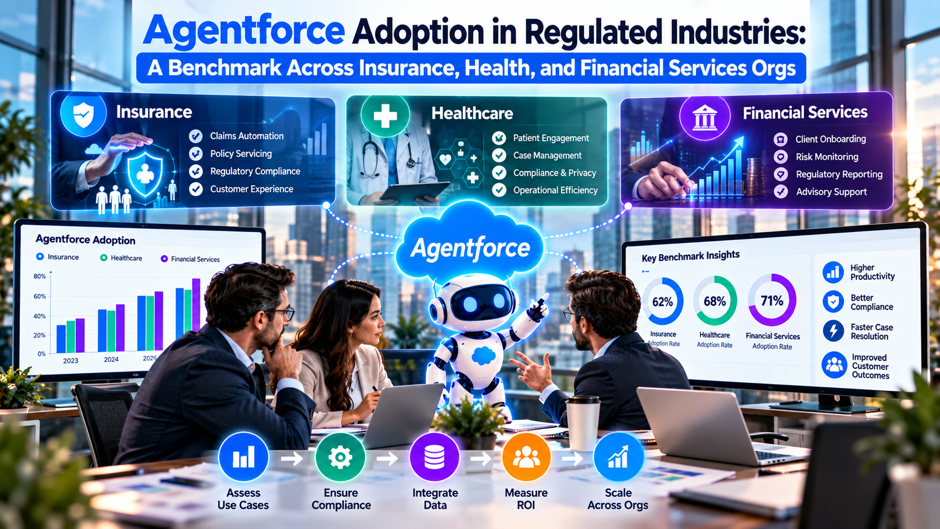
On August 26, 2026, Salesforce reported that Agentforce annual recurring revenue had passed $1.5 billion, up more than 240% year over year, and that customers had generated 3.2 billion agentic work units in a single quarter. Those figures say plenty about Salesforce’s momentum, but they say very little to a compliance officer at an insurer, a hospital system or a bank, because the company doesn’t break adoption out by industry and the rules each of those 3 sectors operates under differ sharply from the rules that govern a retailer or a software company.
This benchmark compares how Agentforce is landing across insurance, health and financial services as of early October 2026. It’s built from published evidence, including company disclosures, named customer outcomes, a vendor-commissioned study and the regulatory timelines each sector faces, and no proprietary survey sits behind it. Where a number comes from Salesforce or a partner, the post says so, and where the evidence is thin, it says that too, because a regulated buyer needs to know which claims can survive an audit.
TL;DR
- Health and insurance show the most visible production evidence, and financial services shows the most regulatory ambiguity. Named deployments cluster around service, intake, scheduling and contact center work with human handoff, while autonomous decisions on claims, clinical care or credit remain rare in published material, and US banking guidance issued in April 2026 explicitly leaves agentic AI outside its formal scope.
- Reported results are real but modest, and most of them come from the vendor. Published figures include 30% of cases deflected at a large auto club and 2% to 3% fewer inbound calls in a commissioned study, which are useful signals that deserve careful reading before anyone builds a business case on them, and 1 Dreamforce 2026 analysis found no audited insurance ROI result from Salesforce.
- Governance decides the pace more than technology does. Insurers answer to a state-adopted AI bulletin that keeps them accountable for vendor models, health organizations manage PHI under HIPAA plus emerging state rules, and banks apply existing risk practices to tools no specific guidance covers yet, so phased, low-autonomy rollouts with human handoff are the dominant pattern across all 3 sectors.
How This Benchmark Was Built and What It Can’t Tell You
The evidence base for this comparison comes from 4 kinds of sources: Salesforce earnings disclosures and product announcements, named customer examples that Salesforce or the customer has published, a Forrester industry spotlight commissioned by Salesforce in August 2026, and regulatory records such as the NAIC model bulletin on AI and the April 2026 interagency model risk guidance. Each source carries a different level of reliability, and the sections below label them so a reader can weigh a Salesforce-reported outcome differently from a regulator’s published guidance.
Several limits shape what this benchmark can claim. Salesforce reports adoption in aggregate, so there’s no published count of regulated-industry customers in production, and any statement about which sector is furthest along rests on the density of named, public examples instead of a census. The scorecard later in this post is an analyst judgment built from that evidence, and it should be read as a structured way to compare readiness rather than as measured survey data.
A final caution concerns timing. Agentforce is a fast-moving product line, regulators are actively revising their guidance, and several figures cited here changed within the past 2 quarters. Anyone using this benchmark to support a business case or a risk review should confirm current numbers directly with Salesforce and with their own regulators before relying on them, and should treat the framework as the durable part of the analysis.
The Platform-Level Signal: What Salesforce Has Disclosed
| Metric | Latest Disclosure | How to Read It |
| Agentforce ARR | Above $1.5 billion in Q2 FY27, up more than 240% year over year | The metric now includes Slackbot and Headless 360, so growth isn’t like-for-like with earlier quarters |
| Agentforce and Data 360 ARR | Nearly $3.9 billion, up more than 210% | Blends 2 product lines, and the Data 360 portion includes acquired Informatica Cloud revenue |
| Agentic work units | 3.2 billion in Q2, up 97% from Q1 | Measures usage volume and doesn’t separate low-risk tasks from regulated workflows |
| Paying customers in production | 2,000 added in the quarter, up 70% quarter over quarter, per Salesforce’s COO | The strongest deployment signal available, though it covers every industry combined |
| Companies using Agentforce | More than 25,000 across 124 countries, per Salesforce | Includes builders and pilots, so it overstates companies in production |
| Earlier milestone | 18,500 deals with more than 9,500 paid as of Q3 FY26 | Roughly half of deals were paid at that point, a useful baseline for conversion |
The table shows a company that’s scaling quickly, and Salesforce’s Q2 FY27 results provide the latest company-level signal behind those figures. None of the disclosures separate insurers, providers or banks from retailers and software firms, and the work-unit counts can’t distinguish a password reset from a claims intake. Reading regulated-sector adoption therefore requires the named examples, product announcements and regulatory timelines covered in the sections that follow.
Insurance: Where Agentforce Is Landing First
Service and First Notice of Loss Intake Lead the Use Cases Salesforce’s insurance offering concentrates on service assistance, claims employee assistance and a voice-enabled claims template that captures first notice of loss around the clock without a service representative on the line. These use cases share a profile that suits a cautious regulated buyer: the agent gathers information, answers coverage questions from approved sources and hands off to a person for anything that affects a coverage or payment decision. Published insurance examples cluster here, including AAA Washington’s member services and Young Drivers’ support and scheduling work in Canada, while broader Salesforce for insurance companies implementations face the same need for controlled access and clear handoffs.
Published Outcomes Are Real but Modest and Largely Self-Reported The most specific insurance figures come from the Auto Club Group, which Salesforce says uses Agentforce across quote, claims and service for 13 million members, with 30% of cases deflected through self-service and response times reduced by up to 10%. Simplyhealth reports serving twice as many members per day and saving 100 hours per week on tier-1 inquiries. Both figures come through Salesforce, and 1 analysis of Dreamforce 2026 noted that the company didn’t publish an audited, named insurance ROI result or new pricing for its insurance stack.
The NAIC Bulletin Shapes How Far Insurers Let Agents Go The NAIC adopted its model bulletin on AI systems in December 2023, and tracking from mid-2026 counts roughly 25 states with formal adoption and about 8 more in progress, though totals vary by source depending on whether states with related guidance are included. The bulletin keeps the insurer accountable for outputs from third-party AI systems and expects a written program covering selection, validation, monitoring and retirement. Agents that touch claims decisions, underwriting or pricing sit squarely inside that scope, which explains why most carriers start at intake and service.
Examination Infrastructure Is Being Built Even Without Public Enforcement 1 analysis found no publicly reported formal enforcement action under an adopted bulletin as of the first quarter of 2026, yet the NAIC began piloting an AI Risk Evaluation Supplement, earlier called the AI Systems Evaluation Tool, with 12 participating states in March 2026, and formal adoption was anticipated at the 2026 Fall National Meeting. Insurers deploying agents now should expect examiners to ask for inventories, testing records and vendor diligence files when that tool matures.
Health: Administrative Workflows First, Clinical Decisions Later
- Agentforce for Health began as a library of pre-built skills for administrative work. Launched in early 2025, Agentforce for Healthcare targeted tasks such as checking eligibility and analyzing clinical trial sites for providers, payers, public health agencies and life sciences companies, and Salesforce named Amplifon, Pacific Clinics, Protas and Rush among early users, which set the pattern of administrative burden reduction as the lead use case.
- The March 2026 HIMSS announcement added 6 agents covering referral triage, EHR writeback, claims resolution, rural telehealth, epidemiology analysis and hospital operations. Salesforce’s March 2026 health-agent announcement paired them with data partnerships involving HealthEx, Verily and Viz.ai, made some templates generally available immediately and scheduled referral triage, root cause analysis and engagement campaigns for June 2026, so the portfolio is broad even though production evidence for the newest agents is still accumulating.
- The EHR writeback agent is the most consequential release from a compliance perspective. It supports bidirectional exchange with systems such as athenahealth through MuleSoft connectors, letting contact center staff retrieve patient data, update demographics and submit medication refill requests, and Salesforce says it operates with full audit trails, which is exactly the control a privacy officer will want to test before any agent writes to a clinical record.
- Named volume examples show where scale is arriving. Salesforce describes CVS Caremark using Agentforce to reason across more than 150 fulfillment substatuses for 87 million members, and UChicago Medicine using an agent against 2.5 million patient inquiries a year, many arriving after hours, and both examples are high-volume inquiry handling with human escalation in place of clinical judgment, which shows where regulated organizations feel comfortable letting agents work at scale today.
- Reported results are encouraging and should be read with their sources in mind. MIMIT Health, an early adopter, reports 459% ROI and $1.5 million in savings through Salesforce announcements, while interviewees in a Forrester spotlight commissioned by Salesforce estimated 20% to 30% less follow-up time, 10% to 25% less rework and an initial 2% to 3% reduction in inbound call volume, which is a sober reminder that early call deflection tends to be modest.
Financial Services: Strong Interest, Regulatory Gap
Salesforce introduced Agentforce for Financial Services on top of Financial Services Cloud with banking and insurance service agents, and by 2026 the company described the product as evolving into Agentforce Financial Services with more than 200 templates, topics and actions spanning banking, wealth, insurance, compliance, lending and collections. Named examples include CaixaBank, which Salesforce quoted as planning to use Agentforce for internal operations and personalized banking across its 20.3 million customers, and Sammons Financial Group. For organizations considering similar deployments, Salesforce consulting for finance has to account for both business workflows and the controls surrounding them rather than treating AI deployment as an isolated technology project.
The regulatory picture changed materially on April 17, 2026, when the Federal Reserve, OCC and FDIC issued revised model risk management guidance, SR 26-2 and OCC Bulletin 2026-13, replacing SR 11-7 after 15 years. The new guidance explicitly places generative and agentic AI outside its scope, describing them as novel and rapidly evolving, and tells banks to apply their existing risk management and governance practices instead. 1 analysis also reports a $30 billion asset threshold for applicability, and the agencies said they plan to issue a request for information on banks’ use of AI, which 1 review couldn’t find in the Federal Register as of late August.
For a bank, that creates an unusual situation: there’s no prescriptive rulebook for agents, and also no safe harbor. Existing obligations around consumer protection, fair lending, complaint handling, recordkeeping and third-party risk still apply to every interaction an agent handles, and examiners will expect the institution to show how it governs a tool that falls outside the formal model definition. Because most agentic capability reaches banks through vendors, the vendor’s governance effectively becomes part of the bank’s own, which pushes many institutions toward narrow, well-monitored deployments in service and advisor support. Outside the US, the EU deferred high-risk AI Act obligations, including those covering credit scoring, to December 2027 under its Digital Omnibus.
The Cross-Industry Benchmark Scorecard
| Dimension | Insurance | Health | Financial Services |
| Density of named public examples | Moderate, led by auto clubs and health plans | Strongest, with providers, payers and pharmacy benefit work | Moderate, led by large banks and wealth firms |
| Typical first use cases | Service answers, first notice of loss intake, member support | Contact center, scheduling, referral triage, eligibility | Service agents, advisor meeting prep, complaint handling |
| Autonomy seen in production | Answers and intake with handoff for decisions | Administrative tasks, with audited EHR writes emerging | Service and advisor assistance under human supervision |
| Primary regulatory anchor | NAIC bulletin, adopted state by state | HIPAA plus a growing set of state AI rules | Existing risk and consumer rules, with SR 26-2 scope exclusion |
| Clarity of agent-specific guidance | Moderate, since the bulletin is technology neutral and documented | Moderate, since HIPAA predates agents but is well understood | Low, since agentic AI is explicitly excluded from model guidance |
| Main bottleneck | Integration with policy and claims core systems | EHR integration and PHI controls | Governance, validation and vendor oversight |
This scorecard reflects the analyst judgment described earlier, and its ratings describe relative evidence and clarity rather than measured adoption rates. Health leads on visible examples because patient and member contact work generates high volumes and clear metrics, while insurance benefits from a mature, state-adopted bulletin that tells carriers what an acceptable program looks like. Financial services shows the widest gap between interest and guidance, which doesn’t prevent adoption but does push institutions to build their own governance standards before regulators supply one.
Regulatory Pressure Points by Industry
Insurance Carries Documentation and Vendor Accountability Duties The NAIC bulletin asks insurers to maintain a written AI systems program, perform pre-use diligence on third-party systems, test for errors and unfair discrimination, and keep records that examiners can review. Because the bulletin treats a vendor’s model like the insurer’s own, a carrier deploying Agentforce should expect to document what the agents can do, which data they use, how outputs get tested and how the carrier would explain a consumer-affecting decision. Contract terms that grant audit rights and regulatory cooperation matter as much as the technology.
Health Combines HIPAA With a Growing Layer of State Requirements Salesforce describes its platform as HIPAA-ready, and that phrase marks a starting point for a covered entity instead of a finish line. Organizations still need business associate agreements, minimum necessary access, role-based permissions and logging that fit their own policies, and the HIPAA Security Rule still requires regulated entities to manage access and security risks around electronic protected health information. Privacy teams reviewing Agentforce should test exactly what patient data an agent can read and write, since the EHR writeback capability raises that question directly.
Financial Services Faces Existing Rules Without an Agent-Specific Rulebook With SR 26-2 setting agentic AI aside, banks and other lenders lean on established frameworks for consumer protection, fair lending, complaint management, recordkeeping and third-party risk. An agent that answers a customer about a fee, a dispute or a loan status creates a record and a potential complaint, and the institution has to show that interactions were accurate, supervised and retrievable. The absence of specific guidance raises the premium on internal standards, such as an agent inventory and defined escalation triggers.
Governance Controls Regulated Buyers Ask For
- Data protection controls inside the platform. The Einstein Trust Layer is described as a built-in framework intended to keep customer data inside the trusted environment when agents interact with language models, and regulated buyers typically ask for written documentation of how data masking, retention and model provider terms work so their own risk teams can verify the claims instead of accepting a summary.
- Scoped permissions and defined actions. Agents operate through topics and actions that administrators define, which lets a team limit what an agent can read, write or trigger, and a least-privilege design that gives a service agent access to coverage answers without access to adjudication functions is the single most common control regulated teams request before approving a pilot. An AI readiness assessment can surface these permission, data and governance gaps before production access is granted.
- Audit trails and observability for every action. Examiners and internal audit want to reconstruct what an agent said, which data it used and what it changed, so regulated deployments should confirm that conversation logs, action logs and reasoning records are retained long enough to satisfy the applicable recordkeeping rules and can be exported for reviewers without custom engineering work.
- Human handoff and escalation rules written down. The published deployments almost all include a defined path to a person, and regulated teams document the triggers for that handoff, such as a complaint, a coverage dispute, a clinical question or a vulnerable customer signal, because those triggers are the practical boundary between assistance and a regulated decision, and examiners tend to ask to see them in writing.
- Testing before and after launch. The NAIC bulletin expects validation and monitoring, banks apply their existing governance to agentic tools, and privacy officers need evidence that patient data stays protected, so successful teams build a test set of real scenarios, review a sample of live interactions on a schedule and keep records that show what changed after each issue. That ongoing work is also where Agentforce managed services can become relevant after the initial deployment.
Adoption Barriers Seen Across All 3 Industries
Data readiness is the barrier that implementation partners mention most often, and it appears in every sector. An insurance agent needs policy histories, claims records and billing data from several systems to answer a question correctly, a health agent needs patient context drawn from an EHR, and a banking agent needs account and transaction data from core systems. Salesforce’s insurance work emphasizes connections to core platforms such as Guidewire, Duck Creek and Applied Epic, while the health agents rely on MuleSoft connectors to EHRs, so Agentforce integration services and the quality of those connections set a ceiling on agent quality.
Risk tolerance is the second barrier, and it’s the reason autonomy remains narrow. Commentators on enterprise AI adoption point out that even a hallucination rate of a single percentage point can be unacceptable in finance and healthcare, and that being the first in a field to adopt an unproven tool offers little upside against the downside. SalesforceBen’s early 2026 assessment captured the open question well: agents are useful as interfaces, assistants and orchestration layers, though it remains unclear whether they’ll be widely trusted to perform fully automated work in regulated sectors.
Commercial uncertainty is the third barrier. 1 Dreamforce 2026 analysis reported that Salesforce didn’t publish new Agentforce pricing, and the company’s pricing now spans consumption credits, premium bundles and outcome-based arrangements, and management said about half of recent Agentforce bookings came from customers refilling credits. That’s an encouraging sign of repeat usage, though it also means a regulated buyer has to model costs that vary with volume, including the cost of the review, testing and monitoring that its own governance requires, before approving a business case.
Reading Vendor-Reported Results With Care
Check Who Produced the Number A figure from Salesforce, a Salesforce partner or a customer quoted in a press release reflects a source with a stake in the outcome, and a Forrester study commissioned by Salesforce is useful but isn’t independent in the way a regulator’s report is. Several implementation partner blogs circulate claims such as 30% lower operating costs or 40% faster claims processing without naming an auditable source, and those should be treated as marketing until a named customer confirms them.
Check What Was Actually Measured Deflection, resolution and satisfaction measure different things, and hours saved can be gross or net of the time spent reviewing agent output. A 30% deflection rate says that interactions didn’t reach a person, and it doesn’t say that customers got correct answers or that complaints stayed flat. Regulated teams should ask for definitions, because an agent that deflects a question incorrectly can create exactly the kind of record an examiner wants to see.
Check the Baseline and the Time Frame Early results often reflect the easiest use cases and the most motivated teams, so gains seen in a pilot may shrink when the agent meets harder inquiries. The company-level ARR figure carries a similar caution, since Salesforce widened the Agentforce definition in Q2 FY27 to include Slackbot and Headless 360, which makes the 240% growth rate a poor guide to regulated-industry traction specifically. Ask for before-and-after data using the same definitions over several months.
A Phased Adoption Path for Regulated Teams
- Start by inventorying candidate use cases and sorting them into risk tiers. Low-risk work such as answering general policy, benefit or product questions sits in the first tier, assisted work such as summarizing records for an adjuster or care coordinator sits in the second, and anything that decides coverage, treatment, credit or pricing sits in the highest tier that requires human decision-making and full documentation.
- Launch with low-autonomy service and intake agents that hand off to people. This matches where published deployments cluster, and Agentforce Service gives teams a relevant model for service-oriented use cases with human oversight. It produces real volume data, error samples and complaint patterns that a governance committee can review, which turns an abstract risk discussion into a concrete one grounded in the organization’s own customer, member and patient interactions, which is far more persuasive to a risk committee than vendor benchmarks.
- Add assisted actions where an employee reviews and approves the agent’s work. Drafting correspondence, preparing meeting briefs and summarizing documents deliver real time savings while a person remains accountable for the outcome, and the review step also generates the measurement data needed to show regulators, auditors and boards that human supervision is genuine, consistent and documented from the very first pilot.
- Permit governed writes to systems of record only after testing the audit trail. An agent that updates a demographic field, submits a refill request or changes a claim status needs scoped permissions, logging that survives audit and a rollback path, and the EHR writeback example shows why privacy and compliance teams should review and approve this step separately from the earlier phases of the rollout.
- Revisit autonomy levels on a schedule tied to evidence and to regulatory change. The NAIC tool, the planned banking request for information and new state laws will all shift expectations, so a quarterly review that compares error rates, complaints and guidance updates against the approved scope keeps the program current instead of letting it drift away from what the governance committee originally approved.
Metrics to Track From Day 1
| Metric | Why It Matters | Regulated-Industry Nuance |
| Accuracy on sampled interactions | Shows whether answers are correct, which deflection alone can’t show | Sample by topic and keep reviewer notes as evidence for examiners |
| Escalation rate and escalation quality | Shows whether the agent hands off when it should | Track handoffs triggered by complaints, disputes and clinical or coverage questions |
| Complaint rate tied to agent contacts | Links the agent to consumer outcomes | Complaint management rules in banking and insurance make this a compliance metric |
| Net hours saved | Captures savings after review and rework time | Include governance and monitoring effort so savings aren’t overstated |
| Audit completeness | Confirms actions and reasoning are logged and retrievable | Test retention periods against recordkeeping requirements |
| Cost per resolved case | Compares agent cost with the human baseline | Include consumption credits and the cost of testing and oversight |
These metrics work together, and no single 1 of them tells a complete story. A high deflection rate paired with a rising complaint rate signals a problem that the deflection number alone would hide, and strong hours-saved figures mean little if the audit trail can’t reconstruct what the agent did. Tracking all 6 from the first pilot gives a regulated team a defensible record, and it also produces the benchmark data the organization will need to compare its results against published claims from vendors and peers.
What to Watch Next
Several developments over the coming months will change this benchmark. The NAIC’s anticipated action on its AI Risk Evaluation Supplement at the Fall 2026 National Meeting would give insurance examiners a standard tool for reviewing AI programs. The federal banking agencies’ promised request for information on AI, including agentic systems, would be the first formal step toward guidance that fills the gap SR 26-2 left. State legislatures continue to add AI disclosure and oversight requirements affecting healthcare and insurance communications.
On the vendor side, the most useful disclosure would be industry-level data, such as counts of regulated-sector customers in production and audited outcomes for named deployments. Salesforce’s next earnings report will update the company-level numbers, and the interesting question for regulated buyers is whether the paid-production count keeps growing at the pace the Q2 figures suggest. Until industry-level data appears, named examples, commissioned studies and regulatory records remain the best evidence available, and this benchmark should be refreshed as that evidence improves.
FAQs
Is there published Agentforce adoption data broken out by industry?
In the sources reviewed for this benchmark, Salesforce reports adoption in aggregate, including more than 25,000 companies using Agentforce and 2,000 paying customers added to production in the latest quarter. It doesn’t publish counts of insurers, health organizations or banks in production, so comparisons between sectors rely on named examples, product announcements and regulatory timelines instead of a census.
Which of the 3 industries is furthest along with Agentforce?
Based on the density of named public examples, health shows the most visible activity, with providers, payers and pharmacy benefit work all represented, and insurance follows with service and claims intake examples. Financial services shows strong interest and a broad product portfolio, though the regulatory ambiguity around agentic AI keeps many deployments narrow. This is an analyst reading of published evidence, and no survey data confirms the ranking.
Is Agentforce usable for organizations that must comply with HIPAA?
Salesforce describes its platform as HIPAA-ready, which means covered entities can configure it for protected health information. Compliance still depends on the organization’s own setup, including a business associate agreement, role-based access, logging and a review of exactly what patient data an agent can read or write. Privacy officers should confirm current terms and scope directly with Salesforce and counsel.
Does SR 26-2 prohibit banks from using AI agents?
No. The April 2026 guidance replaced SR 11-7 and explicitly places generative and agentic AI outside its scope, describing them as novel and rapidly evolving, while telling banks to apply their existing risk management and governance practices. That leaves no agent-specific rulebook and no safe harbor, and the agencies have said they plan to seek public input on how banks use AI before issuing more specific guidance.
How does the NAIC model bulletin affect insurers that use vendor-built agents?
The bulletin keeps the insurer accountable for outcomes from third-party AI systems, so a carrier can’t shift responsibility to a vendor by contract. Insurers in adopting states are expected to maintain a written AI program, perform diligence on vendor systems, test for errors and bias, and be ready for examiner questions, and contract terms that preserve audit rights and regulatory cooperation help support that work.
What’s a sensible first use case for a regulated organization?
Most published deployments start with service and intake: answering questions from approved knowledge, capturing first notice of loss, scheduling or routing patient and member inquiries, and handing off to a person for anything that affects coverage, care or credit. These use cases generate measurable volume, keep a human accountable for decisions and let governance teams review real interactions before the organization expands the agent’s scope.
How should teams interpret vendor-reported ROI figures?
Treat them as hypotheses to test. Ask who produced the number, what exactly was measured, what the baseline was and over what period, and be cautious with figures from commissioned studies or partner blogs that don’t name an auditable customer. A 30% deflection rate and a 459% ROI figure can both be accurate for a specific deployment while telling a different organization very little about its own results.
Which metrics should a regulated team track from the first pilot?
At a minimum, track accuracy on sampled interactions, escalation rate and quality, complaint rate tied to agent contacts, net hours saved after review time, audit completeness and cost per resolved case. Together these show whether the agent is helping customers and meeting recordkeeping duties, and they create the evidence trail that examiners, internal audit and a governance committee will ask for when the program expands.