

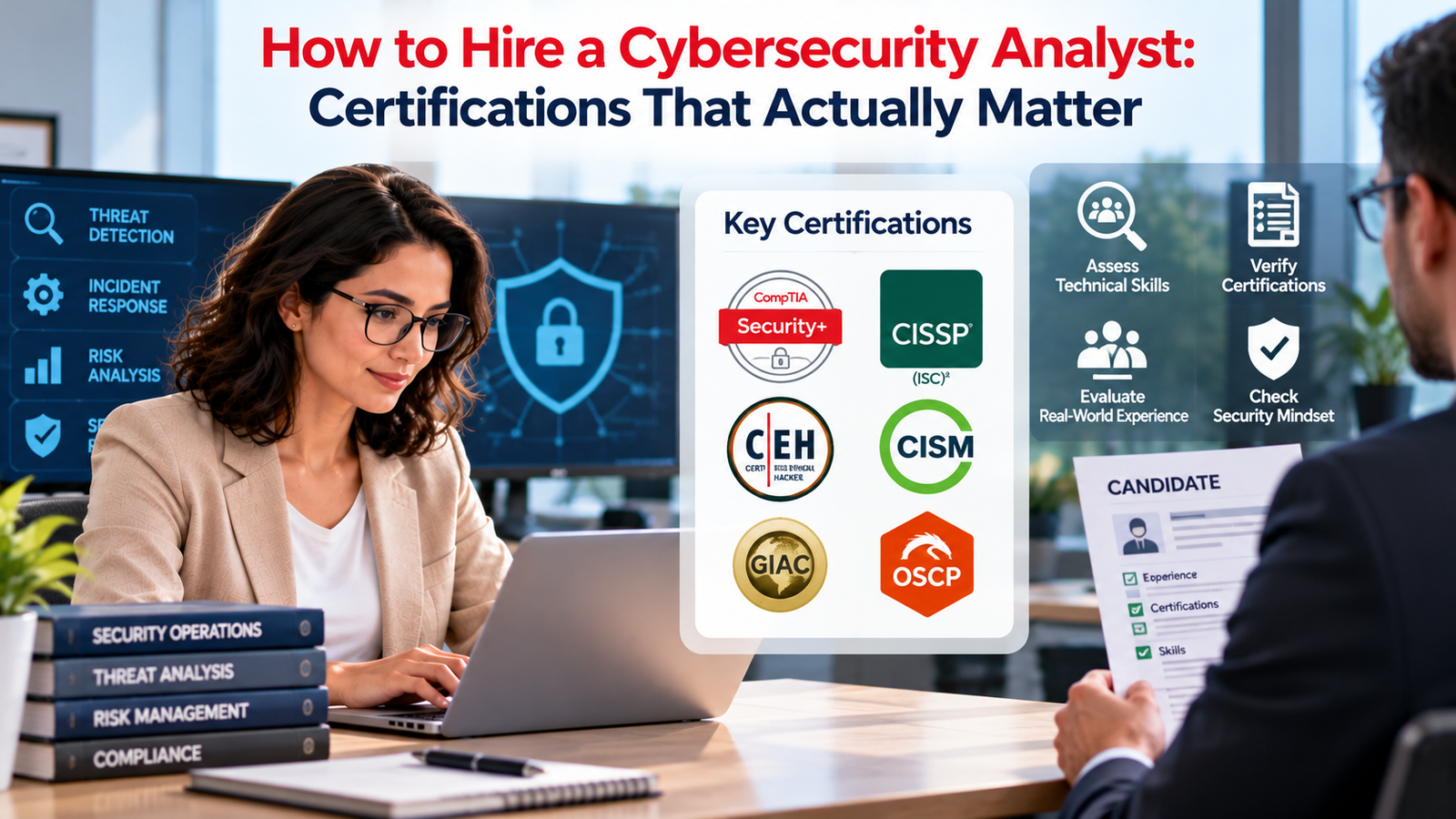
Hiring a security analyst gets harder when the job description starts with a list of certifications instead of the work the person will own. A certificate can confirm that a candidate studied a defined body of knowledge. It can’t prove that the person can investigate a noisy alert, explain why an event matters, or make a sound call with incomplete evidence.
The better approach is to define the analyst role first, then use certifications as one piece of evidence. That matters because the title “cybersecurity analyst” covers very different jobs. One company may need a first-line SOC analyst who spends most of the day in a SIEM. Another may need an experienced investigator who handles incidents, threat hunting, and detection logic. A third may expect the analyst to support vulnerability management or cloud security.
This guide explains how to hire a cybersecurity analyst without turning credentials into a shortcut for judgment. It covers the certifications that fit common analyst roles, the cybersecurity analyst skills worth testing, realistic cybersecurity analyst job requirements, resume screening, practical assessments, and cybersecurity analyst interview questions that reveal how a candidate thinks.
TL;DR
Start with the work, not the certification list. Use entry-level credentials to confirm basic knowledge, practitioner credentials to support role fit, and senior credentials only when the job truly needs senior scope. Test candidates with a short work sample based on your environment. Score investigation quality, reasoning, communication, and evidence handling separately. A certificate can strengthen a hiring case, but it shouldn’t replace proof that the person can do the job.
What A Cybersecurity Analyst Actually Does
A cybersecurity analyst watches for signs of compromise and investigates suspicious activity. The analyst may also help contain incidents and record what happened. The exact mix depends on the employer. Across the occupation, common duties include monitoring for breaches, checking vulnerabilities, preparing reports, and recommending security changes. Related IT experience is also common before people move into analyst work.
That broad definition is why a generic analyst job description causes trouble. An analyst assigned to alert triage needs fast judgment and strong log reading. An analyst who owns vulnerability work needs to interpret scanner output and understand how asset value affects priority. An analyst expected to support incident response needs stronger containment and evidence-handling habits.
Before you hire a cybersecurity analyst, write down the recurring decisions the person will make. Then list the systems that produce the evidence behind those decisions. This gives you a hiring target based on actual work instead of a loose title.
Define The Analyst Role Before You Recruit
The cleanest way to scope the role is to describe tasks, knowledge, and skills instead of relying on a title. NIST’s NICE Framework uses that same model. Its NICE Framework guidance separates the work to be done from the knowledge and skills needed to do it, which makes it useful when a company is building a job description or an assessment.
Start by deciding where the analyst sits in your security process. A monitoring-heavy role may spend most of its time reviewing SIEM alerts, endpoint events, identity logs, and email security findings. A vulnerability-focused role may spend more time on scan results, remediation tracking, exception review, and risk communication. An incident-focused role may need deeper endpoint, network, and containment experience.
NIST updated the NICE Framework components again in 2026. The NICE 2.2 update keeps the framework centered on work roles, competency areas, and task, knowledge, and skill statements. That makes it a better starting point than copying a job post from another company whose tools and risk profile may be different.
A useful role brief should answer 5 questions: what the analyst investigates, what tools they use, what decisions they can make alone, what must be escalated, and what good performance looks like after 90 days. Those answers will shape every later choice about experience and credential fit.
If you need to hire a cybersecurity analyst across several business units, write down which duties are truly shared and which are local. That stops one job post from absorbing every security task in the company and producing a role no single candidate could reasonably match.
Set Cybersecurity Analyst Job Requirements Around The Work
Good cybersecurity analyst job requirements separate what a candidate needs on day 1 from what can be learned after hiring. This keeps the screening bar tied to the job and prevents a long wish list from pushing out capable candidates.
For an early-career role, day-1 requirements might include basic networking knowledge, an ability to read common logs, comfort with Windows or Linux, and a clear incident-triage thought process. If your team can teach its SIEM and ticketing workflow, don’t make years of experience in those exact products mandatory. Tool familiarity helps, but the underlying investigation method matters more.
Current hiring research supports that approach. ISC2 surveyed 929 cybersecurity hiring managers for its 2025 hiring study and found that 90% would consider an early-career candidate with prior IT experience only, while 89% would consider someone with only an entry-level cybersecurity certification. The same research found that 84% used skills-based assessments or tests for entry-level and junior candidates.
For a more experienced role, cybersecurity analyst job requirements should be stricter about independent investigation, incident ownership, evidence quality, and communication with other teams. If the person will write detection logic, add that. If the role touches cloud identity, add the relevant cloud stack. If the analyst will support audits, include the control or regulatory knowledge that the work actually requires.
The goal is a short set of defensible requirements. Every item should connect to a task the person is likely to perform.
When you hire a cybersecurity analyst, separate required experience from preferred exposure. For example, independent incident ownership may be mandatory for a senior analyst while experience with your exact ticketing system may be teachable in the first few weeks.
Cybersecurity Analyst Certifications That Actually Matter
Cybersecurity analyst certifications matter when their scope matches the work and the candidate’s career stage. They matter much less when they are used as prestige filters. A useful hiring screen asks what the credential tested, how recently the candidate earned it, and whether the candidate can apply the material in a realistic scenario.
The following map works well for common analyst hiring decisions.
| Certification | Best Hiring Use | What It Can Signal | Main Caution |
| ISC2 CC | Entry-level screening | Foundational security concepts and security operations basics | Doesn’t replace hands-on evidence |
| CompTIA Security+ | Entry or junior analyst | Broad baseline knowledge across threats, operations, architecture, and governance | Broad scope means depth can vary |
| CompTIA CySA+ | Junior to mid-level analyst | Security operations, vulnerability work, incident response, and analysis | Better fit after some hands-on experience |
| GIAC GSEC | Practitioner screening | Broad technical security knowledge with hands-on exam elements | Cost may reduce how often candidates hold it |
| GIAC GCIH | Incident-focused analyst | Incident handling and attack technique knowledge | Too narrow for some generalist roles |
| Microsoft SC-200 | Microsoft security operations role | Sentinel, Defender, threat hunting, and incident response in the Microsoft stack | Strongest when your environment uses Microsoft security tools |
| CISSP | Senior analyst or lead scope | Broad security knowledge backed by experience requirements | Often excessive for entry-level roles |
For baseline hiring, Security+ is still a practical signal because its current objectives cover threats, security architecture, security operations, and program oversight. The official Security+ exam objectives show that security operations has a large share of the current SY0-701 exam, but a hiring manager should still test whether the candidate can work through evidence instead of assuming an exam pass proves investigation ability.
If you need to hire a cybersecurity analyst for daily security operations, role alignment matters more than the number of credentials on the resume. A certificate should help you predict whether the candidate has studied the kinds of decisions the job will demand.
For analyst work with more direct operational depth, CySA+ V4 (CS0-004) aligns closely with day-to-day security operations. The current CySA+ V4 / CS0-004 exam objectives put 34% of the exam on Security Operations and also cover vulnerability management, incident response and management, and reporting and communication. CompTIA recommends about 4 years of hands-on experience in a SOC analyst (level 2) or vulnerability analyst role, and the exam includes performance-based questions. That makes the credential more useful as supporting evidence for a mid-level analyst than as a hard entry requirement.
How To Read Entry-Level Certifications
Entry-level cybersecurity analyst certifications are most useful when you need evidence that a candidate has learned the basic language of security. They can help distinguish a serious career changer or junior applicant from someone who hasn’t yet built a base, but they shouldn’t become the final screen.
ISC2’s Certified in Cybersecurity is designed for people entering the field and doesn’t require prior work experience. The current CC exam outline covers security principles, governance, identity and access concepts, networking and cloud security, and security operations with incident response. That scope makes CC reasonable for entry-level hiring where the team expects to teach internal tools and processes.
Security+ also fits this layer, especially when you want broader technical coverage. What you shouldn’t do is require several foundation-level certifications that overlap heavily. One credible baseline certificate plus evidence of practice is usually more informative than a string of similar badges.
When you hire a cybersecurity analyst at the entry level, look for what happened after the certificate. Ask what lab work the candidate completed, what logs they analyzed, how they documented a finding, or what project forced them to change an initial assumption. That turns the credential into a starting point for verification instead of an automatic score boost.
When Mid-Level And Role-Specific Certifications Matter
Mid-level cybersecurity analyst certifications become more useful when the role has a defined operating context. At this stage, the question is less about whether the person knows security terms and more about whether their training maps to the investigations you expect them to handle.
GIAC GSEC can support a broad practitioner profile. Its GSEC certification scope includes networking, endpoint security, SIEM concepts, incident handling, cloud topics, vulnerability scanning, Linux, and Windows security. GIAC also uses hands-on CyberLive elements in the exam. A GSEC holder still needs a work sample, but the credential covers many areas that matter to a general security analyst.
GCIH is more specific. The GCIH certification scope centers on detecting and responding to incidents while understanding attack techniques and common attacker tools. It carries more hiring value when the role includes incident response, escalation handling, or first-responder duties than when the job is mostly policy review or vulnerability tracking.
If you plan to hire a cybersecurity analyst into a mature SOC, role-specific credentials can help you compare candidates who already have some security experience. They are most useful when the exam content overlaps with the work you expect during the first 6 months.
Vendor credentials also matter when the analyst will spend much of the day inside a particular platform. Microsoft’s SC-200 role scope covers security operations work using Microsoft Sentinel and Defender products, including triage, incident response, threat hunting, and KQL. If your environment is heavily Microsoft-based, that match can shorten the learning curve. If your environment uses another stack, treat SC-200 as evidence of analyst method rather than proof of tool readiness.
When CISSP Is Useful And When It Is The Wrong Filter
CISSP can be useful for a senior analyst, lead analyst, or role with broad security responsibility. It is usually a poor mandatory filter for an entry-level SOC analyst. The credential has experience rules that make this distinction clear.
ISC2 states in its CISSP experience rules that candidates need 5 years of cumulative full-time experience across at least 2 CISSP domains, with limited ways to satisfy 1 year of that requirement through a degree or approved credential. Someone can pass the exam before meeting the full experience requirement and hold Associate of ISC2 status, but that isn’t the same as being a CISSP.
The mismatch still appears in hiring. ISC2’s 2025 hiring research found that some managers reported requiring CISSP even for early-career positions despite the credential’s experience threshold. That creates an avoidable barrier and can shrink the applicant pool before practical ability is tested.
If you need to hire a cybersecurity analyst who will act as the senior escalation point, CISSP can add useful evidence because the job itself has moved beyond first-line analysis. Even then, verify the candidate’s operating depth instead of assuming the credential settles the question.
Use CISSP when your cybersecurity analyst job requirements include broad risk judgment, cross-functional ownership, senior incident decisions, or leadership duties. Don’t make it mandatory simply because it is well known. A senior credential should match senior work.
Cybersecurity Analyst Skills To Test Before The Interview
The strongest cybersecurity analyst skills show up in how a candidate handles evidence. Knowledge matters, but the job requires turning incomplete signals into a defensible decision. Your screening process should test that directly.
Start with log analysis. Give the candidate a small set of authentication, endpoint, or network events and ask what they would check first. NIST’s NICE material treats log analysis as a concrete security skill, and the broader framework is built around observable tasks and skills. A candidate doesn’t need to know your exact SIEM syntax to explain which fields matter and why.
Next, test triage discipline. The analyst should be able to separate an alert from an incident. Ask what evidence would raise or lower confidence, what would justify containment, and what information is missing. Strong answers usually show a sequence of checks rather than an instant conclusion.
Communication belongs in the same test. NIST’s NICE workplace skills guidance includes communication, critical thinking, integrity, problem solving, and other workplace abilities that support cybersecurity work. For hiring, that means a technically correct answer isn’t enough if the candidate can’t explain risk to an IT owner or record an investigation clearly.
Other analyst skills should follow the role. A vulnerability analyst should be able to reason about exploitability and asset exposure. A SOC analyst should be comfortable correlating alerts across sources. An incident-focused analyst should know how containment choices can affect evidence and business operations.
When you hire a cybersecurity analyst, score these capabilities separately. A candidate may be strong in analysis but weak in communication, or strong in tooling but too quick to make assumptions. Separate scores make those tradeoffs visible.
Review Resumes Portfolios And Hands-On Evidence
Resume review should answer 2 questions: has the candidate worked on problems similar to yours, and can they explain what they personally did? Job titles alone won’t answer either one.
Look for evidence of investigations, alert handling, vulnerability work, scripting, lab projects, or system administration that built relevant habits. For early-career applicants, home labs and structured training can help, but the candidate should be able to explain the setup, the evidence they collected, what went wrong, and what they learned. That gives you more signal than a list of tools with no context.
Transferable IT work deserves a close look. A system administrator may already know authentication logs, patching limits, endpoint behavior, and change control. A network engineer may understand traffic patterns and packet evidence. A help desk technician may have useful identity and troubleshooting experience. The hiring question is whether those habits carry into security investigation. Ask the candidate to walk through a case where the first explanation was wrong and describe the evidence that changed the decision.
Portfolios need the same scrutiny. A public lab write-up can show how someone thinks, but copied walkthroughs prove very little. Pick one project and ask why the candidate chose the data source, how they separated normal activity from suspicious activity, and what they would change if the environment were larger. Candidates who did the work can usually explain tradeoffs and mistakes without reciting the write-up. This approach also helps career changers show useful ability before they have a security job title.
Cybersecurity analyst certifications belong in this review, but they should be read beside experience. A Security+ holder with 2 years of help desk and identity administration work may have stronger practical foundations than a candidate with several badges and little evidence of operating systems or networks.
Verify every certification that materially affects the hiring decision. Use the issuer’s official verification method or a candidate-provided verification link rather than relying on a badge image or resume line. Confirm the credential name, level, holder identity, and status shown by the issuer. If the certification has maintenance or renewal requirements, check whether it is active when active status matters for the role. Record the date of the check in the screening notes so another reviewer can reproduce it.
Credential level matters as much as authenticity. Someone who has passed the CISSP exam but has not yet met ISC2’s experience requirement may hold Associate of ISC2 status rather than the CISSP certification itself. That can still be useful evidence, but it shouldn’t be recorded as a full CISSP. Apply the same discipline to vendor credentials with foundation, associate, professional, or specialty levels. If the resume uses a shortened name, verify the exact credential before scoring it. This prevents an expired, incomplete, or lower-level credential from receiving the same weight as the qualification the job description actually requires.
Use cybersecurity analyst job requirements as a resume rubric. Mark each requirement as proven, plausible, missing, or unclear. Anything marked unclear becomes an interview question. This keeps screening consistent and reduces the chance that a familiar employer name or a long certification list gets more weight than role fit.
Build A Practical Skills Assessment And Score It Fairly
A short work sample is the most direct way to verify cybersecurity analyst skills. Keep it close to the work but remove company-sensitive data. A 30 to 60 minute exercise is usually enough to see how a candidate approaches evidence without turning the hiring process into unpaid project work.
One option is a small alert packet with an authentication event, an endpoint alert, a short process tree, and a few network records. Ask the candidate to state what they know, what they suspect, what they would check next, and whether they would escalate. Another option is a vulnerability finding with asset context and business constraints. Ask how they would set priority and what evidence would change that priority.
NIST’s proficiency guidance stresses workplace capability and practical responsibility rather than academic knowledge alone. That fits a hiring assessment well. Score the candidate on observable work: evidence use, reasoning, technical accuracy, decision quality, and written communication.
Keep the scoring guide fixed before interviews begin. Avoid giving bonus points for naming a specific tool when the task can be solved with sound fundamentals. Also avoid making certifications part of the assessment score if they were already considered during resume review. Otherwise, the same signal gets counted twice.
A fair assessment should also allow more than 1 valid path. Security investigations often involve uncertainty. You want to see whether the candidate can explain why a choice is reasonable and what would make them change course.
When you hire a cybersecurity analyst with this method, the assessment becomes a check on actual work habits. It also gives less experienced candidates a way to prove capability that a resume may not show clearly.
Cybersecurity Analyst Interview Questions That Reveal Judgment
Useful cybersecurity analyst interview questions force a candidate to show a process. Trivia can confirm basic knowledge, but scenario questions reveal whether the person can investigate and communicate under uncertainty.
Ask questions such as:
· “You receive an impossible-travel alert for a finance user. What do you check before you decide it is an account compromise?”
· “An endpoint tool flags PowerShell on a server. What evidence would make the activity normal or suspicious?”
· “A critical vulnerability is found on an internet-facing system, but the service owner says the system can’t be patched this week. How would you handle the situation?”
· “You closed an alert as benign and later learned it was part of a real incident. What would you review first?”
· “Tell me about a technical finding you had to explain to someone outside security. What did you leave out and why?”
The best cybersecurity analyst interview questions have a follow-up. Ask what evidence the candidate wants next. Then change one fact and see whether the conclusion changes. This shows whether the candidate is reasoning from evidence or repeating a memorized playbook.
You can also connect these interview questions to the resume. If a candidate claims strong SIEM work, ask them to describe a difficult correlation problem. If they list incident response, ask how they decided between containment options. If they hold a certification, ask for an example where the certification material helped in a real or lab investigation.
Don’t turn the interview into a contest over obscure commands. The cybersecurity analyst skills that matter most are the ones the person will use repeatedly on your team. Your questions should make those visible.
If you hire a cybersecurity analyst after only a conversational interview, strong presentation can hide weak investigation habits. A scenario with follow-up evidence gives you a more stable basis for comparison because every candidate has to explain a decision under the same conditions.
Budget Pay And Hiring Time
Budget affects who you can hire and how long the search will take. The BLS reports a May 2025 median annual wage of $129,180 for information security analysts in the United States. Its BLS occupation profile also shows that pay varies by industry and worker level, so that figure isn’t a universal salary target. It is a useful market reference when you set a range.
Cybersecurity hiring can also take longer than general technology hiring. A CyberSeek market snapshot based on U.S. job-posting data from Q2 2024 through Q1 2025 reported nearly 500,000 cybersecurity job postings and said cybersecurity jobs took 21% longer to fill than other tech jobs. That is one reason inflated cybersecurity analyst job requirements can become expensive. Every unnecessary filter reduces the pool and can extend an already difficult search.
When you hire a cybersecurity analyst, budget for onboarding as well as salary. A candidate who has the right investigation habits but needs time on your SIEM may be a better hire than someone who knows the tool but can’t explain their reasoning. Build the learning period into the hiring plan instead of trying to buy a perfect match on every line of the job description.
Conclusion: Make The Certification Serve The Role
The best way to hire a cybersecurity analyst is to define the work, set a realistic proficiency level, and test the decisions the person will make. Certifications can support that process when their scope matches the role. They become a problem when they replace direct evidence of ability.
Use entry-level credentials to confirm foundations. Use practitioner and platform credentials when they match the actual operating environment. Reserve senior certifications for jobs that require senior judgment. Then verify cybersecurity analyst skills with a practical exercise and consistent scoring.
A well-built process makes cybersecurity analyst certifications one signal among several. It also gives candidates a fair chance to prove they can do the work that matters after they are hired.
FAQs
What Certification Is Best For An Entry-Level Cybersecurity Analyst?
Security+ and ISC2 CC are both reasonable entry-level options. CC is built for newcomers and doesn’t require work experience. Security+ covers a wider baseline across security concepts and operations. The better choice depends on the role, but neither certificate should replace a practical test of basic analysis and troubleshooting.
Is Security+ Enough To Get Hired As A Cybersecurity Analyst?
Security+ can help a candidate pass an early screening step, but it doesn’t prove that the person can investigate alerts or work through ambiguous evidence. Employers should treat it as proof of baseline study and then test practical ability through labs, prior IT work, a short assessment, or a structured interview.
Is CySA+ Better Than Security+ For An Analyst Role?
CySA+ is more closely aligned with security operations, vulnerability management, and incident response. Security+ is broader and fits an earlier career stage. For a junior or mid-level analyst, CySA+ may provide a stronger role signal, especially when the candidate also has hands-on experience.
Should CISSP Be Required For A Cybersecurity Analyst?
Usually only for senior analyst roles or positions with broad security responsibility. CISSP has a substantial experience requirement, so making it mandatory for an entry-level analyst can screen out otherwise capable candidates. Match the credential requirement to the level of judgment and responsibility the job actually carries.
Do Cybersecurity Analysts Need A College Degree?
Many employers still prefer a bachelor’s degree, and BLS lists it as the typical entry-level education for information security analysts. However, people can enter through relevant IT experience, training, and certifications. Hiring managers should decide whether a degree is truly needed for the work or whether equivalent experience is acceptable.
What Cybersecurity Analyst Skills Should Be Tested First?
Start with log analysis, alert triage, and evidence-based reasoning. Then add skills that match the role, such as vulnerability analysis, incident response, cloud identity, or detection work. Communication should be scored as part of the exercise because analysts need to explain findings and record decisions clearly.
How Long Should A Cybersecurity Analyst Skills Test Take?
A focused assessment can often be completed in 30 to 60 minutes. The goal is to observe how the candidate handles evidence and explains decisions, not to simulate a full workday. Keep the exercise small, job-related, and consistent across candidates so the results are easier to compare.
What Should A Cybersecurity Analyst Practical Test Include?
Use a realistic packet of evidence such as authentication events, endpoint alerts, network records, or a vulnerability finding. Ask what the candidate knows, what they suspect, what they would check next, and what action they would take. The test should reward reasoning more than memorized tool commands.
What Are Good Cybersecurity Analyst Interview Questions?
Good cybersecurity analyst interview questions use scenarios with incomplete information. Ask how the candidate would investigate a suspicious login, a malware alert, or a critical vulnerability with business constraints. Follow up by changing one fact and asking whether the decision changes. That exposes the candidate’s reasoning process.
How Many Cybersecurity Analyst Interview Questions Should I Ask?
A smaller set of deep questions is usually better than a long trivia list. Use enough cybersecurity analyst interview questions to cover investigation, technical judgment, communication, and learning from mistakes. Keep the core questions consistent across candidates so scoring stays fair.
Should Certifications Affect The Interview Score?
They can affect resume screening, but avoid counting the same credential again in the interview score. The interview should measure behavior you can observe, such as reasoning, technical accuracy, and communication. This keeps cybersecurity analyst certifications from overpowering stronger evidence gathered later in the process.
How Do I Verify A Cybersecurity Certification?
Use the certification issuer’s official verification method where available and ask the candidate for the information needed to confirm status. Check that the credential is active if active status matters for the role. Also verify that the name and credential level match what appears on the resume.
Are Vendor Certifications Useful For Cybersecurity Analysts?
Yes, when the analyst will work heavily in that vendor’s security stack. A role-specific platform certificate can show familiarity with the tools and concepts used in that environment. It should carry less weight when the employer uses a different stack, because investigation method matters more than product familiarity.
What Cybersecurity Analyst Job Requirements Should Be Mandatory?
Make requirements mandatory only when the candidate needs them on day 1. These may include core investigation knowledge, a defined level of systems or networking skill, and any experience needed for independent decisions. Move teachable tools and preferred certifications into a preferred section instead of using them as automatic rejection rules.
How Can I Hire A Cybersecurity Analyst Without Overvaluing Certifications?
Use certifications during early screening, then rely on structured evidence. Review relevant work, run a short practical assessment, ask scenario-based questions, and use the same scoring guide for every candidate. That lets cybersecurity analyst certifications support the decision without becoming the decision.