

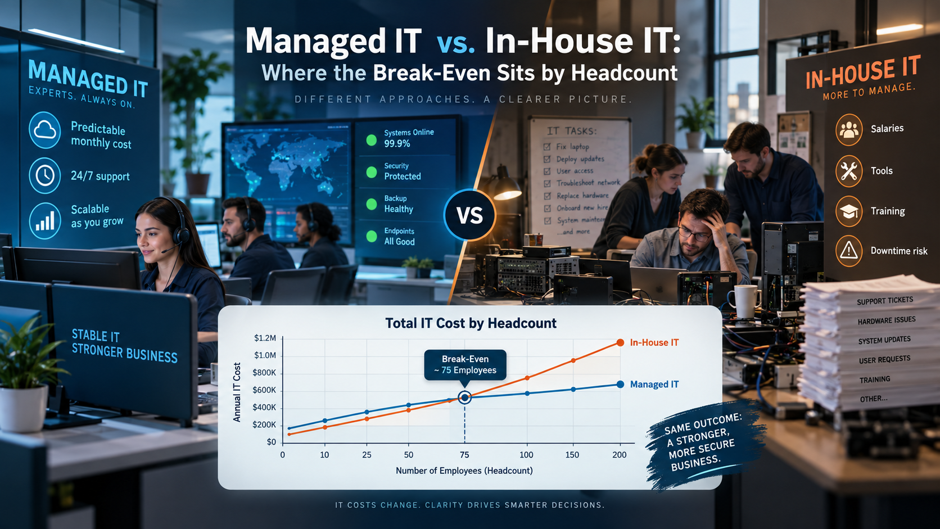
Every IT leader eventually gets asked some version of the same question by finance: are we spending too much on that MSP contract, or would we save money bringing this in-house? The honest answer changes meaningfully depending on which side of a specific headcount threshold the company sits on, and most of the answers floating around the internet either ignore that threshold entirely or quote a single number without explaining why it shifts. A 15-person company and a 300-person company asking the identical question need genuinely different answers, not because the underlying economics work differently in principle, but because the fixed cost of a single in-house hire behaves completely differently once it’s spread across 15 users versus 300.
This guide works through where the break-even actually sits, band by band, using fully loaded cost figures for both sides of the comparison rather than the sticker-price salary or the headline MSP rate that usually gets quoted in isolation. It also covers why the break-even point isn’t purely a mathematical crossover, since coverage, risk exposure, and scalability all shift the calculus even when the raw dollar comparison looks close, and why the dominant model at most mid-size companies in 2026 isn’t a pure choice between one or the other at all.
TL;DR
| Headcount | Most cost-effective model | Why |
| Under 10 | Break-fix or a light MSP retainer | Full monthly MSP contracts and any in-house hire are both overkill relative to actual support volume |
| 10 to 50 | Managed IT services | A single in-house hire costs more than a full MSP team and creates a single point of failure |
| 50 to 75 | Managed IT services, with cost crossover approaching | Raw 1-FTE cost can approach MSP pricing near the upper end, while broader coverage still favours managed or co-managed support. |
| 75 to 150 | Co-managed: 1 internal IT lead plus an MSP | Common co-managed transition band, not a universal pure-cost crossover. |
| 150 to 250 | Co-managed with a slightly larger internal core | Internal headcount grows to 2 or 3, MSP shifts toward specialised coverage rather than full-scope support |
| 250 to 500 | Small internal IT team (4 to 6 FTEs) plus MSP for security operations | Total cost between a pure MSP contract and a pure internal team converges to within a similar range |
| 500-plus | Internal team owns strategy; MSP layer shrinks to specific specialised functions | Per-user MSP cost drops sharply at this scale, but the operating model shifts toward internal ownership regardless |
No single number is the break-even point. Using the cost assumptions below, the raw comparison between 1 fully loaded IT generalist and a broad MSP can cross around 60 to 75 employees. That is a cost calculation, not an operating-model rule. The 75 to 150 range is better treated as a common co-managed transition band, where internal ownership starts growing alongside outside coverage.
Why Headcount Alone Doesn’t Fully Answer the Question
Headcount is the single strongest predictor of where the economics land, which is why this entire guide is organised around it, but treating it as the only variable that matters produces a misleadingly precise-looking answer that doesn’t hold up once a specific company’s actual circumstances are factored in.
Factors that shift the break-even point in either direction, independent of raw headcount:
- Number of physical locations, since multiple offices increase network complexity, site connectivity requirements, and coordination overhead in a way that nudges per-user MSP pricing upward even at an identical headcount, while simultaneously making a single in-house hire’s job considerably harder to do alone
- Industry and compliance scope, since healthcare, financial services, and other heavily regulated sectors carry documentation, audit, and specialist requirements that neither a lean MSP contract nor a single generalist hire adequately covers on its own
- Growth trajectory, since a company planning to double headcount within 18 months gains real value from an MSP’s ability to scale support within days, while a company expecting to remain stable or shrink may prefer the fixed, predictable cost structure of internal staff over per-user pricing that scales with headcount
- Reliance on proprietary or highly customised internal systems, since an MSP’s broad, standardised expertise is less valuable when the environment includes deeply customised, business-specific software that benefits from an internal team’s accumulated institutional knowledge
- Existing internal technical leadership, since a company that already has a capable, technically fluent operations or finance leader can absorb more of the coordination burden that would otherwise require a dedicated internal IT hire earlier than headcount alone would suggest
These factors don’t invalidate the headcount-based framework that follows. They explain why 2 companies at an identical headcount can reasonably land on different answers, and why the bands below should be read as a strong starting point for the conversation rather than a rigid formula that overrides every other consideration.
What In-House IT Actually Costs, Fully Loaded
Before the break-even bands make sense, it’s worth being precise about what an in-house IT hire genuinely costs once every real expense is included, since the number most companies budget against, the base salary listed on a job posting, consistently and significantly understates the true, fully loaded figure.
The Components That Make Up the Fully Loaded Cost
| Cost component | What it covers |
| Base salary | The Bureau of Labor Statistics reports a median annual wage of $99,130 for network and computer systems administrators in May 2025 |
| Benefits and employer taxes | Typically adds 25 to 35% on top of base salary, covering health insurance, retirement contributions, and payroll taxes |
| Tools and licensing | Monitoring software, ticketing systems, security tooling, and administrative access to the platforms the role requires |
| Training and certification | Ongoing professional development needed to keep pace with an evolving threat landscape and technology stack |
| Recruiting and vacancy cost | The cost of finding a replacement and the productivity loss during any gap between hires, rarely included in initial budgeting |
| Equipment | Laptop, monitors, and any specialised hardware the role requires to do its job effectively |
Using the May 2025 BLS median and the benefit and tax range above, a single fully loaded IT generalist starts around $124,000 annually before some tools, training, equipment, recruiting, and vacancy costs are added. A practical all-in planning range of roughly $124,000 to $153,000 still varies by region and seniority, but it gives the cost model below a clearer internal staffing assumption.
Why a Single Hire Is Structurally Risky Regardless of Cost
Beyond the raw dollar figure, a single in-house IT hire creates a structural vulnerability that a cost comparison alone doesn’t fully capture: one person cannot provide 24-hour coverage, cannot be an expert across cloud infrastructure, cybersecurity, networking, and compliance simultaneously, and represents a genuine single point of failure the moment they take vacation, get sick, or leave the company. A 30-person law firm whose sole IT person takes 12 weeks of parental leave has no coverage plan unless something else has been arranged in advance, and this risk exists at any headcount where the internal team consists of exactly one person, regardless of how technically capable that individual is.
What Managed IT Services Actually Cost by Headcount Band
MSP pricing isn’t flat across every company size. It follows a fairly consistent curve where the per-user rate falls as headcount rises, reflecting genuine economies of scale in how a provider delivers support across a larger environment rather than an arbitrary discount offered to bigger accounts.
The per-user, per-month MSP pricing pattern across headcount bands:
- 10 to 25 users: typically $200 to $400 per user per month for comprehensive coverage, reflecting the fixed overhead of onboarding and supporting a small environment spread across relatively few users
- 25 to 100 users: typically $150 to $300 per user per month, with the national average for comprehensive service sitting closer to $150 to $200
- 100 to 500 users: typically $100 to $200 per user per month, as the provider’s fixed costs spread across a meaningfully larger user base
- 500-plus users: typically $40 to $100 per user per month for the MSP layer specifically, though at this scale most organisations have shifted to a co-managed model where this figure covers specialised support rather than full-scope service, with internal salaries covering the rest
A worked example at 2 different headcount points illustrates the pattern clearly:
A 25-person company paying a mid-tier MSP rate of roughly $150 per user per month spends approximately $45,000 annually. For a clearer crossover check, use the article’s stated rates and the $124,000 to $153,000 all-in range for 1 internal generalist. At 50 users, $175 per user per month equals $105,000 annually. At 75 users, the same rate equals $157,500, slightly above that 1-person internal range. That places the raw 1-FTE cost crossover at about 59 to 73 users under this specific $175 rate. At 100 users, $150 per user per month equals $180,000. At 150 users, an illustrative $125 rate equals $225,000, while 2 internal generalists at the stated range cost about $248,000 to $306,000 before comparing differences in coverage. The numbers therefore show 2 separate decisions: raw cost can cross earlier, while the operating model often moves into co-managed territory later as workload, coverage, security needs, and business context require more than a single generalist. A 250-person company at $150 per user per month would spend about $450,000 annually, which begins to approach the cost of a small internal team.
| Headcount | Illustrative annual MSP cost | Cost reading |
| 50 | $105,000 at $175/user/month | Below the $124,000 to $153,000 1-generalist planning range, so the MSP remains lower on raw annual cost. |
| 75 | $157,500 at $175/user/month | Slightly above the 1-generalist range. A raw one-FTE crossover can appear near this point under these assumptions. |
| 100 | $180,000 at $150/user/month | Above 1 generalist, although a 1-person internal team still does not match provider coverage or redundancy. |
| 150 | $225,000 at $125/user/month | Below the roughly $248,000 to $306,000 cost of 2 generalists using the same loaded planning range. |
| 250 | $450,000 at $150/user/month | Starts approaching a 4-person internal team at about $496,000 before higher-end staffing costs are considered. |
The raw crossover is the point where MSP cost equals the loaded cost. With a $175 monthly MSP rate and 1 internal generalist costing $124,000 to $153,000, that crossover falls at roughly 59 to 73 users. A lower negotiated MSP rate pushes the raw crossover to a higher headcount, while a higher internal salary does the same. The comparison also changes when the internal model needs a second person for coverage. That is why the table should not be read as a universal staffing rule. It shows the arithmetic behind the cost question. The 75 to 150 band is a separate operating-model question, where internal ownership may become useful even when the MSP remains cheaper than a properly staffed internal team.
The Break-Even Bands in Detail
With both sides established, the useful question is where raw cost crosses under stated assumptions and where the operating model changes. Those are not always the same point. A 1-person internal comparison can cross in the 60-to-75-user area, while a co-managed structure can become practical later because a growing company needs internal context plus broader coverage.
Under 10 Employees: Neither Full Model Fits Well
At this scale, both a full MSP contract and any in-house hire represent more infrastructure than the actual support volume justifies. Break-fix support, paying an hourly rate only when something breaks, or a lightweight virtual CIO arrangement covering strategic guidance without full operational support, typically makes more sense than either a comprehensive MSP contract or the fixed cost of even a part-time internal hire.
10 to 50 Employees: Managed IT Wins Clearly
This is the range where the case for managed IT services is strongest and most consistently supported across the research. A single in-house hire, even at the lower end of the fully loaded cost range, exceeds what a comprehensive MSP contract costs at this headcount, while delivering a fraction of the coverage: no 24-hour monitoring, no dedicated security specialist, and no redundancy when the single hire is unavailable. Savings in this range commonly fall between 25 and 45% compared to the fully loaded cost of equivalent in-house coverage.
50 to 75 Employees: MSP Still Favoured, Complexity Starts Building
Managed services generally remain cost-effective through much of this range. Near the upper end, the raw annual cost of 1 internal generalist can approach or fall below a broad MSP contract under the illustrative rates above. That does not make a 1-person department automatically equivalent, because coverage and specialist support differ. This is where co-managed planning often starts.
75 to 150 Employees: A Common Co-Managed Transition Zone
This band is better treated as an operating-model transition than a universal cost break-even. By this point, a company may value 1 internal IT lead for day-to-day support and institutional knowledge while keeping an MSP for security operations, after-hours coverage, and specialist work. The raw cost comparison may already have crossed earlier under some rate assumptions. This co-managed structure is common because it adds internal ownership without asking 1 person to provide every form of coverage alone.
150 to 250 Employees: Hybrid Deepens, Internal Core Grows
The internal team typically grows to 2 or 3 people at this scale, still supplemented by an MSP relationship, but with the MSP’s role shifting further toward specialised functions like security operations and compliance support rather than full front-line help desk coverage. The complexity of onboarding, offboarding, and managing devices and SaaS tools across a workforce this size increasingly justifies dedicated internal ownership, even as the MSP relationship continues delivering coverage and expertise the internal team alone couldn’t cost-effectively replicate.
250 to 500 Employees: The Cost Curves Converge
At this scale, a standard MSP contract covering the full user base runs into the hundreds of thousands of dollars annually, a figure that starts to approach what a small internal team of 4 to 6 fully loaded IT staff would cost. Neither model holds a decisive cost advantage over the other at this specific range, which means the decision increasingly turns on factors beyond raw cost: how much strategic, business-specific IT work exists that benefits from institutional knowledge, how comfortable leadership is with the risk profile of each model, and how much the organisation values the direct, embedded relationship an internal team provides during major initiatives like an ERP migration or an acquisition integration that an external MSP typically can’t drive with the same depth.
500-Plus Employees: Internal Ownership Becomes the Default Structure
Above this threshold, the per-user cost of a pure MSP relationship drops significantly, but the operating model shifts toward internal ownership regardless of that lower unit cost, because organisations at this scale typically need dedicated internal leadership setting strategy, owning architecture decisions, and managing the kind of proprietary systems and business-critical integration work an external provider isn’t positioned to own. The MSP relationship at this scale narrows to specific, specialised functions, such as 24/7 security operations centre coverage or niche technical expertise the internal team doesn’t need often enough to justify staffing directly, rather than continuing as the primary delivery model for day-to-day support.
Why Total IT Budget Doesn’t Set the Break-Even
Total IT budget is not the same as IT support cost. Revenue-based IT percentages include software, cloud services, hardware, security products, and other technology spending that can move independently of the managed-versus-in-house support decision. Use those figures for broader budgeting context, not as a substitute for the headcount, staffing, MSP-rate, and coverage calculation used here.
Why the Break-Even Isn’t Purely About Cost
Even within a headcount band where the dollar figures look genuinely close, several non-financial factors consistently tip the decision in a specific direction, and ignoring them produces a comparison that looks rigorous on a spreadsheet while missing what actually drives the real-world outcome for the people relying on the systems day to day.
Coverage and response time separate the models sharply regardless of headcount. Some managed-service contracts provide 24/7 monitoring and P1 response targets in the 15 to 30 minute range, but actual coverage and response commitments depend on the SLA. A single in-house generalist working business hours may not match that coverage. This gap matters most where operations extend beyond a standard business day or downtime carries meaningful financial consequence.
Security depth is difficult for a single internal hire to replicate at any headcount. With millions of cybersecurity positions unfilled globally, hiring even one genuine security specialist internally is a real challenge, and a single generalist covering networking, cloud infrastructure, compliance, and security simultaneously is rarely equipped to match the dedicated security stack, including endpoint detection, security information and event management tooling, and continuous monitoring, that a managed provider spreads across its entire client base.
Scalability works asymmetrically between the 2 models. Adding 20 users to an MSP relationship typically happens within days. Scaling an internal team requires a recruiting process that commonly runs several months once time-to-hire and onboarding are factored in, and scaling down an internal team means layoffs, a genuinely difficult and costly process compared to simply adjusting a per-user MSP contract.
The financial cost of a serious incident dwarfs the underlying service cost comparison. A ransomware event in 2026 commonly runs well above $250,000 once recovery costs, lost productivity, and operational disruption are included, and this risk exposure should weigh into the comparison at any headcount, since the monthly service fee difference between models is frequently smaller than the potential cost of a single serious security incident that better coverage could have prevented or contained more quickly.
Building the Co-Managed Model: What It Actually Looks Like in Practice
Given how often co-managed structures fit companies in the 75-to-250-employee range, it’s worth being specific about how the division of responsibility works in practice. That range describes a common operating-model transition rather than a universal pure-cost crossover, so the split of work still depends on the company’s staffing needs and purchased MSP scope.
The typical division of labour in a well-structured co-managed arrangement:
- The internal IT lead owns day-to-day desk-side support, serves as the primary point of contact and technology liaison for employees, manages vendor relationships and procurement decisions, and carries the institutional knowledge of how the business’s specific systems and workflows actually operate
- The managed services partner provides 24/7 monitoring and after-hours coverage the internal hire can’t reasonably staff alone, delivers specialised security operations including threat detection and incident response, handles complex projects that exceed what a single internal generalist can competently execute, and provides backup coverage during vacation, illness, or turnover in the internal role
This division isn’t arbitrary. It deliberately assigns each side of the relationship to the work it’s genuinely best positioned to do well: the internal hire brings context and relationship continuity that an external provider can’t replicate, while the MSP brings depth, redundancy, and specialised coverage that a single internal hire structurally cannot provide regardless of individual skill or effort.
Common Mistakes When Making This Comparison
Beyond the headcount bands and the non-financial factors already covered, several specific errors show up repeatedly in how organisations actually run this comparison internally, and each one skews the final conclusion in a fairly predictable direction once it quietly takes hold of the budgeting process itself.
- Comparing base salary against the full MSP invoice. The single most common distortion is anchoring on a job posting’s base salary figure, often $75,000 to $95,000, against a fully quoted MSP contract that already includes every associated cost, which makes the in-house option look artificially cheaper than it actually is once benefits, taxes, tools, and training are added back in.
- Ignoring the coverage gap when comparing prices. A dollar-for-dollar comparison that treats one in-house generalist working business hours as equivalent to a full MSP team offering 24/7 monitoring and specialist coverage isn’t really comparing like for like, even when the headline costs land close together, since the actual scope of protection differs substantially between the 2 options.
- Failing to model the cost of a bad month, not just an average one. Most informal comparisons use steady-state monthly costs on both sides and never model what happens during a security incident, a major system migration, or an unplanned staff departure, all of which tend to expose the fragility of a lean internal model far more sharply than they expose any weakness in a managed services relationship.
- Treating the decision as permanent rather than revisitable. Some organisations lock into a model at one headcount and never formally revisit the comparison as the company grows, missing the point at which the mathematics and the operational needs have shifted meaningfully enough to justify a different structure than the one chosen years earlier.
- Evaluating cost without evaluating growth plans. A comparison run purely on current headcount, with no adjustment for a known, planned expansion over the next 12 to 24 months, risks optimising for a snapshot that will be outdated within a single budget cycle, particularly given how much faster an MSP relationship can scale compared to an internal hiring process.
Avoiding these 5 mistakes doesn’t guarantee a specific answer in either direction, but it does ensure that whichever answer a company lands on reflects the actual, fully loaded comparison rather than an artefact of how the numbers happened to get framed during the initial budget conversation.
A Practical Framework for Making the Decision
Rather than defaulting to whichever model a specific vendor or internal advocate happens to be pitching, working through a structured set of questions produces a considerably more defensible answer, one specific to a given organisation’s actual circumstances rather than borrowed wholesale from a generic industry benchmark.
Start by calculating the genuinely fully loaded cost of the in-house alternative, including salary, benefits, employer taxes, tools, training, recruiting cost, and equipment, rather than anchoring on the base salary figure alone, since this single correction is where most informal cost comparisons go wrong before any other factor even enters the picture. Map the current headcount against the bands above as a starting point, then adjust based on the specific factors, industry, locations, growth trajectory, and reliance on proprietary systems, covered earlier in this guide. Quantify the actual cost of downtime and a serious security incident for the specific business, since this figure, not the base service cost comparison alone, often determines which model represents the lower genuine risk-adjusted cost. Pilot a co-managed arrangement before committing fully to either extreme if the organisation sits in the 75-to-250 range where a blended operating model fits the workload and coverage needs, since this structure captures much of the benefit of both models without requiring an irreversible, all-or-nothing commitment upfront.
FAQs
Is there a single, universal break-even headcount that applies to every business? No. Using the rates and loaded staffing assumptions in this guide, a raw 1-generalist-versus-MSP cost crossover can appear around 60 to 75 employees. The 75 to 150 range is better read as a common co-managed transition band, not a universal cost threshold. Industry, number of locations, growth trajectory, compliance requirements, and reliance on proprietary systems can shift both decisions.
Why does a single in-house hire almost never make sense under 50 employees? The fully loaded planning range used in this guide is roughly $124,000 to $153,000 for 1 IT generalist once benefits, taxes, tools, training, equipment, recruiting, and vacancy costs are considered. A broad managed services contract generally costs less at this headcount while providing redundancy and wider coverage. The raw cost comparison and the coverage difference both favour managed services at this scale.
What actually changes once a company crosses into the 250-to-500 employee range? At this scale, the total cost of a comprehensive MSP contract covering the full user base starts to approach what a small internal team of 4 to 6 fully loaded staff would cost, meaning the pure cost advantage that favoured managed services decisively at smaller headcounts largely disappears. The decision increasingly turns on factors beyond raw cost, including how much proprietary or business-critical system work exists that benefits from embedded institutional knowledge, and how the organisation values direct internal ownership during major initiatives an external provider typically isn’t positioned to drive with the same depth.
Does a co-managed model actually cost less than choosing one pure model? Not necessarily. A co-managed model can provide better coverage for a similar total cost, particularly through the 75-to-250 employee range where internal ownership often grows while an MSP keeps selected specialist and after-hours responsibilities. That range is an operating-model transition, not a universal cost crossover, and the combined price depends on which duties remain with the provider.
How much does the number of physical office locations actually affect the calculation? Meaningfully. Multiple locations increase network complexity, require additional site-to-site connectivity, and add coordination overhead that nudges per-user MSP pricing upward even at an identical total headcount, while simultaneously making it considerably harder for a single in-house hire to provide adequate coverage across every site. A single-location 80-person company and a 3-location 80-person company are not facing the same underlying support challenge, even though their headcount is identical, and the multi-location company should expect both models to cost somewhat more than the headcount-based estimate alone would suggest.
What’s the biggest hidden cost that gets left out of most informal in-house versus MSP comparisons? Recruiting and vacancy cost is the most commonly omitted factor. When an internal IT hire leaves, the organisation faces both the direct cost of recruiting a replacement and the productivity loss and risk exposure during the vacancy period itself, which can run for months given how competitive the market for skilled IT talent remains. This cost rarely appears in the original budget comparison but represents a real, recurring expense that favours the managed services model’s built-in redundancy, since an MSP relationship doesn’t experience the same kind of coverage gap when an individual team member leaves the provider’s organisation.
Should a fast-growing company weight the decision differently than a stable one? Yes, significantly. A company planning to double headcount within the next 18 months gains real, quantifiable value from an MSP’s ability to scale support within days rather than the months a recruiting and onboarding process for internal hires typically requires, which can justify leaning toward managed services even at a headcount where the pure cost comparison might otherwise favour a hybrid or internal approach. A stable or slowly growing company, by contrast, can reasonably weight the fixed, predictable cost structure of internal salaries more heavily, since it won’t face the same scaling pressure that makes an MSP’s flexibility particularly valuable.