

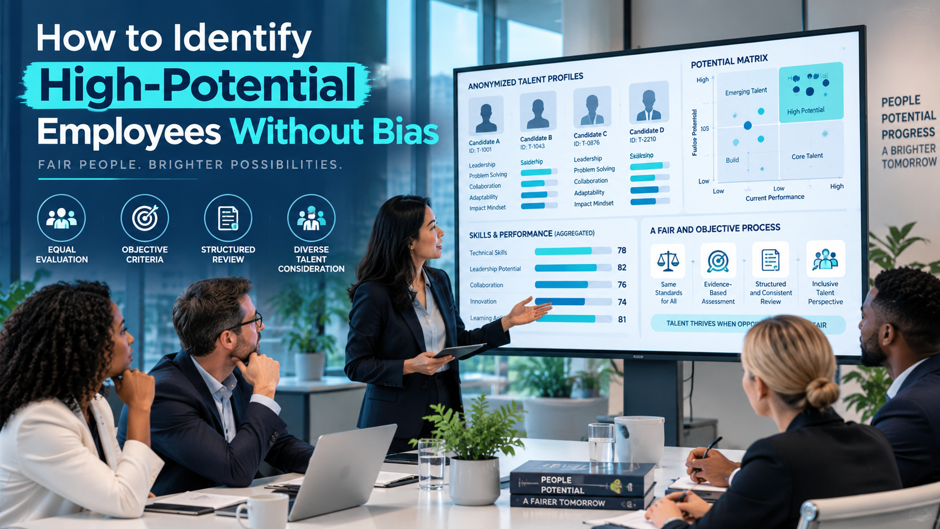
Every organisation believes it knows who its future leaders are. Ask a room of managers to name their high-potential employees and the list comes quickly, confidently, and almost always looks the same: the person who speaks up in meetings, the one who reminds people of a younger version of the boss, the one who’s been visibly busy for the last 2 quarters. What that list rarely reflects is who actually has the capacity, ambition, and behavioural pattern to succeed in a role they haven’t held yet, because visibility and potential are not the same thing, and most identification processes conflate them without anyone noticing.
The cost of getting this wrong compounds quietly. Talented people get overlooked because they work in a function or team with less executive visibility. Confident people get fast-tracked because confidence reads as competence even when the underlying capability isn’t there. And the organisation ends up with a leadership pipeline that reflects who was noticed rather than who was capable, which produces weaker succession coverage and a less diverse leadership bench than the underlying talent pool would support if the process were actually fair.
This guide walks through what high potential actually means, the specific biases that distort identification most often, and the structured methods organisations use to build a HiPo process that survives scrutiny rather than one that simply feels fair to the people running it. It also covers how to check the final output for skew after the process has run, because even a well-designed process can still produce an unbalanced result if nobody explicitly looks for one.
TL;DR
| Element | What it means in practice |
| Potential is not performance | A strong performer in the current role is not automatically capable of succeeding in a bigger, more complex one; the two require separate assessment |
| Manager nomination alone is unreliable | Manager-only identification consistently favours visible, vocal, and similar-to-the-manager employees over quieter high performers |
| Multiple data sources reduce distortion | 360-degree feedback, performance history, psychometric assessment, and engagement data each correct for blind spots the others miss |
| Bias shows up in specific, nameable patterns | Affinity bias, the halo effect, proximity bias, and confirmation bias each distort HiPo identification in a predictable, addressable way |
| Calibration catches inconsistency | Cross-functional review sessions surface cases where one manager’s “high potential” is another manager’s “solid performer,” and reconcile the gap |
| Criteria must be defined before names are discussed | Naming the behaviours and evidence that constitute potential before anyone nominates a person prevents the criteria from being reverse-engineered to fit a favourite |
| The process needs an equity checkpoint | Reviewing the final HiPo list against the demographic and functional composition of the eligible population catches skew that individual decisions don’t reveal |
The organisations that build genuinely fair HiPo processes don’t rely on any single safeguard. They layer defined criteria, multiple data sources, structured assessment, calibration, and an explicit equity review, because each layer catches a different failure mode that the others miss. A process that skips even one of these layers tends to revert, quietly and without anyone deciding it should, to whichever informal shortcut fills the gap left behind.
What High Potential Actually Means
Before addressing bias, it’s worth being precise about what’s being measured, because a vague or overly broad definition of potential is itself one of the biggest sources of inconsistent, biased identification. A term that can mean almost anything to almost anyone inevitably gets filled in with whatever each individual manager already believes leadership looks like, which is exactly the outcome a rigorous process is trying to prevent.
Potential Is Distinct From Performance
Performance measures how well someone executes their current role. Potential measures their capacity to succeed in a role they haven’t held yet, typically one with greater scope, complexity, or ambiguity. These are genuinely different constructs, and conflating them is the single most common error in HiPo identification. A top salesperson who consistently exceeds quota is demonstrating strong current performance; whether they have the strategic thinking, people leadership, and comfort with ambiguity required to run a sales region is a separate question entirely, and one that current performance data doesn’t answer on its own.
This distinction matters practically because organisations that identify HiPos purely from performance review scores end up promoting people into roles that don’t play to the skills that made them succeed in the first place. The individual contributor who was brilliant at closing deals doesn’t automatically become a strong sales manager, because managing a team requires an entirely different skill set that their individual contributor performance never tested.
One established model for assessing potential
One widely used HiPo model assesses ability, aspiration, and engagement rather than treating potential as a single score, because potential is multidimensional and collapsing it into one number can hide meaningful differences. Other established frameworks use different dimensions, including learning agility, adaptability, and role-specific capabilities, so evaluators should define the model they use before assessment begins. A shared model still gives managers consistent language for discussing evidence across employees in each cycle.
Ability covers the cognitive and technical capability to handle increased complexity: can this person process ambiguous information, synthesise across functions, and make sound decisions with incomplete data. Aspiration covers genuine desire for advancement and the willingness to take on the sacrifices that come with it, since not every capable employee wants a bigger role, and assuming they do is its own form of bias. Engagement covers commitment to the organisation and the discretionary effort that shows up in how someone approaches their work beyond the minimum required. Some frameworks add a fourth dimension, learning agility, which measures how quickly someone extracts and applies lessons from new or unfamiliar situations, a trait that research consistently identifies as one of the strongest predictors of leadership success precisely because it doesn’t require the person to have already done the job they’re being considered for.
Why a Narrow Definition Produces Biased Outcomes
When an organisation doesn’t explicitly define these dimensions and instead relies on a manager’s general sense of who seems like leadership material, the assessment defaults to proxies that are easy to observe but poorly correlated with actual potential: confidence in meetings, similarity to existing leaders, and visibility to senior stakeholders. None of these proxies is inherently wrong to notice, but none of them reliably measures ability, aspiration, engagement, or learning agility either, which is exactly why they produce a HiPo list that skews toward people who look and sound like the people already in charge.
This pattern is particularly consequential because it’s self-reinforcing across successive cycles. A HiPo list built on proxy traits produces a leadership bench that looks and sounds like the people who built it, and that bench then goes on to evaluate the next cycle of nominations using the same unexamined proxies, since evaluators tend to recognise potential most readily in people who remind them of their own path. Breaking this cycle requires the explicit, written criteria described throughout this guide precisely because an unwritten standard has no mechanism to resist being quietly redefined by whoever happens to be applying it in any given cycle.
The Specific Biases That Distort HiPo Identification
Bias in talent identification isn’t a vague, unfixable force. It shows up in a small number of well-documented, nameable patterns, and naming them is the first step toward building a process that controls for them. Each pattern below has been studied extensively in organisational psychology research, and each one operates in a predictable enough way that specific process design choices can interrupt it directly rather than relying on general awareness alone.
| Bias type | How it distorts HiPo identification | What it favours |
| Affinity bias | Managers unconsciously rate people who share their background, communication style, or interests more favourably | Employees who resemble the manager demographically or stylistically |
| Halo effect | One standout positive trait (strong presenter, prestigious degree, impressive project) inflates perception of unrelated capabilities | Employees with one visible, impressive credential or moment |
| Horns effect | One negative trait or a single remembered mistake permanently colours perception of everything else the person does | Employees who avoided any visible misstep, regardless of actual output |
| Confirmation bias | Once someone is informally labelled as “high potential,” ambiguous evidence gets interpreted to support that label, and contrary evidence gets discounted | Whoever was noticed first, regardless of whether the initial impression was accurate |
| Proximity bias | Employees who are physically or organisationally closer to senior decision-makers get noticed more than equally capable peers who work at a distance | Employees in headquarters functions, visible teams, or frequent contact with leadership |
| Recency bias | A strong project in the last quarter outweighs a longer track record, distorting the assessment toward whoever had a recent visible win | Employees whose most recent work happened to be highly visible |
| Similar-to-me effect | A specific variant of affinity bias in interview and nomination settings, where evaluators rate people higher when they share personality traits or working style with the evaluator | Employees whose working style mirrors the person doing the nominating |
How These Biases Compound in Practice
These biases rarely operate in isolation. A manager who shares a communication style with a particular employee (affinity bias) is also more likely to interpret that employee’s ambiguous performance charitably (confirmation bias), more likely to remember their strongest moment vividly (halo effect), and more likely to have frequent informal contact with them that increases visibility (proximity bias). The combined effect is a nomination that feels, to the manager, like an obvious and objective call, when in reality it’s the product of 4 separate distortions reinforcing each other.
This compounding effect is precisely why bias-awareness training alone rarely fixes the problem. Telling a manager that affinity bias exists doesn’t stop the halo effect from operating on the same decision through a different mechanism, and research on debiasing interventions consistently finds that awareness training changes what people say about bias far more than it changes the decisions they actually make. Structural changes to the identification process, not individual awareness alone, are what actually interrupt the compounding pattern, which is why every safeguard described in this guide is a change to the process itself rather than a request that evaluators simply try harder to be objective.
Building a Structured Identification Process
A process that produces less biased HiPo lists shares an architecture across organisations that have gotten this right, regardless of company size or industry. The pre-decision identification stage has 5 components, each addressing a different point where bias enters, and removing any single component tends to reopen the vulnerability that component was designed to close. None of the 5 is technically difficult to implement in isolation; what makes the architecture effective is running all 5 together as a connected sequence. An outcome and equity audit follows calibration before the final list is confirmed.
| Component | What it requires | What happens if it’s skipped |
| Role-anchored criteria | Specific, observable behaviours written down and agreed before any names are discussed | Criteria get reverse-engineered to fit whoever a manager already favours |
| Separation from performance review | A distinct conversation, form, and timing from the performance cycle | Recent performance halo bleeds directly into the potential rating |
| Multi-source nomination | Input from a skip-level manager, cross-functional peer, or structured 360 assessment | A single manager’s affinity bias, proximity bias, and halo effect go unchecked |
| Validated assessment tools | Job-relevant validated assessments with adverse-impact monitoring and human judgement | Unvalidated assessments can create bias or adverse impact in selection |
| Cross-functional calibration | A session where nominations are presented and defended in front of peers before the list is finalised | Inconsistency between managers’ standards never surfaces before the list is final |
Each component targets a specific point where the earlier research on bias shows distortion typically enters, and the sequence matters: criteria defined after nominations have already started, or calibration run without independently submitted ratings first, both undermine the safeguard the step was meant to provide. Strong criteria name specific, observable behaviours rather than vague traits, since “took ownership of a cross-functional problem with no formal authority to do so” is assessable evidence, while “shows leadership potential” is not, and the gap between those two kinds of statements is where most bias enters an otherwise well-intentioned process.
The Data Sources That Reduce Bias When Combined
No single data source is sufficient on its own, and each one corrects for weaknesses in the others. The strength of a well-built HiPo process comes from triangulating across sources rather than trusting any one of them in isolation, because a distortion that shows up in one data source rarely shows up the same way, or at all, in a genuinely independent one. Five data sources cover most of the ground that a well-built process needs, and each one closes a specific gap the others leave open.
- 360-degree feedback: structured input from peers, direct reports, managers, and the employee themselves, collected across a defined set of leadership competencies. This is one of the most effective correctives to single-manager bias because it introduces multiple independent observers who each have visibility into different aspects of the person’s actual behaviour, including how they treat people with less power than themselves, a dimension a single manager’s view often misses entirely.
- Performance history over multiple cycles: looking at trend rather than a single strong quarter directly counters recency bias. An employee with a consistent pattern of strong execution across 6 or 8 review cycles provides a materially different evidence base than someone whose most recent quarter happened to include one highly visible win.
- Job-relevant, properly validated assessment tools: standardisation can reduce rater inconsistency because every employee completes the same measure, but it doesn’t make an assessment bias-free. Employers should use instruments that are appropriate for the role and purpose, confirm that they are validated, and monitor selection outcomes for adverse impact. Cognitive, personality, or other employment tests should remain one evidence source rather than an automatically neutral safeguard.
- Engagement and aspiration data: addresses a dimension that performance and 360 feedback don’t directly capture, namely whether the person actually wants a bigger role and is demonstrating the discretionary effort that predicts genuine commitment. This matters both because assuming everyone wants advancement is itself a bias, and because engagement data compared against actual participation in development programmes tends to reveal genuine intent more reliably than survey answers alone.
- Structured behavioural evidence over time: define the behaviours before assessment begins, then record specific examples across a set review period instead of relying on memory. Examples can include how someone clarifies a problem, supports colleagues, or responds when work doesn’t go as planned. Where possible, require evidence from more than 1 observer and assess every eligible employee against the same behavioural indicators. This turns informal observation into comparable evidence and reduces the role of visibility, manager interpretation, and one-off impressions.
None of these sources is designed to override the others when they disagree. A validated assessment that contradicts a glowing manager nomination is not evidence the assessment is wrong; it’s a signal that the disagreement itself needs investigating before the nomination moves forward, and organisations that treat convergence across at least 2 independent sources as a soft requirement for HiPo status consistently produce more defensible, less biased outcomes than those relying on any single input.
The 9-Box Grid: Strengths and Bias Risks
The 9-box grid, plotting employees on performance against potential across a 3-by-3 matrix, remains the most widely used visual framework for talent calibration, and understanding both its value and its specific failure modes is essential for anyone building a HiPo process around it. The grid itself is a neutral tool; whether it reduces or reinforces bias depends entirely on the quality and independence of the data that goes into placing each person on it.
| Grid position | What it represents | Common bias risk at this position |
| High performance, high potential | The clearest HiPo candidates; strong current execution with demonstrated capacity for more | Halo effect can inflate potential rating based purely on strong current performance |
| High performance, moderate potential | Strong, reliable performers whose growth trajectory is genuinely less certain | Risk of assuming “not yet obviously HiPo” means “will never be,” foreclosing future reconsideration |
| High performance, low potential | Core experts who excel in their current scope without aspiration or readiness to expand it | Risk of undervaluing this group’s retention needs because they’re not on a growth track |
| Moderate performance, high potential | Employees showing strong growth signals without yet being a top performer in current role | Highest bias risk category; easy to overlook because current output doesn’t stand out |
| Low performance, any potential | Employees whose current output doesn’t meet expectations regardless of underlying capability | Risk of conflating low performance with low potential when the cause may be poor role fit |
The grid’s core value is forcing explicit, visible placement rather than leaving potential as an unstated impression, which alone improves accountability because a manager has to defend a specific placement rather than a vague sense. Its core risk is that the placement itself is only as unbiased as the inputs used to determine it; a 9-box built entirely from manager opinion with no 360 data, no calibration, and no validated assessment simply visualises the same bias the underlying process contains, giving it the appearance of rigour without the substance.
What Effective Calibration Sessions Actually Look Like
Calibration is where a well-designed process either delivers on its promise or quietly reverts to the same manager-driven bias it was meant to correct, depending entirely on how the session is structured and facilitated. A poorly run calibration session can undo the benefit of every other safeguard in the process, because it’s the point where individual assessments get merged into a single organisational decision, and whatever dynamics dominate that room shape the final outcome regardless of how rigorous the inputs were.
Managers submit initial ratings independently before the session, not collaboratively during it.
Independent submission prevents groupthink and social pressure from shaping the initial data, and it creates a clean baseline that can later be compared against where the group lands after discussion, which is itself useful information about how much influence dominant voices in the room are exerting on the outcome.
Every nomination requires specific evidence, not a general impression.
A facilitator should be trained to ask “what specifically did you observe” whenever a manager presents a nomination, and to treat “they just seem like a leader” as an incomplete answer that needs to be pushed further rather than accepted at face value.
Disagreement between managers is treated as valuable signal, not a problem to be smoothed over.
When 2 managers who both interact with the same employee land on meaningfully different assessments, that gap is exactly the kind of information calibration exists to surface, and the discussion of why the gap exists, whether it reflects different contexts the employee performs in or a genuine bias in one manager’s view, is often the most valuable part of the entire session.
A neutral facilitator, not the most senior person in the room, runs the discussion.
Sessions run by the most senior leader present tend to converge quickly toward that leader’s initial impression, because subordinate managers are reluctant to contradict someone more senior even when they have better direct evidence. A trained facilitator whose role is explicitly to surface disagreement and push for evidence produces materially different, more rigorous outcomes.
The session concludes with an explicit review against the eligible population’s demographic and functional composition.
Comparing the calibrated list against the underlying population, by function, tenure, location, gender, and other relevant dimensions, catches skew that no individual conversation in the room would have surfaced, because skew is a pattern visible only in aggregate, not in any single nomination decision.
Building the Equity Checkpoint Into the Process
Even a well-designed identification process can produce a skewed outcome if nobody explicitly checks for it, because bias operates at the level of individual decisions while skew is a pattern that only becomes visible in aggregate. A process can follow every recommended safeguard at the individual nomination level and still produce a HiPo list that’s disproportionately drawn from one function, one location, or one demographic group, simply because the underlying eligible population itself already reflects historical patterns the identification process alone can’t correct. Five checks, run together, catch most of the skew that individual-level safeguards alone tend to miss:
- Compare against the eligible population, not the whole organisation. The relevant comparison is whether the HiPo list reflects the composition of people who were actually eligible for consideration, adjusted for tenure and role level, not simply whether it reflects the company’s overall workforce, which may include many employees not yet eligible for HiPo consideration for legitimate reasons unrelated to bias.
- Check for functional and geographic concentration, not just demographic skew. A HiPo list drawn disproportionately from headquarters functions or from teams with high executive visibility, even if demographically balanced, still reflects proximity bias operating at a structural level, and that concentration itself represents a governance and pipeline risk worth correcting on its own.
- Review the evidence base for every nomination, not just the final list. An equity review that only looks at the final composition without examining whether the underlying evidence for each nomination meets the defined criteria risks treating a demographically balanced but poorly evidenced list as a success, when the actual goal is a list that’s both fair and accurate at the same time.
- Track outcomes over multiple cycles, not just a single year’s list. A single cycle’s composition can be affected by factors specific to that year; tracking the pattern across several cycles reveals whether the process is systematically producing skewed outcomes or whether a single year’s numbers simply reflect normal variation in a genuinely fair underlying process.
- Use the equity checkpoint as an aggregate process audit. If disparities appear, review whether criteria, evidence quality, access to opportunities, nomination practices, or assessment tools are contributing. Send a nomination back only when its evidence doesn’t meet the criteria, not because of the person’s demographic group. Where protected-characteristic data is used, involve HR or legal review to confirm the analysis and handling requirements.
Running all 5 checks together matters more than running any single one well, because each catches a pattern the others structurally cannot see. A functional concentration check tells nothing about whether individual evidence is sound, and a strong evidence-base review tells nothing about whether the underlying eligible population was itself already skewed before the process began. Organisations that run only 1 or 2 of these checks and treat the result as conclusive are usually catching the most visible form of skew while remaining blind to the others, which is precisely why all 5 need to run as a connected set rather than being treated as interchangeable alternatives.
FAQs
How is high potential different from being a top performer?
Performance measures execution in the current role; potential measures capacity to succeed in a future, typically more complex role that the person hasn’t held yet. The two frequently overlap but are not the same, and an organisation that identifies HiPos purely from performance scores will regularly promote people into roles that don’t suit the skills that made them successful in their original position, while overlooking employees whose current role doesn’t showcase the capabilities a bigger role would actually require.
What’s one of the most useful changes an organisation can make to reduce bias?
Requiring input from more than one source is one important safeguard because manager-only nomination is where affinity bias, proximity bias, and the halo effect can operate with limited challenge. Adding a structured 360-degree assessment, skip-level input, or cross-functional peer review doesn’t eliminate bias by itself, but it introduces multiple partially independent perspectives. Multi-source input works best alongside clearly defined criteria and calibration, which help teams compare evidence consistently instead of allowing one manager’s view to determine the outcome in practice.
Can psychometric assessments alone solve the bias problem?
No. Validated assessments provide a standardised data point that doesn’t vary based on which manager is rating the employee, which is genuinely valuable, but they measure specific dimensions like cognitive ability or personality traits and don’t capture the full picture of demonstrated behaviour, engagement, or contextual performance. The strongest processes use psychometric data as one input among several, comparing it against 360 feedback and performance history rather than treating any single source as sufficient on its own.
How often should a talent risk or HiPo identification cycle run?
Most organisations run a formal identification and calibration cycle annually, often aligned with but conducted separately from the performance review cycle to avoid conflating the two assessments. Lighter interim check-ins, particularly for employees newly nominated or those whose circumstances have changed significantly, help keep the list current without requiring the full calibration process to run more frequently than the organisation has bandwidth to do well.
What should happen to employees who aren’t identified as HiPo in a given cycle?
A defined, transparent process should communicate that HiPo status reflects a point-in-time assessment rather than a permanent judgement, and employees not identified in a given cycle should still receive meaningful feedback and development opportunities. Treating HiPo status as a closed, permanent list rather than a periodically refreshed one is itself a bias risk, since it locks in whatever the composition happened to be in the first cycle and makes it structurally harder for anyone outside that initial group to be recognised later, even as their demonstrated capability grows.
How do you handle a manager who consistently nominates people who don’t hold up under calibration?
This pattern is itself diagnostic and worth addressing directly rather than simply overriding the individual nominations each cycle. It often indicates the manager is applying looser or different criteria than their peers, which calibration training and clearer criteria documentation can improve, but it can also indicate the manager’s own biases are shaping their view of their team in ways that affect more than just HiPo nominations, including day-to-day assignment of visible work and development opportunities, which is worth investigating as a broader management effectiveness question rather than treating as an isolated calibration issue.
Does a smaller organisation without dedicated HR analytics capability need to skip structured HiPo identification?
No, though the specific tools available will differ by scale. Smaller organisations can still define clear, role-anchored criteria in writing, separate potential conversations from performance reviews, require more than one person’s input on every nomination, and run a basic calibration discussion, all of which meaningfully reduce bias without requiring an enterprise talent analytics platform. The core discipline, defined criteria applied consistently and checked by more than one perspective, matters more than the sophistication of the tooling used to support it, and a small organisation that runs a simple, well-facilitated calibration conversation with written criteria will typically produce a fairer outcome than a large one running an expensive platform on top of poorly defined inputs.