

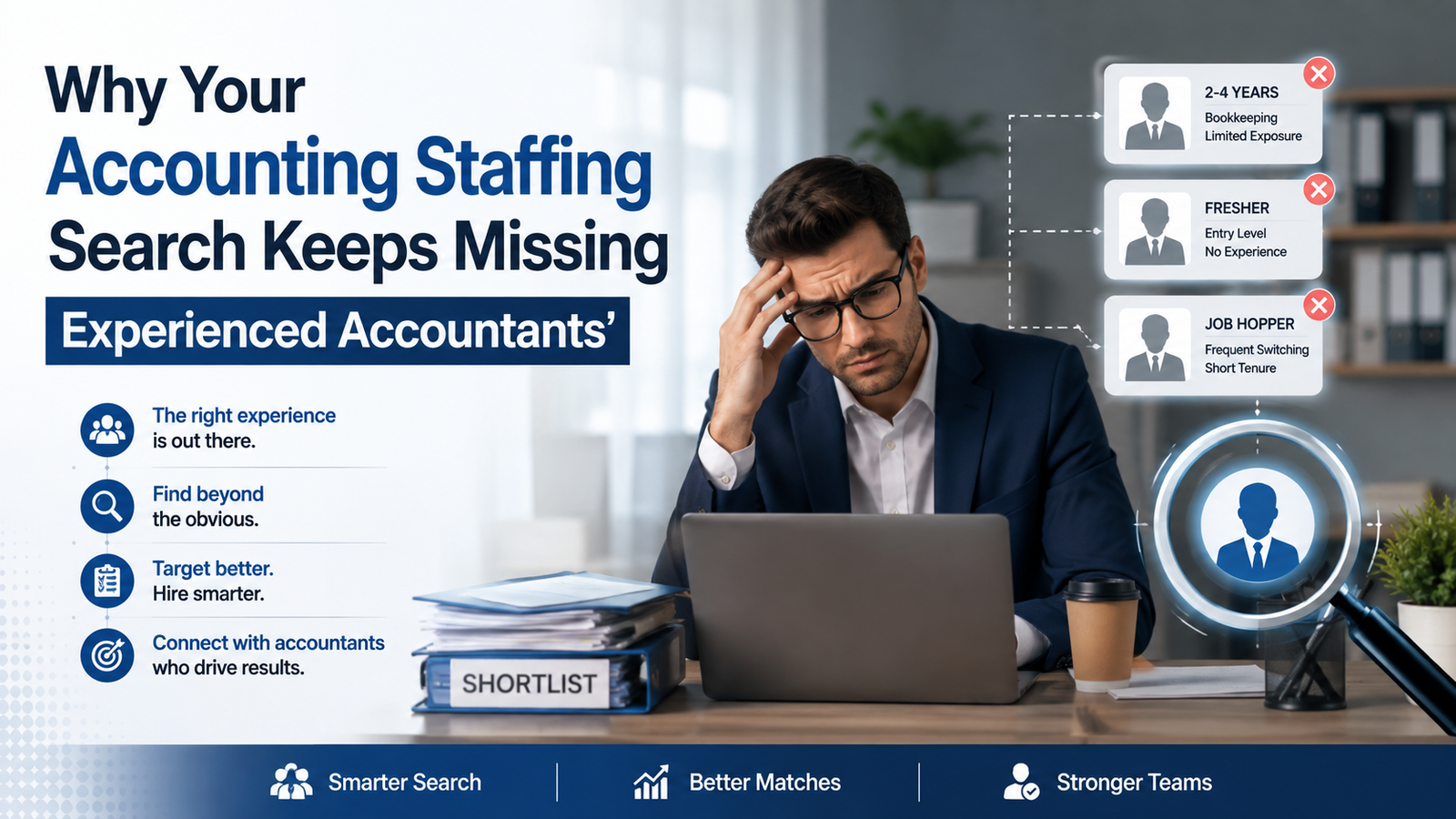
Experienced accountants are still hard to hire even when the broader labor market looks calmer than it did a few years ago. The U.S. Bureau of Labor Statistics reports a May 2025 median annual wage of $83,680 for accountants and auditors, with the highest-paid 10% earning more than $144,090. BLS also projects about 124,200 openings for accountants and auditors each year, on average, from 2024 through 2034, which means employers are competing for experienced people while replacement demand remains high.BLS accountants and auditors data
That competition explains part of the problem, but it doesn’t explain every failed search. Many companies lose qualified accountants because the role is priced below the real market, the job description asks for an unrealistic combination of skills, interviews take too long, or the employment offer gives experienced candidates little reason to move. The shortage can expose a weak hiring process because a smaller pool gives employers less room for slow decisions or vague role design. A company may receive dozens of applications and still have only a few people who can own the close, work with its systems, handle its reporting requirements, and operate at the required level of independence. The useful question, then, is where the hiring process is breaking and which changes will increase the odds of reaching, assessing, and closing the right accountant.
TL;DR
- The supply of experienced accountants is tighter than many hiring plans assume, so a search built around a large pool of immediately available candidates can fail before sourcing begins.
- Compensation has to reflect the actual scope of the role, local market, required credentials, systems knowledge, and the level of risk the accountant will own.
- Overloaded job descriptions shrink the candidate pool by combining several different jobs into one requisition or treating preferred experience as mandatory.
- Slow approval and interview cycles give strong candidates time to accept another offer, while unclear decision rights create avoidable delays inside the company.
- Flexibility, career direction, workload expectations, manager quality, and the condition of the finance function all influence whether an experienced accountant sees the move as worthwhile.
The hiring problem starts before the job is posted
A weak accounting search often begins with an inaccurate picture of the market. Hiring managers may assume that a familiar title such as senior accountant, tax accountant, controller, or internal auditor comes with a predictable supply of candidates. In practice, the same title can represent very different work depending on industry, company size, reporting requirements, ERP environment, close complexity, audit exposure, and leadership expectations. A job that sounds ordinary internally can be a narrow search once all requirements are combined.
That is why role definition has to come before candidate outreach. A specialistAccounting and Finance Recruitment Agency can be useful when the company needs help separating genuine requirements from preferences and understanding which parts of the brief will reduce the available candidate pool. The goal is to define the work precisely enough to assess candidates without making the requisition so narrow that almost nobody can qualify.
A good hiring brief answers practical questions that generic job descriptions often miss. What financial decisions will this person own? Which reporting deadlines will depend on them? Which systems must they know on day 1, and which can they learn? Which credential is legally or operationally required? Which problems must they have handled before? It should also distinguish between work that carries material reporting risk and work that can be learned during onboarding. That distinction matters because an employer may discover that the candidate needs deep revenue-recognition experience but can learn the company’s ERP, or that multi-entity close experience matters more than prior employment in the same industry. Once those questions are clear, sourcing becomes much more focused and interviewers can judge evidence instead of relying on title matching.
Reason 1: the experienced candidate pool is smaller than your requisition assumes
The accounting pipeline has been under pressure for several years, and the latest AICPA education data still shows a smaller graduating base. The AICPA’s 2025 Trends report counted 55,152 bachelor’s and master’s accounting degrees in the 2023-24 academic year, down 6.6% from the prior year. Bachelor’s degrees fell 3.3% to 40,817, while master’s degrees in accounting or taxation fell about 15% to 14,335. Public accounting firms that responded to the survey reported 11,985 new graduate hires in 2024, and 75% of firms that hired that year expected to hire the same number or more in 2025.AICPA accounting pipeline report
Those figures describe new entrants, while your vacancy may require 5, 8, or 12 years of experience. The connection still matters because experienced supply is built from earlier cohorts, and employers compete for the same people after those accountants develop technical judgment, systems knowledge, industry familiarity, and leadership experience. The hiring market also contains a timing problem: an experienced accountant may be open to a move without actively applying, so a job-board-only search can miss people who would consider the right role after direct outreach. Attrition from accounting compounds the pressure because some midcareer professionals move into finance, operations, systems, consulting, or other business roles. Employers should therefore estimate the reachable pool, rather than the theoretical number of people who hold the title nationwide.
| Hiring Assumption | What Actually Happens | Better Response |
|---|---|---|
| A senior title should produce a large pool | Years of experience plus industry and system requirements narrow the pool fast | Rank requirements by business risk |
| Posting on major job boards will reach most qualified people | Experienced accountants may be passive or selectively open to moves | Add direct sourcing and referral channels |
| Local candidates are the safest option | A narrow radius can remove strong candidates who can work hybrid or remote | Test location rules against the work itself |
| More applicants means a healthier search | High volume can hide a very small qualified subset | Measure qualified conversion, not raw applications |
| Every vacancy should be filled permanently | Project or interim coverage may protect deadlines while the permanent search continues | Match the staffing model to the business need |
A company can respond by widening access without lowering standards. Broaderfinance and accounting staffing options can cover permanent, contract, or specialized accounting needs, which matters when a close, audit, implementation, or leave creates a deadline that can’t wait for a long permanent search. Another useful move is to identify adjacent profiles before outreach begins, such as candidates from a different industry who have the same reporting complexity or accountants from another ERP environment who have already learned several systems. This gives recruiters permission to evaluate transferable evidence instead of rejecting people because one label differs. The important distinction is between lowering the bar and removing restrictions that don’t improve job performance.
Reason 2: your compensation range doesn’t match the job you designed
Experienced candidates compare the full assignment with the full offer, and salary is the fastest place for a mismatch to surface. BLS reported a $83,680 median annual wage for accountants and auditors in May 2025, but that national median covers a wide range of industries, geographies, seniority levels, credentials, and responsibilities. A controller fixing a weak close, a senior tax accountant handling complex entities, or an SEC reporting specialist shouldn’t be priced as though the title alone determines market value.
Accounting employers have already been moving pay upward. The 2025 National Management of an Accounting Practice Survey reported by the Journal of Accountancy found that starting pay for new hires with master’s degrees rose about 17% from the 2023 survey to a median of $67,750, while bachelor’s degree starting pay increased 11% to $60,834. The same survey found compensation increased across all 10 positions it tracked, including a 15% rise for managers over the 2-year period.CPA firm pay findings
Experienced accountants also price risk into a move. A company with a delayed close, a vacant controller seat, an ERP conversion, a difficult audit, or heavy turnover may be offering a harder job than the title suggests. Candidates will evaluate workload, reporting pressure, team capability, systems condition, bonus structure, benefits, commute expectations, and how quickly they can gain broader responsibility. They may also compare the certainty of their current role with the unknowns of a new employer, which means a modest salary increase can be insufficient when the new job carries more operational risk. If those factors raise the difficulty of the job, the pay range has to acknowledge that reality.
Before opening the requisition, compare the offer with current market evidence and with the actual burden of the role. Build a range with room for different levels of directly relevant experience, and decide in advance which tradeoffs justify paying near the top of that range. AnAccounting Staffing Agency can also help test whether compensation expectations match the candidate profile being requested, especially when the role combines a credential requirement with niche industry or software experience. If the approved range can’t move, the company should change another part of the brief, such as location, experience mix, system requirement, or title, rather than continuing the same search and expecting a different result.
Reason 3: the job description filters out people who could do the work
Accounting job descriptions often become wish lists because every stakeholder adds one more requirement. The final posting may ask for a CPA, public accounting background, a specific ERP, exact industry experience, advanced reporting knowledge, management experience, tax exposure, and a narrow number of years in similar roles. Each condition may sound sensible alone, but the intersection can leave almost no reachable candidates in the approved geography and pay band. Some jobs genuinely need many of those elements, but the company should be able to explain the business consequence of every mandatory item. If nobody can explain what fails when a requirement is missing, it belongs in the preferred column until evidence proves otherwise.
The profession itself is changing in ways that make title-based screening less useful. The CPA Exam launched a new core-and-discipline model in January 2024, and AICPA’s 2026 review explains that the current structure tests core accounting, audit, and tax knowledge while adding disciplines in business analysis and reporting, information systems and controls, or tax compliance and planning. Each CPA candidate still passes 3 Core sections plus 1 Discipline section, and the exam totals 16 hours of testing across 4 sections. The exam change reflects a profession where technology, systems controls, analysis, and specialized judgment increasingly sit beside traditional accounting work. That means hiring teams should look for evidence of how a candidate applies accounting knowledge in systems and business situations, rather than assuming years in a title capture the whole skill set.current CPA Exam structure
Separate evidence from preference
A useful job brief divides requirements into categories that interviewers can defend. Mandatory requirements should connect to legal responsibility, financial reporting risk, system access, client obligations, or work that must be performed immediately. Preferred requirements can improve ramp time, but a candidate who lacks one may still succeed if adjacent experience shows that the skill can be learned.
Test capability through work, not keyword matching
Interviews should ask for evidence of comparable work. A candidate can explain how they shortened a close, resolved a reconciliation problem, prepared for an audit, corrected a control weakness, or implemented a new accounting process. A short case or technical discussion can reveal more than a résumé line that happens to contain the right software name. When the gap is temporary or tied to a specific project,accounting staff augmentation can also separate an immediate capability need from a long-term headcount decision. That can keep the permanent requisition focused instead of loading short-term project demands onto a job that is supposed to last for years.
Reason 4: your hiring process moves slower than the candidates you want
A strong candidate can disappear while a company is still deciding who should interview them. SHRM’s 2026 recruiting benchmarking research reports a median time-to-fill of 39 calendar days for nonexecutive positions, while executive time-to-fill remained at roughly the prior year’s level. The same research draws from more than 4,600 organizations, making it a useful reference point for employers checking whether their process is unusually slow. Time-to-fill covers the entire requisition-to-acceptance cycle, so the practical lesson isn’t that every accountant must be hired inside 39 days. The lesson is that each internal delay consumes part of the period in which a qualified candidate can receive and accept competing opportunities.SHRM recruiting benchmarks
Accounting searches can be especially vulnerable to delay because several leaders may want input on a hire that touches reporting, tax, audit, controls, cash, or board information. Each extra interview can feel reasonable in isolation, yet the combined process may ask an employed candidate to schedule multiple calls over several weeks. Delays between stages are often more damaging than the number of stages themselves because silence makes candidates question urgency and ownership. A candidate who already understands their market value may interpret that delay as uncertainty about the role or weak internal alignment. The company should therefore set feedback deadlines for interviewers and decide who can move a candidate forward when one stakeholder is unavailable.
| Hiring Stage | Common Delay | Better Operating Rule |
|---|---|---|
| Requisition approval | Budget and title are still being debated after sourcing starts | Approve scope and range before outreach |
| Resume review | Too many reviewers wait to comment | Name one decision owner |
| First interview | Scheduling takes a week | Hold recurring interview blocks |
| Technical assessment | Exercise is longer than the job needs | Test only job-relevant capability |
| Final interview | New stakeholders appear late | Define the panel at launch |
| Offer | Compensation needs a second approval | Preapprove an offer range and exceptions |
Local search intent can make this problem worse when employers focus on the phraseAccounting Staffing Agency Near Me while the real need is access to qualified candidates in a workable geography. Location still matters for onsite roles, local regulations, or jobs that depend on in-person access, but the search radius should follow the work requirement. A company should decide what truly needs physical presence before excluding candidates who could perform the role under a hybrid or remote arrangement.
Reason 5: the role gives experienced accountants too little reason to leave
Experienced accountants rarely move because a company has an opening. They move when the new role improves something important: scope, pay, manager quality, workload, flexibility, career direction, stability, or the chance to solve a problem they want to own. A vacancy can be technically attractive and still lose if the manager can’t explain where the role leads or how success will be recognized. Candidates with stable jobs are comparing the opportunity cost of leaving familiar systems and relationships with the upside of the new position. If the interview process explains duties but never explains why the role is worth the disruption of changing employers, passive candidates have little incentive to continue.
Research summarized by The CPA Journal in 2025 found that accounting attraction and retention are influenced by flexible work arrangements, development opportunities, mentoring, organizational fit, and management support. The article also notes that hybrid arrangements can work in public accounting and that visible support from managers affects how employees judge flexibility. These factors matter even more for experienced hires because they have a reference point from their current employer and can compare tradeoffs with less uncertainty.accounting talent retention research
The employment story should therefore be specific. Explain the reporting line, the condition of the accounting function, why the role is open, the size and capability of the team, the close calendar, the systems in use, the amount of travel, and the decisions the new hire will own. Describe the manager’s expectations during month-end and year-end work, because experienced candidates know that a job’s real workload is often hidden inside deadline patterns. If the role is newly created, explain the business change that created it and which work is being transferred from other people. Hiding a difficult audit, turnover problem, or unfinished system project may increase early interest, but it raises the risk of losing the candidate later when the full picture becomes clear.
Staffing choices can also reduce pressure on the permanent role. For example,bookkeeping staffing can cover transactional work when experienced accountants are spending too much time on basic processing, while a senior hire concentrates on review, reporting, controls, or analysis. Better role design can make the job more attractive because the accountant can see that their time will be used at the level for which they were hired.
A strong accounting hiring process tests the work and protects candidate time
A better process starts by defining the business problem rather than recycling the previous employee’s job description. The hiring manager should write down the outcomes the person must own in the first 6 to 12 months, the deadlines that matter, the technical risks in the seat, and the capabilities that must already be present. For a senior accountant, that might mean owning a portion of the close and preparing reliable schedules for review; for a controller, it may mean restoring reporting discipline and building stronger review controls. The wording should describe work at the actual level of the position so candidates can judge fit early. That creates a basis for sourcing and prevents the interview team from changing the target after candidates enter the process.
Credential requirements need similar care because CPA pathways are changing across U.S. jurisdictions. NASBA’s current pathways resource notes that new licensure pathways are being adopted across the country and that effective dates and requirements differ by jurisdiction. The Ninth Edition of the Uniform Accountancy Act added a model pathway built around a bachelor’s degree with an accounting concentration, 2 years of qualifying experience, and passage of the CPA Exam, but states must adopt their own rules before candidates can rely on a pathway.NASBA licensure pathways
A structured interview should then use the same core questions and scoring criteria for every finalist. Ask candidates to explain the work they personally performed, the judgment they used, the evidence they reviewed, and the result. Interviewers should record examples and score them against agreed criteria before discussing overall impressions, which reduces the chance that charisma or a familiar employer name dominates the decision. For management roles, include questions about review quality, staff development, workload allocation, audit communication, and how the candidate handles incomplete information. Reference checks can then test the same risk areas instead of becoming a general conversation about whether the person was liked. The aim is to compare demonstrated capability against the role rather than rewarding the most polished interview style.
Operational accounting roles may need a different search model from leadership roles. A company dealing with invoice volume or payment backlogs can use specializedaccounts payable staffing while keeping the permanent senior-accountant or controller search focused on higher-level ownership. That division protects deadlines and stops urgent workload from distorting the permanent hiring decision.
When a specialist staffing partner changes the economics of the search
Specialist recruiting becomes useful when the internal team can’t reach enough qualified people, can’t judge a narrow skill set confidently, or can’t give the search enough attention while running normal finance operations. The value comes from expanding access to candidates and reducing wasted screening effort. It also gives the company another view of compensation, candidate availability, work-model expectations, and which requirements are causing qualified people to drop out.
The best way to judge a staffing partner is by process rather than slogans. Ask how the recruiter defines the role, where candidates are sourced, how technical capability is checked, how references are handled, what information is shared with candidates, and how quickly feedback moves in both directions. The recruiter should be able to explain why a candidate fits the business problem, not merely point to matching keywords on a résumé. Ask what happens when the first candidate set is weak, because that response reveals whether the recruiter adjusts the search or simply sends more résumés. Useful partners also push back when the market evidence shows that the pay band, work model, or requirement mix is likely to block the search.
Different hiring problems may need different arrangements. Permanent placement fits a long-term vacancy with a clear mandate. Contract-to-hire can help when both sides need evidence from actual work before making a lasting decision. Interim or project staffing can protect a close, audit, ERP change, tax deadline, or backlog while leadership continues a careful permanent search. Employers should also decide who manages the temporary professional, which work can be handed over immediately, and what documentation has to remain when the assignment ends. That planning prevents short-term coverage from creating another knowledge gap later. The staffing model should follow the business risk created by the vacancy.
A practical hiring plan for your next accounting vacancy
Start with a role calibration meeting that includes the hiring manager and the people who own budget or final approval. Agree on the job’s purpose, salary range, work location, decision rights, essential credentials, required systems knowledge, and the 2 to 4 outcomes that will define a successful first year. If stakeholders disagree, settle that before the requisition reaches candidates.
Then build a search plan around the candidate pool you actually need. Use direct sourcing for passive experienced professionals, employee referrals where appropriate, specialist recruiting when the role is narrow, and job boards for active demand. Set weekly checkpoints that measure qualified people rather than total applicants, because a large top-of-funnel number can hide a weak search. Track how many people meet the essential criteria, how many respond, how many accept interviews, and why qualified candidates withdraw. If response is low, review the message and market fit; if interviews are strong but offers fail, review compensation and role risk. Those conversion points show whether the problem is supply, message, pay, process speed, or the role itself.
Use a short assessment process with clear ownership. A practical sequence can be an initial recruiter or hiring-manager discussion, a technical or work-based interview, and a final conversation with the decision maker when each step tests a different part of the role. If another interview adds no new evidence, remove it. Give candidates a realistic view of workload, systems condition, reporting deadlines, and the reason the position is open so the eventual hire knows what they are accepting.
Finally, treat declined offers and late-stage withdrawals as hiring evidence. Record whether candidates rejected pay, location, workload, title, progression, manager fit, interview delay, or uncertainty about the company. Review the information after several qualified candidates have passed through the same stage and separate one-off preferences from repeated objections. A pattern across several candidates is more useful than blaming an individual applicant. If 4 strong candidates reject the same onsite schedule or say the range is below expectation, the search has produced evidence that leadership can act on. The search improves when the company changes the part of the offer or process that the market keeps rejecting.
The fix is a better hiring system, not a bigger applicant pile
Experienced accountants remain valuable because companies depend on them for accurate reporting, sound controls, credible audits, tax work, cash visibility, and financial judgment. The labor supply makes hiring harder, but employers still control much of what determines whether a search succeeds. They control the brief, the pay range, the speed of decisions, the quality of interviews, the work model, and how clearly the job’s real condition is explained.
The best response is to diagnose the vacancy before adding more sourcing volume. A company that knows which skills are essential can search a wider pool without weakening standards. A company that prices the real work can compete more credibly for experienced people. A company that makes decisions quickly and describes the role accurately gives strong candidates fewer reasons to leave the process. Hiring leaders should review the search weekly and ask which assumption has been disproved by actual candidate behavior. That might be the belief that the salary is competitive, that a specific industry background is essential, that 5 office days are necessary, or that several executives need separate interviews. Each correction should make the next candidate conversation clearer and faster. The strongest accounting hiring system learns from the market while keeping the performance standard tied to the work.
Frequently asked questions
Why is it so difficult to hire experienced accountants right now?
The difficulty comes from both supply and employer demand. BLS projects about 124,200 openings for accountants and auditors each year on average from 2024 through 2034, while recent AICPA education figures show the accounting graduate pipeline had been contracting. Experienced hiring is narrower still because employers may need specific combinations of industry knowledge, systems experience, credentials, and management ability. Companies can improve their odds by defining which requirements truly affect performance and widening the search around the rest.
How long should it take to hire an experienced accountant?
There is no single correct timeline because a staff accountant and a controller require different levels of assessment. SHRM’s 2026 benchmark reports a 39-day median time-to-fill for nonexecutive roles across participating organizations, which gives employers a useful general comparison. An accounting search should move quickly enough that qualified candidates receive feedback while they are still engaged. Internal approval delays should be removed before sourcing begins because candidates shouldn’t carry the cost of indecision inside the employer.
Should a company require a CPA for every senior accounting role?
A CPA should be required when the work, regulation, client expectation, or level of technical responsibility makes the credential necessary. Many senior accounting jobs can be performed well by experienced professionals whose background fits the work even if they don’t hold a CPA. Employers should separate a legal or technical requirement from a preference that was inherited from an older job description. Doing so can enlarge the qualified pool without lowering the performance standard.
How can we tell if our salary range is too low?
Compare the range with current compensation evidence for the role, location, industry, experience level, and required credentials. Then account for the actual burden of the job, including close pressure, team gaps, audit exposure, system problems, travel, or a difficult transition. Repeated candidate withdrawals after compensation is discussed are a strong signal that the approved range and the requested profile don’t match. Employers should change the range or change the brief rather than letting the same mismatch run for months.
Does remote or hybrid work help attract experienced accountants?
It can widen the candidate pool when the duties can be performed effectively outside the office for part or all of the week. Flexibility also changes the economics of a job for candidates who would otherwise face a long commute or relocation. Employers should still define which activities require physical presence, such as access to records, team training, inventory work, or local stakeholder meetings. A clear work model is more credible than vague promises that may change after the person joins.
What should we test during an accounting interview?
Test the work that carries the most risk in the role. That may include close ownership, reconciliations, technical accounting, audit support, tax work, controls, financial reporting, systems use, or staff review. Ask candidates to explain a comparable problem they handled and what they personally decided or produced. A focused case can help when it reflects real job demands and can be completed without asking candidates to perform unpaid work that belongs to the company.
When should we use contract accounting staff instead of making a permanent hire?
Contract support makes sense when the need is tied to a deadline, backlog, leave, implementation, audit, or short-term spike in workload. It can also protect the existing team while a permanent search continues, which reduces pressure to accept the first available candidate. Permanent hiring is better when the work and decision rights will remain part of the organization over time. Some companies use contract-to-hire when they want both sides to evaluate fit through actual work before making a longer commitment.
How do we reduce candidate drop-off during the interview process?
Set the interview sequence before the first candidate enters it and give one person ownership of moving decisions forward. Schedule feedback quickly, avoid adding new interviewers late, and tell candidates what each stage will cover. Be clear about compensation, location, reporting line, and major job conditions early enough that neither side spends weeks on a mismatch. Candidates are more likely to stay engaged when the process is predictable and each conversation has a clear purpose.
What information should we give experienced accountants before making an offer?
Give them enough information to understand the job they are accepting. That includes why the role is open, who they report to, what the team looks like, the state of the close and audit, the systems they will use, expected work location, busy-period demands, and the first major outcomes they will own. Difficult facts should be explained before the offer because late surprises weaken trust and can create early turnover. Strong candidates often ask detailed questions because they are assessing the employer as carefully as the employer is assessing them.
How can we know whether the hiring problem is our process or the market?
Track where qualified candidates disappear. If few qualified people enter the funnel, the problem may be supply, sourcing, geography, or an overly narrow brief. If qualified people engage and then withdraw after pay, interviews, or work-model discussions, the employer has clearer evidence that the offer or process is causing the loss. Review several searches together because repeated patterns are more reliable than one unusual candidate decision.