

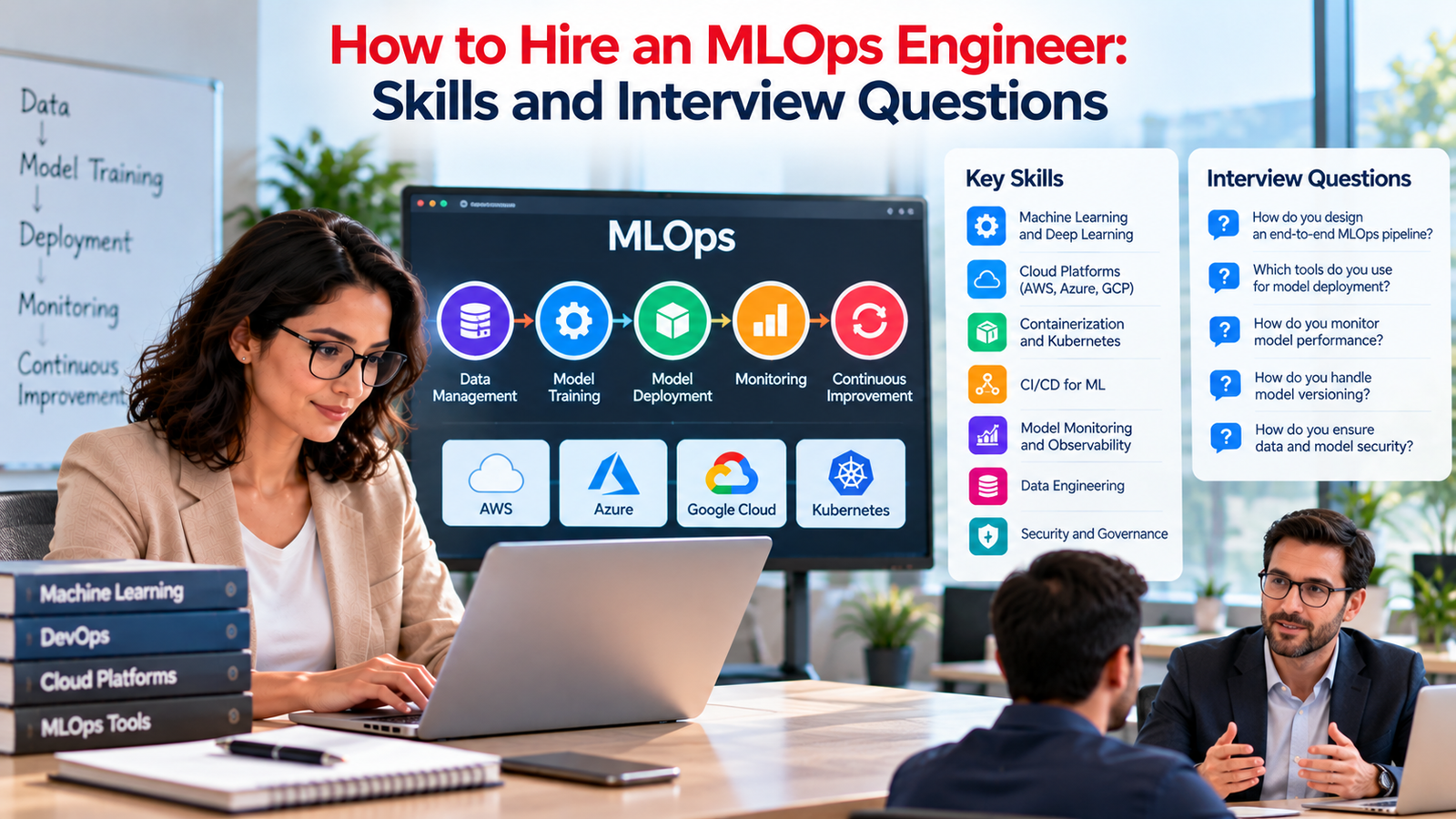
Hiring for MLOps is difficult because the job sits across machine learning and production engineering. A candidate can know model training but have weak deployment habits. Another can know cloud infrastructure but miss data drift, experiment lineage, or retraining controls. The hiring process has to test both sides of the role without turning the interview into a tool-name quiz.
The safest way to hire an MLOps engineer is to start with the production problem the person will own. Define whether the role is mainly about model deployment, ML platform work, training pipelines, model monitoring, or reliability. Then test the candidate against that work. Google describes MLOps as the application of DevOps ideas to ML systems, with automation and monitoring across testing, release, deployment, and infrastructure management in its Google MLOps guide. That framing is useful because it keeps the role tied to operating ML systems, rather than treating it as a list of cloud products.
A strong hiring process also separates principles from tools. The exact stack will change, but the engineer still needs to make training reproducible, move approved models into production, watch model and service behavior, and recover when a release fails. Those outcomes should shape the job description, the interview loop, and the final scorecard.
This guide explains how to hire an MLOps engineer with a clear role definition, focused MLOps interview questions, and evidence-based evaluation. It includes a scorecard, resume signals, practical exercises, and 15 FAQs.
TL;DR
· Define the production problem before you write the job description.
· Treat MLOps as a production engineering role for ML systems, not a generic DevOps or data science position.
· Screen for evidence of deployment, reproducibility, CI/CD, monitoring, rollback, security, and cost awareness.
· Ask candidates to explain systems they personally operated, including failures and tradeoffs.
· Use a structured scorecard so every interviewer measures the same job-related evidence.
· Include a practical system design or troubleshooting exercise that resembles your real environment.
· Give more weight to shipped production work than to a long list of tools or certifications.
What an MLOps Engineer Actually Owns
An MLOps engineer turns model development into an operating system that a team can trust. That usually means building or maintaining the path from source code and training data to a versioned model, a controlled release, and ongoing production checks. AWS makes a similar distinction in its AWS MLOps guidance, where MLOps applies DevOps practices to the machine learning lifecycle. The key hiring point is ownership of the lifecycle, not ownership of one product inside it.
The role often covers training pipelines, artifact management, model registration, deployment controls, infrastructure definitions, monitoring, and incident response. The exact mix depends on team size. In a small company, one MLOps engineer may own most of that path. In a larger company, platform engineers may own infrastructure while the MLOps engineer focuses on model lifecycle controls and developer experience for ML teams.
This is why you shouldn’t hire an MLOps engineer from a generic template. A team that already has a mature platform but weak model monitoring needs a different person from a team that still deploys models manually. Write down the current bottleneck first. Then identify the decisions the new hire must make during the first 6 to 12 months.
A useful ownership statement is specific: “Own the path from approved training run to production model and reduce manual release steps while keeping rollback and monitoring clear.” That tells candidates what success looks like. It also gives interviewers something concrete to test.
Decide Which MLOps Role You Need
The first major hiring decision is the shape of the role. MLOps can mean several jobs under one title, and unclear scope creates weak shortlists. Before you hire an MLOps engineer, list the systems the person will touch and the problems currently slowing the team down.
If the main problem is unreliable training, look for pipeline and reproducibility depth. If deployments are the problem, prioritize containers, release controls, serving patterns, and rollback. If the company has many ML teams, the role may lean toward platform engineering, shared templates, permissions, and internal tooling. Azure’s current Azure model management guidance covers reproducible pipelines, reusable environments, model registration, deployment, metadata, and lifecycle automation. Those categories are a useful checklist for deciding which parts of the lifecycle belong in your role.
You should also decide how much model knowledge the job requires. Some MLOps roles need enough ML knowledge to understand evaluation metrics, feature pipelines, drift, and retraining triggers. Others sit closer to infrastructure and mainly need to support data scientists safely. The job description should make that boundary visible.
When you hire an MLOps engineer, avoid writing a wish list that asks for expert depth in every cloud, every orchestration tool, several ML frameworks, security, data engineering, and distributed systems. Rank skills by need. Mark the rest as useful background. This gives experienced candidates a fair way to show transferable knowledge even if their previous stack used different products.
MLOps Engineer Skills to Screen For
The best skills for this role map to the real failure points of production ML. Start with software engineering. Candidates should be comfortable writing maintainable Python, using version control, reviewing changes, testing code, and managing dependencies. Python environment isolation matters because a model that runs only on one laptop isn’t reproducible. The Python environment guide explains how virtual environments isolate package installations between projects, which is a basic concept a production-focused candidate should understand.
Container knowledge is also common because ML services and pipeline components need consistent runtime environments. A candidate doesn’t need to memorize Docker commands, but they should understand images, dependencies, runtime configuration, and what belongs outside an image. Docker describes containers as isolated processes with the files needed to run in its Docker container basics. In an interview, ask how the candidate would make a training or inference workload reproducible across development and production.
Cloud and orchestration skills matter when your models run on managed services or clusters. The depth should match your environment. A candidate for a Kubernetes-heavy platform should understand pods, deployments, jobs, resources, failure recovery, and configuration. The Kubernetes workload docs explain how workload resources manage pods and different application patterns. Use that as the level of conceptual grounding you expect before asking about advanced cluster design.
CI/CD knowledge should cover code and ML-specific checks. Standard CI tests code on change, while ML pipelines may also need data validation, model evaluation, artifact checks, and promotion rules. The GitHub CI guidance describes automated build and test workflows tied to repository events. A strong candidate should be able to explain what extra checks an ML system needs before a model version can move forward.
Infrastructure as code is another useful signal when the role owns environments. The point isn’t Terraform syntax. The point is repeatable infrastructure changes that can be reviewed and versioned. The Terraform IaC guide explains how configuration files can define and manage infrastructure in a repeatable way. Ask candidates how they keep development, staging, and production from drifting apart.
The final core area is ML lifecycle knowledge. MLOps engineer skills should include experiment lineage, model versioning, deployment safety, monitoring, and retraining decisions. The exact tools can vary, but the candidate should know why each control exists and what breaks when it’s missing.
What Strong Production Experience Looks Like
Production experience is easier to verify when you ask for a system story instead of a tool list. Ask the candidate to choose one model they helped move from experimentation into production. Then walk through the full path: how the model was trained, what artifacts were stored, how a release was approved, how it was served, and how the team knew it was still working.
Experiment tracking is a useful checkpoint because it exposes whether the candidate can reproduce past work. MLflow records parameters, code versions, metrics, and artifacts for individual runs in its MLflow Tracking docs. A strong candidate should explain the same underlying need even if they used a different platform. Listen for immutable references, clear run metadata, and a way to trace a production model back to its training context.
Model registration is another checkpoint. A production team needs to know which model is approved, what version is serving, and how to return to an earlier version when needed. The MLflow Model Registry documents model lineage, versioning, aliases, and metadata. Ask candidates to explain how they separated experiments from approved production artifacts and who or what was allowed to promote a model.
Good production stories include failure. Ask what broke, how the problem was detected, how long diagnosis took, and what changed afterward. A candidate who has operated systems usually remembers concrete failure modes: schema changes, missing features, dependency changes, bad permissions, resource exhaustion, stale data, or a model that passed offline checks but behaved poorly in production.
When you hire an MLOps engineer, this stage should distinguish personal work from team work. Ask, “What did you change yourself?” and “Which decision was yours?” Strong answers can still describe collaboration, but they should make ownership clear.
How to Read Resumes Without Overvaluing Tool Lists
MLOps resumes are often dense with product names. Treat those names as clues, not proof. A candidate can list Kubernetes, MLflow, Terraform, and several cloud services after limited exposure. Your screen should look for evidence that the person used those tools to solve an operating problem.
Strong resume bullets usually contain a system, an action, and a result. For example, a candidate may describe replacing manual model promotion with a versioned release path, adding training checks, or cutting recovery time after failed deployments. The exact number isn’t always the point. What matters is whether the bullet shows ownership and a production consequence.
Weak bullets often say “worked with” or “familiar with” and then list 8 products. That can still be a junior candidate worth interviewing, but it doesn’t prove production depth. For senior roles, look for architecture decisions, incidents, migrations, platform adoption, reliability work, and mentoring around operating practices.
You should also compare the resume with the role shape you defined earlier. If your need is model serving, a candidate with years of batch pipeline work may still be strong, but the gap needs to be tested. If your need is platform ownership, repeated project-level deployments without shared systems work may be a weaker match.
A good resume screen makes later MLOps interview questions more specific. Instead of asking “Do you know Kubernetes?” you can ask why the candidate chose a certain deployment pattern on a project they already claimed to own.
Build a Hiring Scorecard Before Interviews
A scorecard keeps the interview focused on job evidence and reduces the chance that one interviewer rewards confidence while another rewards tool familiarity. Build the scorecard before the first candidate enters the process. Keep the categories tied to work the hire will actually do.
A practical scorecard can use a 1 to 4 scale. A score of 1 means the candidate can’t explain the area. A score of 2 shows basic knowledge but limited production evidence. A score of 3 shows solid production ownership. A score of 4 shows repeated ownership plus sound tradeoff decisions across different situations.
| Area | What to Test | Strong Evidence |
| Software engineering | Code quality, testing, dependencies, Git | Explains maintainable production code and failure prevention |
| ML lifecycle | Training, lineage, promotion, rollback | Can trace a model from run to production and back |
| Deployment | Containers, serving, release patterns | Explains release safety and recovery choices |
| Infrastructure | Cloud, orchestration, IaC | Can reproduce environments and reason about capacity |
| Monitoring | Service and model behavior | Defines alerts, thresholds, drift checks, and response paths |
| Security | Access, secrets, supply chain, auditability | Explains least privilege and release controls |
| Collaboration | Work across ML and platform teams | Clarifies interfaces, ownership, and written runbooks |
Use the scorecard across the full MLOps hiring process. Don’t let every interviewer create separate criteria after meeting the candidate. The panel can assign different areas to different rounds, but the final discussion should come back to the same evidence standard.
The scorecard also helps you separate required MLOps engineer skills from stack-specific knowledge. A strong engineer who hasn’t used your exact feature store may be a better choice than a weaker operator who has. Mark transferable knowledge clearly.
MLOps Hiring Process From Screen to Offer
A good MLOps hiring process can stay focused with 4 stages: an initial screen, a technical depth interview, a system design or practical exercise, and a final cross-functional discussion. More stages can be justified for senior leadership roles, but extra rounds shouldn’t repeat the same questions.
The initial screen should confirm role fit and production exposure. Ask what systems the candidate has owned, what scale or reliability constraints mattered, and where their strongest area sits. Don’t spend this round on trivia. The goal is to decide whether the person’s experience matches the shape of the job.
The technical round should test the core skills that matter in your stack. If CI/CD is central, ask the candidate to design a path from code commit to a releasable model. If shared infrastructure is central, ask about environment isolation, permissions, cost controls, and deployment patterns. Keep the scenario close to your actual work without exposing confidential details.
The practical round should test reasoning under incomplete information. Give the candidate a small system description and one problem, such as unreliable retraining or rising inference latency. Ask them to diagnose causes, request missing information, and propose the first changes they would make. That reveals more than asking for definitions.
The final discussion should test cross-functional work and ownership. MLOps engineers sit between data science and platform teams, so they need to handle unclear boundaries without creating operational gaps. Ask how they negotiate model requirements, release rules, on-call ownership, and documentation.
When you hire an MLOps engineer, make the final decision from the scorecard and written evidence from each round. Avoid a free-form panel where the loudest opinion wins.
MLOps Interview Questions for Technical Depth
Good MLOps interview questions test whether a candidate understands why production controls exist. The strongest MLOps engineer interview questions start with one system the person knows, then move into failure modes. Adjust the expected depth for the level you’re hiring.
Reproducibility and Training
Ask: “A model trained successfully 3 months ago, but the team can’t reproduce the result today. What do you inspect first?”
A strong answer should cover code version, data or dataset reference, dependencies, configuration, random seeds where relevant, feature logic, and the training environment. The candidate should separate deterministic controls from areas where perfect repeatability may still be difficult.
Ask: “What would you store for every training run, and why?”
Look for enough metadata to explain how a model was produced and to compare runs later. The candidate should connect storage decisions to debugging, auditability, and promotion.
CI/CD and Release Safety
Ask: “How does CI/CD for ML differ from CI/CD for a normal web service?”
A useful answer should add data checks and model evaluation to normal software tests. It may also discuss model artifacts, approval thresholds, registry state, retraining, and release gates. The candidate should know that a service can be technically healthy while the model inside it’s producing weaker predictions.
Ask: “When would you use canary, shadow, or blue-green deployment for a model?”
Don’t grade the vocabulary alone. Ask what traffic the candidate would send, what signals they would compare, what failure threshold would stop the release, and how they would roll back.
Monitoring and Incident Response
Ask: “What do you monitor after a model reaches production?”
A complete answer separates service health from model behavior. Prometheus stores metrics as time series and is commonly used for service monitoring, as described in the Prometheus monitoring guide. The candidate should discuss latency, errors, saturation, or throughput alongside model-specific signals such as input drift, prediction distributions, delayed ground-truth performance, and feature quality.
Ask: “An endpoint is healthy, but business performance falls. How do you investigate?”
Listen for a sequence that checks input changes, feature freshness, model output shifts, labeling delays, segment-level performance, and recent releases. Strong MLOps interview questions should force the candidate to connect infrastructure evidence with ML evidence.
Observability depth matters when a system crosses several services. OpenTelemetry provides a common framework for traces, metrics, and logs in its OpenTelemetry overview. A strong candidate should know how telemetry helps follow a request or pipeline step across system boundaries, even if they haven’t used OpenTelemetry itself.
MLOps Engineer Interview Questions for System Design
MLOps engineer interview questions should include at least one design problem because production ML is full of tradeoffs that don’t have one correct answer. Give the candidate a clear business goal, the rough data flow, model update frequency, expected traffic, and a few constraints. Then watch how they ask questions before drawing the system.
A useful prompt is: “Design an ML system for a model that retrains weekly, serves online predictions, and must support rollback to a known model version.” Ask the candidate to cover training triggers, artifact storage, validation, registration, deployment, monitoring, and recovery. Don’t require your exact stack.
Another prompt is: “Our data science team can train models, but production releases take 2 weeks and often need manual fixes. Design the path you would build first.” Strong candidates usually identify the bottleneck before choosing tools. They may propose versioned environments, automated tests, a registry, release gates, and a smaller first production path before expanding the platform.
Security should be part of the design round when the role can change production infrastructure or deploy model artifacts. NIST’s NIST AI RMF provides a framework for managing AI risks across design, development, use, and evaluation. You don’t need candidates to recite the framework, but senior engineers should be able to reason about access, accountability, human review where needed, and how operating controls change with risk.
Ask one failure question after the design. For example: “A newly deployed model increases error rates for one customer segment, but the global metric still looks acceptable. What should the system have captured so you can detect and respond?” This tests whether the candidate thinks beyond averages and whether the monitoring design supports diagnosis.
Use the same core system design prompt for most candidates at the same level. That makes MLOps engineer interview questions easier to score and reduces the chance that one person gets a much easier problem.
Use a Practical Assessment That Mirrors the Job
When you hire an MLOps engineer for a hands-on role, keep the practical assessment close to the job and small enough to respect candidate time. A 60 to 90 minute live exercise or short paid take-home is usually enough for a narrow prompt.
One option is to provide a small repository layout with a training script, dependency file, deployment configuration, and short incident description. Ask what they would change first, what tests are missing, and what information they need before release. Strong answers prioritize risk instead of rewriting everything.
Another option is a troubleshooting exercise. Say model latency doubled after a release while CPU usage stayed normal. Ask for a debugging plan. The candidate may request traces, request size changes, feature service timing, dependency changes, accelerator metrics, or artifact differences. The task tests how they narrow the problem. Guessing the hidden cause carries little weight.
A third option is an infrastructure review. Give a small environment definition and ask how it should be promoted across stages. This works well for platform-heavy roles because it tests repeatability and review habits without requiring a full deployment.
Use MLOps engineer interview questions in the live follow-up, then feed the assessment into the same scorecard used elsewhere. Record what evidence changed your view. Don’t create a separate hidden standard.
Red Flags and False Positives
If you hire an MLOps engineer based on tool recall alone, you can miss weak production judgment. Ask for one real system and keep drilling into how it was approved, deployed, monitored, and rolled back.
A second red flag is treating monitoring as infrastructure-only. A candidate who watches CPU and request errors but never asks about model quality, drift, feature freshness, or data changes is missing a core part of the role. The reverse is also true. A candidate who talks only about model metrics and ignores latency, memory, failures, and capacity may be closer to data science than production operations.
Another warning sign is manual production access as the default answer. Senior candidates should have a clear view of automated release controls, permissions, secrets, and audit trails. NIST’s NIST SSDF guidance recommends integrating secure development practices into the software lifecycle. You don’t need every MLOps engineer to be a security specialist, but they should treat production changes and software supply risks as engineering concerns.
Be careful with false negatives too. A candidate may have strong production ML skills without using your preferred cloud. Another may use internal tools rather than public products. Test the principle behind the tool. If they can explain artifact lineage, environment control, deployment safety, and incident response in another stack, the knowledge may transfer quickly.
Certifications are another possible false positive. They can show study and baseline familiarity, but they shouldn’t outweigh production evidence for experienced roles. Use them as supporting information rather than a substitute for the interview.
Make the Final Hiring Decision
To hire an MLOps engineer with less guesswork, make the final decision answer one question: does the evidence show this person can own the production problems in the role? Return to the scorecard. A low score in a critical area can outweigh high scores in areas the role barely uses.
For a senior hire, require examples of tradeoffs and incidents. The candidate should explain why they chose a design, what failed, and what changed afterward. For a mid-level hire, narrower ownership can be fine if the fundamentals are solid. For a junior hire, focus on software habits, debugging method, and basic ML lifecycle understanding.
When reference checks are part of your process and legally appropriate, use them to verify ownership. Keep questions tied to project scope, reliability, collaboration, and production incidents.
If 2 candidates are close, prefer the one whose strengths match your actual bottleneck. The person with the longest tool list isn’t automatically the better hire. The MLOps hiring process works when it measures the work you need done now and the systems the person will have to own next.
Hire for Production Ownership, Not Tool Recall
The best way to hire an MLOps engineer is to define the production responsibility first and build the interview around evidence of that responsibility. A consistent scorecard helps you hire an MLOps engineer against the same standard each time. A clear role scope prevents you from screening for every tool in the market. A shared scorecard keeps the panel focused. A practical exercise shows how the candidate reasons when the answer isn’t in a certification guide.
Strong MLOps engineer skills combine sound software practice with ML lifecycle knowledge. The candidate should be able to reproduce work, move models through controlled releases, observe production behavior, and respond when something fails. They also need enough infrastructure knowledge to work safely in your environment and enough ML knowledge to understand what can go wrong beyond service uptime.
Use MLOps interview questions that start from real systems and real failure modes. Ask what the candidate personally owned. Ask what they would monitor. Ask how they would roll back. Ask how they would know a new model is better after deployment. Those answers give you stronger hiring evidence than a list of definitions.
If you use the same structure across candidates, your MLOps engineer interview questions become easier to compare and your MLOps hiring process becomes easier to defend. The goal is a hiring decision based on production evidence, role fit, and clear engineering judgment.
FAQs
What Does an MLOps Engineer Do?
An MLOps engineer builds and maintains the systems that move machine learning work from development into production. The role can include training pipelines, model versioning, deployment controls, environment management, monitoring, and incident response. The exact scope depends on the company. In smaller teams, the engineer may own most of the lifecycle. In larger teams, infrastructure or platform groups may own parts of it.
When Should a Company Hire an MLOps Engineer?
A company should consider the role when ML models are moving into production and manual work is causing release delays, weak reproducibility, poor monitoring, or repeated deployment failures. The need becomes stronger when several data scientists share production infrastructure or when the business depends on models that require regular retraining and controlled releases.
What Are the Most Important MLOps Engineer Skills?
Core MLOps engineer skills include software engineering, version control, testing, containers, CI/CD, cloud or infrastructure knowledge, model lifecycle management, monitoring, and debugging. The exact depth should match your environment. A platform-heavy role may need deeper infrastructure knowledge, while a model lifecycle role may need stronger experience with training pipelines and model evaluation.
How Much Machine Learning Knowledge Does an MLOps Engineer Need?
The engineer usually needs enough ML knowledge to understand training and evaluation, feature pipelines, common model metrics, drift, and retraining. The role doesn’t always require deep research knowledge. The right level depends on whether the person will mainly support data scientists or directly own model validation and production behavior.
Should an MLOps Engineer Know Kubernetes?
Kubernetes is useful when your environment runs ML workloads on Kubernetes, but it shouldn’t be a universal requirement. Test the production concepts your team needs, such as container orchestration, resource control, jobs, deployments, failure recovery, and service configuration. A candidate with strong experience on another platform may learn Kubernetes faster than a weak operator who knows its commands.
Which Programming Language Matters Most for MLOps?
Python is common because it’s widely used in machine learning and automation, but language choice should follow your stack. Strong candidates should also be comfortable with shell scripting and configuration formats used in infrastructure work. For hiring, test code quality, debugging, dependency management, and maintainability rather than language trivia.
What MLOps Interview Questions Should Recruiters Ask First?
Recruiters should start with role-fit questions rather than deep technical trivia. Ask what ML systems the candidate has supported in production, what part they personally owned, how models were deployed, and what happened when a release failed. These MLOps interview questions help determine whether the candidate has real production exposure before the technical panel spends time on deeper evaluation.
What MLOps Engineer Interview Questions Work for Senior Candidates?
Senior MLOps engineer interview questions should focus on system design, tradeoffs, failure handling, platform boundaries, security, and cost decisions. Ask the candidate to design a model release path, explain a major incident, define monitoring for a production model, or choose between build and buy options. Require clear reasoning and evidence from prior work.
Should You Use a Take-Home Test for MLOps Hiring?
A short take-home can work if it mirrors the job and respects candidate time. Keep the task narrow, such as reviewing a small pipeline design or diagnosing a production issue. A live system design exercise can also work well. The assessment should test reasoning, prioritization, and production judgment rather than asking candidates to build a large project for free.
How Do You Test MLOps Monitoring Skills?
Give the candidate a production scenario and ask what they would measure. Strong answers cover service health and model behavior. They should discuss signals such as latency, failures, resource use, input changes, feature quality, prediction shifts, and ground-truth performance when labels become available. Then ask what threshold or condition would trigger investigation or rollback.
How Do You Test Reproducibility in an MLOps Interview?
Ask the candidate how they would reproduce a training run from several months ago. Listen for code version, dataset or immutable data reference, dependencies, configuration, environment, feature logic, parameters, and stored artifacts. Then introduce a failure, such as an overwritten dataset, and ask how their system would prevent or detect it.
Are Cloud Certifications Important When Hiring an MLOps Engineer?
Certifications can show baseline knowledge of a cloud platform, but they aren’t strong proof of production ownership by themselves. For experienced roles, shipped systems, incidents, design decisions, and operating habits should carry more weight. Certifications can help when comparing early-career candidates who have limited production history.
What Is the Biggest Mistake in the MLOps Hiring Process?
The biggest mistake is starting with a generic tool list before defining the production problem. That creates a broad job description and interviews that reward familiarity instead of ownership. A better MLOps hiring process starts with the systems the person will own, the failures they must prevent, and the evidence that proves they can do that work.
How Long Should an MLOps Technical Interview Be?
A focused technical interview often fits within 60 to 90 minutes when the scope is clear. Use the time for one or 2 deep scenarios rather than a long list of short questions. The candidate should have enough time to ask clarifying questions, explain tradeoffs, and respond to follow-up failures or changes in constraints.
How Do You Know You Are Ready to Hire an MLOps Engineer?
You’re ready when you can state the production problem, define what the person will own, name the critical MLOps engineer skills, and build a scorecard around real work. If the role is still described as “handle everything related to AI infrastructure,” narrow it before opening the search. Clear scope improves sourcing and makes the final decision easier.