

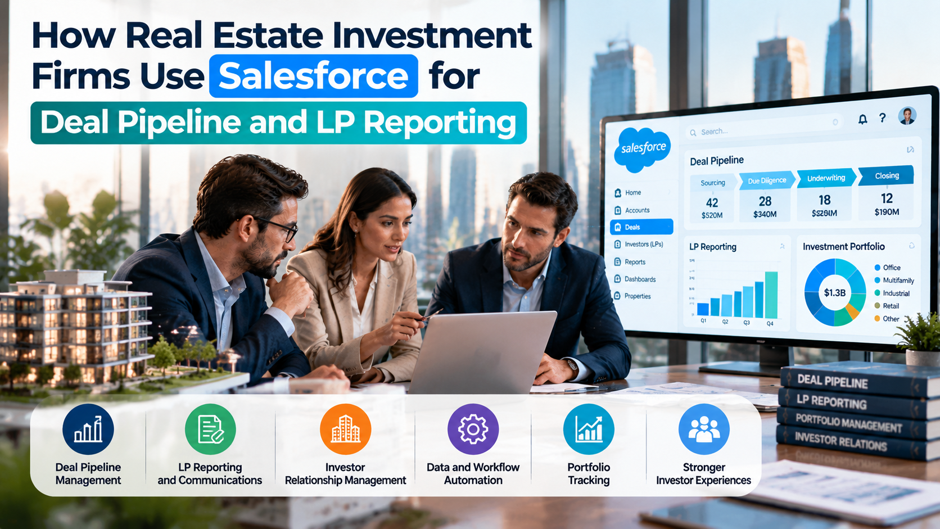
BH Equities ran its acquisitions business the way plenty of real estate investment firms still do today: deal data scattered across individual spreadsheets, historical property information nobody could easily search, and investor matching handled mostly from memory and scattered email threads. Once the firm moved onto Salesforce, leadership could finally track benchmark figures they’d never reliably measured before, units acquired, properties closed, acquisition fees earned per year, all from a single dashboard, and the acquisitions team grew specifically because a central database finally kept everyone connected rather than working from their own separate, outdated version of the truth.
That same basic story repeats across the real estate investment industry in 2 distinct but genuinely connected ways: managing the deal pipeline from initial sourcing all the way through close, and keeping limited partners properly informed through capital calls, distributions and performance reporting once the deal itself is actually done. Salesforce handles both, though the mechanics differ meaningfully between the 2, and firms frequently bring in additional tools built specifically for fund mechanics Salesforce wasn’t originally designed to run. This post walks carefully through how real estate investment firms actually put Salesforce to work across both halves of that lifecycle, and where the platform’s real strengths and its equally real limits actually sit.
TL;DR
- Salesforce’s core strength is centralizing what used to live in scattered spreadsheets and inboxes. Sales Cloud gives real estate investment firms a single source of truth for deal pipeline data, investor contact history and acquisition benchmarks, replacing the disconnected spreadsheets and email threads that quietly cost deals and slow down reporting across the whole team over time, deal after deal.
- Deal pipeline tracking and LP reporting draw on genuinely different parts of the platform. Deal sourcing, underwriting and due diligence typically run through standard and custom Sales Cloud objects, while LP-facing reporting, capital calls, distributions, registry statements, usually runs instead through a Salesforce Experience Cloud portal built specifically and quite deliberately for that particular purpose alone, separate from the rest.
- Salesforce alone isn’t built as a fund accounting system. That’s exactly why most firms eventually pair it with a dedicated tool that handles that specific job. Complex waterfall calculations, NAV tracking and K-1 generation typically require either heavy custom development on top of Salesforce or integration with a purpose-built fund administration platform, which is why many firms run Salesforce for relationships and pipeline while a dedicated tool handles the deeper financial mechanics.
Why Real Estate Investment Firms Turn to Salesforce
Most real estate investment firms that eventually adopt Salesforce aren’t actually switching away from a competing CRM, they’re switching away from having had no real, functioning system in place whatsoever before that point. Deal information lives scattered in individual brokers’ inboxes, historical property data sits buried in whoever closed that specific deal’s own personal files, and matching a new opportunity against the right group of investors depends entirely on someone remembering who expressed interest in a similar deal 2 years earlier. That’s a genuinely real operational risk for a business built almost entirely on relationships and precise timing, since a missed follow-up or a forgotten investor preference can mean losing a promising deal to a competitor who simply tracked their own pipeline more carefully from the start.
Salesforce solves this specific problem by giving a firm exactly 1 place to track everything that matters: contacts, deal stages, property details, investor communication history and the reporting that shows leadership what’s actually happening across the entire pipeline at any given moment. The platform’s underlying adaptability is exactly what makes it genuinely attractive here, since real estate investment firms have unusually specific data structures compared with a typical B2B sales organization, tracking properties alongside deals, investors alongside contacts, and fund structures alongside opportunities, and Salesforce’s genuine customization depth lets a firm build a system that actually reflects how their specific business really works, rather than forcing their unique process to fit a generic sales pipeline template built for someone else’s industry entirely.
What Salesforce Actually Covers in the Investment Lifecycle
| Stage of the Lifecycle | What Salesforce Typically Handles | Common Salesforce Tool |
| Deal sourcing and broker relationships | Tracking inbound and outbound deal flow, broker contact history, property leads | Sales Cloud, often with custom objects for properties |
| Underwriting and due diligence | Document tracking, task management, deal stage progression, team collaboration | Sales Cloud with custom fields and workflow automation |
| Closing and acquisition | Final deal terms, closing checklist tracking, handoff to asset management | Sales Cloud, sometimes integrated with e-signature tools |
| Investor relationship management | Contact history, commitment tracking, communication logs across funds | Sales Cloud, often paired with Experience Cloud for self-service |
| LP reporting and capital activity | Capital call notices, distribution notices, registry statements, document delivery | Salesforce Experience Cloud, frequently custom-built |
Reading this table left to right traces the genuine, actual path a deal and its eventual investors travel through a real estate investment firm’s systems over the full lifecycle, and it shows clearly why firms often end up building 2 connected but genuinely distinct Salesforce environments: 1 internal-facing for the deal team’s own daily work, and 1 external-facing for investors who need their own secure, carefully limited view into exactly what applies to them specifically.
Deal Pipeline Management in Salesforce
Centralizing Data That Used to Live in Scattered Spreadsheets The core function Sales Cloud performs for a real estate investment firm’s deal pipeline is maintaining a genuine single source of truth for every property currently under consideration, every broker relationship feeding that pipeline, and every stage a specific deal has already passed through on its way toward closing. Instead of a spreadsheet that only 1 person actually updates while everyone else works from an outdated copy of it, the deal record lives directly in Salesforce, where the whole acquisitions team sees that same current status, the same notes, and the same complete history at the exact same time.
Tracking Deals Through Distinct, Firm-Specific Stages Real estate deal stages rarely match a generic sales pipeline straight out of the box: sourced, letter of intent, under contract, in due diligence, closed are typical high-level stages, but the specific substeps within due diligence alone, title review, environmental assessment, financing contingency, often need their own dedicated tracking beyond that simple stage name. Salesforce’s customization depth lets a firm build exactly these specific stages as custom fields or a fully custom object, giving leadership a genuinely real-time view of exactly where every active deal currently sits and what’s actually blocking it from moving forward toward close.
Matching Deals to the Right Investors Before the Deal Even Closes Beyond simply tracking the deal itself, Salesforce also supports matching specific opportunities against the investors most likely to actually want exposure to that particular property type, geography or risk profile, using historical commitment data and stated preferences already captured within that same system. This exact matching function is precisely what BH Equities specifically needed a customized system for, connecting deal flow data directly with investor preference data so the team could move quickly from identifying a genuinely promising property all the way to lining up the capital needed to actually close on it.
Where Salesforce Needs Help: The M&A/Deal-Specific Gap
Salesforce’s genuine strength as a relationship and pipeline tracking tool doesn’t automatically extend into the deeper asset-specific data that commercial real estate acquisitions teams actually need on a day-to-day basis. Tracking who you talked to, logging calls and centralizing contact details works well in standard Salesforce, but real-time insight into asset performance, market activity and deal-specific financial modeling generally requires either significant custom development or a separate, purpose-built deal management platform that connects back into Salesforce rather than replacing it entirely.
This specific gap explains why plenty of real estate investment firms running Salesforce successfully for relationship management and pipeline tracking still choose to layer on a dedicated deal management tool for the asset-level analysis that general CRM software was never really built to handle in the first place. The practical pattern that consistently emerges is Salesforce functioning as the system of record for relationships, contacts and pipeline stage, feeding into or pulling from a more specialized tool that handles the property-level financial analysis, market comparables and underwriting models that genuinely benefit from purpose-built functionality rather than yet another customized CRM field bolted on afterward.
Building LP Reporting on Salesforce
- Experience Cloud is the typical foundation for investor-facing portals. Firms building an LP reporting portal on top of Salesforce generally use Experience Cloud specifically, since it’s specifically designed to give external users, in this case investors, a secure, branded, self-service view into a carefully limited slice of the firm’s broader Salesforce data, rather than granting full internal access to everything.
- The portal shares a unified database with the firm’s internal Salesforce instance. A well-built investor portal synchronizes with the same contact records, deal history and activity data the internal team already works from, which means an investor’s capital account information stays consistent with what the firm’s own reporting shows, rather than living in a separate, disconnected system that has to be manually reconciled.
- Custom branding matters considerably more for LP portals than it might for purely internal tools. Since investors interact directly with this portal as a reflection of the firm itself, matching the portal’s visual identity to the firm’s own branding reinforces professionalism and trust in a way that an off-the-shelf, unbranded interface simply doesn’t accomplish nearly as well for a discerning investor.
- Building this out well typically requires a Salesforce implementation partner with real estate or fund experience. The specific mechanics LPs expect, registry statements, capital call notices, distribution tracking, simply aren’t standard Salesforce functionality straight out of the box, which is why firms genuinely serious about this build usually work with a Salesforce implementation partner who has done this specific kind of implementation many times before rather than attempting it as a first-time internal project.
The Core Components Every LP Portal Needs
| Component | What It Shows the Investor | Why It Matters |
| Registry statements | Committed capital, called capital, distributions received, unfunded commitment, current net asset value | Gives LPs a real-time view of their position without waiting for a quarterly PDF |
| Capital call notices | Amount due, payment instructions, wire references, acknowledgement of receipt | Drives LP cash management, so timing and clarity directly affect the investor’s own planning |
| Distribution notices | Payment amount, timing and source, with full historical record | Lets LPs verify what they’ve received against what the fund reports independently |
| Tax documents | K-1s and related filings, organized and searchable by year | Removes the annual scramble of tracking down tax documents through email |
| Document library | Quarterly reports, audited financials, subscription agreements | Creates a single, permanent home for documents that used to live scattered across email threads |
Every 1 of these components gets flagged during genuine LP operational due diligence, which means a firm’s portal isn’t just a convenience feature, it’s increasingly part of how sophisticated investors judge whether a firm’s operations are mature enough to trust with significant capital. A portal that only offers a subset of this list, or that still requires investors to email the firm for basic account information, signals an operational gap that institutional LPs specifically are trained to notice and flag during their own due diligence process.
Salesforce vs Purpose-Built Fund Administration Platforms
What Salesforce Plus Experience Cloud Handles Well A Salesforce-based investor portal excels at unifying the relationship and communication side of LP management, since the exact same system already tracking a deal’s progress and an investor’s commitment history can surface that same information directly to the investor without ever duplicating data entry into a separate platform. For firms that have already invested heavily in customizing Salesforce for deal pipeline management, extending that same platform into investor reporting keeps everything in 1 tightly connected system, rather than maintaining 2 separate tools that constantly need to stay synchronized with each other.
What Purpose-Built Platforms Like Juniper Square, Covercy and InvestNext Handle Differently Dedicated investor management platforms built specifically for real estate and private equity funds typically include fund accounting functionality, automated waterfall calculations and capital call processing as native features rather than custom development, since solving exactly this problem is the entire reason these platforms exist. A firm choosing 1 of these purpose-built platforms trades some of the unified-system advantage Salesforce naturally offers for functionality that’s already built, thoroughly tested and actively maintained specifically for fund mechanics, rather than adapted piece by piece from a general-purpose CRM.
The Real Decision Often Comes Down to Existing Investment and Complexity A firm already running a heavily customized Salesforce deal pipeline, with significant sunk cost already invested in that customization and staff who already know the system well, often finds extending into Experience Cloud for LP reporting the considerably more efficient path, even if a purpose-built platform might offer deeper fund accounting functionality straight out of the box. A newer firm without that existing Salesforce investment already in place, or 1 managing genuinely complex multi-tier waterfall structures spread across many funds, may find a purpose-built platform’s native fund administration functionality well worth the tradeoff of running a separate system apart from their own deal pipeline CRM.
A Real Example: How 1 Firm Used Salesforce for Deal Flow
BH Equities’ experience illustrates both the opportunity and the real work involved in making Salesforce fit a real estate investment firm’s actual operations. The firm recognized Salesforce as the right platform choice, but building a system that genuinely served their specific needs, managing deal flow, matching investors to potential deals, and mining historical data in a way that was actually simple and easy to use, required working with an implementation partner who could translate Salesforce’s general capabilities into something shaped specifically around real estate investment operations rather than a generic sales process.
The results extended beyond simply having better records. Salesforce’s mobile accessibility let the acquisitions team pull up relevant historical data and property trends directly during on-site visits, rather than needing to return to the office to check a spreadsheet before making a decision. And the reporting and dashboard functionality gave leadership visibility into benchmark figures, units, properties and acquisition fees per year, that the firm had genuinely never been able to track reliably before, visibility that directly supported the decision to grow the acquisitions team once a shared, central system replaced the fragmented, individually-owned spreadsheets everyone had been working from separately.
How Deal Pipeline Data and LP Reporting Actually Connect
- Deal pipeline data doesn’t disappear once a transaction closes, it becomes exactly what LPs later see. A property’s acquisition details, purchase price, closing date, projected returns, captured during the deal pipeline stage flow directly into the fund-level reporting an investor later reviews to understand exactly where their committed capital actually went and precisely how well it ultimately performed over time.
- Building both halves on the same foundation tends to produce more accurate, timelier reporting. When the underwriting team updates a property’s projected returns during due diligence, that same data, if properly connected, can flow straight through to investor-facing reporting without anyone needing to manually re-enter the same figures into a second, entirely separate system somewhere else in the stack.
- This connection directly reduces both administrative burden and the risk of drift between systems. Separate systems that don’t share the same underlying data quietly drift out of sync with each other over time, a gap that usually only becomes visible once an investor notices a number in their own report doesn’t quite match what the firm says elsewhere in its own materials.
- Disconnected systems tend to produce exactly the manual reporting burden that plagues many firms. A deal pipeline tool here and a separate investor portal there means someone has to manually pull numbers from the deal system, reformat them, and push them into whatever tool investors actually see, a process that’s slow, error-prone and difficult to scale as deal and investor counts both grow.
Reporting and Dashboards for Internal Leadership
Metrics That Used to Require Manual Compilation Become Straightforward Beyond what LPs themselves see, Salesforce’s reporting and dashboard capabilities give a firm’s own leadership visibility into metrics that used to require manually compiling data from scattered sources every time someone asked a basic question about pipeline health. Tracking the number of active deals by stage, average time from sourcing to close, acquisition fees earned per year, and win rate against competing offers all become straightforward once that underlying data already lives in 1 structured system rather than scattered across individual team members’ personal files and inboxes.
Real Data Replaces Gut Feeling in Staffing and Sourcing Decisions This visibility directly supports decisions that used to rely mostly on gut feeling or incomplete information. A firm deciding whether to expand its acquisitions team, as happened at BH Equities once a shared system replaced fragmented spreadsheets, benefits enormously from actually being able to see, with real data, whether the existing team is handling current deal volume efficiently or genuinely stretched thin. Identifying which brokers or sourcing channels consistently produce the strongest deals becomes a question answered with real evidence rather than a subjective impression, once every deal’s origin and eventual outcome live in the same trackable system.
Different Roles Need Different Views of the Same Underlying Data Dashboards built for different roles within the firm typically surface different views of this same underlying data. A deal team lead might need a dashboard showing every active deal by stage and owner, while firm leadership more often wants a higher-level view showing pipeline value by fund, projected close dates, and how actual acquisition volume compares against the firm’s own targets for the year. Salesforce’s flexibility in building these role-specific views from 1 shared dataset is a genuine strength, letting each stakeholder see exactly what’s relevant to their own decisions.
Security and Access Control Considerations
Real estate investment firms handle genuinely sensitive information across both halves of this entire system, competitive deal terms and property financials on the pipeline side, and individual LP capital account details and specific commitment amounts on the reporting side, which makes access control a genuine design consideration from day 1 rather than something bolted on as an afterthought. Internally, not every team member actually needs visibility into every active deal, and externally, no investor should ever be able to see another investor’s own specific commitment amount or capital account details, a firm boundary that has to be carefully enforced rather than simply assumed to hold.
Salesforce’s own permission and sharing model directly supports this kind of granular control, letting a firm restrict internal visibility by team, role or specific deal, while Experience Cloud’s external-facing permission structure specifically ensures each individual investor only ever sees their own data within that shared portal environment. Getting this specific configuration right matters considerably more than it might initially seem on the surface, since a permission error that accidentally exposes 1 LP’s capital account details to another investor isn’t just an embarrassing mistake to quietly fix, it’s exactly the kind of operational failure that damages hard-earned investor trust and can surface as a real, documented concern during a sophisticated LP’s own due diligence process before they ever commit further capital to the firm.
Common Customizations Real Estate Firms Make
- Custom property objects that go well beyond standard Salesforce fields. Since Salesforce wasn’t originally built around physical assets, firms commonly create custom objects specifically for properties, capturing details like square footage, unit count, asset class and acquisition status in fields a generic sales pipeline simply doesn’t include by default at all, straight out of the box for anyone.
- Fund and entity structures layered on top of standard account and opportunity records. Real estate investment firms frequently manage capital through multiple distinct funds, each with its own investors, terms and reporting requirements, which typically requires custom object relationships connecting funds, investors and deals together in ways standard Salesforce configuration simply doesn’t anticipate straight out of the box.
- Automated workflows for due diligence checklists and approval stages. Rather than tracking due diligence tasks manually, firms commonly build automated workflows that assign tasks, track completion and flag overdue items as a deal moves steadily through underwriting, reducing the real chance that a critical step gets accidentally missed during a fast-moving acquisition process running under real time pressure.
- Integration with property management and accounting systems. Since Salesforce handles the relationship and pipeline side well but isn’t built for property-level financial operations, firms managing properties post-acquisition frequently integrate Salesforce with dedicated property management and accounting platforms, keeping deal history connected to ongoing operational and financial data without ever duplicating records anywhere across these 2 separate systems at once.
Fundraising and Capital Commitment Tracking Before a Fund Even Closes
Before a fund reaches its first close, real estate investment firms spend considerable time and effort tracking soft commitments, formal subscription documents and the ongoing relationship-building work that eventually converts investor interest into actual, committed capital sitting inside the fund. Salesforce supports this fundraising stage in much the same way it already supports deal pipeline tracking, treating each prospective investor’s own journey from initial interest through signed subscription documents as its own trackable pipeline running in parallel with the deal pipeline itself.
This fundraising pipeline typically captures details that matter specifically to the capital raising process itself: how much a given investor has indicated genuine willingness to commit, which prior funds they’ve already participated in, what specific property types or geographies they’ve expressed real interest in, and exactly where each prospective investor currently sits within the subscription process. Having this information genuinely centralized means a firm’s capital raising team can move quickly the moment a strong deal surfaces, since they already know exactly which investors are most likely to want exposure to that specific opportunity, rather than needing to reconstruct that picture from memory or scattered notes every single time a new deal comes through the pipeline.
The same system that tracks this fundraising activity often feeds directly into the LP reporting portal once a commitment finally converts into an actual capital call, closing the loop between that initial fundraising interest and the ongoing reporting relationship that follows for the entire life of the fund thereafter. This genuine continuity is part of what makes building both halves of the system on Salesforce so valuable specifically for firms with the deal and investor scale to justify the upfront investment, since an investor’s entire relationship with the firm, from that very first conversation through the final distribution years later, lives in 1 connected system rather than scattered across a separate fundraising tool, a separate deal CRM and a separate reporting portal that all have to somehow stay synchronized with each other constantly.
FAQs
Can Salesforce genuinely handle LP reporting straight out of the box, or does it actually require real customization?
It genuinely requires real, substantial customization work on the firm’s part. Standard Salesforce doesn’t include registry statements, capital call notices or fund-specific reporting as native functionality, which is why firms building genuine LP reporting capability typically use Salesforce Experience Cloud combined with custom development, or work directly with an implementation partner experienced specifically in real estate or fund-focused Salesforce builds.
Why do some real estate investment firms use Salesforce alongside a separate deal management platform?
Salesforce genuinely excels at relationship tracking, contact history and pipeline stage management, but real-time asset performance data, market activity analysis and deal-specific financial modeling often benefit considerably from purpose-built tools designed specifically for that kind of analysis. Many firms run Salesforce as the primary system of record for relationships and pipeline stage, while a dedicated separate platform handles the deeper property-level financial analysis work instead.
What’s the difference between using Salesforce and using a purpose-built platform like Juniper Square for LP reporting?
A Salesforce-based portal keeps investor reporting connected to the exact same system already tracking deal pipeline and investor relationships, avoiding unnecessary data duplication across separate, disconnected tools. A purpose-built platform typically includes fund accounting, automated waterfall calculations and capital call processing as native, already-built features, trading away some of that unified-system advantage for functionality that doesn’t require custom development to get up and running.
Do real estate investment firms typically build their own Salesforce customizations, or work with an implementation partner?
Most firms genuinely serious about building real deal pipeline and LP reporting functionality work with an implementation partner experienced specifically in real estate or private equity Salesforce builds, since the specific customizations required, custom property objects, fund structures, investor portal mechanics, all go well beyond what standard Salesforce configuration can offer on its own. Attempting this as a first internal project without that specific experience often produces a system that technically works but doesn’t actually fit how the firm’s business really operates.
What core information do institutional LPs expect to see in a fund’s investor portal?
At an absolute minimum, LPs expect registry statements showing committed and called capital alongside distributions and current net asset value, capital call and distribution notices with full payment details, searchable tax documents including K-1s, and a document library holding quarterly reports and audited financials together in 1 place. Sophisticated LPs specifically evaluate all of this closely during their own operational due diligence process, well before ever committing real capital to a fund.
Is Salesforce a good fit for a smaller real estate investment firm just starting to formalize its deal process?
It genuinely can be, though the real return on investment depends heavily on both deal volume and underlying complexity. A firm managing a genuinely small number of deals with just a handful of regular investors may find the customization effort required to build out a proper Salesforce implementation harder to justify than 1 managing dozens of active deals and a steadily growing investor base that specifically needs the kind of centralized tracking and reporting Salesforce was built to provide at real scale.
How does Salesforce mobile access actually benefit real estate acquisitions teams specifically?
Because Salesforce is fully cloud-based, acquisitions team members can access deal history, property details and investor notes directly from a mobile device while physically standing on-site at a property, rather than needing to return to the office to check records before making time-sensitive decisions. This matters specifically in real estate, where evaluating a property often happens directly in person, and having immediate access to historical data and prior deal context can directly affect exactly how quickly a team can move on a promising opportunity.
What typically triggers a real estate investment firm to move from spreadsheets to Salesforce?
The single most common trigger is exactly what happened at firms like BH Equities: data scattered across individual spreadsheets and inboxes eventually reaches a point where nobody on the team has a reliable, shared view of the full pipeline, historical deals become genuinely hard to search, and matching new opportunities against the right investors depends far too heavily on individual memory rather than on any real, shared system. Growth in deal volume or investor count usually accelerates this exact realization, since the coordination cost of disconnected spreadsheets scales considerably faster over time than the cost of properly implementing a shared system would ever require.