

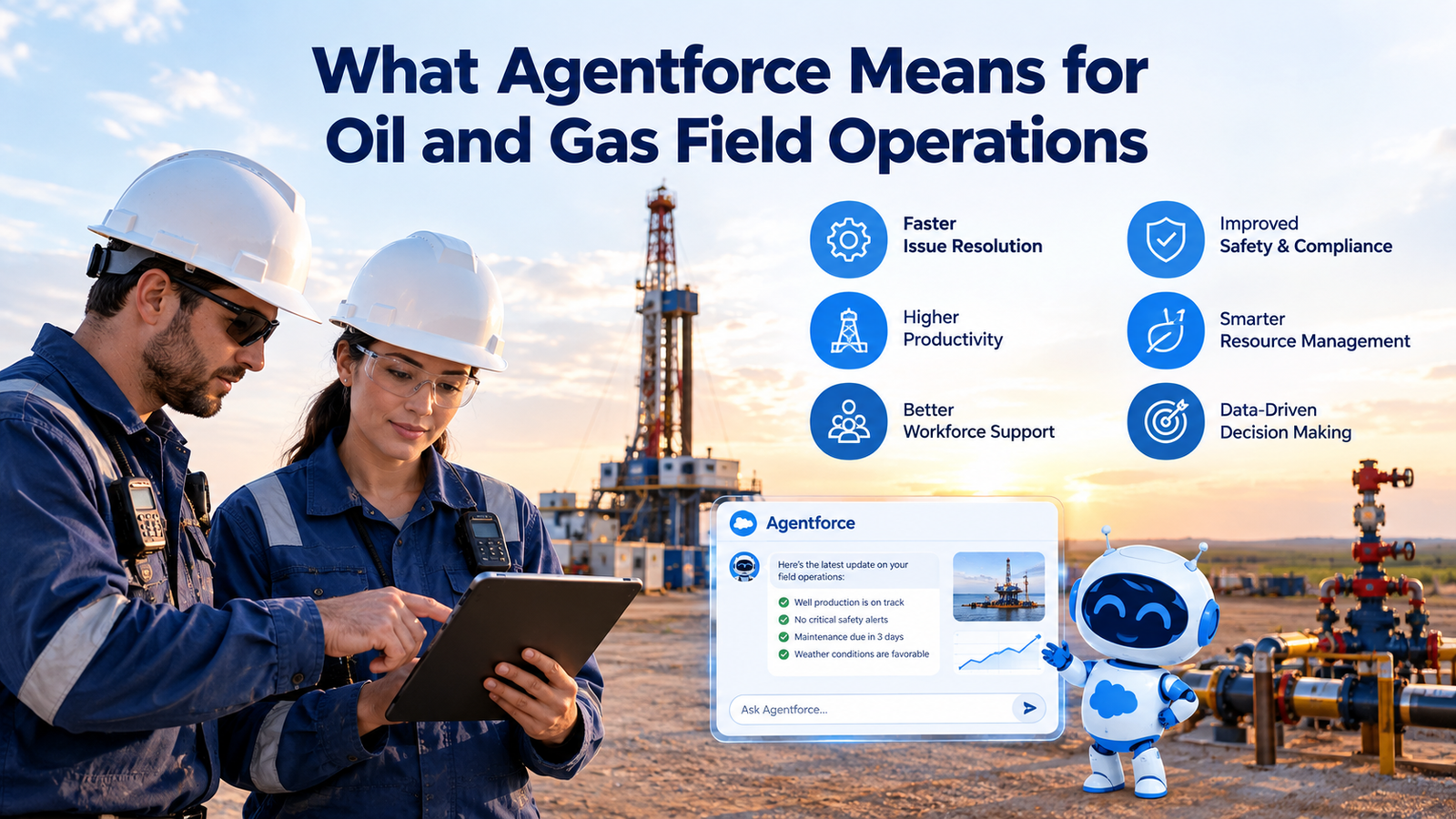
Oil and gas field work has always depended on context. A technician needs to know which asset is involved and what failed before. The worker also needs the right procedure and available parts. Changes in site conditions matter too. Much of that context sits across work orders, asset histories, manuals, service notes, scheduling systems, and operational platforms. The practical question is whether Agentforce can turn scattered information into useful action. It still has to respect the controls that field work requires.
The timing matters. A 2026 McKinsey OFSE survey found that more than 75% of surveyed oilfield services and equipment leaders expected generative AI to improve operational efficiency. Fewer than 25% of companies had moved beyond pilot stages. Deloitte’s 2026 industry outlook also points to rising AI spending and wider use of AI-enabled field services. Scaled field adoption still depends on data quality, connected workflows, and clear operating limits.
That is where Agentforce for oil and gas becomes relevant. It can sit inside Salesforce-based field processes and draw context from approved data. It can answer job-specific questions and carry out configured actions. It can help workers prepare for a job or reduce administrative work after it. It can also help dispatchers react to schedule changes. The value is strongest when the agent works around the physical operation. Established control systems and qualified people should remain responsible for safety-critical decisions.
TL;DR
Agentforce for oil and gas can put work-order context and asset information closer to the worker. It can also surface service history and approved knowledge. It can also help with scheduling changes, job summaries, follow-up work, and other configured service actions.
The strongest early use cases sit in field service coordination and administrative work. Weaker use cases give a general-purpose AI agent direct authority over safety-critical equipment. Operating decisions also need tighter control.
Oil and gas companies should judge Agentforce by field outcomes. Useful measures include preparation time and schedule recovery. Documentation quality and repeat visits also matter. They should also test connectivity, permissions, source data, escalation rules, and auditability before expanding its role.
Why Agentforce Is Entering Field Operations Now
The industry already has the technical foundation for more AI-assisted field work. Sensors, historian data, mobile work management, asset records, and remote monitoring are common across many operations. The newer shift is toward AI that can interpret context. It can also trigger approved business actions instead of only producing a prediction or dashboard.
The International Energy Agency says oil and gas companies have been early adopters of AI. Uses include exploration, production, maintenance, and safety. Its Energy and AI analysis also notes predictive maintenance and leak detection. Remote operations and regulatory work appear as well. Agentforce for oil and gas fits into a different layer of that picture. It is most relevant where field data needs to reach a person. It also fits business workflows that need to move after an operational event is detected.
The workforce issue matters too. The IEA’s energy employment report says today’s AI applications do little to remove the need for applied technical workers. That remains true in operations and maintenance. Much of that work remains physical. That makes AI in oil and gas operations useful as a support layer. A system can still add value when it helps a technician find the right job history faster. The repair itself can remain hands-on work.
McKinsey’s August 2026 upstream AI analysis estimates roughly $65 billion in near-term annual recurring value from AI use cases across upstream oil and gas. It sees a larger long-term potential as technology and operating models mature. They still show why operators and oilfield service firms want practical ways to move beyond experiments. The next step is day-to-day work.
AI adoption doesn’t need to begin with autonomous wells or unmanned maintenance. It can begin with the information and coordination problems that already cost time during oil and gas field operations.
What Agentforce Actually Does in an Oilfield Setting
Agentforce is an AI agent layer on the Salesforce platform. Its useful role in the field depends on approved data and defined instructions. The agent also needs a clear set of actions it is allowed to execute. In practice, the agent can answer questions from work context. It can also call configured Salesforce flows or connected actions when its permissions allow.
Salesforce introduced field-service functions for scheduling, job preparation, troubleshooting, and post-work reporting in its Agentforce field announcement. Those functions aren’t specific to drilling rigs or production sites. Oil and gas companies can apply the same field-service pattern to managed service jobs. The existing process provides the frame. Examples include equipment inspections and preventive maintenance. Parts requests and follow-up work can fit too.
Agentforce for oil and gas should therefore be understood as an operating assistant around field work. It can help connect a worker to the business and service context of a job. It can also reduce the number of screens or searches needed to find records. Where a permitted action exists, the agent can help move the workflow forward.
Salesforce’s energy Agentforce page It describes field summaries grounded in asset history and work-order context. This is where Salesforce for oil and gas becomes more than a customer-management system. When approved field and asset data are connected, the CRM layer can support the technician. That support can begin before physical work starts. It can support the closeout process too.
A useful boundary is to separate service orchestration from process control. Agentforce Field Service can support a work order, suggest a next administrative step, or surface a procedure. A SCADA system, distributed control system, safety instrumented system, or equipment controller performs a different job. Treating those layers as interchangeable would create risk and confuse ownership.
How Work Preparation Changes Before a Technician Arrives
Pre-job preparation is one of the clearest uses for Agentforce Field Service in oil and gas. A worker heading to a field site may need recent work history and asset details. Prior failure notes or open issues may matter as well. The approved procedure still has to be available. Finding that information manually can mean opening several records before the worker has even reached the site.
Salesforce documents an interactive pre-work brief that uses work-order context and connected knowledge to answer follow-up questions. Its pre-work brief guide states that work-order and brief context can pass to Agentforce automatically. The mobile worker therefore doesn’t have to repeat basic asset details. For oil and gas field operations, that model can shorten the search step before hands-on work begins.
A practical pre-work brief might contain the asset identifier and last service event. It can also include open defects, required skill, job location, and relevant knowledge. The agent could answer a focused question about a recent component replacement. It could also check whether a related work order remains open. The value comes from making approved records easier to use, not from inventing new technical guidance.
The mobile interface matters because field workers can’t be expected to use a desktop workflow at every site. Salesforce’s Field Service mobile documentation includes pre-work briefs and knowledge access. It also covers service reports, asset history, and Agentforce actions in the mobile app. That makes oil and gas field operations easier to support from a mobile workflow. Specific features still have different online and offline requirements.
Give the worker faster access to existing job facts. Preserve the existing permit, hazard, and technical review steps. That keeps the agent useful without letting a generated answer become an unofficial work instruction.
How Dispatch and Scheduling Change During the Day
Field schedules change constantly. A job runs long. A technician becomes unavailable. Parts don’t arrive. An urgent failure pushes planned work to another time. Dispatch teams can spend a large part of the day resolving those conflicts. They still have to match the worker to the job and respect service windows.
Agentforce Field Service can help reduce the manual search involved in those decisions. Salesforce’s scheduling guidance covers appointment scheduling, rescheduling, overlap handling, schedule gaps, and dispatch. An AI agent can sit above those configured scheduling rules. It can help a dispatcher find relevant options through natural-language requests.
For oil and gas field operations, this could mean finding a qualified technician for an unscheduled inspection. It could also mean checking whether another appointment can move or fill an unexpected gap. It can also help a dispatcher understand why a job is difficult to place. Existing constraints remain visible in the system.
The limits matter. A dispatcher still needs to know whether a proposed change makes sense in the operating environment. Travel time and site access may be well represented. Permit windows, contractor requirements, weather, crew rest limits, and parts readiness may be less complete. Agentforce for oil and gas works best when scheduling data reflects real dispatcher rules. The system needs those rules in usable form.
Good measures include time to recover from a schedule disruption and jobs reassigned without manual searching. Missed appointments and overtime caused by late changes are useful measures too. A chat interface alone isn’t evidence that dispatch performance improved.
How Asset Maintenance and Work Orders Fit Together
Oilfield maintenance creates a natural bridge between operational signals and field-service work. A sensor or condition-monitoring platform may detect an issue. A maintenance system may flag a threshold. The next question is how that signal becomes a planned job. The job still needs the right asset context, worker, parts, and documentation.
Salesforce describes asset tracking, preventive maintenance, condition-based service, and mobile field processes in its oilfield services software material. This is where Salesforce for oil and gas can act as the business workflow layer around maintenance. The detection itself may happen elsewhere. Once a maintenance need enters the service process, Agentforce can help people work with the resulting record.
Consider a rotating equipment example. A condition-monitoring system detects a pattern that meets a predefined maintenance threshold. An integration creates or updates the service record. Agentforce for oil and gas could help the planner review asset history and related work. It could also find an approved knowledge item or start a permitted scheduling action. A technician could later use the same record context from the mobile app.
The condition-monitoring system owns the measured signal. The maintenance rule defines when attention is required. Salesforce for oil and gas can carry the resulting work through scheduling and field execution. Salesforce for oil and gas also gives people a clearer way to interact with that process.
Companies should resist the temptation to make the agent responsible for every step. Maintenance programs depend on engineering rules, asset criticality, inspection requirements, and local operating conditions. The better design gives each system the job it was built to do. The agent then helps move information across the human workflow.
How Field Knowledge Moves Closer to the Job
Knowledge loss is a field problem long before it becomes an AI problem. Experienced technicians often know which symptoms matter. They also know where documentation is weak and which past repair deserves attention. When that experience isn’t captured, newer workers spend more time searching or asking for help.
Agentforce Field Service can make approved knowledge easier to reach. It can ground answers in work-order context and connected knowledge sources. For AI in oil and gas operations, this changes the way workers search. A technician can ask a narrow question tied to the current asset or job. The worker can then review the source material that supports the answer.
This can help with procedure discovery and parts identification. It can also support prior-job review and standard troubleshooting when source information is controlled. It can help supervisors answer routine questions. They no longer have to be the search engine for every technician in the field.
The knowledge base still needs an owner. Old procedures, duplicate records, unclear asset names, and inconsistent field notes can all weaken the answer. Agentforce for oil and gas can’t turn bad records into reliable engineering guidance. A conversational interface doesn’t change the source quality. A company needs rules for which sources the agent can use. It also needs clear ownership for approvals and removal of outdated material.
If technicians write vague closeout comments, later AI retrieval has little useful detail. Notes such as “checked unit” or “fixed issue” add little context. Better source records improve both human search and AI-assisted search. That makes documentation discipline part of the Agentforce business case.
What Agentforce Can and Cannot Do With Operational Systems
Giving a field agent a vague mandate to “run operations” is a design mistake. Oil and gas sites contain layers of technology with very different risk profiles. Business applications manage records and workflows. Operational technology controls physical processes. Safety systems protect against defined hazards. Those boundaries should remain visible when AI enters the environment.
Agentforce for oil and gas can consume approved information from connected systems when integrations and permissions allow it. For example, a business workflow may receive an asset-health status from another platform. It can then create a maintenance task or surface context to a planner. AI in oil and gas operations becomes useful when the agent can explain the business impact of that event. It can also help carry out an approved service action.
Direct control deserves a much higher bar. CISA’s OT security guidance stresses that business decisions can affect operational technology security. Critical infrastructure operators therefore need controls designed for the OT environment. An AI agent connected to business systems shouldn’t automatically gain a path to process-control functions. Technical possibility is not enough.
A useful architecture places a governed interface between Salesforce for oil and gas and operational systems. Data can move into the business layer through approved APIs, events, or middleware. Actions that could affect physical equipment should pass through the controls already defined for that operation. Some actions may remain read-only. Others may require an explicit human approval or a separate operational workflow.
Teams can see whether the agent summarized information or created a work record. They can also trace schedule suggestions and approved business actions. Clear logs matter when a field outcome needs review. Teams can trace it back to the data and decisions that produced it.
Safety Governance and Human Approval Come First
Oil and gas work changes quickly, and field conditions can make a routine task unsafe. Any discussion of Agentforce for oil and gas has to preserve the authority of established safety processes. An AI response can support preparation. It can’t replace the site’s risk assessment, permit process, or competent-person decision.
OSHA’s JSA process guidance describes job safety analysis as a way to identify job steps and hazards. It also covers safe work procedures before work begins. It also notes that changing conditions can require the job to be reassessed. That principle should shape AI use in oil and gas field operations. If the task or conditions change, the worker should follow the site’s stop-work process. The required reassessment should come before any AI answer is treated as authority to continue.
Agent permissions should follow the same risk logic. Low-risk actions can often have broad use. Examples include summarizing a work order or locating an approved knowledge article. Higher-risk actions should have stricter rules. A system could require supervisor approval before certain records are closed. Approval may also be required before a work scope changes or a field instruction is treated as complete.
Industry guidance is moving in the same direction. IOGP’s 2026 responsible AI principles address decision transparency and regulatory compliance. They also cover operational safety and governance for AI in oil and gas. These issues matter because AI in oil and gas operations can affect field work. A wrong recommendation there can carry a different consequence than a wrong marketing suggestion.
Human review protects against a basic model limit. Generated language can sound confident when the underlying information is incomplete. Field teams need a simple way to see where an answer came from. They must be able to reject it and escalate the issue. The operating rule should be clear. A technician needs to know when the agent is a convenience and when formal procedure takes over.
Connectivity and Offline Work Change the Design
Remote sites make connectivity a design constraint. Wells, compressor stations, pipeline sites, and offshore locations can have weak or intermittent network access. Some Salesforce Field Service functions are built for offline work. Specific Agentforce functions may still require a connection.
The interactive pre-work brief is one example. Salesforce states that the conversational follow-up feature requires an internet connection. It isn’t available when the mobile app is offline. That matters for AI in oil and gas operations. A company can have an offline-capable mobile work process and still lose live AI interaction when connectivity drops.
Field design should therefore separate essential work from connected assistance. A worker should still have the required procedure and work-order details when the network disappears. Safety information and forms should remain available too. Agentforce for oil and gas can add context when a connection exists. The underlying job shouldn’t become impossible because a cloud AI service is temporarily unreachable.
Companies should test the real route a technician follows, including yards, remote roads, offshore transfers, and low-signal areas. The test should show which data is cached and which actions queue for later sync. It should also show which agent functions fail immediately. That is more useful than testing only on a strong office network.
Cybersecurity Data Quality and Access Controls Decide Trust
AI adoption can expose weak data practices that teams tolerated when people searched records manually. If asset identifiers don’t match across systems, an AI agent can expose the gap. Broad access permissions can create another problem. The same applies when old knowledge remains searchable or contractor records are mixed with information they shouldn’t see.
Agentforce for oil and gas should inherit a clear access model. A technician should receive only the records needed for the assigned role and job. Contractors may need a different view from employees. Dispatchers may need broader schedule access without needing every engineering document. Salesforce permissions, integration controls, and source-system rules all have to agree on those boundaries.
Cybersecurity teams should also review how connected data crosses from OT-adjacent systems into enterprise applications. The goal is to avoid turning a convenience integration into an unnecessary path toward sensitive operational assets. Read-only feeds and event brokers can be safer patterns in some environments. Middleware or staged data stores can also reduce direct access.
The agent’s answer is only as useful as the records it can retrieve. If maintenance history is incomplete, the field worker may receive the wrong context. The same can happen when asset names vary by system. AI in oil and gas operations therefore needs master-data discipline and clear source ownership. Teams also need routine checks for stale knowledge.
Auditability should be designed early. Teams need to know which user invoked the agent and which data was available. They also need the proposed action and the action actually executed. Those records support security review and operational learning when something goes wrong.
Where Oil and Gas Companies Should Start
The best first use case is usually one with frequent repetition, clear source data, and limited physical risk. That gives the team enough volume to measure change while keeping the agent away from high-consequence control decisions.
A useful starting sequence is:
• Pick 1 field workflow with a clear delay or administrative burden, such as pre-job preparation or post-work documentation.
• Map the records the worker uses today and identify which system owns each one.
• Define the agent’s allowed actions and the points where human approval is required.
• Test the workflow with a small group of technicians and dispatchers under real connectivity conditions.
• Measure the field result, then correct data and process problems before adding more use cases.
Salesforce for oil and gas is a better fit for some early agent workflows than others. Pre-work summaries, knowledge retrieval, appointment changes, job closeout assistance, and follow-up scheduling have clear business-system boundaries. Automated changes to operating parameters or safety-critical control logic belong in a different risk class.
The pilot should include failure cases. Ask what happens when the work order is missing an asset or the knowledge article is old. Test the offline case too. The process also needs a fallback when the agent can’t complete an action. Agentforce for oil and gas needs a defined fallback for each of those conditions.
Teams should involve field workers early. A slow response can fail in the field even when the answer is correct. Too much text or too many taps can cause the same problem. AI in oil and gas operations has to fit the physical job. The job shouldn’t be forced to fit the AI interface.
What Success Should Look Like
Success should be visible in field performance rather than in the number of agent conversations. A pilot can generate high usage while doing little for the actual work. The scorecard should focus on the delay or quality problem the use case was designed to fix.
For pre-work support, measure time spent gathering job context. Also track how often workers arrive without a needed record. For dispatch, track time spent resolving schedule gaps and the number of manual touches per change. For closeout, track documentation time, rejected reports, and missing fields. For maintenance coordination, track the time from a qualifying maintenance event to a properly assigned work order.
Salesforce for oil and gas can help companies create a consistent field record across crews and contractors. That consistency shouldn’t come at the cost of local operating judgment. Standard fields and guided workflows are useful when they capture what the business actually needs. Extra form steps that exist only because the software allows them will hurt adoption.
The meaning of Agentforce for oil and gas is practical. It gives field organizations another way to connect people with the information and service actions around physical work. Agentforce Field Service can reduce search time and administrative effort when the data foundation is good. It can also help dispatchers manage change during the day. The strongest deployments will keep AI close to the workflow. Safety authority and physical control should stay where they already belong.
FAQs
What Is Agentforce for Oil and Gas?
Agentforce for oil and gas is the use of Salesforce Agentforce capabilities inside oil and gas business and field-service workflows. It can work with approved CRM, asset, work-order, knowledge, and connected external data to answer questions or perform configured actions. Its practical role is strongest around job preparation, scheduling, service coordination, record updates, and field documentation. It shouldn’t be assumed to control physical oilfield equipment unless a separate governed architecture has been designed for that purpose.
How Can Agentforce Help Oil and Gas Field Technicians?
Agentforce can help technicians find job context faster and review asset history. It can also search approved knowledge and reduce time spent writing routine summaries. In connected environments, a technician can also use the mobile work process during oil and gas field operations. The benefit depends on the quality of the source records and the permissions configured for the worker. Safety instructions and formal procedures should still come from approved operating sources.
Can Agentforce Create or Update Work Orders?
Agentforce can perform configured Salesforce actions when the organization gives the agent the required topic, action, flow, API, and user permissions. That can include business actions related to field-service records. Whether it should create or update a specific oilfield work order depends on the company’s process design. Higher-risk changes may need human approval, while routine administrative updates can be handled with fewer steps.
Does Agentforce Replace SCADA or a DCS?
No. SCADA and distributed control systems manage operational processes and physical equipment. Agentforce is designed around AI-assisted business workflows and Salesforce data. A company may connect selected operational information into Salesforce through governed integrations, but that doesn’t make Agentforce a process-control platform. Oil and gas teams should preserve clear boundaries between enterprise applications and systems that directly control equipment or safety functions.
Can Agentforce Support Predictive Maintenance?
Agentforce can support the workflow around predictive maintenance. A separate monitoring or analytics system may detect a condition that requires attention. That event can then feed a service or maintenance process where the agent helps a planner review context, find related records, or start a permitted action. The predictive model and maintenance engineering rules should remain clearly owned by the systems and teams responsible for them.
How Does Agentforce Field Service Help Dispatchers?
Agentforce Field Service can help dispatchers work with scheduling information through natural-language requests and configured field-service actions. It can assist with finding appointments that need attention or helping resolve changes when work shifts during the day. The result still depends on accurate technician skills, service territories, job durations, availability, and other scheduling inputs. Dispatchers should keep authority over exceptions that require operating judgment.
Does Agentforce Work Offline at Remote Sites?
Some Salesforce Field Service mobile functions support offline work, but individual Agentforce features can require an internet connection. Interactive follow-up questions on pre-work briefs are one example that needs connectivity. Oil and gas companies should test each planned feature at the sites where workers will use it. Essential work instructions and safety information should remain available even when an AI service can’t be reached.
Can Agentforce Improve Oilfield Safety?
Agentforce may support safety-related preparation by helping workers find approved records or relevant job context. It shouldn’t replace formal safety systems, risk assessments, permits, or competent-person decisions. A useful design can surface the right procedure or alert a worker to missing information. The worker and operating organization still remain responsible for following required safety controls and stopping work when conditions change.
What Data Does Agentforce Need for Field Work?
Useful field use cases often depend on work orders, asset records, service history, technician information, approved knowledge, parts data, and scheduling rules. Some companies may also bring in selected condition or operational data through integrations. The agent needs clear source ownership so it knows which records can support an answer or action. Poor asset naming and stale documentation can reduce the value of the system quickly.
How Should Contractors Use Agentforce?
Contractors should receive access based on the work they perform and the information they are allowed to see. A contractor may need assigned work orders, approved procedures, site information, and a limited set of service actions. They may not need the same account, asset, or internal operating data available to an employee. Role design and record-level access should be tested before contractors use the agent in production.
What Is a Good First Agentforce Use Case for Oil and Gas?
Pre-work preparation is a strong starting point because it has a clear worker need and can be limited to approved records. Post-work documentation is another useful option where crews spend meaningful time summarizing completed jobs. Dispatch assistance can also work well when scheduling data is reliable. A first project should avoid physical control actions and should have an outcome that can be measured before and after deployment.
How Should Companies Measure Agentforce Field Results?
Measure the field problem the agent is meant to improve. Useful measures can include preparation time, documentation time, repeat visits, schedule recovery time, incomplete records, and manual touches per work order. Adoption also matters because a technically correct tool has little value if technicians avoid it. Companies should compare pilot results with a baseline and review both successful and failed agent interactions.
What Are the Main Risks of Agentforce in Field Operations?
The main risks include poor source data, excessive permissions, weak integration boundaries, unreliable connectivity, and overreliance on generated answers. A company can reduce those risks through source approval, access controls, human review, clear escalation rules, and logging. High-consequence actions need a higher level of control than routine administrative tasks. The risk model should match the physical consequence of the workflow.
Can Agentforce Use Data From Other Oilfield Systems?
Yes, when the required integration is built and access is permitted. Salesforce can receive data from external business or operational sources through APIs and integration tools. Oil and gas companies should decide which information needs to move into the Salesforce layer and whether it should be read-only or actionable. Sensitive OT connections need security review so a business workflow doesn’t create unnecessary access to control environments.
Is Agentforce Suitable for Both Operators and Oilfield Service Companies?
It can be relevant to both, but the workflows differ. Operators may focus on asset work, contractor coordination, inspections, and maintenance processes. Oilfield service companies may focus more on crew scheduling, equipment service, job execution, customer records, and post-job reporting. The platform should reflect the organization’s actual field process rather than copying a generic service template.