

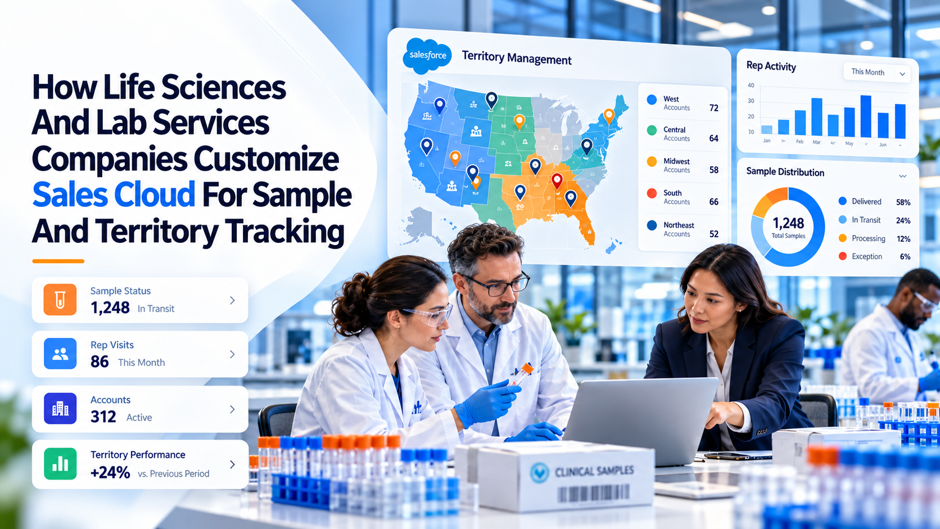
A field sales rep at a diagnostic testing company logs a physician visit in Salesforce exactly the way the platform ships out of the box: an Opportunity, a Task, a follow-up date. What the standard object model has no native way to capture is the specimen kit dropped off during that same visit, the lot number on the reagent samples left behind, or which lab accession number that specimen eventually links back to once it arrives for processing. Standard Sales Cloud was built to track deals and contacts, not chain of custody and regulated sample distribution, which is exactly why life sciences and lab services companies consistently end up customizing it rather than deploying it unchanged.
Understanding how these companies actually adapt Sales Cloud for sample and territory tracking matters considerably for any life sciences or lab services organization evaluating its own CRM strategy, since the customization patterns involved touch custom object design, compliance-driven audit trails, and territory logic considerably more specialized than what a generic sales team ever needs. This guide works through exactly how these organizations extend the platform, covering the 2 genuinely distinct sample-tracking use cases the industry actually contains, the specific custom objects and fields involved, the compliance requirements shaping that design, and where Salesforce’s own purpose-built life sciences tooling now picks up work companies previously had to build entirely themselves.
TL;DR
| Customization area | What life sciences and lab services companies typically build |
| Sample and specimen objects | Custom objects tracking lot numbers, expiration dates, accession numbers, and condition status, since standard Sales Cloud has no native equivalent |
| Chain of custody tracking | A structured, timestamped record of every handoff, signature, and location change a sample or specimen undergoes |
| Territory management | Custom alignment logic connecting sales territories to specific products, accounts, and, in lab settings, specimen collection points |
| Compliance-driven audit trails | Fields and workflows specifically designed to satisfy PDMA, CLIA, CAP, HIPAA, or 21 CFR Part 11 depending on the specific business |
| Mobile field capture | Barcode scanning and offline-capable data entry built for reps and couriers working outside a reliable network connection |
| Native platform evolution | Salesforce’s own Life Sciences Cloud and Health Cloud Advanced Therapy Management increasingly replace what companies previously built from scratch |
The pattern connecting every row above: life sciences and lab services companies genuinely don’t reject Sales Cloud’s core CRM foundation at all, they extend it specifically to capture the regulated, physical-world tracking a standard sales process was simply never designed to handle in the first place.
Why Standard Sales Cloud Needs This Customization in the First Place
Before working through the specific objects and fields involved in genuine, careful, thorough detail right here in this particular section of the guide, it’s genuinely worth understanding exactly why an out-of-the-box Sales Cloud deployment falls genuinely short for this specific industry and its own particular, unique needs.
The Core Gap Between Generic CRM and Regulated Sample Tracking
The specific mismatches between what standard Sales Cloud provides and what life sciences and lab services companies genuinely need:
- Standard Sales Cloud tracks Accounts, Contacts, and Opportunities, none of which natively represent a physical sample, its lot number, its expiration date, or its regulatory status
- Territory assignment in standard Sales Cloud connects reps to Accounts, but doesn’t natively account for product-specific territory alignment or the specimen collection points a lab services company genuinely needs to track
- Audit trail requirements in regulated industries demand a level of timestamped, signature-verified tracking standard field history and activity logging weren’t specifically designed to satisfy
- Mobile field capture for a pharmaceutical sales rep or a specimen courier needs offline-capable barcode scanning, a workflow standard Sales Cloud mobile access doesn’t provide without genuine customization
Why This Gap Historically Forced Companies Into Extensive Custom Build
Native HCP and HCO hierarchies, affiliations, and territory and account plans represent exactly the kind of object model life sciences companies previously had to custom-build entirely on their own within standard Sales Cloud, since no genuinely purpose-built equivalent existed on the platform until relatively recently in the platform’s history.
Why Understanding This History Still Matters Even as Purpose-Built Tools Emerge
Many life sciences and lab services organizations currently running Salesforce are still operating on exactly this kind of custom-built foundation, built well before Salesforce’s own purpose-built life sciences tooling existed, meaning understanding the customization patterns covered throughout this guide remains directly relevant even as newer, native options increasingly become available.
The 2 Genuinely Distinct Sample-Tracking Use Cases
Before diving into specific object and field design work in genuine depth, it’s genuinely essential to recognize that “sample tracking” actually describes 2 meaningfully different business processes depending on exactly which side of the life sciences and lab services spectrum a given company genuinely sits on.
Comparing Physician Sampling and Specimen Chain of Custody
| Dimension | Pharmaceutical physician sampling | Lab services specimen tracking |
| What moves | Product samples distributed from the company outward to healthcare providers | Patient or donor specimens collected and moved inward toward the lab for analysis |
| Primary compliance driver | The Prescription Drug Marketing Act, governing how pharmaceutical samples get distributed and documented | CLIA and CAP accreditation requirements, governing specimen identity and integrity |
| Key tracked data | Lot numbers, expiration dates, recipient healthcare provider details, and quantity distributed | Accession numbers, condition assessment at receipt, freezer or storage location, and disposition |
| Who initiates the tracked event | A field sales representative logging a sample drop during an in-person visit | A phlebotomist, courier, or lab technician logging a specimen handoff or storage event |
Why This Distinction Should Directly Shape Object Design
A company building custom objects for physician sampling genuinely needs fields capturing which healthcare provider received a sample and when, while a company building custom objects for specimen chain of custody genuinely needs fields capturing environmental condition, freeze-thaw cycles, and storage location, meaning a single generic “Sample” object rarely serves both use cases equally well without careful, deliberate design specific to which process it’s actually meant to support.
Why Some Organizations Genuinely Need Both Object Sets Simultaneously
A life sciences company that both distributes physician samples through a commercial sales team and operates diagnostic testing services genuinely needs both categories of custom object working within the same Salesforce org, since these represent 2 distinct business processes with different compliance drivers rather than a single unified workflow that a shared object structure could adequately serve.
Custom Objects for Sample and Specimen Tracking
With the 2 distinct use cases now genuinely established and clearly, fully understood at this particular point in the discussion, the table below breaks down the specific custom objects and fields life sciences and lab services companies commonly build to support genuinely thorough sample and specimen tracking overall.
The Core Custom Object Structure
| Custom object | What it captures |
| Sample or Specimen | The core record representing a single physical unit, carrying a unique identifier, lot or accession number, and current status |
| Chain of Custody Event | A child record capturing each individual handoff, signature, timestamp, and location change the sample or specimen undergoes |
| Storage Location | For specimen tracking specifically, a record representing freezer, rack, box, and position assignment, supporting granular physical location tracking |
| Disposition Record | The final record documenting destruction date, method, and any required witness or certificate of destruction |
Why Lot Number and Expiration Date Fields Deserve Particular Design Attention in Pharma Contexts
For physician sample distribution specifically, capturing lot number and expiration date at the point of distribution, not simply at the point of manufacture, ensures the resulting record genuinely reflects what specific batch reached which specific healthcare provider, information regulators and internal compliance teams both depend on during any later product quality investigation.
Why Accession Numbers and Condition Assessment Fields Matter Equally for Lab Services
For specimen tracking specifically, capturing condition assessment at the moment of receipt, whether a sample arrived acceptable, hemolyzed, clotted, or with insufficient quantity, alongside the assigned accession number, gives a lab genuine, immediate visibility into specimen quality before that specimen ever even reaches an instrument for testing.
Chain of Custody: What Gets Tracked and Why
The specific event categories a genuine chain of custody implementation needs to capture, regardless of whether the underlying object supports pharmaceutical samples or diagnostic specimens:
- Collection or distribution events, capturing who initiated the transfer, the exact timestamp, and, for specimens specifically, the collector’s identity with an attested signature
- Transport and handoff events, documenting every point where physical custody transfers from one person or system to another, since a gap here represents exactly the kind of audit trail failure that surfaces during a regulatory inspection
- Receipt and accessioning events, capturing arrival timestamp, condition assessment, and confirmation the sample or specimen genuinely matches its associated order or distribution record
- Storage and retrieval events, including freeze date, freeze-thaw cycle count, and, for any retrieval, who pulled the item, when, and why
- Final disposition events, documenting destruction date, method, and witness confirmation where a specific regulatory framework requires it
Why Barcode Scanning at the Point of Action Produces a More Defensible Record Than Manual Entry
Capturing each chain of custody event through a barcode scan at the actual moment of action, rather than a typed entry completed later from memory, produces a genuinely more accurate and considerably more defensible audit trail, since manual, after-the-fact entry introduces both timing inaccuracy and genuine risk of simple human error during a busy shift.
Why Configurable Event Triggers Matter More Than Capturing Every Possible Event
Not every single handling event genuinely warrants a formal chain of custody record, and building the flexibility to configure precisely which specific stages, steps, and events actually trigger a chain of custody update, along with what level of electronic signature each specific trigger requires, produces a considerably more usable system than one attempting to log every conceivable touchpoint indiscriminately.
Territory Management Customization
Beyond sample tracking itself as already covered above in this entire guide, the second major customization area life sciences and lab services companies invest in involves adapting standard Sales Cloud territory management to reflect how their specific business genuinely operates day to day, week after week.
The Specific Territory Customizations Commonly Built
| Customization | Why standard territory management falls short without it |
| Product-territory alignment | Standard territory rules connect reps to accounts, but don’t natively account for which specific products or test panels a given rep is authorized to represent within that territory |
| Specimen collection point mapping | Lab services companies frequently need territories aligned to physical collection sites or draw stations, a concept standard account-based territory logic doesn’t directly support |
| HCP specialization matching | Pharmaceutical territory assignment often needs to account for a healthcare provider’s specific specialization alongside pure geographic proximity |
| Coverage gap reporting | Custom reporting surfacing which specific accounts or collection points currently lack active rep coverage, a genuinely critical operational visibility standard territory reports don’t provide out of the box |
Why Product-Territory Alignment Specifically Matters in Pharmaceutical Commercial Operations
A pharmaceutical sales organization commonly manages multiple products across overlapping therapeutic areas, meaning a single healthcare provider account might genuinely fall within one rep’s territory for a specific product while a different rep covers that same account for an entirely different product, a nuance standard, single-dimensional territory assignment simply can’t represent without genuine customization.
Why Field Service Scheduling Extensions Increasingly Support Territory-Aware Visit Planning
Salesforce Field Service, while originally designed for field service operations rather than pharmaceutical sales specifically, has been increasingly customized to support intelligent visit assignment based on territory, provider specialization, and available time slots, giving field representatives genuine, optimized scheduling rather than a manually maintained call list.
The Compliance Frameworks Actually Shaping This Design
The specific regulatory frameworks that directly drive how sample and territory tracking gets built, depending on which segment of the industry a given company operates within:
- The Prescription Drug Marketing Act specifically governs pharmaceutical sample distribution, requiring documented tracking of recipient, quantity, lot number, and distribution date for every physical sample provided to a healthcare provider
- CLIA, specifically 42 CFR Part 493, governs clinical laboratory specimen handling, requiring the kind of traceable chain of custody that supports genuine defensibility during an inspection
- CAP accreditation adds further specimen integrity and identification checklist requirements beyond the baseline CLIA framework, particularly relevant for laboratories pursuing that additional accreditation
- HIPAA governs how patient information gets protected throughout specimen transport and handling, requiring secure handoffs and access restricted specifically to authorized personnel
- 21 CFR Part 11 governs electronic records specifically within clinical trial contexts, requiring genuine audit trail integrity for any specimen tracking supporting trial sponsor requirements
Why a Single Company Often Needs to Satisfy Multiple Overlapping Frameworks Simultaneously
A life sciences company running both a commercial pharmaceutical sales operation and a clinical trial support function genuinely needs its Salesforce customization to satisfy PDMA requirements for one business process and 21 CFR Part 11 requirements for another, meaning the underlying object and audit trail design needs enough flexibility to support multiple compliance frameworks without becoming an unmanageable patchwork of one-off, single-purpose customizations.
Why Building Compliance Requirements Into the Data Model From the Start Matters
Retrofitting genuine audit trail rigor onto an existing, already-deployed object structure is considerably more disruptive than designing that rigor into the object model from the very start, making early, explicit conversation with compliance and quality teams about exactly which regulatory framework applies to which specific business process an essential first step before any genuine object design work begins.
Mobile Field Capture for Reps and Couriers
Given how much of this tracking genuinely happens away from a desk entirely, whether during a physician office visit or a specimen courier’s transport route across a wide, genuinely sprawling territory, mobile field capture design genuinely deserves its own dedicated, focused attention and quite careful consideration.
What Genuine Mobile Field Capture Requires
The specific mobile capabilities life sciences and lab services companies commonly build beyond standard Salesforce mobile access:
- Barcode and QR code scanning integrated directly into the mobile capture flow, letting a rep or courier log an event through a scan rather than manual data entry on a small screen
- Offline-capable data capture, since a courier’s transport route or a rural physician office visit frequently occurs outside reliable network coverage, requiring genuine local storage and later synchronization
- Electronic signature capture appropriate to the specific event type, satisfying the compliance requirement that certain handoffs carry a verified, attested signature rather than a simple checkbox confirmation
- Simplified, purpose-built mobile layouts specifically designed around the handful of fields a field user genuinely needs in the moment, rather than exposing the full underlying object’s complete field set on a small mobile screen
Why Offline Capability Specifically Separates a Genuinely Usable Field Tool From One That Gets Abandoned
A mobile tracking tool that fails or loses data the moment network connectivity drops quickly earns a reputation among field staff as unreliable, and field staff who’ve learned not to trust a tool revert to exactly the paper logs and manual workarounds genuine digital chain of custody tracking was specifically meant to eliminate.
Why Voice and Conversational Mobile Interfaces Are Increasingly Part of This Design Conversation
Newer AI-assisted mobile experiences, offering voice-activated logging and genuine natural language filtering across many objects, are increasingly reducing the friction field representatives previously faced navigating multiple screens and tabs during brief, time-constrained interactions with healthcare providers, or during a busy, demanding specimen collection route each day.
Where Native Platform Capability Now Replaces Custom Build
Given how much of this customization historically required extensive custom development effort and genuine cost over the years, it’s genuinely worth understanding exactly where Salesforce’s own purpose-built tooling now increasingly handles work companies previously had to build entirely from scratch themselves, without any native starting point available.
What Salesforce’s Native Life Sciences Tooling Currently Covers
| Native capability | What it replaces from a typical custom build |
| Life Sciences Cloud HCP and HCO data model | Native affiliation hierarchies and territory and account plans, replacing what companies previously had to custom-build as Salesforce objects |
| PDMA-supporting sample management | Built-in audit trail support for pharmaceutical sample distribution, reducing custom object and workflow build specifically for this use case |
| Advanced Therapy Management chain of custody | Native chain of custody and chain of identity tracking, configurable trigger events, and electronic signature requirements |
| Product-territory alignment | Native support for connecting territory assignment directly to specific products rather than purely to accounts |
Why This Shift Doesn’t Eliminate the Need for Genuine Customization Entirely
Even with this expanding native capability, lab services-specific needs like specimen storage location tracking down to freezer, rack, box, and position, along with company-specific workflow nuances, still commonly require genuine additional customization layered on top of the native foundation, meaning the skills and patterns covered throughout this guide remain directly relevant even as the starting point companies now build from has genuinely improved.
Why Companies Currently Running Older Custom Builds Face a Genuine Migration Decision
Organizations that built extensive custom object structures before this native tooling existed now face a genuine decision between continuing to maintain and extend their existing custom foundation versus migrating toward the newer, purpose-built native capability, a decision that depends heavily on how deeply embedded the existing custom build has become across the organization’s broader Salesforce implementation.
Reporting and Visibility Built Specifically for This Data Model
Beyond the underlying object structure itself already covered above throughout this entire guide, the specific reporting and dashboard needs of life sciences and lab services companies genuinely differ meaningfully and considerably from a typical sales organization’s standard pipeline and forecast reporting approach entirely, completely, and consistently.
The Reporting Views These Companies Commonly Build
The specific reporting and dashboard capabilities life sciences and lab services companies typically need beyond standard Sales Cloud reporting:
- Sample distribution reporting broken down by product, territory, and healthcare provider specialty, supporting both commercial performance tracking and genuine PDMA compliance reporting simultaneously
- Turnaround time reporting for specimen tracking specifically, surfacing exactly where in the collection-to-result pipeline a given specimen currently sits and how long it’s genuinely spent at each stage
- Chain of custody audit reports capable of exporting a complete, timestamped custody packet for any single sample or specimen on demand, without requiring advance preparation before an inspection or legal request
- Territory coverage gap reporting, surfacing specific accounts or collection points currently lacking active rep assignment, a genuinely operational visibility need standard territory reports don’t directly address
- Expiration and inventory aging reports, flagging samples or specimens approaching expiration before that lapse becomes a genuine compliance or quality issue rather than being discovered after the fact
Why On-Demand Audit Trail Export Specifically Deserves Dedicated Report Design
A chain of custody audit report that requires manual assembly or IT involvement to generate defeats much of the genuine value the underlying tracking was built to provide, since regulatory inspections and legal requests typically arrive with limited notice, making a genuinely one-click, on-demand export capability an essential design requirement rather than a nice-to-have addition.
Why Standard Sales Cloud Dashboards Need Genuine Adaptation for This Audience
Standard Sales Cloud dashboards emphasize pipeline value, deal stage, and forecast accuracy, metrics genuinely secondary to this industry’s actual operational priorities, meaning dashboards built specifically for life sciences and lab services users typically need to foreground compliance status, turnaround time, and sample inventory health considerably more prominently than a generic sales dashboard template would by default.
Integrating Sales Cloud With Systems of Record Outside the CRM
Sample and territory tracking inside Salesforce rarely operates in genuine, complete isolation from everything else, since the physical reality of samples and specimens is typically already recorded somewhere else entirely, a laboratory information management system, an ERP, or a dedicated logistics platform of some specific kind.
The Systems Sample Tracking Commonly Needs to Connect With
| External system | Why integration matters |
| Laboratory Information Management System | The genuine system of record for specimen processing, instrument results, and detailed accessioning workflow, meaning Salesforce integration needs to reflect status accurately rather than duplicating that data independently |
| Enterprise resource planning platform | Governs inventory of physical samples and reagents before distribution, meaning territory-based sample allocation in Salesforce needs to stay genuinely synchronized with actual available inventory |
| Courier and logistics tracking systems | Provides real-time transport status and environmental condition monitoring during specimen transit, data that chain of custody tracking benefits from incorporating directly rather than recreating manually |
| Electronic health record systems | For specimen tracking tied to specific patient encounters, integration ensures the chain of custody record genuinely links back to the correct clinical context |
Why LIMS Integration Specifically Deserves Careful Boundary Definition
Given that a laboratory information management system typically already serves as the authoritative record for specimen processing and results, Salesforce’s role in a genuinely well-architected integration should focus specifically on the commercial and field-facing side of specimen tracking, collection, transport, and territory assignment, rather than attempting to duplicate detailed laboratory processing data the LIMS already owns and manages considerably more capably.
Why Real-Time Synchronization Matters More for This Industry Than for a Typical Sales Deployment
A standard sales deployment can often tolerate some data latency between systems without genuine operational consequence, but sample and specimen tracking specifically benefits from near-real-time synchronization, since a stale inventory count or an outdated specimen status can directly translate into a genuine compliance gap or a missed turnaround time commitment that a typical CRM integration delay wouldn’t otherwise create.
Common Mistakes When Customizing Sales Cloud for This Industry
Beyond the specific customization patterns already covered throughout this entire guide, several recurring, genuinely predictable mistakes show up consistently among life sciences and lab services companies building out this kind of tracking, and avoiding these specific mistakes meaningfully improves the odds of a genuinely durable implementation overall.
Building a single generic sample object without distinguishing physician sampling from specimen tracking.
As covered earlier, these represent genuinely different business processes with different compliance drivers, and forcing both into one undifferentiated object structure typically produces a design that serves neither use case particularly well.
Treating chain of custody as a single field rather than a genuine event-based audit trail.
A single status field on a sample record can’t capture the timestamped, signature-verified sequence of handoffs genuine regulatory defensibility actually requires during an inspection or legal proceeding.
Deploying mobile capture without genuine offline capability.
Field reps and couriers frequently work outside reliable network coverage, and a mobile tool that fails without connectivity quickly gets abandoned in favor of the paper workarounds it was meant to replace.
Underestimating how differently overlapping compliance frameworks need to be reflected in the data model.
A company subject to both PDMA and 21 CFR Part 11 across different business lines needs genuine, deliberate design accounting for both, rather than building compliance features narrowly around whichever framework happened to be top of mind first.
Ignoring Salesforce’s expanding native life sciences capability when planning new customization work.
Building extensive custom objects to replicate functionality Salesforce’s own Life Sciences Cloud or Advanced Therapy Management increasingly provides natively wastes genuine implementation effort better spent on the company-specific gaps that native tooling still doesn’t cover.
Failing to involve compliance and quality teams early enough in the object design process. Designing custom sample and specimen tracking objects purely from an IT or sales operations perspective, without genuine early input from the compliance and quality functions that ultimately need to defend that data during an inspection, frequently produces a structure that technically works but doesn’t actually satisfy the specific regulatory scrutiny it was meant to withstand.
FAQs
Should a lab services company use Health Cloud instead of Sales Cloud for specimen tracking specifically?
This depends on the company’s broader needs; Health Cloud is generally built around care delivery and patient-facing workflows, while Sales Cloud, extended with the kind of custom objects covered throughout this guide, better serves companies whose primary need centers on commercial sales operations with sample and specimen tracking layered on top, making the right platform choice depend heavily on which function genuinely represents the organization’s core operational focus.
How much custom development does a typical sample and territory tracking implementation actually require?
This varies considerably based on how much of the newer native Life Sciences Cloud and Advanced Therapy Management capability a given organization can genuinely use, but even companies building on this improved native foundation commonly still need some custom object work for company-specific storage location tracking, unique compliance requirements, or integration with existing lab information management systems.
Can a single Salesforce org genuinely support both pharmaceutical sample distribution and clinical lab specimen tracking simultaneously?
Yes, and many life sciences organizations with both commercial and diagnostic testing operations genuinely need exactly this, though it requires deliberate object design distinguishing the 2 use cases clearly, as covered earlier, rather than attempting to force both processes through a single, undifferentiated object structure.
Does implementing genuine chain of custody tracking in Salesforce require additional licensing beyond standard Sales Cloud?
This depends on whether an organization builds custom objects on standard Sales Cloud licensing or adopts Salesforce’s purpose-built Life Sciences Cloud or Health Cloud Advanced Therapy Management offerings, which typically carry their own specific licensing structure beyond base Sales Cloud, making this a genuine cost consideration worth evaluating directly against a company’s specific compliance and functional requirements.
How should a company handle chain of custody requirements for specimens that need to support both CLIA compliance and clinical trial sponsor requirements simultaneously? This scenario genuinely requires designing the underlying audit trail to satisfy the stricter of the 2 applicable standards, commonly the 21 CFR Part 11 electronic records requirements clinical trial work demands, since building to that stricter standard from the start typically also satisfies the baseline CLIA traceability requirement without needing a separate, parallel tracking structure.
Is barcode scanning genuinely necessary, or can chain of custody tracking work adequately with manual data entry?
While manual entry can technically capture the required data fields, barcode scanning at the point of action produces a genuinely more accurate and defensible record specifically because it eliminates the timing lag and transcription error risk manual entry introduces, making it the considerably stronger practice for any organization genuinely serious about audit trail integrity.
How often should a company revisit its custom sample and territory tracking design as Salesforce’s native life sciences capability continues to evolve?
Given how actively this specific area of the platform continues developing, an annual review comparing current custom build against newly available native capability is a reasonable baseline, allowing a company to identify genuine opportunities to retire custom maintenance burden in favor of increasingly capable native functionality as it becomes available.
What’s the biggest risk of continuing to run an older, entirely custom-built sample tracking system rather than evaluating newer native options?
The biggest risk is ongoing maintenance burden compounding over time, since custom objects and workflows built years ago typically require continued internal expertise to maintain and extend, while native platform capability receives ongoing vendor investment and improvement without that same internal maintenance cost, meaning organizations that never revisit their original custom build risk falling further behind what’s genuinely achievable with considerably less ongoing effort.
How should a company approach change management when migrating field reps or lab staff from a familiar custom system to newer tooling?
Given how heavily this industry depends on field staff genuinely trusting the tools they use daily, particularly for compliance-sensitive chain of custody tracking, a phased rollout with genuine hands-on training and a clear feedback channel for early issues tends to produce considerably stronger adoption than an abrupt, organization-wide switch, since staff who encounter early friction without a clear path to report and resolve it quickly revert to whatever informal workaround they trusted under the previous system.
Does the specific customization approach need to differ for a small, single-site lab versus a large, multi-site life sciences organization?
The core patterns covered throughout this guide, distinguishing sample-tracking use cases, building genuine event-based chain of custody, and aligning territory to actual business structure, apply regardless of organizational size, though a smaller, single-site lab can often implement a genuinely lighter version of this customization, while a large, multi-site organization typically needs more thorough territory hierarchy and cross-site reporting to manage genuinely distributed operations effectively.