

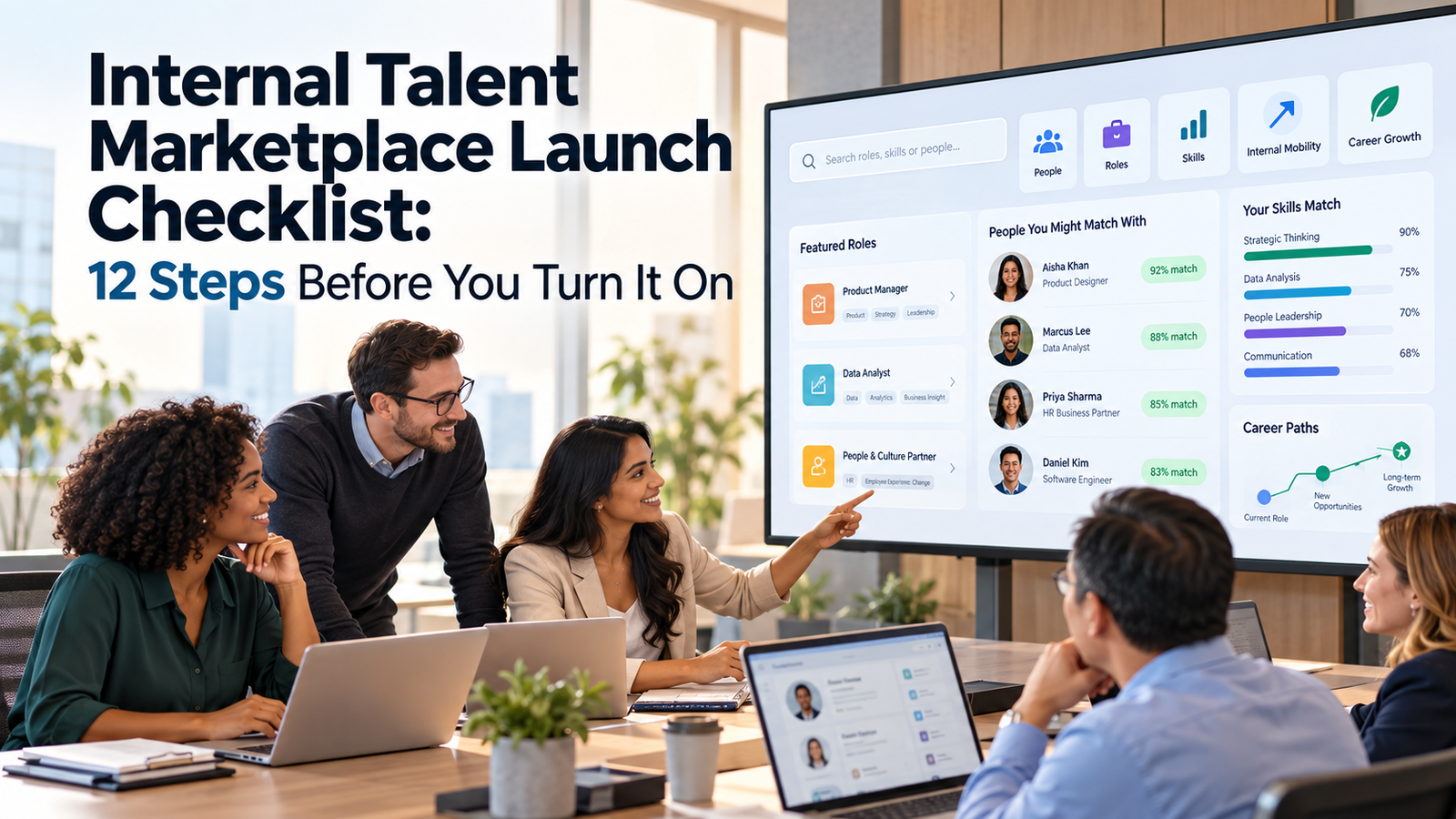
An internal talent marketplace can make internal roles, projects, mentoring, and development work easier to find. The platform, however, is only the visible layer. Employees will judge the program by whether opportunities are real, whether managers let people move, whether skills are represented fairly, and whether a match leads somewhere useful.
That makes launch readiness an operating question rather than a software question. A polished portal still fails when jobs are stale, owners do not respond, profiles are thin, or managers quietly block movement. The same risk appears when matching tools cannot explain why someone was matched or what skill gap remains.
This checklist covers the 12 decisions that should be settled before an internal talent marketplace goes live. It is written for HR and business teams that need a practical way to test readiness. The goal is to make the first launch useful enough that employees return and managers keep posting work.
TL;DR
A successful internal talent marketplace needs more than employee profiles and an AI matching engine. Before launch, define the business outcome, set decision rights, clean skills and role data, decide what opportunities will be visible, publish movement rules, prepare managers, design the employee experience, test matching and accessibility, connect learning to open work, run a pilot, set measures, and prepare day-one support. SHRM reported in 2025 that 35% of organizations in its research were using an internal talent marketplace, up from 25% in 2024, which shows wider adoption but says nothing about whether those programs are producing useful movement. The launch checklist below focuses on the conditions that make adoption worth sustaining.
Define The Business Outcome And Launch Scope
Start by naming the business problem the marketplace is supposed to solve. One organization may need faster redeployment during a restructuring. Another may want more internal applicants for hard-to-fill roles. A third may be trying to create project work that helps people build skills before a formal transfer. Each model needs different rules, data, and measures.
A broad promise such as “improve mobility” is too vague to guide a launch. SHRM’s 2025 Talent Trends research found that internal talent marketplace use had risen to 35% of surveyed organizations. That adoption figure makes scope discipline more important because teams can copy the feature set of other programs without deciding what their own employees need the system to do first.
Write a one-page launch charter. It should state the target employee population, the opportunity types included at launch, who can post them, what movement outcome counts as success, and which business units are in scope. If the first release covers full-time internal jobs plus short-term projects, spell out whether mentoring, job shadowing, rotations, and volunteer work will wait for a later phase.
A company with 25,000 employees does not need to expose every role and project on day 1. A narrower launch gives the internal mobility strategy a practical boundary before wider release. The scope should create choice without becoming hard to govern. That discipline gives the internal talent marketplace a clear first job.
Set Governance And Decision Rights Before Configuration
Assign ownership before teams debate fields, screens, and workflows. Talent management may own policy, HR technology may own integrations, learning may own development content, and business leaders may own opportunity supply. Those responsibilities need a named decision maker because unclear ownership later creates slow approvals or conflicting rules.
Governance should cover both daily operations and policy exceptions. Gartner reported in 2024 that only 8% of organizations in its research had reliable information about the skills their workforce possessed and which skills mattered most to the business, while fewer than 20% said they moved talent effectively to fill skill gaps. Those findings in Gartner’s research on talent fluidity point to a basic launch problem: a marketplace can expose gaps in ownership that were already present in workforce planning.
Create a small operating group that can answer questions fast. It should decide who approves new opportunity types, who resolves disputed skill definitions, who reviews matching complaints, who owns reporting, and who can pause a workflow when data or policy problems appear. Keep the decision path short so employee issues do not sit unresolved.
This is also where skills-based talent management becomes an operating practice rather than a label. If nobody owns the skill library, proficiency rules, evidence standards, and update process, the marketplace will slowly fill with duplicate or unclear skills. Governance needs a cadence for reviewing those records after launch, not a one-time cleanup before it.
Clean Skills Role And Profile Data
Bad data makes a marketplace look arbitrary. Employees may see weak matches because their profiles contain old job titles, broad skill tags, or inferred capabilities they do not recognize. Hiring managers may then stop trusting recommendations, which reduces opportunity posting and creates a cycle of low use.
A current skills model does not need every possible capability on day 1. OECD’s 2026 work on a skills-first labour market stresses the value of common skills languages and ways to connect skills with jobs and learning. For talent marketplace implementation, that means agreeing on a usable core vocabulary before trying to map the whole enterprise.
Review the data that will feed employee profiles: HRIS job history, resume or profile text, learning records, certifications, project history, manager input, and employee-declared skills. Decide which sources can create a skill automatically and which require employee confirmation. Workers should be able to see where important profile data came from and correct mistakes.
Then review role and project data. Each opportunity needs a clear outcome, required skills, skills that can be learned during the assignment, expected time commitment, location or schedule constraints, and an accountable owner. This is where an internal mobility strategy becomes concrete. A marketplace cannot support mobility when opportunities rely on titles and hide the skills underneath them.
A short data-readiness table can prevent vague sign-off:
| Area | Ready When | Launch Risk If Missing |
| Employee profiles | Core history and skills are visible and editable | Poor recommendations and low trust |
| Skill library | Duplicate terms are merged and ownership is assigned | Confusing search and uneven matching |
| Roles and projects | Skills and outcomes are stated in plain language | Employees cannot judge fit |
| Availability data | Workload or timing rules are current | Matches cannot turn into real assignments |
| Learning records | Relevant learning can connect to skill gaps | Development feels detached from opportunity |
Decide Which Opportunities Belong In The Marketplace
Define the supply side before launch. A marketplace with thousands of employee profiles and only a small set of weak opportunities will feel empty. The opposite problem also matters: posting every internal role without clear standards can turn the product into another job board with a new interface. The World Economic Forum’s skills-first research describes skills-first approaches as focusing on skills rather than where those skills were acquired. That principle is useful when deciding what belongs in the marketplace because it supports a wider set of moves than promotion into the next job in a fixed ladder.
Choose the opportunity types that the organization can support in practice. Full-time roles need application and transfer rules. Projects need time commitments and manager agreements. Mentoring needs expectations for both sides. Job shadowing needs privacy and workload boundaries. A short-term assignment also needs an end date and a named evaluator.
For internal talent mobility to work, opportunity owners must accept the responsibilities that come with posting. Require a named owner, a response time, a close date where relevant, and a reason code when an opportunity is withdrawn or an applicant is declined. Employees should not spend time applying to work that has no real sponsor.
Supply quality should be part of the launch gate. Count active opportunities by business unit, level, location, work type, and skill area. If one group has many postings while another has almost none, employees will notice the imbalance quickly. Fix the supply problem before announcing a company-wide marketplace.
Publish Fair Eligibility And Movement Rules
Employees need to know who can apply, when managers are informed, and what can block a move. Hidden rules create more distrust than a restrictive rule that is stated clearly. The marketplace should explain eligibility in the same place where people discover opportunities. Deloitte’s research on skills-based organizations describes a shift toward using skills as a unit for talent decisions rather than relying only on jobs and hierarchy. That shift makes movement rules more important because employees may be matched to work outside their current function or expected career path.
Write policy for common edge cases before launch. Decide whether minimum tenure applies, whether employees on performance plans can apply, how compensation changes are handled, when the current manager is notified, whether approval is required for projects, and how confidential roles are treated. Legal and employee relations teams should review these rules for each jurisdiction in scope.
This step protects the internal mobility strategy from becoming dependent on informal manager discretion. If one manager can release an employee for a project while another can block the same type of move without explanation, workers will read the system as unfair. Clear escalation rules matter as much as clear eligibility rules because they reduce case-by-case exceptions.
For skills-based talent management, selection criteria should also be visible enough to understand. Employees do not need private hiring notes, but they should know which skills were required and which gaps mattered. That feedback can turn a declined application into a development path instead of a dead end.
Fix Manager Incentives And Talent Hoarding
Manager behavior can stop the program even when the technology works. A manager who believes internal movement means losing headcount may delay approvals, discourage applications, or avoid posting project work. Employees will learn those signals fast and may stop using the marketplace. LinkedIn’s account of Schneider Electric’s internal mobility work describes early manager resistance to its talent marketplace and the need to shift toward skills. The example shows that resistance can surface once managers feel the effect of employees seeing opportunities elsewhere.
Prepare managers before employees see the system. Explain what happens when someone applies, how coverage will be handled, what notice periods apply, and how the manager’s own staffing needs will be supported. Give them scripts for career conversations so applications do not trigger surprise or pressure.
The internal mobility strategy should also examine incentives. If managers are rewarded only for holding output within their own team, exporting strong employees can feel like a penalty. Consider whether manager measures should include development, internal moves, project participation, or the growth of team skills. The measure will vary, but it should not punish talent movement.
Internal talent mobility becomes credible when employees see leaders release good people and receive recognition for developing them. That behavior reinforces the launch message employees receive. It also reduces the risk that the marketplace becomes a browsing tool employees use privately while serious career movement still depends on personal networks.
Design The Employee Experience Around Trust
Employees should understand what the system knows about them, what they control, and what happens after they express interest. Trust drops when profile data appears without explanation or a recommendation feels like a decision. CIPD’s 2026 discussion of closing skills gaps through internal mobility highlights the importance of visibility into roles, transferable skills, and progression paths. That visibility helps people see how current skills connect to work beyond their present job title.
Make profile controls clear. Employees should be able to review their skills, interests, career preferences, and availability. If the system infers a skill from work history, label it as inferred until the person confirms it. If some data is required and cannot be edited, explain why.
Then design the path from discovery to action. A match should show why it appeared, what the opportunity requires, which skills already fit, what gaps remain, and what the employee does next. This is where skills-based talent management can help employees make informed choices instead of treating recommendations as a mysterious score.
Privacy expectations need the same clarity. Tell employees which profile fields managers can see, whether browsing is private, when an expression of interest becomes visible, and how long data is retained. Organizations should identify and satisfy any applicable local consultation obligations before launch, with legal or employee-relations review where needed.
Test Matching Logic Bias Accessibility And Human Review
Treat matching as a decision-support system. Even when the platform only recommends opportunities, its ranking can shape who sees work first and who believes they belong. Testing should therefore cover accuracy, fairness, accessibility, and the ability for a person to challenge a bad result. NIST’s AI Risk Management Framework organizes AI risk work around governance, mapping context, measurement, and management. Those ideas fit a marketplace launch because matching tools depend on training data, profile quality, chosen features, and thresholds that may affect groups differently.
Build test cases before launch. Include employees with non-linear careers, career breaks, different job families, older titles, limited profile data, disabilities, and skills learned outside formal training. Check whether the system repeatedly favors employees with the most complete digital history rather than those with relevant capability.
U.S. employers also need to remember that existing discrimination law still applies when software is involved. The EEOC’s guidance on the agency’s role in AI and employment states that federal employment discrimination laws apply to AI and other technology used in employment decisions. Legal review should cover the actual marketplace use case, including promotions, internal selection, training recommendations, and any automated screening.
Accessibility testing must cover the full employee path, not only the homepage. Check keyboard use, screen-reader behavior, color contrast, form labels, error messages, and document attachments. Employees should have a clear route to request an accommodation or report a barrier.
Internal talent mobility also needs human review. Define when a person can override a match, how that decision is recorded, and who reviews repeated complaints. A match score should never become a hidden eligibility rule unless the organization has validated that use and can explain it.
Connect Learning To Real Opportunities
Learning becomes more useful when employees can see where a new skill will take them. A marketplace can make that connection visible by showing the difference between current capability and the requirements of a role or project, then pointing to learning that closes a real gap. The International Labour Organization’s work on algorithmic management in the workplace notes that algorithmic systems can assign, monitor, and evaluate work, which raises questions about job quality and worker experience. For a marketplace, the lesson is to keep development recommendations focused on employee growth and transparent opportunity criteria rather than turning every learning activity into another layer of automated monitoring.
Map learning only where it has a clear connection to a skill or opportunity. If an employee is 1 or 2 skills short of a project, show the course, practice assignment, mentor, or job shadow that can help. Avoid sending people into large learning catalogs with no signal about which activity matters.
This link between learning and work is central to skills-based talent management. It also improves the internal mobility strategy because development investment can be tied to roles the organization expects to need. Learning teams can then see whether people who complete a path become eligible for projects or roles within a reasonable period.
Do not promise that course completion guarantees selection. State what learning changes in the employee profile and what still depends on manager or hiring review. That distinction keeps internal talent mobility grounded in evidence without turning training badges into automatic promotion rights.
Run A Controlled Pilot Before Enterprise Launch
A pilot should test the operating model under real conditions. It is not a demo with friendly users. Choose a business area where there are enough employees, enough opportunity supply, and leaders willing to follow the movement rules when strong people apply elsewhere. SHRM’s review of how internal talent marketplaces stay relevant describes organizations tracking measures such as gigs posted, hosts, applications, and internal movement. That kind of usage detail is useful in a pilot because it shows where the marketplace is breaking before a company-wide announcement makes the problem larger.
Run the pilot long enough for people to complete a meaningful cycle. Employees should create or confirm profiles, receive matches, express interest, hear back from opportunity owners, and begin at least some moves or projects. Capture the time between each stage so you can see where work stalls.
Use structured feedback from employees and managers. Ask whether matches made sense, whether opportunity descriptions were clear, whether managers understood the process, and whether applicants received a useful response. Combine that feedback with system data so a vocal minority does not define the result.
Talent marketplace implementation should include a go or no-go gate after the pilot. Set minimum conditions in advance, such as response-time performance, profile completion quality, opportunity supply, accessibility issues resolved, and no open high-severity policy defects. A calendar date is a poor substitute for readiness.
Set Launch Measures And Operating Rhythms
Choose measures that show whether the marketplace is creating useful movement. Login volume is easy to report, but high traffic can still hide weak opportunity supply or poor conversion. Measure the path from visibility to movement. LinkedIn’s discussion of why internal mobility remains a priority points to familiar barriers such as employees struggling to find opportunities and managers being reluctant to release people. Those barriers should shape what the launch dashboard measures.
A useful scorecard can include:
Active opportunities and the share with complete skill requirements.
Employees with confirmed profiles and current career preferences.
Match-to-view and view-to-interest rates by opportunity type.
Time from expression of interest to first response.
Internal fills, project starts, and completed development moves.
Decline reasons and repeated points of employee drop-off.
Movement patterns by business unit and relevant employee groups where lawful and appropriate.
Manager participation, including opportunity posting and employee release behavior.
Set review rhythms before launch. Weekly operations reviews can handle broken workflows and support tickets. Monthly reviews can look at adoption, supply, and movement. Quarterly governance can examine policy, skills data, fairness, and whether the marketplace still serves the business outcome set at the start.
This is where the internal mobility strategy becomes measurable. Movement should rise because employees can discover and act on opportunities, not because the metric has been redefined. Keep definitions stable enough to compare periods and document reporting changes.
Prepare Communications Support And Day-One Operations
Launch communication should explain the employee action, the manager action, and the rules that sit behind both. Avoid broad claims about career growth if the first release contains only a limited set of projects. Employees should know what is available on day 1 and what comes later. OECD’s 2026 guidance on skills-first talent management emphasizes starting with priority roles, engaging stakeholders, updating skill requirements, and extending skills-first practices beyond hiring. A marketplace launch benefits from the same staged approach because communications can set expectations around what has changed now and what is still being built.
Prepare help content around real questions. Employees will ask who sees their profile, whether their manager is notified, whether they can apply across locations, how skill matches are created, and what happens after a decline. Managers will ask how to post work, how to handle coverage, and whether they can reject an employee’s request to participate.
Create a support route with clear ownership. Tier 1 support can handle login, profile, and navigation issues. Policy questions should move to HR or employee relations. Matching concerns need a path to the product or talent team. A generic inbox without routing rules will slow responses when launch volume peaks.
Talent marketplace implementation also needs day-one monitoring. Watch failed integrations, stale opportunities, duplicate profiles, sudden drops in match volume, and support patterns. Fixing those defects quickly protects trust during the period when employees are deciding whether the marketplace is useful enough to revisit.
Final Readiness Check Before You Turn It On
The final decision should be based on evidence that the operating model works. Deloitte’s 2026 research on creating value with skills describes companies using skills inventories and internal marketplaces to match capability with work. The useful lesson for launch teams is that the marketplace needs reliable inputs and real business demand if matching is going to produce value.
Before approval, ask 12 direct questions. Is the business outcome clear? Are decision rights assigned? Is profile and role data good enough for the first scope? Are there enough real opportunities? Are eligibility rules published? Have managers been prepared to release talent? Do employees understand what data is used? Has matching been tested for fairness and accessibility? Does learning connect to open work? Has the pilot completed a real movement cycle? Are measures defined? Is support ready for launch day?
If several answers are still “mostly,” delay the affected scope rather than hiding the gap behind communications. The internal talent marketplace will create visibility into processes that employees previously experienced through managers and informal networks. That visibility also makes inconsistent rules easier to see.
Launch is the start of an operating cycle. The company still needs to maintain the skills library, role requirements, learning links, manager behavior, and movement rules after go-live. The marketplace is ready when employees can move through the process with clear rules and timely responses at the same time the technology goes live.
Frequently Asked Questions
What Is An Internal Talent Marketplace?
An internal talent marketplace is a company system that connects employees with opportunities inside the organization based on skills, interests, experience, career goals, or availability. Opportunities can include full-time roles, short-term projects, rotations, mentoring, or job shadowing. Many platforms use matching technology to suggest options, but the operating rules around movement matter as much as the matching feature. A useful marketplace gives employees visibility into work they may not have found through their current manager or business unit.
Who Should Own The Internal Talent Marketplace?
Ownership usually spans talent management, HR technology, learning, workforce planning, and business leaders. One accountable leader still needs to own the operating model and resolve conflicts between those groups. HR technology can run the platform without owning movement policy, while talent teams can own policy without controlling integrations. The governance model should state who decides skill definitions, opportunity rules, reporting, exceptions, and matching issues so questions do not bounce between teams. Clear ownership keeps skills-based talent management usable after launch.
How Much Skills Data Is Needed Before Launch?
A company does not need a perfect enterprise skills library before the first release. It does need enough accurate skill data to support the use cases in scope. Start with priority roles, projects, and employee groups, then confirm the skill terms that matter for those areas. Employees should also be able to review and correct important profile information. Skills data can expand after launch, but unclear duplicates and unsupported inferences should be fixed before they influence matching.
Should Employees Need Manager Approval To Apply?
The answer depends on the opportunity type and company policy, but the rule should be explicit. Requiring approval before an employee can even explore opportunities can suppress use and reinforce talent hoarding. A company may instead allow private browsing and expression of interest, then involve the manager when a project or transfer reaches a defined stage. Short-term projects may require workload approval even when full-time internal applications do not. Publish the timing so employees know what to expect.
How Can A Company Reduce Talent Hoarding?
Start by removing ambiguity about release rules and notice periods. Managers should know how their team will be supported when someone moves and how internal movement affects workforce planning. Leadership behavior matters because managers watch what is rewarded. Measures can include development activity, successful internal moves, or participation in project work where that fits the business. Employees should also have an escalation route when a manager blocks movement outside published policy.
How Should AI Matching Be Tested Before Launch?
Test the matching logic with realistic employee profiles and edge cases, then review both the recommendations and the reasons behind them. Include people with non-linear careers, incomplete profiles, career breaks, older job titles, and different accessibility needs. Compare results across relevant groups where lawful and appropriate. The company should know which data affects a match, how employees can correct it, and how concerns are reviewed.
How Long Should A Pilot Run?
Run the pilot long enough for employees to complete the full journey from profile setup through a real move or project start. The period depends on the opportunity type. Short projects can produce evidence faster than full-time transfers with notice periods and interview stages. Do not judge the pilot only by registrations or logins. The important question is whether the operating model works when employees apply, managers respond, decisions are made, and people begin the work.
How Does Learning Fit Into A Talent Marketplace?
Learning should help employees close visible skill gaps tied to actual opportunities. If a role requires a capability the employee lacks, the marketplace can point to a course, mentor, practice project, or other development option that addresses that gap. Completion should update the employee’s evidence where appropriate, but it should not automatically guarantee selection. The strongest link is a clear path from identified skill need to development activity and then to a real chance to use the skill.
Can A Talent Marketplace Work Without A Skills Taxonomy?
It can start with a limited skills model, but it will struggle if every function uses unrelated terms for similar capabilities. A shared vocabulary helps search, matching, reporting, and learning links. The company does not need to settle every skill before launch. It should define the terms used by the first roles and projects, assign ownership for changes, and create a way to merge duplicates. The taxonomy can expand as new opportunity types and business areas enter the marketplace.
How Should Privacy Be Handled In An Internal Talent Marketplace?
Tell employees what data the system uses, where that data comes from, who can see it, and when their activity becomes visible to a manager or opportunity owner. Give employees a way to correct profile data and understand inferred information. Retention rules should match company policy and applicable law. Privacy review should also cover integrations because the marketplace may combine HR records, learning history, career preferences, and project data that were previously stored in separate systems.