

A growing Salesforce org eventually hits the same wall. Someone asks for a change that Flow can’t handle, or a new department wants its own process built in, or 3 clouds need to talk to each other without breaking. That’s the moment a company realizes it needs more than an admin, and the next question is which specialist actually fits the problem.
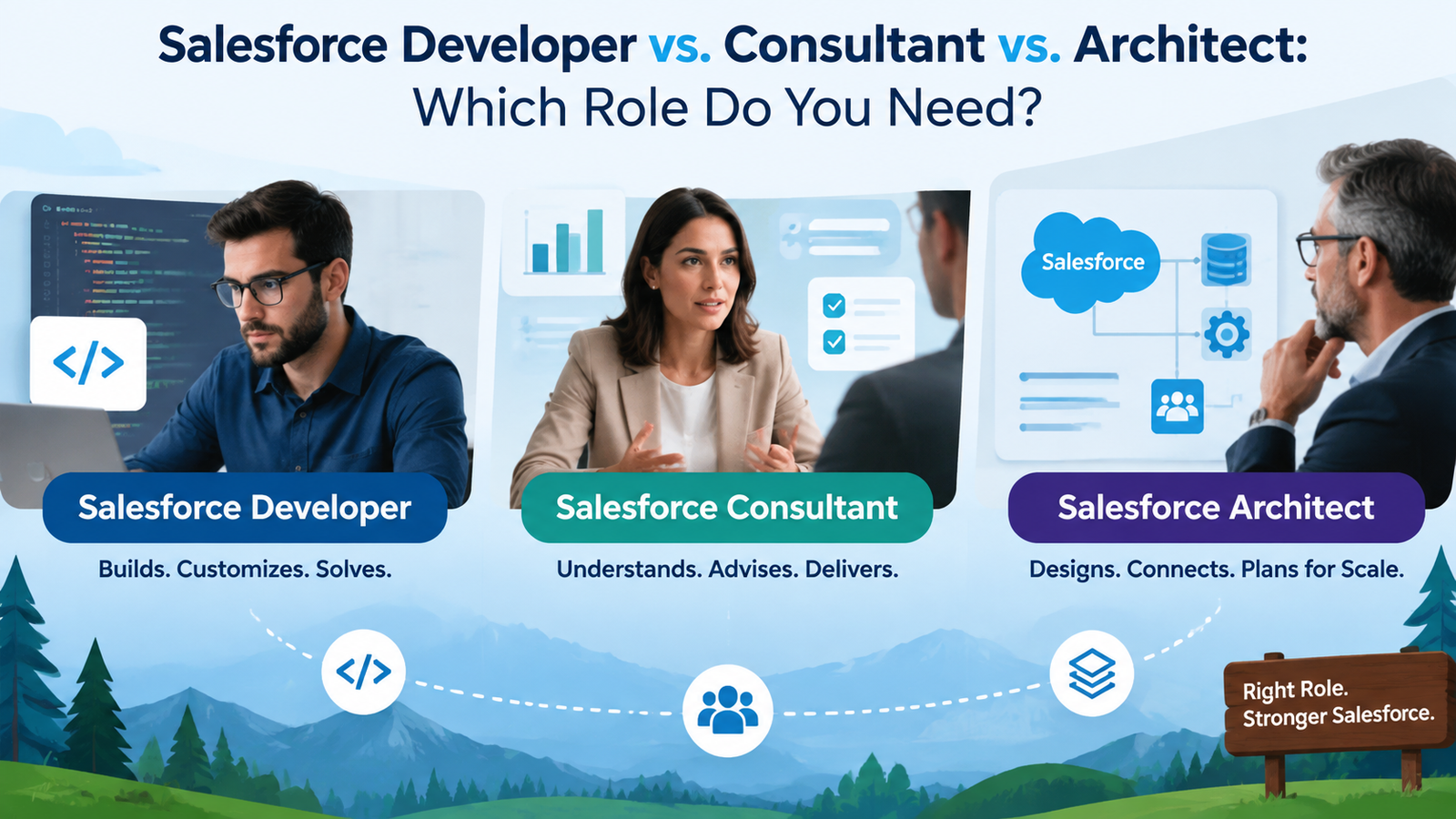
The honest answer is that developer, consultant, and architect aren’t interchangeable titles for the same job. Each one solves a different kind of problem, at a different stage of a project, for a different reason. Hiring the wrong one doesn’t just waste a salary. It slows the project down while the org searches for the person who should have been in the room from the start.
This guide breaks down what each role actually does, what they cost, which certifications separate a real specialist from a resume that lists “Salesforce” as a skill, and how to decide which one your team needs right now.
TL;DR
· A Salesforce Developer writes code: Apex, Lightning Web Components, and integrations. Hire one when the request goes past what point-and-click configuration can do.
· A Salesforce Consultant runs the project: discovery, requirements, configuration, and adoption. Hire one when you’re planning an implementation or a major process change.
· A Salesforce Architect designs the whole system: data model, integration patterns, security, and long-term scalability. Hire one when the org spans multiple clouds or the stakes of getting the design wrong are high.
· Pay reflects scope. Developers and consultants often land in a similar band, while architects, especially Certified Technical Architects, sit well above both.
· Most mid-size and growing Salesforce orgs eventually need all three, just not all at once and not always as full-time hires.
What Is a Salesforce Developer
A Salesforce Developer builds the custom functionality that Salesforce’s declarative tools can’t. Where an admin configures Flow, validation rules, and page layouts, a developer writes Apex classes and triggers, builds Lightning Web Components for custom user interfaces, and connects Salesforce to outside systems through REST and SOAP APIs.
The day-to-day work is closer to software engineering than administration. A developer bulkifies code so it doesn’t hit governor limits, writes test classes with real coverage instead of the bare minimum, and works through code reviews before anything reaches production. Increasingly, that scope stretches into Agentforce and Data Cloud work as companies build AI features on top of their existing org.
Most developers start with the Salesforce Certified Administrator credential as a foundation, then move into Platform Developer I and, for senior roles, Platform Developer II. TheSalesforce Job Descriptions Hub breaks down exactly what hiring managers screen for at each experience tier, from entry-level developers writing basic Apex with guidance to senior developers who own architecture decisions for complex integrations.
Pay can be compared with the broader software field, but the benchmarks need to stay separate. According to theBureau of Labor Statistics, the median annual wage for software developers nationally was $133,080 in May 2024. That figure covers software developers across many industries and platforms, so it shouldn’t be treated as a Salesforce-specific salary measure. A developer is the right hire when the ask is specific and technical: a custom trigger, an integration with an external billing system, or a Lightning component nobody in the ecosystem sells off the shelf.
What Is a Salesforce Consultant
A Salesforce Consultant sits at the intersection of business and platform. The job starts with discovery sessions that uncover what a client or internal stakeholder actually needs, which often differs from the request as written, and ends with a configured solution that the business can actually use and adopt.
Consultants translate requirements into Salesforce features, configure the platform across one or more clouds, and manage the moving pieces of an implementation: timelines, scope, stakeholder communication, and documentation. A strong consultant is part project manager, part business analyst, part platform expert. The skill that separates a good one from a mediocre one usually isn’t Salesforce knowledge. It’s the ability to run a workshop, ask the right question, and push back when a client’s request would create a mess 6 months later.
This work has a close cousin in themanagement analysts occupation the Bureau of Labor Statistics tracks, which posted a median annual wage of $101,190 in May 2024 and is projected to grow much faster than average through the next decade. That figure is a broad management-analysis benchmark, not a Salesforce-specific pay range, so Salesforce compensation should be compared with current role-specific salary data separately.
ASalesforce staffing agency that places both consultants and technical talent will usually tell you the same thing: bring in a consultant before you write a single line of code. Skipping straight to configuration or development without a proper discovery phase is one of the most common reasons Salesforce projects run over budget. A consultant is the right hire when you’re planning an implementation, rolling out a new cloud, or redesigning a process that touches more than one department.
What Is a Salesforce Architect
A Salesforce Architect designs the structure that everything else gets built on. Where a developer writes the code and a consultant runs the project, an architect makes the decisions that determine whether the org can scale, integrate cleanly, and stay secure 5 years from now.
The role splits into 2 overlapping paths. A Solution Architect focuses on what the system should do: stakeholder alignment, cross-cloud design, and the trade-off decisions between platform features, custom code, and outside tools. A Technical Architect focuses on how the system will do it: integration patterns, data flow between Salesforce and external systems, and the deep platform engineering that keeps a complex org from collapsing under its own weight. At the top of both paths sits the Certified Technical Architect. Salesforce now requires 2 stages after a candidate holds both the System Architect and Application Architect credentials: the Architect Review Board Evaluation first, followed by the Architect Review Board Exam. Both stages test a candidate’s ability to design, justify, and defend architectural decisions in front of Salesforce-certified evaluators rather than answer a standard multiple-choice exam.
Architects tend to come from either the admin and consultant side of the ecosystem or from developer and integration backgrounds, which is part of why theSalesforce Candidate Hub treats architecture as its own career track rather than a senior version of any single role. The credential path itself runs through Salesforce’s ownarchitect credential program, which lays out the System Architect and Application Architect tracks that feed into the CTA.
Demand for this role has outpaced supply for years, which is why architects consistently top compensation charts across the ecosystem. Hire an architect when your org spans multiple clouds, when a merger or acquisition is forcing 2 Salesforce environments together, or when the cost of a bad design decision would be measured in months of rework rather than a single sprint.
Salesforce Developer vs Consultant vs Architect at a Glance
Job titles across the ecosystem aren’t always consistent, and plenty of postings blur the lines between these roles. The table below strips the comparison down to what each one actually owns.
| Dimension | Developer | Consultant | Architect |
| Primary focus | Writing and deploying custom code | Running the implementation and driving adoption | Designing the overall system structure |
| Typical background | Computer science or self-taught programming | Business analysis or admin experience | Admin, consultant, or developer background |
| Client-facing? | Rarely, works mostly with internal teams | Constantly, leads discovery and workshops | Occasionally, mostly with technical stakeholders |
| Output | Apex, Lightning Web Components, integrations | Configured solution, documentation, training | Architecture diagrams, integration patterns, governance |
| Best hired for | A specific technical build | A full implementation or process redesign | Multi-cloud strategy and long-term scalability |
Some of the confusion in this comparison comes from adjacent roles that get lumped in with these 3. A Salesforce Business Analyst, for example, overlaps heavily with the consultant track but focuses more narrowly on requirements and less on hands-on configuration. And the broadercomputer systems analysts occupation the government tracks captures a lot of what consultants and business analysts do outside the Salesforce ecosystem specifically: studying an organization’s systems and recommending how to make them run better.
Skills and Certifications for Each Role
Certifications are the fastest way to verify whether a candidate’s resume matches their actual skill level, and each of the 3 roles has its own certification ladder.
Developers typically start with the Salesforce Certified Administrator, then move into Platform Developer I, which covers the programmatic capabilities of the platform, and Platform Developer II for advanced business logic and data modeling. JavaScript Developer I is increasingly expected for anyone doing serious Lightning Web Component work. Hiring managers screening developer candidates also look hard at practical skills: bulk patterns and governor limit awareness, REST and SOAP integration experience, and familiarity with DevOps tools like Copado, Gearset, or Salesforce DX.
Consultants build toward Sales Cloud Consultant, Service Cloud Consultant, or a cloud-specific credential depending on their focus area, often alongside the Business Analyst certification. What separates a strong consultant candidate on paper is breadth across clouds combined with real project delivery experience, more than certification count alone. TheSalesforce Interview Questions Hub is a useful reference for exactly what hiring managers probe for in consultant interviews, since the questions tend to focus as much on workshop facilitation and requirements gathering as on platform knowledge.
Architects sit on top of a certification stack that most candidates spend years building: Application Architect, System Architect, Data Architect, Integration Architect, and several others feed into the 2 credentials that define the top of the ladder, System Architect and Application Architect. Those 2 credentials are prerequisites for the Certified Technical Architect process, which then requires the Architect Review Board Evaluation and the Architect Review Board Exam. The credential remains difficult to earn, but Salesforce’s current credential pages don’t publish a verified percentage of the global talent pool that holds it.
Across all 3 roles, certifications can affect marketability and compensation, but they don’t create a fixed pay premium by count. Current salary surveys show that role, seniority, location, delivery experience, and specialty all affect pay, and certification value depends on whether the credential matches the work. Reviewing certifications is still a useful screening step, but hiring managers should use them with technical assessment and delivery evidence rather than applying a percentage uplift based on the number held.
That said, certification count is a screening tool, not the whole picture. 2 candidates with identical Salesforce certifications can have very different real-world skill levels depending on whether they’ve actually shipped production work or just passed the exams. The strongest hiring processes treat certifications as the filter that narrows a candidate pool, then lean on technical assessments and portfolio review to make the final call.
Salary Expectations for Developers, Consultants, and Architects
Compensation across these 3 roles isn’t close, and understanding the gap helps set realistic budget expectations before a search even starts.
For a current U.S. benchmark, theStott and May 2026 Global Technology Salary Insights Guide lists Salesforce Developers at $110,000 to $170,000 with a $140,000 median, and Salesforce Consultants at $90,000 to $170,000 with a $130,000 median. Those Salesforce-specific ranges should be read separately from the broader BLS figures above, which cover software developers and management analysts across many industries and platforms.
Architect pay sits higher in the same 2026 guide. Salesforce Solution Architects are listed at $150,000 to $185,000 with a $165,000 median, while Salesforce Technical Architects are listed at $180,000 to $240,000 with a $210,000 median. TheSalesforce Salary Hub can still be used as a VALiNTRY hiring benchmark, but any internal figures should be presented with the date, methodology, and scope used to produce them. Public 2026 guides don’t provide a reliable standalone CTA salary band, so CTA compensation shouldn’t be stated as a fixed $250,000 to $300,000+ market fact.
Location, industry, employer type, experience, and specialty can all move an offer away from those benchmarks. Current salary surveys don’t support a universal major-market premium or smaller-market discount that can be applied to every Salesforce role. Certification count also shouldn’t be treated as a fixed pay multiplier. A credential can strengthen a candidate’s market position when it matches the role, but delivery experience and the scope of the job still matter.
Budgeting for a search gets easier once you separate base salary from total compensation. The 2026 salary ranges above are base-salary benchmarks, so bonuses, equity, signing incentives, benefits, and certification reimbursement should be evaluated separately when comparing offers. Their value varies by employer and role, so the article shouldn’t apply one standard bonus or signing-bonus percentage across the market.
When You Need a Salesforce Developer
The clearest signal you need a developer is a request that a declarative admin genuinely can’t build. If the ask involves custom logic that Flow’s decision elements can’t handle, a Lightning component with behavior nobody sells on the AppExchange, or an integration with a system that doesn’t have a pre-built connector, that’s developer territory.
Watch for a few specific patterns. Your admin keeps hitting walls trying to automate something with Flow, and the workaround gets messier each time. A department needs a custom interface that standard Salesforce pages can’t deliver. An external system, whether that’s an ERP, a billing platform, or a proprietary internal tool, needs to talk to Salesforce in real time rather than through a batch import. In each case, the fix requires code, and configuration alone won’t get you there no matter how creative the admin gets.
One caution worth naming: bringing in a developer too early, before requirements are settled, often means building the wrong thing well. A short discovery pass, even an informal one, before code gets written saves rework later.
When You Need a Salesforce Consultant
A consultant earns their keep in the planning and delivery of change, the part of a project that touches people as much as the platform. The most obvious trigger is a net-new implementation: standing up a cloud your org has never used, migrating from a legacy CRM, or rolling out Salesforce to a department that’s never touched it before.
Consultants also pay off when the challenge is more organizational than technical. A department wants a process redesigned, but nobody has mapped the current state clearly enough to know what “better” even looks like. Adoption is lagging after a rollout, and the fix isn’t more features, it’s training and change management. Multiple stakeholders have conflicting requirements, and someone needs to run the discovery sessions that surface the real priorities before anyone touches configuration. These are consultant problems before they’re technical ones.
A good rule of thumb: if the project’s biggest risk is people not using what gets built, hire a consultant. If the biggest risk is the platform not being able to do what’s asked, hire a developer or an architect instead.
When You Need a Salesforce Architect
Architecture becomes necessary the moment a single wrong decision would be expensive to unwind. That threshold usually shows up in a few recognizable situations.
An org spanning multiple clouds, say Sales Cloud, Service Cloud, and a Data Cloud rollout, needs someone thinking about how those pieces interact before implementation starts, not after something breaks. A merger or acquisition forces 2 separate Salesforce orgs to merge, which raises data model conflicts, duplicate automation, and security questions that no single consultant or developer should be deciding alone. A company scaling fast enough that today’s quick fixes will become tomorrow’s technical debt needs someone thinking 2 years ahead, not 2 sprints ahead.
Architects are also the right call when a project’s governance is unclear: multiple teams building in the same org without a shared data model, competing integration patterns, or security holes nobody’s caught yet because nobody owns the full picture. The cost of skipping an architect in these situations rarely shows up immediately. It shows up 18 months later as a rebuild.
When Your Team Needs All Three Roles
Most growing Salesforce orgs eventually need developer, consultant, and architect input, just not on the same timeline or as 3 separate full-time hires from day one.
A typical pattern looks like this: a consultant leads discovery and defines what the solution should do, an architect signs off on how it should be built so the design won’t need to be redone at scale, and a developer executes the custom pieces the architecture calls for. On a smaller project, one senior person might wear 2 of these hats, a consultant who also architects, or a developer who’s grown into solution design. On a larger, multi-cloud rollout, all 3 run as distinct roles working in parallel.
The scale of this ecosystem is part of why the demand keeps growing rather than leveling off. AnIDC study sponsored by Salesforce projected a net gain of 11.6 million jobs and $2.02 trillion in new business revenue tied to the Salesforce economy worldwide between 2022 and 2028, driven in large part by AI adoption across the platform. That kind of growth means more orgs hitting the complexity threshold where a single generalist hire stops being enough, and more competition for the specialists who can fill developer, consultant, and architect roles well.
Contract, Full-Time, or Staffing Partner: How to Hire the Right Fit
Once you know which role you need, the next decision is how to bring that person on. 3 paths cover most situations: a direct full-time hire, a contract or contract-to-hire engagement, or working with a staffing partner who sources and vets candidates on your behalf.
Full-time hires make sense when the need is ongoing. A growing org with a permanent Salesforce roadmap usually needs a developer or admin on staff long-term, not project by project. Contract engagements fit short, defined pieces of work: a migration, a specific integration, or a 3-month architecture review before a bigger initiative kicks off. This is also where classification matters.Federal guidance on worker classification lays out the factors that determine whether a worker is properly treated as an employee or an independent contractor, and getting this wrong carries real legal and financial risk, especially for companies bringing on multiple contractors across a project.
Working through a staffing partner solves a different problem: speed and access to a vetted network. According to theAmerican Staffing Association, millions of temporary and contract professionals work through staffing companies in the United States each year, and a meaningful share of that work sits in higher-skilled professional and technical roles rather than general labor. For a Salesforce search specifically, a partner who already has relationships across the developer, consultant, and architect talent pool can often move faster than an internal recruiting team building that network from scratch. Thisguide to choosing a Salesforce staffing agency walks through what to look for if you’re evaluating partners for the first time.
The right choice usually comes down to 2 questions: how long will you need this skill set, and how fast do you need someone qualified in the seat? Short timeline and specialized skill favor contract or a staffing partner. Long-term need with budget for full benefits favors a direct hire.
Common Mistakes When Choosing a Salesforce Role
A handful of mistakes show up repeatedly across Salesforce hiring searches, and most of them trace back to treating the 3 roles as interchangeable.
Hiring a developer to solve a requirements problem is one of the most common. If nobody’s clearly defined what the business actually needs, adding code to an unclear problem just produces well-built software that solves the wrong thing. Skipping the consultant phase to save money on an implementation often costs more later in rework and low adoption than the consulting fee would have cost upfront.
Another frequent mistake is hiring an architect for a project too small to need one. Bringing in senior architecture talent for a single-cloud, straightforward build adds cost and process overhead without a matching return. On the other end, underestimating architecture needs on a multi-cloud rollout leads to a design that works fine at launch and falls apart 12 months later when a second cloud gets added.
Finally, judging candidates by certification count alone misses the point. A candidate with 8 Salesforce certifications and no delivery experience is a real risk on a client-facing project, just as a candidate with deep experience and only 2 certifications might be a stronger hire than their resume suggests. Certifications verify knowledge. They don’t verify judgment, and judgment is what separates a good hire from a great one in all 3 of these roles.
A less obvious mistake is writing one job posting that tries to cover all 3 roles at once, hoping to find a unicorn who develops, consults, and architects equally well. These generalist postings tend to attract candidates who are moderately skilled at everything and genuinely strong at nothing, which is the opposite of what a complex Salesforce project needs. A clearly scoped search for a Salesforce Developer, a Salesforce Consultant, or a Salesforce Architect, run separately, consistently surfaces stronger candidates than a blended posting that asks for all three.
Conclusion
The developer, consultant, and architect roles solve different problems at different points in a Salesforce org’s life. A developer builds what configuration can’t. A consultant plans and delivers change that touches people as much as the platform. An architect designs the structure that keeps the whole system from breaking as it grows. Getting the match right the first time saves months of rework and keeps a project’s budget where it belongs, on the work instead of the fix.
Most teams don’t need to solve this alone. Reach out toconnect with a Salesforce recruiter who can help match the right role, and the right person, to what your project actually needs.
FAQs
What is the difference between a Salesforce Developer, Consultant, and Architect?
A Developer writes custom code such as Apex and Lightning Web Components. A Consultant runs the implementation, from discovery through configuration and adoption. An Architect designs the overall system structure, including data model, integrations, and long-term scalability. Each role solves a different kind of problem within the same Salesforce project.
Can one person do all three Salesforce roles?
On smaller projects, yes. It’s common for a senior consultant to also handle solution architecture, or for an experienced developer to grow into an architecture track over time. On larger or multi-cloud projects, the roles usually split because each one requires enough depth that doing all 3 well at once becomes difficult.
Which Salesforce role pays the most?
Architects generally sit above developers and consultants in current Salesforce salary surveys. Stott and May’s 2026 U.S. guide lists Salesforce Solution Architects at a $165,000 median and Technical Architects at a $210,000 median, compared with $140,000 for Developers and $130,000 for Consultants. CTA pay can be higher, but current public guides don’t support a single reliable $300,000+ figure for the credential.
Do I need a Salesforce Consultant before implementation or a Developer?
A Consultant almost always comes first. Discovery and requirements gathering shape what actually needs to be built, and skipping straight to development without that groundwork is one of the most common reasons Salesforce projects run over budget or miss the mark.
What certifications does a Salesforce Architect need?
The path runs through the Application Architect and System Architect credentials, which are prerequisites for the Certified Technical Architect process. Salesforce then requires 2 stages: the Architect Review Board Evaluation followed by the Architect Review Board Exam. Reaching those prerequisites usually means completing several supporting architect credentials first, including Data Architect and Integration Architect.
Is a Salesforce Business Analyst the same as a Consultant?
Not quite. A Business Analyst focuses more narrowly on requirements gathering, process mapping, and documentation. A Consultant covers that work too but also owns configuration, client relationships, and full project delivery, making the consultant role broader in scope.
How long does it take to become a Salesforce Architect?
There isn’t one fixed timeline. Most architects build through years of admin, developer, consultant, integration, or solution-design work before taking on architecture responsibilities. The CTA path adds further prerequisites and 2 review-board stages, so reaching that credential usually takes longer than moving into an architect title.
Should a small business hire a Salesforce Developer or a Consultant first?
A Consultant first, in almost every case. Small businesses rarely need custom code before they’ve clarified their processes and configured the platform properly. A Developer becomes necessary later, once a specific technical limitation shows up that configuration can’t solve.
What does a Salesforce Solution Architect do differently from a Technical Architect?
A Solution Architect focuses on what the system should do: stakeholder alignment and cross-cloud design decisions. A Technical Architect focuses on how it gets built: integration patterns, data flow, and platform engineering. For the CTA credential, Salesforce requires the System Architect and Application Architect credentials before a candidate enters the 2-stage review-board process.
Can a Salesforce Admin become a Developer or Architect?
Yes, and it’s a common career path. Admins who want to move into development typically start with Platform Developer I after building strong declarative skills. Admins moving toward architecture often go through a consultant or business analyst phase first to build the strategic and stakeholder skills the role demands.
How much does it cost to hire a Salesforce Consultant?
Costs vary by engagement type and seniority. For a current U.S. salary benchmark, Stott and May’s 2026 guide lists Salesforce Consultants at $90,000 to $170,000 in annual base salary with a $130,000 median. Contract rates vary by project length, specialty, and engagement model, so hourly or project pricing should be benchmarked separately.
What is the difference between contract and permanent Salesforce hires?
Contract hires suit short, defined pieces of work, such as a migration or a specific integration, without the long-term commitment of a full-time role. Permanent hires make more sense when the need is ongoing, such as a growing org that needs continuous platform support.
Do Salesforce Developers need to code?
Yes. While admins handle configuration through point-and-click tools, developers write Apex, build Lightning Web Components, and manage integrations through code. That technical depth is what separates the Developer role from configuration-focused roles like Admin or Consultant.
When should a company hire a Salesforce Architect instead of a Consultant?
When the stakes of a design decision are high: a multi-cloud rollout, a merger combining 2 Salesforce orgs, or fast scaling that will strain today’s architecture within a year or 2. A Consultant handles planning and delivery, while an Architect handles the structural decisions underneath it.
How do I know which Salesforce role my project actually needs?
Start with the nature of the problem. If it’s a specific technical build, look for a Developer. If it’s planning, process change, or a new implementation, look for a Consultant. If the stakes involve long-term scalability or multi-cloud complexity, bring in an Architect. Many projects need more than one role at different stages.