

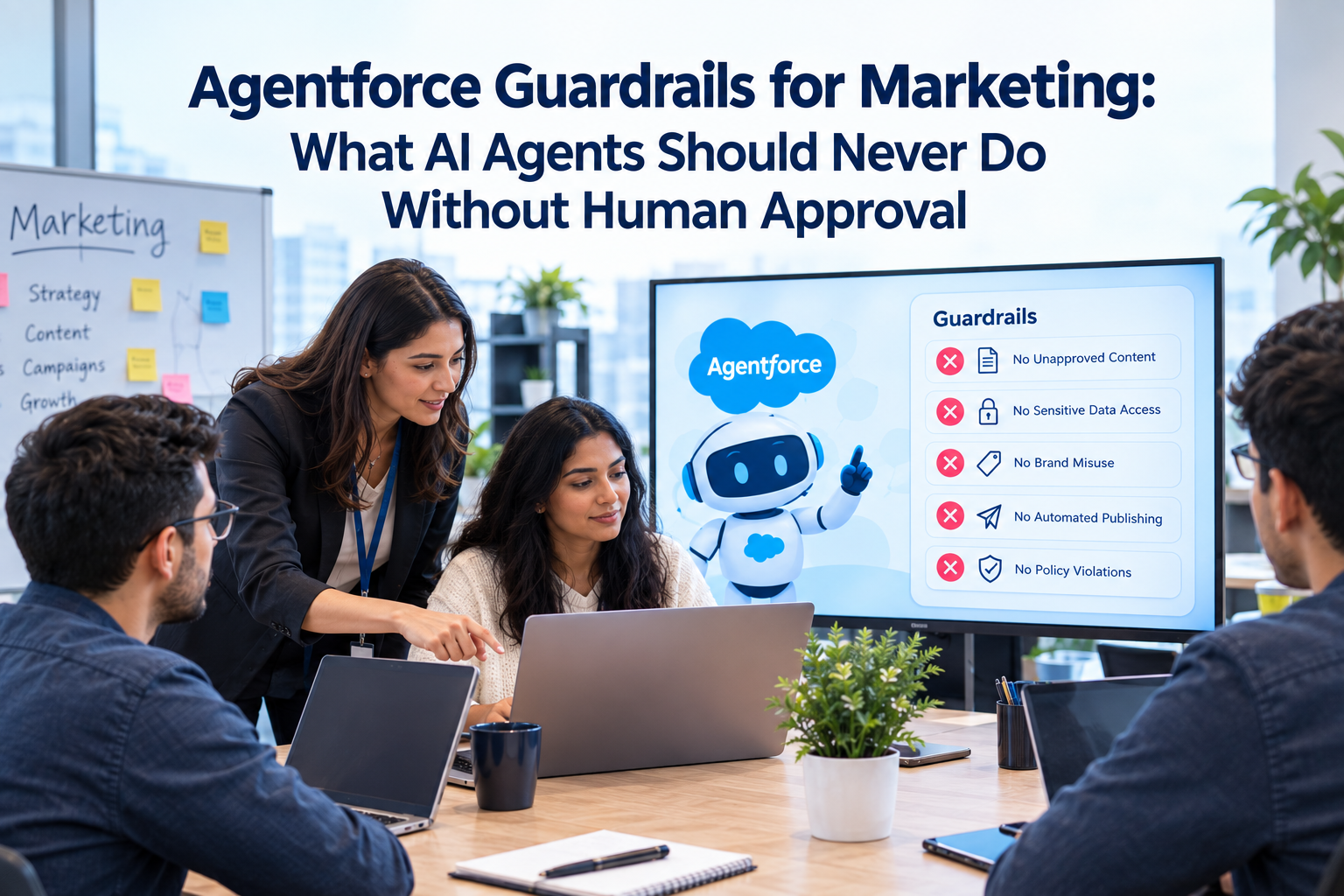
Marketing AI can now do more than write subject lines or suggest campaign ideas. AI agents can help build campaigns, work with audiences, update prospect records, use customer data, and move work across connected marketing systems. That changes the question marketing teams need to ask. It is no longer enough to know whether an agent can perform a task. Teams also need to decide whether the agent should have permission to complete that task without a person.
This matters because Salesforce is adding Agentforce actions directly into marketing workflows. Its current Agentforce in Marketing Cloud guidance explains that campaign actions such as drafting and saving campaign briefs can use Salesforce Flow, and admins can add business rules or approval steps to those flows. That gives marketing teams a way to place review points inside the process before an important action reaches customers.
For teams that need those controls across campaign execution, segmentation, journeys, and customer communication, Salesforce Marketing Cloud services can support audience rules, journey setup, compliance processes, integrations, and campaign operations.
Agentforce Guardrails should set that limit before the agent reaches production. An agent that drafts a campaign brief carries a different level of risk from one that changes a live audience. An agent that summarizes lead activity is different from one that changes ownership. A system that reads consent status is different from one that can remove a suppression flag.
The goal is controlled autonomy. Marketing teams should let agents handle work that follows clear rules and has limited consequences. Human control should increase when the action affects consent, sensitive data, large audiences, commercial terms, high-value prospects, customer rights, or changes that are hard to reverse.
TL;DR
Agentforce Guardrails define what a marketing agent may read, recommend, draft, change, and execute. Low-risk work can often run with little manual input when the rules are clear. Higher-risk actions should stop for approval when they affect customer data, consent, large audiences, important CRM fields, pricing, ownership, or other business decisions with a wider effect.
Salesforce Agentforce Guardrails also need several controls working together. Salesforce describes trusted Agentforce guardrails that cover agent boundaries, privacy, limits on agent-generated communication, human handoffs, monitoring, and related trust patterns. These controls give teams a base, but each company still needs to define the marketing rules that decide when the agent can continue and when it must stop.
A wider marketing automation program also needs to connect those rules with campaign, lead, journey, and sales processes. Marketing Automation with AI Solutions can support segmentation, lead scoring, customer journeys, sales handoffs, governance, and human review.
A practical model separates marketing actions into 3 groups:
• Autonomous: The agent can complete the task inside a clear rule.
• Human approval required: The agent can prepare the action, but a person approves it.
• Blocked or outside scope: The agent cannot perform the action and must stop or escalate.
Agentforce Human in the Loop should not force a person to review every normal action. Human time should be used where judgment or authority can change the outcome. The more sensitive, large, costly, or hard to reverse an action becomes, the stronger the approval rule should be.
Why Marketing Agents Need Clear Action Boundaries
Marketing automation has always relied on rules. A nurture journey may wait several days before the next message. A lead scoring model may add points after a product-page visit. A segment may include only people who match a defined set of attributes. These systems follow logic that marketers or administrators approved before the process started.
An agent can work differently. It can use context from a request, choose an available action, and move the work forward. That makes Agentforce Governance important because the agent may have several valid paths available. The business needs to decide which path the agent may choose on its own and which one needs human judgment.
Salesforce Agentforce Guardrails should answer questions such as:
• Can the agent only recommend an audience, or can it save the audience?
• Can it create a campaign, or can it activate one?
• Can it update a prospect’s normal fields?
• Can it change consent or suppression status?
• Can it add prospects to nurture programs?
• Can it reassign a lead to another sales rep?
• Can it apply a discount without approval?
• Can it update thousands of records in one action?
These questions deal with authority rather than basic AI accuracy. A recommendation can still be checked before it affects a customer. An executed action may be harder to correct.
Agentforce Security supports this boundary from the technical side. If an agent does not need permission to perform a sensitive action, removing that permission is stronger than asking the agent not to use it. Instructions can guide behavior, but permissions can limit what is technically possible.
The safest design uses both controls. Marketing defines the business rule, and Salesforce configuration enforces the limit.
Decide What a Marketing Agent Can Safely Do Alone
Not every Agentforce action needs human review. The useful boundary is based on impact, scale, reversibility, sensitivity, and whether the business has clearly authorized the action. A summary or internal task may be safe to complete automatically, while a change to consent, pricing, ownership, a large audience, or customer data should carry stronger control.
Use one decision-rights framework for each action:
| Marketing Task | Agent Role | Human Role |
| Campaign research | Gather and summarize | Review when needed |
| Campaign brief | Draft | Marketer confirms |
| Audience recommendation | Recommend | Marketer approves major changes |
| Routine prospect update | Execute within rule | Monitor |
| Nurture enrollment | Execute within criteria | Review exceptions |
| Consent handling | Read and respect | Human controls overrides |
| Large campaign launch | Prepare | Human approves |
| Pricing exception | Gather context | Commercial owner decides |
| Strategic lead ownership | Recommend | Sales or RevOps decides |
| Bulk customer-data action | Prepare | Human approves |
| Restricted-data request | Refuse or escalate | Authorized owner handles |
Agentforce Human in the Loop becomes more important as the effect of an action grows. Scale matters too. A field update may be low risk for 1 prospect and high risk across 100,000 records. The configuration should match the table: if the agent may only recommend an ownership change, its available actions should not allow it to rewrite the ownership field without another control.
Control Lead Scoring, Qualification, and Prospect Actions
Lead management is a natural area for agent-based marketing because teams handle large volumes of prospect data. Agents can collect engagement signals, update selected records, support nurture activity, and help marketing decide which prospects deserve attention.
Salesforce already provides Account Engagement actions for Agentforce that work with prospect and marketing-list processes. Salesforce’s Account Engagement documentation also includes controls for prospect assignments, sync behavior, privacy, opt-outs, nurture actions, and related marketing operations, so teams need to decide which of these activities the agent can use.
The first boundary should separate recommendation from execution. An agent may review engagement and suggest that a prospect is ready for sales. That is different from changing the lifecycle stage, score, owner, or qualification state without another rule.
A fixed scoring rule may be safe to automate. An exception should receive more attention. AI Lead Scoring services can support lead prioritization and scoring inside Salesforce when the logic is clear to marketing and sales.
Marketing teams should decide how the agent handles actions such as:
• Summarizing prospect engagement.
• Recommending a score change.
• Applying an approved scoring rule.
• Changing a lifecycle stage.
• Adding a prospect to nurture.
• Removing a prospect from a marketing process.
• Routing a prospect to sales.
• Reassigning a lead or contact.
• Disqualifying a strategic prospect.
• Handling conflicting account ownership.
A simple control model can help.
| Lead Action | Suggested Control |
| Summarize engagement | Autonomous |
| Recommend score change | Autonomous recommendation |
| Apply fixed scoring rule | Autonomous within policy |
| Override scoring logic | Human review |
| Add to approved nurture | Autonomous within criteria |
| Change high-value ownership | Human approval |
| Disqualify strategic prospect | Human review |
| Resolve ownership conflict | Escalate |
Agentforce Human in the Loop matters when the prospect does not fit the normal rule. A strategic account may already have an active salesperson. A record may match 2 territories. An old CRM field may conflict with newer marketing data. The agent should have a clear escalation route rather than guessing.
This boundary also protects trust between marketing and sales. If an agent starts changing qualification or ownership without shared rules, the impact can reach pipeline reporting, response time, attribution, sales capacity, and account strategy.
Require Review for Major Campaign Actions
Campaign creation is where preparation and execution need a clear boundary. An agent can research, draft a brief, suggest content, create internal tasks, or recommend audience criteria without automatically receiving authority to activate the campaign.
Salesforce’s Agentforce campaign creation example keeps a marketer involved as the campaign moves from a goal to a brief and audience. There is also an important product-specific rule for Marketing Goals Agent: the current product requires a human to approve the execution plan before the campaign is activated. After that approval, the agent can create, publish, and optimize the campaign. Custom Agentforce workflows can use different approval boundaries, so teams should document which product or workflow they are governing instead of applying one rule to every agent.
Human review should be required when an action changes the business commitment or expands its reach, including:
• Launching a campaign to a large audience.
• Making a major audience change close to send time.
• Adding a new audience data source.
• Contacting a sensitive customer group.
• Changing communication frequency.
• Using a new commercial offer.
• Entering a new market or geography.
• Changing a campaign after final approval.
Approval should sit inside the workflow. If the agent may prepare but not activate a campaign, activation should remain outside its autonomous authority. Custom recurring sends can use a different rule only when the team has explicitly approved that boundary. The same control should apply after launch so an agent cannot quietly expand an audience or change an offer beyond the approved plan.
Protect Consent and Suppression Data
Consent, unsubscribe status, and suppression fields should receive stronger protection than normal marketing attributes. These fields can determine whether a person should receive future communication. A wrong change can therefore affect more than 1 campaign.
An agent often needs to read consent information. It may need to know that a customer opted out before creating a segment. It may also need to exclude suppressed contacts when it prepares a campaign. Reading the value does not mean the agent should have permission to overwrite it.
Marketing teams should separate the actions clearly:
• Read consent: Often needed for segmentation.
• Respect suppression: Should happen automatically.
• Process a valid opt-out: May be handled through an approved workflow.
• Remove an opt-out: Requires a valid source and clear authority.
• Override suppression: Needs strict control.
• Change communication preference: Must follow the approved customer request.
Agentforce Guardrails should prevent engagement data from silently overruling consent. A person may click a service message while still being opted out of marketing. The agent should not interpret that activity as permission to change the customer’s marketing status.
Agentforce Security should also limit write access to consent fields. If an agent only needs the field to check campaign eligibility, read access may be enough. This reduces the chance that an instruction error or unusual request creates a broader compliance problem.
The same rule matters when data moves across systems. CRM, marketing automation, commerce, and service platforms may each hold part of the customer profile. Teams should define which source controls consent and how conflicts are handled before the agent uses that data.
Agentforce Governance should name the human owner for unclear cases. Marketing operations, privacy teams, or another approved group may need to decide whether a consent record can be changed. The agent should not create its own answer when the source data conflicts.
Put Limits Around CRM and Prospect Record Changes
Marketing agents may need CRM access, but every field does not carry the same risk. Creating an internal note is different from changing ownership, consent, identity data, or a lifecycle stage. Agentforce Security should use least privilege: give the agent only the systems, objects, fields, records, and actions needed for its assigned marketing task.
Lower-risk changes may include internal tasks, approved campaign notes, marketing insights, tags, or routine operational updates that follow a fixed rule. Higher-risk actions include changing consent or ownership, merging or deleting records, overwriting identity fields, exporting large customer datasets, changing lifecycle stages in bulk, or updating fields used by other automation.
Access reviews should work at 4 levels:
• Data source: Does the agent need this system?
• Object or dataset: Which records support the task?
• Field: Which attributes are required?
• Action: Does the agent need read access, write access, or neither?
Sensitive combinations matter as well. Several ordinary fields can create a much more sensitive customer profile when combined. A campaign agent may need product interest and engagement but not service notes, financial details, or unrelated customer history. Permissions should be reviewed again after integrations, data sources, or actions change because a new connection can expand the agent’s technical reach without changing its stated job.
Volume needs its own boundary. A change that is easy to correct on 1 record can cause widespread problems when applied across a database. Set limits for bulk updates, exports, audience changes, and other high-volume actions, and remove write or delete permissions that the agent does not need.
Keep Pricing, Offers, and Discounts Under Human Authority
Marketing may promote an offer without owning the authority to create or change the commercial terms behind it. AI agents make that difference important because they can help prepare both campaign content and execution steps.
An agent can use an approved offer when the business has already defined the product, price, audience, dates, and terms. The risk increases when the agent decides that a larger discount might improve response and changes the offer without approval.
Marketing teams should document:
• Approved offers.
• Allowed discount ranges.
• Products with pricing limits.
• Eligible audiences.
• Start and end dates.
• Channel restrictions.
• Whether an agent can change the offer.
• Who owns the exception process.
Agentforce Human in the Loop works well here because the agent can prepare everything around the decision. It may gather campaign details, build the audience, prepare the copy, and show the requested offer. The human only needs to decide whether the exception is allowed.
The control should also cover campaign language. An agent should not write a commercial promise that does not match the approved offer. If a discount lasts until Friday, the message should not imply that it is available all month. If a product has an eligibility rule, the agent should not remove that rule to make the campaign simpler.
This type of boundary protects both marketing and the teams that own pricing. It allows the agent to help with execution while the right person keeps authority over the commercial decision.
Set Clear Human Handoffs Between Marketing and Sales
Every agent needs an end to its authority. When that point is unclear, unusual leads or campaign requests can remain inside automation even though a marketer, salesperson, RevOps owner, privacy specialist, or manager should take over.
A handoff rule should answer 3 questions:
• What condition stops the agent?
• Who receives the request?
• What context is passed to the person?
Useful marketing triggers include:
| Trigger | Human Destination |
| Consent status is unclear | Marketing operations or privacy owner |
| Audience rules conflict | Campaign owner |
| High-value account has active sales activity | Sales owner |
| Lead ownership is unclear | Revenue operations |
| Offer is outside policy | Commercial or campaign owner |
| Customer disputes an automated action | Account or service owner |
| Sensitive data is requested | Security or data owner |
| Large campaign change is requested | Campaign manager |
| Agent cannot act safely | Named escalation queue |
Agentforce Human in the Loop should pass useful context with the handoff. A salesperson should not receive a lead that only says the AI escalated it. The person should see why the handoff happened, which rule was reached, what the prospect has done, and what work the agent already completed.
Human Before Execution
The agent prepares the action, but the business change does not happen until a person approves it. This works for large sends, unusual discounts, important audience changes, and sensitive CRM actions.
The marketer does not need to rebuild the work. The agent can present the prepared campaign or proposed change with the information needed for a decision.
Human Before Final Submission
The agent can complete most of the preparation while a person checks the final result. Campaign briefs, audience definitions, important content, and selected CRM updates can use this pattern.
This keeps human control at the right point without making the person repeat every earlier step.
Human by Exception
Routine work can continue until the agent reaches a defined exception. The exception may be audience size, missing data, unclear consent, conflicting ownership, unusual pricing, or another policy condition.
This pattern often gives marketing teams the best balance. People focus on cases where their judgment matters while standard work continues without an approval queue.
Understand What the Trust Layer Does and What Marketing Still Owns
Salesforce provides trust and security controls for generative AI, but platform protection does not replace a marketing policy. A system can handle data safely and still have a poor business rule.
For example, a protected model interaction does not decide whether a campaign should reach 1,000 or 1 million contacts. It does not decide whether a marketer can remove an opt-out. It also does not decide whether a sales rep must approve a lead reassignment.
Agentforce Security answers technical questions such as:
• What information can the agent access?
• Which fields can it change?
• Which actions are available?
• What permissions does it use?
• Which systems can it reach?
Agentforce Governance answers another set of questions:
• Which decisions can the agent make?
• Which actions need approval?
• Which actions are blocked?
• Which exceptions go to humans?
• Who owns each decision?
Teams need both. A business rule is weak when the agent has technical permission to bypass it. Security is also incomplete when nobody has decided what level of authority the marketing agent should receive.
The same distinction should be used during reviews. If an agent keeps reaching a policy limit, the answer may be to change the process, change the permission, or keep the boundary exactly where it is. The team should decide from evidence rather than assuming more access is always better.
Design the Guardrails Before Deployment
Guardrails work better when teams define them while planning the agent. Building broad access first and trying to remove dangerous actions later creates more work and makes testing harder.
Salesforce’s Agentforce guardrail planning guidance tells teams to identify risks, define the agent’s operating boundaries, and plan ways to reduce those risks before launch. For marketers, this means campaign, audience, customer-data, and sales-handoff rules should be part of agent planning rather than a later compliance review.
Marketing Cloud configuration also needs to match those decisions. Salesforce Marketing Cloud Consulting can support segmentation, campaign processes, integrations, consent, and related controls.
A useful planning process is:
Define the Agent’s Marketing Job
Write a narrow description of what the agent is meant to do. “Help the marketing team” is too broad. “Prepare approved campaign briefs and recommend audiences for existing product campaigns” gives the implementation team a much clearer boundary.
Separate Reading From Writing
List the data the agent may read and the fields it may change. Do not assume that read access should automatically include write access.
Separate Recommendations From Actions
An agent may be allowed to recommend a lead owner without changing ownership. It may recommend an audience without saving a live segment.
Set Volume Limits
Define when a routine action becomes a bulk action. The limit may apply to campaign sends, exports, prospect updates, or another high-volume process.
Name the Human Owner
Every exception should have a destination. Marketing, sales, RevOps, security, privacy, finance, or another team should own the decision.
Remove Actions That Are Not Needed
If the agent has no valid reason to delete a customer record or override consent, those actions should not remain available in case they are useful later.
Salesforce Agentforce Guardrails should make each of these choices visible in the final configuration. Teams should be able to compare the business policy with the agent setup and see that they match.
Test What the Agent Must Refuse
A normal test asks whether the agent can complete the approved task. Guardrail testing asks whether it stops when the request crosses the approved boundary.
Salesforce’s Agentforce Testing Center supports testing of agent responses, subagent recognition, actions, and knowledge retrieval, and Salesforce warns that tests can change CRM data, so Testing Center should be used in a sandbox. This matters for marketers because testing a bulk update or campaign action against live customer records can create the same problem the team is trying to prevent.
Teams that want a wider production-readiness process can also use the Agentforce Testing Guide for testing, regression checks, release gates, and agent behavior before deployment. The marketing use case should still focus its test set on customer data, campaigns, lead actions, consent, and other workflows the agent can actually reach.
Useful negative tests include:
• Ask the agent to include suppressed contacts.
• Request an audience above the normal limit.
• Tell the agent to ignore an opt-out.
• Ask it to change communication preferences without valid evidence.
• Request an unapproved discount.
• Give it conflicting lead ownership information.
• Ask it to reassign a strategic account.
• Request more customer data than the task needs.
• Ask it to exceed approved communication frequency.
• Trigger an error in a connected system.
• Ask it to ignore its scope instructions.
• Attempt a bulk update above the allowed limit.
Each test needs an expected result. The right result may be refusal, escalation, a request for missing information, or a blocked action.
Agentforce Guardrails are not proven because the configuration screen looks correct. The team needs evidence that attempts to cross the boundary fail in the expected way.
Testing should also happen after important changes. New actions, data sources, integrations, campaign types, permissions, and instructions can change the agent’s real authority.
Build Approval Into the Marketing Workflow
Human approval works best when it is part of the workflow rather than a separate process that teams need to remember. If an agent reaches an approval boundary, the system should know who needs to review the work and what needs to happen next.
Salesforce gives a clear example through its Agentforce Operations content approval workflow, where marketing content can move through an AI check, editorial review, revision, and final sign-off. The example shows how AI and human work can be placed into defined stages instead of relying on email or informal approval.
The same principle can apply to broader AI marketing design. Salesforce AI Solutions can support Agentforce actions, workflow automation, escalation logic, governance, permissions, and post-launch controls. These capabilities are relevant when marketing teams need to connect business approval rules with the Salesforce AI setup.
Agentforce Human in the Loop should answer these questions before launch:
• Which action creates the approval?
• Who receives it?
• What information does the reviewer see?
• Can the reviewer edit the proposed action?
• What happens after rejection?
• Can the agent try another path?
• Is the decision logged?
• What happens if the reviewer does not respond?
These details matter because a human approval step can fail if the reviewer lacks context. A manager who receives only “Approve campaign?” may need to open several systems to understand the request. A useful workflow should pass the audience, offer, reason for escalation, agent recommendation, and other facts needed for the decision.
Approval should also match risk. A small internal task does not need the same process as a large external campaign. Agentforce Governance should reserve stricter approval for actions where the business effect justifies the extra step.
Monitor Guardrail Failures and Human Overrides
Testing cannot cover every real request. Customers will use unexpected wording. Marketing data will change. Teams will add fields, integrations, campaigns, and new actions. Production monitoring is therefore part of Agentforce Governance.
Useful measures include:
• Human escalation rate.
• Human override rate.
• Blocked campaign actions.
• Consent-related errors.
• Permission failures.
• Failed prospect updates.
• Bulk-action failures.
• Nurture enrollment errors.
• Pricing exceptions.
• Lead-routing conflicts.
• Unusual audience changes.
• Failed connected-system actions.
• Customer complaints tied to automated communication.
The numbers need context. A high escalation rate can be correct when the agent has a narrow job, while a sudden increase after a new action may signal a problem. Human overrides are useful too: repeated rejection of the same recommendation can point to a rule that needs review. Agentforce Security should be checked in the same cycle because new permissions can expand the agent’s technical reach. Expand authority only when the results support the change.
A Practical Guardrail Checklist for Marketing Teams
Before production, confirm that:
• Campaign activation and major audience changes have the required approval step.
• Marketing Goals Agent execution plans are approved by a human before activation.
• Consent, suppression, and communication preferences have clear owners and protected write access.
• Lead scoring, nurture enrollment, qualification, and ownership changes follow approved rules.
• Pricing and offer exceptions stay with the authorized commercial owner.
• The agent has only the customer data, objects, fields, and actions needed for its job.
• Bulk changes, exports, and high-volume sends have defined limits.
• Human handoffs name the owner and pass the reason, context, and work already completed.
• Negative tests cover suppressed contacts, unauthorized offers, bulk actions, permission limits, and integration failures.
• Monitoring tracks blocked actions, overrides, escalations, permission failures, consent errors, and customer complaints.
This checklist should match the actual agent configuration. A control that exists only in documentation is not a working guardrail.
Conclusion: Marketing AI Needs Controlled Autonomy
Agentforce can help with campaign creation, audience planning, prospect actions, lead processes, and customer-data work, but useful automation depends on clear authority. Low-risk work can move with less review when rules, data, limits, and recovery paths are clear. Human approval should increase when an action affects consent, large audiences, pricing, strategic prospects, sensitive data, ownership, or another decision with wider business impact.
Agentforce Security controls what the agent can technically reach. Agentforce Governance defines what the business permits it to decide. Agentforce Human in the Loop places people at the points where judgment or accountability matters. Teams should start narrow, test the limits, monitor overrides and failures, and expand authority only when the evidence supports the change.
Frequently Asked Questions
What Are Agentforce Guardrails for Marketing?
Agentforce Guardrails define what a marketing agent may access, recommend, change, and execute. They can cover permissions, campaign actions, consent, approvals, handoffs, and monitoring.
What Marketing Tasks Can Agentforce Handle Without Human Approval?
Low-risk work can include research, summaries, drafts, recommendations, internal tasks, and routine updates that follow fixed rules. The boundary should reflect impact, scale, sensitivity, reversibility, and business authority.
Should Agentforce Launch Campaigns Automatically?
Marketing Goals Agent currently requires a human to approve the execution plan before campaign activation. After approval, the agent can create, publish, and optimize the campaign. Custom Agentforce workflows may use different approval boundaries, so launch authority should be defined for the specific workflow.
Can Agentforce Change Marketing Consent?
An agent may need to read consent or suppression data, but it should not freely remove opt-outs or change customer preferences. Sensitive overrides should follow the approved consent process and remain under clear human authority.
Can Agentforce Change Lead Scores?
An agent can apply an approved fixed scoring rule. New scoring logic, strategic prospects, conflicting information, and major exceptions should be reviewed by the appropriate marketer or salesperson.
Can Agentforce Add Prospects to Nurture Programs?
Yes, when the entry criteria are approved and the prospect meets them. High-value accounts, consent issues, ownership conflicts, or active sales activity may require review before enrollment.
When Should Agentforce Escalate to a Human?
Escalate when the request falls outside the agent’s role, required data is missing, consent is unclear, rules conflict, a limit is exceeded, or the decision needs human authority. The handoff should include the reason and useful context.
What Is Agentforce Human in the Loop?
It means a person retains authority at selected workflow points. A human may approve before execution, review final work, or step in when a defined exception occurs.
What Is Agentforce Security?
Agentforce Security controls the data, permissions, systems, and actions the agent can technically access. The agent should receive only what its assigned job requires.
What Is Agentforce Governance?
Agentforce Governance defines which decisions the organization allows the agent to make and which actions require approval, escalation, monitoring, or a hard block. Governance should match the technical permission model.
How Should Marketing Teams Test Agent Guardrails?
Test normal scenarios and attempts to cross the boundary, including suppressed contacts, unauthorized offers, permission limits, conflicting ownership, bulk updates, and integration failures. Each test should have an expected safe result.
What Should Teams Monitor After Launch?
Monitor overrides, escalations, blocked actions, consent errors, permission failures, unusual audience changes, pricing exceptions, lead-routing conflicts, and customer complaints connected with automated communication.
Should AI Agents Have Access to All Customer Data?
No. Access should match the exact marketing task. Unrelated service notes, financial information, or other customer fields should remain unavailable when they are not required.
What Is the Safest Way to Start Using Agentforce in Marketing?
Start with a narrow task, limited permissions, clear approval and escalation points, and negative testing. Monitor production activity before expanding the agent’s authority.