

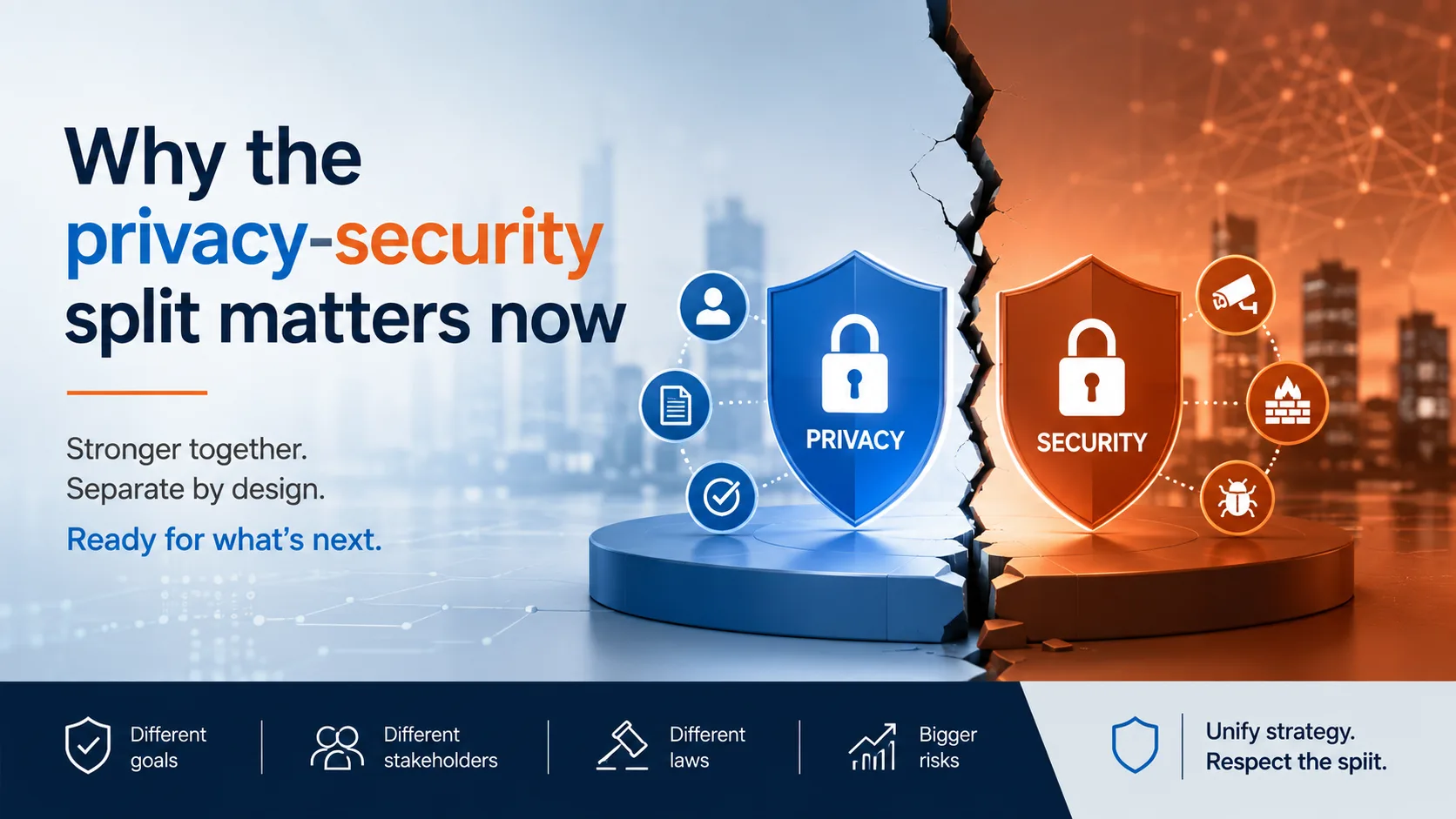
Why the privacy-security split matters now
Privacy and security are often treated as interchangeable terms because both deal with information risk. That shortcut creates a real management problem. Privacy governs whether personal information should be collected, why it can be used, who may receive it, and how long it should remain available. Security protects information and systems against unauthorized access, alteration, destruction, theft, and interruption. An organization can perform well in one area while failing badly in the other.
That distinction has become harder to ignore.California privacy regulations that took effect on January 1, 2026 added requirements covering risk assessments and cybersecurity audits for certain businesses. Cybersecurity-audit certification deadlines begin on April 1, 2028 for businesses above the specified $100 million revenue threshold, followed by later deadlines for other covered revenue bands (confirm current CPPA thresholds and dates before publishing, as these are subject to rulemaking updates). Privacy regulation is therefore reaching directly into the evidence businesses keep about security controls, while the underlying privacy duties remain distinct.
The practical lesson is simple. A security team can stop an attacker and still leave the organization with a privacy problem if personal information was collected without an appropriate basis, retained too long, or shared beyond its intended purpose. A privacy team can write sound retention rules and consent requirements, yet those rules provide little protection if weak credentials or an exposed application let an attacker reach the records. Mature programs connect the 2 disciplines without merging their responsibilities.
TL;DR
Privacy determines the acceptable handling of personal information. It deals with collection, purpose, consent or another lawful basis where required, disclosure, retention, individual rights, and disposal. Security determines how information and the systems around it are protected. It deals with access control, authentication, encryption, vulnerability management, monitoring, incident response, recovery, and other safeguards.
The relationship becomes clearer when the same record is viewed from 2 angles. A customer record may be strongly encrypted and available only to approved employees, which is a security strength. If that record is later used for a purpose outside the organization’s stated or permitted use, the security controls haven’t solved the privacy issue. The reverse can happen as well. A business may have clear privacy notices and strict retention periods, yet a weak cloud configuration can expose the information to an attacker.
|
Question |
Privacy View |
Security View |
|---|---|---|
|
What information should exist? |
Collect only what the purpose requires |
Protect information that exists |
|
Who should use it? |
Define permitted users and purposes |
Enforce access decisions |
|
How long should it stay? |
Set retention and deletion rules |
Protect it during the retention period |
|
What happens during an incident? |
Assess impact on people and legal duties |
Contain, investigate, recover, and preserve evidence |
|
How is success judged? |
Appropriate use and respect for rights |
Reduced exposure and effective control performance |
The strongest operating model gives privacy and security separate ownership while creating shared checkpoints around systems, vendors, identity, data flows, incidents, and evidence. That model helps executives understand exactly what failed when a problem appears instead of treating every issue as a generic “data protection” failure.
Privacy and security answer different questions
A useful starting point is to define each discipline by the decision it makes. Privacy asks whether an organization should collect or process particular personal information, what purpose permits that processing, who may receive it, and when the information should be removed. Security asks what could compromise information or systems and which safeguards can reduce that exposure. Those questions meet often, yet they don’t produce the same answer.
ACybersecurity Services Company may support access controls, monitoring, penetration testing, endpoint defenses, incident handling, awareness training, and related security work. Those capabilities can support privacy requirements because privacy promises depend on reliable safeguards. They can’t decide every privacy matter on their own. Legal basis, individual rights, permitted processing purposes, retention decisions, disclosure restrictions, and notice obligations often require privacy, legal, governance, and business input.
NIST makes the separation visible in its own framework work. TheNIST Privacy Framework was created to help organizations manage privacy risk, while NIST maintains a separate Cybersecurity Framework for cybersecurity risk. NIST designed the Privacy Framework so the 2 frameworks can be used together, and its Privacy Framework 1.1 work has specifically sought closer alignment with CSF 2.0. The Privacy Framework 1.1 initial public draft was released in April 2025, with its public comment period closing on June 13, 2025 (confirm current status — a final version may have since been published).
A practical distinction follows from this framework split. Privacy requirements help define which uses of information are acceptable. Security controls help enforce parts of that decision and protect the information from other risks. Keeping those responsibilities visible makes audits clearer, incident decisions faster, and technical requirements easier to trace back to the business reason behind them.
Security protects systems, privacy governs personal information
Cybersecurity reaches further than personal information. A manufacturing control system, proprietary source code repository, financial forecasting model, authentication service, network device, or production application may require strong security even when the asset contains little or no personal information. Loss of availability, unauthorized modification, or destruction can still damage operations. Privacy normally becomes central when information relates to identifiable people and its collection or use creates consequences for those individuals.
TheNIST CSF 2.0, published on February 26, 2024, frames cybersecurity around 6 high-level functions: Govern, Identify, Protect, Detect, Respond, and Recover. CSF 2.0 also broadened the framework’s intended audience beyond its earlier critical-infrastructure focus, making it applicable to organizations across sectors and levels of technical maturity. That structure shows why security can’t be reduced to confidentiality alone. Availability, response, recovery, governance, and operational risk matter as well.
Security work commonly includes several control areas:
- Identity and access controls that decide which authenticated users can reach systems or records.
- Encryption that reduces exposure when protected information is stored or transmitted.
- Monitoring and detection that surface suspicious behavior or abnormal access.
- Patch and configuration management that reduce known technical weaknesses.
- Response and recovery procedures that limit damage after an incident begins.
Those controls require evidence that they continue to work as environments change. A periodicvulnerability assessment service can help identify exposed software, configuration errors, identity weaknesses, and other technical conditions before they remain unnoticed for long periods. Security therefore operates as a continuing control process rather than a policy document that gets reviewed only before an audit.
Where privacy and security overlap
The 2 disciplines meet most clearly around confidentiality. Privacy may say that a payroll employee can view a worker’s bank information for salary processing. Security translates part of that rule into access permissions, authentication requirements, logging, and controls against unauthorized disclosure. Privacy establishes the permitted use. Security helps make that permitted use technically enforceable.
The overlap becomes easier to see across the information lifecycle.
|
Lifecycle Stage |
Privacy Responsibility |
Security Responsibility |
|---|---|---|
|
Collection |
Limit collection to an appropriate purpose |
Protect collection forms, APIs, and transmission |
|
Storage |
Set retention and use restrictions |
Control access and protect stored records |
|
Internal use |
Define acceptable use |
Enforce permissions and record activity |
|
Sharing |
Determine approved recipients and conditions |
Protect transfer channels and credentials |
|
Deletion |
Define when information should be removed |
Make deletion reliable and prevent unauthorized recovery |
TheFTC data security guidance connects these responsibilities in a practical way. Its business guidance starts with knowing what personal information an organization holds, reducing information that isn’t needed, protecting retained information, disposing of unnecessary records, and preparing for security incidents. That sequence matters because reducing unnecessary personal information can lower privacy exposure and reduce the amount of information available to an attacker at the same time.
This connection explains why aCybersecurity Services Provider should understand the organization’s information-handling requirements before selecting controls. Technical work is more useful when engineers know which systems contain sensitive records, which roles legitimately need access, how long those records should remain, and which business processes depend on them. Security then supports the intended information rules instead of protecting every asset in exactly the same way.
How laws treat privacy and security as separate duties
Privacy laws often contain security obligations, which can make the disciplines look identical at first glance. A closer reading usually separates requirements concerning lawful or appropriate information handling from requirements concerning protection against compromise. That division appears clearly in regulations that define both rights and security duties.
TheGDPR text provides a strong example. Article 32 requires controllers and processors to use security measures appropriate to risk, with concepts including encryption, confidentiality, integrity, availability, recovery, and regular testing. Article 33 separately establishes a breach-notification requirement that can require notification to a supervisory authority within 72 hours after a controller becomes aware of a qualifying personal-data breach. The regulation also sets separate duties covering lawful processing, individual rights, purpose restrictions, data minimisation, and other privacy matters.
The distinction affects financial exposure as well. GDPR Article 83 provides different maximum fine tiers depending on the provision involved. Certain controller and processor obligations can fall within a tier of up to €10 million or 2% of worldwide annual turnover, while violations of specified core processing principles or data-subject rights can reach up to €20 million or 4%, whichever applicable amount is higher under the provision. These figures show why an organization can’t assume that passing a technical security test resolves the broader privacy duties attached to the same information.
Security operations still matter directly to those duties. Continuous detection throughmanaged detection and response can help teams identify suspicious activity, retain operational evidence, and respond when a security event occurs. That capability may support breach analysis and reporting decisions, but legal and privacy teams still need to determine which information was affected, which people or jurisdictions are involved, and what notification duties apply.
What a privacy failure looks like without a security breach
A privacy failure doesn’t require an attacker. Imagine a business collects customer information through a secure encrypted portal, places it in a protected system, restricts access to approved employees, and records every access attempt. The technical safeguards could work exactly as intended. A privacy issue can still arise if the business later uses the information for an incompatible purpose, keeps it beyond the approved retention period, or gives it to a recipient outside the permitted processing arrangement.
Healthcare law provides a particularly clear distinction. TheHIPAA Security Rule applies safeguards to electronic protected health information and requires regulated entities to address confidentiality, integrity, availability, anticipated threats, impermissible uses or disclosures, and workforce compliance. The HIPAA Privacy Rule has a different role. It establishes standards around uses and disclosures of protected health information and gives individuals specified rights over that information. HHS expressly describes the Security Rule as complementing the privacy standards rather than replacing them.
This matters for governance because some privacy failures are caused by perfectly authorized users. An employee may have valid system credentials and legitimate access to a record for one business function. Using the same record for an unrelated purpose can still create a privacy issue even though the authentication system recorded a valid login. Security can prove who accessed the information. Privacy determines whether that use was appropriate.
Organizations evaluatingCybersecurity Service Providers should therefore ask how technical controls will receive requirements from privacy, legal, records-management, and business owners. The provider doesn’t need to own every privacy decision. It should be able to translate approved decisions into access, logging, protection, detection, and evidence requirements without blurring accountability.
What a security failure looks like without a privacy violation
Security failures can occur where personal information isn’t the primary asset. An attacker who alters manufacturing instructions, encrypts a production server, destroys system backups, or disrupts a customer-facing application can create a serious cybersecurity incident even if no identifiable person’s records are exposed. Integrity and availability failures remain security failures because the organization’s systems or information have been compromised.
Where personal information is involved, one event can produce both kinds of failure. In June 2026, the FTC finalized an order involving an education technology provider after alleging that security failures contributed to a breach affecting personal information relating to 10.1 million students (this postdates our verification window — confirm the order and figures against the FTC release before publishing). TheFTC Illuminate order required measures concerning security, information collection, retention, deletion, and representations about privacy and security practices. The FTC also alleged that the company had been alerted to security weaknesses nearly 2 years before the breach.
The case illustrates why incident reviews should separate root causes from downstream privacy effects. A weak authentication method, missed vulnerability, or poor network control may be the security root cause. Exposure of personal records can then trigger privacy analysis concerning affected people, permitted disclosures, retention, notices, and contractual duties. Combining every issue under the label “data breach” can hide which control actually failed.
Azero trust cybersecurity services model can reduce some security exposure by applying identity-based access, least privilege, and continuing validation rather than assuming that network location alone establishes trust. These controls can support privacy requirements by limiting who can reach sensitive information, but they still depend on privacy and business owners defining who should receive access in the first place.
How to build controls around data, identity, and access
A workable privacy-security model starts with information rather than products. Teams need to know what information exists, where it moves, which systems process it, which people can reach it, and what business purpose supports those activities. Without that map, privacy teams struggle to understand processing and security teams struggle to prioritize protection.
A practical control sequence can follow 5 stages:
- Identify the information and systems. Record sensitive information types, applications, cloud services, endpoints, integrations, vendors, and physical locations that matter to the business.
- Assign handling rules. Define approved purposes, access roles, retention periods, disclosure limits, and other privacy requirements that apply to each information class.
- Translate rules into controls. Configure authentication, permissions, encryption, segmentation, logging, monitoring, backup, and other security measures according to the assigned risk.
- Test what was implemented. Review access, scan for vulnerabilities, test response plans, inspect configurations, and confirm that retained evidence matches the stated control.
- Remove what no longer belongs. Delete unnecessary information, close stale accounts, revoke obsolete privileges, retire unused services, and update records when processing changes.
The value comes from traceability. If a privacy requirement says customer identity records should remain available only to certain operational roles, the security design should show which access rule implements that decision. Logs should then provide evidence that access is behaving as intended. When a requirement changes, teams should know which systems and controls must change with it.
This is also wherecyber insurance readiness can expose gaps that ordinary policy reviews miss. Insurers increasingly ask for evidence concerning access controls, endpoint protection, monitoring, incident response, backups, vulnerability work, and related security practices. The insurance question is different from the privacy question, but the evidence behind both often comes from the same systems and operating records.
How cybersecurity services providers should support privacy outcomes
Security providers add the most value when they understand the privacy requirements that technical controls are expected to support. That starts during scoping. A security assessment should identify which systems contain sensitive personal information, which workloads have regulatory importance, which third parties receive information, and which business operations would be affected by loss of confidentiality, integrity, or availability.
Providers should then connect security work to clearly defined control objectives. An identity project can support least-privilege access. Vulnerability testing can examine systems that process sensitive information. Monitoring can focus on unusual access or exfiltration indicators. Incident-response procedures can preserve the records privacy and legal teams need to determine scope, affected information, timing, and notification duties.
A provider evaluation can use questions such as these:
|
Evaluation Area |
Question To Ask |
|---|---|
|
Data awareness |
Does the provider identify which systems hold sensitive information before testing or monitoring them? |
|
Identity |
Can controls reflect approved roles and access restrictions? |
|
Evidence |
Are logs, findings, remediation records, and incident timelines retained in a useful form? |
|
Incident support |
Can the provider establish what happened and which assets were involved? |
|
Third parties |
Can monitoring and assessment cover relevant vendor or cloud dependencies? |
|
Governance |
Can technical findings be mapped back to the organization’s stated risk requirements? |
The goal is clear accountability. Security specialists should own the technical quality of security controls within their scope. Privacy, legal, records, product, and business owners should retain decisions that depend on lawful processing, acceptable use, individual rights, business purpose, or jurisdiction. Shared evidence then connects those responsibilities without turning one team into a substitute for the other.
How to measure privacy and security without blurring them
Measurement fails when every privacy and security activity is pushed into one score. A single rating can hide whether the organization has weak technical safeguards, excessive information collection, poor retention practices, unresolved access problems, or delayed incident response. Each problem requires a different owner and a different corrective action.
Security measurements should focus on control performance and exposure. Useful measures may cover remediation time for serious vulnerabilities, percentage of privileged accounts protected by stronger authentication, coverage of logging on high-risk systems, detection and response timing, backup testing, stale-account removal, or security-awareness results. Each metric should have a clear definition, data source, target, owner, and review period.
Privacy measurements should focus on information handling and accountability. Examples can include overdue deletion actions, unresolved access requests, processing activities without current documentation, exceptions to approved retention rules, unreviewed vendor changes, or systems that contain sensitive information without an assigned owner. The measure needs to show a decision or risk rather than merely count activity.
A combined executive view can place privacy and security measures beside one another and then show where they intersect. For example, a system may have an open critical vulnerability and also hold information beyond its approved retention period. Security can address the vulnerability while privacy or records owners address retention. Leadership sees the shared risk without losing the identity of either problem.
What organizations should do next
Organizations should treat privacy and security as connected parts of enterprise risk management with different primary questions. Privacy sets rules around personal-information handling and the rights or expectations attached to that information. Security protects the systems and information required by the business and provides controls that help enforce many privacy decisions.
The first practical step is to map sensitive information to systems, purposes, owners, users, vendors, retention periods, and security controls. That map exposes mismatches quickly. A business may discover personal information that has no current business need, applications that lack adequate monitoring, users whose access exceeds their current role, or incident procedures that don’t provide the evidence needed for privacy decisions.
The next step is to test both sides independently and then test the handoffs between them. Privacy reviews should examine collection, use, sharing, retention, and rights handling. Security reviews should test exposure, access, configuration, detection, response, and recovery. Joint exercises should examine what happens when a security incident affects personal information and which team makes each decision.
The distinction matters because a secure system can still misuse personal information, and a well-written privacy program can still sit on top of weak technical defenses. Organizations reduce confusion when each requirement has an owner, each control has evidence, and each incident can be traced from technical cause to privacy consequence. That clarity gives teams a better basis for deciding what needs to change next.
Frequently asked questions
What is the main difference between privacy and security?
Privacy governs the appropriate collection, use, sharing, retention, and disposal of personal information. Security protects information and systems against unauthorized access, alteration, destruction, theft, and disruption. The 2 disciplines overlap because personal information needs security safeguards, yet their primary decisions remain different. A secure database can still create a privacy problem if its information is used outside the approved purpose.
Can you have security without privacy?
Yes. An organization can apply strong encryption, access controls, monitoring, and authentication while still handling personal information in a way that creates a privacy problem. For example, an authorized employee may use securely stored customer information for a purpose that wasn’t approved. The security controls may work correctly even though the information use is inappropriate. That is why security evidence alone can’t establish privacy compliance.
Can you have privacy without security?
Privacy rules can exist without effective security, but the privacy program will be exposed to failure. A policy may correctly limit access and define retention, yet attackers can bypass those intentions if credentials, applications, endpoints, or cloud services are poorly protected. Security gives technical force to many privacy decisions. Organizations therefore need privacy requirements and security controls to operate together.
Is cybersecurity the same as data privacy?
Cybersecurity has a wider technical and operational scope. It protects networks, applications, devices, services, information, and business operations from digital threats and failures. Data privacy focuses mainly on the appropriate handling of information about people and the rights or requirements attached to that processing. Some cybersecurity controls support privacy, but cybersecurity responsibilities also cover assets with little personal information.
Is data security part of privacy?
Data security supports privacy and may be required by privacy law, but the concepts shouldn’t be treated as identical. Security measures can protect personal information against unauthorized access, accidental loss, or malicious activity. Privacy also governs questions that security tools can’t answer, including appropriate purpose, retention, disclosure, and individual rights. Security therefore forms an important part of protecting personal information while privacy remains a separate governance discipline.
What is an example of a privacy violation without a hack?
Consider a business that securely stores customer information and gives access only to approved employees. A privacy issue can arise if an authorized employee uses those records for an unrelated purpose that the organization hasn’t permitted. No attacker, malware infection, or technical bypass is required. The issue comes from inappropriate use of information by someone who may have valid technical access.
What is an example of a security incident without a privacy breach?
An attacker could disrupt an industrial control system or destroy non-personal production information without exposing information about identifiable people. The incident can still be serious because system availability or information integrity has been damaged. Cybersecurity addresses those operational consequences even when privacy law isn’t the central issue. The exact legal effect will depend on the affected information, systems, contracts, and jurisdiction.
Who should own privacy and security inside a business?
Ownership should reflect the decision being made. Security leaders normally own technical security architecture, threat management, control operation, incident containment, and related security evidence within their authority. Privacy, legal, records, compliance, and business owners may own decisions about permitted processing, rights, retention, disclosure, and jurisdictional duties. Strong governance defines the handoffs so requirements can move from policy into technical controls without losing accountability.
How should a company choose a cybersecurity services provider for privacy-sensitive systems?
The company should first identify the systems, information types, users, business processes, and legal requirements that matter. It can then assess whether the provider can translate those requirements into technical controls, testing, monitoring, incident evidence, and remediation work. Provider experience with regulated systems can be useful, but claims should be checked against the actual service scope and evidence. The final selection should reflect the organization’s risk, systems, information sensitivity, and internal capabilities.
Why do privacy and security need separate assessments?
Separate assessments make the root cause of a problem easier to see. A privacy review may find excessive collection, inappropriate sharing, missing retention decisions, or weak rights handling, while a security assessment may find exposed services, configuration errors, weak authentication, or poor monitoring. Combining every issue into one generic score can hide those differences. Separate findings can still be brought together in a shared risk view so leadership can prioritize work without confusing ownership.